About the Report
Base Year 2024Brazil Carbon Trading & ESG Platforms Market Overview
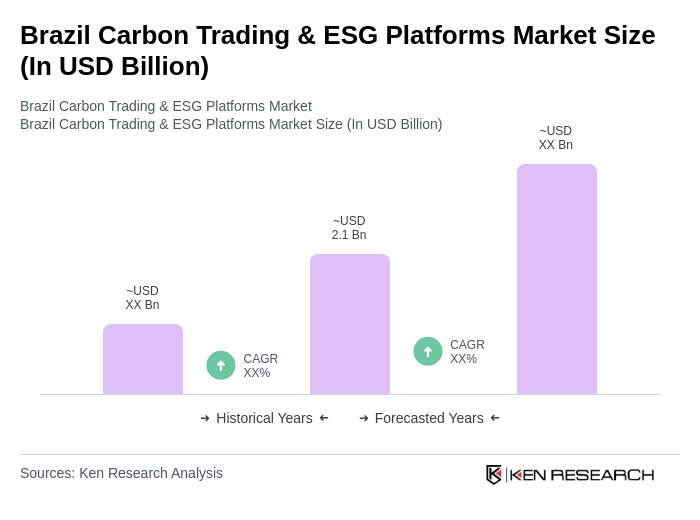
- The Brazil Carbon Trading & ESG Platforms Market is valued at approximatelyUSD 2.1 billion, based on a five-year historical analysis. This growth is primarily driven by increasing regulatory pressures, expanded eligibility for soil carbon offsets, surging corporate net-zero commitments, and the international endorsement of Brazil’s voluntary carbon registry. The market has seen a surge in demand for carbon credits and ESG reporting tools as companies strive to meet their environmental goals and comply with national and international standards.
- Key players in this market include São Paulo, Rio de Janeiro, and Brasília, which dominate due to their economic significance and concentration of industries that are major carbon emitters. These cities are also home to numerous corporations and financial institutions that are increasingly investing in carbon trading and ESG platforms to enhance their sustainability profiles and meet regulatory requirements.
- In 2023, Brazil’s government implemented theNational Policy on Climate Change (Política Nacional sobre Mudança do Clima, Law No. 12.187/2009, regulated by Decree No. 11.075/2022, Ministry of Environment), which mandates that companies report their greenhouse gas emissions and adopt measures to reduce them. This regulation establishes operational requirements for emissions reporting, sectoral reduction targets, and compliance thresholds for regulated entities, thereby driving the demand for carbon trading and ESG platforms across various sectors.
Brazil Carbon Trading & ESG Platforms Market Segmentation
By Type:The market is segmented into Compliance Carbon Credits, Voluntary Carbon Credits, Carbon Offset Projects, ESG Reporting Platforms, Carbon Footprint Calculators, Carbon Trading Platforms, Enhanced Rock Weathering & Carbon Removal Solutions, and Others. Compliance credits are primarily driven by regulatory mandates, while voluntary credits are supported by corporate sustainability initiatives and international standards. Carbon offset projects in Brazil are dominated by afforestation, reforestation, and REDD+ initiatives, with energy efficiency and soil carbon sequestration emerging as fast-growing segments. ESG reporting platforms and carbon footprint calculators are increasingly adopted by corporations to meet investor and regulatory demands for transparency.

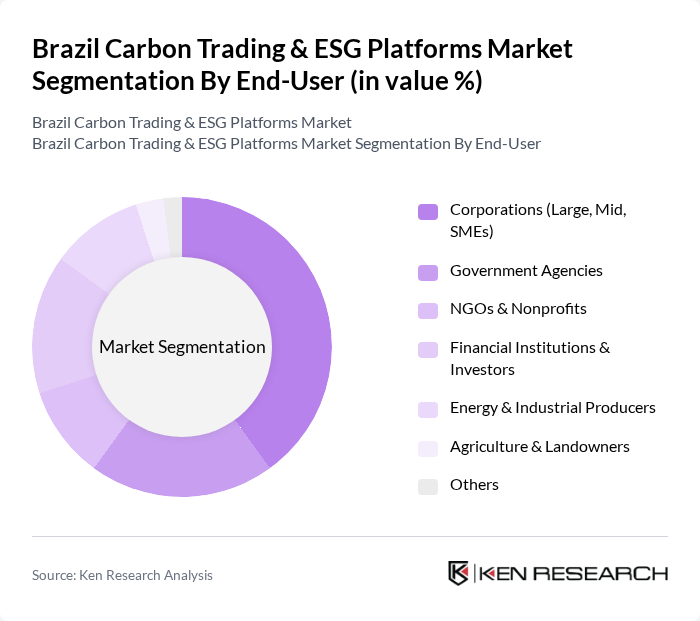
By End-User:The end-user segmentation includes Corporations (Large, Mid, SMEs), Government Agencies, NGOs & Nonprofits, Financial Institutions & Investors, Energy & Industrial Producers, Agriculture & Landowners, and Others. Corporations represent the largest segment, driven by compliance requirements and voluntary net-zero pledges. Government agencies are increasingly active due to national climate policies and sectoral targets. NGOs and nonprofits play a key role in project development and advocacy, while financial institutions and investors are expanding their involvement in carbon trading and ESG-linked financing. Energy and industrial producers are subject to the most stringent reporting and offset obligations, and agriculture and landowners are gaining market share due to new soil carbon offset eligibility.
Brazil Carbon Trading & ESG Platforms Market Competitive Landscape
The Brazil Carbon Trading & ESG Platforms Market is characterized by a dynamic mix of regional and international players. Leading participants such as EcoSecurities, Moss.Earth, Biofílica Ambipar Environment, Carbonext, Verra, Gold Standard, C-Quest Capital, Carbon Trust, AirCarbon Exchange, Carbon Trade eXchange (CTX), BetaCarbon, Carbonplace, South Pole, Climatize, ClimatePartner contribute to innovation, geographic expansion, and service delivery in this space.
Brazil Carbon Trading & ESG Platforms Market Industry Analysis
Growth Drivers
- Increasing Corporate Sustainability Initiatives:In Brazil, over 70% of large corporations have adopted sustainability strategies, driven by a growing recognition of environmental responsibility. The Brazilian government reported that corporate investments in sustainability reached approximately BRL 60 billion in future. This trend is expected to continue, as companies increasingly align their operations with global sustainability goals, enhancing their reputations and attracting eco-conscious consumers. Such initiatives are pivotal in fostering a robust carbon trading market.
- Government Mandates for Emission Reductions:Brazil's National Policy on Climate Change mandates a 37% reduction in greenhouse gas emissions by 2025, creating a regulatory framework that encourages carbon trading. The government allocated BRL 1.5 billion in future to support emission reduction projects. This regulatory push not only compels companies to participate in carbon trading but also stimulates the development of innovative solutions to meet these targets, thereby driving market growth.
- Rising Investor Demand for ESG Compliance:In future, investments in ESG-compliant funds in Brazil surged to BRL 180 billion, reflecting a significant shift in investor preferences. Institutional investors are increasingly prioritizing companies with strong ESG credentials, leading to a heightened focus on carbon trading as a means to demonstrate commitment to sustainability. This trend is expected to bolster the market, as companies seek to attract investment by enhancing their ESG profiles through carbon trading initiatives.
Market Challenges
- Lack of Standardization in Carbon Credits:The Brazilian carbon market faces challenges due to the absence of standardized carbon credit systems. Currently, there are over 20 different carbon credit registries, leading to confusion and inefficiencies. This fragmentation results in a lack of trust among investors and companies, hindering market growth. The Brazilian government is working on establishing a unified framework, but until then, this challenge remains a significant barrier to market expansion.
- High Initial Investment Costs:The upfront costs associated with implementing carbon trading systems can be prohibitive, particularly for small and medium-sized enterprises (SMEs). In future, SMEs reported an average initial investment of BRL 600,000 to comply with carbon trading regulations. This financial burden limits participation in the market, as many SMEs struggle to allocate resources for compliance. Addressing this challenge is crucial for broadening market access and fostering a more inclusive carbon trading environment.
Brazil Carbon Trading & ESG Platforms Market Future Outlook
The Brazil Carbon Trading and ESG Platforms market is poised for significant evolution, driven by increasing regulatory support and corporate commitment to sustainability. As Brazil enhances its climate policies, the integration of advanced technologies like blockchain will streamline carbon credit transactions, improving transparency and efficiency. Furthermore, the collaboration with international carbon markets will facilitate knowledge sharing and investment, positioning Brazil as a leader in carbon trading. This dynamic environment will likely attract more participants, fostering innovation and growth in the sector.
Market Opportunities
- Expansion of Carbon Offset Projects:Brazil has the potential to expand its carbon offset projects significantly, with an estimated 1.5 billion tons of CO2 emissions available for offsetting. This presents a lucrative opportunity for companies to invest in reforestation and renewable energy projects, enhancing their sustainability profiles while generating revenue through carbon credits.
- Development of Innovative ESG Platforms:The demand for innovative ESG platforms is on the rise, with a projected market value of BRL 12 billion in future. Companies that develop user-friendly, data-driven platforms can capitalize on this trend, providing businesses with tools to track emissions and improve compliance, thereby driving market growth and enhancing corporate sustainability efforts.
Scope of the Report
| Segment | Sub-Segments |
|---|---|
| By Type | Compliance Carbon Credits Voluntary Carbon Credits Carbon Offset Projects ESG Reporting Platforms Carbon Footprint Calculators Carbon Trading Platforms Enhanced Rock Weathering & Carbon Removal Solutions Others |
| By End-User | Corporations (Large, Mid, SMEs) Government Agencies NGOs & Nonprofits Financial Institutions & Investors Energy & Industrial Producers Agriculture & Landowners Others |
| By Application | Emission Reduction & Offset Projects Sustainability & ESG Reporting Investment & Portfolio Analysis Risk & Compliance Management Supply Chain Decarbonization Others |
| By Investment Source | Private Investments Public Funding International Grants & Climate Finance Corporate Sponsorships Others |
| By Policy Support | Government Subsidies Tax Incentives Regulatory Frameworks (SBCE, etc.) Certification & Verification Programs Others |
| By Market Maturity | Emerging Markets Established Markets Niche Markets Others |
| By Geographic Focus | Southeast South Northeast North Central-West Others |
Key Target Audience
Investors and Venture Capitalist Firms
Government and Regulatory Bodies (e.g., Brazilian Institute of Environment and Renewable Natural Resources, Ministry of the Environment)
Carbon Credit Project Developers
Environmental NGOs and Advocacy Groups
Corporate Sustainability Officers
Energy and Utility Companies
Financial Institutions and Banks
Carbon Market Exchanges
Players Mentioned in the Report:
EcoSecurities
Moss.Earth
Biofilica Ambipar Environment
Carbonext
Verra
Gold Standard
C-Quest Capital
Carbon Trust
AirCarbon Exchange
Carbon Trade eXchange (CTX)
BetaCarbon
Carbonplace
South Pole
Climatize
ClimatePartner
Table of Contents
Market Assessment Phase
1. Executive Summary and Approach
2. Brazil Carbon Trading & ESG Platforms Market Overview
2.1 Key Insights and Strategic Recommendations
2.2 Brazil Carbon Trading & ESG Platforms Market Overview
2.3 Definition and Scope
2.4 Evolution of Market Ecosystem
2.5 Timeline of Key Regulatory Milestones
2.6 Value Chain & Stakeholder Mapping
2.7 Business Cycle Analysis
2.8 Policy & Incentive Landscape
3. Brazil Carbon Trading & ESG Platforms Market Analysis
3.1 Growth Drivers
3.1.1 Increasing Corporate Sustainability Initiatives
3.1.2 Government Mandates for Emission Reductions
3.1.3 Rising Investor Demand for ESG Compliance
3.1.4 Technological Advancements in Carbon Tracking
3.2 Market Challenges
3.2.1 Lack of Standardization in Carbon Credits
3.2.2 Limited Awareness Among SMEs
3.2.3 Regulatory Uncertainty
3.2.4 High Initial Investment Costs
3.3 Market Opportunities
3.3.1 Expansion of Carbon Offset Projects
3.3.2 Development of Innovative ESG Platforms
3.3.3 Collaboration with International Carbon Markets
3.3.4 Growing Demand for Carbon Footprint Reporting
3.4 Market Trends
3.4.1 Integration of Blockchain in Carbon Trading
3.4.2 Rise of Carbon Neutral Certifications
3.4.3 Increased Focus on Biodiversity in ESG
3.4.4 Shift Towards Decentralized Trading Platforms
3.5 Government Regulation
3.5.1 National Policy on Climate Change
3.5.2 Emission Trading System Implementation
3.5.3 Incentives for Renewable Energy Projects
3.5.4 Reporting Requirements for Corporations
4. SWOT Analysis
5. Stakeholder Analysis
6. Porter's Five Forces Analysis
7. Brazil Carbon Trading & ESG Platforms Market Market Size, 2019-2024
7.1 By Value
7.2 By Volume
7.3 By Average Selling Price
8. Brazil Carbon Trading & ESG Platforms Market Segmentation
8.1 By Type
8.1.1 Compliance Carbon Credits
8.1.2 Voluntary Carbon Credits
8.1.3 Carbon Offset Projects
8.1.4 ESG Reporting Platforms
8.1.5 Carbon Footprint Calculators
8.1.6 Carbon Trading Platforms
8.1.7 Enhanced Rock Weathering & Carbon Removal Solutions
8.1.8 Others
8.2 By End-User
8.2.1 Corporations (Large, Mid, SMEs)
8.2.2 Government Agencies
8.2.3 NGOs & Nonprofits
8.2.4 Financial Institutions & Investors
8.2.5 Energy & Industrial Producers
8.2.6 Agriculture & Landowners
8.2.7 Others
8.3 By Application
8.3.1 Emission Reduction & Offset Projects
8.3.2 Sustainability & ESG Reporting
8.3.3 Investment & Portfolio Analysis
8.3.4 Risk & Compliance Management
8.3.5 Supply Chain Decarbonization
8.3.6 Others
8.4 By Investment Source
8.4.1 Private Investments
8.4.2 Public Funding
8.4.3 International Grants & Climate Finance
8.4.4 Corporate Sponsorships
8.4.5 Others
8.5 By Policy Support
8.5.1 Government Subsidies
8.5.2 Tax Incentives
8.5.3 Regulatory Frameworks (SBCE, etc.)
8.5.4 Certification & Verification Programs
8.5.5 Others
8.6 By Market Maturity
8.6.1 Emerging Markets
8.6.2 Established Markets
8.6.3 Niche Markets
8.6.4 Others
8.7 By Geographic Focus
8.7.1 Southeast
8.7.2 South
8.7.3 Northeast
8.7.4 North
8.7.5 Central-West
8.7.6 Others
9. Brazil Carbon Trading & ESG Platforms Market Competitive Analysis
9.1 Market Share of Key Players
9.2 Cross Comparison of Key Players
9.2.1 Company Name
9.2.2 Platform Type (Trading, Registry, ESG Reporting, Offset Project Developer, etc.)
9.2.3 Revenue Growth Rate (Brazil-specific, last 3 years)
9.2.4 Market Penetration Rate (Share of Brazilian carbon/ESG transactions)
9.2.5 Number of Verified Carbon Credits Issued/Traded (annual, in tCO2e)
9.2.6 Number of Corporate Clients (Brazil)
9.2.7 Customer Retention Rate
9.2.8 Average Deal Size (USD or BRL)
9.2.9 Customer Acquisition Cost
9.2.10 Return on Investment (ROI) for Clients
9.2.11 Platform Uptime/Availability (%)
9.2.12 Net Promoter Score (NPS)
9.2.13 ESG Data Coverage (number of ESG metrics tracked)
9.2.14 Compliance with Brazilian Regulatory Standards (SBCE, ANP, etc.)
9.2.15 Integration with International Carbon Markets (e.g., EU ETS compatibility)
9.3 SWOT Analysis of Top Players
9.4 Pricing Analysis
9.5 Detailed Profile of Major Companies
9.5.1 EcoSecurities
9.5.2 Moss.Earth
9.5.3 Biofílica Ambipar Environment
9.5.4 Carbonext
9.5.5 Verra
9.5.6 Gold Standard
9.5.7 C-Quest Capital
9.5.8 Carbon Trust
9.5.9 AirCarbon Exchange
9.5.10 Carbon Trade eXchange (CTX)
9.5.11 BetaCarbon
9.5.12 Carbonplace
9.5.13 South Pole
9.5.14 Climatize
9.5.15 ClimatePartner
10. Brazil Carbon Trading & ESG Platforms Market End-User Analysis
10.1 Procurement Behavior of Key Ministries
10.1.1 Ministry of Environment
10.1.2 Ministry of Finance
10.1.3 Ministry of Energy
10.2 Corporate Spend on Infrastructure & Energy
10.2.1 Investment in Renewable Energy
10.2.2 Budget Allocation for Sustainability Projects
10.2.3 Expenditure on Carbon Offsetting
10.3 Pain Point Analysis by End-User Category
10.3.1 Corporations
10.3.2 Government Agencies
10.3.3 NGOs
10.4 User Readiness for Adoption
10.4.1 Awareness Levels
10.4.2 Training Needs
10.4.3 Technology Adoption Rates
10.5 Post-Deployment ROI and Use Case Expansion
10.5.1 Measurement of Carbon Reduction
10.5.2 Expansion into New Markets
10.5.3 Long-term Sustainability Goals
11. Brazil Carbon Trading & ESG Platforms Market Future Size, 2025-2030
11.1 By Value
11.2 By Volume
11.3 By Average Selling Price
Go-To-Market Strategy Phase
1. Whitespace Analysis + Business Model Canvas
1.1 Market Gaps Identification
1.2 Value Proposition Development
1.3 Revenue Streams Analysis
1.4 Key Partnerships Exploration
1.5 Customer Segmentation
1.6 Cost Structure Assessment
1.7 Competitive Advantage Analysis
2. Marketing and Positioning Recommendations
2.1 Branding Strategies
2.2 Product USPs
2.3 Target Audience Identification
2.4 Communication Channels
2.5 Marketing Budget Allocation
2.6 Performance Metrics
3. Distribution Plan
3.1 Urban Retail Strategies
3.2 Rural NGO Tie-ups
3.3 Online Distribution Channels
3.4 Partnerships with Local Businesses
3.5 Logistics and Supply Chain Management
4. Channel & Pricing Gaps
4.1 Underserved Routes
4.2 Pricing Bands Analysis
4.3 Competitor Pricing Strategies
4.4 Customer Willingness to Pay
4.5 Price Sensitivity Assessment
5. Unmet Demand & Latent Needs
5.1 Category Gaps
5.2 Consumer Segments
5.3 Emerging Trends
5.4 Feedback from Current Users
5.5 Future Needs Assessment
6. Customer Relationship
6.1 Loyalty Programs
6.2 After-sales Service
6.3 Customer Feedback Mechanisms
6.4 Community Engagement
6.5 Customer Education Initiatives
7. Value Proposition
7.1 Sustainability Initiatives
7.2 Integrated Supply Chains
7.3 Cost Savings for Users
7.4 Enhanced Brand Image
7.5 Long-term Partnerships
8. Key Activities
8.1 Regulatory Compliance
8.2 Branding Efforts
8.3 Distribution Setup
8.4 Training and Development
8.5 Market Research
9. Entry Strategy Evaluation
9.1 Domestic Market Entry Strategy
9.1.1 Product Mix
9.1.2 Pricing Band
9.1.3 Packaging
9.2 Export Entry Strategy
9.2.1 Target Countries
9.2.2 Compliance Roadmap
10. Entry Mode Assessment
10.1 Joint Ventures
10.2 Greenfield Investments
10.3 Mergers & Acquisitions
10.4 Distributor Model
11. Capital and Timeline Estimation
11.1 Capital Requirements
11.2 Timelines
12. Control vs Risk Trade-Off
12.1 Ownership vs Partnerships
13. Profitability Outlook
13.1 Breakeven Analysis
13.2 Long-term Sustainability
14. Potential Partner List
14.1 Distributors
14.2 Joint Ventures
14.3 Acquisition Targets
15. Execution Roadmap
15.1 Phased Plan for Market Entry
15.1.1 Market Setup
15.1.2 Market Entry
15.1.3 Growth Acceleration
15.1.4 Scale & Stabilize
15.2 Key Activities and Milestones
15.2.1 Milestone Planning
15.2.2 Activity Scheduling
Research Methodology
Phase 1: Approach1
Desk Research
- Analysis of Brazil's national carbon trading regulations and frameworks
- Review of ESG reporting standards and guidelines from regulatory bodies
- Examination of market reports and white papers from environmental NGOs and think tanks
Primary Research
- Interviews with executives from leading Brazilian companies engaged in carbon trading
- Surveys targeting sustainability officers in various industries
- Focus groups with stakeholders from environmental organizations and regulatory agencies
Validation & Triangulation
- Cross-validation of findings with data from international carbon markets
- Triangulation of insights from interviews, surveys, and secondary data sources
- Sanity checks through expert panels comprising industry veterans and academics
Phase 2: Market Size Estimation1
Top-down Assessment
- Estimation of total carbon emissions in Brazil and potential trading volumes
- Analysis of government policies promoting ESG initiatives and their impact on market size
- Identification of key sectors contributing to carbon trading activities
Bottom-up Modeling
- Collection of transaction data from existing carbon trading platforms in Brazil
- Estimation of average transaction values based on historical trading data
- Volume x price modeling to project future trading activities
Forecasting & Scenario Analysis
- Multi-factor analysis incorporating economic growth, regulatory changes, and market demand
- Scenario modeling based on varying levels of corporate commitment to ESG practices
- Development of baseline, optimistic, and pessimistic forecasts through 2030
Phase 3: CATI Sample Composition1
| Scope Item/Segment | Sample Size | Target Respondent Profiles |
|---|---|---|
| Corporate Carbon Trading Participants | 60 | Chief Sustainability Officers, Environmental Managers |
| ESG Reporting and Compliance | 50 | Compliance Officers, Financial Analysts |
| Government Regulatory Bodies | 40 | Policy Makers, Environmental Regulators |
| Environmental NGOs and Advocacy Groups | 45 | Program Directors, Research Analysts |
| Investors in ESG Platforms | 50 | Investment Managers, ESG Analysts |
Frequently Asked Questions
What is the current value of the Brazil Carbon Trading & ESG Platforms Market?
The Brazil Carbon Trading & ESG Platforms Market is valued at approximately USD 2.1 billion, driven by regulatory pressures, corporate net-zero commitments, and the demand for carbon credits and ESG reporting tools.
What are the main drivers of growth in the Brazil Carbon Trading Market?
Which cities are the key players in Brazil's Carbon Trading Market?
What is the National Policy on Climate Change in Brazil?
Other Regional/Country Reports
Indonesia Carbon Trading & ESG Platforms Market
Malaysia Carbon Trading & ESG Platforms Market
KSA Carbon Trading & ESG Platforms Market
APAC Carbon Trading & ESG Platforms Market
SEA Carbon Trading & ESG Platforms Market
Other Adjacent Reports
KSA Carbon Trading Platforms Market
Belgium ESG Reporting Software Market
South Africa Voluntary Carbon Credits Market
Kuwait Compliance Carbon Markets Market
Bahrain Sustainable Finance Market Report Size, Share, Growth Drivers, Trends, Opportunities & Forecast 2025–2030Vietnam Renewable Energy Certificates Market
Saudi Arabia Green Bonds Market Size, Share, Growth Drivers & Forecast 2025–2030Philippines Environmental Consulting Services Market
KSA Climate Risk Assessment Market
Thailand Biodiversity Offsets Market
Why Buy From Us?

What makes us stand out is that our consultants follow Robust, Refine and Result (RRR) methodology. Robust for clear definitions, approaches and sanity checking, Refine for differentiating respondents' facts and opinions, and Result for presenting data with story.

We have set a benchmark in the industry by offering our clients with syndicated and customized market research reports featuring coverage of entire market as well as meticulous research and analyst insights.

While we don't replace traditional research, we flip the method upside down. Our dual approach of Top Bottom & Bottom Top ensures quality deliverable by not just verifying company fundamentals but also looking at the sector and macroeconomic factors.

With one step in the future, our research team constantly tries to show you the bigger picture. We help with some of the tough questions you may encounter along the way: How is the industry positioned? Best marketing channel? KPI's of competitors? By aligning every element, we help maximize success.

Our report gives you instant access to the answers and sources that other companies might choose to hide. We elaborate each steps of research methodology we have used and showcase you the sample size to earn your trust.

If you need any support, we are here! We pride ourselves on universe strength, data quality, and quick, friendly, and professional service.