About the Report
Base Year 2024Brazil Online Travel Aggregators and OTAs Market Overview
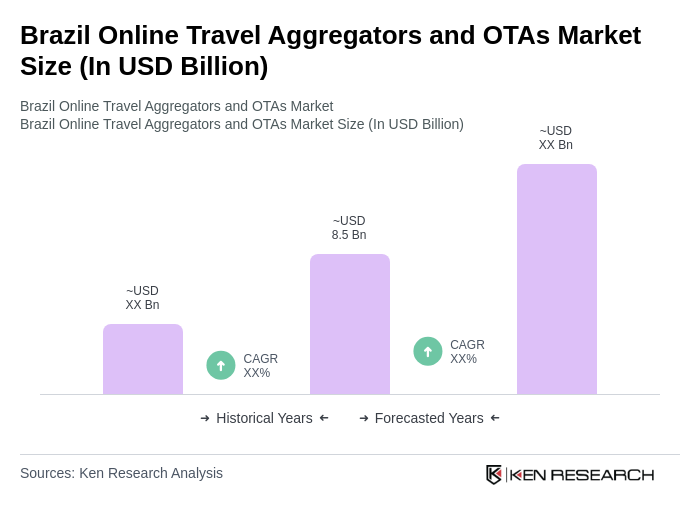
- The Brazil Online Travel Aggregators and OTAs Market is valued at USD 8.5 billion, based on a five-year historical analysis. This growth is primarily driven by the increasing adoption of digital platforms for travel bookings, a rise in disposable income among consumers, and the growing trend of experiential travel. The market has seen a significant shift towards online platforms, with consumers preferring the convenience and variety offered by OTAs.
- Key cities such as São Paulo, Rio de Janeiro, and Brasília dominate the market due to their status as major tourist destinations and business hubs. These cities attract both domestic and international travelers, leading to a higher demand for travel services. The concentration of hotels, attractions, and business facilities in these urban areas further enhances their appeal, making them focal points for online travel aggregators.
- In 2023, the Brazilian government implemented regulations aimed at enhancing consumer protection in the travel sector. This includes mandatory transparency in pricing and the requirement for OTAs to provide clear information regarding cancellation policies and fees. Such regulations are designed to foster trust and ensure that consumers are well-informed when making travel arrangements online.
Brazil Online Travel Aggregators and OTAs Market Segmentation
By Type:The market can be segmented into various types of services offered by online travel aggregators and OTAs. The primary subsegments include Hotel Booking, Flight Booking, Car Rentals, Vacation Packages, Travel Insurance, Activities and Experiences, and Others. Each of these subsegments caters to different consumer needs and preferences, contributing to the overall market dynamics.
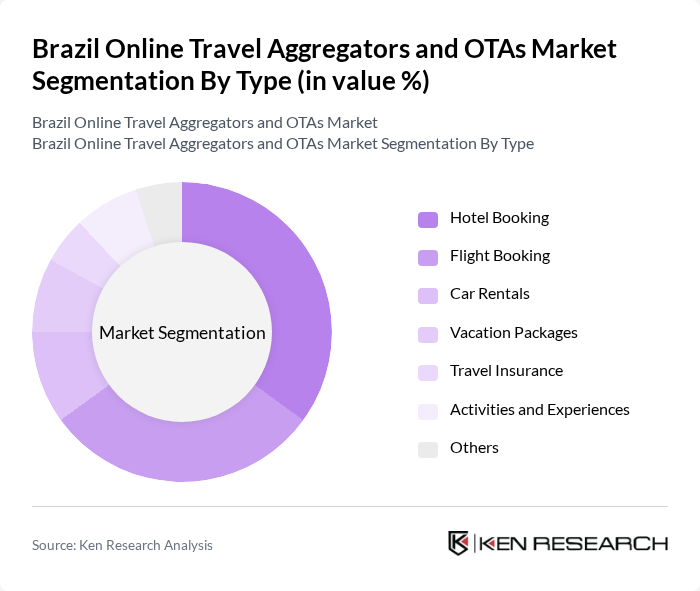
The Hotel Booking subsegment is currently dominating the market due to the high volume of travelers seeking accommodation options. With the rise of online platforms, consumers are increasingly inclined to compare prices and book hotels through OTAs, which offer a wide range of choices and competitive pricing. Additionally, the growing trend of domestic tourism has further fueled the demand for hotel bookings, making it a critical component of the overall travel experience.
By End-User:The market can also be segmented based on the end-users, which include Leisure Travelers, Business Travelers, Group Travelers, and Solo Travelers. Each of these segments has distinct preferences and requirements, influencing their choice of travel services and platforms.
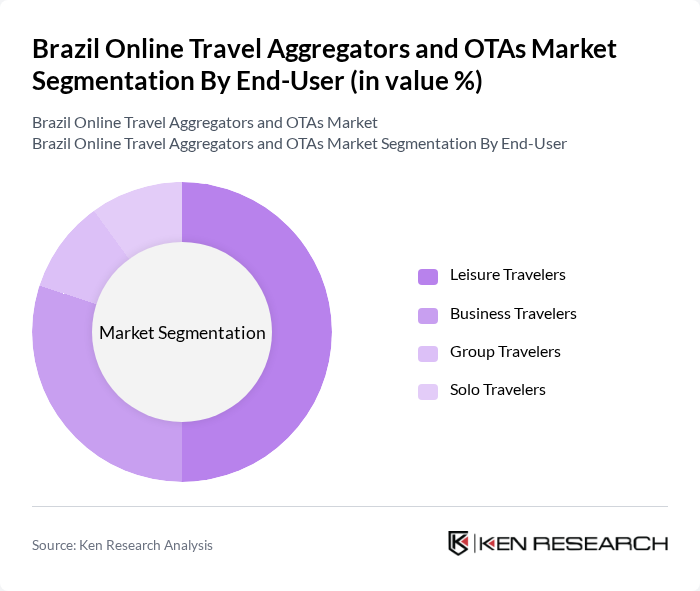
Leisure Travelers represent the largest segment in the market, driven by the increasing popularity of travel for recreation and relaxation. This group tends to book vacations and experiences through OTAs, seeking convenience and variety. The rise of social media and travel influencers has also played a significant role in inspiring leisure travel, leading to a surge in demand for travel services tailored to this demographic.
Brazil Online Travel Aggregators and OTAs Market Competitive Landscape
The Brazil Online Travel Aggregators and OTAs Market is characterized by a dynamic mix of regional and international players. Leading participants such as Booking.com, Decolar.com, Expedia Group, CVC Brasil Operadora e Agência de Viagens S.A., Viajanet, Hotel Urbano, 123milhas, Hurb, Travelgenio, Meliá Hotels International, Latam Airlines, Azul Linhas Aéreas Brasileiras, Gol Linhas Aéreas Inteligentes, Rentcars.com, KAYAK contribute to innovation, geographic expansion, and service delivery in this space.
Brazil Online Travel Aggregators and OTAs Market Industry Analysis
Growth Drivers
- Increasing Internet Penetration:Brazil's internet penetration rate reached 75% in the future, with over 200 million users accessing online services. This growth is driven by improved infrastructure and affordable mobile data plans, which have increased access to online travel platforms. The Brazilian government aims to expand internet access to rural areas, potentially increasing the number of online travelers. As more consumers go online, the demand for travel aggregators and OTAs is expected to rise significantly.
- Rise in Domestic and International Travel:In the future, Brazil recorded over 62 million domestic trips and 6 million international trips, reflecting a robust recovery in travel demand post-pandemic. The country's diverse attractions, from the Amazon rainforest to vibrant cities like Rio de Janeiro, continue to draw tourists. The Brazilian Tourism Ministry projects a 10% increase in travel volume for the future, further boosting the online travel market as consumers increasingly seek convenient booking options through OTAs.
- Adoption of Mobile Booking Platforms:Mobile bookings accounted for 45% of all online travel transactions in Brazil in the future, a significant increase from previous years. The proliferation of smartphones and user-friendly travel apps has made it easier for consumers to book travel on-the-go. With over 150 million smartphone users in Brazil, the trend towards mobile booking is expected to continue, driving growth for OTAs that optimize their platforms for mobile users and enhance user experience.
Market Challenges
- Intense Competition among OTAs:The Brazilian online travel market is highly competitive, with over 50 active OTAs vying for market share. Major players like Decolar and Viajanet dominate, but new entrants continue to emerge, intensifying price wars and reducing profit margins. In the future, the average commission rate for OTAs dropped to 12%, down from 15% in previous years, as companies strive to attract price-sensitive consumers, challenging profitability and sustainability.
- Regulatory Compliance Issues:The Brazilian travel industry faces stringent regulations, including consumer protection laws and data privacy regulations. In the future, the National Data Protection Authority (ANPD) imposed fines totaling BRL 5 million on companies for non-compliance with data protection laws. These regulations require OTAs to invest in compliance measures, which can strain resources and divert funds from marketing and technology enhancements, hindering growth potential in a competitive landscape.
Brazil Online Travel Aggregators and OTAs Market Future Outlook
The Brazilian online travel market is poised for significant growth, driven by increasing internet access and a resurgence in travel demand. As consumers prioritize convenience, mobile booking platforms will become essential for OTAs. Additionally, the focus on sustainable travel options will shape consumer preferences, prompting OTAs to adapt their offerings. The integration of advanced technologies, such as AI for personalized services, will further enhance customer experiences, positioning the market for robust expansion in the future.
Market Opportunities
- Growth in Eco-Tourism:Eco-tourism is gaining traction in Brazil, with a reported 20% increase in eco-friendly travel options in the future. This trend presents an opportunity for OTAs to develop specialized packages that cater to environmentally conscious travelers, tapping into a growing market segment that values sustainability and responsible travel practices.
- Partnerships with Local Businesses:Collaborating with local businesses can enhance the offerings of OTAs, providing unique travel experiences. In the future, partnerships with local tour operators and accommodations increased by 30%, allowing OTAs to offer exclusive deals and personalized services. This strategy not only boosts local economies but also attracts travelers seeking authentic experiences, creating a win-win scenario.
Scope of the Report
| Segment | Sub-Segments |
|---|---|
| By Type | Hotel Booking Flight Booking Car Rentals Vacation Packages Travel Insurance Activities and Experiences Others |
| By End-User | Leisure Travelers Business Travelers Group Travelers Solo Travelers |
| By Sales Channel | Online Platforms Mobile Applications Travel Agencies Direct Bookings |
| By Customer Segment | Millennials Gen X Baby Boomers |
| By Pricing Model | Dynamic Pricing Fixed Pricing Subscription Models |
| By Geographic Coverage | Domestic Travel International Travel |
| By Payment Method | Credit/Debit Cards Digital Wallets Bank Transfers Others |
Key Target Audience
Investors and Venture Capitalist Firms
Government and Regulatory Bodies (e.g., Agência Nacional de Aviação Civil, Ministério do Turismo)
Travel and Tourism Boards
Online Payment Solution Providers
Hospitality Industry Stakeholders
Marketing and Advertising Agencies
Data Analytics and Technology Firms
Travel Insurance Companies
Players Mentioned in the Report:
Booking.com
Decolar.com
Expedia Group
CVC Brasil Operadora e Agencia de Viagens S.A.
Viajanet
Hotel Urbano
123milhas
Hurb
Travelgenio
Melia Hotels International
Latam Airlines
Azul Linhas Aereas Brasileiras
Gol Linhas Aereas Inteligentes
Rentcars.com
KAYAK
Table of Contents
Market Assessment Phase
1. Executive Summary and Approach
2. Brazil Online Travel Aggregators and OTAs Market Overview
2.1 Key Insights and Strategic Recommendations
2.2 Brazil Online Travel Aggregators and OTAs Market Overview
2.3 Definition and Scope
2.4 Evolution of Market Ecosystem
2.5 Timeline of Key Regulatory Milestones
2.6 Value Chain & Stakeholder Mapping
2.7 Business Cycle Analysis
2.8 Policy & Incentive Landscape
3. Brazil Online Travel Aggregators and OTAs Market Analysis
3.1 Growth Drivers
3.1.1 Increasing Internet Penetration
3.1.2 Rise in Domestic and International Travel
3.1.3 Adoption of Mobile Booking Platforms
3.1.4 Enhanced Customer Experience through Personalization
3.2 Market Challenges
3.2.1 Intense Competition among OTAs
3.2.2 Regulatory Compliance Issues
3.2.3 Economic Instability Affecting Consumer Spending
3.2.4 Cybersecurity Threats
3.3 Market Opportunities
3.3.1 Growth in Eco-Tourism
3.3.2 Expansion of Travel Packages and Bundling
3.3.3 Partnerships with Local Businesses
3.3.4 Utilization of Big Data for Market Insights
3.4 Market Trends
3.4.1 Shift towards Sustainable Travel Options
3.4.2 Increased Use of AI in Customer Service
3.4.3 Growth of Subscription-Based Travel Services
3.4.4 Focus on Health and Safety in Travel
3.5 Government Regulation
3.5.1 Consumer Protection Laws
3.5.2 Data Privacy Regulations
3.5.3 Travel and Tourism Promotion Policies
3.5.4 Environmental Regulations for Tourism
4. SWOT Analysis
5. Stakeholder Analysis
6. Porter's Five Forces Analysis
7. Brazil Online Travel Aggregators and OTAs Market Market Size, 2019-2024
7.1 By Value
7.2 By Volume
7.3 By Average Selling Price
8. Brazil Online Travel Aggregators and OTAs Market Segmentation
8.1 By Type
8.1.1 Hotel Booking
8.1.2 Flight Booking
8.1.3 Car Rentals
8.1.4 Vacation Packages
8.1.5 Travel Insurance
8.1.6 Activities and Experiences
8.1.7 Others
8.2 By End-User
8.2.1 Leisure Travelers
8.2.2 Business Travelers
8.2.3 Group Travelers
8.2.4 Solo Travelers
8.3 By Sales Channel
8.3.1 Online Platforms
8.3.2 Mobile Applications
8.3.3 Travel Agencies
8.3.4 Direct Bookings
8.4 By Customer Segment
8.4.1 Millennials
8.4.2 Gen X
8.4.3 Baby Boomers
8.5 By Pricing Model
8.5.1 Dynamic Pricing
8.5.2 Fixed Pricing
8.5.3 Subscription Models
8.6 By Geographic Coverage
8.6.1 Domestic Travel
8.6.2 International Travel
8.7 By Payment Method
8.7.1 Credit/Debit Cards
8.7.2 Digital Wallets
8.7.3 Bank Transfers
8.7.4 Others
9. Brazil Online Travel Aggregators and OTAs Market Competitive Analysis
9.1 Market Share of Key Players
9.2 Cross Comparison of Key Players
9.2.1 Company Name
9.2.2 Group Size (Large, Medium, or Small as per industry convention)
9.2.3 Customer Acquisition Cost
9.2.4 Average Order Value
9.2.5 Conversion Rate
9.2.6 Customer Retention Rate
9.2.7 Revenue per User
9.2.8 Pricing Strategy
9.2.9 Market Penetration Rate
9.2.10 Customer Satisfaction Score
9.3 SWOT Analysis of Top Players
9.4 Pricing Analysis
9.5 Detailed Profile of Major Companies
9.5.1 Booking.com
9.5.2 Decolar.com
9.5.3 Expedia Group
9.5.4 CVC Brasil Operadora e Agência de Viagens S.A.
9.5.5 Viajanet
9.5.6 Hotel Urbano
9.5.7 123milhas
9.5.8 Hurb
9.5.9 Travelgenio
9.5.10 Meliá Hotels International
9.5.11 Latam Airlines
9.5.12 Azul Linhas Aéreas Brasileiras
9.5.13 Gol Linhas Aéreas Inteligentes
9.5.14 Rentcars.com
9.5.15 KAYAK
10. Brazil Online Travel Aggregators and OTAs Market End-User Analysis
10.1 Procurement Behavior of Key Ministries
10.1.1 Travel Budget Allocation
10.1.2 Preferred Booking Channels
10.1.3 Compliance with Travel Policies
10.2 Corporate Spend on Infrastructure & Energy
10.2.1 Investment in Travel Technology
10.2.2 Budget for Employee Travel
10.2.3 Partnerships with OTAs
10.3 Pain Point Analysis by End-User Category
10.3.1 Booking Complexity
10.3.2 Lack of Customization
10.3.3 Customer Support Issues
10.4 User Readiness for Adoption
10.4.1 Familiarity with Online Platforms
10.4.2 Trust in Digital Transactions
10.4.3 Willingness to Use Mobile Apps
10.5 Post-Deployment ROI and Use Case Expansion
10.5.1 Measurement of Travel Efficiency
10.5.2 User Feedback and Improvement
10.5.3 Expansion of Services Offered
11. Brazil Online Travel Aggregators and OTAs Market Future Size, 2025-2030
11.1 By Value
11.2 By Volume
11.3 By Average Selling Price
Go-To-Market Strategy Phase
1. Whitespace Analysis + Business Model Canvas
1.1 Market Gaps Identification
1.2 Value Proposition Development
1.3 Revenue Streams Analysis
1.4 Cost Structure Evaluation
1.5 Key Partnerships Exploration
1.6 Customer Segmentation
1.7 Channels and Customer Relationships
2. Marketing and Positioning Recommendations
2.1 Branding Strategies
2.2 Product USPs
2.3 Target Audience Identification
2.4 Marketing Channels Selection
2.5 Campaign Planning
3. Distribution Plan
3.1 Urban Retail Strategies
3.2 Rural NGO Tie-Ups
3.3 Online vs Offline Distribution
3.4 Partnership Opportunities
4. Channel & Pricing Gaps
4.1 Underserved Routes
4.2 Pricing Bands Analysis
4.3 Competitor Pricing Comparison
5. Unmet Demand & Latent Needs
5.1 Category Gaps
5.2 Consumer Segments Analysis
5.3 Emerging Trends Identification
6. Customer Relationship
6.1 Loyalty Programs
6.2 After-Sales Service
6.3 Customer Feedback Mechanisms
7. Value Proposition
7.1 Sustainability Initiatives
7.2 Integrated Supply Chains
7.3 Unique Selling Points
8. Key Activities
8.1 Regulatory Compliance
8.2 Branding Efforts
8.3 Distribution Setup
9. Entry Strategy Evaluation
9.1 Domestic Market Entry Strategy
9.1.1 Product Mix
9.1.2 Pricing Band
9.1.3 Packaging
9.2 Export Entry Strategy
9.2.1 Target Countries
9.2.2 Compliance Roadmap
10. Entry Mode Assessment
10.1 Joint Ventures
10.2 Greenfield Investments
10.3 Mergers & Acquisitions
10.4 Distributor Model
11. Capital and Timeline Estimation
11.1 Capital Requirements
11.2 Timelines
12. Control vs Risk Trade-Off
12.1 Ownership vs Partnerships
13. Profitability Outlook
13.1 Breakeven Analysis
13.2 Long-Term Sustainability
14. Potential Partner List
14.1 Distributors
14.2 Joint Ventures
14.3 Acquisition Targets
15. Execution Roadmap
15.1 Phased Plan for Market Entry
15.1.1 Market Setup
15.1.2 Market Entry
15.1.3 Growth Acceleration
15.1.4 Scale & Stabilize
15.2 Key Activities and Milestones
15.2.1 Activity Planning
15.2.2 Milestone Tracking
Research Methodology
Phase 1: Approach1
Desk Research
- Analysis of industry reports from Brazilian tourism authorities and market research firms
- Review of online travel aggregator platforms and their service offerings
- Examination of consumer behavior studies and travel trends in Brazil
Primary Research
- Interviews with executives from leading OTAs and travel aggregators in Brazil
- Surveys targeting frequent travelers to understand preferences and usage patterns
- Focus groups with travel agents to gather insights on market dynamics
Validation & Triangulation
- Cross-validation of findings with data from tourism boards and industry associations
- Triangulation of consumer insights with sales data from OTAs
- Sanity checks through expert panel reviews comprising industry veterans
Phase 2: Market Size Estimation1
Top-down Assessment
- Estimation of total travel expenditure in Brazil as a basis for OTA market size
- Segmentation of market by type of travel (leisure, business, etc.) and service (flights, hotels, etc.)
- Incorporation of growth rates from historical data and tourism forecasts
Bottom-up Modeling
- Collection of transaction data from major OTAs to establish average booking values
- Analysis of user engagement metrics to estimate conversion rates
- Volume x average transaction value calculations for different service categories
Forecasting & Scenario Analysis
- Multi-factor regression analysis incorporating economic indicators and travel sentiment
- Scenario modeling based on potential impacts of regulatory changes and market disruptions
- Development of baseline, optimistic, and pessimistic forecasts through 2030
Phase 3: CATI Sample Composition1
| Scope Item/Segment | Sample Size | Target Respondent Profiles |
|---|---|---|
| Leisure Travel Users | 150 | Frequent Travelers, Vacation Planners |
| Business Travel Users | 100 | Corporate Travel Managers, Business Executives |
| Travel Agency Professionals | 80 | Travel Agents, Agency Owners |
| OTA Platform Users | 120 | Online Booking Users, Mobile App Users |
| Tourism Industry Experts | 60 | Tour Operators, Industry Analysts |
Frequently Asked Questions
What is the current value of the Brazil Online Travel Aggregators and OTAs market?
The Brazil Online Travel Aggregators and OTAs market is valued at approximately USD 8.5 billion, reflecting significant growth driven by increased digital platform adoption, rising disposable incomes, and a growing trend towards experiential travel.
Which cities are the main hubs for online travel aggregators in Brazil?
What regulations has the Brazilian government implemented for OTAs in 2023?
What are the primary services offered by online travel aggregators in Brazil?
Other Regional/Country Reports
Indonesia Online Travel Aggregators and OTAs Market
Malaysia Online Travel Aggregators and OTAs Market
KSA Online Travel Aggregators and OTAs Market
APAC Online Travel Aggregators and OTAs Market
SEA Online Travel Aggregators and OTAs Market
Vietnam Online Travel Aggregators and OTAs Market
Other Adjacent Reports
South Korea Travel Technology Market
Oman Hospitality Software Market
Malaysia Airline Reservation Systems Market
Indonesia Car Rental Services Market
Kuwait travel insurance market report size, share, growth drivers, trends, opportunities & forecast 2025–2030Bahrain Tour Operator Market
Qatar Mobile Booking Platforms Market
Kuwait E-Tourism Market
Bahrain digital payment solutions market size, share, growth drivers, trends, opportunities & forecast 2025–2030Oman Travel Analytics Market
Why Buy From Us?

What makes us stand out is that our consultants follow Robust, Refine and Result (RRR) methodology. Robust for clear definitions, approaches and sanity checking, Refine for differentiating respondents' facts and opinions, and Result for presenting data with story.

We have set a benchmark in the industry by offering our clients with syndicated and customized market research reports featuring coverage of entire market as well as meticulous research and analyst insights.

While we don't replace traditional research, we flip the method upside down. Our dual approach of Top Bottom & Bottom Top ensures quality deliverable by not just verifying company fundamentals but also looking at the sector and macroeconomic factors.

With one step in the future, our research team constantly tries to show you the bigger picture. We help with some of the tough questions you may encounter along the way: How is the industry positioned? Best marketing channel? KPI's of competitors? By aligning every element, we help maximize success.

Our report gives you instant access to the answers and sources that other companies might choose to hide. We elaborate each steps of research methodology we have used and showcase you the sample size to earn your trust.

If you need any support, we are here! We pride ourselves on universe strength, data quality, and quick, friendly, and professional service.