About the Report
Base Year 2024Brazil Sports Equipment and Outdoor Gear Market Overview
- The Brazil Sports Equipment and Outdoor Gear Market is valued at USD 11.5 billion, based on a five-year historical analysis. This growth is primarily driven by increasing health consciousness among consumers, a rise in outdoor recreational activities, and the growing popularity of sports events in the country. The market has seen a significant uptick in demand for both professional and amateur sports equipment, reflecting a broader trend towards active lifestyles. Notably, the surge in football, volleyball, and fitness activities, as well as the expansion of eCommerce platforms, have contributed to market expansion .
- Key cities such as São Paulo, Rio de Janeiro, and Brasília dominate the market due to their large populations and vibrant sports cultures. São Paulo, being the financial hub, has a higher concentration of retail outlets and sports facilities, while Rio de Janeiro attracts tourists for outdoor activities. Brasília's government initiatives to promote sports also contribute to its market presence .
- In 2023, the Brazilian government implemented the “National Policy for Sustainable Production and Consumption” (Política Nacional de Produção e Consumo Sustentáveis, Decree No. 10.940/2022, issued by the Presidency of the Republic), which includes operational requirements for manufacturers in the sports equipment sector. This regulation mandates that manufacturers adopt eco-friendly production processes and prioritize recyclable materials, with compliance monitored through annual sustainability reporting and product labeling standards.

Brazil Sports Equipment and Outdoor Gear Market Segmentation
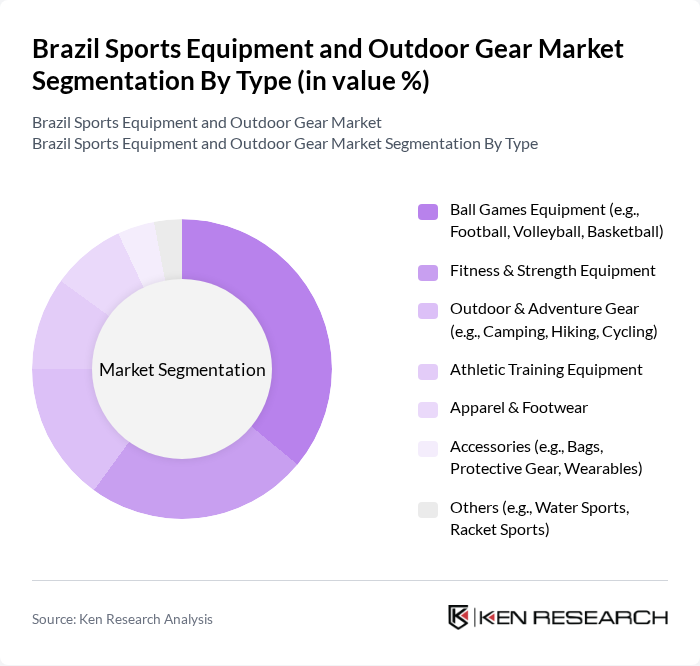
By Type:The market is segmented into various types of sports equipment and outdoor gear, including ball games equipment, fitness and strength equipment, outdoor and adventure gear, athletic training equipment, apparel and footwear, accessories, and others. Among these, ball games equipment, particularly football and basketball gear, dominates the market due to Brazil's rich sporting culture and the popularity of these sports. The increasing participation in fitness activities and the growing adoption of home fitness solutions have also led to a significant demand for fitness and strength equipment .
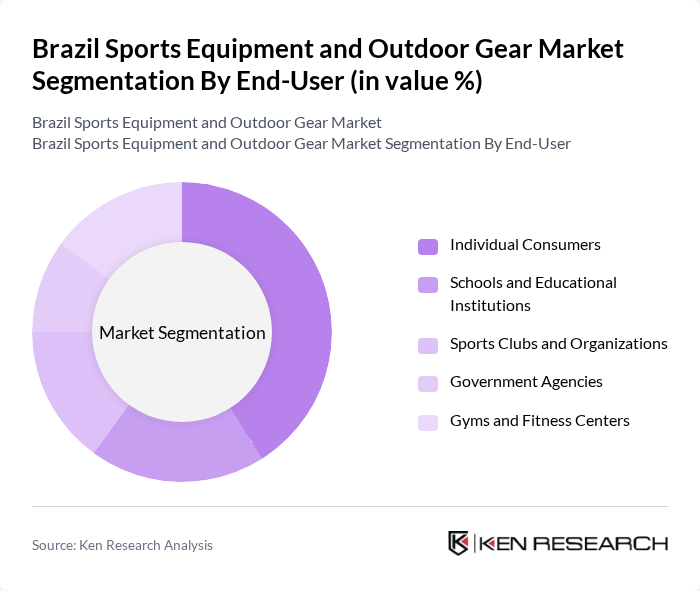
By End-User:The end-user segmentation includes individual consumers, schools and educational institutions, sports clubs and organizations, government agencies, and gyms and fitness centers. Individual consumers represent the largest segment, driven by the growing trend of personal fitness, recreational sports, and increased online purchasing. Schools and educational institutions also contribute significantly, as they increasingly invest in sports programs and facilities to promote physical education .
Brazil Sports Equipment and Outdoor Gear Market Competitive Landscape
The Brazil Sports Equipment and Outdoor Gear Market is characterized by a dynamic mix of regional and international players. Leading participants such as Decathlon Brasil, Nike do Brasil, Adidas do Brasil, Under Armour Brasil, Puma Brasil, Mizuno do Brasil, Asics Brasil, Wilson Sporting Goods Brasil, The North Face Brasil, Columbia Sportswear Brasil, Salomon Brasil, New Balance Brasil, Oakley Brasil, Skechers Brasil, Reebok Brasil, Centauro, Netshoes (Grupo Magalu), Penalty (Cambuci S.A.), Kanxa, Fila Brasil contribute to innovation, geographic expansion, and service delivery in this space.
Brazil Sports Equipment and Outdoor Gear Market Industry Analysis
Growth Drivers
- Increasing Participation in Sports and Fitness Activities:The Brazilian population engaged in sports and fitness activities has surged, with approximately 30 million individuals participating in organized sports. This trend is supported by a growing health consciousness, with 60% of Brazilians prioritizing fitness. The government’s investment of R$1.5 billion in sports infrastructure has further facilitated access to facilities, encouraging more people to engage in physical activities, thus driving demand for sports equipment and outdoor gear.
- Rising Disposable Income Among Consumers:Brazil's GDP per capita is projected to reach R$40,000, reflecting a 5% increase from the previous year. This rise in disposable income allows consumers to allocate more funds towards sports and outdoor activities. As a result, spending on sports equipment is expected to increase, with households investing an average of R$1,200 annually on fitness-related products. This trend is crucial for the growth of the sports equipment market, as consumers seek quality gear.
- Growth of E-commerce Platforms for Sports Equipment:E-commerce sales of sports equipment in Brazil reached approximately R$3.6 billion, with a projected growth rate of 20% in the following year. The increasing penetration of the internet, which stands at 84% of the population, has facilitated online shopping. Major platforms like Mercado Livre and Amazon Brazil are expanding their sports categories, making it easier for consumers to access a wide range of products, thus boosting overall market growth.
Market Challenges
- Economic Fluctuations Affecting Consumer Spending:Brazil's economy is projected to grow at a modest rate of 2.9%, influenced by inflation rates hovering around 4%. These economic fluctuations can lead to reduced consumer spending on non-essential items, including sports equipment. As disposable income becomes constrained, consumers may prioritize essential goods over recreational spending, posing a challenge for market growth in the sports equipment sector.
- Competition from Low-Cost Imports:The influx of low-cost imported sports equipment, particularly from Asia, poses a significant challenge to local manufacturers. Imports accounted for 40% of the sports equipment market, with average prices 30% lower than domestic products. This price disparity pressures local companies to lower their prices, potentially impacting profit margins and market share, thereby complicating the competitive landscape for Brazilian manufacturers.
Brazil Sports Equipment and Outdoor Gear Market Future Outlook
The future of the Brazil sports equipment and outdoor gear market appears promising, driven by increasing health awareness and a shift towards online shopping. As more consumers prioritize fitness, the demand for innovative and high-quality products is expected to rise. Additionally, the expansion of outdoor recreational areas and government initiatives to promote sports will likely enhance market growth. Companies that adapt to these trends and invest in technology will be well-positioned to capture emerging opportunities in this evolving landscape.
Market Opportunities
- Expansion of Outdoor Recreational Areas:The Brazilian government plans to invest R$500 million in developing national parks and recreational areas. This initiative will create new opportunities for outdoor gear sales, as more consumers will seek equipment for hiking, camping, and other outdoor activities, thus driving market growth.
- Increasing Demand for Eco-Friendly Products:With 70% of Brazilian consumers expressing a preference for sustainable products, the demand for eco-friendly sports equipment is on the rise. Companies that focus on sustainable materials and practices can tap into this growing market segment, potentially increasing their customer base and enhancing brand loyalty.
Scope of the Report
| Segment | Sub-Segments |
|---|---|
| By Type | Ball Games Equipment (e.g., Football, Volleyball, Basketball) Fitness & Strength Equipment Outdoor & Adventure Gear (e.g., Camping, Hiking, Cycling) Athletic Training Equipment Apparel & Footwear Accessories (e.g., Bags, Protective Gear, Wearables) Others (e.g., Water Sports, Racket Sports) |
| By End-User | Individual Consumers Schools and Educational Institutions Sports Clubs and Organizations Government Agencies Gyms and Fitness Centers |
| By Sales Channel | Online Retail Brick-and-Mortar Stores Wholesale Distributors Direct Sales Specialty Sports Stores |
| By Price Range | Budget Mid-Range Premium |
| By Brand Loyalty | Brand Loyal Customers Price-Sensitive Customers First-Time Buyers |
| By Product Lifecycle Stage | Introduction Stage Growth Stage Maturity Stage |
| By Distribution Mode | Direct Distribution Indirect Distribution E-commerce Platforms |
Key Target Audience
Investors and Venture Capitalist Firms
Government and Regulatory Bodies (e.g., Brazilian Ministry of Sports, National Institute of Metrology, Quality and Technology)
Manufacturers and Producers
Distributors and Retailers
Sports Federations and Associations
Outdoor Recreation Organizations
Fitness and Wellness Centers
Financial Institutions
Players Mentioned in the Report:
Decathlon Brasil
Nike do Brasil
Adidas do Brasil
Under Armour Brasil
Puma Brasil
Mizuno do Brasil
Asics Brasil
Wilson Sporting Goods Brasil
The North Face Brasil
Columbia Sportswear Brasil
Salomon Brasil
New Balance Brasil
Oakley Brasil
Skechers Brasil
Reebok Brasil
Centauro
Netshoes (Grupo Magalu)
Penalty (Cambuci S.A.)
Kanxa
Fila Brasil
Table of Contents
Market Assessment Phase
1. Executive Summary and Approach
2. Brazil Sports Equipment and Outdoor Gear Market Overview
2.1 Key Insights and Strategic Recommendations
2.2 Brazil Sports Equipment and Outdoor Gear Market Overview
2.3 Definition and Scope
2.4 Evolution of Market Ecosystem
2.5 Timeline of Key Regulatory Milestones
2.6 Value Chain & Stakeholder Mapping
2.7 Business Cycle Analysis
2.8 Policy & Incentive Landscape
3. Brazil Sports Equipment and Outdoor Gear Market Analysis
3.1 Growth Drivers
3.1.1 Increasing participation in sports and fitness activities
3.1.2 Rising disposable income among consumers
3.1.3 Growth of e-commerce platforms for sports equipment
3.1.4 Government initiatives promoting outdoor activities
3.2 Market Challenges
3.2.1 Economic fluctuations affecting consumer spending
3.2.2 Competition from low-cost imports
3.2.3 Limited awareness of premium products
3.2.4 Supply chain disruptions
3.3 Market Opportunities
3.3.1 Expansion of outdoor recreational areas
3.3.2 Increasing demand for eco-friendly products
3.3.3 Growth in youth sports programs
3.3.4 Technological advancements in sports gear
3.4 Market Trends
3.4.1 Shift towards online shopping for sports equipment
3.4.2 Rising popularity of fitness tracking devices
3.4.3 Increased focus on health and wellness
3.4.4 Customization and personalization of sports gear
3.5 Government Regulation
3.5.1 Regulations on product safety standards
3.5.2 Import tariffs on sports equipment
3.5.3 Environmental regulations for manufacturing
3.5.4 Incentives for local production
4. SWOT Analysis
5. Stakeholder Analysis
6. Porter's Five Forces Analysis
7. Brazil Sports Equipment and Outdoor Gear Market Market Size, 2019-2024
7.1 By Value
7.2 By Volume
7.3 By Average Selling Price
8. Brazil Sports Equipment and Outdoor Gear Market Segmentation
8.1 By Type
8.1.1 Ball Games Equipment (e.g., Football, Volleyball, Basketball)
8.1.2 Fitness & Strength Equipment
8.1.3 Outdoor & Adventure Gear (e.g., Camping, Hiking, Cycling)
8.1.4 Athletic Training Equipment
8.1.5 Apparel & Footwear
8.1.6 Accessories (e.g., Bags, Protective Gear, Wearables)
8.1.7 Others (e.g., Water Sports, Racket Sports)
8.2 By End-User
8.2.1 Individual Consumers
8.2.2 Schools and Educational Institutions
8.2.3 Sports Clubs and Organizations
8.2.4 Government Agencies
8.2.5 Gyms and Fitness Centers
8.3 By Sales Channel
8.3.1 Online Retail
8.3.2 Brick-and-Mortar Stores
8.3.3 Wholesale Distributors
8.3.4 Direct Sales
8.3.5 Specialty Sports Stores
8.4 By Price Range
8.4.1 Budget
8.4.2 Mid-Range
8.4.3 Premium
8.5 By Brand Loyalty
8.5.1 Brand Loyal Customers
8.5.2 Price-Sensitive Customers
8.5.3 First-Time Buyers
8.6 By Product Lifecycle Stage
8.6.1 Introduction Stage
8.6.2 Growth Stage
8.6.3 Maturity Stage
8.7 By Distribution Mode
8.7.1 Direct Distribution
8.7.2 Indirect Distribution
8.7.3 E-commerce Platforms
9. Brazil Sports Equipment and Outdoor Gear Market Competitive Analysis
9.1 Market Share of Key Players
9.2 Cross Comparison of Key Players
9.2.1 Company Name
9.2.2 Group Size (Large, Medium, or Small as per industry convention)
9.2.3 Revenue (Brazil, USD millions)
9.2.4 Revenue Growth Rate (YoY %)
9.2.5 Market Share (%)
9.2.6 Market Penetration Rate (Urban/Rural/Online)
9.2.7 Customer Retention Rate (%)
9.2.8 Product Return Rate (%)
9.2.9 Average Selling Price (ASP)
9.2.10 Distribution Network Coverage (No. of Outlets/Online Presence)
9.2.11 Brand Recognition Score
9.2.12 Customer Satisfaction Index
9.2.13 Sustainability/ESG Initiatives
9.3 SWOT Analysis of Top Players
9.4 Pricing Analysis
9.5 Detailed Profile of Major Companies
9.5.1 Decathlon Brasil
9.5.2 Nike do Brasil
9.5.3 Adidas do Brasil
9.5.4 Under Armour Brasil
9.5.5 Puma Brasil
9.5.6 Mizuno do Brasil
9.5.7 Asics Brasil
9.5.8 Wilson Sporting Goods Brasil
9.5.9 The North Face Brasil
9.5.10 Columbia Sportswear Brasil
9.5.11 Salomon Brasil
9.5.12 New Balance Brasil
9.5.13 Oakley Brasil
9.5.14 Skechers Brasil
9.5.15 Reebok Brasil
9.5.16 Centauro
9.5.17 Netshoes (Grupo Magalu)
9.5.18 Penalty (Cambuci S.A.)
9.5.19 Kanxa
9.5.20 Fila Brasil
10. Brazil Sports Equipment and Outdoor Gear Market End-User Analysis
10.1 Procurement Behavior of Key Ministries
10.1.1 Sports Ministry Procurement Trends
10.1.2 Education Ministry Equipment Needs
10.1.3 Health Ministry Initiatives
10.2 Corporate Spend on Infrastructure & Energy
10.2.1 Corporate Sponsorship in Sports
10.2.2 Investment in Sports Facilities
10.2.3 Spending on Employee Wellness Programs
10.3 Pain Point Analysis by End-User Category
10.3.1 Individual Consumer Pain Points
10.3.2 Institutional Pain Points
10.3.3 Corporate Pain Points
10.4 User Readiness for Adoption
10.4.1 Awareness of New Products
10.4.2 Willingness to Invest in Quality
10.4.3 Adoption of Technology in Sports
10.5 Post-Deployment ROI and Use Case Expansion
10.5.1 Measuring ROI for Sports Programs
10.5.2 Expansion of Use Cases in Schools
10.5.3 Corporate Use Cases for Team Building
11. Brazil Sports Equipment and Outdoor Gear Market Future Size, 2025-2030
11.1 By Value
11.2 By Volume
11.3 By Average Selling Price
Go-To-Market Strategy Phase
1. Whitespace Analysis + Business Model Canvas
1.1 Market Gaps Identification
1.2 Business Model Options
1.3 Value Proposition Development
1.4 Revenue Streams Analysis
1.5 Cost Structure Evaluation
1.6 Key Partnerships
1.7 Customer Segments
2. Marketing and Positioning Recommendations
2.1 Branding Strategies
2.2 Product USPs
3. Distribution Plan
3.1 Urban Retail vs Rural NGO Tie-ups
4. Channel & Pricing Gaps
4.1 Underserved Routes
4.2 Pricing Bands
5. Unmet Demand & Latent Needs
5.1 Category Gaps
5.2 Consumer Segments
6. Customer Relationship
6.1 Loyalty Programs
6.2 After-sales Service
7. Value Proposition
7.1 Sustainability
7.2 Integrated Supply Chains
8. Key Activities
8.1 Regulatory Compliance
8.2 Branding
8.3 Distribution Setup
9. Entry Strategy Evaluation
9.1 Domestic Market Entry Strategy
9.1.1 Product Mix
9.1.2 Pricing Band
9.1.3 Packaging
9.2 Export Entry Strategy
9.2.1 Target Countries
9.2.2 Compliance Roadmap
10. Entry Mode Assessment
10.1 JV
10.2 Greenfield
10.3 M&A
10.4 Distributor Model
11. Capital and Timeline Estimation
11.1 Capital Requirements
11.2 Timelines
12. Control vs Risk Trade-Off
12.1 Ownership vs Partnerships
13. Profitability Outlook
13.1 Breakeven Analysis
13.2 Long-term Sustainability
14. Potential Partner List
14.1 Distributors
14.2 JVs
14.3 Acquisition Targets
15. Execution Roadmap
15.1 Phased Plan for Market Entry
15.1.1 Market Setup
15.1.2 Market Entry
15.1.3 Growth Acceleration
15.1.4 Scale & Stabilize
15.2 Key Activities and Milestones
15.2.1 Activity Timeline
15.2.2 Milestone Tracking
Research Methodology
Phase 1: Approach1
Desk Research
- Analysis of industry reports from Brazilian sports equipment associations and outdoor gear organizations
- Review of government publications on sports participation rates and outdoor activity trends in Brazil
- Examination of market studies and white papers from research institutions focusing on consumer behavior in sports and outdoor activities
Primary Research
- Interviews with key stakeholders in the sports equipment and outdoor gear sectors, including manufacturers and distributors
- Surveys conducted with retailers to gather insights on sales trends and consumer preferences
- Field interviews with outdoor enthusiasts and sports professionals to understand usage patterns and brand perceptions
Validation & Triangulation
- Cross-validation of findings through comparison with historical sales data and market growth rates
- Triangulation of insights from primary interviews with secondary data sources to ensure consistency
- Sanity checks through expert panel reviews involving industry veterans and market analysts
Phase 2: Market Size Estimation1
Top-down Assessment
- Estimation of market size based on national sports participation statistics and outdoor activity reports
- Segmentation of the market by product categories such as fitness equipment, camping gear, and sports apparel
- Incorporation of demographic data to assess potential market growth among different age groups and regions
Bottom-up Modeling
- Collection of sales data from leading retailers and e-commerce platforms in the sports and outdoor sectors
- Estimation of average selling prices and volume sold for various product categories
- Analysis of consumer spending patterns on sports and outdoor activities to derive market potential
Forecasting & Scenario Analysis
- Utilization of time-series analysis to project future market trends based on historical data
- Scenario modeling based on economic indicators, consumer spending, and potential impacts of major sporting events
- Development of multiple growth scenarios (baseline, optimistic, and pessimistic) to account for market volatility
Phase 3: CATI Sample Composition1
| Scope Item/Segment | Sample Size | Target Respondent Profiles |
|---|---|---|
| Retail Sales of Sports Equipment | 100 | Store Managers, Sales Representatives |
| Outdoor Gear Consumer Insights | 60 | Outdoor Enthusiasts, Adventure Tour Operators |
| Fitness Equipment Market Trends | 80 | Gym Owners, Fitness Trainers |
| Sports Apparel Purchasing Behavior | 50 | Fashion Retailers, Brand Managers |
| Market Dynamics in E-commerce for Sports Gear | 40 | E-commerce Managers, Digital Marketing Specialists |
Frequently Asked Questions
What is the current value of the Brazil Sports Equipment and Outdoor Gear Market?
The Brazil Sports Equipment and Outdoor Gear Market is valued at approximately USD 11.5 billion, reflecting a significant growth trend driven by increased health consciousness and participation in sports and outdoor activities among consumers.
What factors are driving the growth of the sports equipment market in Brazil?
Which cities are the largest markets for sports equipment in Brazil?
How has e-commerce impacted the sports equipment market in Brazil?
Other Regional/Country Reports
Other Adjacent Reports
UAE Fitness Equipment Market
Japan Sports Apparel Market
KSA Athletic Footwear Market
South Africa Outdoor Adventure Gear Market
Singapore Sports Nutrition Market
Qatar Gym and Fitness Services Market
Germany E-commerce Retail Market
Kuwait Sporting Goods Retail Market
Kuwait Adventure Tourism Market
Singapore Sports Accessories Market
Why Buy From Us?

What makes us stand out is that our consultants follow Robust, Refine and Result (RRR) methodology. Robust for clear definitions, approaches and sanity checking, Refine for differentiating respondents' facts and opinions, and Result for presenting data with story.

We have set a benchmark in the industry by offering our clients with syndicated and customized market research reports featuring coverage of entire market as well as meticulous research and analyst insights.

While we don't replace traditional research, we flip the method upside down. Our dual approach of Top Bottom & Bottom Top ensures quality deliverable by not just verifying company fundamentals but also looking at the sector and macroeconomic factors.

With one step in the future, our research team constantly tries to show you the bigger picture. We help with some of the tough questions you may encounter along the way: How is the industry positioned? Best marketing channel? KPI's of competitors? By aligning every element, we help maximize success.

Our report gives you instant access to the answers and sources that other companies might choose to hide. We elaborate each steps of research methodology we have used and showcase you the sample size to earn your trust.

If you need any support, we are here! We pride ourselves on universe strength, data quality, and quick, friendly, and professional service.