About the Report
Base Year 2024Canada Infrastructure Sector Market Overview
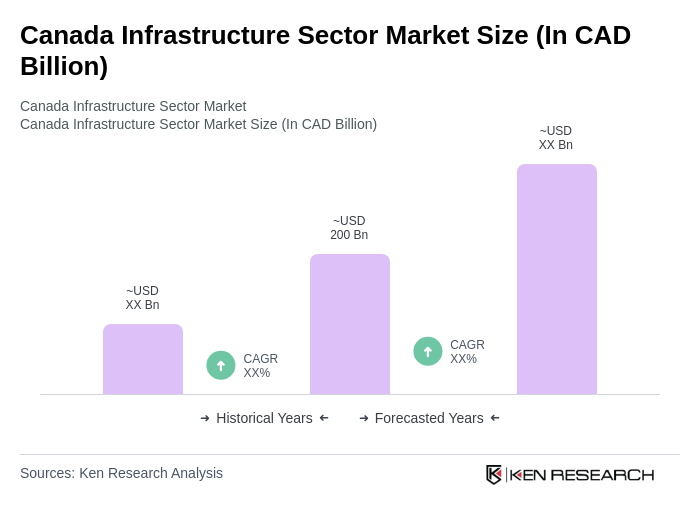
- The Canada Infrastructure Sector Market is valued at CAD 200 billion, based on a five-year historical analysis. This growth is primarily driven by increased public investment, urbanization, and modernization needs across transport, energy, water, and digital assets, with governments prioritizing resilience and climate-aligned infrastructure. The demand for infrastructure development is further fueled by population growth and the necessity for sustainable and resilient infrastructure solutions.
- Key players in this market include major cities such as Toronto, Vancouver, and Montreal, which dominate due to their large populations and economic activities. These urban centers are focal points for infrastructure investments, driven by the need for improved transportation networks, utilities, and social infrastructure to support their growing populations and economic development.
- In 2023, the Canadian government implemented the Investing in Canada Infrastructure Program, allocating CAD 10 billion to enhance public infrastructure. This initiative aims to improve transportation systems, water management, and energy efficiency, thereby addressing critical infrastructure needs and promoting sustainable development across the country.
Canada Infrastructure Sector Market Segmentation
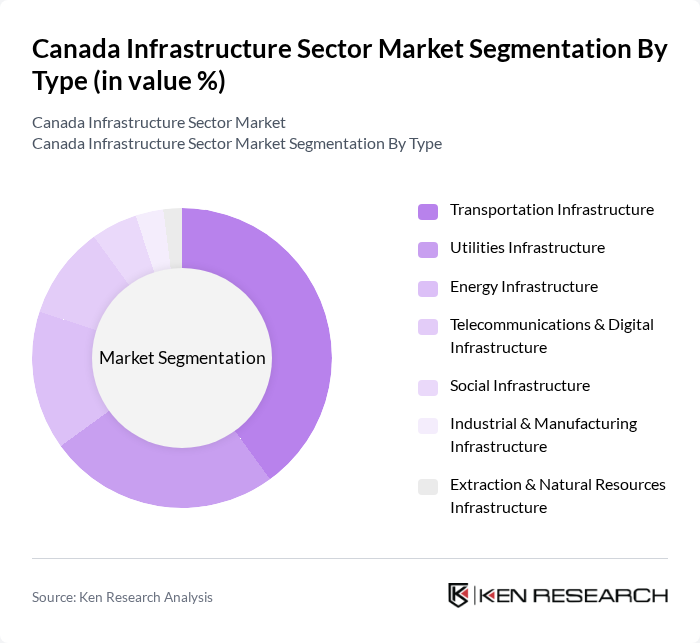
By Type:The infrastructure sector can be segmented into various types, including transportation, utilities, energy, telecommunications, social, industrial, and extraction infrastructure. Each type plays a crucial role in supporting the overall economic framework and addressing the specific needs of urban and rural populations.
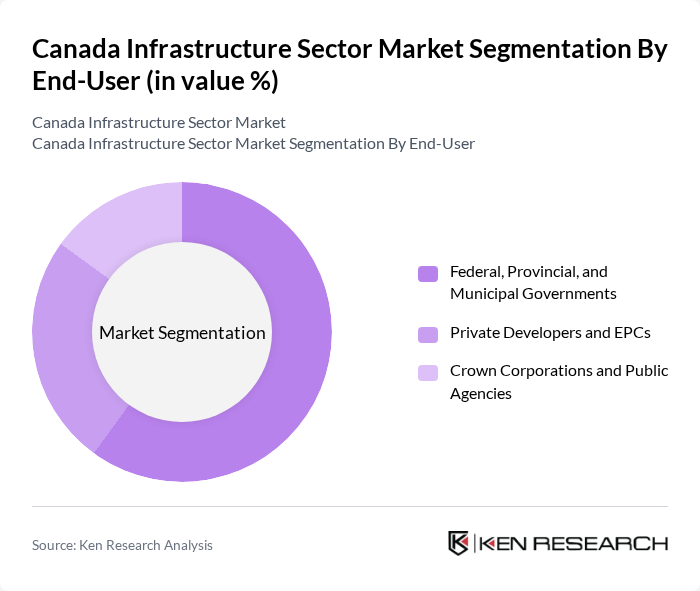
By End-User:The end-users of infrastructure projects include federal, provincial, and municipal governments, private developers, and crown corporations. Each of these entities plays a significant role in funding, developing, and maintaining infrastructure projects across Canada.
Canada Infrastructure Sector Market Competitive Landscape
The Canada Infrastructure Sector Market is characterized by a dynamic mix of regional and international players. Leading participants such as SNC-Lavalin Group Inc. (AtkinsRéalis), EllisDon Corporation, PCL Constructors Inc., Aecon Group Inc., Graham Construction, Kiewit Corporation, Bird Construction Inc., Ledcor Group, Stantec Inc., WSP Global Inc., AECOM, Jacobs Solutions Inc., Tetra Tech, Inc., HDR, Inc., Golder Associates Ltd. (WSP acquired), CRH Canada Group Inc. (Dufferin Construction), Green Infrastructure Partners Inc. (GIP), Bantrel Co., Graham Management Services LP, Hatch Ltd. contribute to innovation, geographic expansion, and service delivery in this space.
Canada Infrastructure Sector Market Industry Analysis
Growth Drivers
- Increased Government Investment:The Canadian government allocated CAD 10 billion for infrastructure projects in future, focusing on transportation and public transit. This investment aims to enhance connectivity and reduce congestion in urban areas. Additionally, the federal budget emphasizes infrastructure as a key driver for economic recovery, with plans to invest CAD 180 billion over the next decade. Such financial commitments are expected to stimulate job creation and boost local economies significantly.
- Urbanization and Population Growth:Canada’s urban population is projected to reach 38 million in future, increasing demand for housing and public services. The urbanization rate is approximately 81%, leading to a surge in infrastructure needs, particularly in major cities like Toronto and Vancouver. This growth necessitates substantial investments in transportation, water supply, and waste management systems to accommodate the rising population and improve living standards across urban centers.
- Infrastructure Modernization Initiatives:The Canadian government has initiated a CAD 15 billion program aimed at modernizing aging infrastructure, particularly in transportation and utilities. This initiative addresses the urgent need for upgrades to roads, bridges, and public transit systems, which are critical for safety and efficiency. By future, it is estimated that 30% of existing infrastructure will require significant repairs or replacements, highlighting the importance of these modernization efforts to ensure long-term sustainability.
Market Challenges
- Budget Constraints:Despite increased government investment, budget constraints remain a significant challenge for infrastructure projects. In future, provincial and municipal governments are expected to face a combined deficit of CAD 5 billion, limiting their ability to fund new initiatives. This financial pressure can lead to project delays and reduced scope, ultimately impacting the quality and timeliness of infrastructure development across Canada.
- Skilled Labor Shortages:The Canadian construction sector is experiencing a skilled labor shortage, with an estimated 100,000 positions unfilled in future. This shortage is exacerbated by an aging workforce and insufficient training programs. As infrastructure projects ramp up, the lack of skilled workers can lead to increased labor costs and project delays, hindering the overall progress of essential infrastructure developments across the country.
Canada Infrastructure Sector Market Future Outlook
The future of the Canadian infrastructure sector appears promising, driven by ongoing government investments and a focus on modernization. As urbanization continues, cities will increasingly adopt smart technologies to enhance efficiency and sustainability. Furthermore, the integration of green infrastructure practices will likely gain momentum, aligning with global sustainability goals. These trends indicate a robust pipeline of projects aimed at improving resilience and adaptability in the face of climate change and population growth challenges.
Market Opportunities
- Public-Private Partnerships (PPPs):The Canadian government is actively promoting PPPs to leverage private sector expertise and funding. In future, an estimated CAD 8 billion in projects will be developed through PPPs, enhancing efficiency and innovation in infrastructure delivery. This model allows for shared risks and resources, making it an attractive option for financing large-scale infrastructure initiatives.
- Green Infrastructure Projects:With a growing emphasis on sustainability, investments in green infrastructure are expected to reach CAD 6 billion in future. These projects focus on renewable energy, water conservation, and eco-friendly construction practices. The shift towards green infrastructure not only addresses environmental concerns but also creates new job opportunities and stimulates economic growth in the sector.
Scope of the Report
| Segment | Sub-Segments |
|---|---|
| By Type | Transportation Infrastructure (roads and highways, bridges, rail, mass transit, airports, ports and waterways) Utilities Infrastructure (water supply, wastewater, stormwater, solid waste) Energy Infrastructure (power generation, electricity transmission & distribution, oil & gas pipelines) Telecommunications & Digital Infrastructure (fiber networks, mobile networks, data centers) Social Infrastructure (schools, hospitals, defense, public buildings) Industrial & Manufacturing Infrastructure (industrial parks, metal/ore production, petroleum refining, chemical manufacturing) Extraction & Natural Resources Infrastructure (power for extraction, water management, gas, logistics) |
| By End-User | Federal, Provincial, and Municipal Governments Private Developers and EPCs Crown Corporations and Public Agencies |
| By Investment Source | Public Funding (federal, provincial/territorial, municipal) Private Capital (corporate capex, infrastructure funds, pension funds) Foreign Direct Investment (FDI) Public-Private Partnerships (PPP/P3) |
| By Application | Urban Development (transit, housing, utilities) Rural and Northern Development (transport links, broadband, community facilities) Asset Rehabilitation & Maintenance |
| By Project Size | Megaprojects (CAD 1B+) Large Projects (CAD 100M–1B) Small & Medium Projects (below CAD 100M) |
| By Funding Type | Grants and Transfers Loans and Credit Facilities Equity and Project Finance |
| By Policy Support | Subsidies and Incentive Programs Tax Incentives Regulatory and Permitting Facilitation |
Key Target Audience
Investors and Venture Capitalist Firms
Government and Regulatory Bodies (e.g., Infrastructure Canada, Transport Canada)
Construction and Engineering Firms
Public-Private Partnership (PPP) Entities
Real Estate Developers
Utility Companies
Environmental Agencies (e.g., Canadian Environmental Assessment Agency)
Financial Institutions and Banks
Players Mentioned in the Report:
SNC-Lavalin Group Inc. (AtkinsRealis)
EllisDon Corporation
PCL Constructors Inc.
Aecon Group Inc.
Graham Construction
Kiewit Corporation
Bird Construction Inc.
Ledcor Group
Stantec Inc.
WSP Global Inc.
AECOM
Jacobs Solutions Inc.
Tetra Tech, Inc.
HDR, Inc.
Golder Associates Ltd. (WSP acquired)
CRH Canada Group Inc. (Dufferin Construction)
Green Infrastructure Partners Inc. (GIP)
Bantrel Co.
Graham Management Services LP
Hatch Ltd.
Table of Contents
Market Assessment Phase
1. Executive Summary and Approach
2. Canada Infrastructure Sector Market Overview
2.1 Key Insights and Strategic Recommendations
2.2 Canada Infrastructure Sector Market Overview
2.3 Definition and Scope
2.4 Evolution of Market Ecosystem
2.5 Timeline of Key Regulatory Milestones
2.6 Value Chain & Stakeholder Mapping
2.7 Business Cycle Analysis
2.8 Policy & Incentive Landscape
3. Canada Infrastructure Sector Market Analysis
3.1 Growth Drivers
3.1.1 Increased Government Investment
3.1.2 Urbanization and Population Growth
3.1.3 Infrastructure Modernization Initiatives
3.1.4 Technological Advancements in Construction
3.2 Market Challenges
3.2.1 Budget Constraints
3.2.2 Regulatory Compliance Issues
3.2.3 Skilled Labor Shortages
3.2.4 Environmental Concerns
3.3 Market Opportunities
3.3.1 Public-Private Partnerships (PPPs)
3.3.2 Green Infrastructure Projects
3.3.3 Smart City Developments
3.3.4 Investment in Renewable Energy Infrastructure
3.4 Market Trends
3.4.1 Digital Transformation in Construction
3.4.2 Sustainability and Eco-Friendly Practices
3.4.3 Modular and Prefabricated Construction
3.4.4 Increased Focus on Resilience and Adaptation
3.5 Government Regulation
3.5.1 Infrastructure Investment Programs
3.5.2 Environmental Protection Regulations
3.5.3 Safety Standards and Compliance
3.5.4 Local Content Requirements
4. SWOT Analysis
5. Stakeholder Analysis
6. Porter's Five Forces Analysis
7. Canada Infrastructure Sector Market Market Size, 2019-2024
7.1 By Value
7.2 By Volume
7.3 By Average Selling Price
8. Canada Infrastructure Sector Market Segmentation
8.1 By Type
8.1.1 Transportation Infrastructure (roads and highways, bridges, rail, mass transit, airports, ports and waterways)
8.1.2 Utilities Infrastructure (water supply, wastewater, stormwater, solid waste)
8.1.3 Energy Infrastructure (power generation, electricity transmission & distribution, oil & gas pipelines)
8.1.4 Telecommunications & Digital Infrastructure (fiber networks, mobile networks, data centers)
8.1.5 Social Infrastructure (schools, hospitals, defense, public buildings)
8.1.6 Industrial & Manufacturing Infrastructure (industrial parks, metal/ore production, petroleum refining, chemical manufacturing)
8.1.7 Extraction & Natural Resources Infrastructure (power for extraction, water management, gas, logistics)
8.2 By End-User
8.2.1 Federal, Provincial, and Municipal Governments
8.2.2 Private Developers and EPCs
8.2.3 Crown Corporations and Public Agencies
8.3 By Investment Source
8.3.1 Public Funding (federal, provincial/territorial, municipal)
8.3.2 Private Capital (corporate capex, infrastructure funds, pension funds)
8.3.3 Foreign Direct Investment (FDI)
8.3.4 Public-Private Partnerships (PPP/P3)
8.4 By Application
8.4.1 Urban Development (transit, housing, utilities)
8.4.2 Rural and Northern Development (transport links, broadband, community facilities)
8.4.3 Asset Rehabilitation & Maintenance
8.5 By Project Size
8.5.1 Megaprojects (CAD 1B+)
8.5.2 Large Projects (CAD 100M–1B)
8.5.3 Small & Medium Projects (below CAD 100M)
8.6 By Funding Type
8.6.1 Grants and Transfers
8.6.2 Loans and Credit Facilities
8.6.3 Equity and Project Finance
8.7 By Policy Support
8.7.1 Subsidies and Incentive Programs
8.7.2 Tax Incentives
8.7.3 Regulatory and Permitting Facilitation
9. Canada Infrastructure Sector Market Competitive Analysis
9.1 Market Share of Key Players
9.2 Cross Comparison of Key Players
9.2.1 Company Name
9.2.2 Group Size (Large, Medium, or Small as per industry convention)
9.2.3 Backlog (total, infrastructure mix, years of coverage)
9.2.4 Revenue Growth Rate (3-year CAGR)
9.2.5 EBITDA Margin / Operating Margin
9.2.6 Win Rate on Public Tenders/P3 Bids
9.2.7 Project Delivery Model Mix (DBB, DB, DBF, DBFM/P3)
9.2.8 Safety Performance (TRIF/LTIF)
9.2.9 On-time/On-budget Project Completion Rate
9.2.10 Capital Structure (net debt/EBITDA) and Bonding Capacity
9.2.11 Workforce Capacity (headcount, skilled trades availability)
9.2.12 Geographic Footprint (provincial exposure, urban vs. remote)
9.2.13 ESG Metrics (Scope 1–3 intensity, sustainable project share)
9.2.14 Claims/Change Orders Ratio
9.2.15 Supplier/Subcontractor Concentration
9.3 SWOT Analysis of Top Players
9.4 Pricing Analysis
9.5 Detailed Profile of Major Companies
9.5.1 SNC-Lavalin Group Inc. (AtkinsRéalis)
9.5.2 EllisDon Corporation
9.5.3 PCL Constructors Inc.
9.5.4 Aecon Group Inc.
9.5.5 Graham Construction
9.5.6 Kiewit Corporation
9.5.7 Bird Construction Inc.
9.5.8 Ledcor Group
9.5.9 Stantec Inc.
9.5.10 WSP Global Inc.
9.5.11 AECOM
9.5.12 Jacobs Solutions Inc.
9.5.13 Tetra Tech, Inc.
9.5.14 HDR, Inc.
9.5.15 Golder Associates Ltd. (WSP acquired)
9.5.16 CRH Canada Group Inc. (Dufferin Construction)
9.5.17 Green Infrastructure Partners Inc. (GIP)
9.5.18 Bantrel Co.
9.5.19 Graham Management Services LP
9.5.20 Hatch Ltd.
10. Canada Infrastructure Sector Market End-User Analysis
10.1 Procurement Behavior of Key Ministries
10.1.1 Ministry of Transportation
10.1.2 Ministry of Environment
10.1.3 Ministry of Municipal Affairs
10.2 Corporate Spend on Infrastructure & Energy
10.2.1 Infrastructure Investment Trends
10.2.2 Energy Efficiency Initiatives
10.2.3 Sustainability Goals
10.3 Pain Point Analysis by End-User Category
10.3.1 Budget Limitations
10.3.2 Project Delays
10.3.3 Compliance Challenges
10.4 User Readiness for Adoption
10.4.1 Technology Adoption Rates
10.4.2 Training and Skill Development Needs
10.5 Post-Deployment ROI and Use Case Expansion
10.5.1 Performance Metrics
10.5.2 Long-term Maintenance Costs
11. Canada Infrastructure Sector Market Future Size, 2025-2030
11.1 By Value
11.2 By Volume
11.3 By Average Selling Price
Go-To-Market Strategy Phase
1. Whitespace Analysis + Business Model Canvas
1.1 Market Gaps Identification
1.2 Value Proposition Development
1.3 Revenue Streams Analysis
1.4 Key Partnerships Exploration
1.5 Customer Segmentation
1.6 Cost Structure Assessment
1.7 Competitive Advantage Analysis
2. Marketing and Positioning Recommendations
2.1 Branding Strategies
2.2 Product USPs
2.3 Target Market Positioning
2.4 Communication Strategies
2.5 Digital Marketing Approaches
3. Distribution Plan
3.1 Urban Retail Strategies
3.2 Rural NGO Tie-ups
3.3 Online Distribution Channels
3.4 Direct Sales Approaches
4. Channel & Pricing Gaps
4.1 Underserved Routes
4.2 Pricing Bands Analysis
4.3 Competitor Pricing Strategies
5. Unmet Demand & Latent Needs
5.1 Category Gaps
5.2 Consumer Segments Analysis
5.3 Emerging Trends Identification
6. Customer Relationship
6.1 Loyalty Programs
6.2 After-sales Service
6.3 Customer Feedback Mechanisms
7. Value Proposition
7.1 Sustainability Initiatives
7.2 Integrated Supply Chains
7.3 Customer-Centric Solutions
8. Key Activities
8.1 Regulatory Compliance
8.2 Branding Efforts
8.3 Distribution Setup
9. Entry Strategy Evaluation
9.1 Domestic Market Entry Strategy
9.1.1 Product Mix Considerations
9.1.2 Pricing Band Strategy
9.1.3 Packaging Options
9.2 Export Entry Strategy
9.2.1 Target Countries
9.2.2 Compliance Roadmap
10. Entry Mode Assessment
10.1 Joint Ventures
10.2 Greenfield Investments
10.3 Mergers & Acquisitions
10.4 Distributor Model
11. Capital and Timeline Estimation
11.1 Capital Requirements
11.2 Timelines for Implementation
12. Control vs Risk Trade-Off
12.1 Ownership vs Partnerships
13. Profitability Outlook
13.1 Breakeven Analysis
13.2 Long-term Sustainability
14. Potential Partner List
14.1 Distributors
14.2 Joint Ventures
14.3 Acquisition Targets
15. Execution Roadmap
15.1 Phased Plan for Market Entry
15.1.1 Market Setup
15.1.2 Market Entry
15.1.3 Growth Acceleration
15.1.4 Scale & Stabilize
15.2 Key Activities and Milestones
15.2.1 Milestone Planning
15.2.2 Activity Tracking
Research Methodology
Phase 1: Approach1
Desk Research
- Analysis of government reports and infrastructure investment plans from Infrastructure Canada
- Review of industry publications and market reports from Canadian construction and engineering associations
- Examination of economic indicators and demographic data from Statistics Canada
Primary Research
- Interviews with senior executives from major infrastructure firms and contractors
- Surveys targeting municipal planners and government officials involved in infrastructure projects
- Focus groups with stakeholders from public-private partnerships (PPPs) in the infrastructure sector
Validation & Triangulation
- Cross-validation of findings through multiple data sources including trade publications and government statistics
- Triangulation of insights from primary interviews with secondary data trends
- Sanity checks conducted through expert panels comprising industry veterans and academic researchers
Phase 2: Market Size Estimation1
Top-down Assessment
- Estimation of total infrastructure spending based on national budget allocations and provincial investments
- Segmentation of market size by infrastructure type: transportation, utilities, and social infrastructure
- Incorporation of future growth projections based on urbanization trends and population growth
Bottom-up Modeling
- Collection of project-level data from major infrastructure projects across Canada
- Cost analysis based on historical project expenditures and current market rates
- Volume estimates derived from the number of ongoing and planned projects in various sectors
Forecasting & Scenario Analysis
- Multi-variable forecasting models incorporating economic growth, government policy changes, and technological advancements
- Scenario analysis based on potential shifts in funding sources and infrastructure priorities
- Development of baseline, optimistic, and pessimistic forecasts through 2030
Phase 3: CATI Sample Composition1
| Scope Item/Segment | Sample Size | Target Respondent Profiles |
|---|---|---|
| Transportation Infrastructure Projects | 140 | Project Managers, Civil Engineers |
| Utility Infrastructure Development | 110 | Utility Executives, Regulatory Affairs Managers |
| Social Infrastructure Initiatives | 90 | Community Development Officers, Urban Planners |
| Public-Private Partnerships (PPPs) | 70 | PPP Project Leads, Financial Analysts |
| Infrastructure Policy and Regulation | 80 | Government Officials, Policy Advisors |
Frequently Asked Questions
What is the current value of the Canada Infrastructure Sector Market?
The Canada Infrastructure Sector Market is valued at approximately CAD 200 billion, driven by increased public investment, urbanization, and modernization needs across various infrastructure types, including transportation, energy, and utilities.
What are the main growth drivers for the Canada Infrastructure Sector?
Which cities are the primary players in the Canada Infrastructure Sector?
What is the Investing in Canada Infrastructure Program?
Other Regional/Country Reports
Indonesia Infrastructure Sector Market
Malaysia Infrastructure Sector Market
Why Buy From Us?

What makes us stand out is that our consultants follow Robust, Refine and Result (RRR) methodology. Robust for clear definitions, approaches and sanity checking, Refine for differentiating respondents' facts and opinions, and Result for presenting data with story.

We have set a benchmark in the industry by offering our clients with syndicated and customized market research reports featuring coverage of entire market as well as meticulous research and analyst insights.

While we don't replace traditional research, we flip the method upside down. Our dual approach of Top Bottom & Bottom Top ensures quality deliverable by not just verifying company fundamentals but also looking at the sector and macroeconomic factors.

With one step in the future, our research team constantly tries to show you the bigger picture. We help with some of the tough questions you may encounter along the way: How is the industry positioned? Best marketing channel? KPI's of competitors? By aligning every element, we help maximize success.

Our report gives you instant access to the answers and sources that other companies might choose to hide. We elaborate each steps of research methodology we have used and showcase you the sample size to earn your trust.

If you need any support, we are here! We pride ourselves on universe strength, data quality, and quick, friendly, and professional service.