About the Report
Base Year 2024China Bioplastics Market Overview
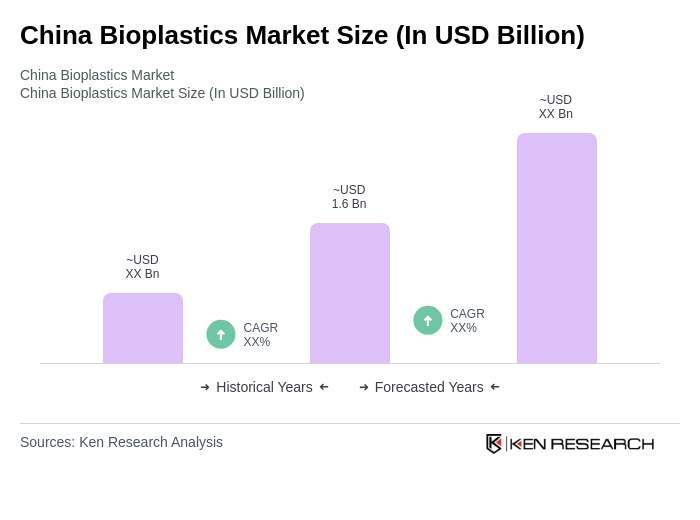
- The China Bioplastics Market is valued at approximately USD 1.6 billion, based on a five-year historical analysis. This valuation aligns with recent industry assessments that place the market around the low-to-mid USD billion range in the current period, reflecting strong domestic capacity additions and demand from packaging and agriculture.
- Growth is primarily driven by increasing environmental awareness, national and provincial measures restricting conventional single-use plastics while allowing certified biodegradable alternatives, and rising demand from packaging, foodservice, and agricultural mulch films. China’s policy stance has accelerated investment and capacity in PLA, PBAT, and PBS value chains, with PLA gaining share due to its compostability and improving performance.
- Policy context: China’s plastic control measures phase out many single-use plastics and actively permit biodegradable substitutes rather than mandating a switch to paper or wood. While authorities have tightened oversight to curb “pseudo-degradable” claims, there is no blanket mandate that all single-use plastics be replaced by biodegradable alternatives by 2025; instead, bans and restrictions are being implemented with carve-outs for compliant biodegradable materials, which has stimulated bioplastics capacity and uptake.
China Bioplastics Market Segmentation
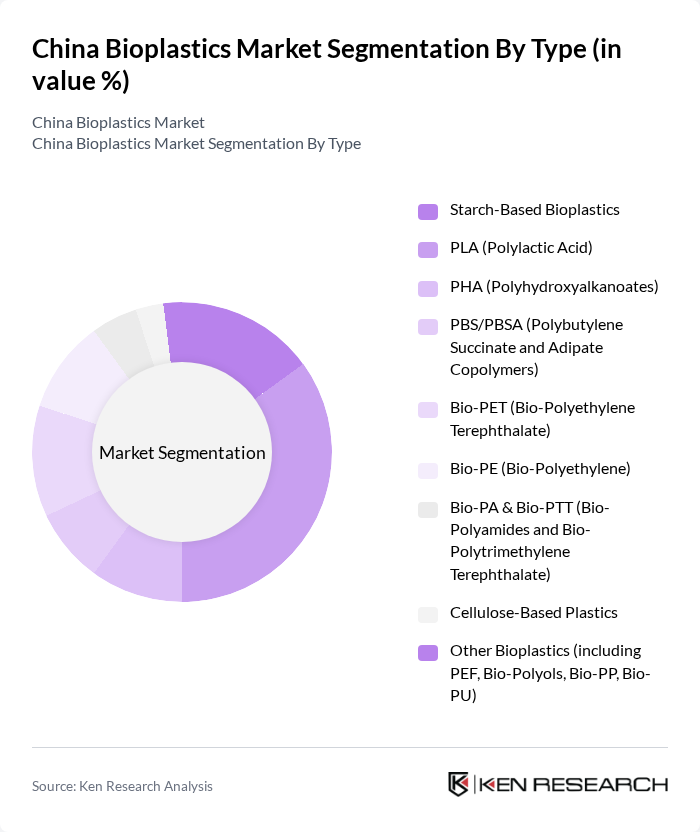
By Type:The bioplastics market can be segmented into various types, including starch-based bioplastics, PLA (Polylactic Acid), PHA (Polyhydroxyalkanoates), PBS/PBSA (Polybutylene Succinate and Adipate Copolymers), Bio-PET (Bio-Polyethylene Terephthalate), Bio-PE (Bio-Polyethylene), Bio-PA & Bio-PTT (Bio-Polyamides and Bio-Polytrimethylene Terephthalate), cellulose-based plastics, and other bioplastics. Among these, PLA is currently the leading subsegment due to its versatility and widespread application in packaging and consumer goods, supported by rapid PLA capacity expansion encouraged under China’s biodegradable-friendly policy framework.
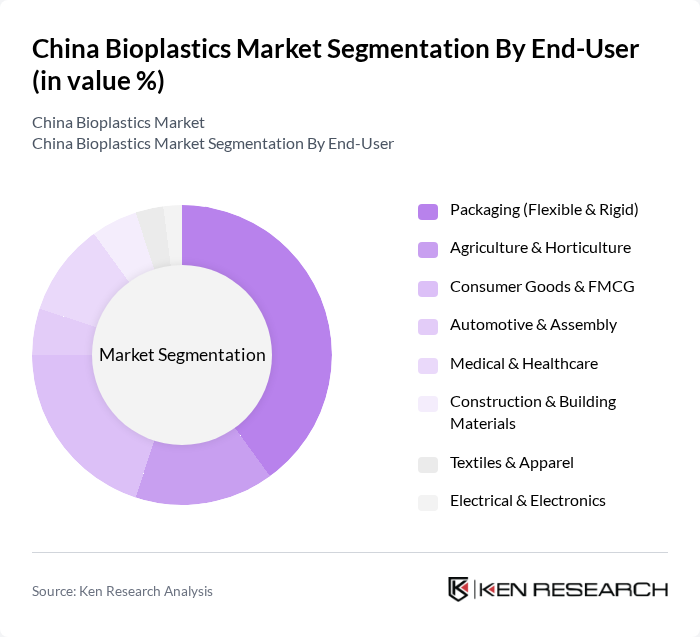
By End-User:The bioplastics market is segmented by end-user industries, including packaging (flexible and rigid), agriculture and horticulture, consumer goods and FMCG, automotive and assembly, medical and healthcare, construction and building materials, textiles and apparel, and electrical and electronics. The packaging segment is the largest due to the increasing demand for sustainable packaging solutions driven by retailer and brand commitments and regulatory pressures favoring biodegradable alternatives in certain use cases.
China Bioplastics Market Competitive Landscape
The China Bioplastics Market is characterized by a dynamic mix of regional and international players. Leading participants such as Hisun Biomaterials Co., Ltd. (Zhejiang Hisun Biomaterials), TotalEnergies Corbion PLA, BBCA Biochemical Co., Ltd. (Anhui BBCA), COFCO Biotechnology Co., Ltd., Kingfa Sci. & Tech. Co., Ltd. (Kingfa Biobased Materials), BASF SE, NatureWorks LLC, Novamont S.p.A., Danimer Scientific, Shenzhen Esun Industrial Co., Ltd. (eSUN), Zhejiang Huafon Biomaterials Co., Ltd. (PBS/PBAT), Shandong Intco Recycling Resources Co., Ltd. (Biomaterials), BBCA PHBV Industrial Investment Co., Ltd. (PHA), Danhua Chemical Technology Co., Ltd. (China National Chemical Engineering Danhua), Toray Industries, Inc. (Toray Industries Suzhou – Bio-PET) contribute to innovation, geographic expansion, and service delivery in this space.
China Bioplastics Market Industry Analysis
Growth Drivers
- Increasing Environmental Awareness:The growing concern over plastic pollution has led to a significant rise in environmental awareness among consumers in China. In future, approximately 75% of Chinese consumers are expected to prioritize eco-friendly products, according to a survey by the China National Environmental Protection Agency. This shift is driving demand for bioplastics, which are perceived as a sustainable alternative to conventional plastics, thus fostering market growth and encouraging manufacturers to innovate in this sector.
- Government Support and Regulations:The Chinese government has implemented various policies to promote the use of bioplastics, including subsidies and tax incentives. In future, the government plans to allocate over 1.2 billion RMB to support bioplastics research and development. Additionally, regulations aimed at reducing single-use plastics are expected to tighten, creating a favorable environment for bioplastics manufacturers. This proactive approach is crucial for enhancing the market's growth trajectory and attracting investments in sustainable materials.
- Rising Demand for Sustainable Products:The demand for sustainable products in China is on the rise, driven by both consumer preferences and corporate responsibility initiatives. In future, the market for sustainable packaging is projected to reach 350 billion RMB, with bioplastics capturing a significant share. Companies are increasingly adopting bioplastics to meet consumer expectations and enhance brand loyalty. This trend is further supported by the growing number of eco-conscious brands entering the market, which is expected to bolster the bioplastics sector significantly.
Market Challenges
- High Production Costs:One of the primary challenges facing the bioplastics market in China is the high production costs associated with bioplastic materials. In future, the average production cost of bioplastics is estimated to be 35% higher than that of conventional plastics. This cost disparity limits the competitiveness of bioplastics, making it difficult for manufacturers to scale operations and achieve profitability. As a result, many companies are hesitant to invest in bioplastics production, hindering market growth.
- Limited Consumer Awareness:Despite the increasing environmental awareness, there remains a significant gap in consumer knowledge regarding bioplastics. In future, only about 45% of consumers in China are expected to understand the benefits and applications of bioplastics. This lack of awareness poses a challenge for market penetration, as consumers may be reluctant to choose bioplastic products over traditional options. Effective marketing and educational campaigns are essential to bridge this gap and drive adoption in the market.
China Bioplastics Market Future Outlook
The future of the bioplastics market in China appears promising, driven by increasing environmental consciousness and supportive government policies. As consumer preferences shift towards sustainable products, the demand for bioplastics is expected to rise significantly. Innovations in bioplastic materials and applications will likely enhance product offerings, making them more appealing to consumers. Furthermore, collaborations between bioplastics manufacturers and eco-friendly brands will foster growth, creating a robust ecosystem that supports sustainability and environmental protection in the coming years.
Market Opportunities
- Expansion into Emerging Markets:There is a substantial opportunity for bioplastics manufacturers to expand into emerging markets within Asia. With a projected growth rate of 18% in these regions, companies can tap into new customer bases that are increasingly seeking sustainable alternatives. This expansion can lead to increased revenue streams and greater market share for bioplastics in the global landscape.
- Development of New Bioplastic Materials:The ongoing research and development in bioplastics present opportunities for creating innovative materials that cater to diverse applications. In future, investments in R&D are expected to exceed 600 million RMB, focusing on enhancing the properties of bioplastics. This innovation can lead to the introduction of high-performance bioplastics, further driving market growth and adoption across various industries.
Scope of the Report
| Segment | Sub-Segments |
|---|---|
| By Type | Starch-Based Bioplastics PLA (Polylactic Acid) PHA (Polyhydroxyalkanoates) PBS/PBSA (Polybutylene Succinate and Adipate Copolymers) Bio-PET (Bio-Polyethylene Terephthalate) Bio-PE (Bio-Polyethylene) Bio-PA & Bio-PTT (Bio-Polyamides and Bio-Polytrimethylene Terephthalate) Cellulose-Based Plastics Other Bioplastics (including PEF, Bio-Polyols, Bio-PP, Bio-PU) |
| By End-User | Packaging (Flexible & Rigid) Agriculture & Horticulture Consumer Goods & FMCG Automotive & Assembly Medical & Healthcare Construction & Building Materials Textiles & Apparel Electrical & Electronics |
| By Application | Flexible Packaging Films & Bags Rigid Packaging (Trays, Cups, Clamshells) Disposable Cutlery, Plates, and Straws Agricultural Films & Mulch Bottles and Containers D Printing Filaments Foam & Biocomposites |
| By Distribution Channel | Direct Sales (B2B/Project-Based) Industrial Distributors E-commerce & Online Portals Specialty Materials Traders |
| By Region | Eastern China (Shanghai, Jiangsu, Zhejiang) Southern China (Guangdong, Guangxi, Hainan) Northern China (Beijing, Tianjin, Hebei) Western China (Sichuan, Chongqing, Shaanxi) |
| By Price Range | Economy Mid-Range Premium |
| By Others | Custom Bioplastics Solutions (Compounds, Masterbatches, OEM Grades) |
Key Target Audience
Investors and Venture Capitalist Firms
Government and Regulatory Bodies (e.g., Ministry of Ecology and Environment, National Development and Reform Commission)
Manufacturers and Producers of Bioplastics
Distributors and Retailers of Bioplastics Products
Packaging Industry Stakeholders
Bioplastics Research and Development Organizations
Environmental NGOs and Advocacy Groups
Financial Institutions and Investment Banks
Players Mentioned in the Report:
Hisun Biomaterials Co., Ltd. (Zhejiang Hisun Biomaterials)
TotalEnergies Corbion PLA
BBCA Biochemical Co., Ltd. (Anhui BBCA)
COFCO Biotechnology Co., Ltd.
Kingfa Sci. & Tech. Co., Ltd. (Kingfa Biobased Materials)
BASF SE
NatureWorks LLC
Novamont S.p.A.
Danimer Scientific
Shenzhen Esun Industrial Co., Ltd. (eSUN)
Zhejiang Huafon Biomaterials Co., Ltd. (PBS/PBAT)
Shandong Intco Recycling Resources Co., Ltd. (Biomaterials)
BBCA PHBV Industrial Investment Co., Ltd. (PHA)
Danhua Chemical Technology Co., Ltd. (China National Chemical Engineering Danhua)
Toray Industries, Inc. (Toray Industries Suzhou Bio-PET)
Table of Contents
Market Assessment Phase
1. Executive Summary and Approach
2. China Bioplastics Market Overview
2.1 Key Insights and Strategic Recommendations
2.2 China Bioplastics Market Overview
2.3 Definition and Scope
2.4 Evolution of Market Ecosystem
2.5 Timeline of Key Regulatory Milestones
2.6 Value Chain & Stakeholder Mapping
2.7 Business Cycle Analysis
2.8 Policy & Incentive Landscape
3. China Bioplastics Market Analysis
3.1 Growth Drivers
3.1.1 Increasing Environmental Awareness
3.1.2 Government Support and Regulations
3.1.3 Rising Demand for Sustainable Products
3.1.4 Technological Advancements in Bioplastics
3.2 Market Challenges
3.2.1 High Production Costs
3.2.2 Limited Consumer Awareness
3.2.3 Competition from Conventional Plastics
3.2.4 Supply Chain Limitations
3.3 Market Opportunities
3.3.1 Expansion into Emerging Markets
3.3.2 Development of New Bioplastic Materials
3.3.3 Collaborations with Eco-Friendly Brands
3.3.4 Increased Investment in R&D
3.4 Market Trends
3.4.1 Growth of Biodegradable Plastics
3.4.2 Shift Towards Circular Economy
3.4.3 Innovations in Bioplastic Applications
3.4.4 Consumer Preference for Eco-Friendly Packaging
3.5 Government Regulation
3.5.1 Plastic Waste Management Policies
3.5.2 Incentives for Bioplastics Production
3.5.3 Standards for Biodegradable Materials
3.5.4 Restrictions on Single-Use Plastics
4. SWOT Analysis
5. Stakeholder Analysis
6. Porter's Five Forces Analysis
7. China Bioplastics Market Market Size, 2019-2024
7.1 By Value
7.2 By Volume
7.3 By Average Selling Price
8. China Bioplastics Market Segmentation
8.1 By Type
8.1.1 Starch-Based Bioplastics
8.1.2 PLA (Polylactic Acid)
8.1.3 PHA (Polyhydroxyalkanoates)
8.1.4 PBS/PBSA (Polybutylene Succinate and Adipate Copolymers)
8.1.5 Bio-PET (Bio-Polyethylene Terephthalate)
8.1.6 Bio-PE (Bio-Polyethylene)
8.1.7 Bio-PA & Bio-PTT (Bio-Polyamides and Bio-Polytrimethylene Terephthalate)
8.1.8 Cellulose-Based Plastics
8.1.9 Other Bioplastics (including PEF, Bio-Polyols, Bio-PP, Bio-PU)
8.2 By End-User
8.2.1 Packaging (Flexible & Rigid)
8.2.2 Agriculture & Horticulture
8.2.3 Consumer Goods & FMCG
8.2.4 Automotive & Assembly
8.2.5 Medical & Healthcare
8.2.6 Construction & Building Materials
8.2.7 Textiles & Apparel
8.2.8 Electrical & Electronics
8.3 By Application
8.3.1 Flexible Packaging Films & Bags
8.3.2 Rigid Packaging (Trays, Cups, Clamshells)
8.3.3 Disposable Cutlery, Plates, and Straws
8.3.4 Agricultural Films & Mulch
8.3.5 Bottles and Containers
8.3.6 3D Printing Filaments
8.3.7 Foam & Biocomposites
8.4 By Distribution Channel
8.4.1 Direct Sales (B2B/Project-Based)
8.4.2 Industrial Distributors
8.4.3 E-commerce & Online Portals
8.4.4 Specialty Materials Traders
8.5 By Region
8.5.1 Eastern China (Shanghai, Jiangsu, Zhejiang)
8.5.2 Southern China (Guangdong, Guangxi, Hainan)
8.5.3 Northern China (Beijing, Tianjin, Hebei)
8.5.4 Western China (Sichuan, Chongqing, Shaanxi)
8.6 By Price Range
8.6.1 Economy
8.6.2 Mid-Range
8.6.3 Premium
8.7 Others
8.7.1 Custom Bioplastics Solutions (Compounds, Masterbatches, OEM Grades)
9. China Bioplastics Market Competitive Analysis
9.1 Market Share of Key Players
9.2 Cross Comparison of Key Players
9.2.1 Company Name (China operations)
9.2.2 Installed Capacity in China (tons/year)
9.2.3 Capacity Utilization (%)
9.2.4 Revenue from Bioplastics in China (USD, latest FY)
9.2.5 Volume Sales by Application Mix (packaging/agri/others, %)
9.2.6 Geographic Footprint in China (number of plants/provinces covered)
9.2.7 Average Selling Price by Polymer (USD/ton)
9.2.8 R&D Intensity (% of revenue) and Patent Filings (last 3 years)
9.2.9 Product Portfolio Breadth (PLA/PHA/PBS/Bio-PET/etc., count)
9.2.10 Strategic Partnerships & Downstream Offtake Agreements (count)
9.2.11 Compliance & Certifications (GB/T, compostability, food contact, count)
9.2.12 Carbon Intensity per ton (kg CO?e/ton) and Recyclability/Biodegradability Claims
9.3 SWOT Analysis of Top Players
9.4 Pricing Analysis
9.5 Detailed Profile of Major Companies
9.5.1 Hisun Biomaterials Co., Ltd. (Zhejiang Hisun Biomaterials)
9.5.2 TotalEnergies Corbion PLA
9.5.3 BBCA Biochemical Co., Ltd. (Anhui BBCA)
9.5.4 COFCO Biotechnology Co., Ltd.
9.5.5 Kingfa Sci. & Tech. Co., Ltd. (Kingfa Biobased Materials)
9.5.6 BASF SE
9.5.7 NatureWorks LLC
9.5.8 Novamont S.p.A.
9.5.9 Danimer Scientific
9.5.10 Shenzhen Esun Industrial Co., Ltd. (eSUN)
9.5.11 Zhejiang Huafon Biomaterials Co., Ltd. (PBS/PBAT)
9.5.12 Shandong Intco Recycling Resources Co., Ltd. (Biomaterials)
9.5.13 BBCA PHBV Industrial Investment Co., Ltd. (PHA)
9.5.14 Danhua Chemical Technology Co., Ltd. (China National Chemical Engineering Danhua)
9.5.15 Toray Industries, Inc. (Toray Industries Suzhou – Bio-PET)
10. China Bioplastics Market End-User Analysis
10.1 Procurement Behavior of Key Ministries
10.1.1 Government Initiatives for Sustainable Procurement
10.1.2 Budget Allocations for Bioplastics
10.1.3 Collaboration with Private Sector
10.2 Corporate Spend on Infrastructure & Energy
10.2.1 Investment in Bioplastics Infrastructure
10.2.2 Energy Efficiency Initiatives
10.2.3 Funding for Research and Development
10.3 Pain Point Analysis by End-User Category
10.3.1 Cost Constraints
10.3.2 Quality Assurance Issues
10.3.3 Supply Chain Disruptions
10.4 User Readiness for Adoption
10.4.1 Awareness of Bioplastics Benefits
10.4.2 Training and Education Needs
10.4.3 Availability of Alternatives
10.5 Post-Deployment ROI and Use Case Expansion
10.5.1 Measurement of Environmental Impact
10.5.2 Cost Savings Analysis
10.5.3 Potential for Market Expansion
11. China Bioplastics Market Future Size, 2025-2030
11.1 By Value
11.2 By Volume
11.3 By Average Selling Price
Go-To-Market Strategy Phase
1. Whitespace Analysis + Business Model Canvas
1.1 Identification of Market Gaps
1.2 Value Proposition Development
1.3 Revenue Streams Analysis
1.4 Key Partnerships
1.5 Cost Structure Evaluation
1.6 Customer Segmentation
1.7 Channels of Distribution
2. Marketing and Positioning Recommendations
2.1 Branding Strategies
2.2 Product USPs
2.3 Target Audience Identification
2.4 Communication Strategies
2.5 Digital Marketing Approaches
3. Distribution Plan
3.1 Urban Retail Strategies
3.2 Rural NGO Tie-Ups
3.3 E-commerce Integration
3.4 Logistics and Supply Chain Management
4. Channel & Pricing Gaps
4.1 Underserved Routes
4.2 Pricing Bands Analysis
4.3 Competitor Pricing Strategies
5. Unmet Demand & Latent Needs
5.1 Category Gaps
5.2 Consumer Segments Analysis
5.3 Product Development Opportunities
6. Customer Relationship
6.1 Loyalty Programs
6.2 After-sales Service
6.3 Customer Feedback Mechanisms
7. Value Proposition
7.1 Sustainability Initiatives
7.2 Integrated Supply Chains
7.3 Competitive Advantages
8. Key Activities
8.1 Regulatory Compliance
8.2 Branding Efforts
8.3 Distribution Setup
9. Entry Strategy Evaluation
9.1 Domestic Market Entry Strategy
9.1.1 Product Mix Considerations
9.1.2 Pricing Band Strategy
9.1.3 Packaging Innovations
9.2 Export Entry Strategy
9.2.1 Target Countries Identification
9.2.2 Compliance Roadmap Development
10. Entry Mode Assessment
10.1 Joint Ventures
10.2 Greenfield Investments
10.3 Mergers & Acquisitions
10.4 Distributor Model Evaluation
11. Capital and Timeline Estimation
11.1 Capital Requirements
11.2 Timelines for Implementation
12. Control vs Risk Trade-Off
12.1 Ownership vs Partnerships
13. Profitability Outlook
13.1 Breakeven Analysis
13.2 Long-term Sustainability Strategies
14. Potential Partner List
14.1 Distributors
14.2 Joint Ventures
14.3 Acquisition Targets
15. Execution Roadmap
15.1 Phased Plan for Market Entry
15.1.1 Market Setup
15.1.2 Market Entry
15.1.3 Growth Acceleration
15.1.4 Scale & Stabilize
15.2 Key Activities and Milestones
15.2.1 Milestone Planning
15.2.2 Activity Tracking
Research Methodology
Phase 1: Approach1
Desk Research
- Analysis of industry reports from Chinese bioplastics associations and environmental agencies
- Review of academic publications and white papers on bioplastics technology and market trends
- Examination of government policy documents and regulations impacting bioplastics production and usage
Primary Research
- Interviews with key stakeholders in bioplastics manufacturing, including CEOs and R&D heads
- Surveys targeting procurement managers in industries utilizing bioplastics, such as packaging and automotive
- Field visits to production facilities to gather insights on operational practices and challenges
Validation & Triangulation
- Cross-validation of findings through multiple data sources, including trade publications and market surveys
- Triangulation of qualitative insights from interviews with quantitative data from market reports
- Sanity checks conducted through expert panels comprising industry veterans and academic researchers
Phase 2: Market Size Estimation1
Top-down Assessment
- Estimation of market size based on national production statistics and consumption patterns of bioplastics
- Segmentation of the market by application areas such as packaging, agriculture, and consumer goods
- Incorporation of growth projections from government initiatives promoting sustainable materials
Bottom-up Modeling
- Collection of sales data from leading bioplastics manufacturers to establish baseline volumes
- Cost analysis of bioplastics production, including raw material sourcing and processing expenses
- Volume x price modeling to derive revenue estimates for different bioplastics segments
Forecasting & Scenario Analysis
- Utilization of econometric models to forecast market growth based on GDP and environmental regulations
- Scenario planning based on potential shifts in consumer preferences towards sustainable products
- Development of multiple forecasts (baseline, optimistic, and pessimistic) through 2030
Phase 3: CATI Sample Composition1
| Scope Item/Segment | Sample Size | Target Respondent Profiles |
|---|---|---|
| Bioplastics in Packaging | 150 | Packaging Managers, Sustainability Coordinators |
| Bioplastics in Agriculture | 100 | Agricultural Product Managers, Farm Operations Directors |
| Consumer Goods Applications | 80 | Product Development Managers, Brand Managers |
| Automotive Industry Usage | 70 | Procurement Managers, Design Engineers |
| Research Institutions and Academia | 60 | Research Scientists, Environmental Policy Experts |
Frequently Asked Questions
What is the current value of the China Bioplastics Market?
The China Bioplastics Market is valued at approximately USD 1.6 billion, reflecting strong domestic capacity additions and demand, particularly in packaging and agriculture. This valuation is based on a five-year historical analysis and aligns with recent industry assessments.
What factors are driving the growth of the bioplastics market in China?
How is the Chinese government supporting the bioplastics industry?
What are the main challenges facing the bioplastics market in China?
Other Regional/Country Reports
Indonesia Bioplastics Market
Malaysia Bioplastics Market
KSA Bioplastics Market
Why Buy From Us?

What makes us stand out is that our consultants follow Robust, Refine and Result (RRR) methodology. Robust for clear definitions, approaches and sanity checking, Refine for differentiating respondents' facts and opinions, and Result for presenting data with story.

We have set a benchmark in the industry by offering our clients with syndicated and customized market research reports featuring coverage of entire market as well as meticulous research and analyst insights.

While we don't replace traditional research, we flip the method upside down. Our dual approach of Top Bottom & Bottom Top ensures quality deliverable by not just verifying company fundamentals but also looking at the sector and macroeconomic factors.

With one step in the future, our research team constantly tries to show you the bigger picture. We help with some of the tough questions you may encounter along the way: How is the industry positioned? Best marketing channel? KPI's of competitors? By aligning every element, we help maximize success.

Our report gives you instant access to the answers and sources that other companies might choose to hide. We elaborate each steps of research methodology we have used and showcase you the sample size to earn your trust.

If you need any support, we are here! We pride ourselves on universe strength, data quality, and quick, friendly, and professional service.