About the Report
Base Year 2024Listen to the audio summary
China E Bike Market Overview
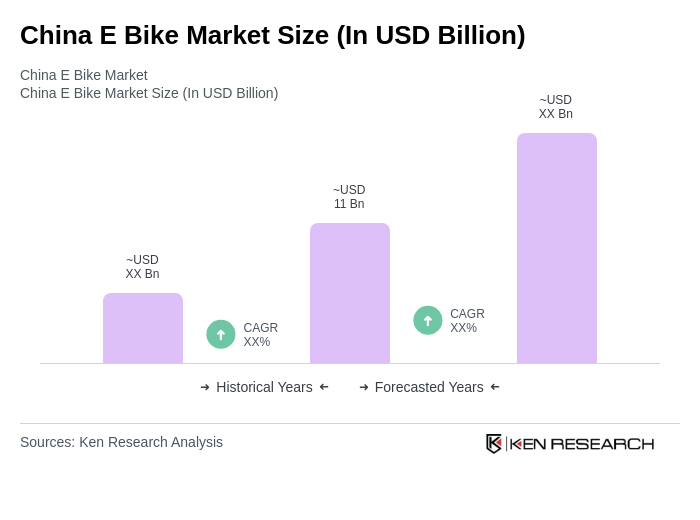
- The China E Bike Market is valued at USD 11 billion, based on a five-year historical analysis. This growth is primarily driven by increasing urbanization, government initiatives promoting electric vehicles, and rising consumer demand for eco-friendly transportation options. The market has seen a significant uptick in sales as consumers shift towards sustainable mobility solutions, particularly in densely populated urban areas .
- Key cities such as Beijing, Shanghai, and Shenzhen dominate the market due to their high population density, extensive cycling infrastructure, and supportive government policies. These cities have implemented various incentives to encourage the adoption of e-bikes, making them attractive for both consumers and manufacturers. The urban landscape and lifestyle in these regions further facilitate the use of e-bikes as a primary mode of transport .
- In 2023, the Chinese government introduced regulations mandating that all e-bikes must comply with safety standards, including speed limits and battery specifications. This regulation aims to enhance safety for riders and pedestrians while promoting the use of high-quality, reliable e-bikes. Manufacturers are required to adhere to these standards to ensure their products are eligible for sale in the market, thereby fostering a safer riding environment .
China E Bike Market Segmentation
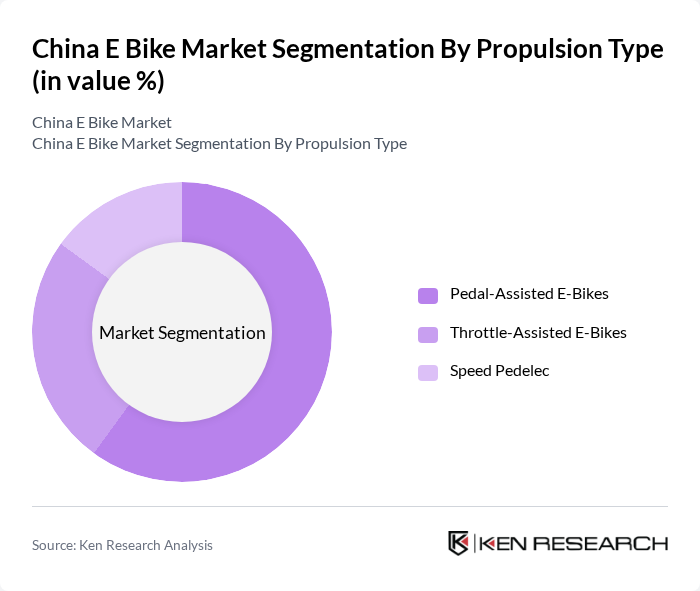
By Propulsion Type:The propulsion type segmentation includes Pedal-Assisted E-Bikes, Throttle-Assisted E-Bikes, and Speed Pedelec. Among these, Pedal-Assisted E-Bikes dominate the market due to their user-friendly nature, ability to provide a more natural cycling experience, and compliance with local regulations. Consumers increasingly favor these bikes for daily commuting, as they offer a balance between physical activity and assistance, making them ideal for urban environments .
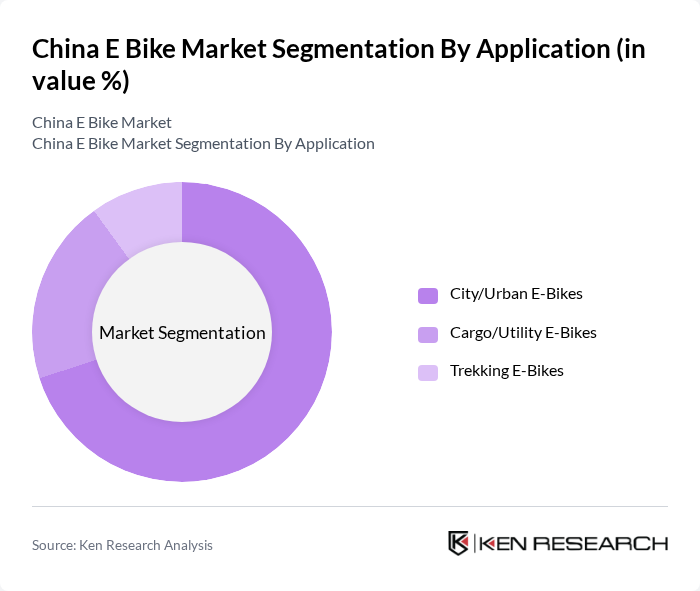
By Application:The application segmentation encompasses City/Urban E-Bikes, Cargo/Utility E-Bikes, and Trekking E-Bikes. City/Urban E-Bikes are the leading subsegment, driven by the increasing need for efficient urban transportation solutions. As cities become more congested, consumers are opting for e-bikes to navigate traffic and reduce commuting times. The convenience and practicality of these bikes for short-distance travel make them highly popular among urban dwellers .
China E Bike Market Competitive Landscape
The China E Bike Market is characterized by a dynamic mix of regional and international players. Leading participants such as Yadea Technology Group Co., Ltd., Aima Technology Group Co., Ltd., Sunra Electric Vehicle Co., Ltd., Luyuan Electric Vehicle Co., Ltd., NIU Technologies, TAILG Electric Vehicle Co., Ltd., BYVIN Group, Giant Manufacturing Co., Ltd., Merida Industry Co., Ltd., Xiaomi Corporation, Accell Group N.V., Trek Bicycle Corporation, Specialized Bicycle Components, Inc., Rad Power Bikes, and Bosch eBike Systems contribute to innovation, geographic expansion, and service delivery in this space .
China E Bike Market Industry Analysis
Growth Drivers
- Increasing Urbanization:Urbanization in China is accelerating, with the urban population projected to reach 65% in future, up from 61% in 2020. This shift creates a demand for efficient transportation solutions, particularly in congested cities. The urban population increase translates to approximately 910 million people living in urban areas, driving the need for compact and eco-friendly transportation options like e-bikes. This trend is supported by the government's focus on sustainable urban development, further enhancing e-bike adoption.
- Government Incentives for Electric Vehicles:The Chinese government has allocated over $60 billion in subsidies and incentives for electric vehicles, including e-bikes, as part of its commitment to reduce carbon emissions. In future, these incentives are expected to continue, encouraging consumers to switch from traditional vehicles to e-bikes. Additionally, local governments are implementing tax breaks and rebates, making e-bikes more financially accessible. This supportive policy environment is crucial for stimulating market growth and increasing e-bike sales.
- Technological Advancements in Battery Life:The average battery life of e-bikes has improved significantly, with many models now offering ranges of up to 100 kilometers on a single charge. This advancement is largely due to innovations in lithium-ion battery technology, which have reduced charging times to under 4 hours. As of future, the battery market for e-bikes is projected to grow to approximately $10 billion, driven by consumer demand for longer-lasting and more efficient batteries, enhancing the overall appeal of e-bikes.
Market Challenges
- Regulatory Compliance Issues:E-bike manufacturers face stringent regulatory compliance challenges, particularly regarding safety and emissions standards. In future, the Chinese government is expected to enforce stricter regulations, requiring manufacturers to invest significantly in compliance measures. This could increase production costs by up to 15%, potentially impacting pricing strategies and market competitiveness. Navigating these regulations is essential for manufacturers to avoid penalties and ensure market access.
- High Competition Among Manufacturers:The e-bike market in China is characterized by intense competition, with over 300 manufacturers vying for market share. This saturation leads to price wars, which can erode profit margins. In future, the average profit margin for e-bike manufacturers is projected to decline to around 5%, down from 8% in 2020. Companies must differentiate their products through innovation and branding to maintain profitability in this highly competitive landscape.
China E Bike Market Future Outlook
The future of the e-bike market in China appears promising, driven by ongoing urbanization and technological advancements. As cities continue to expand, the demand for sustainable transportation solutions will likely increase. Additionally, the integration of smart technologies, such as IoT and AI, will enhance user experience and safety. Manufacturers that adapt to these trends and invest in innovative features will be well-positioned to capture market share and meet evolving consumer preferences in future.
Market Opportunities
- Expansion into Rural Areas:With approximately 35% of China's population residing in rural areas, there is significant potential for e-bike adoption. As infrastructure improves, e-bikes can provide affordable and efficient transportation options for rural residents, enhancing mobility and access to services. Targeting this demographic could lead to substantial market growth, as rural consumers increasingly seek modern transportation solutions.
- Development of Smart E-Bikes:The rise of smart technology presents an opportunity for manufacturers to develop connected e-bikes equipped with features like GPS tracking and health monitoring. In future, the smart e-bike segment is expected to grow significantly, appealing to tech-savvy consumers. This innovation can enhance user experience and safety, positioning companies to capitalize on the growing trend of smart mobility solutions.
Scope of the Report
| Segment | Sub-Segments |
|---|---|
| By Propulsion Type | Pedal-Assisted E-Bikes Throttle-Assisted E-Bikes Speed Pedelec |
| By Application | City/Urban E-Bikes Cargo/Utility E-Bikes Trekking E-Bikes |
| By Battery Type | Lithium-Ion Batteries Lead-Acid Batteries Nickel-Metal Hydride Batteries |
| By Drive Type | Chain Drive Belt Drive |
| By End-User | Individual Consumers Delivery Services Corporate Fleets Government Agencies |
| By Sales Channel | Online Retail Offline Retail Direct Sales Distributors |
| By Price Range | Budget E-Bikes Mid-Range E-Bikes Premium E-Bikes |
| By Usage | Daily Commuting Recreational Use Delivery and Logistics |
| By Region | East China South China North China West China |
Key Target Audience
Investors and Venture Capitalist Firms
Government and Regulatory Bodies (e.g., Ministry of Industry and Information Technology, National Development and Reform Commission)
Manufacturers and Producers
Distributors and Retailers
Logistics and Supply Chain Companies
Battery and Component Suppliers
Urban Planning and Transportation Authorities
Insurance Companies
Players Mentioned in the Report:
Yadea Technology Group Co., Ltd.
Aima Technology Group Co., Ltd.
Sunra Electric Vehicle Co., Ltd.
Luyuan Electric Vehicle Co., Ltd.
NIU Technologies
TAILG Electric Vehicle Co., Ltd.
BYVIN Group
Giant Manufacturing Co., Ltd.
Merida Industry Co., Ltd.
Xiaomi Corporation
Accell Group N.V.
Trek Bicycle Corporation
Specialized Bicycle Components, Inc.
Rad Power Bikes
Bosch eBike Systems
Table of Contents
Go-To-Market Strategy Phase
1. Whitespace Analysis + Business Model Canvas
1.1 Market Gaps Identification
1.2 Business Model Options
1.3 Value Proposition Development
1.4 Revenue Streams Analysis
1.5 Cost Structure Evaluation
1.6 Key Partnerships Exploration
1.7 Customer Segmentation Insights
2. Marketing and Positioning Recommendations
2.1 Branding Strategies
2.2 Product USPs
2.3 Target Audience Identification
2.4 Communication Channels
2.5 Promotional Tactics
2.6 Market Positioning Framework
3. Distribution Plan
3.1 Urban Retail Strategies
3.2 Rural NGO Tie-ups
3.3 E-commerce Integration
3.4 Logistics and Supply Chain Management
3.5 Distribution Partnerships
4. Channel & Pricing Gaps
4.1 Underserved Routes
4.2 Pricing Bands Analysis
4.3 Competitor Pricing Strategies
4.4 Consumer Price Sensitivity
4.5 Value-Based Pricing Models
5. Unmet Demand & Latent Needs
5.1 Category Gaps Identification
5.2 Consumer Segments Analysis
5.3 Emerging Trends Exploration
5.4 Product Development Opportunities
6. Customer Relationship
6.1 Loyalty Programs
6.2 After-sales Service Strategies
6.3 Customer Feedback Mechanisms
6.4 Community Engagement Initiatives
7. Value Proposition
7.1 Sustainability Initiatives
7.2 Integrated Supply Chains
7.3 Customer-Centric Innovations
7.4 Competitive Differentiation
8. Key Activities
8.1 Regulatory Compliance
8.2 Branding Initiatives
8.3 Distribution Setup
8.4 Market Research Activities
9. Entry Strategy Evaluation
9.1 Domestic Market Entry Strategy
9.1.1 Product Mix Considerations
9.1.2 Pricing Band Strategy
9.1.3 Packaging Innovations
9.2 Export Entry Strategy
9.2.1 Target Countries Analysis
9.2.2 Compliance Roadmap Development
10. Entry Mode Assessment
10.1 Joint Ventures
10.2 Greenfield Investments
10.3 Mergers & Acquisitions
10.4 Distributor Model Evaluation
11. Capital and Timeline Estimation
11.1 Capital Requirements Analysis
11.2 Timelines for Market Entry
12. Control vs Risk Trade-Off
12.1 Ownership vs Partnerships
12.2 Risk Mitigation Strategies
13. Profitability Outlook
13.1 Breakeven Analysis
13.2 Long-term Sustainability Strategies
14. Potential Partner List
14.1 Distributors
14.2 Joint Ventures
14.3 Acquisition Targets
15. Execution Roadmap
15.1 Phased Plan for Market Entry
15.1.1 Market Setup
15.1.2 Market Entry
15.1.3 Growth Acceleration
15.1.4 Scale & Stabilize
15.2 Key Activities and Milestones
15.2.1 Milestone Planning
15.2.2 Activity Tracking
Research Methodology
Phase 1: Approach1
Desk Research
- Analysis of industry reports from government agencies and trade associations related to the e-bike sector in China
- Review of market trends and consumer behavior studies published in academic journals and market research publications
- Examination of import/export data and sales statistics from the National Bureau of Statistics of China
Primary Research
- Interviews with key stakeholders including manufacturers, distributors, and retailers in the e-bike market
- Surveys targeting end-users to gather insights on purchasing preferences and usage patterns
- Focus group discussions with urban commuters to understand the impact of e-bikes on transportation choices
Validation & Triangulation
- Cross-validation of findings through comparison with historical sales data and market forecasts
- Triangulation of insights from primary interviews with secondary data sources to ensure consistency
- Sanity checks conducted through expert panel reviews involving industry veterans and market analysts
Phase 2: Market Size Estimation1
Top-down Assessment
- Estimation of total addressable market (TAM) based on national transportation statistics and urban mobility trends
- Segmentation of the market by e-bike types, including pedal-assist and throttle-controlled models
- Incorporation of government incentives and subsidies for e-bike adoption in urban areas
Bottom-up Modeling
- Collection of sales data from leading e-bike manufacturers and retailers to establish baseline figures
- Estimation of average selling prices (ASPs) across different e-bike categories
- Volume projections based on historical growth rates and emerging market trends
Forecasting & Scenario Analysis
- Multi-variable forecasting models incorporating factors such as urbanization rates, environmental policies, and consumer preferences
- Scenario analysis based on potential regulatory changes and technological advancements in battery and motor efficiency
- Development of baseline, optimistic, and pessimistic market growth scenarios through 2030
Phase 3: CATI Sample Composition1
| Scope Item/Segment | Sample Size | Target Respondent Profiles |
|---|---|---|
| Urban Commuter Insights | 150 | Daily e-bike users, occasional riders |
| Retailer Feedback | 100 | Store Managers, Sales Representatives |
| Manufacturer Perspectives | 80 | Production Managers, Product Development Heads |
| Policy Maker Interviews | 50 | Transportation Officials, Urban Planners |
| Consumer Behavior Surveys | 120 | General public, potential e-bike buyers |
Frequently Asked Questions
1. What is the current value of the China E Bike Market?
The China E Bike Market is valued at approximately USD 11 billion, driven by urbanization, government initiatives promoting electric vehicles, and increasing consumer demand for eco-friendly transportation options. This growth reflects a significant shift towards sustainable mobility solutions in urban areas.
2. Which cities are leading in the China E Bike Market?
3. What regulations has the Chinese government introduced for e-bikes in 2023?
4. What are the main types of e-bikes available in China?
Other Regional/Country Reports
Why Buy From Us?

What makes us stand out is that our consultants follow Robust, Refine and Result (RRR) methodology. Robust for clear definitions, approaches and sanity checking, Refine for differentiating respondents' facts and opinions, and Result for presenting data with story.

We have set a benchmark in the industry by offering our clients with syndicated and customized market research reports featuring coverage of entire market as well as meticulous research and analyst insights.

While we don't replace traditional research, we flip the method upside down. Our dual approach of Top Bottom & Bottom Top ensures quality deliverable by not just verifying company fundamentals but also looking at the sector and macroeconomic factors.

With one step in the future, our research team constantly tries to show you the bigger picture. We help with some of the tough questions you may encounter along the way: How is the industry positioned? Best marketing channel? KPI's of competitors? By aligning every element, we help maximize success.

Our report gives you instant access to the answers and sources that other companies might choose to hide. We elaborate each steps of research methodology we have used and showcase you the sample size to earn your trust.

If you need any support, we are here! We pride ourselves on universe strength, data quality, and quick, friendly, and professional service.