About the Report
Base Year 2024China Washing Machine Market Overview
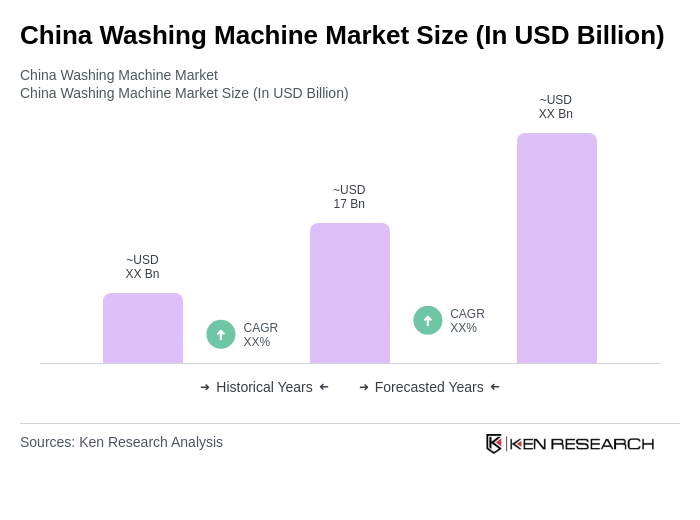
- The China Washing Machine Market is valued at USD 17 billion, based on a five-year historical analysis. This growth is primarily driven by increasing urbanization, rising disposable incomes, and a growing preference for energy-efficient and smart appliances among consumers. The market has seen a significant shift towards smart washing machines, reflecting the integration of IoT, AI, and automation features that align with consumer demand for convenience, connectivity, and sustainability.
- Key cities such as Beijing, Shanghai, and Guangzhou dominate the market due to their high population density, advanced economic development, and substantial consumer purchasing power. These urban centers are characterized by a rapidly expanding middle class that prioritizes modern, energy-efficient household appliances, contributing to the overall demand for washing machines in the region.
- In 2023, the Chinese government implemented the "Minimum Allowable Values of Energy Efficiency and Energy Efficiency Grades for Household Washing Machines (GB 12021.4-2023)" issued by the State Administration for Market Regulation and Standardization Administration of China. This regulation mandates manufacturers to meet specific energy consumption limits and efficiency grades for washing machines, promoting the production of more energy-efficient models. The initiative forms part of China’s broader strategy to reduce carbon emissions and promote sustainable consumption practices nationwide.
China Washing Machine Market Segmentation
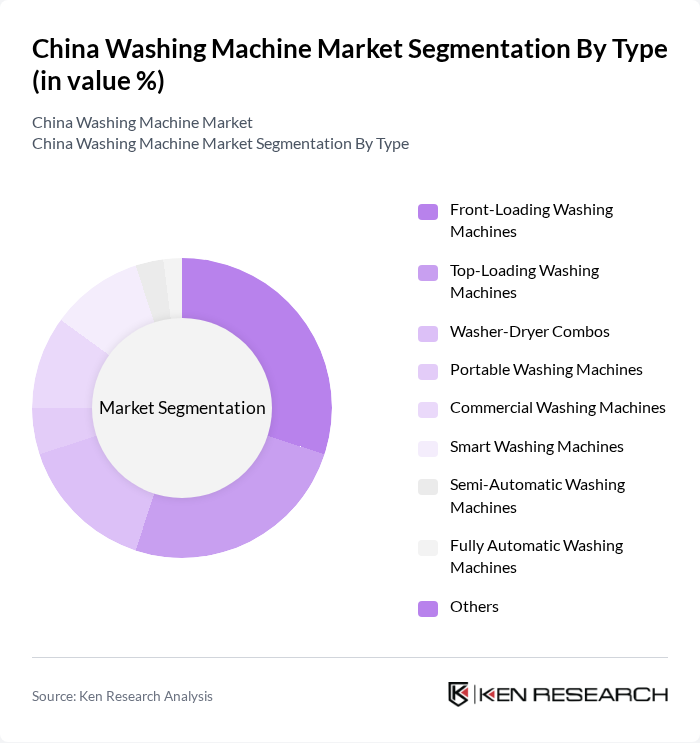
By Type:The washing machine market can be segmented into various types, including front-loading, top-loading, washer-dryer combos, portable washing machines, commercial washing machines, smart washing machines, semi-automatic washing machines, fully automatic washing machines, and others. Among these, front-loading washing machines are gaining popularity due to their superior energy efficiency and cleaning performance. The integration of smart technologies such as IoT and AI is increasingly influencing consumer preferences, resulting in growing demand for smart washing machines that offer remote control, automation, and enhanced user experience.
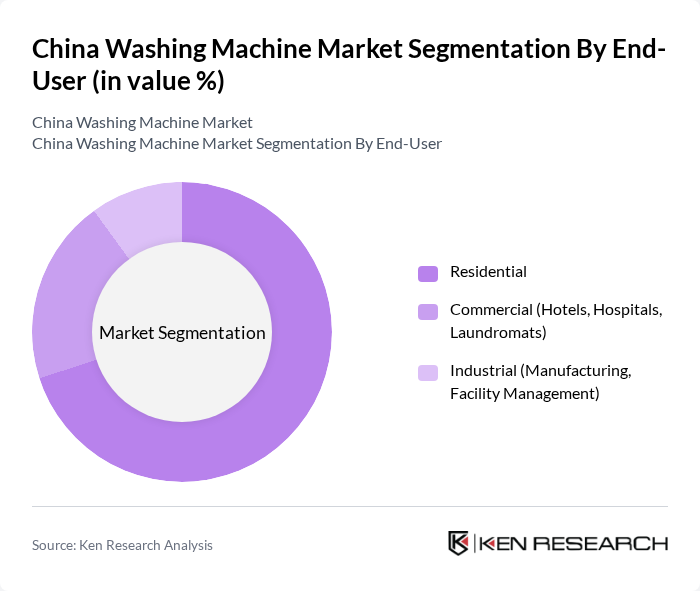
By End-User:The market can be segmented based on end-users into residential, commercial (including hotels, hospitals, and laundromats), and industrial (manufacturing and facility management). The residential segment dominates the market, driven by the increasing number of urban households and the modernization of home appliances. Commercial and industrial segments are also significant, requiring high-capacity machines and advanced features for efficient laundry operations in hospitality, healthcare, and manufacturing environments.
China Washing Machine Market Competitive Landscape
The China Washing Machine Market is characterized by a dynamic mix of regional and international players. Leading participants such as Haier Group, Midea Group, Little Swan (a Midea Group brand), Whirlpool Corporation, Samsung Electronics, Gree Electric Appliances, Hisense Group, Panasonic Corporation, Electrolux AB, TCL Technology, BSH Hausgeräte GmbH (Bosch, Siemens), Sharp Corporation, AUX Group, Arçelik A.?., AEG (Electrolux) contribute to innovation, geographic expansion, and service delivery in this space.
China Washing Machine Market Industry Analysis
Growth Drivers
- Increasing Urbanization:Urbanization in China is projected to reach approximately 65% in future, with over 900 million people living in urban areas. This demographic shift drives demand for household appliances, including washing machines, as urban residents typically have higher living standards and greater access to modern conveniences. The urban population's growth is expected to increase the number of households, leading to an estimated 15 million new washing machine units sold annually, significantly boosting market growth.
- Rising Disposable Incomes:China's disposable income per capita is approximately 43,000 CNY (about 6,000 USD) in future. This increase in disposable income allows consumers to invest in higher-quality, technologically advanced washing machines. As more households can afford premium appliances, the demand for washing machines is expected to grow, with an estimated increase of 20% in sales of mid to high-end models, reflecting changing consumer preferences.
- Technological Advancements:The washing machine industry in China is experiencing rapid technological advancements, with smart washing machines estimated to account for approximately 30% of total sales in future. Innovations such as IoT connectivity and AI-driven features enhance user experience and efficiency. The introduction of these technologies is projected to increase the average selling price of washing machines by 10%, as consumers are willing to pay more for enhanced functionality and convenience, driving overall market growth.
Market Challenges
- Intense Competition:The Chinese washing machine market is characterized by intense competition, with over 100 brands vying for market share. Major players like Haier and Midea dominate, but numerous smaller brands also contribute to market saturation. This competitive landscape leads to aggressive pricing strategies, which can erode profit margins. The average profit margin for washing machine manufacturers is estimated to be around 5%, posing a significant challenge for sustaining profitability.
- Supply Chain Disruptions:The washing machine industry faces ongoing supply chain disruptions, exacerbated by global events and trade tensions. The average lead time for sourcing components is projected to increase by 20%, impacting production schedules and inventory management. Manufacturers may struggle to meet consumer demand due to these delays, leading to potential revenue losses. Additionally, rising raw material costs could further strain supply chains, complicating operational efficiency.
China Washing Machine Market Future Outlook
The future of the washing machine market in China appears promising, driven by technological innovations and evolving consumer preferences. As urbanization continues, the demand for smart and energy-efficient appliances is expected to rise significantly. Manufacturers are likely to focus on integrating IoT capabilities into their products, enhancing user experience. Additionally, the shift towards online sales channels will facilitate greater market penetration, allowing brands to reach a broader audience and adapt to changing shopping behaviors effectively.
Market Opportunities
- Expansion into Rural Markets:With approximately 490 million people still residing in rural areas, there is a significant opportunity for washing machine manufacturers to expand their reach. Targeting these markets with affordable, efficient models could lead to an estimated increase of 10 million units sold annually, tapping into a previously underserved consumer base eager for modern conveniences.
- Development of Smart Washing Machines:The growing trend towards smart home technology presents a lucrative opportunity for manufacturers. Smart washing machines are expected to capture approximately 30% of the market share in future, driven by consumer demand for connectivity and automation. Investing in R&D for innovative features can enhance brand competitiveness and attract tech-savvy consumers, potentially increasing sales by 15% in this segment.
Scope of the Report
| Segment | Sub-Segments |
|---|---|
| By Type | Front-Loading Washing Machines Top-Loading Washing Machines Washer-Dryer Combos Portable Washing Machines Commercial Washing Machines Smart Washing Machines Semi-Automatic Washing Machines Fully Automatic Washing Machines Others |
| By End-User | Residential Commercial (Hotels, Hospitals, Laundromats) Industrial (Manufacturing, Facility Management) |
| By Distribution Channel | Supermarkets and Hypermarkets Specialty Stores Online Retail Other Distribution Channels |
| By Price Range | Budget Mid-Range Premium |
| By Brand | Domestic Brands International Brands |
| By Features | Energy-Efficient Models Smart Technology Integration High Capacity Inverter Technology Quick Wash Function |
| By Application | Household Use Commercial Use Industrial Use Others |
Key Target Audience
Investors and Venture Capitalist Firms
Government and Regulatory Bodies (e.g., Ministry of Industry and Information Technology, National Development and Reform Commission)
Manufacturers and Producers
Distributors and Retailers
Importers and Exporters
Technology Providers
Industry Associations (e.g., China Household Electrical Appliances Association)
Financial Institutions
Players Mentioned in the Report:
Haier Group
Midea Group
Little Swan (a Midea Group brand)
Whirlpool Corporation
Samsung Electronics
Gree Electric Appliances
Hisense Group
Panasonic Corporation
Electrolux AB
TCL Technology
BSH Hausgerate GmbH (Bosch, Siemens)
Sharp Corporation
AUX Group
Arcelik A.S.
AEG (Electrolux)
Table of Contents
Market Assessment Phase
1. Executive Summary and Approach
2. China Washing Machine Market Overview
2.1 Key Insights and Strategic Recommendations
2.2 China Washing Machine Market Overview
2.3 Definition and Scope
2.4 Evolution of Market Ecosystem
2.5 Timeline of Key Regulatory Milestones
2.6 Value Chain & Stakeholder Mapping
2.7 Business Cycle Analysis
2.8 Policy & Incentive Landscape
3. China Washing Machine Market Analysis
3.1 Growth Drivers
3.1.1 Increasing Urbanization
3.1.2 Rising Disposable Incomes
3.1.3 Technological Advancements
3.1.4 Growing Demand for Energy-Efficient Appliances
3.2 Market Challenges
3.2.1 Intense Competition
3.2.2 Price Sensitivity Among Consumers
3.2.3 Supply Chain Disruptions
3.2.4 Regulatory Compliance Costs
3.3 Market Opportunities
3.3.1 Expansion into Rural Markets
3.3.2 Development of Smart Washing Machines
3.3.3 Eco-Friendly Product Innovations
3.3.4 Strategic Partnerships with E-commerce Platforms
3.4 Market Trends
3.4.1 Increasing Adoption of IoT in Appliances
3.4.2 Shift Towards Online Sales Channels
3.4.3 Focus on Sustainable Manufacturing Practices
3.4.4 Customization and Personalization of Products
3.5 Government Regulation
3.5.1 Energy Efficiency Standards
3.5.2 Environmental Protection Laws
3.5.3 Import Tariffs on Appliances
3.5.4 Consumer Safety Regulations
4. SWOT Analysis
5. Stakeholder Analysis
6. Porter's Five Forces Analysis
7. China Washing Machine Market Market Size, 2019-2024
7.1 By Value
7.2 By Volume
7.3 By Average Selling Price
8. China Washing Machine Market Segmentation
8.1 By Type
8.1.1 Front-Loading Washing Machines
8.1.2 Top-Loading Washing Machines
8.1.3 Washer-Dryer Combos
8.1.4 Portable Washing Machines
8.1.5 Commercial Washing Machines
8.1.6 Smart Washing Machines
8.1.7 Semi-Automatic Washing Machines
8.1.8 Fully Automatic Washing Machines
8.1.9 Others
8.2 By End-User
8.2.1 Residential
8.2.2 Commercial (Hotels, Hospitals, Laundromats)
8.2.3 Industrial (Manufacturing, Facility Management)
8.3 By Distribution Channel
8.3.1 Supermarkets and Hypermarkets
8.3.2 Specialty Stores
8.3.3 Online Retail
8.3.4 Other Distribution Channels
8.4 By Price Range
8.4.1 Budget
8.4.2 Mid-Range
8.4.3 Premium
8.5 By Brand
8.5.1 Domestic Brands
8.5.2 International Brands
8.6 By Features
8.6.1 Energy-Efficient Models
8.6.2 Smart Technology Integration
8.6.3 High Capacity
8.6.4 Inverter Technology
8.6.5 Quick Wash Function
8.7 By Application
8.7.1 Household Use
8.7.2 Commercial Use
8.7.3 Industrial Use
8.7.4 Others
9. China Washing Machine Market Competitive Analysis
9.1 Market Share of Key Players
9.2 Cross Comparison of Key Players
9.2.1 Company Name
9.2.2 Market Share (%)
9.2.3 Revenue (USD Million)
9.2.4 Revenue Growth Rate (%)
9.2.5 Market Penetration Rate (%)
9.2.6 Customer Satisfaction Index
9.2.7 Average Selling Price (ASP)
9.2.8 Product Innovation Index
9.2.9 Distribution Channel Coverage
9.2.10 Brand Recognition Score
9.2.11 After-Sales Service Rating
9.2.12 Return on Investment (ROI)
9.3 SWOT Analysis of Top Players
9.4 Pricing Analysis
9.5 Detailed Profile of Major Companies
9.5.1 Haier Group
9.5.2 Midea Group
9.5.3 Little Swan (a Midea Group brand)
9.5.4 Whirlpool Corporation
9.5.5 Samsung Electronics
9.5.6 Gree Electric Appliances
9.5.7 Hisense Group
9.5.8 Panasonic Corporation
9.5.9 Electrolux AB
9.5.10 TCL Technology
9.5.11 BSH Hausgeräte GmbH (Bosch, Siemens)
9.5.12 Sharp Corporation
9.5.13 AUX Group
9.5.14 Arçelik A.?.
9.5.15 AEG (Electrolux)
10. China Washing Machine Market End-User Analysis
10.1 Procurement Behavior of Key Ministries
10.1.1 Budget Allocation Trends
10.1.2 Procurement Processes
10.1.3 Supplier Selection Criteria
10.2 Corporate Spend on Infrastructure & Energy
10.2.1 Investment Trends
10.2.2 Budget Prioritization
10.3 Pain Point Analysis by End-User Category
10.3.1 Cost of Ownership
10.3.2 Maintenance Challenges
10.3.3 Product Reliability
10.4 User Readiness for Adoption
10.4.1 Awareness Levels
10.4.2 Adoption Barriers
10.5 Post-Deployment ROI and Use Case Expansion
10.5.1 Performance Metrics
10.5.2 User Feedback Mechanisms
11. China Washing Machine Market Future Size, 2025-2030
11.1 By Value
11.2 By Volume
11.3 By Average Selling Price
Go-To-Market Strategy Phase
1. Whitespace Analysis + Business Model Canvas
1.1 Market Gaps Identification
1.2 Business Model Development
2. Marketing and Positioning Recommendations
2.1 Branding Strategies
2.2 Product USPs
3. Distribution Plan
3.1 Urban Retail Strategies
3.2 Rural NGO Tie-ups
4. Channel & Pricing Gaps
4.1 Underserved Routes
4.2 Pricing Bands
5. Unmet Demand & Latent Needs
5.1 Category Gaps
5.2 Consumer Segments
6. Customer Relationship
6.1 Loyalty Programs
6.2 After-sales Service
7. Value Proposition
7.1 Sustainability Initiatives
7.2 Integrated Supply Chains
8. Key Activities
8.1 Regulatory Compliance
8.2 Branding Efforts
8.3 Distribution Setup
9. Entry Strategy Evaluation
9.1 Domestic Market Entry Strategy
9.1.1 Product Mix
9.1.2 Pricing Band
9.1.3 Packaging Strategies
9.2 Export Entry Strategy
9.2.1 Target Countries
9.2.2 Compliance Roadmap
10. Entry Mode Assessment
10.1 Joint Ventures
10.2 Greenfield Investments
10.3 Mergers & Acquisitions
10.4 Distributor Model
11. Capital and Timeline Estimation
11.1 Capital Requirements
11.2 Timelines
12. Control vs Risk Trade-Off
12.1 Ownership vs Partnerships
13. Profitability Outlook
13.1 Breakeven Analysis
13.2 Long-term Sustainability
14. Potential Partner List
14.1 Distributors
14.2 Joint Ventures
14.3 Acquisition Targets
15. Execution Roadmap
15.1 Phased Plan for Market Entry
15.1.1 Market Setup
15.1.2 Market Entry
15.1.3 Growth Acceleration
15.1.4 Scale & Stabilize
15.2 Key Activities and Milestones
15.2.1 Activity Planning
15.2.2 Milestone Tracking
Research Methodology
Phase 1: Approach1
Desk Research
- Analysis of industry reports from government agencies and market research firms
- Review of consumer behavior studies and market trends published in trade journals
- Examination of import/export data and statistics from customs authorities
Primary Research
- Interviews with product managers at leading washing machine manufacturers
- Surveys conducted with retail store managers and appliance sales representatives
- Focus groups with consumers to understand preferences and buying behavior
Validation & Triangulation
- Cross-validation of findings through multiple data sources including sales data and consumer feedback
- Triangulation of insights from industry experts and market analysts
- Sanity checks through expert panel discussions to ensure data reliability
Phase 2: Market Size Estimation1
Top-down Assessment
- Estimation of total market size based on national household appliance sales data
- Segmentation of market by product type, including front-load and top-load washing machines
- Incorporation of demographic trends and urbanization rates affecting washing machine adoption
Bottom-up Modeling
- Collection of sales volume data from major retailers and e-commerce platforms
- Estimation of average selling prices across different washing machine categories
- Calculation of market share based on unit sales and revenue figures from key players
Forecasting & Scenario Analysis
- Utilization of historical sales data to project future market growth rates
- Scenario analysis based on economic indicators and consumer spending patterns
- Development of best-case, worst-case, and most-likely market scenarios through 2030
Phase 3: CATI Sample Composition1
| Scope Item/Segment | Sample Size | Target Respondent Profiles |
|---|---|---|
| Residential Washing Machine Purchases | 150 | Homeowners, Apartment Dwellers |
| Retail Sales Insights | 90 | Store Managers, Sales Associates |
| Consumer Preferences and Trends | 120 | General Consumers, Tech-Savvy Buyers |
| Market Entry Strategies for New Brands | 80 | Marketing Managers, Brand Strategists |
| Impact of E-commerce on Washing Machine Sales | 70 | E-commerce Managers, Digital Marketing Specialists |
Frequently Asked Questions
What is the current value of the China washing machine market?
The China washing machine market is valued at approximately USD 17 billion, driven by factors such as urbanization, rising disposable incomes, and a growing preference for energy-efficient and smart appliances among consumers.
What are the main factors driving growth in the China washing machine market?
Which cities dominate the China washing machine market?
What types of washing machines are popular in China?
Other Regional/Country Reports
Malaysia Washing Machine Market
KSA Washing Machine Market
SEA Washing Machine Market
Why Buy From Us?

What makes us stand out is that our consultants follow Robust, Refine and Result (RRR) methodology. Robust for clear definitions, approaches and sanity checking, Refine for differentiating respondents' facts and opinions, and Result for presenting data with story.

We have set a benchmark in the industry by offering our clients with syndicated and customized market research reports featuring coverage of entire market as well as meticulous research and analyst insights.

While we don't replace traditional research, we flip the method upside down. Our dual approach of Top Bottom & Bottom Top ensures quality deliverable by not just verifying company fundamentals but also looking at the sector and macroeconomic factors.

With one step in the future, our research team constantly tries to show you the bigger picture. We help with some of the tough questions you may encounter along the way: How is the industry positioned? Best marketing channel? KPI's of competitors? By aligning every element, we help maximize success.

Our report gives you instant access to the answers and sources that other companies might choose to hide. We elaborate each steps of research methodology we have used and showcase you the sample size to earn your trust.

If you need any support, we are here! We pride ourselves on universe strength, data quality, and quick, friendly, and professional service.