About the Report
Base Year 2024Egypt Rice Market Overview
- The Egypt Rice Market is valued at USD 2.0 billion, based on a five-year historical analysis. This growth is primarily driven by the increasing demand for rice as a staple food, coupled with the government's focus on enhancing agricultural productivity and food security. The rise in population and urbanization has further fueled the consumption of rice, making it a critical component of the Egyptian diet.
- Key cities dominating the market include Cairo, Alexandria, and Giza. These urban centers are characterized by high population densities and significant consumer demand for rice, which is a staple in Egyptian cuisine. The proximity to major agricultural regions also facilitates efficient distribution and supply chain management, contributing to their dominance in the rice market.
- In 2023, the Egyptian government implemented a new regulation aimed at promoting sustainable rice farming practices. This regulation mandates the adoption of water-saving irrigation techniques and the use of certified seeds to enhance yield and reduce environmental impact. The initiative is part of a broader strategy to ensure food security and sustainable agricultural development in the country.

Egypt Rice Market Segmentation
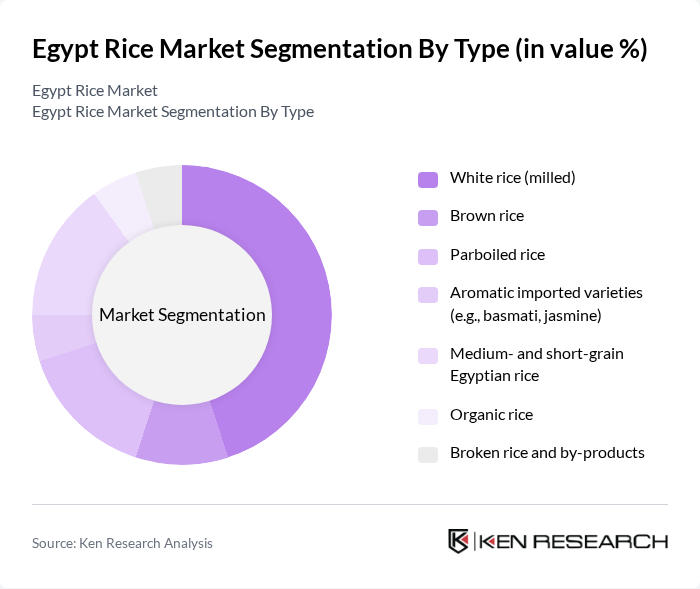
By Type:The rice market can be segmented into various types, including white rice (milled), brown rice, parboiled rice, aromatic imported varieties (e.g., basmati, jasmine), medium- and short-grain Egyptian rice, organic rice, and broken rice and by-products. Among these, white rice (milled) is the most consumed type due to its versatility and preference among consumers for everyday meals. The demand for organic rice is also on the rise as health-conscious consumers seek healthier options.
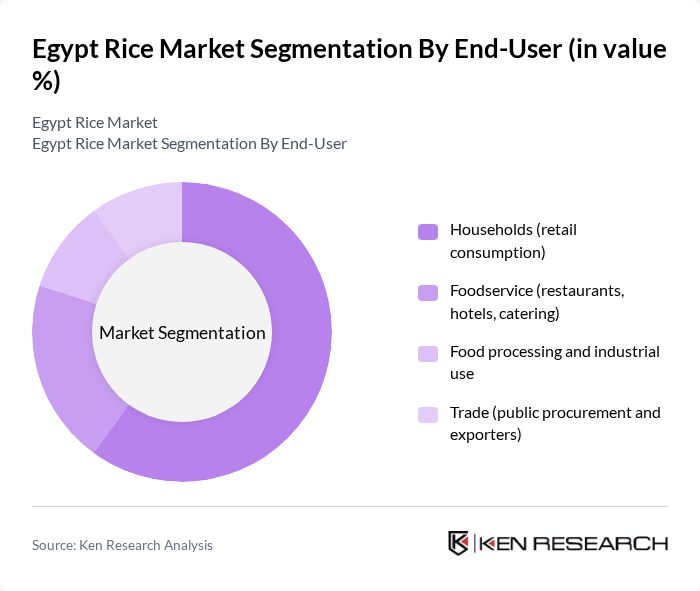
By End-User:The end-user segmentation includes households (retail consumption), foodservice (restaurants, hotels, catering), food processing and industrial use, and trade (public procurement and exporters). Households represent the largest segment, driven by the staple nature of rice in daily meals. The foodservice sector is also growing, as more restaurants and catering services incorporate rice dishes into their menus, reflecting changing consumer preferences.
Egypt Rice Market Competitive Landscape
The Egypt Rice Market is characterized by a dynamic mix of regional and international players. Leading participants such as Egyptian Holding Company for Food Industries (EHCFI), General Authority for Supply Commodities (GASC), Al Doha for Food Industries, El Maleka for Food Industries, Edita Food Industries (rice snacks and cereals portfolio), Abo Donkol for Food Industries (Rice Land), El Weleily Group (grains trading and milling), Americana Egypt (foodservice procurement), Seoudi Supermarket (private label rice), Carrefour Egypt (Majid Al Futtaim Retail – private label rice), HyperOne (private label and distribution), BIM Egypt (B?M) – discount retail private label, Metro Markets & Fresh Food Market (retail private label), Rashid Rice Mills (Kafr El Sheikh), North Delta Rice Mills (Dakahlia) contribute to innovation, geographic expansion, and service delivery in this space.
Egypt Rice Market Industry Analysis
Growth Drivers
- Increasing Domestic Consumption:Egypt's rice consumption reached approximately 4.1 million tons, driven by a growing preference for rice as a staple food. The average per capita consumption is around 35 kg annually, reflecting a steady demand. With the population projected to exceed 110 million, domestic consumption is expected to rise further, bolstering the local rice market. This trend is supported by cultural factors, as rice remains a central component of Egyptian cuisine.
- Government Support for Rice Production:The Egyptian government allocated around EGP 1.5 billion (approximately USD 48 million) to support rice farmers through subsidies and agricultural programs. This financial backing aims to enhance productivity and ensure food security. Additionally, initiatives to provide training on modern farming techniques are expected to improve yields, with the government targeting a 10% increase in production efficiency, further solidifying the rice sector's growth.
- Rising Population and Urbanization:Egypt's urban population is projected to reach 50% in future, contributing to increased demand for rice. The urbanization trend is accompanied by a shift in dietary preferences, with rice becoming a preferred choice among urban dwellers. The World Bank estimates that urban areas will see a population increase of approximately 2 million people annually, driving the need for stable rice supplies. This demographic shift is a significant growth driver for the rice market in Egypt.
Market Challenges
- Water Scarcity Issues:Egypt faces severe water scarcity, with the Nile River providing 97% of its water supply. The annual water availability is approximately 570 cubic meters per capita, significantly below the global average of 1,700 cubic meters. This scarcity poses a challenge for rice cultivation, which is water-intensive. As climate change exacerbates these conditions, the government must implement sustainable water management practices to ensure rice production remains viable.
- Competition from Imported Rice:In future, Egypt imported around 1.2 million tons of rice, primarily from India and Pakistan, to meet domestic demand. The influx of cheaper imported rice poses a significant challenge to local producers, who struggle to compete on price. The government has imposed import tariffs, but the pressure from international markets remains strong. This competition can undermine local rice prices and affect farmers' profitability, creating a challenging environment for domestic production.
Egypt Rice Market Future Outlook
The Egypt rice market is poised for significant developments as it navigates challenges and opportunities. With a focus on sustainable practices and modern farming techniques, the sector is likely to enhance productivity and resilience. The government's commitment to supporting local farmers through subsidies and training programs will be crucial. Additionally, the increasing consumer demand for organic and value-added rice products presents a promising avenue for growth, potentially transforming the market landscape in the coming years.
Market Opportunities
- Adoption of Modern Farming Techniques:The integration of precision agriculture and advanced irrigation systems can significantly boost rice yields. By investing in technology, farmers can optimize water usage and improve crop management, potentially increasing production in future. This shift not only enhances food security but also positions Egypt as a competitive player in the regional rice market.
- Development of Value-Added Rice Products:There is a growing market for specialty rice products, such as organic and fortified rice. In future, the demand for these products is expected to rise, driven by health-conscious consumers. Investing in processing facilities to create value-added products can enhance profitability for local producers, tapping into both domestic and export markets effectively.
Scope of the Report
| Segment | Sub-Segments |
|---|---|
| By Type | White rice (milled) Brown rice Parboiled rice Aromatic imported varieties (e.g., basmati, jasmine) Medium- and short-grain Egyptian rice Organic rice Broken rice and by-products |
| By End-User | Households (retail consumption) Foodservice (restaurants, hotels, catering) Food processing and industrial use Trade (public procurement and exporters) |
| By Distribution Channel | Supermarkets and hypermarkets Traditional grocery and kirana stores Wholesale markets Online retail and quick commerce |
| By Packaging Type | Bulk (25–50 kg sacks) Retail packs (1–10 kg) Institutional packs (10–25 kg) Eco-friendly and recyclable packaging |
| By Price Range | Premium Mid-range Economy |
| By Quality | Premium quality (low broken, high whiteness) Standard quality Value/low quality (higher broken) |
| By Region | Nile Delta (Kafr El Sheikh, Dakahlia, Sharqia) Greater Cairo and Giza Alexandria and West Delta Upper Egypt |
Key Target Audience
Investors and Venture Capitalist Firms
Government and Regulatory Bodies (e.g., Ministry of Agriculture and Land Reclamation, General Authority for Supply Commodities)
Manufacturers and Producers
Distributors and Retailers
Exporters and Importers
Food Processing Companies
Industry Associations (e.g., Egyptian Rice Exporters Association)
Financial Institutions
Players Mentioned in the Report:
Egyptian Holding Company for Food Industries (EHCFI)
General Authority for Supply Commodities (GASC)
Al Doha for Food Industries
El Maleka for Food Industries
Edita Food Industries (rice snacks and cereals portfolio)
Abo Donkol for Food Industries (Rice Land)
El Weleily Group (grains trading and milling)
Americana Egypt (foodservice procurement)
Seoudi Supermarket (private label rice)
Carrefour Egypt (Majid Al Futtaim Retail private label rice)
HyperOne (private label and distribution)
BIM Egypt (BIM) discount retail private label
Metro Markets & Fresh Food Market (retail private label)
Rashid Rice Mills (Kafr El Sheikh)
North Delta Rice Mills (Dakahlia)
Table of Contents
Market Assessment Phase
1. Executive Summary and Approach
2. Egypt Rice Market Overview
2.1 Key Insights and Strategic Recommendations
2.2 Egypt Rice Market Overview
2.3 Definition and Scope
2.4 Evolution of Market Ecosystem
2.5 Timeline of Key Regulatory Milestones
2.6 Value Chain & Stakeholder Mapping
2.7 Business Cycle Analysis
2.8 Policy & Incentive Landscape
3. Egypt Rice Market Analysis
3.1 Growth Drivers
3.1.1 Increasing domestic consumption
3.1.2 Government support for rice production
3.1.3 Rising population and urbanization
3.1.4 Export opportunities in regional markets
3.2 Market Challenges
3.2.1 Water scarcity issues
3.2.2 Fluctuating global rice prices
3.2.3 Competition from imported rice
3.2.4 Infrastructure limitations
3.3 Market Opportunities
3.3.1 Adoption of modern farming techniques
3.3.2 Development of value-added rice products
3.3.3 Expansion of distribution networks
3.3.4 Investment in irrigation technologies
3.4 Market Trends
3.4.1 Shift towards organic rice production
3.4.2 Increasing consumer awareness of health benefits
3.4.3 Growth of e-commerce in rice sales
3.4.4 Focus on sustainability and eco-friendly practices
3.5 Government Regulation
3.5.1 Subsidies for rice farmers
3.5.2 Import tariffs on foreign rice
3.5.3 Quality control standards for rice
3.5.4 Environmental regulations on water usage
4. SWOT Analysis
5. Stakeholder Analysis
6. Porter's Five Forces Analysis
7. Egypt Rice Market Market Size, 2019-2024
7.1 By Value
7.2 By Volume
7.3 By Average Selling Price
8. Egypt Rice Market Segmentation
8.1 By Type
8.1.1 White rice (milled)
8.1.2 Brown rice
8.1.3 Parboiled rice
8.1.4 Aromatic imported varieties (e.g., basmati, jasmine)
8.1.5 Medium- and short-grain Egyptian rice
8.1.6 Organic rice
8.1.7 Broken rice and by-products
8.2 By End-User
8.2.1 Households (retail consumption)
8.2.2 Foodservice (restaurants, hotels, catering)
8.2.3 Food processing and industrial use
8.2.4 Trade (public procurement and exporters)
8.3 By Distribution Channel
8.3.1 Supermarkets and hypermarkets
8.3.2 Traditional grocery and kirana stores
8.3.3 Wholesale markets
8.3.4 Online retail and quick commerce
8.4 By Packaging Type
8.4.1 Bulk (25–50 kg sacks)
8.4.2 Retail packs (1–10 kg)
8.4.3 Institutional packs (10–25 kg)
8.4.4 Eco-friendly and recyclable packaging
8.5 By Price Range
8.5.1 Premium
8.5.2 Mid-range
8.5.3 Economy
8.6 By Quality
8.6.1 Premium quality (low broken, high whiteness)
8.6.2 Standard quality
8.6.3 Value/low quality (higher broken)
8.7 By Region
8.7.1 Nile Delta (Kafr El Sheikh, Dakahlia, Sharqia)
8.7.2 Greater Cairo and Giza
8.7.3 Alexandria and West Delta
8.7.4 Upper Egypt
9. Egypt Rice Market Competitive Analysis
9.1 Market Share of Key Players
9.2 Cross Comparison of Key Players
9.2.1 Company Name
9.2.2 Group Size (Large, Medium, or Small as per industry convention)
9.2.3 Egypt rice sales revenue (latest fiscal year)
9.2.4 Volume sold (metric tons, Egypt)
9.2.5 Market penetration (retail ACV coverage, %)
9.2.6 Share of parboiled vs white rice (%)
9.2.7 Average realized price (EGP/kg)
9.2.8 Gross margin (%)
9.2.9 Milling capacity (MT/day) and utilization (%)
9.2.10 Distribution reach (governorates covered, channels)
9.2.11 Share of public tenders (GASC/ASCM) in sales (%)
9.2.12 Private-label supply share (%)
9.2.13 Import reliance (share of imported aromatic varieties, %)
9.2.14 Brand awareness index (prompted, %)
9.2.15 New SKUs launched (last 12 months)
9.3 SWOT Analysis of Top Players
9.4 Pricing Analysis
9.5 Detailed Profile of Major Companies
9.5.1 Egyptian Holding Company for Food Industries (EHCFI)
9.5.2 General Authority for Supply Commodities (GASC)
9.5.3 Al Doha for Food Industries
9.5.4 El Maleka for Food Industries
9.5.5 Edita Food Industries (rice snacks and cereals portfolio)
9.5.6 Abo Donkol for Food Industries (Rice Land)
9.5.7 El Weleily Group (grains trading and milling)
9.5.8 Americana Egypt (foodservice procurement)
9.5.9 Seoudi Supermarket (private label rice)
9.5.10 Carrefour Egypt (Majid Al Futtaim Retail – private label rice)
9.5.11 HyperOne (private label and distribution)
9.5.12 BIM Egypt (B?M) – discount retail private label
9.5.13 Metro Markets & Fresh Food Market (retail private label)
9.5.14 Rashid Rice Mills (Kafr El Sheikh)
9.5.15 North Delta Rice Mills (Dakahlia)
10. Egypt Rice Market End-User Analysis
10.1 Procurement Behavior of Key Ministries
10.1.1 Ministry of Agriculture
10.1.2 Ministry of Supply and Internal Trade
10.1.3 Ministry of Finance
10.2 Corporate Spend on Infrastructure & Energy
10.2.1 Investment in irrigation systems
10.2.2 Funding for storage facilities
10.2.3 Expenditure on transportation logistics
10.3 Pain Point Analysis by End-User Category
10.3.1 Supply chain disruptions
10.3.2 Price volatility
10.3.3 Quality assurance issues
10.4 User Readiness for Adoption
10.4.1 Awareness of modern farming techniques
10.4.2 Access to financing options
10.4.3 Training and support availability
10.5 Post-Deployment ROI and Use Case Expansion
10.5.1 Measurement of yield improvements
10.5.2 Assessment of cost savings
10.5.3 Evaluation of market expansion opportunities
11. Egypt Rice Market Future Size, 2025-2030
11.1 By Value
11.2 By Volume
11.3 By Average Selling Price
Go-To-Market Strategy Phase
1. Whitespace Analysis + Business Model Canvas
1.1 Market gaps identification
1.2 Value proposition development
1.3 Revenue model exploration
1.4 Customer segmentation analysis
1.5 Competitive landscape overview
1.6 Key partnerships identification
1.7 Cost structure analysis
2. Marketing and Positioning Recommendations
2.1 Branding strategies
2.2 Product USPs
2.3 Target audience definition
2.4 Communication channels selection
2.5 Promotional tactics
2.6 Market positioning statement
3. Distribution Plan
3.1 Urban retail vs rural NGO tie-ups
3.2 Distribution channel optimization
3.3 Logistics and supply chain management
3.4 Partnership with local distributors
3.5 E-commerce strategy
4. Channel & Pricing Gaps
4.1 Underserved routes
4.2 Pricing bands
4.3 Competitor pricing analysis
4.4 Consumer price sensitivity
4.5 Value-based pricing strategies
5. Unmet Demand & Latent Needs
5.1 Category gaps
5.2 Consumer segments
5.3 Product innovation opportunities
5.4 Market entry barriers
5.5 Customer feedback incorporation
6. Customer Relationship
6.1 Loyalty programs
6.2 After-sales service
6.3 Customer engagement strategies
6.4 Feedback and improvement loops
6.5 Community building initiatives
7. Value Proposition
7.1 Sustainability
7.2 Integrated supply chains
7.3 Quality assurance
7.4 Customer-centric approach
7.5 Competitive differentiation
8. Key Activities
8.1 Regulatory compliance
8.2 Branding
8.3 Distribution setup
8.4 Market research
8.5 Training and development
9. Entry Strategy Evaluation
9.1 Domestic Market Entry Strategy
9.1.1 Product mix
9.1.2 Pricing band
9.1.3 Packaging
9.2 Export Entry Strategy
9.2.1 Target countries
9.2.2 Compliance roadmap
10. Entry Mode Assessment
10.1 JV
10.2 Greenfield
10.3 M&A
10.4 Distributor Model
11. Capital and Timeline Estimation
11.1 Capital requirements
11.2 Timelines
12. Control vs Risk Trade-Off
12.1 Ownership vs Partnerships
13. Profitability Outlook
13.1 Breakeven analysis
13.2 Long-term sustainability
14. Potential Partner List
14.1 Distributors
14.2 JVs
14.3 Acquisition targets
15. Execution Roadmap
15.1 Phased Plan for Market Entry
15.1.1 Market Setup
15.1.2 Market Entry
15.1.3 Growth Acceleration
15.1.4 Scale & Stabilize
15.2 Key Activities and Milestones
15.2.1 Activity timelines
15.2.2 Milestone tracking
Research Methodology
Phase 1: Approach1
Desk Research
- Analysis of national agricultural statistics from the Egyptian Ministry of Agriculture
- Review of market reports and publications from the Food and Agriculture Organization (FAO)
- Examination of trade data and import/export statistics from the Central Agency for Public Mobilization and Statistics (CAPMAS)
Primary Research
- Interviews with key stakeholders in the rice supply chain, including farmers and distributors
- Surveys conducted with rice mill operators to understand production capacities and challenges
- Focus group discussions with consumers to gauge preferences and purchasing behavior
Validation & Triangulation
- Cross-validation of findings with data from agricultural cooperatives and industry associations
- Triangulation of insights from primary interviews with secondary data trends
- Sanity checks through expert reviews from agronomists and market analysts
Phase 2: Market Size Estimation1
Top-down Assessment
- Estimation of total rice consumption based on national dietary guidelines and population data
- Analysis of rice production volumes and yield rates from agricultural reports
- Incorporation of government policies affecting rice subsidies and pricing
Bottom-up Modeling
- Collection of data on rice production from local farmers and agricultural cooperatives
- Estimation of market share for different rice varieties based on sales data
- Cost analysis of production inputs, including seeds, fertilizers, and labor
Forecasting & Scenario Analysis
- Multi-factor regression analysis incorporating economic indicators and climate impact on yields
- Scenario modeling based on potential changes in consumer preferences and import policies
- Development of baseline, optimistic, and pessimistic forecasts through 2030
Phase 3: CATI Sample Composition1
| Scope Item/Segment | Sample Size | Target Respondent Profiles |
|---|---|---|
| Rice Farmers | 120 | Smallholder Farmers, Large-scale Producers |
| Rice Mill Operators | 90 | Mill Managers, Production Supervisors |
| Distributors and Wholesalers | 80 | Supply Chain Managers, Sales Representatives |
| Retailers | 70 | Store Managers, Category Buyers |
| Consumers | 140 | Household Decision Makers, Health-conscious Shoppers |
Frequently Asked Questions
What is the current value of the Egypt Rice Market?
The Egypt Rice Market is valued at approximately USD 2.0 billion, driven by increasing demand for rice as a staple food and government initiatives aimed at enhancing agricultural productivity and food security.
What factors are driving the growth of the Egypt Rice Market?
Which cities are the main consumers of rice in Egypt?
What regulations has the Egyptian government implemented for rice farming?
Other Regional/Country Reports
Why Buy From Us?

What makes us stand out is that our consultants follow Robust, Refine and Result (RRR) methodology. Robust for clear definitions, approaches and sanity checking, Refine for differentiating respondents' facts and opinions, and Result for presenting data with story.

We have set a benchmark in the industry by offering our clients with syndicated and customized market research reports featuring coverage of entire market as well as meticulous research and analyst insights.

While we don't replace traditional research, we flip the method upside down. Our dual approach of Top Bottom & Bottom Top ensures quality deliverable by not just verifying company fundamentals but also looking at the sector and macroeconomic factors.

With one step in the future, our research team constantly tries to show you the bigger picture. We help with some of the tough questions you may encounter along the way: How is the industry positioned? Best marketing channel? KPI's of competitors? By aligning every element, we help maximize success.

Our report gives you instant access to the answers and sources that other companies might choose to hide. We elaborate each steps of research methodology we have used and showcase you the sample size to earn your trust.

If you need any support, we are here! We pride ourselves on universe strength, data quality, and quick, friendly, and professional service.