Gcc Anti Counterfeit Pharmaceuticals Cosmetics Packaging Market Size, Share, Growth Drivers, Trends, Opportunities & Forecast 2025–2030

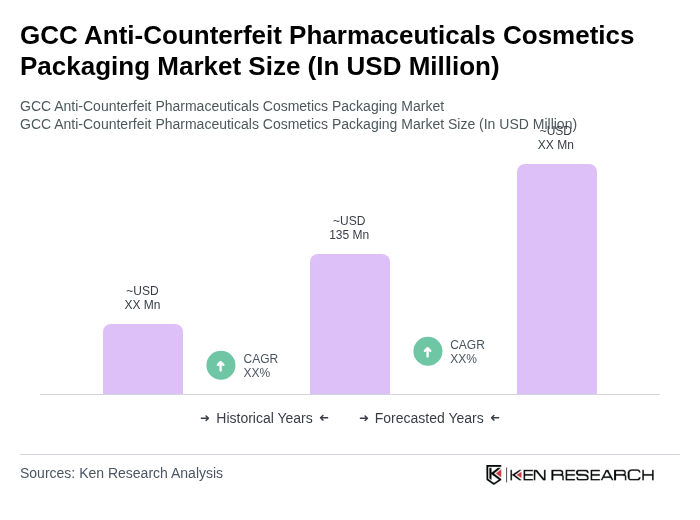
The GCC Anti-Counterfeit Pharmaceuticals Cosmetics Packaging Market is worth USD 135 million, fueled by anti-counterfeit regulations and advanced packaging solutions.

Region:Middle East

Author(s):Dev

Product Code:KRAD7703

Pages:95

Published On:December 2025
About the Report

Base Year 2024

GCC Anti-Counterfeit Pharmaceuticals Cosmetics Packaging Market Overview

  • The GCC Anti-Counterfeit Pharmaceuticals Cosmetics Packaging Market is valued at USD 135 million, based on a five-year historical analysis. This growth is primarily driven by increasing regulatory measures against counterfeit products, rising consumer awareness regarding product authenticity, the growing demand for advanced packaging solutions that ensure product safety and integrity, and escalating adoption of serialization and track-and-trace technologies amid rising counterfeit drug incidents.
  • Key players in this market include the UAE and Saudi Arabia, which dominate due to their robust pharmaceutical and cosmetics industries, coupled with stringent regulations aimed at combating counterfeit products. The presence of major multinational corporations and a growing e-commerce sector further enhance their market position.
  • The UAE Cabinet Resolution No. 37 of 2021, issued by the UAE Ministry of Health and Prevention (MOHAP), mandates serialization and track-and-trace systems for pharmaceutical products exceeding AED 100,000 in annual sales value, requiring unique identifiers on packaging for supply chain verification and compliance through authorized platforms.
GCC Anti-Counterfeit Pharmaceuticals Cosmetics Packaging Market Size

GCC Anti-Counterfeit Pharmaceuticals Cosmetics Packaging Market Segmentation

By Technology Type:

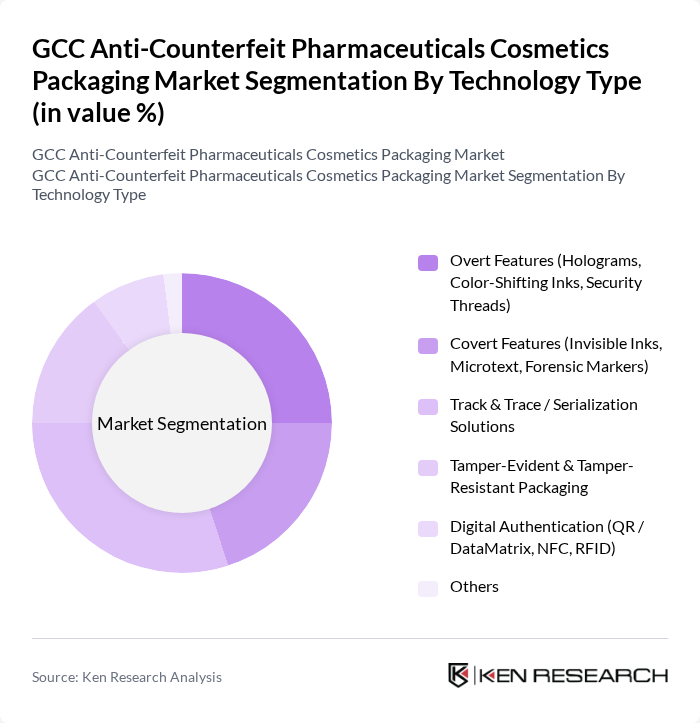
GCC Anti-Counterfeit Pharmaceuticals Cosmetics Packaging Market segmentation by Technology Type.

The technology type segment is dominated by Track & Trace / Serialization Solutions, which account for a significant portion of the market. This dominance is attributed to the increasing regulatory requirements for product traceability and the growing need for supply chain transparency. Consumers are becoming more aware of counterfeit risks, prompting manufacturers to adopt advanced serialization technologies to ensure product authenticity. The demand for tamper-evident packaging is also rising, driven by consumer safety concerns and the need for reliable product protection.

By End-User Industry:
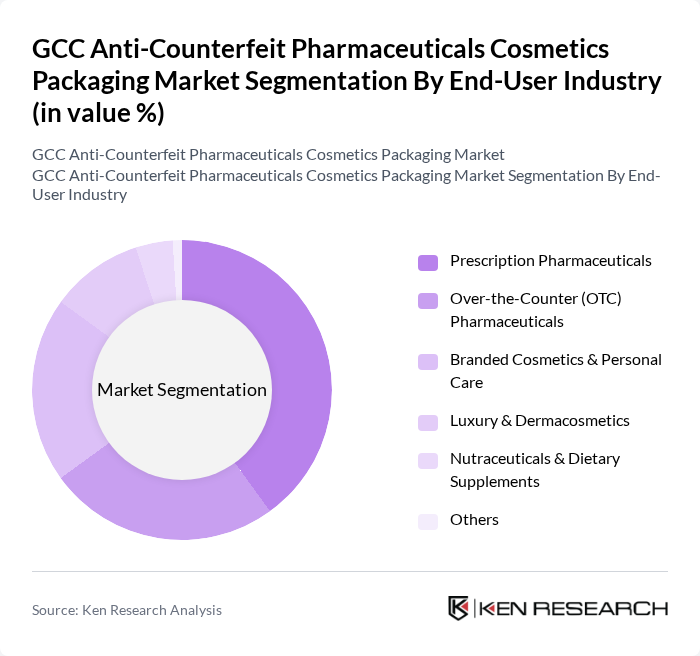
GCC Anti-Counterfeit Pharmaceuticals Cosmetics Packaging Market segmentation by End-User Industry.

The end-user industry segment is led by Prescription Pharmaceuticals, which holds the largest market share. This is primarily due to stringent regulations and the high value of prescription medications, which necessitate robust anti-counterfeit measures. The growing awareness of counterfeit drugs among consumers and healthcare professionals has further propelled the demand for secure packaging solutions in this sector. Over-the-Counter (OTC) Pharmaceuticals also show significant growth, driven by increasing consumer health consciousness and the rising demand for safe and authentic products.

GCC Anti-Counterfeit Pharmaceuticals Cosmetics Packaging Market Competitive Landscape

The GCC Anti-Counterfeit Pharmaceuticals Cosmetics Packaging Market is characterized by a dynamic mix of regional and international players. Leading participants such as Avery Dennison Corporation, 3M Company, SATO Holdings Corporation, Zebra Technologies Corporation, CCL Industries Inc., SICPA Holding SA, Authentix, Inc., DuPont de Nemours, Inc., Markem-Imaje Corporation, tesa SE, Krones AG, Honeywell International Inc., Sealed Air Corporation, R.R. Donnelley & Sons Company, WestRock Company contribute to innovation, geographic expansion, and service delivery in this space.

Avery Dennison Corporation

1935

Glendale, California, USA

3M Company

1902

Maplewood, Minnesota, USA

SATO Holdings Corporation

1940

Tokyo, Japan

Zebra Technologies Corporation

1969

Lincolnshire, Illinois, USA

CCL Industries Inc.

1951

Toronto, Canada

Company

Establishment Year

Headquarters

Group Size (Global, Regional, or Local)

GCC Revenue from Anti-Counterfeit Pharma & Cosmetics Packaging

Revenue Growth Rate in GCC Market

Installed Base of Serialized / Track & Trace Lines in GCC

Share of GCC Pharmaceutical vs Cosmetics Customers

Average Deal Size with Key Accounts

GCC Anti-Counterfeit Pharmaceuticals Cosmetics Packaging Market Industry Analysis

Growth Drivers

  • Increasing Demand for Authenticity:The GCC region has witnessed a significant rise in the demand for authentic products, particularly in pharmaceuticals and cosmetics. In future, the market for genuine pharmaceuticals is projected to reach $12 billion, driven by consumer preferences for quality and safety. This demand is further fueled by the increasing incidence of counterfeit products, which has prompted consumers to seek verified authenticity in their purchases, thereby enhancing the need for anti-counterfeit packaging solutions.
  • Rising Consumer Awareness:Consumer awareness regarding the dangers of counterfeit products has escalated in the GCC, with 75% of consumers expressing concern over product authenticity in recent surveys. This heightened awareness is leading to a greater demand for anti-counterfeit measures, as consumers are more inclined to choose brands that prioritize safety and transparency. The increasing availability of information through digital platforms is also contributing to this trend, encouraging consumers to make informed purchasing decisions.
  • Stringent Regulatory Frameworks:The GCC governments are implementing stricter regulations to combat counterfeit products, with initiatives such as the Gulf Cooperation Council's (GCC) unified anti-counterfeit laws. In future, regulatory bodies are expected to increase enforcement actions, resulting in a 20% rise in compliance costs for manufacturers. These regulations are driving the adoption of advanced packaging solutions that meet safety standards, thereby fostering growth in the anti-counterfeit packaging market.

Market Challenges

  • High Costs of Anti-Counterfeit Solutions:The implementation of anti-counterfeit technologies can be prohibitively expensive for many manufacturers, particularly small and medium-sized enterprises (SMEs). In future, the average cost of integrating advanced packaging solutions is estimated to be around $250,000 per facility. This financial burden can deter SMEs from adopting necessary measures, limiting the overall market growth and leaving gaps in product security across the industry.
  • Lack of Standardization:The absence of standardized anti-counterfeit measures across the GCC complicates the market landscape. Currently, only 35% of manufacturers comply with existing guidelines, leading to inconsistencies in product safety and traceability. This lack of uniformity not only hampers consumer trust but also creates challenges for regulatory bodies in enforcing compliance, ultimately affecting the effectiveness of anti-counterfeit initiatives in the region.

GCC Anti-Counterfeit Pharmaceuticals Cosmetics Packaging Market Future Outlook

The future of the GCC anti-counterfeit pharmaceuticals and cosmetics packaging market appears promising, driven by technological advancements and increasing regulatory pressures. As manufacturers adopt innovative solutions like blockchain and IoT, the market is expected to evolve significantly in future. Additionally, the growing emphasis on sustainability will likely influence packaging designs, aligning with consumer preferences for eco-friendly products. These trends indicate a robust shift towards more secure and responsible packaging practices in the coming years.

Market Opportunities

  • Expansion of E-commerce:The rapid growth of e-commerce in the GCC, projected to reach $35 billion in future, presents a significant opportunity for anti-counterfeit packaging solutions. As online shopping increases, so does the risk of counterfeit products, prompting e-commerce platforms to seek reliable packaging technologies that ensure product authenticity and consumer safety.
  • Development of Smart Packaging Solutions:The rise of smart packaging technologies, such as QR codes and NFC tags, offers a lucrative opportunity for manufacturers. In future, the smart packaging segment is expected to grow by 25%, driven by consumer demand for interactive and informative packaging. This trend not only enhances product security but also improves consumer engagement, creating a win-win scenario for brands and customers alike.

Scope of the Report

SegmentSub-Segments
By Technology Type

Overt Features (Holograms, Color-Shifting Inks, Security Threads)

Covert Features (Invisible Inks, Microtext, Forensic Markers)

Track & Trace / Serialization Solutions

Tamper-Evident & Tamper-Resistant Packaging

Digital Authentication (QR / DataMatrix, NFC, RFID)

Others

By End-User Industry

Prescription Pharmaceuticals

Over-the-Counter (OTC) Pharmaceuticals

Branded Cosmetics & Personal Care

Luxury & Dermacosmetics

Nutraceuticals & Dietary Supplements

Others

By Packaging Format

Primary Packaging (Blisters, Bottles, Vials, Tubes)

Secondary Packaging (Cartons, Sleeves, Labels)

Tertiary / Transport Packaging

Unit-Level vs Case- / Pallet-Level Solutions

Others

By Material

Plastic

Paper & Paperboard

Metal

Glass

Hybrid & Smart Materials

Others

By Authentication & Tracking Platform

Cloud-Based Track & Trace Platforms

On-Premise Track & Trace Systems

Brand Protection & Consumer Engagement Apps

Government / Regulator-Driven Systems

Others

By Distribution & Channel Risk Profile

Hospital & Clinic Pharmacies

Retail Pharmacies & Drugstores

E-Pharmacies & Online Beauty Retailers

Duty-Free & Travel Retail

Informal & Grey Channels

Others

By Country

UAE

Saudi Arabia

Qatar

Kuwait

Oman

Bahrain

Key Target Audience

Investors and Venture Capitalist Firms

Government and Regulatory Bodies (e.g., Gulf Cooperation Council, Saudi Food and Drug Authority, UAE Ministry of Health and Prevention)

Pharmaceutical and Cosmetics Manufacturers

Packaging Solution Providers

Logistics and Supply Chain Companies

Quality Assurance and Testing Laboratories

Industry Associations (e.g., Gulf Pharmaceutical Industries Association)

Insurance Companies and Risk Management Firms

Players Mentioned in the Report:

Avery Dennison Corporation

3M Company

SATO Holdings Corporation

Zebra Technologies Corporation

CCL Industries Inc.

SICPA Holding SA

Authentix, Inc.

DuPont de Nemours, Inc.

Markem-Imaje Corporation

tesa SE

Krones AG

Honeywell International Inc.

Sealed Air Corporation

R.R. Donnelley & Sons Company

WestRock Company

Table of Contents

Market Assessment Phase

1. Executive Summary and Approach


2. GCC Anti-Counterfeit Pharmaceuticals Cosmetics Packaging Market Overview

2.1 Key Insights and Strategic Recommendations

2.2 GCC Anti-Counterfeit Pharmaceuticals Cosmetics Packaging Market Overview

2.3 Definition and Scope

2.4 Evolution of Market Ecosystem

2.5 Timeline of Key Regulatory Milestones

2.6 Value Chain & Stakeholder Mapping

2.7 Business Cycle Analysis

2.8 Policy & Incentive Landscape


3. GCC Anti-Counterfeit Pharmaceuticals Cosmetics Packaging Market Analysis

3.1 Growth Drivers

3.1.1 Increasing Demand for Authenticity
3.1.2 Rising Consumer Awareness
3.1.3 Stringent Regulatory Frameworks
3.1.4 Technological Advancements in Packaging

3.2 Market Challenges

3.2.1 High Costs of Anti-Counterfeit Solutions
3.2.2 Lack of Standardization
3.2.3 Limited Awareness Among Small Manufacturers
3.2.4 Evolving Counterfeit Techniques

3.3 Market Opportunities

3.3.1 Expansion of E-commerce
3.3.2 Collaborations with Technology Providers
3.3.3 Growth in Emerging Markets
3.3.4 Development of Smart Packaging Solutions

3.4 Market Trends

3.4.1 Adoption of Blockchain Technology
3.4.2 Increasing Use of QR Codes
3.4.3 Shift Towards Sustainable Packaging
3.4.4 Integration of IoT in Packaging

3.5 Government Regulation

3.5.1 Implementation of Anti-Counterfeit Laws
3.5.2 Regulatory Compliance for Packaging Materials
3.5.3 Guidelines for Traceability
3.5.4 Standards for Packaging Safety

4. SWOT Analysis


5. Stakeholder Analysis


6. Porter's Five Forces Analysis


7. GCC Anti-Counterfeit Pharmaceuticals Cosmetics Packaging Market Market Size, 2019-2024

7.1 By Value

7.2 By Volume

7.3 By Average Selling Price


8. GCC Anti-Counterfeit Pharmaceuticals Cosmetics Packaging Market Segmentation

8.1 By Technology Type

8.1.1 Overt Features (Holograms, Color-Shifting Inks, Security Threads)
8.1.2 Covert Features (Invisible Inks, Microtext, Forensic Markers)
8.1.3 Track & Trace / Serialization Solutions
8.1.4 Tamper-Evident & Tamper-Resistant Packaging
8.1.5 Digital Authentication (QR / DataMatrix, NFC, RFID)
8.1.6 Others

8.2 By End-User Industry

8.2.1 Prescription Pharmaceuticals
8.2.2 Over-the-Counter (OTC) Pharmaceuticals
8.2.3 Branded Cosmetics & Personal Care
8.2.4 Luxury & Dermacosmetics
8.2.5 Nutraceuticals & Dietary Supplements
8.2.6 Others

8.3 By Packaging Format

8.3.1 Primary Packaging (Blisters, Bottles, Vials, Tubes)
8.3.2 Secondary Packaging (Cartons, Sleeves, Labels)
8.3.3 Tertiary / Transport Packaging
8.3.4 Unit-Level vs Case- / Pallet-Level Solutions
8.3.5 Others

8.4 By Material

8.4.1 Plastic
8.4.2 Paper & Paperboard
8.4.3 Metal
8.4.4 Glass
8.4.5 Hybrid & Smart Materials
8.4.6 Others

8.5 By Authentication & Tracking Platform

8.5.1 Cloud-Based Track & Trace Platforms
8.5.2 On-Premise Track & Trace Systems
8.5.3 Brand Protection & Consumer Engagement Apps
8.5.4 Government / Regulator-Driven Systems
8.5.5 Others

8.6 By Distribution & Channel Risk Profile

8.6.1 Hospital & Clinic Pharmacies
8.6.2 Retail Pharmacies & Drugstores
8.6.3 E-Pharmacies & Online Beauty Retailers
8.6.4 Duty-Free & Travel Retail
8.6.5 Informal & Grey Channels
8.6.6 Others

8.7 By Country

8.7.1 UAE
8.7.2 Saudi Arabia
8.7.3 Qatar
8.7.4 Kuwait
8.7.5 Oman
8.7.6 Bahrain

9. GCC Anti-Counterfeit Pharmaceuticals Cosmetics Packaging Market Competitive Analysis

9.1 Market Share of Key Players

9.2 Cross Comparison of Key Players

9.2.1 Company Name
9.2.2 Group Size (Global, Regional, or Local)
9.2.3 GCC Revenue from Anti-Counterfeit Pharma & Cosmetics Packaging
9.2.4 Revenue Growth Rate in GCC Market
9.2.5 Installed Base of Serialized / Track & Trace Lines in GCC
9.2.6 Share of GCC Pharmaceutical vs Cosmetics Customers
9.2.7 Average Deal Size with Key Accounts
9.2.8 Geographic Coverage within GCC (Number of Countries Served)
9.2.9 Portfolio Breadth (Number of Anti-Counterfeit Technologies Offered)
9.2.10 R&D / Innovation Intensity (R&D as % of Revenue)
9.2.11 Strategic Partnerships with GCC Regulators / Large Pharma
9.2.12 Reference Installations & Flagship Projects in GCC

9.3 SWOT Analysis of Top Players

9.4 Pricing Analysis

9.5 Detailed Profile of Major Companies

9.5.1 Avery Dennison Corporation
9.5.2 3M Company
9.5.3 SATO Holdings Corporation
9.5.4 Zebra Technologies Corporation
9.5.5 CCL Industries Inc.
9.5.6 SICPA Holding SA
9.5.7 Authentix, Inc.
9.5.8 DuPont de Nemours, Inc.
9.5.9 Markem-Imaje Corporation
9.5.10 tesa SE
9.5.11 Krones AG
9.5.12 Honeywell International Inc.
9.5.13 Sealed Air Corporation
9.5.14 R.R. Donnelley & Sons Company
9.5.15 WestRock Company

10. GCC Anti-Counterfeit Pharmaceuticals Cosmetics Packaging Market End-User Analysis

10.1 Procurement Behavior of Key Ministries

10.1.1 Government Procurement Policies
10.1.2 Budget Allocations for Anti-Counterfeit Measures
10.1.3 Collaboration with Private Sector
10.1.4 Evaluation Criteria for Suppliers

10.2 Corporate Spend on Infrastructure & Energy

10.2.1 Investment in Anti-Counterfeit Technologies
10.2.2 Budgeting for Packaging Innovations
10.2.3 Funding for Research and Development
10.2.4 Others

10.3 Pain Point Analysis by End-User Category

10.3.1 Challenges Faced by Pharmaceutical Companies
10.3.2 Issues in Cosmetic Packaging
10.3.3 Regulatory Compliance Difficulties
10.3.4 Others

10.4 User Readiness for Adoption

10.4.1 Awareness of Anti-Counterfeit Solutions
10.4.2 Training and Support Needs
10.4.3 Technology Adoption Barriers
10.4.4 Others

10.5 Post-Deployment ROI and Use Case Expansion

10.5.1 Measurement of ROI
10.5.2 Case Studies of Successful Implementations
10.5.3 Future Use Cases
10.5.4 Others

11. GCC Anti-Counterfeit Pharmaceuticals Cosmetics Packaging Market Future Size, 2025-2030

11.1 By Value

11.2 By Volume

11.3 By Average Selling Price


Go-To-Market Strategy Phase

1. Whitespace Analysis + Business Model Canvas

1.1 Market Gaps Identification

1.2 Business Model Development


2. Marketing and Positioning Recommendations

2.1 Branding Strategies

2.2 Product USPs


3. Distribution Plan

3.1 Urban Retail vs Rural NGO Tie-ups


4. Channel & Pricing Gaps

4.1 Underserved Routes

4.2 Pricing Bands


5. Unmet Demand & Latent Needs

5.1 Category Gaps

5.2 Consumer Segments


6. Customer Relationship

6.1 Loyalty Programs

6.2 After-sales Service


7. Value Proposition

7.1 Sustainability

7.2 Integrated Supply Chains


8. Key Activities

8.1 Regulatory Compliance

8.2 Branding

8.3 Distribution Setup


9. Entry Strategy Evaluation

9.1 Domestic Market Entry Strategy

9.1.1 Product Mix
9.1.2 Pricing Band
9.1.3 Packaging

9.2 Export Entry Strategy

9.2.1 Target Countries
9.2.2 Compliance Roadmap

10. Entry Mode Assessment

10.1 JV

10.2 Greenfield

10.3 M&A

10.4 Distributor Model


11. Capital and Timeline Estimation

11.1 Capital Requirements

11.2 Timelines


12. Control vs Risk Trade-Off

12.1 Ownership vs Partnerships


13. Profitability Outlook

13.1 Breakeven Analysis

13.2 Long-term Sustainability


14. Potential Partner List

14.1 Distributors

14.2 JVs

14.3 Acquisition Targets


15. Execution Roadmap

15.1 Phased Plan for Market Entry

15.1.1 Market Setup
15.1.2 Market Entry
15.1.3 Growth Acceleration
15.1.4 Scale & Stabilize

15.2 Key Activities and Milestones

15.2.1 Milestone Planning
15.2.2 Activity Tracking

Research Methodology

ApproachModellingSample

Phase 1: Approach1

Desk Research

  • Analysis of market reports from industry associations and regulatory bodies in the GCC region
  • Review of academic journals and publications focusing on anti-counterfeit technologies in pharmaceuticals and cosmetics
  • Examination of trade publications and news articles highlighting recent trends and innovations in packaging solutions

Primary Research

  • Interviews with key stakeholders in the pharmaceutical and cosmetics industries, including manufacturers and distributors
  • Surveys conducted with packaging technology providers to understand current offerings and innovations
  • Focus group discussions with consumers to gauge awareness and perceptions of anti-counterfeit packaging

Validation & Triangulation

  • Cross-validation of findings through multiple data sources, including market reports and expert opinions
  • Triangulation of qualitative insights from interviews with quantitative data from surveys
  • Sanity checks through expert panel reviews to ensure the reliability of the data collected

Phase 2: Market Size Estimation1

Top-down Assessment

  • Estimation of the total market size based on regional pharmaceutical and cosmetics sales data
  • Segmentation of the market by product type, including anti-counterfeit labels, holograms, and RFID solutions
  • Incorporation of growth rates from industry forecasts and government initiatives aimed at combating counterfeiting

Bottom-up Modeling

  • Collection of data from leading packaging firms to establish baseline sales figures for anti-counterfeit solutions
  • Analysis of production costs and pricing strategies for various anti-counterfeit packaging technologies
  • Volume estimates based on the adoption rates of anti-counterfeit measures across different sectors

Forecasting & Scenario Analysis

  • Development of forecasting models using historical data and projected growth rates in the GCC market
  • Scenario analysis based on potential regulatory changes and shifts in consumer behavior towards counterfeit products
  • Creation of multiple projections (baseline, optimistic, and pessimistic) to account for market volatility

Phase 3: CATI Sample Composition1

Scope Item/SegmentSample SizeTarget Respondent Profiles
Pharmaceutical Manufacturers110Production Managers, Quality Assurance Officers
Cosmetics Brands85Brand Managers, Product Development Leads
Packaging Technology Providers75Sales Directors, R&D Managers
Regulatory Bodies45Compliance Officers, Policy Makers
Consumer Focus Groups60End-users, Retail Customers

Frequently Asked Questions

What is the current value of the GCC Anti-Counterfeit Pharmaceuticals Cosmetics Packaging Market?

The GCC Anti-Counterfeit Pharmaceuticals Cosmetics Packaging Market is valued at approximately USD 135 million, reflecting a significant growth driven by increasing regulatory measures and consumer awareness regarding product authenticity.

What are the main drivers of growth in the GCC Anti-Counterfeit Pharmaceuticals Cosmetics Packaging Market?

Which countries dominate the GCC Anti-Counterfeit Pharmaceuticals Cosmetics Packaging Market?

What regulatory measures are in place to combat counterfeit products in the GCC?

Other Regional/Country Reports

Indonesia Anti Counterfeit Pharmaceuticals Cosmetics Packaging Market

Malaysia Anti Counterfeit Pharmaceuticals Cosmetics Packaging Market

KSA Anti Counterfeit Pharmaceuticals Cosmetics Packaging Market

APAC Anti Counterfeit Pharmaceuticals Cosmetics Packaging Market

SEA Anti Counterfeit Pharmaceuticals Cosmetics Packaging Market

Vietnam Anti Counterfeit Pharmaceuticals Cosmetics Packaging Market

Other Adjacent Reports

Middle East pharmaceutical packaging market size, share, growth drivers, trends, opportunities & forecast 2025–2030

South Korea Cosmetics Packaging Market

Global Track and Trace Solutions Market Outlook to 2030

Indonesia Serialization Technology Market

UAE Tamper-Evident Packaging Market

Oman Holographic Security Market

KSA RFID Technology Market

Saudi Arabia blockchain supply chain market report size, share, growth drivers, trends, opportunities & forecast 2025–2030

Mexico E-commerce Packaging Market

Bahrain Regulatory Compliance Software Market

Why Buy From Us?

Refine Robust Result (RRR) Framework

What makes us stand out is that our consultants follow Robust, Refine and Result (RRR) methodology. Robust for clear definitions, approaches and sanity checking, Refine for differentiating respondents' facts and opinions, and Result for presenting data with story.

Our Reach Is Unmatched

We have set a benchmark in the industry by offering our clients with syndicated and customized market research reports featuring coverage of entire market as well as meticulous research and analyst insights.

Shifting the Research Paradigm

While we don't replace traditional research, we flip the method upside down. Our dual approach of Top Bottom & Bottom Top ensures quality deliverable by not just verifying company fundamentals but also looking at the sector and macroeconomic factors.

More Insights-Better Decisions

With one step in the future, our research team constantly tries to show you the bigger picture. We help with some of the tough questions you may encounter along the way: How is the industry positioned? Best marketing channel? KPI's of competitors? By aligning every element, we help maximize success.

Transparency and Trust

Our report gives you instant access to the answers and sources that other companies might choose to hide. We elaborate each steps of research methodology we have used and showcase you the sample size to earn your trust.

Round the Clock Support

If you need any support, we are here! We pride ourselves on universe strength, data quality, and quick, friendly, and professional service.

Why Clients Choose Us?

400000+
Reports in repository
150+
Consulting projects a year
100+
Analysts
8000+
Client Queries in 2022