Gcc Ceramic Packaging Market Report Size, Share, Growth Drivers, Trends, Opportunities & Forecast 2025–2030

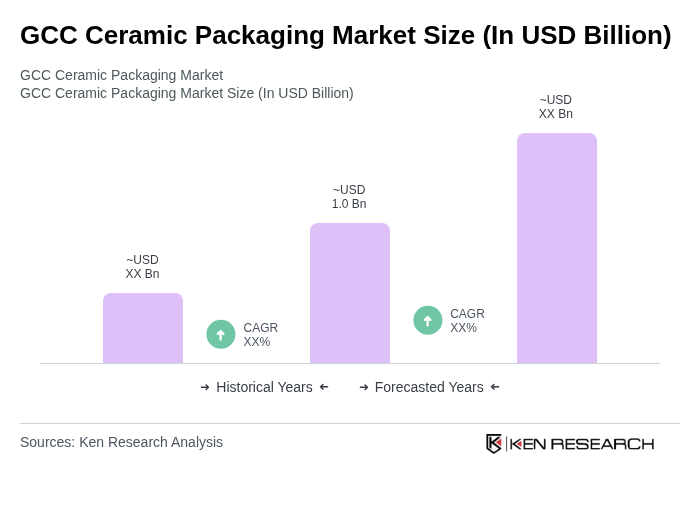
The GCC Ceramic Packaging Market, worth USD 1.0 billion, is growing due to high-performance needs in electronics, automotive, and medical sectors, with key players like Kyocera and NGK leading innovation.

Region:Middle East

Author(s):Dev

Product Code:KRAD6338

Pages:99

Published On:December 2025
About the Report

Base Year 2024

GCC Ceramic Packaging Market Overview

  • The GCC Ceramic Packaging Market is valued at USD 1.0 billion, based on a five?year historical analysis and the region’s share within the global ceramic packaging market, which is estimated at around USD 11–13 billion. This growth is primarily driven by the increasing demand for high?performance packaging solutions in electronics, automotive, and healthcare sectors, in line with global adoption of ceramic packaging for medical devices, power electronics, and harsh?environment electronics. The rise in consumer electronics, expansion of semiconductor content in vehicles, and the push for miniaturization and higher reliability in devices have significantly contributed to the market's expansion in GCC, supported by ongoing investments in advanced manufacturing and semiconductor-related activities, particularly in Saudi Arabia and the UAE.
  • Key players in this market include the UAE and Saudi Arabia, which dominate due to their advanced manufacturing capabilities and strong investment in technology, especially in electronics, advanced materials, and high?value industrial sectors that consume ceramic packages and related components. The UAE's strategic location as a trade hub and Saudi Arabia's focus on diversifying its economy away from oil through Vision 2030, including initiatives in electronics, aerospace, and medical technology manufacturing, have further solidified their positions in the ceramic packaging value chain within the GCC.
  • In 2023, GCC authorities intensified policies to promote sustainable and environmentally responsible product design, including electronics, through national frameworks such as the UAE’s Circular Economy Policy 2021–2031 and Saudi Arabia’s National Environmental Strategy, which encourage the use of materials with higher durability, recyclability, and reduced hazardous content in products and components. In particular, the UAE Cabinet Resolution No. 10 of 2017 on Integrated Waste Management, issued by the UAE Cabinet, and Saudi Arabia’s Environmental Law issued by Royal Decree No. M/165 of 2020, require producers and importers of electrical and electronic equipment to manage waste responsibly, comply with hazardous?substance restrictions, and adopt designs that facilitate resource efficiency and safer disposal, which is supporting innovation in more sustainable ceramic and hermetic packaging solutions.
GCC Ceramic Packaging Market Size

GCC Ceramic Packaging Market Segmentation

By Package Type:The ceramic packaging market is segmented into various package types, including Ceramic Dual In-line Packages (CER-DIP), Ceramic Leadless Chip Carriers (CLCC), Ceramic Pin Grid Arrays (CPGA), Ceramic Ball Grid Arrays (CBGA), Hermetic Ceramic Sealed Packages, and Others. These package families are widely recognized in the global ceramic package market and are used in high?reliability electronics, power modules, and RF applications. Among these, Ceramic Dual In-line Packages (CER-DIP) and other hermetic leaded/leadless packages remain important in legacy and high?reliability systems, although global trends indicate growing use of leadless chip carriers, ball grid arrays, and advanced hermetic packages in high?density and high?frequency applications such as automotive power electronics, 5G, aerospace, and medical implants. In the GCC context, demand for these package types is driven by imported semiconductor content for automotive, defense, and healthcare equipment as well as localized assembly and testing activities that favor robust ceramic and hermetic packages.
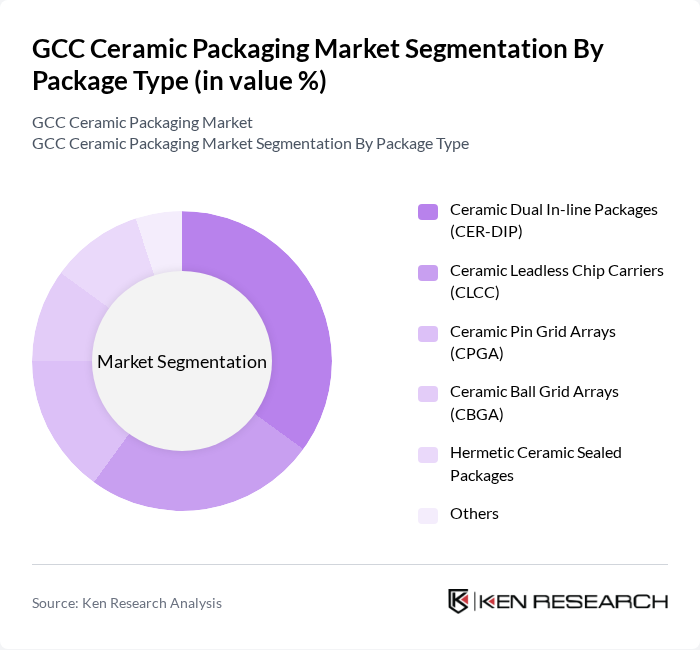
GCC Ceramic Packaging Market segmentation by Package Type.

By End-User Industry:The market is also segmented by end-user industries, including Electronics & Semiconductors, Automotive & EV Power Electronics, Aerospace & Defense, Medical Devices & Healthcare Electronics, Industrial & Energy (Power Modules, Renewables), and Others. This segmentation aligns with global ceramic packaging demand, where electronics, automotive, aerospace, medical, and industrial sectors account for the largest share of consumption. The Electronics & Semiconductors segment is the most dominant, driven by the rapid growth of consumer electronics, communications infrastructure, and high?performance computing, alongside increased semiconductor content in vehicles and industrial systems. This segment's growth is fueled by technological advancements such as 5G, wide?bandgap power devices (SiC and GaN), and miniaturized medical and defense electronics, which require ceramic packages capable of delivering excellent thermal management, hermetic sealing, and reliability under harsh operating conditions.
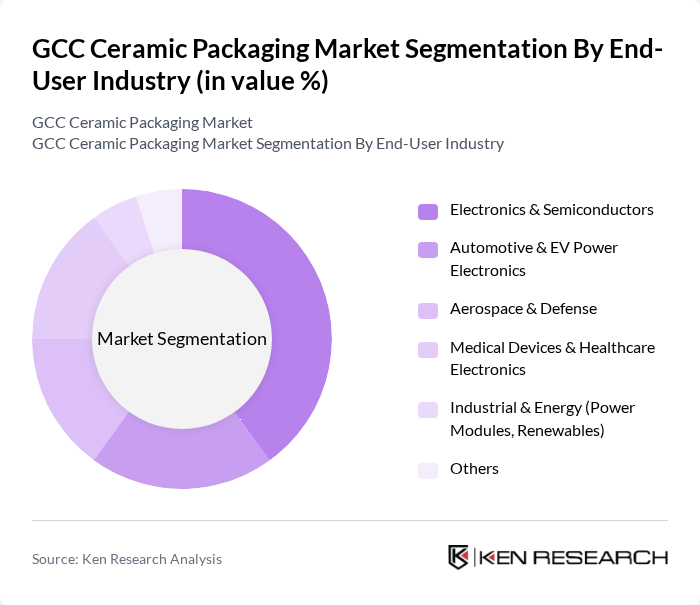
GCC Ceramic Packaging Market segmentation by End-User Industry.

GCC Ceramic Packaging Market Competitive Landscape

The GCC Ceramic Packaging Market is characterized by a dynamic mix of regional and international players. Leading participants such as Kyocera Corporation, NGK Insulators, Ltd., CoorsTek, Inc., CeramTec GmbH, MARUWA Co., Ltd., NEO Tech (formerly Natel Engineering), SCHOTT AG, Amkor Technology, Inc., ASE Technology Holding Co., Ltd., Tong Hsing Electronic Industries, Ltd., Egide Group, Materion Corporation, Microsemi Corporation (Microchip Technology Inc.), Hermetic Solutions Group, Schmid + Partner Engineering AG (SPEAG) contribute to innovation, geographic expansion, and service delivery in this space.

Kyocera Corporation

1959

Kyoto, Japan

NGK Insulators, Ltd.

1919

Nagoya, Japan

CoorsTek, Inc.

1910

Golden, Colorado, USA

CeramTec GmbH

1903

Plochingen, Germany

MARUWA Co., Ltd.

1973

Nishio, Aichi, Japan

Company

Establishment Year

Headquarters

Group Size (Global, Regional, or Local)

GCC Ceramic Packaging Revenue

GCC Revenue Growth Rate (CAGR)

Share of Revenue from Ceramic Packaging

Installed Capacity / Production Volume in GCC

Key End?Use Coverage (No. of Target Industries Served)

GCC Ceramic Packaging Market Industry Analysis

Growth Drivers

  • Increasing Demand for Sustainable Packaging Solutions:The GCC region is witnessing a significant shift towards sustainable packaging, driven by a growing awareness of environmental issues. In future, the GCC countries are expected to generate approximately 1.6 million tons of plastic waste, prompting a transition to eco-friendly alternatives like ceramic packaging. This shift is supported by government initiatives aimed at reducing plastic usage, with a projected 25% increase in sustainable packaging adoption across various sectors, including food and beverages.
  • Growth in the Food and Beverage Industry:The GCC food and beverage sector is projected to reach a market value of $210 billion in future, fueled by a rising population and increasing disposable incomes. This growth is driving demand for high-quality packaging solutions that preserve product integrity and enhance shelf appeal. As consumers become more health-conscious, the need for safe and sustainable packaging options is paramount, leading to a surge in ceramic packaging adoption within this industry.
  • Rising Consumer Preference for Premium Packaging:In future, the GCC market is expected to see a 20% increase in demand for premium packaging solutions, particularly in the cosmetics and gourmet food sectors. Consumers are increasingly willing to pay a premium for aesthetically pleasing and functional packaging that reflects quality and brand values. This trend is driving manufacturers to innovate in ceramic packaging, offering unique designs and enhanced functionality that cater to discerning consumers seeking luxury experiences.

Market Challenges

  • High Production Costs of Ceramic Materials:The production of ceramic packaging involves significant costs, primarily due to the raw materials and energy-intensive manufacturing processes. In future, the average cost of ceramic materials is projected to rise by 12%, impacting profit margins for manufacturers. This challenge is exacerbated by fluctuating energy prices and supply chain disruptions, making it difficult for companies to maintain competitive pricing while ensuring product quality.
  • Competition from Alternative Packaging Materials:The ceramic packaging market faces stiff competition from cheaper alternatives such as plastic and glass. In future, the global plastic packaging market is expected to reach $520 billion, highlighting the significant market share that alternative materials hold. This competition poses a challenge for ceramic packaging manufacturers, who must differentiate their products through innovation and sustainability to capture market interest and consumer loyalty.

GCC Ceramic Packaging Market Future Outlook

The GCC ceramic packaging market is poised for growth, driven by increasing consumer demand for sustainable and premium packaging solutions. Innovations in ceramic technology are expected to enhance product offerings, while the expansion of e-commerce will further boost demand for aesthetically pleasing packaging. As regulatory pressures mount for sustainable practices, manufacturers will need to adapt quickly to remain competitive. The focus on customization and personalization will also shape future product development, catering to evolving consumer preferences in the region.

Market Opportunities

  • Innovations in Ceramic Packaging Technology:Advancements in ceramic materials and manufacturing processes present significant opportunities for market players. In future, the introduction of lightweight and biodegradable ceramic options could attract environmentally conscious consumers, potentially increasing market share by 30% in targeted segments.
  • Expansion into Emerging Markets:The GCC region's strategic location offers access to emerging markets in Africa and Asia. In future, tapping into these markets could lead to a 35% increase in export opportunities for ceramic packaging manufacturers, driven by rising demand for quality packaging solutions in developing economies.

Scope of the Report

SegmentSub-Segments
By Package Type

Ceramic Dual In-line Packages (CER-DIP)

Ceramic Leadless Chip Carriers (CLCC)

Ceramic Pin Grid Arrays (CPGA)

Ceramic Ball Grid Arrays (CBGA)

Hermetic Ceramic Sealed Packages

Others

By End-User Industry

Electronics & Semiconductors

Automotive & EV Power Electronics

Aerospace & Defense

Medical Devices & Healthcare Electronics

Industrial & Energy (Power Modules, Renewables)

Others

By Application

Integrated Circuit (IC) Packaging

Sensor & MEMS Packaging

Power Module & RF/Microwave Packaging

LED & Optoelectronic Packaging

Others

By Distribution Channel

Direct Sales (OEM & Tier-1)

Distributors & Electronic Component Traders

Online B2B Platforms

Others

By Country

UAE

Saudi Arabia

Qatar

Kuwait

Oman

Bahrain

By Material Type

Alumina (Al?O?) Ceramics

Aluminum Nitride (AlN) Ceramics

Zirconia and Other Advanced Ceramics

Glass–Ceramic Materials

Others

By Sealing / Design Type

Hermetic Ceramic Packages

Non?Hermetic / Plastic–Ceramic Hybrid Packages

Multilayer Ceramic Packages

Custom / Application?Specific Designs

Key Target Audience

Investors and Venture Capitalist Firms

Government and Regulatory Bodies (e.g., Ministry of Industry and Advanced Technology, Saudi Standards, Metrology and Quality Organization)

Manufacturers and Producers

Distributors and Retailers

Packaging Designers and Engineers

Raw Material Suppliers

Logistics and Supply Chain Companies

Environmental and Sustainability Organizations

Players Mentioned in the Report:

Kyocera Corporation

NGK Insulators, Ltd.

CoorsTek, Inc.

CeramTec GmbH

MARUWA Co., Ltd.

NEO Tech (formerly Natel Engineering)

SCHOTT AG

Amkor Technology, Inc.

ASE Technology Holding Co., Ltd.

Tong Hsing Electronic Industries, Ltd.

Egide Group

Materion Corporation

Microsemi Corporation (Microchip Technology Inc.)

Hermetic Solutions Group

Schmid + Partner Engineering AG (SPEAG)

Table of Contents

Market Assessment Phase

1. Executive Summary and Approach


2. GCC Ceramic Packaging Market Overview

2.1 Key Insights and Strategic Recommendations

2.2 GCC Ceramic Packaging Market Overview

2.3 Definition and Scope

2.4 Evolution of Market Ecosystem

2.5 Timeline of Key Regulatory Milestones

2.6 Value Chain & Stakeholder Mapping

2.7 Business Cycle Analysis

2.8 Policy & Incentive Landscape


3. GCC Ceramic Packaging Market Analysis

3.1 Growth Drivers

3.1.1 Increasing demand for sustainable packaging solutions
3.1.2 Growth in the food and beverage industry
3.1.3 Rising consumer preference for premium packaging
3.1.4 Expansion of e-commerce and retail sectors

3.2 Market Challenges

3.2.1 High production costs of ceramic materials
3.2.2 Competition from alternative packaging materials
3.2.3 Regulatory compliance and standards
3.2.4 Limited awareness among consumers

3.3 Market Opportunities

3.3.1 Innovations in ceramic packaging technology
3.3.2 Expansion into emerging markets
3.3.3 Collaborations with food and beverage brands
3.3.4 Customization and personalization trends

3.4 Market Trends

3.4.1 Shift towards eco-friendly packaging solutions
3.4.2 Increasing use of smart packaging technologies
3.4.3 Growth in online retail and direct-to-consumer sales
3.4.4 Rising demand for aesthetic and functional packaging

3.5 Government Regulation

3.5.1 Packaging waste management regulations
3.5.2 Standards for food safety and packaging materials
3.5.3 Incentives for sustainable packaging initiatives
3.5.4 Import/export regulations for ceramic products

4. SWOT Analysis


5. Stakeholder Analysis


6. Porter's Five Forces Analysis


7. GCC Ceramic Packaging Market Market Size, 2019-2024

7.1 By Value

7.2 By Volume

7.3 By Average Selling Price


8. GCC Ceramic Packaging Market Segmentation

8.1 By Package Type

8.1.1 Ceramic Dual In-line Packages (CER-DIP)
8.1.2 Ceramic Leadless Chip Carriers (CLCC)
8.1.3 Ceramic Pin Grid Arrays (CPGA)
8.1.4 Ceramic Ball Grid Arrays (CBGA)
8.1.5 Hermetic Ceramic Sealed Packages
8.1.6 Others

8.2 By End-User Industry

8.2.1 Electronics & Semiconductors
8.2.2 Automotive & EV Power Electronics
8.2.3 Aerospace & Defense
8.2.4 Medical Devices & Healthcare Electronics
8.2.5 Industrial & Energy (Power Modules, Renewables)
8.2.6 Others

8.3 By Application

8.3.1 Integrated Circuit (IC) Packaging
8.3.2 Sensor & MEMS Packaging
8.3.3 Power Module & RF/Microwave Packaging
8.3.4 LED & Optoelectronic Packaging
8.3.5 Others

8.4 By Distribution Channel

8.4.1 Direct Sales (OEM & Tier-1)
8.4.2 Distributors & Electronic Component Traders
8.4.3 Online B2B Platforms
8.4.4 Others

8.5 By Country

8.5.1 UAE
8.5.2 Saudi Arabia
8.5.3 Qatar
8.5.4 Kuwait
8.5.5 Oman
8.5.6 Bahrain

8.6 By Material Type

8.6.1 Alumina (Al?O?) Ceramics
8.6.2 Aluminum Nitride (AlN) Ceramics
8.6.3 Zirconia and Other Advanced Ceramics
8.6.4 Glass–Ceramic Materials
8.6.5 Others

8.7 By Sealing / Design Type

8.7.1 Hermetic Ceramic Packages
8.7.2 Non?Hermetic / Plastic–Ceramic Hybrid Packages
8.7.3 Multilayer Ceramic Packages
8.7.4 Custom / Application?Specific Designs

9. GCC Ceramic Packaging Market Competitive Analysis

9.1 Market Share of Key Players

9.2 Cross Comparison of Key Players

9.2.1 Company Name
9.2.2 Group Size (Global, Regional, or Local)
9.2.3 GCC Ceramic Packaging Revenue
9.2.4 GCC Revenue Growth Rate (CAGR)
9.2.5 Share of Revenue from Ceramic Packaging
9.2.6 Installed Capacity / Production Volume in GCC
9.2.7 Key End?Use Coverage (No. of Target Industries Served)
9.2.8 Average Selling Price (ASP) Positioning
9.2.9 Gross Margin on Ceramic Packaging
9.2.10 R&D Intensity (% of Revenue)
9.2.11 New Product Launches / Design Wins in Last 3 Years
9.2.12 Geographic Penetration within GCC (No. of Countries Served)
9.2.13 Strategic Partnerships / Local JV Count

9.3 SWOT Analysis of Top Players

9.4 Pricing Analysis

9.5 Detailed Profile of Major Companies

9.5.1 Kyocera Corporation
9.5.2 NGK Insulators, Ltd.
9.5.3 CoorsTek, Inc.
9.5.4 CeramTec GmbH
9.5.5 MARUWA Co., Ltd.
9.5.6 NEO Tech (formerly Natel Engineering)
9.5.7 SCHOTT AG
9.5.8 Amkor Technology, Inc.
9.5.9 ASE Technology Holding Co., Ltd.
9.5.10 Tong Hsing Electronic Industries, Ltd.
9.5.11 Egide Group
9.5.12 Materion Corporation
9.5.13 Microsemi Corporation (Microchip Technology Inc.)
9.5.14 Hermetic Solutions Group
9.5.15 Schmid + Partner Engineering AG (SPEAG)

10. GCC Ceramic Packaging Market End-User Analysis

10.1 Procurement Behavior of Key Ministries

10.1.1 Government procurement policies
10.1.2 Budget allocation for ceramic packaging
10.1.3 Supplier selection criteria
10.1.4 Contract management practices

10.2 Corporate Spend on Infrastructure & Energy

10.2.1 Investment trends in ceramic packaging
10.2.2 Budgeting for sustainable materials
10.2.3 Cost-benefit analysis of ceramic packaging
10.2.4 Long-term financial commitments

10.3 Pain Point Analysis by End-User Category

10.3.1 Quality assurance issues
10.3.2 Supply chain disruptions
10.3.3 Cost management challenges
10.3.4 Regulatory compliance hurdles

10.4 User Readiness for Adoption

10.4.1 Awareness of ceramic packaging benefits
10.4.2 Training and support needs
10.4.3 Adoption barriers
10.4.4 Feedback mechanisms

10.5 Post-Deployment ROI and Use Case Expansion

10.5.1 Measurement of ROI
10.5.2 Case studies of successful implementations
10.5.3 Scalability of ceramic packaging solutions
10.5.4 Future use case opportunities

11. GCC Ceramic Packaging Market Future Size, 2025-2030

11.1 By Value

11.2 By Volume

11.3 By Average Selling Price


Go-To-Market Strategy Phase

1. Whitespace Analysis + Business Model Canvas

1.1 Market gaps identification

1.2 Value proposition development

1.3 Revenue model exploration

1.4 Customer segmentation analysis

1.5 Competitive landscape assessment

1.6 Key partnerships identification

1.7 Risk assessment and mitigation


2. Marketing and Positioning Recommendations

2.1 Branding strategies

2.2 Product USPs

2.3 Target audience definition

2.4 Marketing channels selection

2.5 Messaging and communication strategy

2.6 Performance metrics

2.7 Budget allocation


3. Distribution Plan

3.1 Urban retail strategies

3.2 Rural NGO tie-ups

3.3 E-commerce integration

3.4 Logistics and supply chain management

3.5 Distribution partnerships

3.6 Inventory management

3.7 Performance tracking


4. Channel & Pricing Gaps

4.1 Underserved routes

4.2 Pricing bands analysis

4.3 Competitor pricing strategies

4.4 Customer willingness to pay

4.5 Price elasticity assessment

4.6 Discounting strategies

4.7 Value-based pricing


5. Unmet Demand & Latent Needs

5.1 Category gaps identification

5.2 Consumer segments analysis

5.3 Product development opportunities

5.4 Market entry barriers

5.5 Customer feedback incorporation

5.6 Trend analysis

5.7 Future demand forecasting


6. Customer Relationship

6.1 Loyalty programs

6.2 After-sales service

6.3 Customer engagement strategies

6.4 Feedback loops

6.5 Relationship management tools

6.6 Retention strategies

6.7 Customer satisfaction metrics


7. Value Proposition

7.1 Sustainability initiatives

7.2 Integrated supply chains

7.3 Unique selling points

7.4 Customer-centric approach

7.5 Competitive advantages

7.6 Market differentiation

7.7 Long-term value creation


8. Key Activities

8.1 Regulatory compliance

8.2 Branding efforts

8.3 Distribution setup

8.4 Marketing campaigns

8.5 Training and development

8.6 Performance monitoring

8.7 Stakeholder engagement


9. Entry Strategy Evaluation

9.1 Domestic Market Entry Strategy

9.1.1 Product mix considerations
9.1.2 Pricing band analysis
9.1.3 Packaging strategies

9.2 Export Entry Strategy

9.2.1 Target countries selection
9.2.2 Compliance roadmap development

10. Entry Mode Assessment

10.1 Joint Ventures

10.2 Greenfield Investments

10.3 Mergers & Acquisitions

10.4 Distributor Model

10.5 Risk assessment

10.6 Strategic fit evaluation

10.7 Long-term sustainability


11. Capital and Timeline Estimation

11.1 Capital requirements

11.2 Timelines for market entry

11.3 Financial projections

11.4 Funding sources

11.5 Cost management strategies

11.6 Investment return expectations


12. Control vs Risk Trade-Off

12.1 Ownership considerations

12.2 Partnerships evaluation

12.3 Risk management strategies

12.4 Control mechanisms

12.5 Long-term implications

12.6 Stakeholder interests


13. Profitability Outlook

13.1 Breakeven analysis

13.2 Long-term sustainability

13.3 Profit margin expectations

13.4 Revenue growth projections

13.5 Cost structure analysis

13.6 Financial health indicators


14. Potential Partner List

14.1 Distributors

14.2 Joint Ventures

14.3 Acquisition targets

14.4 Strategic alliances

14.5 Collaboration opportunities

14.6 Partnership evaluation criteria


15. Execution Roadmap

15.1 Phased Plan for Market Entry

15.1.1 Market Setup
15.1.2 Market Entry
15.1.3 Growth Acceleration
15.1.4 Scale & Stabi

Research Methodology

ApproachModellingSample

Phase 1: Approach1

Desk Research

  • Industry reports from GCC trade associations and ceramic packaging councils
  • Market analysis from government publications and economic development agencies
  • Academic journals and white papers focusing on ceramic materials and packaging innovations

Primary Research

  • Interviews with key stakeholders in the ceramic packaging supply chain, including manufacturers and distributors
  • Surveys targeting packaging engineers and product managers in consumer goods companies
  • Field visits to production facilities to gather insights on operational practices and technology adoption

Validation & Triangulation

  • Cross-validation of findings through multiple data sources, including trade publications and market surveys
  • Triangulation of qualitative insights from interviews with quantitative data from market reports
  • Sanity checks conducted through expert panel discussions with industry veterans

Phase 2: Market Size Estimation1

Top-down Assessment

  • Analysis of overall packaging market size in the GCC region, focusing on ceramic segment contributions
  • Segmentation by end-user industries such as food and beverage, pharmaceuticals, and cosmetics
  • Incorporation of regional economic growth forecasts and consumer spending trends

Bottom-up Modeling

  • Volume estimates based on production capacities of leading ceramic packaging manufacturers
  • Cost analysis derived from material sourcing and production processes
  • Estimation of market share based on sales data from key players in the ceramic packaging sector

Forecasting & Scenario Analysis

  • Multi-variable forecasting models incorporating trends in sustainability and consumer preferences
  • Scenario planning based on potential regulatory changes affecting packaging materials
  • Development of baseline, optimistic, and pessimistic market growth scenarios through 2030

Phase 3: CATI Sample Composition1

Scope Item/SegmentSample SizeTarget Respondent Profiles
Food & Beverage Packaging120Packaging Managers, Quality Assurance Officers
Pharmaceutical Packaging Solutions100Regulatory Affairs Specialists, Product Development Managers
Cosmetic and Personal Care Packaging80Brand Managers, Supply Chain Coordinators
Industrial Ceramic Packaging70Procurement Managers, Operations Directors
Market Trends and Innovations90Research Analysts, Market Strategists

Frequently Asked Questions

What is the current value of the GCC Ceramic Packaging Market?

The GCC Ceramic Packaging Market is valued at approximately USD 1.0 billion, reflecting its significant share within the global ceramic packaging market, which is estimated to be between USD 11 billion and USD 13 billion.

What are the main drivers of growth in the GCC Ceramic Packaging Market?

Which countries are leading in the GCC Ceramic Packaging Market?

How is sustainability influencing the GCC Ceramic Packaging Market?

Other Regional/Country Reports

Indonesia Ceramic Packaging Market Report Size, Share, Growth Drivers, Trends, Opportunities & Forecast 2025–2030

Malaysia Ceramic Packaging Market Report Size, Share, Growth Drivers, Trends, Opportunities & Forecast 2025–2030

KSA Ceramic Packaging Market Report Size, Share, Growth Drivers, Trends, Opportunities & Forecast 2025–2030

APAC Ceramic Packaging Market Report Size, Share, Growth Drivers, Trends, Opportunities & Forecast 2025–2030

SEA Ceramic Packaging Market Report Size, Share, Growth Drivers, Trends, Opportunities & Forecast 2025–2030

Vietnam Ceramic Packaging Market Report Size, Share, Growth Drivers, Trends, Opportunities & Forecast 2025–2030

Why Buy From Us?

Refine Robust Result (RRR) Framework

What makes us stand out is that our consultants follow Robust, Refine and Result (RRR) methodology. Robust for clear definitions, approaches and sanity checking, Refine for differentiating respondents' facts and opinions, and Result for presenting data with story.

Our Reach Is Unmatched

We have set a benchmark in the industry by offering our clients with syndicated and customized market research reports featuring coverage of entire market as well as meticulous research and analyst insights.

Shifting the Research Paradigm

While we don't replace traditional research, we flip the method upside down. Our dual approach of Top Bottom & Bottom Top ensures quality deliverable by not just verifying company fundamentals but also looking at the sector and macroeconomic factors.

More Insights-Better Decisions

With one step in the future, our research team constantly tries to show you the bigger picture. We help with some of the tough questions you may encounter along the way: How is the industry positioned? Best marketing channel? KPI's of competitors? By aligning every element, we help maximize success.

Transparency and Trust

Our report gives you instant access to the answers and sources that other companies might choose to hide. We elaborate each steps of research methodology we have used and showcase you the sample size to earn your trust.

Round the Clock Support

If you need any support, we are here! We pride ourselves on universe strength, data quality, and quick, friendly, and professional service.

Why Clients Choose Us?

400000+
Reports in repository
150+
Consulting projects a year
100+
Analysts
8000+
Client Queries in 2022








