Gcc Enameled Cookware Market Report Size, Share, Growth Drivers, Trends, Opportunities & Forecast 2025–2030

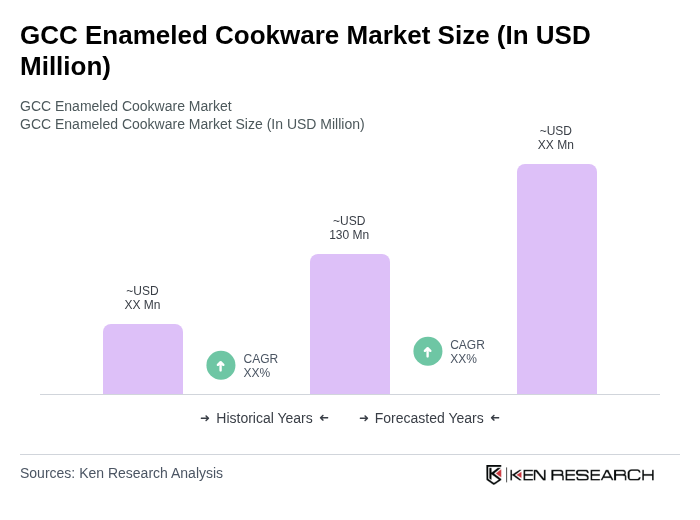
GCC enameled cookware market, valued at USD 130 million, grows with consumer preference for premium, health-conscious cookware amid expanding retail and e-commerce.

Region:Middle East

Author(s):Shubham

Product Code:KRAD6582

Pages:87

Published On:December 2025
About the Report

Base Year 2024

GCC Enameled Cookware Market Overview

  • The GCC Enameled Cookware Market is valued at USD 130 million, based on a five-year historical analysis of its share within the global enameled cookware industry and the region’s contribution to premium cookware demand. This growth is primarily driven by increasing consumer preference for durable and aesthetically pleasing cookware, alongside a rising trend in home cooking and culinary experimentation across the Middle East. The market has seen a surge in demand for enameled cookware due to its non-reactive properties, heat-retention performance, and ease of maintenance, appealing strongly to health-conscious and design-focused consumers.
  • Key players in this market include the United Arab Emirates and Saudi Arabia, which dominate due to their robust modern retail infrastructure, high per-capita income levels, and concentration of organized homeware retail and e-commerce. The UAE's diverse expatriate population, strong tourism sector, and cosmopolitan culinary culture foster a strong demand for premium and branded cookware, including enameled cast iron and steel ranges. Saudi Arabia's growing urbanization, expanding middle class, and ongoing investments in hospitality and foodservice, particularly under national transformation and tourism initiatives, contribute to increased sales of enameled cookware across both residential and HoReCa channels.
  • In the GCC region, cookware placed on the market must comply with Gulf and national food-contact material safety frameworks, which apply to enameled cookware as well. For example, the Gulf Technical Regulation for Food Contact Materials “GSO 1863/2013 – Materials and Articles in Contact with Food” issued by the GCC Standardization Organization, together with national implementations such as the UAE Cabinet Resolution No. 10 of 2017 on the UAE Food Safety Law and subsequent implementing regulations, requires that cookware and its coatings do not transfer harmful substances to food, mandates conformity assessment and documentation, and enforces labeling and traceability obligations for manufacturers, importers, and distributors. These requirements effectively ensure that enameled cookware imported and sold in GCC markets must meet specific migration limits and safety criteria, supporting consumer health protection and encouraging manufacturers to adopt safer enamel formulations and more sustainable production practices.
GCC Enameled Cookware Market Size

GCC Enameled Cookware Market Segmentation

By Product Type:The product type segmentation includes various categories such as Enameled Cast Iron Pots & Dutch Ovens, Enameled Cast Iron Pans & Skillets, Enameled Steel Cookware, Enameled Bakeware & Roasters, and Others. Among these, Enameled Cast Iron Pots & Dutch Ovens are leading the market due to their versatility and ability to retain heat, aligning with global patterns where pots and multi-purpose vessels command a leading share in enameled cookware. Their suitability for braising, stewing, baking, and slow cooking makes them a favorite among home cooks and professional chefs alike, while the trend towards slow cooking, one-pot meals, and gourmet home dining has further boosted their popularity in GCC households and premium HoReCa kitchens.
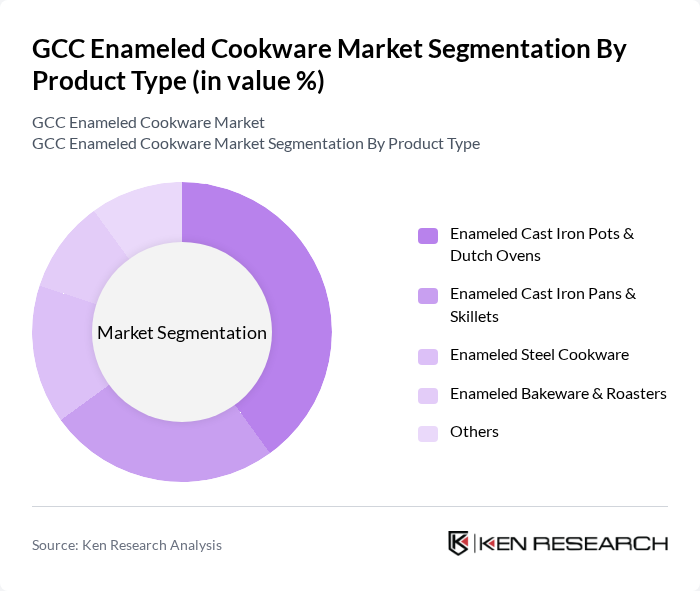
GCC Enameled Cookware Market segmentation by Product Type.

By Application:The application segmentation encompasses Residential Households, HoReCa (Hotels, Restaurants & Cafés), Institutional Catering (Airlines, Hospitals, Schools), and Others. The Residential Households segment is the most significant, consistent with global trends where residential users account for the majority of enameled cookware consumption, driven by the increasing preference for home cooking, kitchen upgrades, and aesthetically coordinated cookware. This segment benefits from the rising number of cooking shows, recipe platforms, and social media influencers promoting home-cooked meals, table presentation, and premium cookware brands, which supports higher adoption of enameled cast iron and steel products in GCC homes.
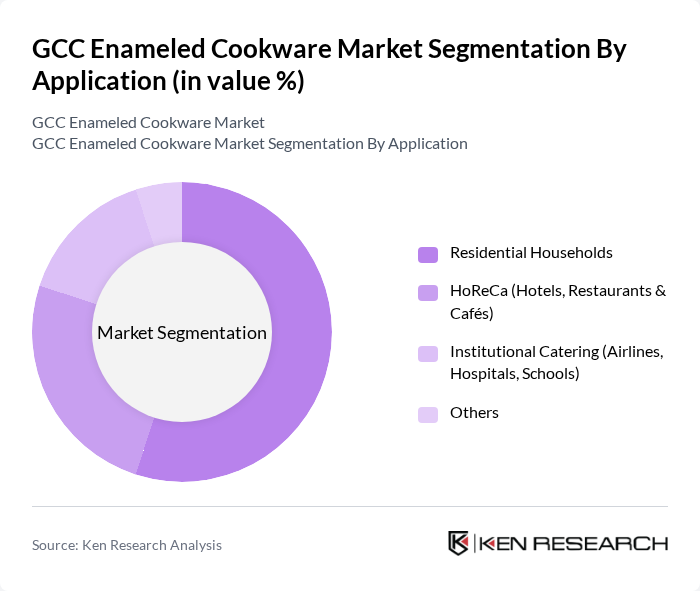
GCC Enameled Cookware Market segmentation by Application.

GCC Enameled Cookware Market Competitive Landscape

The GCC Enameled Cookware Market is characterized by a dynamic mix of regional and international players. Leading participants such as Le Creuset, Staub (Zwilling Group), Tefal (Groupe SEB), Lodge Cast Iron, Tramontina, Fontignac (Zwilling Group), BergHOFF, Royalford (Western International Group), Home Centre (Landmark Group – Private Label Cookware), IKEA (Enameled Cookware Range), Meyer Corporation (including Anolon & Circulon Enameled Lines), Prestige (TTK Prestige), Noon East & AmazonBasics (Regional E-commerce Private Labels), Douti Home (Regional Cookware Brand), Carrefour & Lulu Private Label Enameled Cookware contribute to innovation, geographic expansion, and service delivery in this space.

Le Creuset

1925

France

Staub (Zwilling Group)

1974

France

Tefal (Groupe SEB)

1956

France

Lodge Cast Iron

1896

USA

Tramontina

1911

Brazil

Company

Establishment Year

Headquarters

Regional Presence in GCC (Number of Countries Served)

Estimated GCC Enameled Cookware Revenue

GCC Revenue Growth Rate (CAGR)

Enameled Cookware Portfolio Breadth (SKUs / Categories)

Average Selling Price Positioning (Economy / Mid / Premium / Luxury)

Share of Online Sales in GCC (%)

GCC Enameled Cookware Market Industry Analysis

Growth Drivers

  • Increasing Consumer Preference for Non-Toxic Cookware:The GCC region has seen a significant shift towards non-toxic cookware, with a reported 60% of consumers prioritizing health-conscious products. This trend is driven by rising concerns over chemical leaching from traditional cookware. According to the World Health Organization, the demand for safer cooking materials is expected to grow, with the GCC's health-conscious population projected to reach 26 million in future, further fueling the enameled cookware market.
  • Rising Disposable Income in the GCC Region:The GCC's average disposable income is projected to reach $32,000 per capita in future, reflecting a 6% increase from previous period. This economic growth enables consumers to invest in higher-quality cookware, including enameled options. As disposable income rises, consumers are more likely to prioritize premium products that offer durability and aesthetic appeal, thus driving demand for enameled cookware in the region.
  • Expansion of Retail Channels and E-Commerce Platforms:The GCC's retail landscape is evolving, with e-commerce sales expected to surpass $35 billion in future, growing at a rate of 16% annually. This expansion provides enameled cookware brands with increased visibility and accessibility. Enhanced online shopping experiences and the proliferation of retail outlets allow consumers to easily access a variety of enameled cookware options, thus stimulating market growth in the region.

Market Challenges

  • High Competition from Alternative Cookware Materials:The enameled cookware market faces intense competition from alternatives such as stainless steel and non-stick materials, which account for approximately 42% of the cookware market share in the GCC. This competition is exacerbated by aggressive pricing strategies from manufacturers of these alternatives, making it challenging for enameled cookware brands to maintain market share and profitability in a price-sensitive environment.
  • Fluctuating Raw Material Prices:The cost of raw materials for enameled cookware, such as steel and enamel coatings, has seen volatility, with prices increasing by 12% in the last year alone. This fluctuation can significantly impact production costs and profit margins for manufacturers. As global supply chains remain unstable, the enameled cookware industry must navigate these challenges to sustain competitive pricing and product availability.

GCC Enameled Cookware Market Future Outlook

The GCC enameled cookware market is poised for growth, driven by increasing consumer awareness of health benefits and a shift towards eco-friendly products. As disposable incomes rise, consumers are expected to invest more in premium cookware. Additionally, the expansion of e-commerce platforms will facilitate greater access to diverse product offerings. Innovations in design and functionality will further enhance market appeal, positioning enameled cookware as a preferred choice among discerning consumers in the region.

Market Opportunities

  • Expansion into Untapped Markets:There is significant potential for enameled cookware brands to penetrate untapped markets within the GCC, particularly in rural areas where awareness of product benefits is low. Targeting these regions could lead to a 22% increase in market share in future, as consumers become more health-conscious and seek quality cookware options.
  • Collaborations with Local Chefs and Influencers:Partnering with local chefs and influencers can enhance brand visibility and credibility. Such collaborations can drive consumer interest and engagement, potentially increasing sales by 17% as these figures suggest that influencer marketing significantly impacts purchasing decisions in the GCC, particularly among younger demographics.

Scope of the Report

SegmentSub-Segments
By Product Type

Enameled Cast Iron Pots & Dutch Ovens

Enameled Cast Iron Pans & Skillets

Enameled Steel Cookware

Enameled Bakeware & Roasters

Others

By Application

Residential Households

HoReCa (Hotels, Restaurants & Cafés)

Institutional Catering (Airlines, Hospitals, Schools)

Others

By Distribution Channel

Supermarkets/Hypermarkets

Specialty Cookware & Department Stores

Online Retail & Marketplaces

Direct-to-Consumer Brand Stores

Others

By Price Range

Economy

Mid-Range

Premium

Luxury

By Material Base

Enameled Cast Iron

Enameled Carbon Steel

Enameled Stainless Steel

Others

By Aesthetic & Color Theme

Classic Solid Colors

Gradient & Multi-Tone Finishes

Limited Edition & Seasonal Colors

Custom & Private-Label Designs

By Brand Positioning

Global Luxury Brands

International Mid-Tier Brands

Value & Private-Label Brands

Local & Regional Brands

Key Target Audience

Investors and Venture Capitalist Firms

Government and Regulatory Bodies (e.g., Ministry of Commerce and Industry, Saudi Food and Drug Authority)

Manufacturers and Producers

Distributors and Retailers

Importers and Exporters

Industry Associations (e.g., Gulf Cooperation Council Manufacturers Association)

Financial Institutions

Quality Assurance and Testing Laboratories

Players Mentioned in the Report:

Le Creuset

Staub (Zwilling Group)

Tefal (Groupe SEB)

Lodge Cast Iron

Tramontina

Fontignac (Zwilling Group)

BergHOFF

Royalford (Western International Group)

Home Centre (Landmark Group Private Label Cookware)

IKEA (Enameled Cookware Range)

Meyer Corporation (including Anolon & Circulon Enameled Lines)

Prestige (TTK Prestige)

Noon East & AmazonBasics (Regional E-commerce Private Labels)

Douti Home (Regional Cookware Brand)

Carrefour & Lulu Private Label Enameled Cookware

Table of Contents

Market Assessment Phase

1. Executive Summary and Approach


2. GCC Enameled Cookware Market Overview

2.1 Key Insights and Strategic Recommendations

2.2 GCC Enameled Cookware Market Overview

2.3 Definition and Scope

2.4 Evolution of Market Ecosystem

2.5 Timeline of Key Regulatory Milestones

2.6 Value Chain & Stakeholder Mapping

2.7 Business Cycle Analysis

2.8 Policy & Incentive Landscape


3. GCC Enameled Cookware Market Analysis

3.1 Growth Drivers

3.1.1 Increasing consumer preference for non-toxic cookware
3.1.2 Rising disposable income in the GCC region
3.1.3 Growing awareness of health benefits associated with enameled cookware
3.1.4 Expansion of retail channels and e-commerce platforms

3.2 Market Challenges

3.2.1 High competition from alternative cookware materials
3.2.2 Fluctuating raw material prices
3.2.3 Limited consumer awareness about product benefits
3.2.4 Regulatory compliance and quality standards

3.3 Market Opportunities

3.3.1 Expansion into untapped markets within the GCC
3.3.2 Introduction of innovative product designs
3.3.3 Collaborations with local chefs and influencers
3.3.4 Growth in online sales channels

3.4 Market Trends

3.4.1 Increasing demand for eco-friendly cookware
3.4.2 Rising popularity of gourmet cooking at home
3.4.3 Shift towards premium and artisanal cookware
3.4.4 Enhanced focus on product aesthetics and design

3.5 Government Regulation

3.5.1 Standards for food safety and cookware materials
3.5.2 Import regulations and tariffs on cookware
3.5.3 Environmental regulations regarding manufacturing processes
3.5.4 Consumer protection laws related to product labeling

4. SWOT Analysis


5. Stakeholder Analysis


6. Porter's Five Forces Analysis


7. GCC Enameled Cookware Market Market Size, 2019-2024

7.1 By Value

7.2 By Volume

7.3 By Average Selling Price


8. GCC Enameled Cookware Market Segmentation

8.1 By Product Type

8.1.1 Enameled Cast Iron Pots & Dutch Ovens
8.1.2 Enameled Cast Iron Pans & Skillets
8.1.3 Enameled Steel Cookware
8.1.4 Enameled Bakeware & Roasters
8.1.5 Others

8.2 By Application

8.2.1 Residential Households
8.2.2 HoReCa (Hotels, Restaurants & Cafés)
8.2.3 Institutional Catering (Airlines, Hospitals, Schools)
8.2.4 Others

8.3 By Distribution Channel

8.3.1 Supermarkets/Hypermarkets
8.3.2 Specialty Cookware & Department Stores
8.3.3 Online Retail & Marketplaces
8.3.4 Direct-to-Consumer Brand Stores
8.3.5 Others

8.4 By Price Range

8.4.1 Economy
8.4.2 Mid-Range
8.4.3 Premium
8.4.4 Luxury

8.5 By Material Base

8.5.1 Enameled Cast Iron
8.5.2 Enameled Carbon Steel
8.5.3 Enameled Stainless Steel
8.5.4 Others

8.6 By Aesthetic & Color Theme

8.6.1 Classic Solid Colors
8.6.2 Gradient & Multi-Tone Finishes
8.6.3 Limited Edition & Seasonal Colors
8.6.4 Custom & Private-Label Designs

8.7 By Brand Positioning

8.7.1 Global Luxury Brands
8.7.2 International Mid-Tier Brands
8.7.3 Value & Private-Label Brands
8.7.4 Local & Regional Brands

9. GCC Enameled Cookware Market Competitive Analysis

9.1 Market Share of Key Players

9.2 Cross Comparison of Key Players

9.2.1 Company Name
9.2.2 Regional Presence in GCC (Number of Countries Served)
9.2.3 Estimated GCC Enameled Cookware Revenue
9.2.4 GCC Revenue Growth Rate (CAGR)
9.2.5 Enameled Cookware Portfolio Breadth (SKUs / Categories)
9.2.6 Average Selling Price Positioning (Economy / Mid / Premium / Luxury)
9.2.7 Share of Online Sales in GCC (%)
9.2.8 Retail Touchpoints in GCC (Stores / Key Retail Partners)
9.2.9 Brand Awareness & Preference Score in GCC
9.2.10 Warranty & After-Sales Coverage (Years / Service Network Depth)
9.2.11 New Product Launch Frequency in GCC (Per Year)

9.3 SWOT Analysis of Top Players

9.4 Pricing Analysis

9.5 Detailed Profile of Major Companies

9.5.1 Le Creuset
9.5.2 Staub (Zwilling Group)
9.5.3 Tefal (Groupe SEB)
9.5.4 Lodge Cast Iron
9.5.5 Tramontina
9.5.6 Fontignac (Zwilling Group)
9.5.7 BergHOFF
9.5.8 Royalford (Western International Group)
9.5.9 Home Centre (Landmark Group – Private Label Cookware)
9.5.10 IKEA (Enameled Cookware Range)
9.5.11 Meyer Corporation (including Anolon & Circulon Enameled Lines)
9.5.12 Prestige (TTK Prestige)
9.5.13 Noon East & AmazonBasics (Regional E-commerce Private Labels)
9.5.14 Douti Home (Regional Cookware Brand)
9.5.15 Carrefour & Lulu Private Label Enameled Cookware

10. GCC Enameled Cookware Market End-User Analysis

10.1 Procurement Behavior of Key Ministries

10.1.1 Key Procurement Policies
10.1.2 Budget Allocation Trends
10.1.3 Supplier Selection Criteria
10.1.4 Contract Management Practices

10.2 Corporate Spend on Infrastructure & Energy

10.2.1 Investment Trends in Cookware
10.2.2 Budgeting for Kitchen Equipment
10.2.3 Corporate Partnerships with Cookware Brands
10.2.4 Sustainability Initiatives

10.3 Pain Point Analysis by End-User Category

10.3.1 Quality Concerns
10.3.2 Price Sensitivity
10.3.3 Availability of Products
10.3.4 After-Sales Support

10.4 User Readiness for Adoption

10.4.1 Awareness Levels
10.4.2 Training and Support Needs
10.4.3 Adoption Barriers
10.4.4 Feedback Mechanisms

10.5 Post-Deployment ROI and Use Case Expansion

10.5.1 Measurement of ROI
10.5.2 Use Case Scenarios
10.5.3 Customer Feedback Integration
10.5.4 Future Expansion Plans

11. GCC Enameled Cookware Market Future Size, 2025-2030

11.1 By Value

11.2 By Volume

11.3 By Average Selling Price


Go-To-Market Strategy Phase

1. Whitespace Analysis + Business Model Canvas

1.1 Market Gaps Identification

1.2 Business Model Framework


2. Marketing and Positioning Recommendations

2.1 Branding Strategies

2.2 Product USPs


3. Distribution Plan

3.1 Urban Retail Strategies

3.2 Rural NGO Tie-Ups


4. Channel & Pricing Gaps

4.1 Underserved Routes

4.2 Pricing Bands Analysis


5. Unmet Demand & Latent Needs

5.1 Category Gaps

5.2 Consumer Segments


6. Customer Relationship

6.1 Loyalty Programs

6.2 After-Sales Service


7. Value Proposition

7.1 Sustainability Initiatives

7.2 Integrated Supply Chains


8. Key Activities

8.1 Regulatory Compliance

8.2 Branding Efforts

8.3 Distribution Setup


9. Entry Strategy Evaluation

9.1 Domestic Market Entry Strategy

9.1.1 Product Mix Considerations
9.1.2 Pricing Band Strategy
9.1.3 Packaging Innovations

9.2 Export Entry Strategy

9.2.1 Target Countries Analysis
9.2.2 Compliance Roadmap

10. Entry Mode Assessment

10.1 Joint Ventures

10.2 Greenfield Investments

10.3 Mergers & Acquisitions

10.4 Distributor Model


11. Capital and Timeline Estimation

11.1 Capital Requirements

11.2 Timelines for Market Entry


12. Control vs Risk Trade-Off

12.1 Ownership vs Partnerships


13. Profitability Outlook

13.1 Breakeven Analysis

13.2 Long-Term Sustainability


14. Potential Partner List

14.1 Distributors

14.2 Joint Ventures

14.3 Acquisition Targets


15. Execution Roadmap

15.1 Phased Plan for Market Entry

15.1.1 Market Setup
15.1.2 Market Entry
15.1.3 Growth Acceleration
15.1.4 Scale & Stabilize

15.2 Key Activities and Milestones

15.2.1 Milestone Planning
15.2.2 Activity Tracking

Research Methodology

ApproachModellingSample

Phase 1: Approach1

Desk Research

  • Market reports from industry associations such as the Gulf Cooperation Council (GCC) and local trade bodies
  • Analysis of import/export data from customs authorities and trade statistics
  • Review of consumer behavior studies and market trends published in academic journals

Primary Research

  • Interviews with product managers at leading cookware manufacturers in the GCC region
  • Surveys with retailers and distributors to understand market dynamics and consumer preferences
  • Focus group discussions with end-users to gather insights on product features and brand perceptions

Validation & Triangulation

  • Cross-validation of findings through multiple data sources including sales data and market surveys
  • Triangulation of insights from primary interviews with secondary research findings
  • Sanity checks conducted through expert panel reviews comprising industry veterans

Phase 2: Market Size Estimation1

Top-down Assessment

  • Estimation of total market size based on regional cookware sales data and growth rates
  • Segmentation of the market by product type, including enameled cookware, and end-user demographics
  • Incorporation of macroeconomic factors such as GDP growth and consumer spending trends in the GCC

Bottom-up Modeling

  • Collection of sales volume data from key manufacturers and retailers in the enameled cookware segment
  • Estimation of average selling prices based on product categories and market positioning
  • Calculation of market size using volume x price methodology for accurate revenue projections

Forecasting & Scenario Analysis

  • Development of forecasting models based on historical sales data and market growth trends
  • Scenario analysis considering factors such as changes in consumer preferences and economic conditions
  • Creation of baseline, optimistic, and pessimistic forecasts through 2030 to account for market volatility

Phase 3: CATI Sample Composition1

Scope Item/SegmentSample SizeTarget Respondent Profiles
Retail Market Insights150Store Managers, Category Buyers
Consumer Preferences Survey120Home Cooks, Culinary Enthusiasts
Distribution Channel Analysis100Wholesale Distributors, Importers
Brand Perception Study120Brand Managers, Marketing Executives
Product Feature Evaluation80Product Designers, Quality Assurance Managers

Frequently Asked Questions

What is the current value of the GCC Enameled Cookware Market?

The GCC Enameled Cookware Market is valued at approximately USD 130 million, reflecting its significant share within the global enameled cookware industry and the region's growing demand for premium cookware options.

What factors are driving the growth of the GCC Enameled Cookware Market?

Which countries are the leading players in the GCC Enameled Cookware Market?

What types of enameled cookware are most popular in the GCC region?

Other Regional/Country Reports

Indonesia Enameled Cookware Market

Malaysia Enameled Cookware Market

KSA Enameled Cookware Market

APAC Enameled Cookware Market

SEA Enameled Cookware Market

Vietnam Enameled Cookware Market

Why Buy From Us?

Refine Robust Result (RRR) Framework

What makes us stand out is that our consultants follow Robust, Refine and Result (RRR) methodology. Robust for clear definitions, approaches and sanity checking, Refine for differentiating respondents' facts and opinions, and Result for presenting data with story.

Our Reach Is Unmatched

We have set a benchmark in the industry by offering our clients with syndicated and customized market research reports featuring coverage of entire market as well as meticulous research and analyst insights.

Shifting the Research Paradigm

While we don't replace traditional research, we flip the method upside down. Our dual approach of Top Bottom & Bottom Top ensures quality deliverable by not just verifying company fundamentals but also looking at the sector and macroeconomic factors.

More Insights-Better Decisions

With one step in the future, our research team constantly tries to show you the bigger picture. We help with some of the tough questions you may encounter along the way: How is the industry positioned? Best marketing channel? KPI's of competitors? By aligning every element, we help maximize success.

Transparency and Trust

Our report gives you instant access to the answers and sources that other companies might choose to hide. We elaborate each steps of research methodology we have used and showcase you the sample size to earn your trust.

Round the Clock Support

If you need any support, we are here! We pride ourselves on universe strength, data quality, and quick, friendly, and professional service.

Why Clients Choose Us?

400000+
Reports in repository
150+
Consulting projects a year
100+
Analysts
8000+
Client Queries in 2022








