About the Report
Base Year 2024GCC Industrial Boiler Market Overview
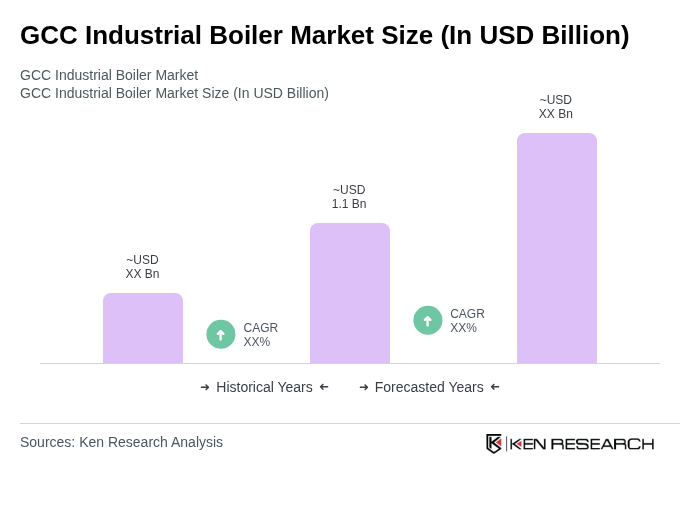
- The GCC Industrial Boiler Market is valued at USD 1.1 billion, based on a five-year historical analysis. This growth is primarily driven by the increasing demand for energy-efficient solutions, rapid industrialization, and the expansion of sectors such as oil and gas, chemicals, and power generation. The market is further influenced by the adoption of advanced boiler technologies to meet stringent emissions standards and sustainability goals, as well as the modernization of industrial infrastructure across the region .
- Key players in this market include Saudi Arabia, the UAE, and Qatar, which dominate due to substantial investments in infrastructure and industrial projects. Saudi Arabia’s Vision 2030 initiative and the UAE’s economic diversification strategies have accelerated demand for industrial boilers. Qatar’s expanding energy sector and ongoing industrial projects further reinforce its market prominence, making these countries central to the GCC Industrial Boiler Market .
- In 2023, the GCC governments enforced stricter emissions regulations to reduce greenhouse gas emissions from industrial operations. For example, the “GCC Standardization Organization Technical Regulation for Stationary Combustion Plants, GSO 2528:2023,” issued by the GCC Standardization Organization, mandates compliance with specific emissions thresholds and efficiency standards for industrial boilers. These regulations require industries to upgrade their boiler systems to meet new operational and environmental benchmarks, thereby driving demand for advanced and environmentally friendly boiler technologies across the region .
GCC Industrial Boiler Market Segmentation
By Type:The market is segmented into various types of boilers, including Fire-tube Boilers, Water-tube Boilers, Electric Boilers, Biomass Boilers, Oil & Gas Boilers, Vertical Boilers, and Others. Each type serves different industrial needs and applications, with specific advantages in efficiency, capacity, and fuel type .

TheFire-tube Boilerssegment leads the market, attributed to their widespread use in food processing, manufacturing, and other industries where efficient heat transfer and lower operational costs are critical.Water-tube Boilersare increasingly adopted in power generation and high-pressure applications due to their superior capacity and safety features. The growing focus on energy efficiency and sustainability is accelerating the adoption ofElectricandBiomass Boilers, which are recognized as environmentally friendly alternatives for industrial heating needs .
By End-User:The market is segmented by end-user industries, including Chemicals & Petrochemicals, Food & Beverage, Oil & Gas, Power Generation, Metals & Mining, Refineries, and Others. Each sector has unique requirements for boiler systems based on their operational processes and energy needs .

TheChemicals & Petrochemicalssector is the leading end-user of industrial boilers, driven by the need for steam and heat in various chemical processes. TheOil & Gasindustry follows closely, utilizing boilers for enhanced oil recovery and processing. TheFood & Beveragesector is also significant, requiring boilers for cooking, pasteurization, and cleaning processes. The increasing demand for energy-efficient and sustainable solutions is pushing these industries to adopt advanced boiler technologies .
GCC Industrial Boiler Market Competitive Landscape
The GCC Industrial Boiler Market is characterized by a dynamic mix of regional and international players. Leading participants such as Babcock & Wilcox Enterprises, Inc., Siemens AG, Thermax Limited, Mitsubishi Power, Ltd. (formerly Mitsubishi Hitachi Power Systems, Ltd.), Bosch Thermotechnology, Cleaver-Brooks, Inc., IHI Corporation, Hurst Boiler & Welding Company, Inc., Fulton Boiler Works, Inc., Spirax Sarco Limited, Parker Boiler Company, A. O. Smith Corporation, Viessmann Group, Bharat Heavy Electricals Limited (BHEL), Dongfang Electric Corporation contribute to innovation, geographic expansion, and service delivery in this space.
GCC Industrial Boiler Market Industry Analysis
Growth Drivers
- Increasing Industrialization in GCC Countries:The GCC region has witnessed a significant surge in industrialization, with the manufacturing sector contributing approximately $120 billion to the GDP in future. This growth is driven by investments in petrochemicals, metals, and construction, which are projected to increase by 6% annually. As industries expand, the demand for industrial boilers, essential for various processes, is expected to rise, further stimulating market growth.
- Rising Demand for Energy-Efficient Solutions:The GCC countries are increasingly prioritizing energy efficiency, with energy consumption projected to reach 1,400 TWh in future. This shift is driven by the need to reduce operational costs and comply with energy efficiency mandates. Consequently, the demand for advanced industrial boilers that offer higher efficiency ratings and lower emissions is expected to grow, creating a favorable market environment for innovative boiler technologies.
- Government Initiatives for Infrastructure Development:The GCC governments have committed over $1 trillion to infrastructure projects as part of their Vision 2030 initiatives. This investment includes the construction of new industrial facilities and energy plants, which will require robust industrial boiler systems. The ongoing infrastructure development is anticipated to create a substantial demand for industrial boilers, thereby driving market growth in the region.
Market Challenges
- High Initial Investment Costs:The initial capital required for industrial boiler installation can exceed $1.5 million, posing a significant barrier for many companies, especially SMEs. This high upfront cost can deter potential buyers from investing in new boiler systems, limiting market growth. Additionally, the long payback periods associated with energy-efficient boilers can further complicate investment decisions for businesses in the region.
- Stringent Environmental Regulations:The GCC region is facing increasingly stringent environmental regulations aimed at reducing emissions from industrial operations. Compliance with these regulations often requires significant upgrades to existing boiler systems, which can be costly and complex. As companies strive to meet these standards, the pressure to invest in cleaner technologies may hinder short-term market growth due to the associated financial burdens.
GCC Industrial Boiler Market Future Outlook
The GCC industrial boiler market is poised for transformative growth, driven by technological advancements and a strong focus on sustainability. As industries adopt smart technologies and IoT integration, operational efficiencies are expected to improve significantly. Furthermore, the increasing emphasis on renewable energy sources will likely reshape the market landscape, encouraging the development of hybrid boiler solutions. These trends indicate a shift towards more sustainable practices, positioning the market for robust expansion in the coming years.
Market Opportunities
- Adoption of Smart Boiler Technologies:The integration of smart technologies in boiler systems presents a significant opportunity for growth. With an estimated 35% reduction in operational costs through automation and real-time monitoring, industries are likely to invest in these advanced solutions, enhancing efficiency and reliability in operations.
- Growth in Renewable Energy Integration:The GCC's commitment to renewable energy, with investments projected to reach $100 billion in future, opens avenues for hybrid boiler solutions. These systems can utilize both traditional fuels and renewable sources, aligning with sustainability goals and reducing carbon footprints, thus attracting environmentally conscious businesses.
Scope of the Report
| Segment | Sub-Segments |
|---|---|
| By Type | Fire-tube Boilers Water-tube Boilers Electric Boilers Biomass Boilers Oil & Gas Boilers Vertical Boilers Others |
| By End-User | Chemicals & Petrochemicals Food & Beverage Oil & Gas Power Generation Metals & Mining Refineries Others |
| By Fuel Type | Natural Gas Biomass Oil Diesel Coal Others |
| By Capacity | Up to 10 TPH –20 TPH –50 TPH Above 50 TPH –150 BHP –300 BHP –600 BHP |
| By Application | Process Steam Power Generation Heating Hot Water Generation Others |
| By Region | Saudi Arabia UAE Qatar Kuwait Oman Bahrain |
| By Policy Support | Subsidies Tax Exemptions Grants Others |
Key Target Audience
Investors and Venture Capitalist Firms
Government and Regulatory Bodies (e.g., GCC Standardization Organization, Ministry of Energy and Industry)
Manufacturers and Producers
Distributors and Retailers
Industrial Facility Operators
Energy and Utility Companies
Environmental Agencies (e.g., Ministry of Environment and Climate Change)
Trade Associations and Industry Groups
Players Mentioned in the Report:
Babcock & Wilcox Enterprises, Inc.
Siemens AG
Thermax Limited
Mitsubishi Power, Ltd. (formerly Mitsubishi Hitachi Power Systems, Ltd.)
Bosch Thermotechnology
Cleaver-Brooks, Inc.
IHI Corporation
Hurst Boiler & Welding Company, Inc.
Fulton Boiler Works, Inc.
Spirax Sarco Limited
Parker Boiler Company
A. O. Smith Corporation
Viessmann Group
Bharat Heavy Electricals Limited (BHEL)
Dongfang Electric Corporation
Table of Contents
Market Assessment Phase
1. Executive Summary and Approach
2. GCC Industrial Boiler Market Overview
2.1 Key Insights and Strategic Recommendations
2.2 GCC Industrial Boiler Market Overview
2.3 Definition and Scope
2.4 Evolution of Market Ecosystem
2.5 Timeline of Key Regulatory Milestones
2.6 Value Chain & Stakeholder Mapping
2.7 Business Cycle Analysis
2.8 Policy & Incentive Landscape
3. GCC Industrial Boiler Market Analysis
3.1 Growth Drivers
3.1.1 Increasing industrialization in GCC countries
3.1.2 Rising demand for energy-efficient solutions
3.1.3 Government initiatives for infrastructure development
3.1.4 Expansion of the manufacturing sector
3.2 Market Challenges
3.2.1 High initial investment costs
3.2.2 Stringent environmental regulations
3.2.3 Competition from alternative energy sources
3.2.4 Limited availability of skilled workforce
3.3 Market Opportunities
3.3.1 Adoption of smart boiler technologies
3.3.2 Growth in renewable energy integration
3.3.3 Expansion into emerging markets
3.3.4 Increasing focus on sustainability and emissions reduction
3.4 Market Trends
3.4.1 Shift towards automation and IoT in boiler systems
3.4.2 Rising preference for modular boiler systems
3.4.3 Development of hybrid boiler solutions
3.4.4 Enhanced focus on predictive maintenance
3.5 Government Regulation
3.5.1 Emission standards for industrial boilers
3.5.2 Energy efficiency mandates
3.5.3 Safety regulations for boiler operations
3.5.4 Incentives for renewable energy adoption
4. SWOT Analysis
5. Stakeholder Analysis
6. Porter's Five Forces Analysis
7. GCC Industrial Boiler Market Market Size, 2019-2024
7.1 By Value
7.2 By Volume
7.3 By Average Selling Price
8. GCC Industrial Boiler Market Segmentation
8.1 By Type
8.1.1 Fire-tube Boilers
8.1.2 Water-tube Boilers
8.1.3 Electric Boilers
8.1.4 Biomass Boilers
8.1.5 Oil & Gas Boilers
8.1.6 Vertical Boilers
8.1.7 Others
8.2 By End-User
8.2.1 Chemicals & Petrochemicals
8.2.2 Food & Beverage
8.2.3 Oil & Gas
8.2.4 Power Generation
8.2.5 Metals & Mining
8.2.6 Refineries
8.2.7 Others
8.3 By Fuel Type
8.3.1 Natural Gas
8.3.2 Biomass
8.3.3 Oil
8.3.4 Diesel
8.3.5 Coal
8.3.6 Others
8.4 By Capacity
8.4.1 Up to 10 TPH
8.4.2 10–20 TPH
8.4.3 20–50 TPH
8.4.4 Above 50 TPH
8.4.5 10–150 BHP
8.4.6 151–300 BHP
8.4.7 301–600 BHP
8.5 By Application
8.5.1 Process Steam
8.5.2 Power Generation
8.5.3 Heating
8.5.4 Hot Water Generation
8.5.5 Others
8.6 By Region
8.6.1 Saudi Arabia
8.6.2 UAE
8.6.3 Qatar
8.6.4 Kuwait
8.6.5 Oman
8.6.6 Bahrain
8.7 By Policy Support
8.7.1 Subsidies
8.7.2 Tax Exemptions
8.7.3 Grants
8.7.4 Others
9. GCC Industrial Boiler Market Competitive Analysis
9.1 Market Share of Key Players
9.2 Cross Comparison of Key Players
9.2.1 Company Name
9.2.2 Group Size (Large, Medium, or Small as per industry convention)
9.2.3 Revenue Growth Rate
9.2.4 Market Share in GCC Industrial Boiler Market
9.2.5 Installed Boiler Base (Units or MW)
9.2.6 Major End-User Segments Served
9.2.7 Regional Presence (GCC Countries Covered)
9.2.8 Product Portfolio Breadth (Types/Fuels/Capacities)
9.2.9 After-Sales Service Network Strength
9.2.10 Technology/Innovation Index (Patents, R&D Spend, New Launches)
9.2.11 Supply Chain Efficiency
9.2.12 Pricing Strategy
9.2.13 Customer Satisfaction Index
9.3 SWOT Analysis of Top Players
9.4 Pricing Analysis
9.5 Detailed Profile of Major Companies
9.5.1 Babcock & Wilcox Enterprises, Inc.
9.5.2 Siemens AG
9.5.3 Thermax Limited
9.5.4 Mitsubishi Power, Ltd. (formerly Mitsubishi Hitachi Power Systems, Ltd.)
9.5.5 Bosch Thermotechnology
9.5.6 Cleaver-Brooks, Inc.
9.5.7 IHI Corporation
9.5.8 Hurst Boiler & Welding Company, Inc.
9.5.9 Fulton Boiler Works, Inc.
9.5.10 Spirax Sarco Limited
9.5.11 Parker Boiler Company
9.5.12 A. O. Smith Corporation
9.5.13 Viessmann Group
9.5.14 Bharat Heavy Electricals Limited (BHEL)
9.5.15 Dongfang Electric Corporation
10. GCC Industrial Boiler Market End-User Analysis
10.1 Procurement Behavior of Key Ministries
10.1.1 Key decision-making processes
10.1.2 Budget allocation trends
10.1.3 Preferred procurement methods
10.1.4 Evaluation criteria for suppliers
10.2 Corporate Spend on Infrastructure & Energy
10.2.1 Investment trends in energy efficiency
10.2.2 Budget priorities for industrial upgrades
10.2.3 Spending on maintenance and operations
10.2.4 Future spending forecasts
10.3 Pain Point Analysis by End-User Category
10.3.1 Common operational challenges
10.3.2 Cost-related issues
10.3.3 Regulatory compliance difficulties
10.3.4 Technology adoption barriers
10.4 User Readiness for Adoption
10.4.1 Awareness of new technologies
10.4.2 Training and skill development needs
10.4.3 Financial readiness for investment
10.4.4 Support for transition to new systems
10.5 Post-Deployment ROI and Use Case Expansion
10.5.1 Measurement of operational efficiency gains
10.5.2 Long-term cost savings analysis
10.5.3 Expansion of applications post-deployment
10.5.4 User feedback and improvement cycles
11. GCC Industrial Boiler Market Future Size, 2025-2030
11.1 By Value
11.2 By Volume
11.3 By Average Selling Price
Go-To-Market Strategy Phase
1. Whitespace Analysis + Business Model Canvas
1.1 Market gaps identification
1.2 Value proposition development
1.3 Revenue model exploration
1.4 Customer segmentation analysis
1.5 Competitive landscape overview
1.6 Key partnerships identification
1.7 Risk assessment
2. Marketing and Positioning Recommendations
2.1 Branding strategies
2.2 Product USPs
2.3 Target market identification
2.4 Communication strategies
2.5 Digital marketing approaches
2.6 Customer engagement tactics
2.7 Performance metrics
3. Distribution Plan
3.1 Urban retail strategies
3.2 Rural NGO tie-ups
3.3 E-commerce integration
3.4 Logistics and supply chain management
3.5 Distribution channel optimization
3.6 Partnership with local distributors
3.7 Performance tracking
4. Channel & Pricing Gaps
4.1 Underserved routes
4.2 Pricing bands analysis
4.3 Competitor pricing strategies
4.4 Customer willingness to pay
4.5 Price elasticity assessment
4.6 Discounting strategies
4.7 Value-based pricing models
5. Unmet Demand & Latent Needs
5.1 Category gaps identification
5.2 Consumer segments analysis
5.3 Emerging trends exploration
5.4 Product development opportunities
5.5 Market entry barriers
5.6 Customer feedback incorporation
5.7 Future demand forecasting
6. Customer Relationship
6.1 Loyalty programs
6.2 After-sales service
6.3 Customer support strategies
6.4 Feedback mechanisms
6.5 Relationship management tools
6.6 Community engagement initiatives
6.7 Performance evaluation
7. Value Proposition
7.1 Sustainability initiatives
7.2 Integrated supply chains
7.3 Cost-saving measures
7.4 Quality assurance processes
7.5 Customer-centric innovations
7.6 Competitive advantages
7.7 Long-term vision alignment
8. Key Activities
8.1 Regulatory compliance
8.2 Branding efforts
8.3 Distribution setup
8.4 Training and development
8.5 Market research
8.6 Stakeholder engagement
8.7 Performance monitoring
9. Entry Strategy Evaluation
9.1 Domestic Market Entry Strategy
9.1.1 Product mix considerations
9.1.2 Pricing band analysis
9.1.3 Packaging strategies
9.2 Export Entry Strategy
9.2.1 Target countries identification
9.2.2 Compliance roadmap development
10. Entry Mode Assessment
10.1 Joint Ventures
10.2 Greenfield Investments
10.3 Mergers & Acquisitions
10.4 Distributor Model
10.5 Risk assessment
10.6 Market entry feasibility
10.7 Long-term strategy alignment
11. Capital and Timeline Estimation
11.1 Capital requirements
11.2 Timelines for market entry
11.3 Resource allocation
11.4 Financial projections
11.5 Risk management strategies
11.6 Milestone tracking
12. Control vs Risk Trade-Off
12.1 Ownership considerations
12.2 Partnerships evaluation
12.3 Risk mitigation strategies
12.4 Long-term sustainability
12.5 Performance monitoring
12.6 Strategic alignment
13. Profitability Outlook
13.1 Breakeven analysis
13.2 Long-term sustainability
13.3 Financial health assessment
13.4 Market conditions impact
13.5 Profit margin analysis
13.6 Growth potential evaluation
14. Potential Partner List
14.1 Distributors
14.2 Joint Ventures
14.3 Acquisition targets
14.4 Strategic alliances
14.5 Local partnerships
14.6 International collaborations
14.7 Performance evaluation
15. Execution Roadmap
15.1 Phased Plan for Market Entry
15.1.1 Market Setup
15.1.2 Market Entry
15.1.3 Growth Acceleration
15.1.4 Scale & Stabiliz
Research Methodology
Phase 1: Approach1
Desk Research
- Industry reports from GCC energy and industrial associations
- Market analysis publications from government agencies and trade organizations
- Technical papers and whitepapers on boiler technologies and applications
Primary Research
- Interviews with engineering managers at industrial boiler manufacturers
- Surveys with facility managers in key sectors such as oil & gas, petrochemicals, and power generation
- Field visits to operational sites to gather firsthand insights on boiler usage and maintenance
Validation & Triangulation
- Cross-validation of data from multiple industry sources and expert opinions
- Triangulation of market size estimates using production, consumption, and import/export data
- Sanity checks through feedback from industry experts and stakeholders
Phase 2: Market Size Estimation1
Top-down Assessment
- Analysis of total industrial energy consumption in the GCC region
- Segmentation of the market by end-user industries and boiler types
- Incorporation of government initiatives promoting energy efficiency and sustainability
Bottom-up Modeling
- Estimation of boiler installations based on historical data and growth trends
- Operational cost analysis derived from average pricing of boiler systems and maintenance
- Volume x cost calculations for different boiler capacities and applications
Forecasting & Scenario Analysis
- Multi-variable regression analysis considering factors like industrial growth and energy prices
- Scenario modeling based on regulatory changes and technological advancements
- Development of baseline, optimistic, and pessimistic forecasts through 2030
Phase 3: CATI Sample Composition1
| Scope Item/Segment | Sample Size | Target Respondent Profiles |
|---|---|---|
| Oil & Gas Sector Boiler Usage | 100 | Operations Managers, Engineering Directors |
| Petrochemical Industry Boiler Applications | 80 | Plant Managers, Process Engineers |
| Power Generation Boiler Systems | 90 | Technical Directors, Maintenance Supervisors |
| Food & Beverage Industry Boiler Needs | 60 | Production Managers, Quality Assurance Heads |
| Pharmaceutical Sector Boiler Compliance | 50 | Regulatory Affairs Managers, Facility Engineers |
Frequently Asked Questions
What is the current value of the GCC Industrial Boiler Market?
The GCC Industrial Boiler Market is valued at approximately USD 1.1 billion, driven by increasing demand for energy-efficient solutions and rapid industrialization across sectors such as oil and gas, chemicals, and power generation.
Which countries dominate the GCC Industrial Boiler Market?
What are the key drivers of growth in the GCC Industrial Boiler Market?
What types of boilers are available in the GCC Industrial Boiler Market?
Other Regional/Country Reports
Indonesia Industrial Boiler Market
Malaysia Industrial Boiler Market
KSA Industrial Boiler Market
APAC Industrial Boiler Market
SEA Industrial Boiler Market
Other Adjacent Reports
Belgium Water Treatment Equipment Market
Thailand Emission Control System Market
UAE Power Generation Equipment Market
Brazil Petrochemical Equipment Market
Brazil Industrial Valve Market
South Africa Boiler Accessory Market
United States Energy Management System Market Outlook to 2030: Size, Share, Growth and TrendsWhy Buy From Us?

What makes us stand out is that our consultants follow Robust, Refine and Result (RRR) methodology. Robust for clear definitions, approaches and sanity checking, Refine for differentiating respondents' facts and opinions, and Result for presenting data with story.

We have set a benchmark in the industry by offering our clients with syndicated and customized market research reports featuring coverage of entire market as well as meticulous research and analyst insights.

While we don't replace traditional research, we flip the method upside down. Our dual approach of Top Bottom & Bottom Top ensures quality deliverable by not just verifying company fundamentals but also looking at the sector and macroeconomic factors.

With one step in the future, our research team constantly tries to show you the bigger picture. We help with some of the tough questions you may encounter along the way: How is the industry positioned? Best marketing channel? KPI's of competitors? By aligning every element, we help maximize success.

Our report gives you instant access to the answers and sources that other companies might choose to hide. We elaborate each steps of research methodology we have used and showcase you the sample size to earn your trust.

If you need any support, we are here! We pride ourselves on universe strength, data quality, and quick, friendly, and professional service.