Region:Middle East
Author(s):Shubham
Product Code:KRAC4206
Pages:85
Published On:October 2025
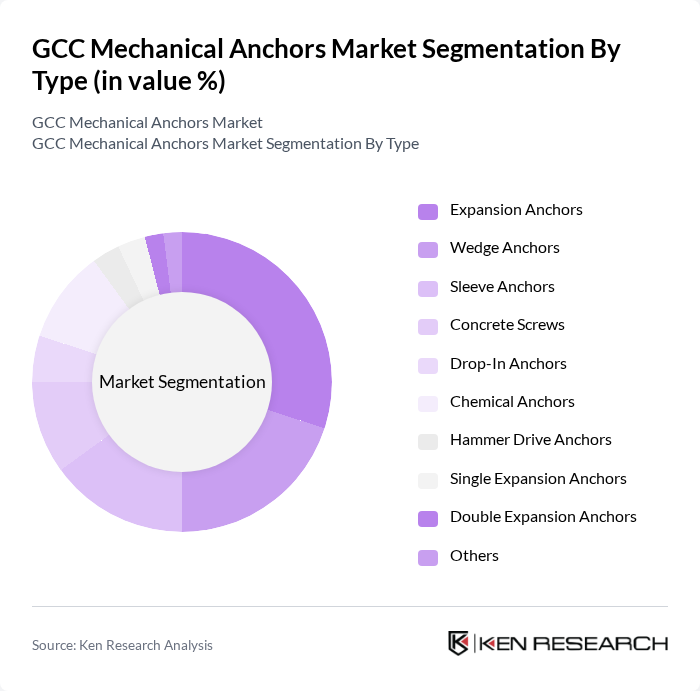
By Type:The mechanical anchors market can be segmented into various types, including Expansion Anchors, Wedge Anchors, Sleeve Anchors, Concrete Screws, Drop-In Anchors, Chemical Anchors, Hammer Drive Anchors, Single Expansion Anchors, Double Expansion Anchors, and Others. Expansion Anchors lead the market due to their versatility and ease of installation in various substrates, including concrete and masonry. The growing trend of DIY projects and home renovations has further propelled demand, making these anchors a preferred choice for both professionals and consumers. Recent innovations focus on corrosion resistance, ease of installation, and compatibility with advanced building materials, reflecting broader industry trends toward sustainability and performance.
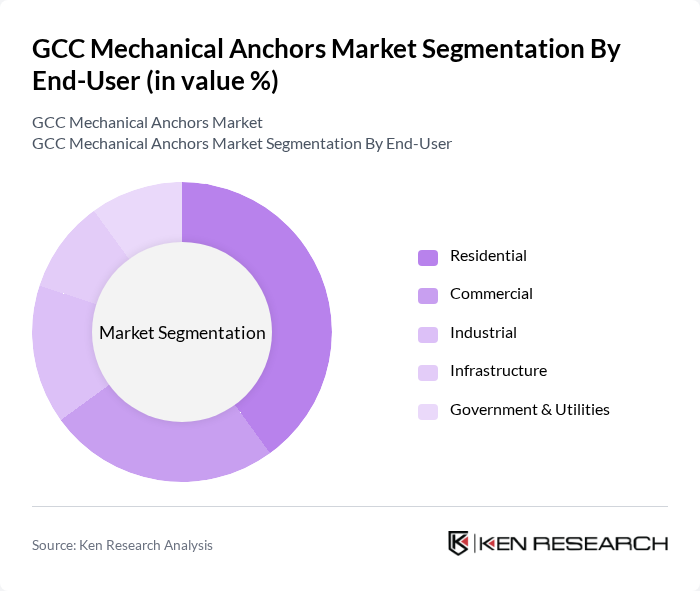
By End-User:The market can be segmented based on end-users, including Residential, Commercial, Industrial, Infrastructure, and Government & Utilities. The Residential segment is currently the dominant end-user, driven by the increasing number of housing projects and renovations in the GCC region. The rise in disposable income and a growing preference for home improvement projects have significantly contributed to the demand for mechanical anchors in residential applications. Commercial and infrastructure segments also show robust growth, supported by new office towers, retail spaces, and transportation projects. Industrial applications are expanding with the growth of manufacturing and logistics hubs, while government investments in utilities and public infrastructure further diversify demand.
The GCC Mechanical Anchors Market is characterized by a dynamic mix of regional and international players. Leading participants such as Hilti Corporation, fischer Group, ITW Construction Products, Sika AG, Simpson Strong-Tie Company Inc., Ramset (ITW), DEWALT (Stanley Black & Decker), Bosch Power Tools, Mungo Befestigungstechnik AG, EJOT Group, Würth Group, Fischer Middle East FZE, Rawlplug Ltd., Powers Fasteners (Stanley Black & Decker), Fastenal Company contribute to innovation, geographic expansion, and service delivery in this space.
The GCC mechanical anchors market is poised for significant growth, driven by ongoing construction projects and a shift towards sustainable building practices. As governments continue to invest in infrastructure, the demand for innovative anchoring solutions will rise. Additionally, the integration of smart technologies in construction processes is expected to enhance operational efficiency. Companies that adapt to these trends and focus on developing eco-friendly products will likely capture a larger market share, positioning themselves favorably in the evolving landscape.
| Segment | Sub-Segments |
|---|---|
| By Type | Expansion Anchors Wedge Anchors Sleeve Anchors Concrete Screws Drop-In Anchors Chemical Anchors Hammer Drive Anchors Single Expansion Anchors Double Expansion Anchors Others |
| By End-User | Residential Commercial Industrial Infrastructure Government & Utilities |
| By Application | Construction Renovation Infrastructure Projects Maintenance |
| By Material | Steel Stainless Steel Plastic Others |
| By Distribution Channel | Direct Sales Distributors & Wholesalers Online Retail Specialty Stores Others |
| By Region | UAE Saudi Arabia Qatar Kuwait Oman Bahrain Others |
| By Price Range | Low Medium High Others |
| Scope Item/Segment | Sample Size | Target Respondent Profiles |
|---|---|---|
| Commercial Construction Projects | 100 | Project Managers, Site Engineers |
| Residential Building Developments | 80 | Contractors, Architects |
| Infrastructure and Public Works | 70 | Government Officials, Civil Engineers |
| Industrial Facility Installations | 50 | Facility Managers, Procurement Specialists |
| Retail and Commercial Renovations | 60 | Interior Designers, Construction Supervisors |
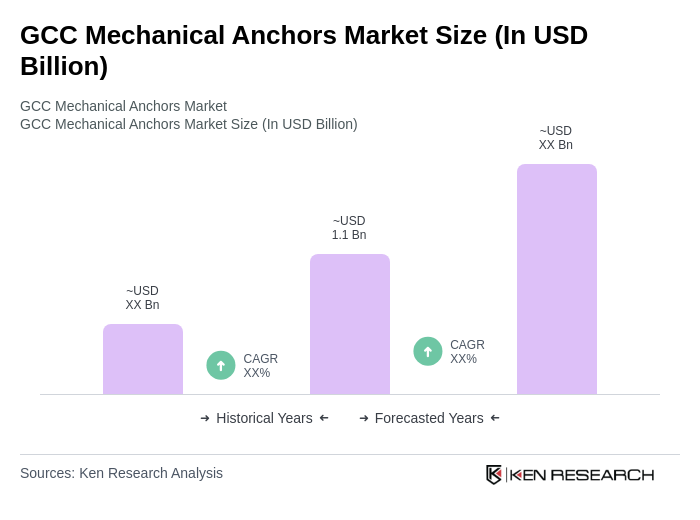
The GCC Mechanical Anchors Market is valued at approximately USD 1.1 billion, driven by significant growth in the construction and infrastructure sectors across the Gulf Cooperation Council region, particularly in the UAE and Saudi Arabia.

What makes us stand out is that our consultants follow Robust, Refine and Result (RRR) methodology. Robust for clear definitions, approaches and sanity checking, Refine for differentiating respondents' facts and opinions, and Result for presenting data with story.

We have set a benchmark in the industry by offering our clients with syndicated and customized market research reports featuring coverage of entire market as well as meticulous research and analyst insights.

While we don't replace traditional research, we flip the method upside down. Our dual approach of Top Bottom & Bottom Top ensures quality deliverable by not just verifying company fundamentals but also looking at the sector and macroeconomic factors.

With one step in the future, our research team constantly tries to show you the bigger picture. We help with some of the tough questions you may encounter along the way: How is the industry positioned? Best marketing channel? KPI's of competitors? By aligning every element, we help maximize success.

Our report gives you instant access to the answers and sources that other companies might choose to hide. We elaborate each steps of research methodology we have used and showcase you the sample size to earn your trust.

If you need any support, we are here! We pride ourselves on universe strength, data quality, and quick, friendly, and professional service.













