About the Report
Base Year 2024GCC Micro Syringes Market Overview
- The GCC Micro Syringes Market is valued at USD 55 million, based on a five-year historical analysis and its share within the broader global micro syringes and GCC syringes and needles markets. This growth is primarily driven by the increasing demand for precision in drug delivery systems and micro-volume fluid handling, particularly in the pharmaceutical, biotechnology, and analytical chemistry sectors. The rise in chronic diseases, expansion of vaccination and injectable therapy programs, and the need for accurate dosing in diagnostics and chromatography-based testing have further propelled the market, leading to a surge in the adoption of micro syringes across clinical, laboratory, and research applications.
- Key country-level demand centers in this market include Saudi Arabia and the United Arab Emirates, which dominate due to their advanced healthcare infrastructure, higher per capita healthcare expenditure, and significant investments in medical technology and laboratory capacity. The presence and regional hubs of leading pharmaceutical companies, contract research organizations, and analytical laboratories in these countries foster innovation and enhance the demand for micro syringes for chromatography, diagnostics, and therapeutic applications, making them pivotal within the GCC region.
- In 2023, the Saudi Food and Drug Authority (SFDA) strengthened requirements around sharp medical devices under the “Medical Devices Interim Regulation” issued by the SFDA in 2013 and its implementing rules, which classify syringes and related needle products as medical devices and require prior marketing authorization, conformity assessment, and post-market surveillance. In parallel, the Kingdom’s healthcare system operates under the “Occupational Safety and Health Program for Healthcare Facilities” of the Ministry of Health, which requires the adoption of engineering controls to prevent sharps injuries, including the use of safety-engineered syringe and needle designs where available, in line with international occupational safety standards. These regulatory and occupational safety frameworks aim to minimize needlestick injuries and enhance patient and worker safety, thereby supporting the uptake of advanced and safety-oriented micro syringe technologies in hospitals and laboratories.

GCC Micro Syringes Market Segmentation
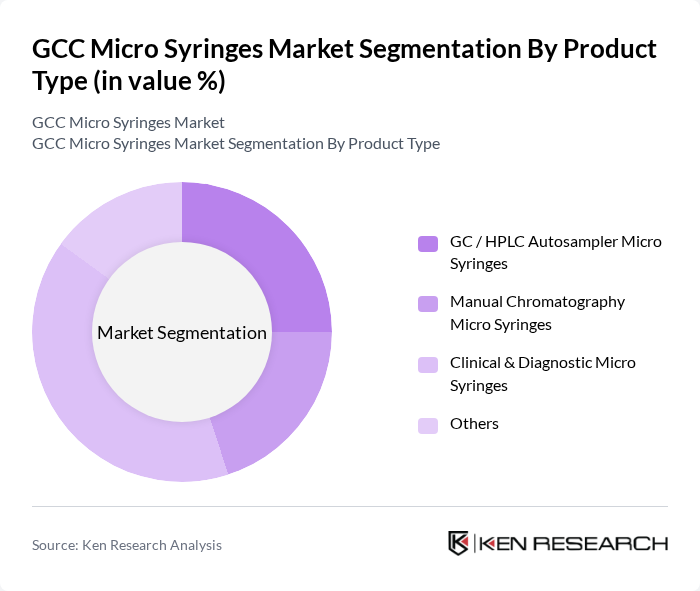
By Product Type:The product type segmentation includes various categories such as GC / HPLC Autosampler Micro Syringes, Manual Chromatography Micro Syringes, Clinical & Diagnostic Micro Syringes, and Others. This structure aligns with global market practice, where micro syringes are broadly used in chromatography (GC/HPLC autosamplers and manual injections) and in clinical or diagnostic workflows for precise liquid handling. Clinical & Diagnostic Micro Syringes account for a significant share in healthcare-focused demand in GCC due to their essential role in sample preparation, analyte transfer, and precise medication or reagent delivery in diagnostics and patient care, particularly in hospital laboratories and centralized reference labs that handle high test volumes for chronic and infectious diseases.
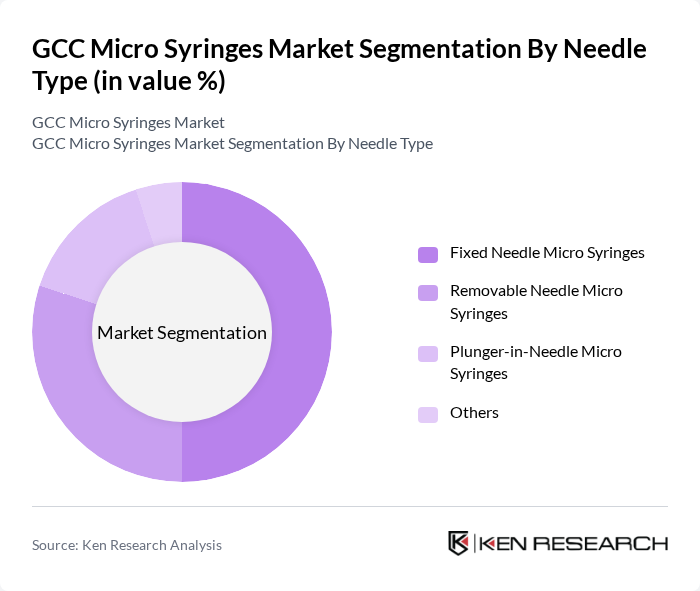
By Needle Type:The needle type segmentation encompasses Fixed Needle Micro Syringes, Removable Needle Micro Syringes, Plunger-in-Needle Micro Syringes, and Others. This categorization is consistent with leading manufacturers’ portfolios, which distinguish between integrated (fixed) needle syringes, interchangeable needle designs, and specialized plunger-in-needle formats for ultra-low dead volume and high-precision applications. Fixed Needle Micro Syringes dominate this segment in many clinical and routine analytical settings due to their ease of use, reduced dead volume, and reliability; their integrated design minimizes the risk of leakage and contamination and supports accurate dosing and repeatability, making them a preferred choice among healthcare and laboratory professionals for high-frequency, standardized workflows.
GCC Micro Syringes Market Competitive Landscape
The GCC Micro Syringes Market is characterized by a dynamic mix of regional and international players. Leading participants such as Hamilton Company, SGE Analytical Science (Trajan Scientific and Medical), Thermo Fisher Scientific Inc., Agilent Technologies, Inc., Shimadzu Corporation, Restek Corporation, Metrohm AG, PerkinElmer Inc., VICI AG International, DWK Life Sciences GmbH, Becton, Dickinson and Company, Terumo Corporation, Nipro Corporation, Medline Industries, LP, Local & Regional GCC Distributors (e.g., Al Mazroui Medical & Chemical Supplies LLC, Gulf Scientific Corporation) contribute to innovation, geographic expansion, and service delivery in this space by supplying micro syringes for GC, HPLC, spectroscopy, and clinical laboratory applications alongside broader syringe and needle portfolios.
GCC Micro Syringes Market Industry Analysis
Growth Drivers
- Increasing Demand for Precision Medicine:The GCC region is witnessing a surge in precision medicine, driven by a projected increase in healthcare spending, which is expected to reach $108 billion in future. This growth is fueled by advancements in genomics and biotechnology, leading to a higher demand for micro syringes that facilitate targeted drug delivery. The rise in personalized therapies necessitates precise dosing, further propelling the micro syringes market as healthcare providers seek effective solutions for individualized patient care.
- Rising Prevalence of Chronic Diseases:Chronic diseases such as diabetes and cardiovascular conditions are on the rise in the GCC, with diabetes prevalence expected to reach 12.8% in future. This increase drives the demand for micro syringes, particularly for insulin delivery and other chronic disease management. The growing patient population necessitates efficient drug delivery systems, making micro syringes essential for improving treatment outcomes and enhancing patient adherence to medication regimens.
- Technological Advancements in Micro Syringe Manufacturing:The micro syringes market is benefiting from technological innovations, with manufacturers investing approximately $1.6 billion in R&D in future. These advancements include the development of materials that enhance biocompatibility and reduce manufacturing costs. Enhanced production techniques are leading to higher precision and reliability in micro syringe design, which is crucial for the effective delivery of biologics and other sensitive medications, thus expanding market opportunities.
Market Challenges
- High Production Costs:The production of micro syringes involves sophisticated technology and high-quality materials, leading to significant manufacturing costs, estimated at around $0.52 per unit in future. These costs can hinder market entry for new players and limit the affordability of micro syringes in developing healthcare systems within the GCC. As a result, manufacturers must balance quality and cost to remain competitive while ensuring accessibility for healthcare providers.
- Stringent Regulatory Requirements:The micro syringes market faces challenges due to stringent regulatory frameworks imposed by authorities such as the FDA and EMA. Compliance with these regulations often requires extensive testing and documentation, which can take up to 20 months and cost upwards of $2.1 million. These barriers can delay product launches and increase the financial burden on manufacturers, impacting their ability to innovate and respond to market demands effectively.
GCC Micro Syringes Market Future Outlook
The GCC micro syringes market is poised for significant growth, driven by the increasing adoption of advanced drug delivery systems and a focus on patient-centric healthcare solutions. As healthcare infrastructure improves, particularly in emerging markets, the demand for innovative micro syringe designs will rise. Additionally, collaborations between manufacturers and pharmaceutical companies are expected to enhance product offerings, ensuring that micro syringes meet evolving healthcare needs while adhering to regulatory standards.
Market Opportunities
- Expansion in Emerging Markets:The GCC region's emerging markets present substantial opportunities for micro syringe manufacturers, with healthcare expenditure projected to grow by 8% annually. This growth is driven by increasing investments in healthcare infrastructure and rising patient populations, creating a demand for efficient drug delivery systems that micro syringes can fulfill, thereby enhancing market penetration.
- Development of Innovative Micro Syringe Designs:There is a growing opportunity for manufacturers to develop innovative micro syringe designs that incorporate smart technology, such as integrated sensors for dosage accuracy. This innovation can significantly enhance patient safety and compliance, addressing the needs of healthcare providers and patients alike, and potentially capturing a larger market share in the GCC region.
Scope of the Report
| Segment | Sub-Segments |
|---|---|
| By Product Type | GC / HPLC Autosampler Micro Syringes Manual Chromatography Micro Syringes Clinical & Diagnostic Micro Syringes Others |
| By Needle Type | Fixed Needle Micro Syringes Removable Needle Micro Syringes Plunger-in-Needle Micro Syringes Others |
| By End-User | Hospital & Reference Laboratories Pharmaceutical & Biotechnology Companies CROs and Academic & Research Institutes Forensic & Environmental Testing Laboratories Others |
| By Volume Range | ? 10 ?L – 100 ?L – 500 ?L > 500 ?L |
| By Material | Glass Micro Syringes Plastic / Polymer Micro Syringes Stainless Steel Micro Syringes Others |
| By Distribution Channel | Direct Sales to End-Users Distributor / Dealer Network Online Medical & Laboratory E-commerce Platforms Others |
| By Country (GCC) | Saudi Arabia United Arab Emirates Qatar Oman Kuwait Bahrain |
Key Target Audience
Investors and Venture Capitalist Firms
Government and Regulatory Bodies (e.g., Gulf Health Council, Saudi Food and Drug Authority)
Manufacturers and Producers
Distributors and Retailers
Healthcare Providers and Hospitals
Pharmaceutical Companies
Medical Device Regulatory Agencies
Insurance Companies and Payers
Players Mentioned in the Report:
Hamilton Company
SGE Analytical Science (Trajan Scientific and Medical)
Thermo Fisher Scientific Inc.
Agilent Technologies, Inc.
Shimadzu Corporation
Restek Corporation
Metrohm AG
PerkinElmer Inc.
VICI AG International
DWK Life Sciences GmbH
Becton, Dickinson and Company
Terumo Corporation
Nipro Corporation
Medline Industries, LP
Local & Regional GCC Distributors (e.g., Al Mazroui Medical & Chemical Supplies LLC, Gulf Scientific Corporation)
Table of Contents
Market Assessment Phase
1. Executive Summary and Approach
2. GCC Micro Syringes Market Overview
2.1 Key Insights and Strategic Recommendations
2.2 GCC Micro Syringes Market Overview
2.3 Definition and Scope
2.4 Evolution of Market Ecosystem
2.5 Timeline of Key Regulatory Milestones
2.6 Value Chain & Stakeholder Mapping
2.7 Business Cycle Analysis
2.8 Policy & Incentive Landscape
3. GCC Micro Syringes Market Analysis
3.1 Growth Drivers
3.1.1 Increasing demand for precision medicine
3.1.2 Rising prevalence of chronic diseases
3.1.3 Technological advancements in micro syringe manufacturing
3.1.4 Growing focus on patient safety and comfort
3.2 Market Challenges
3.2.1 High production costs
3.2.2 Stringent regulatory requirements
3.2.3 Competition from alternative drug delivery systems
3.2.4 Limited awareness among healthcare professionals
3.3 Market Opportunities
3.3.1 Expansion in emerging markets
3.3.2 Development of innovative micro syringe designs
3.3.3 Collaborations with pharmaceutical companies
3.3.4 Increasing investments in healthcare infrastructure
3.4 Market Trends
3.4.1 Shift towards single-use micro syringes
3.4.2 Integration of smart technology in drug delivery
3.4.3 Growing demand for prefilled syringes
3.4.4 Emphasis on sustainable manufacturing practices
3.5 Government Regulation
3.5.1 Compliance with ISO standards
3.5.2 FDA and EMA approval processes
3.5.3 Guidelines for medical device safety
3.5.4 Regulations on waste management and disposal
4. SWOT Analysis
5. Stakeholder Analysis
6. Porter's Five Forces Analysis
7. GCC Micro Syringes Market Size, 2019-2024
7.1 By Value
7.2 By Volume
7.3 By Average Selling Price
8. GCC Micro Syringes Market Segmentation
8.1 By Product Type
8.1.1 GC / HPLC Autosampler Micro Syringes
8.1.2 Manual Chromatography Micro Syringes
8.1.3 Clinical & Diagnostic Micro Syringes
8.1.4 Others
8.2 By Needle Type
8.2.1 Fixed Needle Micro Syringes
8.2.2 Removable Needle Micro Syringes
8.2.3 Plunger-in-Needle Micro Syringes
8.2.4 Others
8.3 By End-User
8.3.1 Hospital & Reference Laboratories
8.3.2 Pharmaceutical & Biotechnology Companies
8.3.3 CROs and Academic & Research Institutes
8.3.4 Forensic & Environmental Testing Laboratories
8.3.5 Others
8.4 By Volume Range
8.4.1 ? 10 ?L
8.4.2 10.1 – 100 ?L
8.4.3 100.1 – 500 ?L
8.4.4 > 500 ?L
8.5 By Material
8.5.1 Glass Micro Syringes
8.5.2 Plastic / Polymer Micro Syringes
8.5.3 Stainless Steel Micro Syringes
8.5.4 Others
8.6 By Distribution Channel
8.6.1 Direct Sales to End-Users
8.6.2 Distributor / Dealer Network
8.6.3 Online Medical & Laboratory E-commerce Platforms
8.6.4 Others
8.7 By Country (GCC)
8.7.1 Saudi Arabia
8.7.2 United Arab Emirates
8.7.3 Qatar
8.7.4 Oman
8.7.5 Kuwait
8.7.6 Bahrain
9. GCC Micro Syringes Market Competitive Analysis
9.1 Market Share of Key Players
9.2 Cross Comparison of Key Players
9.2.1 Company Name
9.2.2 Group Size (Global, Regional, or Local Player)
9.2.3 GCC Micro Syringes Revenue (Latest Year, USD Million)
9.2.4 3-Year GCC Revenue CAGR (%)
9.2.5 Share of GCC Revenue in Global Micro Syringes Sales (%)
9.2.6 Product Portfolio Breadth (GC/HPLC, Clinical, Custom, etc.)
9.2.7 Installed Base of Micro Syringes in GCC Labs (Estimated Units)
9.2.8 Average Selling Price Band in GCC (Low / Mid / Premium)
9.2.9 Share of Sales via Distributors vs Direct (%)
9.2.10 R&D and Product Innovation Intensity (Micro Syringes-related Patents / Launches)
9.2.11 Key GCC Customer Segments Served (Hospitals, Pharma, CROs, etc.)
9.2.12 After-Sales & Technical Support Coverage in GCC (Countries Covered)
9.3 SWOT Analysis of Top Players
9.4 Pricing Analysis
9.5 Detailed Profile of Major Companies
9.5.1 Hamilton Company
9.5.2 SGE Analytical Science (Trajan Scientific and Medical)
9.5.3 Thermo Fisher Scientific Inc.
9.5.4 Agilent Technologies, Inc.
9.5.5 Shimadzu Corporation
9.5.6 Restek Corporation
9.5.7 Metrohm AG
9.5.8 PerkinElmer Inc.
9.5.9 VICI AG International
9.5.10 DWK Life Sciences GmbH
9.5.11 Becton, Dickinson and Company
9.5.12 Terumo Corporation
9.5.13 Nipro Corporation
9.5.14 Medline Industries, LP
9.5.15 Local & Regional GCC Distributors (e.g., Al Mazroui Medical & Chemical Supplies LLC, Gulf Scientific Corporation)
10. GCC Micro Syringes Market End-User Analysis
10.1 Procurement Behavior of Key Ministries
10.1.1 Budget Allocation Trends
10.1.2 Procurement Processes
10.1.3 Supplier Selection Criteria
10.1.4 Contract Management Practices
10.2 Corporate Spend on Infrastructure & Energy
10.2.1 Investment Trends in Healthcare
10.2.2 Spending on Medical Devices
10.2.3 Budgeting for Innovation
10.2.4 Cost Management Strategies
10.3 Pain Point Analysis by End-User Category
10.3.1 Challenges in Supply Chain Management
10.3.2 Issues with Product Quality
10.3.3 Regulatory Compliance Difficulties
10.3.4 Training and Support Needs
10.4 User Readiness for Adoption
10.4.1 Awareness Levels
10.4.2 Training Requirements
10.4.3 Infrastructure Readiness
10.4.4 Financial Preparedness
10.5 Post-Deployment ROI and Use Case Expansion
10.5.1 Measurement of Success Metrics
10.5.2 Feedback Mechanisms
10.5.3 Opportunities for Upscaling
10.5.4 Long-term Value Assessment
11. GCC Micro Syringes Market Future Size, 2025-2030
11.1 By Value
11.2 By Volume
11.3 By Average Selling Price
Go-To-Market Strategy Phase
1. Whitespace Analysis + Business Model Canvas
1.1 Market Gaps Identification
1.2 Value Proposition Development
1.3 Revenue Streams Analysis
1.4 Cost Structure Evaluation
1.5 Key Partnerships Exploration
1.6 Customer Segmentation
1.7 Channels of Distribution
2. Marketing and Positioning Recommendations
2.1 Branding Strategies
2.2 Product USPs
3. Distribution Plan
3.1 Urban Retail vs Rural NGO Tie-ups
4. Channel & Pricing Gaps
4.1 Underserved Routes
4.2 Pricing Bands
5. Unmet Demand & Latent Needs
5.1 Category Gaps
5.2 Consumer Segments
6. Customer Relationship
6.1 Loyalty Programs
6.2 After-sales Service
7. Value Proposition
7.1 Sustainability
7.2 Integrated Supply Chains
8. Key Activities
8.1 Regulatory Compliance
8.2 Branding
8.3 Distribution Setup
9. Entry Strategy Evaluation
9.1 Domestic Market Entry Strategy
9.1.1 Product Mix
9.1.2 Pricing Band
9.1.3 Packaging
9.2 Export Entry Strategy
9.2.1 Target Countries
9.2.2 Compliance Roadmap
10. Entry Mode Assessment
10.1 JV
10.2 Greenfield
10.3 M&A
10.4 Distributor Model
11. Capital and Timeline Estimation
11.1 Capital Requirements
11.2 Timelines
12. Control vs Risk Trade-Off
12.1 Ownership vs Partnerships
13. Profitability Outlook
13.1 Breakeven Analysis
13.2 Long-term Sustainability
14. Potential Partner List
14.1 Distributors
14.2 JVs
14.3 Acquisition Targets
15. Execution Roadmap
15.1 Phased Plan for Market Entry
15.1.1 Market Setup
15.1.2 Market Entry
15.1.3 Growth Acceleration
15.1.4 Scale & Stabilize
15.2 Key Activities and Milestones
15.2.1 Milestone Planning
15.2.2 Activity Tracking
Research Methodology
Phase 1: Approach1
Desk Research
- Industry reports from healthcare associations and market research firms
- Published articles and white papers on micro syringe technology and applications
- Government publications and health ministry reports on medical device regulations in the GCC
Primary Research
- Interviews with product managers at leading medical device manufacturers
- Surveys with healthcare professionals and pharmacists regarding usage trends
- Field interviews with hospital procurement officers and medical supply distributors
Validation & Triangulation
- Cross-validation of data from multiple sources including trade publications and expert opinions
- Triangulation of market size estimates using sales data and industry growth rates
- Sanity checks through expert panel discussions and feedback sessions
Phase 2: Market Size Estimation1
Top-down Assessment
- Analysis of overall healthcare expenditure in the GCC region
- Segmentation of market size by end-user categories such as hospitals, clinics, and home care
- Incorporation of demographic trends and disease prevalence affecting micro syringe demand
Bottom-up Modeling
- Volume estimates based on historical sales data from key distributors and manufacturers
- Cost analysis of micro syringes including production, distribution, and retail pricing
- Estimation of market share for various product types and applications
Forecasting & Scenario Analysis
- Multi-variable forecasting using factors such as population growth and healthcare advancements
- Scenario analysis based on potential regulatory changes and technological innovations
- Development of baseline, optimistic, and pessimistic market projections through 2030
Phase 3: CATI Sample Composition1
| Scope Item/Segment | Sample Size | Target Respondent Profiles |
|---|---|---|
| Hospital Procurement Departments | 45 | Procurement Managers, Supply Chain Coordinators |
| Pharmaceutical Distributors | 40 | Sales Managers, Distribution Heads |
| Healthcare Professionals | 50 | Doctors, Nurses, Pharmacists |
| Medical Device Regulatory Bodies | 40 | Regulatory Affairs Specialists, Compliance Officers |
| Research Institutions and Universities | 45 | Research Scientists, Academic Professors |
Frequently Asked Questions
What is the current value of the GCC Micro Syringes Market?
The GCC Micro Syringes Market is valued at approximately USD 55 million, reflecting a significant demand for precision in drug delivery systems and micro-volume fluid handling across various sectors, including pharmaceuticals and biotechnology.
What factors are driving the growth of the GCC Micro Syringes Market?
Which countries are the primary demand centers for micro syringes in the GCC region?
What are the main product types in the GCC Micro Syringes Market?
Other Regional/Country Reports
Indonesia Micro Syringes Market
Malaysia Micro Syringes Market
KSA Micro Syringes Market
APAC Micro Syringes Market
SEA Micro Syringes Market
Vietnam Micro Syringes Market
Other Adjacent Reports
Oman Syringes and Needles Market
Mexico Chromatography Systems Market
Kuwait Drug Delivery Devices Market Size, Share, Growth Drivers, Trends, Opportunities & Forecast 2025–2030UAE Precision Medicine MarketPhilippines Biotechnology Equipment Market
KSA laboratory consumables market market report size, share, growth drivers, trends, opportunities & forecast 2025–2030Malaysia Injectable Pharmaceuticals Market
Germany Medical Diagnostics Market
Germany Analytical Instruments Market
Japan Safety Engineered Devices Market
Why Buy From Us?

What makes us stand out is that our consultants follow Robust, Refine and Result (RRR) methodology. Robust for clear definitions, approaches and sanity checking, Refine for differentiating respondents' facts and opinions, and Result for presenting data with story.

We have set a benchmark in the industry by offering our clients with syndicated and customized market research reports featuring coverage of entire market as well as meticulous research and analyst insights.

While we don't replace traditional research, we flip the method upside down. Our dual approach of Top Bottom & Bottom Top ensures quality deliverable by not just verifying company fundamentals but also looking at the sector and macroeconomic factors.

With one step in the future, our research team constantly tries to show you the bigger picture. We help with some of the tough questions you may encounter along the way: How is the industry positioned? Best marketing channel? KPI's of competitors? By aligning every element, we help maximize success.

Our report gives you instant access to the answers and sources that other companies might choose to hide. We elaborate each steps of research methodology we have used and showcase you the sample size to earn your trust.

If you need any support, we are here! We pride ourselves on universe strength, data quality, and quick, friendly, and professional service.