About the Report
Base Year 2024GCC Small Caliber Ammunition Market Overview
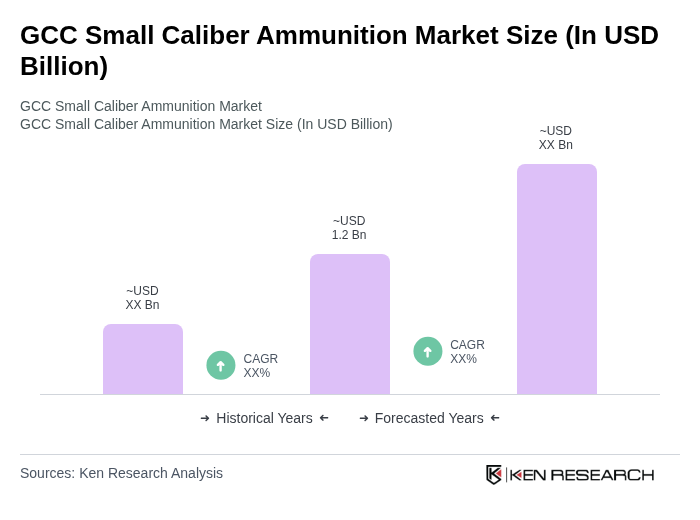
- The GCC Small Caliber Ammunition Market is valued at USD 1.2 billion, based on a five-year historical analysis. This growth is primarily driven by increasing defense budgets, heightened security concerns, and a rising civilian interest in shooting sports and hunting activities. The demand for small caliber ammunition has surged due to ongoing military modernization programs, expansion of law enforcement agencies, and the adoption of advanced ammunition technologies across the region. Additionally, the GCC is witnessing increased investments in local manufacturing and supply chain resilience, further fueling market expansion .
- Key players in this market include Saudi Arabia, the United Arab Emirates, and Qatar. These countries dominate the market due to significant investments in defense and security, a strategic focus on enhancing local manufacturing capabilities, and robust government support for domestic production. The presence of established defense industries, such as Saudi Arabian Military Industries (SAMI) and Barij Munitions, and ongoing initiatives to localize ammunition production further solidify their leadership in the small caliber ammunition sector .
- The GCC region enforces strict regulations on the import, sale, and manufacturing of small caliber ammunition. For example, the United Arab Emirates applies the Federal Law No. 5 of 2013 on Firearms, Ammunition, and Explosives, issued by the Ministry of Interior, which mandates licensing, compliance with international safety standards, and regular inspections for all ammunition manufacturers and importers. These regulations are designed to enhance product quality and safety, ensuring that ammunition meets the specifications required for both military and civilian use .
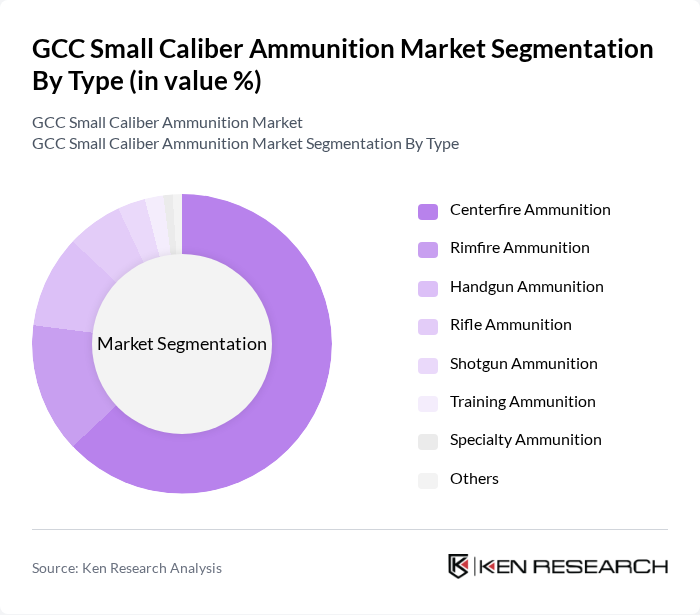
GCC Small Caliber Ammunition Market Segmentation
By Type:The market is segmented into various types of ammunition, including Centerfire Ammunition, Rimfire Ammunition, Handgun Ammunition, Rifle Ammunition, Shotgun Ammunition, Training Ammunition, Specialty Ammunition, and Others. Among these, Centerfire Ammunition is the leading subsegment due to its widespread use in military and law enforcement applications. The reliability and performance of centerfire cartridges make them the preferred choice for tactical operations and training exercises. The growing popularity of shooting sports and the adoption of high-performance ammunition by security agencies have further boosted demand for this type of ammunition .
By Caliber:The market is segmented by caliber into 5.56mm, 7.62mm, 9mm, .22LR, .308, 12 Gauge (Shotgun Shells), and Others. The 5.56mm caliber is the most dominant segment, primarily due to its extensive use in military applications and its popularity among civilian shooters for sport and self-defense. The versatility and availability of 5.56mm ammunition have made it a preferred choice for both tactical and recreational shooting, driving its market share significantly. The 7.62mm and 9mm calibers also hold substantial shares due to their adoption in military, police, and civilian markets .

GCC Small Caliber Ammunition Market Competitive Landscape
The GCC Small Caliber Ammunition Market is characterized by a dynamic mix of regional and international players. Leading participants such as Saudi Arabian Military Industries (SAMI), Barij Munitions (UAE), Caracal International (UAE), General Dynamics Ordnance and Tactical Systems, Northrop Grumman, BAE Systems, Winchester Ammunition (Olin Corporation), Federal Premium Ammunition (Vista Outdoor Inc.), Remington Ammunition (Vista Outdoor Inc.), Hornady Manufacturing Company, Sellier & Bellot, Magtech Ammunition (CBC Global Ammunition), PMC Ammunition (Poongsan Corporation), Fiocchi Munizioni, Tula Cartridge Works, MEN Metallwerk Elisenhütte GmbH, Ruag Ammotec, and Aguila Ammunition (Industrias Tecnos S.A. de C.V.) contribute to innovation, geographic expansion, and service delivery in this space.
GCC Small Caliber Ammunition Market Industry Analysis
Growth Drivers
- Increasing Defense Budgets:The GCC region has seen a significant increase in defense spending, with a collective budget of approximately $180 billion in future. Countries like Saudi Arabia and the UAE are leading this trend, allocating around $70 billion and $30 billion, respectively. This surge in defense budgets is primarily driven by regional security concerns and the need for modernization of military capabilities, directly boosting demand for small caliber ammunition.
- Rising Civilian Demand for Sporting Ammunition:The civilian market for sporting ammunition in the GCC is projected to reach $1.5 billion in future, fueled by a growing interest in recreational shooting and hunting. Countries such as Qatar and Oman are witnessing a rise in shooting clubs and events, contributing to increased sales. This trend is supported by a demographic shift towards younger populations engaging in outdoor activities, further driving the demand for small caliber ammunition.
- Technological Advancements in Ammunition Production:The GCC small caliber ammunition market is benefiting from technological innovations, with investments in advanced manufacturing processes estimated at $600 million in future. These advancements include the adoption of automated production lines and improved quality control measures, which enhance efficiency and reduce production costs. As manufacturers embrace these technologies, they can meet the growing demand for high-performance ammunition, thus driving market growth.
Market Challenges
- Stringent Regulatory Compliance:The small caliber ammunition market in the GCC faces significant challenges due to stringent regulatory frameworks. Compliance with international arms control agreements and local laws requires manufacturers to invest heavily in legal and operational adjustments. For instance, the cost of compliance can reach up to $12 million per company annually, impacting profitability and operational efficiency, thereby posing a challenge to market growth.
- Supply Chain Disruptions:The GCC small caliber ammunition market is vulnerable to supply chain disruptions, particularly due to geopolitical tensions and global trade uncertainties. In future, disruptions in the supply of raw materials, such as lead and brass, have led to delays and increased costs, with estimates suggesting a 20% rise in production costs. These challenges hinder manufacturers' ability to meet demand and maintain competitive pricing in the market.
GCC Small Caliber Ammunition Market Future Outlook
The future of the GCC small caliber ammunition market appears promising, driven by ongoing defense investments and a growing civilian interest in shooting sports. As regional tensions persist, defense budgets are likely to remain robust, fostering demand for advanced ammunition. Additionally, the trend towards eco-friendly production methods and smart ammunition technology is expected to gain traction, aligning with global sustainability goals and enhancing operational effectiveness in military applications.
Market Opportunities
- Expansion into Emerging Markets:The GCC small caliber ammunition market has significant opportunities for expansion into emerging markets in Africa and Asia. With a projected growth rate of 12% in these regions, GCC manufacturers can leverage their expertise and technology to capture new customer bases, enhancing their market presence and profitability.
- Development of Eco-Friendly Ammunition:There is a growing demand for eco-friendly ammunition solutions, with the market for biodegradable options expected to reach $250 million in future. GCC manufacturers can capitalize on this trend by investing in R&D to develop sustainable products, appealing to environmentally conscious consumers and aligning with global regulatory trends.
Scope of the Report
| Segment | Sub-Segments |
|---|---|
| By Type | Centerfire Ammunition Rimfire Ammunition Handgun Ammunition Rifle Ammunition Shotgun Ammunition Training Ammunition Specialty Ammunition Others |
| By Caliber | mm mm mm LR Gauge (Shotgun Shells) Others |
| By End-User | Military Law Enforcement / Homeland Security Civilian (Sport Shooting, Hunting, Self-Defense) Security Services Others |
| By Application | Defense Hunting Sports Shooting Training Law Enforcement Operations Others |
| By Distribution Channel | Direct Procurement (Government Contracts) Distributors Online Retail Offline Retail Others |
| By Material | Brass Steel Aluminum Polymer Lead-Free / Eco-Friendly Materials Others |
| By Payload | Full Metal Jacket Hollow Point Soft Point Non-Lethal / Training Rounds Others |
| By Region | Saudi Arabia United Arab Emirates (UAE) Qatar Kuwait Oman Bahrain |
Key Target Audience
Investors and Venture Capitalist Firms
Government and Regulatory Bodies (e.g., Ministry of Defense, Ministry of Interior)
Manufacturers and Producers
Distributors and Retailers
Military and Defense Contractors
Law Enforcement Agencies
Armed Forces Procurement Departments
Security and Defense Industry Associations
Players Mentioned in the Report:
Saudi Arabian Military Industries (SAMI)
Barij Munitions (UAE)
Caracal International (UAE)
General Dynamics Ordnance and Tactical Systems
Northrop Grumman
BAE Systems
Winchester Ammunition (Olin Corporation)
Federal Premium Ammunition (Vista Outdoor Inc.)
Remington Ammunition (Vista Outdoor Inc.)
Hornady Manufacturing Company
Sellier & Bellot
Magtech Ammunition (CBC Global Ammunition)
PMC Ammunition (Poongsan Corporation)
Fiocchi Munizioni
Tula Cartridge Works
MEN Metallwerk Elisenhutte GmbH
Ruag Ammotec
Aguila Ammunition (Industrias Tecnos S.A. de C.V.)
Table of Contents
Market Assessment Phase
1. Executive Summary and Approach
2. GCC Small Caliber Ammunition Market Overview
2.1 Key Insights and Strategic Recommendations
2.2 GCC Small Caliber Ammunition Market Overview
2.3 Definition and Scope
2.4 Evolution of Market Ecosystem
2.5 Timeline of Key Regulatory Milestones
2.6 Value Chain & Stakeholder Mapping
2.7 Business Cycle Analysis
2.8 Policy & Incentive Landscape
3. GCC Small Caliber Ammunition Market Analysis
3.1 Growth Drivers
3.1.1 Increasing Defense Budgets
3.1.2 Rising Civilian Demand for Sporting Ammunition
3.1.3 Technological Advancements in Ammunition Production
3.1.4 Geopolitical Tensions in the Region
3.2 Market Challenges
3.2.1 Stringent Regulatory Compliance
3.2.2 Supply Chain Disruptions
3.2.3 Competition from Alternative Technologies
3.2.4 Fluctuating Raw Material Prices
3.3 Market Opportunities
3.3.1 Expansion into Emerging Markets
3.3.2 Development of Eco-Friendly Ammunition
3.3.3 Strategic Partnerships with Defense Contractors
3.3.4 Increased Investment in R&D
3.4 Market Trends
3.4.1 Shift Towards Smart Ammunition
3.4.2 Growing Popularity of Recreational Shooting
3.4.3 Enhanced Focus on Safety and Training
3.4.4 Digitalization in Manufacturing Processes
3.5 Government Regulation
3.5.1 Export Control Regulations
3.5.2 Licensing Requirements for Manufacturers
3.5.3 Environmental Regulations on Production
3.5.4 Safety Standards for Ammunition Storage
4. SWOT Analysis
5. Stakeholder Analysis
6. Porter's Five Forces Analysis
7. GCC Small Caliber Ammunition Market Market Size, 2019-2024
7.1 By Value
7.2 By Volume
7.3 By Average Selling Price
8. GCC Small Caliber Ammunition Market Segmentation
8.1 By Type
8.1.1 Centerfire Ammunition
8.1.2 Rimfire Ammunition
8.1.3 Handgun Ammunition
8.1.4 Rifle Ammunition
8.1.5 Shotgun Ammunition
8.1.6 Training Ammunition
8.1.7 Specialty Ammunition
8.1.8 Others
8.2 By Caliber
8.2.1 5.56mm
8.2.2 7.62mm
8.2.3 9mm
8.2.4 .22LR
8.2.5 .308
8.2.6 12 Gauge (Shotgun Shells)
8.2.7 Others
8.3 By End-User
8.3.1 Military
8.3.2 Law Enforcement / Homeland Security
8.3.3 Civilian (Sport Shooting, Hunting, Self-Defense)
8.3.4 Security Services
8.3.5 Others
8.4 By Application
8.4.1 Defense
8.4.2 Hunting
8.4.3 Sports Shooting
8.4.4 Training
8.4.5 Law Enforcement Operations
8.4.6 Others
8.5 By Distribution Channel
8.5.1 Direct Procurement (Government Contracts)
8.5.2 Distributors
8.5.3 Online Retail
8.5.4 Offline Retail
8.5.5 Others
8.6 By Material
8.6.1 Brass
8.6.2 Steel
8.6.3 Aluminum
8.6.4 Polymer
8.6.5 Lead-Free / Eco-Friendly Materials
8.6.6 Others
8.7 By Payload
8.7.1 Full Metal Jacket
8.7.2 Hollow Point
8.7.3 Soft Point
8.7.4 Non-Lethal / Training Rounds
8.7.5 Others
8.8 By Region
8.8.1 Saudi Arabia
8.8.2 United Arab Emirates (UAE)
8.8.3 Qatar
8.8.4 Kuwait
8.8.5 Oman
8.8.6 Bahrain
9. GCC Small Caliber Ammunition Market Competitive Analysis
9.1 Market Share of Key Players
9.2 KPIs for Cross Comparison of Key Players
9.2.1 Annual Revenue (USD)
9.2.2 Market Share in GCC Small Caliber Ammunition Segment (%)
9.2.3 Production Capacity (Rounds per Year)
9.2.4 Export Volume to GCC Countries
9.2.5 Number of Defense Contracts Awarded in GCC
9.2.6 R&D Investment as % of Revenue
9.2.7 Product Portfolio Breadth (Number of Caliber Types)
9.2.8 Local Manufacturing Presence (Yes/No, Number of Facilities)
9.2.9 Compliance with GCC Regulatory Standards
9.2.10 Delivery Lead Time (Days)
9.3 SWOT Analysis of Top Players
9.4 Pricing Analysis
9.5 List of Major Companies
9.5.1 Saudi Arabian Military Industries (SAMI)
9.5.2 Barij Munitions (UAE)
9.5.3 Caracal International (UAE)
9.5.4 General Dynamics Ordnance and Tactical Systems
9.5.5 Northrop Grumman
9.5.6 BAE Systems
9.5.7 Winchester Ammunition (Olin Corporation)
9.5.8 Federal Premium Ammunition (Vista Outdoor Inc.)
9.5.9 Remington Ammunition (Vista Outdoor Inc.)
9.5.10 Hornady Manufacturing Company
9.5.11 Sellier & Bellot
9.5.12 Magtech Ammunition (CBC Global Ammunition)
9.5.13 PMC Ammunition (Poongsan Corporation)
9.5.14 Fiocchi Munizioni
9.5.15 Tula Cartridge Works
9.5.16 MEN Metallwerk Elisenhütte GmbH
9.5.17 Ruag Ammotec
9.5.18 Aguila Ammunition (Industrias Tecnos S.A. de C.V.)
10. GCC Small Caliber Ammunition Market End-User Analysis
10.1 Procurement Behavior of Key Ministries
10.1.1 Budget Allocation Trends
10.1.2 Procurement Processes
10.1.3 Supplier Selection Criteria
10.1.4 Contract Duration and Renewal Practices
10.2 Corporate Spend on Infrastructure & Energy
10.2.1 Investment Trends in Defense
10.2.2 Spending on Ammunition and Equipment
10.2.3 Budget Forecasting
10.2.4 Cost Management Strategies
10.3 Pain Point Analysis by End-User Category
10.3.1 Supply Chain Issues
10.3.2 Quality Assurance Challenges
10.3.3 Regulatory Compliance Difficulties
10.3.4 Cost Constraints
10.4 User Readiness for Adoption
10.4.1 Training and Support Needs
10.4.2 Technology Adoption Rates
10.4.3 Feedback Mechanisms
10.4.4 User Experience Insights
10.5 Post-Deployment ROI and Use Case Expansion
10.5.1 Performance Metrics
10.5.2 Long-term Value Assessment
10.5.3 Expansion Opportunities
10.5.4 User Satisfaction Levels
11. GCC Small Caliber Ammunition Market Future Size, 2025-2030
11.1 By Value
11.2 By Volume
11.3 By Average Selling Price
Go-To-Market Strategy Phase
1. Whitespace Analysis + Business Model Canvas
1.1 Market Gaps Identification
1.2 Business Model Framework
2. Marketing and Positioning Recommendations
2.1 Branding Strategies
2.2 Product USPs
3. Distribution Plan
3.1 Urban Retail Strategies
3.2 Rural NGO Tie-ups
4. Channel & Pricing Gaps
4.1 Underserved Routes
4.2 Pricing Bands Analysis
5. Unmet Demand & Latent Needs
5.1 Category Gaps
5.2 Consumer Segments
6. Customer Relationship
6.1 Loyalty Programs
6.2 After-sales Service
7. Value Proposition
7.1 Sustainability Initiatives
7.2 Integrated Supply Chains
8. Key Activities
8.1 Regulatory Compliance
8.2 Branding Efforts
8.3 Distribution Setup
9. Entry Strategy Evaluation
9.1 Domestic Market Entry Strategy
9.1.1 Product Mix Considerations
9.1.2 Pricing Band Strategy
9.1.3 Packaging Solutions
9.2 Export Entry Strategy
9.2.1 Target Countries Identification
9.2.2 Compliance Roadmap Development
10. Entry Mode Assessment
10.1 Joint Ventures
10.2 Greenfield Investments
10.3 Mergers & Acquisitions
10.4 Distributor Model Evaluation
11. Capital and Timeline Estimation
11.1 Capital Requirements
11.2 Timelines for Implementation
12. Control vs Risk Trade-Off
12.1 Ownership Considerations
12.2 Partnerships Evaluation
13. Profitability Outlook
13.1 Breakeven Analysis
13.2 Long-term Sustainability Strategies
14. Potential Partner List
14.1 Distributors
14.2 Joint Ventures
14.3 Acquisition Targets
15. Execution Roadmap
15.1 Phased Plan for Market Entry
15.1.1 Market Setup
15.1.2 Market Entry
15.1.3 Growth Acceleration
15.1.4 Scale & Stabilize
15.2 Key Activities and Milestones
15.2.1 Milestone Planning
15.2.2 Activity Tracking
Research Methodology
Phase 1: Approach1
Desk Research
- Analysis of market reports from defense and ammunition industry associations
- Review of government publications and defense budgets from GCC countries
- Examination of trade statistics and import/export data related to small caliber ammunition
Primary Research
- Interviews with military procurement officers and defense contractors
- Surveys with retailers and distributors of small caliber ammunition
- Field interviews with experts in ammunition manufacturing and technology
Validation & Triangulation
- Cross-validation of findings through multiple data sources including industry reports and expert opinions
- Triangulation of market trends using historical data and current market dynamics
- Sanity checks through expert panel discussions and feedback sessions
Phase 2: Market Size Estimation1
Top-down Assessment
- Estimation of total market size based on defense spending in GCC countries
- Segmentation by military, law enforcement, and civilian markets
- Incorporation of regional security dynamics and geopolitical factors influencing demand
Bottom-up Modeling
- Volume estimates based on production capacities of leading manufacturers in the region
- Cost analysis derived from pricing models of small caliber ammunition products
- Assessment of sales data from distributors and retailers to establish market penetration rates
Forecasting & Scenario Analysis
- Multi-variable forecasting using defense budget projections and regional conflict scenarios
- Scenario analysis based on potential changes in regulations and military procurement policies
- Development of baseline, optimistic, and pessimistic market growth projections through 2030
Phase 3: CATI Sample Composition1
| Scope Item/Segment | Sample Size | Target Respondent Profiles |
|---|---|---|
| Military Procurement Departments | 45 | Procurement Officers, Defense Analysts |
| Law Enforcement Agencies | 38 | Police Chiefs, Tactical Unit Leaders |
| Ammunition Manufacturers | 32 | Production Managers, R&D Directors |
| Distributors and Retailers | 42 | Sales Managers, Inventory Specialists |
| Defense Industry Experts | 28 | Consultants, Market Analysts |
Frequently Asked Questions
What is the current value of the GCC Small Caliber Ammunition Market?
The GCC Small Caliber Ammunition Market is valued at approximately USD 1.2 billion, driven by increased defense budgets, security concerns, and growing civilian interest in shooting sports and hunting activities across the region.
Which countries are the key players in the GCC Small Caliber Ammunition Market?
What types of small caliber ammunition are available in the GCC market?
What are the main growth drivers for the GCC Small Caliber Ammunition Market?
Other Regional/Country Reports
Indonesia Small Caliber Ammunition Market
Malaysia Small Caliber Ammunition Market
Other Adjacent Reports
Mexico Firearms Market
Philippines Large Caliber Ammunition Market
Belgium Defense Equipment Market
Oman Military Training Services Market
Bahrain shooting sports equipment market report Size, Share, Growth Drivers, Trends, Opportunities & Forecast 2025–2030Mexico Law Enforcement Gear Market
South Africa Ammunition Components Market
Brazil Ballistics Technology Market
Brazil Hunting Accessories Market
Southeast Asia Personal Protective Equipment Market Outlook to 2030: Size, Share, Growth and TrendsWhy Buy From Us?

What makes us stand out is that our consultants follow Robust, Refine and Result (RRR) methodology. Robust for clear definitions, approaches and sanity checking, Refine for differentiating respondents' facts and opinions, and Result for presenting data with story.

We have set a benchmark in the industry by offering our clients with syndicated and customized market research reports featuring coverage of entire market as well as meticulous research and analyst insights.

While we don't replace traditional research, we flip the method upside down. Our dual approach of Top Bottom & Bottom Top ensures quality deliverable by not just verifying company fundamentals but also looking at the sector and macroeconomic factors.

With one step in the future, our research team constantly tries to show you the bigger picture. We help with some of the tough questions you may encounter along the way: How is the industry positioned? Best marketing channel? KPI's of competitors? By aligning every element, we help maximize success.

Our report gives you instant access to the answers and sources that other companies might choose to hide. We elaborate each steps of research methodology we have used and showcase you the sample size to earn your trust.

If you need any support, we are here! We pride ourselves on universe strength, data quality, and quick, friendly, and professional service.