About the Report
Base Year 2024Kuwait Personal Protective Equipment Market Overview
- The Kuwait Personal Protective Equipment market is valued at USD 140 million, based on a five-year historical analysis. This growth is primarily driven by increasing awareness of workplace safety regulations, coupled with a rise in industrial activities across various sectors, including construction and oil & gas. The demand for high-quality protective gear has surged as companies prioritize employee safety and compliance with international standards.
- Kuwait City and Al Ahmadi are the dominant regions in the Personal Protective Equipment market due to their concentration of industrial activities, particularly in the oil and gas sector. The presence of major oil companies and ongoing infrastructure projects in these areas significantly contribute to the demand for PPE, as safety regulations become more stringent and companies invest in protective gear to ensure worker safety.
- The Ministerial Resolution No. 349 of 2018 issued by the Ministry of Public Works mandates the use of personal protective equipment in construction and oil & gas industries, requiring employers to supply certified PPE including helmets, gloves, and respiratory protection meeting Kuwaiti standards for all workers on sites exceeding 10 employees. Compliance involves regular inspections and certification from approved bodies, with penalties for non-adherence, thereby boosting PPE demand across high-risk operations.

Kuwait Personal Protective Equipment Market Segmentation
By Product Type:
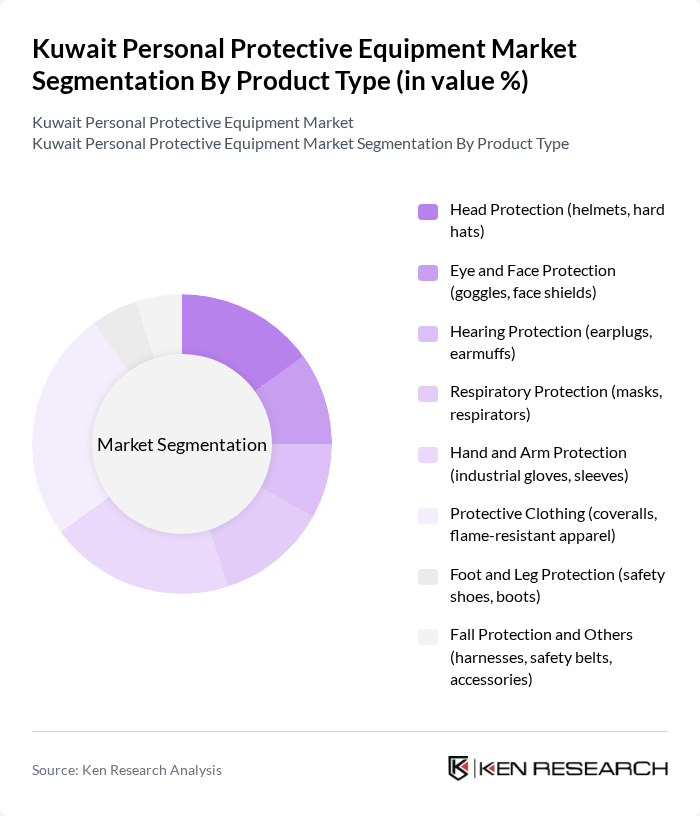
The product type segmentation of the Kuwait Personal Protective Equipment market includes various categories such as Head Protection, Eye and Face Protection, Hearing Protection, Respiratory Protection, Hand and Arm Protection, Protective Clothing, Foot and Leg Protection, and Fall Protection and Others. Among these, Respiratory Protection is the leading sub-segment, driven by the increasing need for safety in hazardous work environments, particularly in construction and oil & gas sectors. The demand for masks and respirators has surged as companies prioritize worker safety and compliance with regulations.
By End-User Industry:
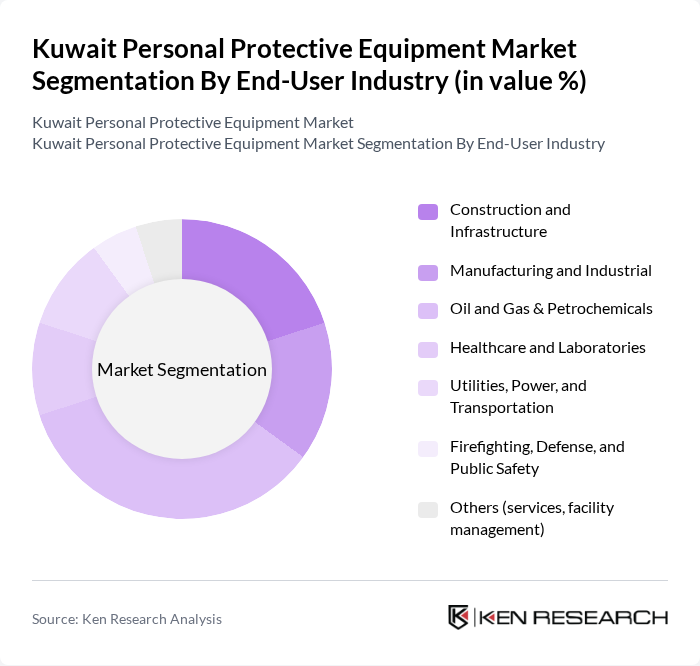
The end-user industry segmentation of the Kuwait Personal Protective Equipment market includes Construction and Infrastructure, Manufacturing and Industrial, Oil and Gas & Petrochemicals, Healthcare and Laboratories, Utilities, Power, and Transportation, Firefighting, Defense, and Public Safety, and Others. The Construction sector is the dominant segment, driven by the high-risk nature of operations in this industry. The stringent safety regulations and the need for specialized protective gear have led to increased investments in PPE, making it a critical component of operational safety in this sector.
Kuwait Personal Protective Equipment Market Competitive Landscape
The Kuwait Personal Protective Equipment market is characterized by a dynamic mix of regional and international players. Leading participants such as Alshaya Group, Gulf Safety & Security Co. W.L.L., Al Bahar & Bardawil Co. for Technical Equipment, Al Dhow for Environmental Projects Company (PPE supply & safety services), 3M Company (3M Gulf), Honeywell International Inc. (Honeywell Safety Products), DuPont de Nemours, Inc. (DuPont Personal Protection), Ansell Limited, MSA Safety Incorporated, Lakeland Industries, Inc., Radians, Inc., JSP Limited, Bullard Company, Uvex Safety Group, Delta Plus Group, Kimberly-Clark Corporation, Cordova Safety Products, Ergodyne Corporation, PIP Global (Protective Industrial Products) contribute to innovation, geographic expansion, and service delivery in this space.
Kuwait Personal Protective Equipment Market Industry Analysis
Growth Drivers
- Increasing Workplace Safety Regulations:The Kuwaiti government has implemented stringent workplace safety regulations, mandating the use of personal protective equipment (PPE) across various sectors. In future, the Ministry of Health is expected to enforce compliance with safety standards, impacting over 1,200 businesses. This regulatory push is projected to increase PPE demand by approximately 15,000 units annually, reflecting a commitment to enhancing worker safety and reducing occupational hazards.
- Rising Awareness of Occupational Hazards:There is a growing recognition of occupational hazards among workers and employers in Kuwait. In future, an estimated 60% of employees in high-risk industries will undergo safety training, leading to a heightened demand for PPE. This awareness is expected to drive the market, with an anticipated increase in PPE sales by 20% as companies prioritize employee safety and compliance with health regulations.
- Growth in Construction and Industrial Sectors:The construction sector in Kuwait is projected to grow by 8% in future, driven by government investments in infrastructure projects. This growth is expected to create a significant demand for PPE, with an estimated requirement of 25,000 additional units to meet safety standards. The industrial sector's expansion, particularly in oil and gas, further contributes to the increasing need for high-quality protective gear, bolstering market growth.
Market Challenges
- High Cost of Quality PPE:The high cost associated with quality personal protective equipment poses a significant challenge for businesses in Kuwait. In future, the average price of certified PPE is projected to be around KWD 50 per unit, which can be prohibitive for small and medium-sized enterprises (SMEs). This financial barrier may lead to inadequate safety measures, increasing the risk of workplace accidents and injuries.
- Lack of Awareness Among Small Businesses:Many small businesses in Kuwait remain unaware of the importance of PPE and the associated regulations. In future, it is estimated that only 30% of SMEs will comply with safety standards, resulting in a significant gap in PPE adoption. This lack of awareness not only jeopardizes worker safety but also hinders the overall growth of the PPE market, as these businesses represent a substantial portion of the economy.
Kuwait Personal Protective Equipment Market Future Outlook
The future of the Kuwait personal protective equipment market appears promising, driven by increasing regulatory compliance and a growing emphasis on workplace safety. As the construction and industrial sectors expand, the demand for innovative and high-quality PPE is expected to rise. Additionally, the integration of smart technology and sustainable materials into PPE products will likely enhance user experience and safety, positioning the market for significant growth in the coming years.
Market Opportunities
- Expansion of E-commerce Platforms:The rise of e-commerce in Kuwait presents a significant opportunity for PPE suppliers. In future, online sales of PPE are projected to increase by 30%, allowing businesses to reach a broader customer base. This shift towards digital platforms can enhance accessibility and convenience for consumers, driving overall market growth.
- Increasing Demand for Customized PPE:There is a growing trend towards customized PPE solutions tailored to specific industry needs. In future, approximately 40% of businesses are expected to seek personalized protective gear, creating a lucrative market segment. This demand for customization can lead to innovative product offerings and increased customer satisfaction, further stimulating market expansion.
Scope of the Report
| Segment | Sub-Segments |
|---|---|
| By Product Type | Head Protection (helmets, hard hats) Eye and Face Protection (goggles, face shields) Hearing Protection (earplugs, earmuffs) Respiratory Protection (masks, respirators) Hand and Arm Protection (industrial gloves, sleeves) Protective Clothing (coveralls, flame-resistant apparel) Foot and Leg Protection (safety shoes, boots) Fall Protection and Others (harnesses, safety belts, accessories) |
| By End-User Industry | Construction and Infrastructure Manufacturing and Industrial Oil and Gas & Petrochemicals Healthcare and Laboratories Utilities, Power, and Transportation Firefighting, Defense, and Public Safety Others (services, facility management) |
| By Application | Industrial Safety Construction Site Safety Oil & Gas and Chemical Handling Healthcare and Infection Control Emergency Response and Firefighting Others |
| By Distribution Channel | Direct Sales and Key Accounts (oil & gas, large contractors) Specialized Safety Distributors Industrial and Hardware Retail Stores Online and E-commerce Platforms Government and Institutional Tenders |
| By Material Type | Fabric-based (cotton, aramid, non-wovens) Plastic-based (polycarbonate, PVC, ABS) Rubber and Latex Leather and Metal Components Composite and Advanced Materials |
| By Certification / Standards Compliance | EN / CE Marked (EU standards) ANSI / OSHA Compliant ISO and NFPA Certified Products Gulf / Kuwait-specific Standards and Approvals Others |
| By Region | Kuwait City Hawalli Al Ahmadi Al Jahra Farwaniya, Mubarak Al-Kabeer and Others |
Key Target Audience
Investors and Venture Capitalist Firms
Government and Regulatory Bodies (e.g., Kuwait Public Authority for Industry, Kuwait Ministry of Health)
Manufacturers and Producers
Distributors and Retailers
Construction and Engineering Companies
Oil and Gas Industry Stakeholders
Healthcare Providers and Facilities
Safety and Compliance Officers
Players Mentioned in the Report:
Alshaya Group
Gulf Safety & Security Co. W.L.L.
Al Bahar & Bardawil Co. for Technical Equipment
Al Dhow for Environmental Projects Company (PPE supply & safety services)
3M Company (3M Gulf)
Honeywell International Inc. (Honeywell Safety Products)
DuPont de Nemours, Inc. (DuPont Personal Protection)
Ansell Limited
MSA Safety Incorporated
Lakeland Industries, Inc.
Radians, Inc.
JSP Limited
Bullard Company
Uvex Safety Group
Delta Plus Group
Kimberly-Clark Corporation
Cordova Safety Products
Ergodyne Corporation
PIP Global (Protective Industrial Products)
Table of Contents
Market Assessment Phase
1. Executive Summary and Approach
2. Kuwait Personal Protective Equipment Market Overview
2.1 Key Insights and Strategic Recommendations
2.2 Kuwait Personal Protective Equipment Market Overview
2.3 Definition and Scope
2.4 Evolution of Market Ecosystem
2.5 Timeline of Key Regulatory Milestones
2.6 Value Chain & Stakeholder Mapping
2.7 Business Cycle Analysis
2.8 Policy & Incentive Landscape
3. Kuwait Personal Protective Equipment Market Analysis
3.1 Growth Drivers
3.1.1 Increasing workplace safety regulations
3.1.2 Rising awareness of occupational hazards
3.1.3 Growth in construction and industrial sectors
3.1.4 Technological advancements in PPE
3.2 Market Challenges
3.2.1 High cost of quality PPE
3.2.2 Lack of awareness among small businesses
3.2.3 Counterfeit products in the market
3.2.4 Limited local manufacturing capabilities
3.3 Market Opportunities
3.3.1 Expansion of e-commerce platforms
3.3.2 Increasing demand for customized PPE
3.3.3 Government initiatives for safety training
3.3.4 Collaborations with international suppliers
3.4 Market Trends
3.4.1 Shift towards sustainable materials
3.4.2 Integration of smart technology in PPE
3.4.3 Growth of rental services for PPE
3.4.4 Focus on ergonomic designs
3.5 Government Regulation
3.5.1 Implementation of safety standards by the Ministry of Health
3.5.2 Mandatory PPE training for workers
3.5.3 Regulations on PPE quality and certification
3.5.4 Incentives for local manufacturers
4. SWOT Analysis
5. Stakeholder Analysis
6. Porter's Five Forces Analysis
7. Kuwait Personal Protective Equipment Market Market Size, 2019-2024
7.1 By Value
7.2 By Volume
7.3 By Average Selling Price
8. Kuwait Personal Protective Equipment Market Segmentation
8.1 By Product Type
8.1.1 Head Protection (helmets, hard hats)
8.1.2 Eye and Face Protection (goggles, face shields)
8.1.3 Hearing Protection (earplugs, earmuffs)
8.1.4 Respiratory Protection (masks, respirators)
8.1.5 Hand and Arm Protection (industrial gloves, sleeves)
8.1.6 Protective Clothing (coveralls, flame-resistant apparel)
8.1.7 Foot and Leg Protection (safety shoes, boots)
8.1.8 Fall Protection and Others (harnesses, safety belts, accessories)
8.2 By End-User Industry
8.2.1 Construction and Infrastructure
8.2.2 Manufacturing and Industrial
8.2.3 Oil and Gas & Petrochemicals
8.2.4 Healthcare and Laboratories
8.2.5 Utilities, Power, and Transportation
8.2.6 Firefighting, Defense, and Public Safety
8.2.7 Others (services, facility management)
8.3 By Application
8.3.1 Industrial Safety
8.3.2 Construction Site Safety
8.3.3 Oil & Gas and Chemical Handling
8.3.4 Healthcare and Infection Control
8.3.5 Emergency Response and Firefighting
8.3.6 Others
8.4 By Distribution Channel
8.4.1 Direct Sales and Key Accounts (oil & gas, large contractors)
8.4.2 Specialized Safety Distributors
8.4.3 Industrial and Hardware Retail Stores
8.4.4 Online and E-commerce Platforms
8.4.5 Government and Institutional Tenders
8.5 By Material Type
8.5.1 Fabric-based (cotton, aramid, non-wovens)
8.5.2 Plastic-based (polycarbonate, PVC, ABS)
8.5.3 Rubber and Latex
8.5.4 Leather and Metal Components
8.5.5 Composite and Advanced Materials
8.6 By Certification / Standards Compliance
8.6.1 EN / CE Marked (EU standards)
8.6.2 ANSI / OSHA Compliant
8.6.3 ISO and NFPA Certified Products
8.6.4 Gulf / Kuwait-specific Standards and Approvals
8.6.5 Others
8.7 By Region
8.7.1 Kuwait City
8.7.2 Hawalli
8.7.3 Al Ahmadi
8.7.4 Al Jahra
8.7.5 Farwaniya, Mubarak Al-Kabeer and Others
9. Kuwait Personal Protective Equipment Market Competitive Analysis
9.1 Market Share of Key Players
9.2 Cross Comparison of Key Players
9.2.1 Company Name
9.2.2 Company Size (global vs regional vs local player)
9.2.3 Kuwait PPE Revenue and 3–5 Year CAGR
9.2.4 Product Portfolio Breadth (number of PPE categories covered)
9.2.5 Sector Coverage in Kuwait (construction, oil & gas, healthcare, etc.)
9.2.6 Channel Strength (direct contracts, distributors, retail, online)
9.2.7 Kuwait Market Share / Penetration Index
9.2.8 Average Realized Price Positioning (value, mid, premium)
9.2.9 Compliance & Certification Coverage (EN, ANSI, ISO, local)
9.2.10 Local Partnership Intensity (agents, JV, franchise, in-country office)
9.2.11 Innovation and New Product Introduction Frequency
9.2.12 Key Kuwait Contracts / Key Accounts (oil companies, ministries, large contractors)
9.3 SWOT Analysis of Top Players
9.4 Pricing Analysis
9.5 Detailed Profile of Major Companies
9.5.1 Alshaya Group
9.5.2 Gulf Safety & Security Co. W.L.L.
9.5.3 Al Bahar & Bardawil Co. for Technical Equipment
9.5.4 Al Dhow for Environmental Projects Company (PPE supply & safety services)
9.5.5 3M Company (3M Gulf)
9.5.6 Honeywell International Inc. (Honeywell Safety Products)
9.5.7 DuPont de Nemours, Inc. (DuPont Personal Protection)
9.5.8 Ansell Limited
9.5.9 MSA Safety Incorporated
9.5.10 Lakeland Industries, Inc.
9.5.11 Radians, Inc.
9.5.12 JSP Limited
9.5.13 Bullard Company
9.5.14 Uvex Safety Group
9.5.15 Delta Plus Group
9.5.16 Kimberly-Clark Corporation
9.5.17 Cordova Safety Products
9.5.18 Ergodyne Corporation
9.5.19 PIP Global (Protective Industrial Products)
10. Kuwait Personal Protective Equipment Market End-User Analysis
10.1 Procurement Behavior of Key Ministries
10.1.1 Ministry of Health
10.1.2 Ministry of Interior
10.1.3 Ministry of Public Works
10.1.4 Ministry of Oil
10.2 Corporate Spend on Infrastructure & Energy
10.2.1 Construction Projects
10.2.2 Industrial Developments
10.2.3 Oil and Gas Investments
10.2.4 Healthcare Infrastructure
10.3 Pain Point Analysis by End-User Category
10.3.1 Construction Sector
10.3.2 Manufacturing Sector
10.3.3 Healthcare Sector
10.3.4 Oil and Gas Sector
10.4 User Readiness for Adoption
10.4.1 Training Programs
10.4.2 Awareness Campaigns
10.4.3 Accessibility of PPE
10.4.4 Feedback Mechanisms
10.5 Post-Deployment ROI and Use Case Expansion
10.5.1 Cost Savings Analysis
10.5.2 Productivity Improvements
10.5.3 Safety Incident Reduction
10.5.4 Expansion into New Markets
11. Kuwait Personal Protective Equipment Market Future Size, 2025-2030
11.1 By Value
11.2 By Volume
11.3 By Average Selling Price
Go-To-Market Strategy Phase
1. Whitespace Analysis + Business Model Canvas
1.1 Market Gaps Identification
1.2 Business Model Development
2. Marketing and Positioning Recommendations
2.1 Branding Strategies
2.2 Product USPs
3. Distribution Plan
3.1 Urban Retail vs Rural NGO Tie-ups
4. Channel & Pricing Gaps
4.1 Underserved Routes
4.2 Pricing Bands
5. Unmet Demand & Latent Needs
5.1 Category Gaps
5.2 Consumer Segments
6. Customer Relationship
6.1 Loyalty Programs
6.2 After-sales Service
7. Value Proposition
7.1 Sustainability
7.2 Integrated Supply Chains
8. Key Activities
8.1 Regulatory Compliance
8.2 Branding
8.3 Distribution Setup
9. Entry Strategy Evaluation
9.1 Domestic Market Entry Strategy
9.1.1 Product Mix
9.1.2 Pricing Band
9.1.3 Packaging
9.2 Export Entry Strategy
9.2.1 Target Countries
9.2.2 Compliance Roadmap
10. Entry Mode Assessment
10.1 JV
10.2 Greenfield
10.3 M&A
10.4 Distributor Model
11. Capital and Timeline Estimation
11.1 Capital Requirements
11.2 Timelines
12. Control vs Risk Trade-Off
12.1 Ownership vs Partnerships
13. Profitability Outlook
13.1 Breakeven Analysis
13.2 Long-term Sustainability
14. Potential Partner List
14.1 Distributors
14.2 JVs
14.3 Acquisition Targets
15. Execution Roadmap
15.1 Phased Plan for Market Entry
15.1.1 Market Setup
15.1.2 Market Entry
15.1.3 Growth Acceleration
15.1.4 Scale & Stabilize
15.2 Key Activities and Milestones
15.2.1 Activity Planning
15.2.2 Milestone Tracking
Research Methodology
Phase 1: Approach1
Desk Research
- Analysis of industry reports from local and international safety organizations
- Review of government publications and regulations related to personal protective equipment (PPE) in Kuwait
- Examination of market trends and forecasts from trade associations and industry journals
Primary Research
- Interviews with safety officers and procurement managers in key industries such as oil and gas, construction, and healthcare
- Surveys targeting end-users of PPE to understand preferences and purchasing behavior
- Focus group discussions with industry experts and safety consultants to gather qualitative insights
Validation & Triangulation
- Cross-validation of findings through multiple data sources including trade publications and expert interviews
- Triangulation of quantitative data from surveys with qualitative insights from interviews
- Sanity checks conducted through expert panel reviews to ensure data reliability
Phase 2: Market Size Estimation1
Top-down Assessment
- Estimation of total market size based on national expenditure on workplace safety and PPE
- Segmentation of the market by industry verticals and types of PPE used
- Incorporation of growth rates from historical data and projected industry expansions
Bottom-up Modeling
- Collection of sales data from leading PPE manufacturers and distributors in Kuwait
- Estimation of average selling prices and volume sold across different PPE categories
- Analysis of procurement patterns and inventory turnover rates in key sectors
Forecasting & Scenario Analysis
- Development of forecasting models based on economic indicators and industry growth trends
- Scenario analysis considering regulatory changes and shifts in safety standards
- Projections of market growth under various economic conditions through 2030
Phase 3: CATI Sample Composition1
| Scope Item/Segment | Sample Size | Target Respondent Profiles |
|---|---|---|
| Oil and Gas Industry PPE Usage | 70 | Safety Managers, Operations Supervisors |
| Construction Sector Safety Equipment | 100 | Site Managers, Procurement Officers |
| Healthcare PPE Requirements | 60 | Healthcare Administrators, Infection Control Officers |
| Manufacturing Industry Safety Gear | 50 | Production Managers, Safety Compliance Officers |
| Retail Sector PPE Insights | 40 | Store Managers, Safety Coordinators |
Frequently Asked Questions
What is the current value of the Kuwait Personal Protective Equipment market?
The Kuwait Personal Protective Equipment market is valued at approximately USD 140 million, reflecting a significant growth driven by increased awareness of workplace safety regulations and rising industrial activities, particularly in construction and oil & gas sectors.
Which regions in Kuwait dominate the Personal Protective Equipment market?
What are the key regulations affecting the PPE market in Kuwait?
What are the main product types in the Kuwait PPE market?
Other Regional/Country Reports
Other Adjacent Reports
Egypt Occupational Health Services Market
Bahrain Safety Training and Certification Market
UAE Industrial Hygiene Products Market
Singapore Emergency Response Equipment Market
Bahrain Workwear and Uniforms Market
Australia Fire Safety Equipment Market Size, Share & Forecast, By Product Type, End-Use Industry, Technology & Sales Channel, 2025–2032KSA Hazardous Material Handling Market
Japan Ergonomics Products Market
Belgium Risk Management Software Market
UAE Regulatory Compliance Services Market
Why Buy From Us?

What makes us stand out is that our consultants follow Robust, Refine and Result (RRR) methodology. Robust for clear definitions, approaches and sanity checking, Refine for differentiating respondents' facts and opinions, and Result for presenting data with story.

We have set a benchmark in the industry by offering our clients with syndicated and customized market research reports featuring coverage of entire market as well as meticulous research and analyst insights.

While we don't replace traditional research, we flip the method upside down. Our dual approach of Top Bottom & Bottom Top ensures quality deliverable by not just verifying company fundamentals but also looking at the sector and macroeconomic factors.

With one step in the future, our research team constantly tries to show you the bigger picture. We help with some of the tough questions you may encounter along the way: How is the industry positioned? Best marketing channel? KPI's of competitors? By aligning every element, we help maximize success.

Our report gives you instant access to the answers and sources that other companies might choose to hide. We elaborate each steps of research methodology we have used and showcase you the sample size to earn your trust.

If you need any support, we are here! We pride ourselves on universe strength, data quality, and quick, friendly, and professional service.