About the Report
Base Year 2024GCC Specialty Printing Consumables Market Overview
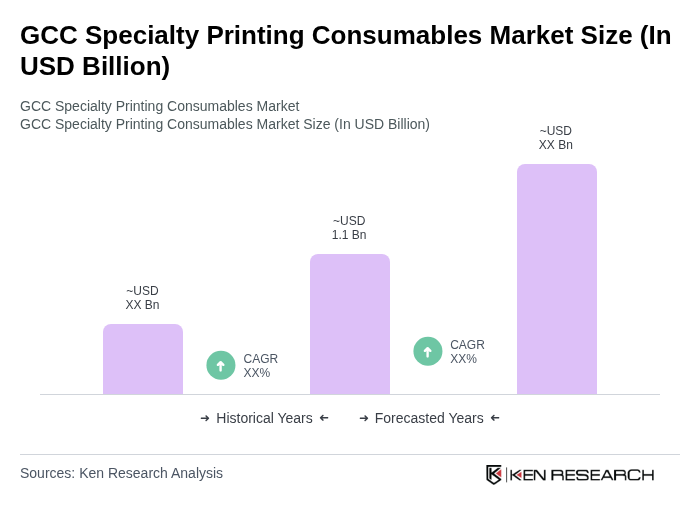
- The GCC Specialty Printing Consumables Market is valued at USD 1.1 billion, based on a five-year historical analysis. This growth is primarily driven by the increasing demand for high-quality printing solutions across packaging, labels, textiles, décor, and signage applications, supported by the rapid expansion of retail, FMCG, and construction sectors in the region. The rise in e-commerce and omnichannel retail, along with increased demand for short-run, customized, and variable-data printing for brands, has further fueled market expansion as businesses seek to enhance branding, product visibility, and consumer engagement.
- Key contributors in this market include the UAE, Saudi Arabia, and Qatar, which lead due to their robust industrial bases, large-scale logistics and retail operations, and significant investments in infrastructure, smart cities, and tourism-led projects that intensify demand for signage, wayfinding, and decorative printing. The UAE, in particular, has established itself as a regional hub for printing and packaging technology, with strong presence of international OEMs, trade shows (such as print and signage exhibitions in Dubai), and advanced digital and wide-format printing installations that foster innovation in specialty inks, substrates, and finishing solutions.
- In 2023, GCC countries continued implementing environmental and product-safety frameworks that promote more sustainable printing practices, including controls on volatile organic compounds (VOCs), hazardous substances, and waste from printing and packaging activities. One key reference instrument is the Gulf Standards Organization’s “GSO 1863/2013: Printing inks used on food packaging – General requirements”, issued by the Gulf Standardization Organization, which defines compositional and migration requirements for printing inks used on food-contact packaging, pushing converters and ink manufacturers in GCC to adopt low-VOC, low-migration, and compliant ink chemistries. In addition, national environmental regulations such as the UAE Cabinet Resolution No. 39 of 2006 on Air Pollution Regulation, issued by the UAE Cabinet, set emission-control requirements for industrial facilities, including those using solvent-based inks and coatings, which encourages printers to shift toward eco-friendly, water-based, UV, and energy-curable systems to reduce environmental impact while supporting sustainable growth of the specialty printing sector.
GCC Specialty Printing Consumables Market Segmentation
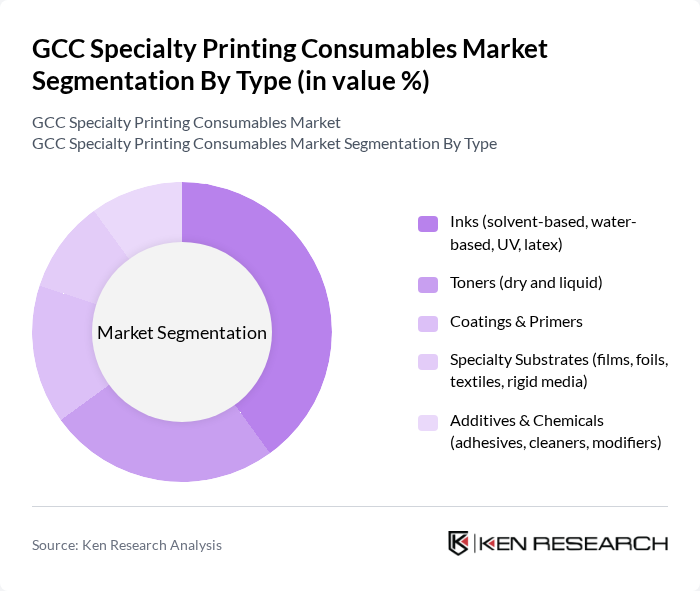
By Type:The market is segmented into various types, including inks, toners, coatings, specialty substrates, and additives. This structure is consistent with the global specialty printing consumables taxonomy, where inks, toners, specialty substrates, and chemicals/additives form the core product groups. Among these, inks, particularly water-based, UV-curable, latex, and low-migration formulations, are leading the market due to their versatility across packaging, textiles, signage, and industrial applications, as well as their improving environmental profile. The demand for toners is also significant, driven by the continued use of laser and digital electrophotographic printing in offices, professional service firms, and commercial print shops. Coatings and primers are essential for enhancing print quality, adhesion, scratch resistance, and outdoor durability in labels, flexible packaging, corrugated, and display graphics. Specialty substrates, including synthetic films, foils, textiles, and rigid media such as PVC boards, acrylics, and composites, cater to niche and high-value applications in industrial, décor, and large-format signage segments.
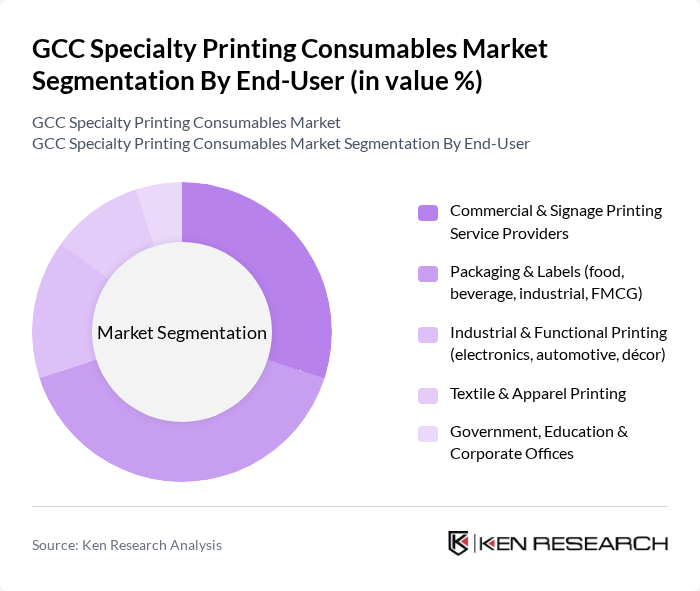
By End-User:The end-user segmentation includes commercial and signage printing service providers, packaging and labels, industrial and functional printing, textile and apparel printing, and government, education, and corporate offices. This segmentation aligns with the primary application clusters identified globally for specialty printing consumables, namely commercial printing and publishing, office and professional, packaging, and industrial/functional uses. The packaging and labels segment is the largest, driven by strong growth in food and beverage, personal care, pharmaceuticals, and FMCG sectors, which require visually appealing, compliant, and often variable-data packaging solutions, including flexible packaging, folding cartons, and pressure-sensitive labels. Commercial and signage printing services are also expanding, as brands and government agencies increasingly invest in high-quality indoor and outdoor signage, retail POS materials, exhibition graphics, and promotional print to support tourism, events, and retail development across the GCC.
GCC Specialty Printing Consumables Market Competitive Landscape
The GCC Specialty Printing Consumables Market is characterized by a dynamic mix of regional and international players. Leading participants such as HP Inc., Canon Inc., Seiko Epson Corporation, Xerox Holdings Corporation, Ricoh Company, Ltd., Brother Industries, Ltd., Lexmark International, Inc., Fujifilm Holdings Corporation, DuPont de Nemours, Inc., Avery Dennison Corporation, Flint Group, Sun Chemical Corporation, Siegwerk Druckfarben AG & Co. KGaA, DIC Corporation, Nazdar Ink Technologies contribute to innovation, geographic expansion, and service delivery in this space, consistent with global listings of key specialty printing consumables and digital printing OEMs.
GCC Specialty Printing Consumables Market Industry Analysis
Growth Drivers
- Increasing Demand for High-Quality Printing Solutions:The GCC region has witnessed a surge in demand for high-quality printing solutions, driven by a projected increase in the printing industry’s revenue, which is expected to reach $5.5 billion in future. This growth is fueled by the rising need for premium packaging and marketing materials, particularly in sectors like cosmetics and food. The region's focus on enhancing brand visibility and product differentiation further propels this demand, making high-quality consumables essential for businesses.
- Technological Advancements in Printing Technologies:The GCC specialty printing consumables market is significantly influenced by technological advancements, with investments in innovative printing technologies expected to exceed $1.7 billion in future. These advancements include digital printing and 3D printing, which enhance efficiency and reduce waste. As companies adopt these technologies, the demand for specialized consumables that support these processes, such as inks and substrates, is anticipated to rise, driving market growth.
- Expansion of the Packaging Industry:The packaging industry in the GCC is projected to grow to $30 billion in future, driven by increased consumer spending and e-commerce growth. This expansion is particularly evident in sectors like food and beverage, where packaging plays a crucial role in product safety and marketing. As a result, the demand for specialty printing consumables, such as labels and flexible packaging materials, is expected to rise, further stimulating market growth in the region.
Market Challenges
- Fluctuating Raw Material Prices:The specialty printing consumables market faces challenges due to fluctuating raw material prices, which can impact production costs. For instance, the price of key materials like pigments and resins has seen volatility, with increases of up to 20% in recent years. This unpredictability can lead to tighter profit margins for manufacturers, forcing them to either absorb costs or pass them onto consumers, potentially affecting market stability.
- Intense Competition Among Key Players:The GCC specialty printing consumables market is characterized by intense competition, with over 60 key players vying for market share. This competitive landscape has led to price wars and aggressive marketing strategies, which can erode profit margins. Companies are compelled to innovate continuously and improve their product offerings to maintain a competitive edge, which can strain resources and impact overall market growth.
GCC Specialty Printing Consumables Market Future Outlook
The future of the GCC specialty printing consumables market appears promising, driven by ongoing technological innovations and a shift towards sustainable practices. As businesses increasingly adopt digital printing technologies, the demand for specialized consumables is expected to rise. Additionally, the growing emphasis on eco-friendly materials will likely shape product development, encouraging manufacturers to invest in sustainable solutions. This evolving landscape presents opportunities for companies to differentiate themselves through innovation and sustainability, ensuring long-term growth in the market.
Market Opportunities
- Growth in Digital Printing Applications:The rise of digital printing applications presents a significant opportunity for the specialty printing consumables market. With the digital printing segment projected to grow by $1.2 billion in future, manufacturers can capitalize on this trend by developing consumables tailored for digital technologies, enhancing efficiency and quality in printing processes.
- Increasing Demand for Eco-Friendly Printing Consumables:As sustainability becomes a priority for consumers and businesses alike, the demand for eco-friendly printing consumables is expected to rise. The market for biodegradable inks and recyclable substrates is projected to grow by 25% annually, providing manufacturers with the opportunity to innovate and meet this demand, thereby enhancing their market position.
Scope of the Report
| Segment | Sub-Segments |
|---|---|
| By Type | Inks (solvent-based, water-based, UV, latex) Toners (dry and liquid) Coatings & Primers Specialty Substrates (films, foils, textiles, rigid media) Additives & Chemicals (adhesives, cleaners, modifiers) |
| By End-User | Commercial & Signage Printing Service Providers Packaging & Labels (food, beverage, industrial, FMCG) Industrial & Functional Printing (electronics, automotive, décor) Textile & Apparel Printing Government, Education & Corporate Offices |
| By Application | Digital Inkjet Printing (wide-format, UV, latex) Offset & Sheetfed Printing Flexographic Printing Gravure Printing Screen & 3D / Additive Printing |
| By Distribution Channel | Direct Sales (OEMs & ink manufacturers) Regional Distributors & Dealers Online B2B Platforms & E-commerce Retail & Trade Counters Managed Print Service Providers |
| By Geography | UAE Saudi Arabia Qatar Kuwait Oman Bahrain |
| By Product Formulation | Water-based Solvent-based UV-curable & EB-curable Latex & Other Advanced Formulations |
| By Market Segment | Large Print Service Providers & Converters SMEs (print shops, label & packaging converters) In-house & Corporate Printing Units Specialty & Niche Applications (3D, functional, security) |
Key Target Audience
Investors and Venture Capitalist Firms
Government and Regulatory Bodies (e.g., Ministry of Economy, Ministry of Commerce and Industry)
Manufacturers and Producers
Distributors and Retailers
Printing Service Providers
Packaging Companies
Industry Associations (e.g., Gulf Printing and Packaging Association)
Financial Institutions
Players Mentioned in the Report:
HP Inc.
Canon Inc.
Seiko Epson Corporation
Xerox Holdings Corporation
Ricoh Company, Ltd.
Brother Industries, Ltd.
Lexmark International, Inc.
Fujifilm Holdings Corporation
DuPont de Nemours, Inc.
Avery Dennison Corporation
Flint Group
Sun Chemical Corporation
Siegwerk Druckfarben AG & Co. KGaA
DIC Corporation
Nazdar Ink Technologies
Table of Contents
Market Assessment Phase
1. Executive Summary and Approach
2. GCC Specialty Printing Consumables Market Overview
2.1 Key Insights and Strategic Recommendations
2.2 GCC Specialty Printing Consumables Market Overview
2.3 Definition and Scope
2.4 Evolution of Market Ecosystem
2.5 Timeline of Key Regulatory Milestones
2.6 Value Chain & Stakeholder Mapping
2.7 Business Cycle Analysis
2.8 Policy & Incentive Landscape
3. GCC Specialty Printing Consumables Market Analysis
3.1 Growth Drivers
3.1.1 Increasing demand for high-quality printing solutions
3.1.2 Technological advancements in printing technologies
3.1.3 Expansion of the packaging industry
3.1.4 Rising e-commerce and online retail activities
3.2 Market Challenges
3.2.1 Fluctuating raw material prices
3.2.2 Intense competition among key players
3.2.3 Environmental regulations and sustainability concerns
3.2.4 Rapid technological changes
3.3 Market Opportunities
3.3.1 Growth in digital printing applications
3.3.2 Increasing demand for eco-friendly printing consumables
3.3.3 Expansion into emerging markets
3.3.4 Development of customized printing solutions
3.4 Market Trends
3.4.1 Shift towards sustainable and biodegradable materials
3.4.2 Rise of automation in printing processes
3.4.3 Increasing integration of AI in printing technologies
3.4.4 Growth of on-demand printing services
3.5 Government Regulation
3.5.1 Compliance with environmental standards
3.5.2 Regulations on waste management in printing
3.5.3 Standards for product safety and quality
3.5.4 Incentives for adopting green technologies
4. SWOT Analysis
5. Stakeholder Analysis
6. Porter's Five Forces Analysis
7. GCC Specialty Printing Consumables Market Market Size, 2019-2024
7.1 By Value
7.2 By Volume
7.3 By Average Selling Price
8. GCC Specialty Printing Consumables Market Segmentation
8.1 By Type
8.1.1 Inks (solvent-based, water-based, UV, latex)
8.1.2 Toners (dry and liquid)
8.1.3 Coatings & Primers
8.1.4 Specialty Substrates (films, foils, textiles, rigid media)
8.1.5 Additives & Chemicals (adhesives, cleaners, modifiers)
8.2 By End-User
8.2.1 Commercial & Signage Printing Service Providers
8.2.2 Packaging & Labels (food, beverage, industrial, FMCG)
8.2.3 Industrial & Functional Printing (electronics, automotive, décor)
8.2.4 Textile & Apparel Printing
8.2.5 Government, Education & Corporate Offices
8.3 By Application
8.3.1 Digital Inkjet Printing (wide-format, UV, latex)
8.3.2 Offset & Sheetfed Printing
8.3.3 Flexographic Printing
8.3.4 Gravure Printing
8.3.5 Screen & 3D / Additive Printing
8.4 By Distribution Channel
8.4.1 Direct Sales (OEMs & ink manufacturers)
8.4.2 Regional Distributors & Dealers
8.4.3 Online B2B Platforms & E-commerce
8.4.4 Retail & Trade Counters
8.4.5 Managed Print Service Providers
8.5 By Geography
8.5.1 UAE
8.5.2 Saudi Arabia
8.5.3 Qatar
8.5.4 Kuwait
8.5.5 Oman
8.5.6 Bahrain
8.6 By Product Formulation
8.6.1 Water-based
8.6.2 Solvent-based
8.6.3 UV-curable & EB-curable
8.6.4 Latex & Other Advanced Formulations
8.7 By Market Segment
8.7.1 Large Print Service Providers & Converters
8.7.2 SMEs (print shops, label & packaging converters)
8.7.3 In-house & Corporate Printing Units
8.7.4 Specialty & Niche Applications (3D, functional, security)
9. GCC Specialty Printing Consumables Market Competitive Analysis
9.1 Market Share of Key Players
9.2 Cross Comparison of Key Players
9.2.1 Company Name
9.2.2 Regional Presence in GCC (number of countries / branches)
9.2.3 GCC Specialty Printing Consumables Revenue (latest year, USD million)
9.2.4 3-year Revenue CAGR in GCC Specialty Printing Consumables
9.2.5 Product Portfolio Breadth (inks, toners, coatings, substrates, chemicals)
9.2.6 Share of Eco-friendly / Low-VOC & UV / Water-based Products
9.2.7 Installed Base of Specialty Printers Supported in GCC
9.2.8 Distribution Network Strength (number of GCC distributors / channel partners)
9.2.9 Average Realized Price per Liter / kg (selected key SKUs)
9.2.10 Key End-use Exposure Mix (packaging, signage, textile, industrial)
9.2.11 On?ground Technical Support & Service Coverage (response time / service hubs)
9.2.12 Ongoing Local Partnerships & JVs with GCC Converters / PSPs
9.3 SWOT Analysis of Top Players
9.4 Pricing Analysis
9.5 Detailed Profile of Major Companies
9.5.1 HP Inc.
9.5.2 Canon Inc.
9.5.3 Seiko Epson Corporation
9.5.4 Xerox Holdings Corporation
9.5.5 Ricoh Company, Ltd.
9.5.6 Brother Industries, Ltd.
9.5.7 Lexmark International, Inc.
9.5.8 Fujifilm Holdings Corporation
9.5.9 DuPont de Nemours, Inc.
9.5.10 Avery Dennison Corporation
9.5.11 Flint Group
9.5.12 Sun Chemical Corporation
9.5.13 Siegwerk Druckfarben AG & Co. KGaA
9.5.14 DIC Corporation
9.5.15 Nazdar Ink Technologies
10. GCC Specialty Printing Consumables Market End-User Analysis
10.1 Procurement Behavior of Key Ministries
10.1.1 Budget Allocation Trends
10.1.2 Preferred Suppliers
10.1.3 Procurement Processes
10.1.4 Contracting Strategies
10.2 Corporate Spend on Infrastructure & Energy
10.2.1 Investment Trends
10.2.2 Key Projects
10.2.3 Spending Priorities
10.2.4 Budget Forecasts
10.3 Pain Point Analysis by End-User Category
10.3.1 Quality Concerns
10.3.2 Supply Chain Disruptions
10.3.3 Cost Management Issues
10.3.4 Technology Adoption Barriers
10.4 User Readiness for Adoption
10.4.1 Training Needs
10.4.2 Technology Familiarity
10.4.3 Infrastructure Readiness
10.4.4 Support Requirements
10.5 Post-Deployment ROI and Use Case Expansion
10.5.1 Performance Metrics
10.5.2 Case Studies
10.5.3 User Feedback
10.5.4 Future Expansion Plans
11. GCC Specialty Printing Consumables Market Future Size, 2025-2030
11.1 By Value
11.2 By Volume
11.3 By Average Selling Price
Go-To-Market Strategy Phase
1. Whitespace Analysis + Business Model Canvas
1.1 Market Gaps Identification
1.2 Value Proposition Development
1.3 Revenue Streams Analysis
1.4 Key Partnerships Exploration
1.5 Cost Structure Assessment
1.6 Customer Segmentation
1.7 Channels of Distribution
2. Marketing and Positioning Recommendations
2.1 Branding Strategies
2.2 Product USPs
2.3 Target Audience Identification
2.4 Communication Strategy
2.5 Digital Marketing Tactics
3. Distribution Plan
3.1 Urban Retail Strategies
3.2 Rural NGO Tie-ups
3.3 E-commerce Integration
3.4 Logistics and Supply Chain Management
4. Channel & Pricing Gaps
4.1 Underserved Routes
4.2 Pricing Bands Analysis
4.3 Competitor Pricing Comparison
5. Unmet Demand & Latent Needs
5.1 Category Gaps Identification
5.2 Consumer Segments Analysis
5.3 Product Development Opportunities
6. Customer Relationship
6.1 Loyalty Programs
6.2 After-sales Service Enhancements
6.3 Customer Feedback Mechanisms
7. Value Proposition
7.1 Sustainability Initiatives
7.2 Integrated Supply Chains
7.3 Competitive Advantages
8. Key Activities
8.1 Regulatory Compliance
8.2 Branding Initiatives
8.3 Distribution Setup
9. Entry Strategy Evaluation
9.1 Domestic Market Entry Strategy
9.1.1 Product Mix Considerations
9.1.2 Pricing Band Strategy
9.1.3 Packaging Innovations
9.2 Export Entry Strategy
9.2.1 Target Countries Analysis
9.2.2 Compliance Roadmap Development
10. Entry Mode Assessment
10.1 Joint Ventures
10.2 Greenfield Investments
10.3 Mergers & Acquisitions
10.4 Distributor Model Evaluation
11. Capital and Timeline Estimation
11.1 Capital Requirements Analysis
11.2 Timelines for Implementation
12. Control vs Risk Trade-Off
12.1 Ownership vs Partnerships
12.2 Risk Mitigation Strategies
13. Profitability Outlook
13.1 Breakeven Analysis
13.2 Long-term Sustainability Strategies
14. Potential Partner List
14.1 Distributors
14.2 Joint Ventures
14.3 Acquisition Targets
15. Execution Roadmap
15.1 Phased Plan for Market Entry
15.1.1 Market Setup
15.1.2 Market Entry
15.1.3 Growth Acceleration
15.1.4 Scale & Stabilize
15.2 Key Activities and Milestones
15.2.1 Milestone Planning
15.2.2 Activity Tracking
Research Methodology
Phase 1: Approach1
Desk Research
- Industry reports from GCC trade associations and market research firms
- Analysis of import/export data from national customs authorities
- Review of published articles and white papers on specialty printing consumables
Primary Research
- Interviews with product managers at leading printing consumables manufacturers
- Surveys with distributors and retailers in the GCC region
- Field interviews with end-users in various sectors such as packaging and textiles
Validation & Triangulation
- Cross-validation of findings through multiple data sources and expert opinions
- Triangulation of market size estimates from sales data and industry forecasts
- Sanity checks through feedback from industry experts and stakeholders
Phase 2: Market Size Estimation1
Top-down Assessment
- Analysis of overall printing market size in the GCC and its growth trajectory
- Segmentation by product type, including inks, toners, and specialty substrates
- Incorporation of regional economic indicators and consumer trends
Bottom-up Modeling
- Volume estimates based on production capacities of key manufacturers
- Cost analysis derived from pricing strategies of major product categories
- Estimation of market share based on sales data from distributors and retailers
Forecasting & Scenario Analysis
- Multi-variable forecasting using historical growth rates and market drivers
- Scenario analysis based on potential regulatory changes and technological advancements
- Development of baseline, optimistic, and pessimistic market projections through 2030
Phase 3: CATI Sample Composition1
| Scope Item/Segment | Sample Size | Target Respondent Profiles |
|---|---|---|
| Commercial Printing Sector | 100 | Production Managers, Sales Directors |
| Packaging Industry | 80 | Procurement Managers, Quality Assurance Heads |
| Textile Printing Applications | 70 | Textile Designers, Operations Managers |
| Advertising and Marketing Firms | 90 | Creative Directors, Marketing Managers |
| Office Supplies and Stationery | 60 | Retail Managers, Supply Chain Coordinators |
Frequently Asked Questions
What is the current value of the GCC Specialty Printing Consumables Market?
The GCC Specialty Printing Consumables Market is valued at approximately USD 1.1 billion, reflecting a robust growth trajectory driven by increasing demand for high-quality printing solutions across various sectors, including packaging, textiles, and signage.
What factors are driving the growth of the GCC Specialty Printing Consumables Market?
Which countries are the leading contributors to the GCC Specialty Printing Consumables Market?
What types of products are included in the GCC Specialty Printing Consumables Market?
Other Regional/Country Reports
Indonesia Specialty Printing Consumables Market
Malaysia Specialty Printing Consumables Market
KSA Specialty Printing Consumables Market
APAC Specialty Printing Consumables Market
SEA Specialty Printing Consumables Market
Vietnam Specialty Printing Consumables Market
Other Adjacent Reports
Egypt Digital Printing Technology Market
KSA packaging materials market report size, share, growth drivers, trends, opportunities & forecast 2025–2030Kuwait Label Printing Market
GCC textile printing market report Size, Share, Growth Drivers, Trends, Opportunities & Forecast 2025–2030South Korea Signage and Display Market
UAE Inkjet Ink Market
Indonesia 3D Printing Consumables Market
Thailand Sustainable Printing Solutions Market
Bahrain Commercial Printing Services Market
South Korea E-commerce Packaging Market
Why Buy From Us?

What makes us stand out is that our consultants follow Robust, Refine and Result (RRR) methodology. Robust for clear definitions, approaches and sanity checking, Refine for differentiating respondents' facts and opinions, and Result for presenting data with story.

We have set a benchmark in the industry by offering our clients with syndicated and customized market research reports featuring coverage of entire market as well as meticulous research and analyst insights.

While we don't replace traditional research, we flip the method upside down. Our dual approach of Top Bottom & Bottom Top ensures quality deliverable by not just verifying company fundamentals but also looking at the sector and macroeconomic factors.

With one step in the future, our research team constantly tries to show you the bigger picture. We help with some of the tough questions you may encounter along the way: How is the industry positioned? Best marketing channel? KPI's of competitors? By aligning every element, we help maximize success.

Our report gives you instant access to the answers and sources that other companies might choose to hide. We elaborate each steps of research methodology we have used and showcase you the sample size to earn your trust.

If you need any support, we are here! We pride ourselves on universe strength, data quality, and quick, friendly, and professional service.