Ken Research Logo

GCC toaster market Size, Share, Growth Drivers, Trends, Opportunities & Forecast 2025–2030

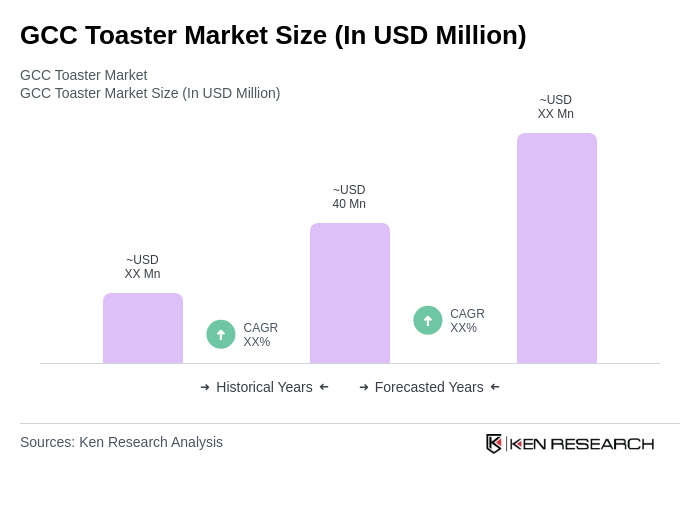
GCC Toaster Market, valued at USD 40 million, is growing due to convenient kitchen appliances demand, urbanization, and energy-efficient regulations in the region.

Region:Middle East

Author(s):Shubham

Product Code:KRAC4236

Pages:83

Published On:October 2025
About the Report

Base Year 2024

GCC Toaster Market Overview

  • The GCC Toaster Market is valued at USD 40 million, based on a five-year historical analysis. This growth is primarily driven by increasing consumer demand for convenient kitchen appliances, a rise in urbanization, and a growing middle-class population in the region. The trend towards modern cooking solutions, the popularity of breakfast foods, and the rapid adoption of smart kitchen appliances have further fueled the market's expansion .
  • Key players in this market include the United Arab Emirates, Saudi Arabia, and Qatar. The UAE leads due to its high disposable income and a robust retail sector, while Saudi Arabia benefits from a large population and increasing household spending on kitchen appliances. Qatar's rapid urban development and rising expatriate population also contribute to its market prominence .
  • In 2023, the Gulf Standardization Organization (GSO) issued the "GSO 2530:2023 Energy Efficiency Requirements for Electrical Appliances," mandating that all new household appliances, including toasters, meet specific energy consumption and labeling standards. This regulation promotes the adoption of energy-efficient technologies and encourages manufacturers to innovate in product design and functionality by requiring minimum energy performance and clear efficiency labeling for all appliances sold in GCC member states .
GCC Toaster Market Size

GCC Toaster Market Segmentation

By Type:The market is segmented into various types of toasters, including Pop-Up Toasters, Toaster Ovens, Conveyor/Commercial Toasters, Smart Toasters, 2-Slice Toasters, 4-Slice Toasters, and Others (e.g., Sandwich Toasters, Specialty Toasters). Among these, Pop-Up Toasters hold the largest share due to their convenience and ease of use, making them a staple in most households. The increasing trend of quick breakfast solutions and the growing preference for compact, user-friendly appliances have led to higher demand for these products. Smart Toasters are gaining traction as consumers seek advanced features such as digital controls, customizable browning, and connectivity .

GCC Toaster Market segmentation by Type.

By End-User:The market is divided into Residential and Commercial segments. The Residential segment is the largest, driven by the growing number of households, the increasing trend of home cooking, and the popularity of convenient breakfast appliances. Consumers are investing in kitchen appliances that offer efficiency and ease of use, leading to a surge in demand for toasters. The Commercial segment, which includes hotels, restaurants, and cafés, is also significant as these establishments require high-capacity toasters to meet customer demands. The growth of the hospitality sector in the GCC further supports commercial toaster sales .
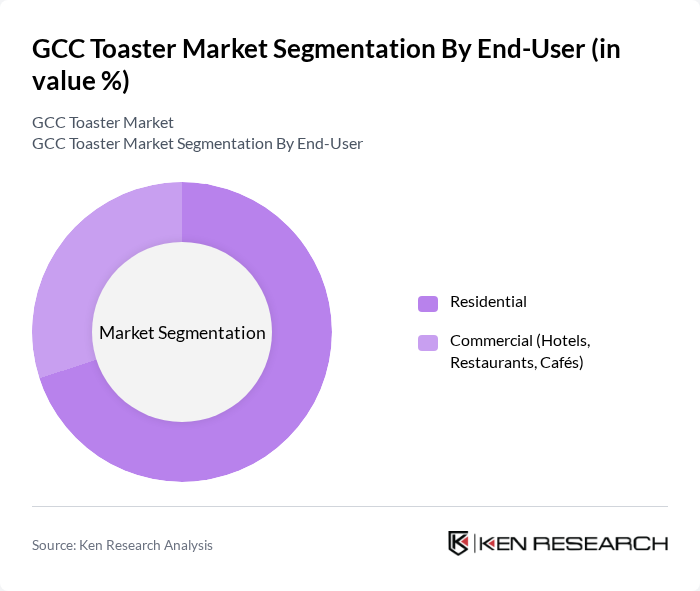
GCC Toaster Market segmentation by End-User.

GCC Toaster Market Competitive Landscape

The GCC Toaster Market is characterized by a dynamic mix of regional and international players. Leading participants such as Philips Domestic Appliances, Breville Group Limited, Cuisinart (Conair Corporation), Black+Decker (Stanley Black & Decker, Inc.), Hamilton Beach Brands Holding Company, Kenwood Limited (De'Longhi Group), Tefal (Groupe SEB), Morphy Richards, Panasonic Corporation, Smeg S.p.A., Oster (Newell Brands), Russell Hobbs (Spectrum Brands), De'Longhi S.p.A., West Bend (Focus Products Group International, LLC), Sharp Corporation, Nikai Group (UAE), Geepas (Western International Group, UAE), Aftron (Al-Futtaim Group, UAE) contribute to innovation, geographic expansion, and service delivery in this space.

Philips Domestic Appliances

1891

Amsterdam, Netherlands

Breville Group Limited

1932

Melbourne, Australia

Cuisinart (Conair Corporation)

1973

East Windsor, New Jersey, USA

Black+Decker (Stanley Black & Decker, Inc.)

1910

Towson, Maryland, USA

Hamilton Beach Brands Holding Company

1904

Richmond, Virginia, USA

Company

Establishment Year

Headquarters

Group Size (Large, Medium, or Small as per industry convention)

Revenue (USD, GCC region)

Revenue Growth Rate (YoY %)

Market Share in GCC Toaster Segment (%)

Distribution Network Coverage (No. of Outlets/Partners in GCC)

Product Portfolio Breadth (No. of Toaster SKUs)

GCC Toaster Market Industry Analysis

Growth Drivers

  • Increasing Urbanization:Urbanization in the GCC region is projected to reach 85% in the future, according to the World Bank. This shift leads to a higher demand for kitchen appliances, including toasters, as urban dwellers seek convenience in their cooking. The growing population in urban areas, estimated at 50 million, drives the need for efficient appliances that cater to fast-paced lifestyles, thereby boosting the toaster market significantly.
  • Rising Disposable Incomes:The average disposable income in the GCC is expected to rise to $28,000 per capita in the future, as reported by the IMF. This increase allows consumers to spend more on household appliances, including toasters. As families prioritize quality and convenience, the demand for premium toaster models with advanced features is likely to grow, enhancing market dynamics and encouraging manufacturers to innovate.
  • Growing Demand for Convenience Appliances:The GCC's appliance market is witnessing a surge in demand for convenience-oriented products, with sales of kitchen appliances projected to reach $4.5 billion in the future. This trend is driven by busy lifestyles and a preference for quick meal preparation. Toasters, being essential for breakfast and snack preparation, are increasingly favored, leading to a robust growth trajectory in the sector.

Market Challenges

  • Intense Competition:The GCC toaster market is characterized by fierce competition, with over 45 brands vying for market share. This saturation leads to price wars, which can erode profit margins. Companies must invest heavily in marketing and product differentiation to stand out, which can strain resources and impact overall profitability, as highlighted by industry reports indicating a 9% decline in average margins.
  • Fluctuating Raw Material Prices:The cost of raw materials for manufacturing toasters, such as stainless steel and plastic, has seen significant volatility, with prices increasing by 12% in the last year alone. This fluctuation poses a challenge for manufacturers, as it complicates pricing strategies and can lead to increased production costs. Companies must navigate these challenges to maintain competitive pricing while ensuring quality.

GCC Toaster Market Future Outlook

The GCC toaster market is poised for significant evolution, driven by technological advancements and changing consumer preferences. As smart home technology becomes more prevalent, integration of IoT features in toasters is expected to gain traction. Additionally, the rising focus on health-conscious cooking will likely influence product development, with manufacturers introducing toasters that promote healthier meal options. These trends indicate a dynamic market landscape that will adapt to consumer needs and technological innovations.

Market Opportunities

  • Technological Advancements:The integration of smart technology in toasters presents a lucrative opportunity. With an estimated 20% of households in the GCC adopting smart home devices in the future, manufacturers can capitalize on this trend by developing toasters that connect to mobile apps, enhancing user experience and convenience.
  • Eco-Friendly Product Demand:As sustainability becomes a priority, the demand for eco-friendly kitchen appliances is on the rise. The GCC market is expected to see a 15% increase in sales of energy-efficient toasters in the future, driven by consumer awareness and regulatory support for environmentally friendly products, creating a significant opportunity for manufacturers.

Scope of the Report

SegmentSub-Segments
By Type

Pop-Up Toasters

Toaster Ovens

Conveyor/Commercial Toasters

Smart Toasters

Slice Toasters

Slice Toasters

Others (e.g., Sandwich Toasters, Specialty Toasters)

By End-User

Residential

Commercial (Hotels, Restaurants, Cafés)

By Sales Channel

Online Retail

Offline Retail (Hypermarkets, Supermarkets, Specialty Stores)

Direct Sales

Distributors

By Price Range

Budget

Mid-Range

Premium

By Brand

Local Brands

International Brands

Private Labels

By Design

Classic Design

Modern Design

Retro Design

By Functionality

Basic Functionality

Multi-Functionality (e.g., Defrost, Reheat, Bagel)

Programmable/Smart Features

Key Target Audience

Investors and Venture Capitalist Firms

Government and Regulatory Bodies (e.g., Ministry of Economy, Saudi Standards, Metrology and Quality Organization)

Manufacturers and Producers

Distributors and Retailers

Importers and Exporters

Industry Associations (e.g., Gulf Cooperation Council Chamber of Commerce)

Financial Institutions

Market Analysts and Industry Experts

Players Mentioned in the Report:

Philips Domestic Appliances

Breville Group Limited

Cuisinart (Conair Corporation)

Black+Decker (Stanley Black & Decker, Inc.)

Hamilton Beach Brands Holding Company

Kenwood Limited (De'Longhi Group)

Tefal (Groupe SEB)

Morphy Richards

Panasonic Corporation

Smeg S.p.A.

Oster (Newell Brands)

Russell Hobbs (Spectrum Brands)

De'Longhi S.p.A.

West Bend (Focus Products Group International, LLC)

Sharp Corporation

Nikai Group (UAE)

Geepas (Western International Group, UAE)

Aftron (Al-Futtaim Group, UAE)

Table of Contents

Market Assessment Phase

1. Executive Summary and Approach


2. GCC Toaster Market Overview

2.1 Key Insights and Strategic Recommendations

2.2 GCC Toaster Market Overview

2.3 Definition and Scope

2.4 Evolution of Market Ecosystem

2.5 Timeline of Key Regulatory Milestones

2.6 Value Chain & Stakeholder Mapping

2.7 Business Cycle Analysis

2.8 Policy & Incentive Landscape


3. GCC Toaster Market Analysis

3.1 Growth Drivers

3.1.1 Increasing Urbanization
3.1.2 Rising Disposable Incomes
3.1.3 Growing Demand for Convenience Appliances
3.1.4 Expansion of Retail Channels

3.2 Market Challenges

3.2.1 Intense Competition
3.2.2 Fluctuating Raw Material Prices
3.2.3 Regulatory Compliance Costs
3.2.4 Consumer Price Sensitivity

3.3 Market Opportunities

3.3.1 Technological Advancements
3.3.2 Eco-Friendly Product Demand
3.3.3 E-commerce Growth
3.3.4 Customization Trends

3.4 Market Trends

3.4.1 Smart Toasters Integration
3.4.2 Health-Conscious Cooking Options
3.4.3 Aesthetic Design Preferences
3.4.4 Subscription Services for Kitchen Appliances

3.5 Government Regulation

3.5.1 Safety Standards Compliance
3.5.2 Energy Efficiency Regulations
3.5.3 Import Tariffs on Appliances
3.5.4 Consumer Protection Laws

4. SWOT Analysis


5. Stakeholder Analysis


6. Porter's Five Forces Analysis


7. GCC Toaster Market Market Size, 2019-2024

7.1 By Value

7.2 By Volume

7.3 By Average Selling Price


8. GCC Toaster Market Segmentation

8.1 By Type

8.1.1 Pop-Up Toasters
8.1.2 Toaster Ovens
8.1.3 Conveyor/Commercial Toasters
8.1.4 Smart Toasters
8.1.5 2-Slice Toasters
8.1.6 4-Slice Toasters
8.1.7 Others (e.g., Sandwich Toasters, Specialty Toasters)

8.2 By End-User

8.2.1 Residential
8.2.2 Commercial (Hotels, Restaurants, Cafés)

8.3 By Sales Channel

8.3.1 Online Retail
8.3.2 Offline Retail (Hypermarkets, Supermarkets, Specialty Stores)
8.3.3 Direct Sales
8.3.4 Distributors

8.4 By Price Range

8.4.1 Budget
8.4.2 Mid-Range
8.4.3 Premium

8.5 By Brand

8.5.1 Local Brands
8.5.2 International Brands
8.5.3 Private Labels

8.6 By Design

8.6.1 Classic Design
8.6.2 Modern Design
8.6.3 Retro Design

8.7 By Functionality

8.7.1 Basic Functionality
8.7.2 Multi-Functionality (e.g., Defrost, Reheat, Bagel)
8.7.3 Programmable/Smart Features

9. GCC Toaster Market Competitive Analysis

9.1 Market Share of Key Players

9.2 Cross Comparison of Key Players

9.2.1 Company Name
9.2.2 Group Size (Large, Medium, or Small as per industry convention)
9.2.3 Revenue (USD, GCC region)
9.2.4 Revenue Growth Rate (YoY %)
9.2.5 Market Share in GCC Toaster Segment (%)
9.2.6 Distribution Network Coverage (No. of Outlets/Partners in GCC)
9.2.7 Product Portfolio Breadth (No. of Toaster SKUs)
9.2.8 Average Selling Price (USD)
9.2.9 Customer Satisfaction Index (GCC, Survey-based)
9.2.10 Brand Recognition Score (GCC, Survey-based)
9.2.11 After-Sales Service Coverage (GCC Countries Served)
9.2.12 Innovation Index (e.g., Smart/Connected Product Launches)

9.3 SWOT Analysis of Top Players

9.4 Pricing Analysis

9.5 Detailed Profile of Major Companies

9.5.1 Philips Domestic Appliances
9.5.2 Breville Group Limited
9.5.3 Cuisinart (Conair Corporation)
9.5.4 Black+Decker (Stanley Black & Decker, Inc.)
9.5.5 Hamilton Beach Brands Holding Company
9.5.6 Kenwood Limited (De'Longhi Group)
9.5.7 Tefal (Groupe SEB)
9.5.8 Morphy Richards
9.5.9 Panasonic Corporation
9.5.10 Smeg S.p.A.
9.5.11 Oster (Newell Brands)
9.5.12 Russell Hobbs (Spectrum Brands)
9.5.13 De'Longhi S.p.A.
9.5.14 West Bend (Focus Products Group International, LLC)
9.5.15 Sharp Corporation
9.5.16 Nikai Group (UAE)
9.5.17 Geepas (Western International Group, UAE)
9.5.18 Aftron (Al-Futtaim Group, UAE)

10. GCC Toaster Market End-User Analysis

10.1 Procurement Behavior of Key Ministries

10.1.1 Budget Allocation Trends
10.1.2 Procurement Processes
10.1.3 Supplier Selection Criteria

10.2 Corporate Spend on Infrastructure & Energy

10.2.1 Investment Trends in Kitchen Appliances
10.2.2 Budgeting for Upgrades
10.2.3 Cost-Benefit Analysis

10.3 Pain Point Analysis by End-User Category

10.3.1 Reliability Issues
10.3.2 Maintenance Costs
10.3.3 Energy Consumption Concerns

10.4 User Readiness for Adoption

10.4.1 Awareness of New Technologies
10.4.2 Training Needs
10.4.3 Adoption Barriers

10.5 Post-Deployment ROI and Use Case Expansion

10.5.1 Performance Metrics
10.5.2 User Feedback Mechanisms
10.5.3 Future Expansion Plans

11. GCC Toaster Market Future Size, 2025-2030

11.1 By Value

11.2 By Volume

11.3 By Average Selling Price


Go-To-Market Strategy Phase

1. Whitespace Analysis + Business Model Canvas

1.1 Market Gaps Identification

1.2 Value Proposition Development

1.3 Revenue Streams Analysis

1.4 Customer Segmentation

1.5 Key Partnerships

1.6 Cost Structure

1.7 Channels of Distribution


2. Marketing and Positioning Recommendations

2.1 Branding Strategies

2.2 Product USPs

2.3 Target Audience Identification

2.4 Marketing Channels

2.5 Promotional Strategies


3. Distribution Plan

3.1 Urban Retail Strategies

3.2 Rural NGO Tie-Ups

3.3 E-commerce Integration

3.4 Logistics and Supply Chain Management


4. Channel & Pricing Gaps

4.1 Underserved Routes

4.2 Pricing Bands Analysis

4.3 Competitor Pricing Strategies


5. Unmet Demand & Latent Needs

5.1 Category Gaps

5.2 Consumer Segments Analysis

5.3 Product Development Opportunities


6. Customer Relationship

6.1 Loyalty Programs

6.2 After-sales Service

6.3 Customer Engagement Strategies


7. Value Proposition

7.1 Sustainability Initiatives

7.2 Integrated Supply Chains

7.3 Customer-Centric Innovations


8. Key Activities

8.1 Regulatory Compliance

8.2 Branding Efforts

8.3 Distribution Setup


9. Entry Strategy Evaluation

9.1 Domestic Market Entry Strategy

9.1.1 Product Mix Considerations
9.1.2 Pricing Band Strategy
9.1.3 Packaging Innovations

9.2 Export Entry Strategy

9.2.1 Target Countries
9.2.2 Compliance Roadmap

10. Entry Mode Assessment

10.1 Joint Ventures

10.2 Greenfield Investments

10.3 Mergers & Acquisitions

10.4 Distributor Model


11. Capital and Timeline Estimation

11.1 Capital Requirements

11.2 Timelines for Implementation


12. Control vs Risk Trade-Off

12.1 Ownership vs Partnerships


13. Profitability Outlook

13.1 Breakeven Analysis

13.2 Long-term Sustainability


14. Potential Partner List

14.1 Distributors

14.2 Joint Ventures

14.3 Acquisition Targets


15. Execution Roadmap

15.1 Phased Plan for Market Entry

15.1.1 Market Setup
15.1.2 Market Entry
15.1.3 Growth Acceleration
15.1.4 Scale & Stabilize

15.2 Key Activities and Milestones

15.2.1 Milestone Planning
15.2.2 Activity Tracking

Research Methodology

ApproachModellingSample

Phase 1: Approach1

Desk Research

  • Market reports from industry associations and trade publications specific to the GCC toaster market
  • Analysis of import/export data from GCC customs and trade statistics
  • Review of consumer behavior studies and market trends published by regional research firms

Primary Research

  • Interviews with product managers at leading appliance manufacturers in the GCC
  • Surveys conducted with retailers and distributors to understand market dynamics
  • Focus groups with consumers to gauge preferences and buying behavior regarding toasters

Validation & Triangulation

  • Cross-validation of findings through multiple data sources including sales data and consumer feedback
  • Triangulation of insights from primary interviews with secondary research findings
  • Sanity checks through expert reviews from industry analysts and market specialists

Phase 2: Market Size Estimation1

Top-down Assessment

  • Estimation of total market size based on household appliance spending trends in the GCC
  • Segmentation of the market by product type, including conventional and smart toasters
  • Incorporation of demographic data to assess potential market growth in urban areas

Bottom-up Modeling

  • Collection of sales volume data from major retailers and e-commerce platforms
  • Estimation of average selling prices across different toaster categories
  • Calculation of market size based on unit sales and revenue generation from key segments

Forecasting & Scenario Analysis

  • Utilization of historical sales data to project future growth rates for the toaster market
  • Scenario analysis based on economic indicators and consumer trends in the GCC
  • Development of best-case, worst-case, and most-likely scenarios through 2030

Phase 3: CATI Sample Composition1

Scope Item/SegmentSample SizeTarget Respondent Profiles
Retail Sales of Toasters150Store Managers, Sales Representatives
Consumer Preferences in Kitchen Appliances120Homeowners, Apartment Dwellers
Market Trends in Smart Appliances100Tech Enthusiasts, Early Adopters
Distribution Channels for Toasters80Distributors, Supply Chain Managers
Consumer Feedback on Toaster Features110Product Reviewers, Cooking Enthusiasts

Frequently Asked Questions

What is the current value of the GCC Toaster Market?

The GCC Toaster Market is valued at approximately USD 40 million, driven by increasing consumer demand for convenient kitchen appliances, urbanization, and a growing middle-class population in the region.

Which countries are the key players in the GCC Toaster Market?

What types of toasters are popular in the GCC market?

What are the main growth drivers for the GCC Toaster Market?

Other Regional/Country Reports

Indonesia Toaster Market Size, Share, Growth Drivers, Trends, Opportunities & Forecast 2025–2030

Malaysia Toaster Market Size, Share, Growth Drivers, Trends, Opportunities & Forecast 2025–2030

KSA Toaster Market Size, Share, Growth Drivers, Trends, Opportunities & Forecast 2025–2030

APAC Toaster Market Size, Share, Growth Drivers, Trends, Opportunities & Forecast 2025–2030

SEA Toaster Market Size, Share, Growth Drivers, Trends, Opportunities & Forecast 2025–2030

Vietnam Toaster Market Size, Share, Growth Drivers, Trends, Opportunities & Forecast 2025–2030

Other Adjacent Reports

Vietnam Coffee Maker Market

UAE Electric Kettle Market

Belgium Blender Market

South Africa Food Processor Market

Indonesia microwave oven market size, share, growth drivers, trends, opportunities & forecast 2025–2030Indonesia air fryer market Size, Share, Growth Drivers, Trends, Opportunities & Forecast 2025–2030

South Africa Juicer Market

Germany Sandwich Maker Market

South Africa Bread Maker Market

UAE Slow Cooker Market

Why Buy From Us?

Refine Robust Result (RRR) Framework

What makes us stand out is that our consultants follow Robust, Refine and Result (RRR) methodology. Robust for clear definitions, approaches and sanity checking, Refine for differentiating respondents' facts and opinions, and Result for presenting data with story.

Our Reach Is Unmatched

We have set a benchmark in the industry by offering our clients with syndicated and customized market research reports featuring coverage of entire market as well as meticulous research and analyst insights.

Shifting the Research Paradigm

While we don't replace traditional research, we flip the method upside down. Our dual approach of Top Bottom & Bottom Top ensures quality deliverable by not just verifying company fundamentals but also looking at the sector and macroeconomic factors.

More Insights-Better Decisions

With one step in the future, our research team constantly tries to show you the bigger picture. We help with some of the tough questions you may encounter along the way: How is the industry positioned? Best marketing channel? KPI's of competitors? By aligning every element, we help maximize success.

Transparency and Trust

Our report gives you instant access to the answers and sources that other companies might choose to hide. We elaborate each steps of research methodology we have used and showcase you the sample size to earn your trust.

Round the Clock Support

If you need any support, we are here! We pride ourselves on universe strength, data quality, and quick, friendly, and professional service.

Why Clients Choose Us?

400000+
Reports in repository
150+
Consulting projects a year
100+
Analysts
8000+
Client Queries in 2022








