About the Report
Base Year 2024Global Air Conditioning Equipment Market Overview
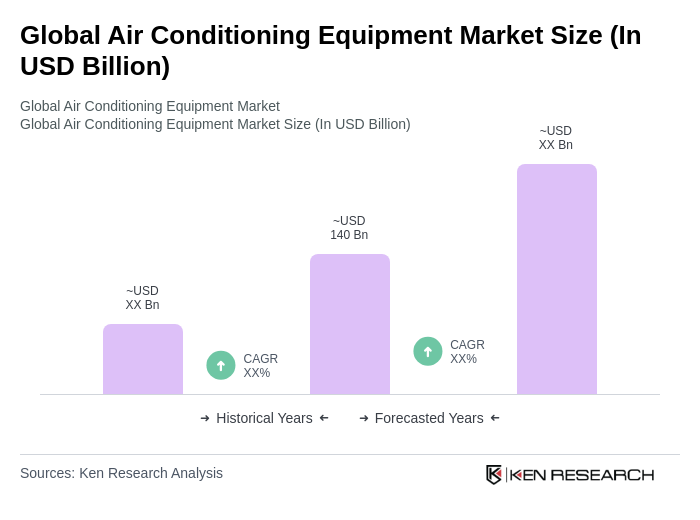
- The Global Air Conditioning Equipment Market is valued at approximately USD 140 billion, based on a five-year historical analysis. Multiple industry trackers segment the space slightly differently (air conditioning equipment vs. broader HVAC equipment vs. air conditioners), but all indicate a large, triple?digit?billion market supported by sustained demand across residential, commercial, and industrial applications .
- Growth is driven by rising cooling demand from higher temperatures and urbanization, alongside accelerating adoption of energy?efficient and inverter-based systems. Asia-Pacific accounts for the largest share of air conditioning equipment revenue and unit demand, reflecting rapid urban development and large-scale residential and commercial installations .
- The European Union’s Ecodesign framework mandates minimum energy performance standards for ACs and heat pumps, complemented by energy labelling updates and refrigerant transition policies under F-Gas rules. These measures tighten efficiency baselines, cut lifecycle emissions, and are pushing manufacturers toward higher?SEER/SCOP, inverter, and lower?GWP refrigerant solutions to remain compliant and competitive .
Global Air Conditioning Equipment Market Segmentation
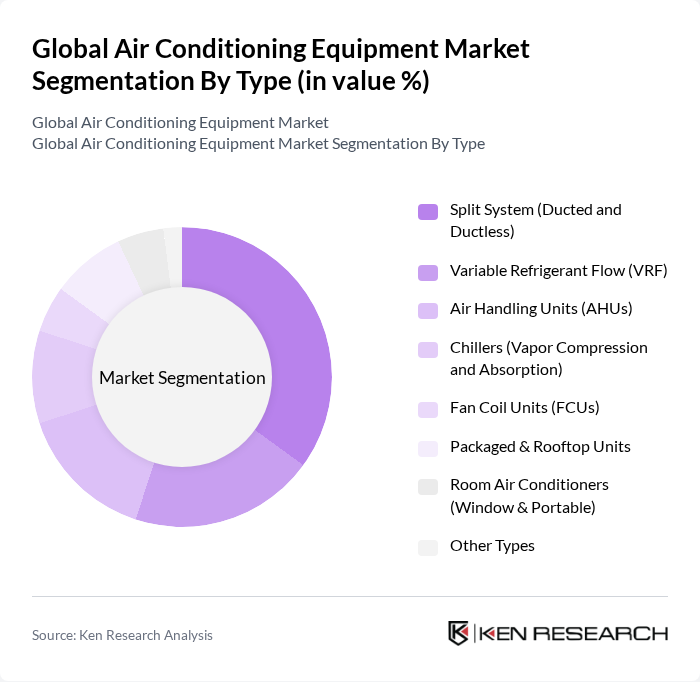
By Type:The air conditioning equipment market can be segmented into various types, including Split System (Ducted and Ductless), Variable Refrigerant Flow (VRF), Air Handling Units (AHUs), Chillers (Vapor Compression and Absorption), Fan Coil Units (FCUs), Packaged & Rooftop Units, Room Air Conditioners (Window & Portable), and Other Types. Among these, the Split System (Ducted and Ductless) segment is currently leading the market due to its versatility and efficiency, making it a preferred choice for both residential and commercial applications. The prominence of split systems is reinforced by widespread adoption in APAC residential and small commercial settings and regulatory emphasis on inverter efficiency classes .
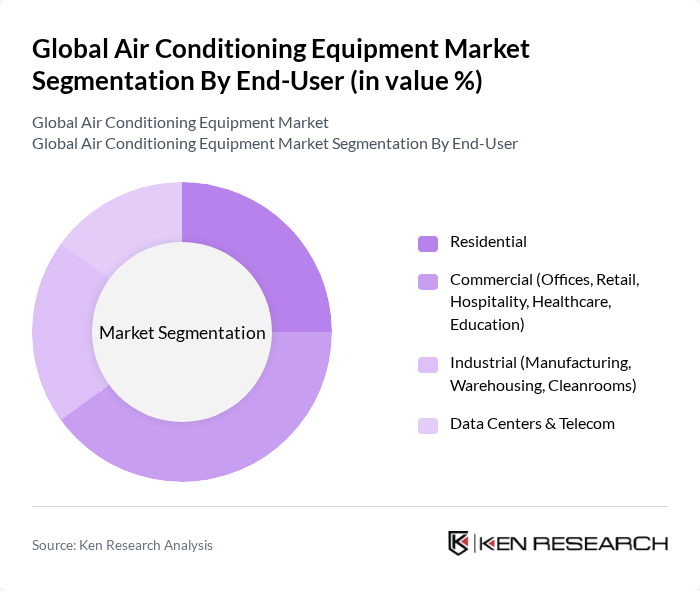
By End-User:The market can also be segmented by end-user categories, including Residential, Commercial (Offices, Retail, Hospitality, Healthcare, Education), Industrial (Manufacturing, Warehousing, Cleanrooms), and Data Centers & Telecom. The Commercial segment is currently the largest due to the increasing demand for air conditioning in office buildings, retail spaces, and hospitality sectors, driven by the need for comfortable environments and improved indoor air quality. APAC’s large installed base in commercial facilities and ongoing new-build activity further underpins commercial leadership .
Global Air Conditioning Equipment Market Competitive Landscape
The Global Air Conditioning Equipment Market is characterized by a dynamic mix of regional and international players. Leading participants such as Daikin Industries, Ltd., Carrier Global Corporation, Trane Technologies plc, Mitsubishi Electric Corporation, LG Electronics Inc., Panasonic Holdings Corporation, Johnson Controls International plc (York), Rheem Manufacturing Company, Gree Electric Appliances, Inc. of Zhuhai, Fujitsu General Limited, Hitachi, Ltd. (Johnson Controls–Hitachi Air Conditioning), Samsung Electronics Co., Ltd., Lennox International Inc., Haier Smart Home Co., Ltd. (Haier HVAC/MRCOOL brands), Midea Group Co., Ltd. contribute to innovation, geographic expansion, and service delivery in this space .
Global Air Conditioning Equipment Market Industry Analysis
Growth Drivers
- Increasing Demand for Energy-Efficient Systems:The global push for energy efficiency is driving the air conditioning equipment market, with energy-efficient systems projected to save approximately 30% on energy costs. In future, the global energy consumption for air conditioning is expected to reach 2,200 terawatt-hours (TWh), highlighting the need for systems that minimize energy use while maximizing performance. This demand is further supported by government incentives aimed at reducing energy consumption and promoting sustainable practices.
- Rising Temperatures and Climate Change:The average global temperature is projected to rise by 1.5 degrees Celsius in future, leading to increased demand for cooling solutions. Regions experiencing extreme heat, such as the Middle East and parts of Asia, are expected to see a surge in air conditioning installations, with an estimated 1.6 billion units needed globally in future. This trend underscores the urgent need for effective cooling systems to combat climate-related challenges.
- Urbanization and Infrastructure Development:In future, it is estimated that over 65% of the global population will reside in urban areas, driving the demand for air conditioning systems in residential and commercial buildings. Urban infrastructure projects, particularly in emerging markets, are expected to contribute to a significant increase in air conditioning installations, with an estimated 350 million new units required in urban centers alone. This urbanization trend is a key driver for market growth.
Market Challenges
- High Initial Installation Costs:The average cost of installing a new air conditioning system can range from three thousand to seven thousand dollars, which poses a significant barrier for many consumers and businesses. In future, the high upfront costs are expected to deter potential buyers, particularly in developing regions where disposable income is lower. This challenge may slow down market penetration and adoption rates for new technologies.
- Environmental Regulations and Compliance:Stricter environmental regulations are being implemented globally, particularly regarding refrigerant use and emissions. In future, compliance with these regulations may require significant investment in technology upgrades, with costs potentially exceeding one billion dollars for major manufacturers. This regulatory landscape presents a challenge for companies to innovate while adhering to environmental standards, impacting their operational costs and market strategies.
Global Air Conditioning Equipment Market Future Outlook
The future of the air conditioning equipment market is poised for transformation, driven by technological advancements and changing consumer preferences. The integration of smart technologies and IoT capabilities is expected to enhance system efficiency and user experience. Additionally, as sustainability becomes a priority, manufacturers will increasingly focus on eco-friendly refrigerants and energy-efficient designs. These trends will shape the market landscape, fostering innovation and creating new opportunities for growth in the coming years.
Market Opportunities
- Growth in Smart Home Technology:The rise of smart home technology presents a significant opportunity for air conditioning manufacturers. In future, the smart home market is projected to reach one hundred thirty-five billion dollars, with smart HVAC systems playing a crucial role. This integration allows for enhanced control and energy management, appealing to tech-savvy consumers seeking convenience and efficiency.
- Expansion in Emerging Markets:Emerging markets, particularly in Asia and Africa, are experiencing rapid urbanization and economic growth. In future, these regions are expected to account for over 45% of global air conditioning demand. This expansion offers manufacturers a lucrative opportunity to tap into new customer bases, driving sales and fostering brand loyalty in previously underserved markets.
Scope of the Report
| Segment | Sub-Segments |
|---|---|
| By Type | Split System (Ducted and Ductless) Variable Refrigerant Flow (VRF) Air Handling Units (AHUs) Chillers (Vapor Compression and Absorption) Fan Coil Units (FCUs) Packaged & Rooftop Units Room Air Conditioners (Window & Portable) Other Types |
| By End-User | Residential Commercial (Offices, Retail, Hospitality, Healthcare, Education) Industrial (Manufacturing, Warehousing, Cleanrooms) Data Centers & Telecom |
| By Application | Comfort Cooling Process Cooling Data Center & Mission-Critical Cooling Indoor Air Quality & Ventilation-Integrated Systems Others |
| By Distribution Channel | Direct (Project Sales/EPC) Dealer/Distributor Network Retail (Brand Stores & Multi-brand Outlets) Online/E-commerce Others |
| By Region | North America Europe Asia-Pacific Latin America Middle East & Africa |
| By Price Range | Entry-Level Mid-Range Premium |
| By Energy & Efficiency | Inverter vs. Non-Inverter Efficiency Ratings (SEER/EER/IEER) Refrigerant Type (R-32, R-410A, R-290, Low-GWP Alternatives) |
Key Target Audience
Investors and Venture Capitalist Firms
Government and Regulatory Bodies (e.g., Environmental Protection Agency, Department of Energy)
Manufacturers and Producers
Distributors and Retailers
Building and Construction Companies
Facility Management Firms
Energy Efficiency Organizations
Trade Associations and Industry Groups
Players Mentioned in the Report:
Daikin Industries, Ltd.
Carrier Global Corporation
Trane Technologies plc
Mitsubishi Electric Corporation
LG Electronics Inc.
Panasonic Holdings Corporation
Johnson Controls International plc (York)
Rheem Manufacturing Company
Gree Electric Appliances, Inc. of Zhuhai
Fujitsu General Limited
Hitachi, Ltd. (Johnson ControlsHitachi Air Conditioning)
Samsung Electronics Co., Ltd.
Lennox International Inc.
Haier Smart Home Co., Ltd. (Haier HVAC/MRCOOL brands)
Midea Group Co., Ltd.
Table of Contents
Market Assessment Phase
1. Executive Summary and Approach
2. Global Air Conditioning Equipment Market Overview
2.1 Key Insights and Strategic Recommendations
2.2 Global Air Conditioning Equipment Market Overview
2.3 Definition and Scope
2.4 Evolution of Market Ecosystem
2.5 Timeline of Key Regulatory Milestones
2.6 Value Chain & Stakeholder Mapping
2.7 Business Cycle Analysis
2.8 Policy & Incentive Landscape
3. Global Air Conditioning Equipment Market Analysis
3.1 Growth Drivers
3.1.1 Increasing demand for energy-efficient systems
3.1.2 Rising temperatures and climate change
3.1.3 Urbanization and infrastructure development
3.1.4 Technological advancements in HVAC systems
3.2 Market Challenges
3.2.1 High initial installation costs
3.2.2 Environmental regulations and compliance
3.2.3 Supply chain disruptions
3.2.4 Competition from alternative cooling solutions
3.3 Market Opportunities
3.3.1 Growth in smart home technology
3.3.2 Expansion in emerging markets
3.3.3 Increasing focus on sustainability
3.3.4 Development of innovative cooling technologies
3.4 Market Trends
3.4.1 Shift towards IoT-enabled air conditioning systems
3.4.2 Adoption of eco-friendly refrigerants
3.4.3 Integration of AI in HVAC systems
3.4.4 Growth of rental and leasing models
3.5 Government Regulation
3.5.1 Energy efficiency standards
3.5.2 Emission reduction targets
3.5.3 Incentives for renewable energy use
3.5.4 Regulations on refrigerant use
4. SWOT Analysis
5. Stakeholder Analysis
6. Porter's Five Forces Analysis
7. Global Air Conditioning Equipment Market Market Size, 2019-2024
7.1 By Value
7.2 By Volume
7.3 By Average Selling Price
8. Global Air Conditioning Equipment Market Segmentation
8.1 By Type
8.1.1 Split System (Ducted and Ductless)
8.1.2 Variable Refrigerant Flow (VRF)
8.1.3 Air Handling Units (AHUs)
8.1.4 Chillers (Vapor Compression and Absorption)
8.1.5 Fan Coil Units (FCUs)
8.1.6 Packaged & Rooftop Units
8.1.7 Room Air Conditioners (Window & Portable)
8.1.8 Other Types
8.2 By End-User
8.2.1 Residential
8.2.2 Commercial (Offices, Retail, Hospitality, Healthcare, Education)
8.2.3 Industrial (Manufacturing, Warehousing, Cleanrooms)
8.2.4 Data Centers & Telecom
8.3 By Application
8.3.1 Comfort Cooling
8.3.2 Process Cooling
8.3.3 Data Center & Mission-Critical Cooling
8.3.4 Indoor Air Quality & Ventilation-Integrated Systems
8.3.5 Others
8.4 By Distribution Channel
8.4.1 Direct (Project Sales/EPC)
8.4.2 Dealer/Distributor Network
8.4.3 Retail (Brand Stores & Multi-brand Outlets)
8.4.4 Online/E-commerce
8.4.5 Others
8.5 By Region
8.5.1 North America
8.5.2 Europe
8.5.3 Asia-Pacific
8.5.4 Latin America
8.5.5 Middle East & Africa
8.6 By Price Range
8.6.1 Entry-Level
8.6.2 Mid-Range
8.6.3 Premium
8.7 By Energy & Efficiency
8.7.1 Inverter vs. Non-Inverter
8.7.2 Efficiency Ratings (SEER/EER/IEER)
8.7.3 Refrigerant Type (R-32, R-410A, R-290, Low-GWP Alternatives)
9. Global Air Conditioning Equipment Market Competitive Analysis
9.1 Market Share of Key Players
9.2 Cross Comparison of Key Players
9.2.1 Company Name
9.2.2 Scale (Global, Regional, or Local)
9.2.3 HVAC Segment Revenue and YoY Growth
9.2.4 Geographic Revenue Mix (APAC/NA/EU/MEA/LatAm)
9.2.5 Product Mix Share (RAC, VRF, Chillers, AHU/FCU, Rooftops)
9.2.6 Installed Base/Units Shipped (Latest Year)
9.2.7 Energy-Efficient Portfolio Share (Inverter/High-SEER)
9.2.8 R&D Intensity (% of Revenue)
9.2.9 Aftermarket & Services Share of Revenue
9.2.10 Channel Strength (Direct vs. Indirect Sales Mix)
9.2.11 Backlog/Order Book (Projects/Applied HVAC)
9.2.12 Gross Margin and EBITDA Margin (HVAC Segment)
9.2.13 Warranty/Service Network Coverage (Countries/Service Points)
9.2.14 Sustainability KPIs (Refrigerant Transition, Scope 1–3 Targets)
9.3 SWOT Analysis of Top Players
9.4 Pricing Analysis
9.5 Detailed Profile of Major Companies
9.5.1 Daikin Industries, Ltd.
9.5.2 Carrier Global Corporation
9.5.3 Trane Technologies plc
9.5.4 Mitsubishi Electric Corporation
9.5.5 LG Electronics Inc.
9.5.6 Panasonic Holdings Corporation
9.5.7 Johnson Controls International plc (York)
9.5.8 Rheem Manufacturing Company
9.5.9 Gree Electric Appliances, Inc. of Zhuhai
9.5.10 Fujitsu General Limited
9.5.11 Hitachi, Ltd. (Johnson Controls–Hitachi Air Conditioning)
9.5.12 Samsung Electronics Co., Ltd.
9.5.13 Lennox International Inc.
9.5.14 Haier Smart Home Co., Ltd. (Haier HVAC/MRCOOL brands)
9.5.15 Midea Group Co., Ltd.
10. Global Air Conditioning Equipment Market End-User Analysis
10.1 Procurement Behavior of Key Ministries
10.1.1 Government procurement policies
10.1.2 Budget allocation for air conditioning systems
10.1.3 Preference for energy-efficient solutions
10.2 Corporate Spend on Infrastructure & Energy
10.2.1 Investment trends in HVAC systems
10.2.2 Budgeting for maintenance and upgrades
10.2.3 Corporate sustainability initiatives
10.3 Pain Point Analysis by End-User Category
10.3.1 High operational costs
10.3.2 Reliability and maintenance issues
10.3.3 Compliance with regulations
10.4 User Readiness for Adoption
10.4.1 Awareness of energy-efficient options
10.4.2 Financial readiness for investment
10.4.3 Technical capability for installation
10.5 Post-Deployment ROI and Use Case Expansion
10.5.1 Measurement of energy savings
10.5.2 Expansion into new applications
10.5.3 Long-term maintenance considerations
11. Global Air Conditioning Equipment Market Future Size, 2025-2030
11.1 By Value
11.2 By Volume
11.3 By Average Selling Price
Go-To-Market Strategy Phase
1. Whitespace Analysis + Business Model Canvas
1.1 Market gaps and opportunities
1.2 Business model components
1.3 Value proposition analysis
1.4 Revenue streams
1.5 Cost structure
1.6 Key partnerships
1.7 Customer segments
2. Marketing and Positioning Recommendations
2.1 Branding strategies
2.2 Product USPs
2.3 Target market identification
2.4 Communication strategies
2.5 Digital marketing approaches
3. Distribution Plan
3.1 Urban retail strategies
3.2 Rural NGO tie-ups
3.3 E-commerce strategies
3.4 Direct sales approaches
4. Channel & Pricing Gaps
4.1 Underserved routes
4.2 Pricing bands analysis
4.3 Competitor pricing strategies
5. Unmet Demand & Latent Needs
5.1 Category gaps
5.2 Consumer segments analysis
5.3 Emerging trends
6. Customer Relationship
6.1 Loyalty programs
6.2 After-sales service
6.3 Customer feedback mechanisms
7. Value Proposition
7.1 Sustainability initiatives
7.2 Integrated supply chains
7.3 Competitive advantages
8. Key Activities
8.1 Regulatory compliance
8.2 Branding efforts
8.3 Distribution setup
9. Entry Strategy Evaluation
9.1 Domestic Market Entry Strategy
9.1.1 Product mix considerations
9.1.2 Pricing band strategies
9.1.3 Packaging approaches
9.2 Export Entry Strategy
9.2.1 Target countries analysis
9.2.2 Compliance roadmap
10. Entry Mode Assessment
10.1 Joint Ventures
10.2 Greenfield investments
10.3 Mergers & Acquisitions
10.4 Distributor Model
11. Capital and Timeline Estimation
11.1 Capital requirements
11.2 Timelines for market entry
12. Control vs Risk Trade-Off
12.1 Ownership considerations
12.2 Partnerships analysis
13. Profitability Outlook
13.1 Breakeven analysis
13.2 Long-term sustainability strategies
14. Potential Partner List
14.1 Distributors
14.2 Joint Ventures
14.3 Acquisition targets
15. Execution Roadmap
15.1 Phased Plan for Market Entry
15.1.1 Market Setup
15.1.2 Market Entry
15.1.3 Growth Acceleration
15.1.4 Scale & Stabilize
15.2 Key Activities and Milestones
15.2.1 Milestone tracking
15.2.2 Activity scheduling
Research Methodology
Phase 1: Approach1
Desk Research
- Industry reports from HVAC associations and market research firms
- Government publications on energy efficiency standards and regulations
- Market analysis from trade journals and academic publications on air conditioning technologies
Primary Research
- Interviews with product managers at leading air conditioning manufacturers
- Surveys with HVAC contractors and installation service providers
- Field interviews with end-users in residential and commercial sectors
Validation & Triangulation
- Cross-validation of data from multiple industry sources and expert opinions
- Triangulation of market size estimates using sales data and shipment statistics
- Sanity checks through expert panel reviews and feedback loops
Phase 2: Market Size Estimation1
Top-down Assessment
- Analysis of global air conditioning market size based on regional sales data
- Segmentation by product type (e.g., split systems, central systems) and application (residential, commercial)
- Incorporation of macroeconomic indicators such as GDP growth and urbanization rates
Bottom-up Modeling
- Estimation of unit sales based on historical data from manufacturers and distributors
- Operational cost analysis derived from installation and maintenance service pricing
- Volume x average selling price calculations for each product segment
Forecasting & Scenario Analysis
- Multi-factor regression analysis incorporating climate change impacts and energy efficiency trends
- Scenario modeling based on potential regulatory changes and technological advancements
- Baseline, optimistic, and pessimistic forecasts through 2030
Phase 3: CATI Sample Composition1
| Scope Item/Segment | Sample Size | Target Respondent Profiles |
|---|---|---|
| Residential Air Conditioning Market | 140 | Homeowners, Property Managers |
| Commercial HVAC Systems | 110 | Facility Managers, Building Owners |
| Industrial Cooling Solutions | 80 | Operations Managers, Plant Engineers |
| Energy Efficiency Programs | 70 | Energy Auditors, Sustainability Consultants |
| Smart Air Conditioning Technologies | 90 | Product Managers, Technology Officers |
Frequently Asked Questions
What is the current value of the Global Air Conditioning Equipment Market?
The Global Air Conditioning Equipment Market is valued at approximately USD 140 billion, reflecting significant demand across residential, commercial, and industrial applications. This valuation is based on a comprehensive five-year historical analysis of the market.
What factors are driving the growth of the air conditioning equipment market?
Which region accounts for the largest share of the air conditioning equipment market?
What are the main types of air conditioning equipment available in the market?
Other Regional/Country Reports
Indonesia Air Conditioning Equipment Market
Why Buy From Us?

What makes us stand out is that our consultants follow Robust, Refine and Result (RRR) methodology. Robust for clear definitions, approaches and sanity checking, Refine for differentiating respondents' facts and opinions, and Result for presenting data with story.

We have set a benchmark in the industry by offering our clients with syndicated and customized market research reports featuring coverage of entire market as well as meticulous research and analyst insights.

While we don't replace traditional research, we flip the method upside down. Our dual approach of Top Bottom & Bottom Top ensures quality deliverable by not just verifying company fundamentals but also looking at the sector and macroeconomic factors.

With one step in the future, our research team constantly tries to show you the bigger picture. We help with some of the tough questions you may encounter along the way: How is the industry positioned? Best marketing channel? KPI's of competitors? By aligning every element, we help maximize success.

Our report gives you instant access to the answers and sources that other companies might choose to hide. We elaborate each steps of research methodology we have used and showcase you the sample size to earn your trust.

If you need any support, we are here! We pride ourselves on universe strength, data quality, and quick, friendly, and professional service.