About the Report
Base Year 2024Global Bathroom Furniture Market Overview
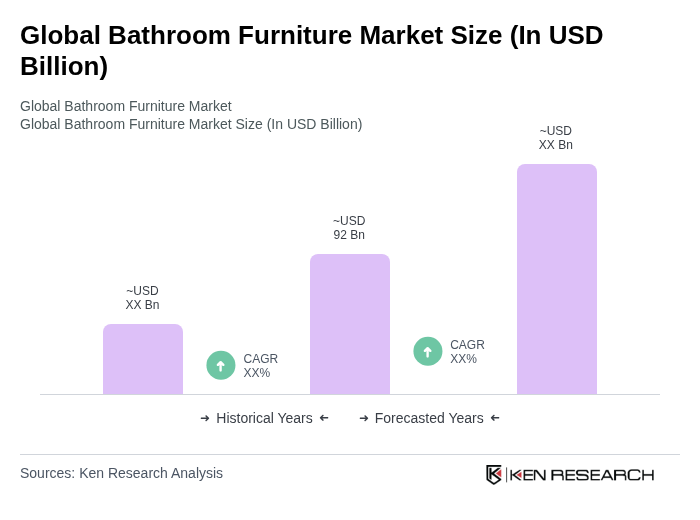
- The Global Bathroom Furniture Market is valued at USD 92 billion, based on a five-year historical analysis. This growth is primarily driven by increasing consumer demand for stylish and functional bathroom solutions, rising disposable incomes, and rapid urbanization. The market has seen a surge in renovations and new constructions, with a notable shift toward integrated storage, eco-friendly materials, and smart bathroom solutions, further accelerating demand for innovative bathroom furniture designs .
- Key players in this market include the United States, Germany, and China, which dominate due to robust manufacturing capabilities, advanced technology, and strong consumer bases. The United States leads in innovation and design trends, supported by a thriving home renovation sector and high demand for premium products. Germany is recognized for high-quality craftsmanship and durable furniture, while China benefits from cost-effective production, rapid urbanization, and a growing middle class driving domestic demand .
- In 2023, the European Union implemented Regulation (EU) 2023/1230 on water efficiency requirements for bathroom fixtures, issued by the European Commission. This regulation mandates that all new bathroom furniture products integrated with water fixtures must comply with specified water-saving standards, including maximum flow rates and product labeling. The regulation aims to promote sustainability and reduce water consumption across member states, compelling manufacturers to innovate and ensure compliance with these standards .
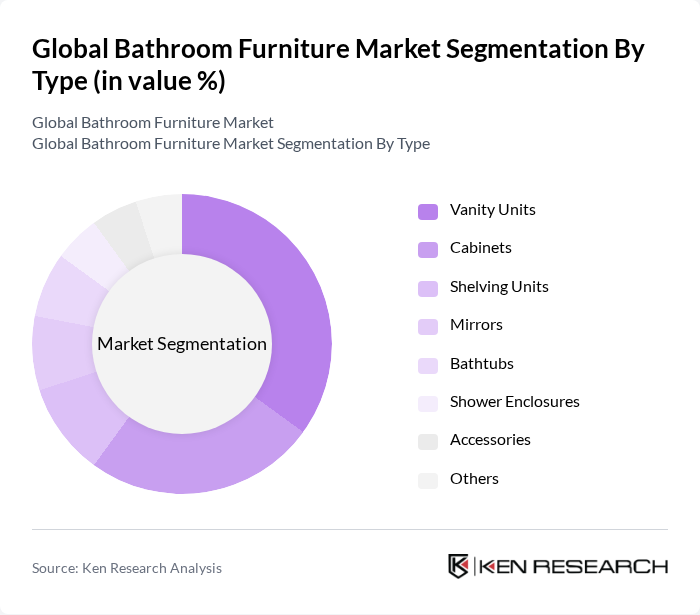
Global Bathroom Furniture Market Segmentation
By Type:The bathroom furniture market is segmented into various types, including vanity units, cabinets, shelving units, mirrors, bathtubs, shower enclosures, accessories, and others. Among these, vanity units are currently the most popular choice among consumers due to their multifunctionality and aesthetic appeal. They often serve as a focal point in bathroom design, combining storage with style. The trend towards compact, space-saving, and smart designs has further propelled the demand for vanity units, making them a leading segment in the market .
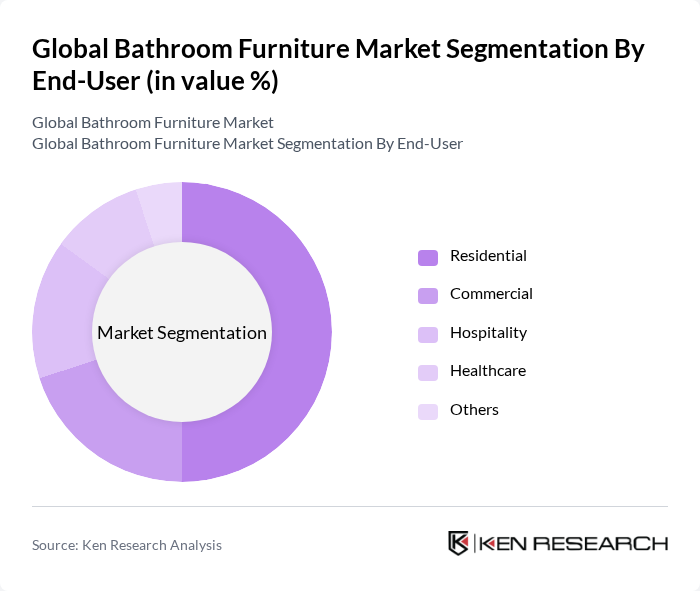
By End-User:The market is also segmented by end-user, which includes residential, commercial, hospitality, healthcare, and others. The residential segment is the largest, driven by increasing home renovations, urbanization, and the desire for personalized, high-quality bathroom spaces. Consumers are investing in premium bathroom furniture to enhance their living environments and integrate smart, eco-friendly solutions. The commercial and hospitality sectors are also significant contributors, as businesses seek to create appealing and functional spaces for customers and guests .
Global Bathroom Furniture Market Competitive Landscape
The Global Bathroom Furniture Market is characterized by a dynamic mix of regional and international players. Leading participants such as Kohler Co., Moen Incorporated, American Standard Brands, TOTO Ltd., Roca Sanitario, S.A., Duravit AG, Hansgrohe SE, LIXIL Group Corporation, Jacuzzi Brands LLC, Victoria + Albert Baths, Villeroy & Boch AG, Geberit AG, Sanipex Group, Aqualisa Products Ltd., Ideal Standard International NV, Roper Rhodes Ltd., Jaquar Group, Porcelanosa Grupo, Vitra (Eczac?ba?? Group), Arrow Group contribute to innovation, geographic expansion, and service delivery in this space.
Global Bathroom Furniture Market Industry Analysis
Growth Drivers
- Increasing Demand for Modern Designs:The global trend towards modern and stylish bathroom designs is driving the bathroom furniture market. In future, the global home improvement market is projected to reach $450 billion, with a significant portion allocated to bathroom renovations. This shift is fueled by consumer preferences for aesthetics and functionality, leading to increased investments in contemporary bathroom furniture. The rise in social media influence also promotes innovative designs, encouraging consumers to upgrade their spaces.
- Rising Disposable Income:As disposable income levels rise, particularly in developing regions, consumer spending on home improvement is expected to increase. In future, the global average disposable income is projected to reach $12,000 per capita, up from $11,500. This increase allows consumers to invest more in high-quality bathroom furniture, reflecting their desire for luxury and comfort. Enhanced purchasing power is driving demand for premium products, further stimulating market growth.
- Growth in Real Estate and Construction:The real estate and construction sectors are experiencing robust growth, significantly impacting the bathroom furniture market. In future, global construction spending is expected to exceed $12 trillion, with residential projects accounting for a substantial share. This growth is driven by urbanization and population growth, leading to increased demand for new housing and renovations. Consequently, the need for modern bathroom furniture is rising, supporting market expansion.
Market Challenges
- High Competition and Market Saturation:The bathroom furniture market faces intense competition, with numerous players vying for market share. In future, the number of manufacturers is expected to exceed 1,500 globally, leading to market saturation. This saturation results in price wars and reduced profit margins, making it challenging for companies to differentiate their products. As a result, businesses must innovate continuously to maintain a competitive edge and attract consumers.
- Fluctuating Raw Material Prices:The bathroom furniture industry is significantly affected by the volatility of raw material prices. In future, the cost of key materials such as wood and metal is projected to rise by 10% due to supply chain disruptions and increased demand. This fluctuation can lead to higher production costs, impacting profit margins for manufacturers. Companies must navigate these challenges by optimizing supply chains and exploring alternative materials to mitigate risks.
Global Bathroom Furniture Market Future Outlook
The future of the bathroom furniture market appears promising, driven by evolving consumer preferences and technological advancements. As sustainability becomes a priority, manufacturers are expected to focus on eco-friendly materials and energy-efficient production processes. Additionally, the integration of smart technology into bathroom furniture will likely enhance user experience, catering to the growing demand for convenience and functionality. These trends indicate a dynamic market landscape, with opportunities for innovation and growth in the coming years.
Market Opportunities
- Expansion into Emerging Markets:Emerging markets present significant growth opportunities for bathroom furniture manufacturers. With urbanization rates projected to reach 60% in regions like Southeast Asia in future, the demand for modern bathroom solutions is expected to surge. Companies can capitalize on this trend by tailoring products to local preferences and investing in marketing strategies that resonate with these new consumers.
- Introduction of Smart Bathroom Solutions:The rise of smart home technology offers a lucrative opportunity for the bathroom furniture market. In future, the smart home market is expected to reach $135 billion, with smart bathroom products gaining traction. Manufacturers can innovate by integrating IoT technology into bathroom furniture, enhancing functionality and user experience, thus attracting tech-savvy consumers looking for modern solutions.
Scope of the Report
| Segment | Sub-Segments |
|---|---|
| By Type | Vanity Units Cabinets Shelving Units Mirrors Bathtubs Shower Enclosures Accessories Others |
| By End-User | Residential Commercial Hospitality Healthcare Others |
| By Material | Wood Metal Glass Ceramic Plastic Others |
| By Style | Contemporary Traditional Rustic Industrial Minimalist Others |
| By Color | Neutral Tones Bold Colors Pastels Dark Shades Others |
| By Distribution Channel | Online Retail Offline Retail Direct Sales Showrooms E-commerce Marketplaces Others |
| By Price Range | Budget Mid-Range Premium Luxury Others |
| By Region | North America Europe Asia-Pacific Latin America Middle East & Africa |
Key Target Audience
Investors and Venture Capitalist Firms
Government and Regulatory Bodies (e.g., Environmental Protection Agency, Department of Housing and Urban Development)
Manufacturers and Producers
Distributors and Retailers
Interior Designers and Architects
Home Improvement and Renovation Companies
Real Estate Developers
Financial Institutions
Players Mentioned in the Report:
Kohler Co.
Moen Incorporated
American Standard Brands
TOTO Ltd.
Roca Sanitario, S.A.
Duravit AG
Hansgrohe SE
LIXIL Group Corporation
Jacuzzi Brands LLC
Victoria + Albert Baths
Villeroy & Boch AG
Geberit AG
Sanipex Group
Aqualisa Products Ltd.
Ideal Standard International NV
Roper Rhodes Ltd.
Jaquar Group
Porcelanosa Grupo
Vitra (Eczacbas Group)
Arrow Group
Table of Contents
Market Assessment Phase
1. Executive Summary and Approach
2. Global Bathroom Furniture Market Overview
2.1 Key Insights and Strategic Recommendations
2.2 Global Bathroom Furniture Market Overview
2.3 Definition and Scope
2.4 Evolution of Market Ecosystem
2.5 Timeline of Key Regulatory Milestones
2.6 Value Chain & Stakeholder Mapping
2.7 Business Cycle Analysis
2.8 Policy & Incentive Landscape
3. Global Bathroom Furniture Market Analysis
3.1 Growth Drivers
3.1.1 Increasing demand for modern and stylish bathroom designs
3.1.2 Rising disposable income and consumer spending
3.1.3 Growth in the real estate and construction sectors
3.1.4 Increasing focus on sustainability and eco-friendly materials
3.2 Market Challenges
3.2.1 High competition and market saturation
3.2.2 Fluctuating raw material prices
3.2.3 Changing consumer preferences and trends
3.2.4 Regulatory compliance and standards
3.3 Market Opportunities
3.3.1 Expansion into emerging markets
3.3.2 Introduction of smart bathroom solutions
3.3.3 Collaborations with interior designers and architects
3.3.4 Customization and personalization of products
3.4 Market Trends
3.4.1 Increasing popularity of minimalist designs
3.4.2 Growth in online retail and e-commerce platforms
3.4.3 Rising demand for multifunctional bathroom furniture
3.4.4 Emphasis on health and wellness in bathroom design
3.5 Government Regulation
3.5.1 Environmental regulations on materials used
3.5.2 Safety standards for bathroom furniture
3.5.3 Regulations on water efficiency and conservation
3.5.4 Compliance with building codes and standards
4. SWOT Analysis
5. Stakeholder Analysis
6. Porter's Five Forces Analysis
7. Global Bathroom Furniture Market Market Size, 2019-2024
7.1 By Value
7.2 By Volume
7.3 By Average Selling Price
8. Global Bathroom Furniture Market Segmentation
8.1 By Type
8.1.1 Vanity Units
8.1.2 Cabinets
8.1.3 Shelving Units
8.1.4 Mirrors
8.1.5 Bathtubs
8.1.6 Shower Enclosures
8.1.7 Accessories
8.1.8 Others
8.2 By End-User
8.2.1 Residential
8.2.2 Commercial
8.2.3 Hospitality
8.2.4 Healthcare
8.2.5 Others
8.3 By Material
8.3.1 Wood
8.3.2 Metal
8.3.3 Glass
8.3.4 Ceramic
8.3.5 Plastic
8.3.6 Others
8.4 By Style
8.4.1 Contemporary
8.4.2 Traditional
8.4.3 Rustic
8.4.4 Industrial
8.4.5 Minimalist
8.4.6 Others
8.5 By Color
8.5.1 Neutral Tones
8.5.2 Bold Colors
8.5.3 Pastels
8.5.4 Dark Shades
8.5.5 Others
8.6 By Distribution Channel
8.6.1 Online Retail
8.6.2 Offline Retail
8.6.3 Direct Sales
8.6.4 Showrooms
8.6.5 E-commerce Marketplaces
8.6.6 Others
8.7 By Price Range
8.7.1 Budget
8.7.2 Mid-Range
8.7.3 Premium
8.7.4 Luxury
8.7.5 Others
8.8 By Region
8.8.1 North America
8.8.2 Europe
8.8.3 Asia-Pacific
8.8.4 Latin America
8.8.5 Middle East & Africa
9. Global Bathroom Furniture Market Competitive Analysis
9.1 Market Share of Key Players(Micro, Small, Medium, Large Enterprises)
9.2 Cross Comparison of Key Players
9.2.1 Company Name
9.2.2 Group Size (Large, Medium, or Small as per industry convention)
9.2.3 Global Revenue (USD, latest fiscal year)
9.2.4 Revenue Growth Rate (CAGR %)
9.2.5 Market Share (%)
9.2.6 Geographic Presence (Number of countries/regions)
9.2.7 Product Portfolio Breadth (Number of SKUs or product lines)
9.2.8 R&D/Innovation Spend (% of revenue)
9.2.9 Distribution Network Strength (Number of retail/distribution partners)
9.2.10 Brand Recognition Index (based on global surveys or rankings)
9.2.11 Customer Satisfaction Score (NPS or equivalent)
9.2.12 Sustainability/ESG Rating
9.3 SWOT Analysis of Top Players
9.4 Pricing Analysis(By Class and Payload)
9.5 Detailed Profile of Major Companies
9.5.1 Kohler Co.
9.5.2 Moen Incorporated
9.5.3 American Standard Brands
9.5.4 TOTO Ltd.
9.5.5 Roca Sanitario, S.A.
9.5.6 Duravit AG
9.5.7 Hansgrohe SE
9.5.8 LIXIL Group Corporation
9.5.9 Jacuzzi Brands LLC
9.5.10 Victoria + Albert Baths
9.5.11 Villeroy & Boch AG
9.5.12 Geberit AG
9.5.13 Sanipex Group
9.5.14 Aqualisa Products Ltd.
9.5.15 Ideal Standard International NV
9.5.16 Roper Rhodes Ltd.
9.5.17 Jaquar Group
9.5.18 Porcelanosa Grupo
9.5.19 Vitra (Eczac?ba?? Group)
9.5.20 Arrow Group
10. Global Bathroom Furniture Market End-User Analysis
10.1 Procurement Behavior of Key Ministries
10.1.1 Government contracts and tenders
10.1.2 Budget allocation for public facilities
10.1.3 Preference for sustainable products
10.1.4 Compliance with safety standards
10.2 Corporate Spend on Infrastructure & Energy
10.2.1 Investment in commercial bathroom renovations
10.2.2 Budgeting for eco-friendly upgrades
10.2.3 Spending on luxury bathroom fittings
10.2.4 Allocation for maintenance and repairs
10.3 Pain Point Analysis by End-User Category
10.3.1 Quality and durability concerns
10.3.2 Availability of customization options
10.3.3 Price sensitivity among consumers
10.3.4 Need for efficient space utilization
10.4 User Readiness for Adoption
10.4.1 Awareness of modern bathroom solutions
10.4.2 Willingness to invest in upgrades
10.4.3 Interest in smart technology integration
10.4.4 Readiness for eco-friendly products
10.5 Post-Deployment ROI and Use Case Expansion
10.5.1 Measurement of customer satisfaction
10.5.2 Analysis of cost savings from efficiency
10.5.3 Evaluation of product performance
10.5.4 Opportunities for product line expansion
11. Global Bathroom Furniture Market Future Size, 2025-2030
11.1 By Value
11.2 By Volume
11.3 By Average Selling Price
Go-To-Market Strategy Phase
1. Whitespace Analysis + Business Model Canvas
1.1 Market Gaps Identification
1.2 Value Proposition Development
1.3 Revenue Streams Analysis
1.4 Customer Segmentation
1.5 Key Partnerships
1.6 Cost Structure Analysis
1.7 Channels of Distribution
2. Marketing and Positioning Recommendations
2.1 Branding Strategies
2.2 Product USPs
2.3 Target Audience Identification
2.4 Marketing Channels Selection
2.5 Promotional Strategies
2.6 Customer Engagement Tactics
2.7 Performance Metrics
3. Distribution Plan
3.1 Urban Retail Strategies
3.2 Rural NGO Tie-ups
3.3 E-commerce Integration
3.4 Direct Sales Approaches
3.5 Showroom Strategies
3.6 Logistics and Supply Chain Management
3.7 Distribution Partnerships
4. Channel & Pricing Gaps
4.1 Underserved Routes
4.2 Pricing Bands Analysis
4.3 Competitor Pricing Strategies
4.4 Customer Price Sensitivity
4.5 Value-Based Pricing Models
4.6 Discounting Strategies
4.7 Pricing Optimization Techniques
5. Unmet Demand & Latent Needs
5.1 Category Gaps
5.2 Consumer Segments Analysis
5.3 Emerging Trends Identification
5.4 Product Development Opportunities
5.5 Market Entry Strategies
5.6 Customer Feedback Mechanisms
5.7 Innovation Opportunities
6. Customer Relationship
6.1 Loyalty Programs
6.2 After-sales Service
6.3 Customer Feedback Systems
6.4 Engagement Strategies
6.5 Retention Strategies
6.6 Relationship Management Tools
6.7 Community Building Initiatives
7. Value Proposition
7.1 Sustainability Initiatives
7.2 Integrated Supply Chains
7.3 Unique Selling Points
7.4 Customer-Centric Innovations
7.5 Competitive Advantages
7.6 Brand Positioning
7.7 Market Differentiation Strategies
8. Key Activities
8.1 Regulatory Compliance
8.2 Branding Initiatives
8.3 Distribution Setup
8.4 Marketing Campaigns
8.5 Product Development
8.6 Customer Engagement Activities
8.7 Performance Monitoring
9. Entry Strategy Evaluation
9.1 Domestic Market Entry Strategy
9.1.1 Product Mix Considerations
9.1.2 Pricing Band Analysis
9.1.3 Packaging Strategies
9.2 Export Entry Strategy
9.2.1 Target Countries Identification
9.2.2 Compliance Roadmap Development
10. Entry Mode Assessment
10.1 Joint Ventures
10.2 Greenfield Investments
10.3 Mergers & Acquisitions
10.4 Distributor Model Evaluation
10.5 Risk Assessment
10.6 Strategic Partnerships
10.7 Market Adaptation Strategies
11. Capital and Timeline Estimation
11.1 Capital Requirements
11.2 Timelines for Market Entry
11.3 Financial Projections
11.4 Funding Sources
11.5 Investment Strategies
11.6 Cost Management Plans
12. Control vs Risk Trade-Off
12.1 Ownership Considerations
12.2 Partnership Dynamics
12.3 Risk Mitigation Strategies
12.4 Control Mechanisms
12.5 Strategic Decision-Making
12.6 Performance Monitoring
13. Profitability Outlook
13.1 Breakeven Analysis
13.2 Long-term Sustainability
13.3 Profit Margin Projections
13.4 Revenue Growth Strategies
13.5 Cost Reduction Initiatives
13.6 Financial Health Assessment
14. Potential Partner List
14.1 Distributors
14.2 Joint Ventures
14.
Research Methodology
Phase 1: Approach1
Desk Research
- Industry reports from market research firms focusing on bathroom furniture trends
- Statistical data from government publications on home improvement and construction
- Analysis of consumer behavior studies related to bathroom renovations and furniture purchases
Primary Research
- Interviews with interior designers specializing in bathroom renovations
- Surveys conducted with homeowners who have recently remodeled their bathrooms
- Focus groups with retail managers from bathroom furniture outlets
Validation & Triangulation
- Cross-validation of findings through multiple data sources including sales data and consumer feedback
- Triangulation of insights from primary interviews with secondary research findings
- Sanity checks performed by industry experts to ensure data reliability
Phase 2: Market Size Estimation1
Top-down Assessment
- Estimation of market size based on overall home improvement expenditure trends
- Segmentation of market data by product type, including vanities, cabinets, and accessories
- Incorporation of demographic trends influencing bathroom renovations, such as urbanization
Bottom-up Modeling
- Collection of sales data from leading bathroom furniture manufacturers and retailers
- Estimation of average selling prices across different product categories
- Volume estimates based on historical sales data and projected growth rates
Forecasting & Scenario Analysis
- Multi-variable forecasting using economic indicators and housing market trends
- Scenario analysis based on potential shifts in consumer preferences towards eco-friendly materials
- Development of baseline, optimistic, and pessimistic market growth scenarios through 2030
Phase 3: CATI Sample Composition1
| Scope Item/Segment | Sample Size | Target Respondent Profiles |
|---|---|---|
| Residential Bathroom Renovations | 120 | Homeowners, Interior Designers |
| Commercial Bathroom Installations | 60 | Facility Managers, Architects |
| Retail Bathroom Furniture Sales | 50 | Store Managers, Sales Representatives |
| Online Bathroom Furniture Purchases | 70 | E-commerce Managers, Digital Marketing Specialists |
| Trends in Sustainable Bathroom Products | 40 | Sustainability Officers, Product Designers |
Frequently Asked Questions
What is the current value of the Global Bathroom Furniture Market?
The Global Bathroom Furniture Market is valued at approximately USD 92 billion, driven by increasing consumer demand for stylish and functional bathroom solutions, rising disposable incomes, and rapid urbanization.
What are the key drivers of growth in the bathroom furniture market?
Which regions dominate the Global Bathroom Furniture Market?
What types of products are included in the bathroom furniture market?
Other Regional/Country Reports
Indonesia Bathroom Furniture Market
Malaysia Bathroom Furniture Market
KSA Bathroom Furniture Market
APAC Bathroom Furniture Market
SEA Bathroom Furniture Market
Vietnam Bathroom Furniture Market
Other Adjacent Reports
Vietnam Sanitary Ware Market
India Home Decor Market Size, Share & Forecast, By Product Type, Price Tier & Distribution Channel, 2026–2032UAE Plumbing Fixtures Market Size Share Growth Drivers Trends Opportunities & Forecast 2025–2030Global Interior Design Services Market Size, Share & Forecast, By Service Type, Customer Type & End-Use Industry, 2026–2031Thailand Cabinetry Market
UAE Bathroom Accessories MarketSingapore Tile and Flooring Market
Global Lighting Fixtures Market Size, Share, Growth Drivers, Trends, Opportunities & Forecast 2025–2030Qatar Smart Home Technology MarketWhy Buy From Us?

What makes us stand out is that our consultants follow Robust, Refine and Result (RRR) methodology. Robust for clear definitions, approaches and sanity checking, Refine for differentiating respondents' facts and opinions, and Result for presenting data with story.

We have set a benchmark in the industry by offering our clients with syndicated and customized market research reports featuring coverage of entire market as well as meticulous research and analyst insights.

While we don't replace traditional research, we flip the method upside down. Our dual approach of Top Bottom & Bottom Top ensures quality deliverable by not just verifying company fundamentals but also looking at the sector and macroeconomic factors.

With one step in the future, our research team constantly tries to show you the bigger picture. We help with some of the tough questions you may encounter along the way: How is the industry positioned? Best marketing channel? KPI's of competitors? By aligning every element, we help maximize success.

Our report gives you instant access to the answers and sources that other companies might choose to hide. We elaborate each steps of research methodology we have used and showcase you the sample size to earn your trust.

If you need any support, we are here! We pride ourselves on universe strength, data quality, and quick, friendly, and professional service.