About the Report
Base Year 2024Global Business Jet Market Overview
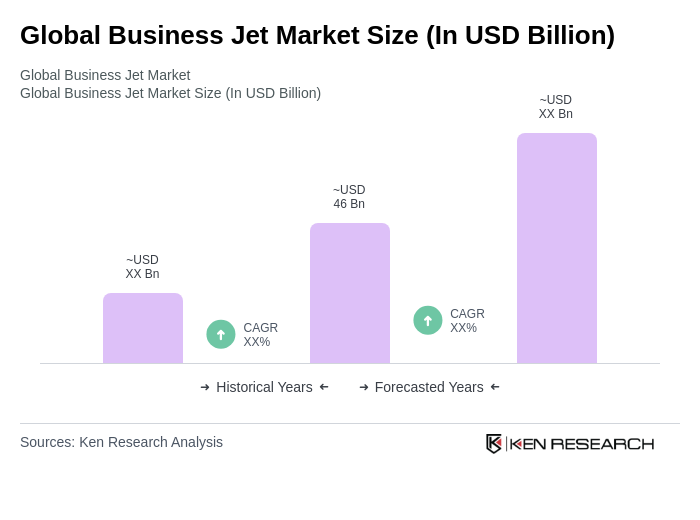
- The Global Business Jet Market is valued at USD 46 billion, based on a five-year historical analysis. This growth is primarily driven by rising private air travel among high?net?worth individuals and corporates, expansion of fractional/charter models, and sustained upgrades in avionics, cabins, and fuel?efficient airframes that enhance performance, comfort, and operating economics.
- Key players in this market include the United States, Europe, and the Asia Pacific region. The United States leads due to the largest installed business aviation fleet, dense network of general aviation airports/FBOs, and high concentration of high?net?worth individuals. Europe follows with strong corporate demand and established charter/fractional ecosystems, while Asia Pacific is growing on increasing wealth creation and expanding business aviation infrastructure.
- In 2023, the U.S. government advanced multiple safety and certification updates applicable to business aviation, including FAA rulemaking to strengthen flight crew record sharing and continued operational safety directives; however, there was no single, universal mandate that “all new business jets” comply with a newly introduced safety protocol in that year. Instead, business jets remain subject to ongoing FAA airworthiness, certification, and safety management requirements applied through existing rules and directives.
Global Business Jet Market Segmentation
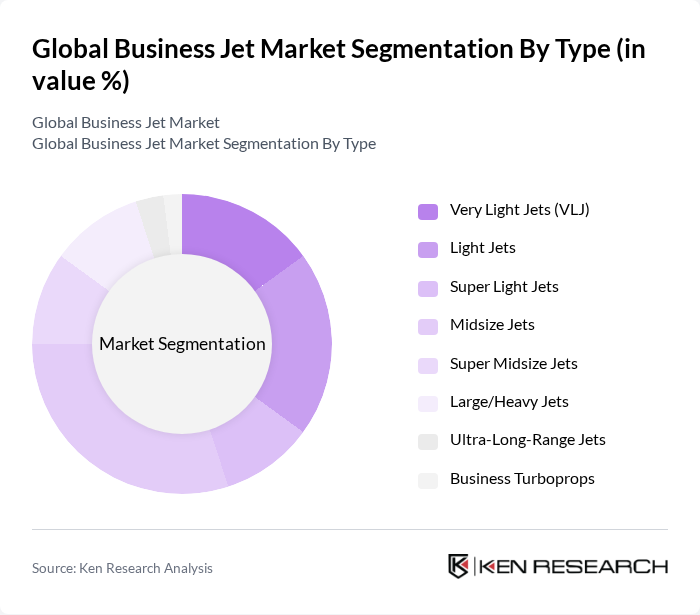
By Type:The business jet market is segmented into various types, including Very Light Jets (VLJ), Light Jets, Super Light Jets, Midsize Jets, Super Midsize Jets, Large/Heavy Jets, Ultra-Long-Range Jets, and Business Turboprops. Midsize and Super Midsize categories collectively account for a significant portion of demand due to their balance of range, cabin size, and operating cost, serving most corporate missions efficiently.
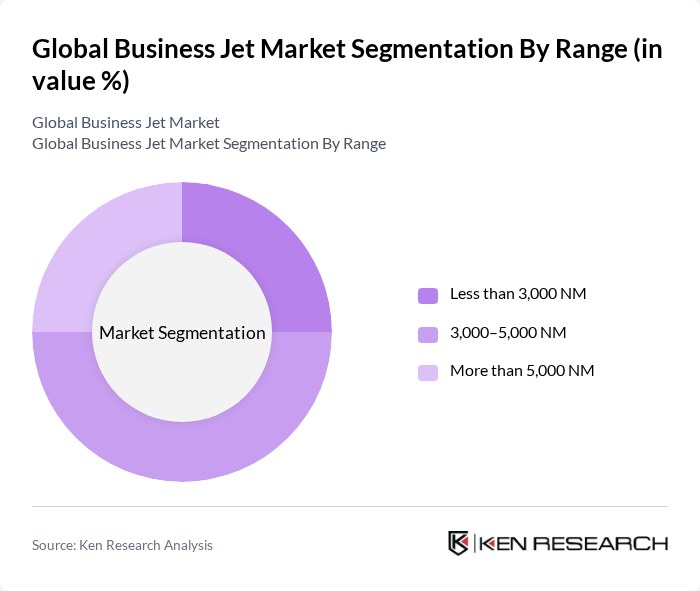
By Range:The market is also segmented by range, including Less than 3,000 NM, 3,000–5,000 NM, and More than 5,000 NM. The 3,000–5,000 NM segment covers core corporate city?pairs, enabling non?stop missions across major regional hubs while optimizing acquisition and operating costs—hence it captures the largest share.
Global Business Jet Market Competitive Landscape
The Global Business Jet Market is characterized by a dynamic mix of regional and international players. Leading participants such as Bombardier Inc., Gulfstream Aerospace Corporation, Dassault Aviation, Embraer S.A., Textron Aviation Inc. (Cessna, Beechcraft), Boeing Business Jets (BBJ), Airbus Corporate Jets (ACJ), Honda Aircraft Company, Pilatus Aircraft Ltd, Cirrus Aircraft, Piaggio Aerospace, Piper Aircraft, Inc., Nextant Aerospace, Textron Inc., Saab AB contribute to innovation, geographic expansion, and service delivery in this space.
Global Business Jet Market Industry Analysis
Growth Drivers
- Increasing Demand for Private Travel:The global business jet market is experiencing a surge in demand for private travel, driven by a projected increase in the number of high-net-worth individuals (HNWIs). According to the World Wealth Report, the number of HNWIs is expected to reach 24 million in the future, up from 22 million previously. This growth translates to a higher demand for private jets, as affluent individuals seek personalized travel solutions that offer convenience and flexibility.
- Expansion of Business Operations Globally:As companies expand their operations internationally, the need for efficient travel solutions has intensified. The International Monetary Fund (IMF) forecasts global GDP growth of 3.5% in the future, encouraging businesses to invest in private aviation for quicker access to emerging markets. This trend is particularly evident in Asia-Pacific, where business jet registrations increased by 18% in the future, reflecting the region's growing economic significance and the demand for rapid business travel.
- Technological Advancements in Aircraft Design:Innovations in aircraft technology are enhancing the appeal of business jets. The introduction of lighter materials and more efficient engines has improved fuel efficiency by up to 25%, according to industry reports. Furthermore, advancements in avionics and cabin comfort are attracting buyers. The global investment in aviation technology is projected to reach $12 billion in the future, fostering a competitive environment that drives the development of next-generation business jets.
Market Challenges
- High Operational Costs:Operating a business jet involves significant costs, including maintenance, fuel, and crew salaries. The average annual operating cost for a mid-size business jet is approximately $1.8 million, according to the National Business Aviation Association (NBAA). These high costs can deter potential buyers, particularly in regions where economic growth is slower, limiting market expansion and accessibility for smaller enterprises seeking private aviation solutions.
- Stringent Regulatory Compliance:The business jet industry faces rigorous regulatory frameworks that can complicate operations. Compliance with Federal Aviation Administration (FAA) regulations and International Civil Aviation Organization (ICAO) standards requires substantial investment in safety and operational protocols. In the future, the FAA is expected to increase oversight, which may lead to additional costs for operators. This regulatory burden can hinder market entry for new players and stifle innovation within the industry.
Global Business Jet Market Future Outlook
The future of the business jet market appears promising, driven by ongoing technological advancements and a growing emphasis on sustainability. As electric and hybrid aircraft gain traction, manufacturers are likely to invest heavily in research and development, enhancing operational efficiency. Additionally, the rise of on-demand air mobility services is expected to reshape travel patterns, making private aviation more accessible. These trends indicate a dynamic market landscape that will adapt to evolving consumer preferences and regulatory requirements.
Market Opportunities
- Growth in Emerging Markets:Emerging markets, particularly in Asia and Africa, present significant opportunities for business jet manufacturers. With a projected GDP growth rate of 6.0% in these regions, demand for private aviation services is expected to rise. This growth is driven by increasing wealth and a burgeoning middle class, creating a favorable environment for business jet acquisitions and charter services.
- Increasing Demand for Charter Services:The charter services segment is poised for expansion, with the global charter market expected to grow by $3 billion in the future. This growth is fueled by the rising preference for flexible travel options among businesses and individuals. As companies seek cost-effective solutions, charter services offer an attractive alternative to ownership, enhancing market accessibility and driving overall industry growth.
Scope of the Report
| Segment | Sub-Segments |
|---|---|
| By Type | Very Light Jets (VLJ) Light Jets Super Light Jets Midsize Jets Super Midsize Jets Large/Heavy Jets Ultra-Long-Range Jets Business Turboprops |
| By Range | Less than 3,000 NM ,000–5,000 NM More than 5,000 NM |
| By Ownership/Business Model | Full Ownership (New) Full Ownership (Pre-Owned) Fractional Ownership Jet Card/Membership On-Demand Charter |
| By Point of Sale | OEM Aftermarket |
| By End-User | Corporate Government & VVIP Charter Operators High-Net-Worth Individuals (HNWI/UHNW) |
| By Application | Business Travel Air Ambulance/MedEvac Special Missions (Surveillance, Training) Leisure/Tourism |
| By Region | North America Europe Asia Pacific Middle East & Africa Latin America |
Key Target Audience
Investors and Venture Capitalist Firms
Government and Regulatory Bodies (e.g., Federal Aviation Administration, European Union Aviation Safety Agency)
Manufacturers and Producers
Aircraft Maintenance, Repair, and Overhaul (MRO) Service Providers
Charter and Fractional Ownership Companies
Airports and Fixed Base Operators (FBOs)
Insurance Companies Specializing in Aviation
Trade Associations and Industry Groups
Players Mentioned in the Report:
Bombardier Inc.
Gulfstream Aerospace Corporation
Dassault Aviation
Embraer S.A.
Textron Aviation Inc. (Cessna, Beechcraft)
Boeing Business Jets (BBJ)
Airbus Corporate Jets (ACJ)
Honda Aircraft Company
Pilatus Aircraft Ltd
Cirrus Aircraft
Piaggio Aerospace
Piper Aircraft, Inc.
Nextant Aerospace
Textron Inc.
Saab AB
Table of Contents
Market Assessment Phase
1. Executive Summary and Approach
2. Global Business Jet Market Overview
2.1 Key Insights and Strategic Recommendations
2.2 Global Business Jet Market Overview
2.3 Definition and Scope
2.4 Evolution of Market Ecosystem
2.5 Timeline of Key Regulatory Milestones
2.6 Value Chain & Stakeholder Mapping
2.7 Business Cycle Analysis
2.8 Policy & Incentive Landscape
3. Global Business Jet Market Analysis
3.1 Growth Drivers
3.1.1 Increasing Demand for Private Travel
3.1.2 Expansion of Business Operations Globally
3.1.3 Technological Advancements in Aircraft Design
3.1.4 Rising Disposable Incomes in Emerging Markets
3.2 Market Challenges
3.2.1 High Operational Costs
3.2.2 Stringent Regulatory Compliance
3.2.3 Market Saturation in Developed Regions
3.2.4 Environmental Concerns and Sustainability Issues
3.3 Market Opportunities
3.3.1 Growth in Emerging Markets
3.3.2 Increasing Demand for Charter Services
3.3.3 Innovations in Sustainable Aviation Fuel
3.3.4 Expansion of FBO (Fixed Base Operator) Services
3.4 Market Trends
3.4.1 Shift Towards Electric and Hybrid Aircraft
3.4.2 Customization and Personalization of Aircraft
3.4.3 Integration of Advanced Avionics Systems
3.4.4 Growth of On-Demand Air Mobility Services
3.5 Government Regulation
3.5.1 FAA Regulations on Aircraft Safety
3.5.2 International Civil Aviation Organization (ICAO) Standards
3.5.3 Environmental Regulations on Emissions
3.5.4 Tax Incentives for Business Aviation
4. SWOT Analysis
5. Stakeholder Analysis
6. Porter's Five Forces Analysis
7. Global Business Jet Market Market Size, 2019-2024
7.1 By Value
7.2 By Volume
7.3 By Average Selling Price
8. Global Business Jet Market Segmentation
8.1 By Type
8.1.1 Very Light Jets (VLJ)
8.1.2 Light Jets
8.1.3 Super Light Jets
8.1.4 Midsize Jets
8.1.5 Super Midsize Jets
8.1.6 Large/Heavy Jets
8.1.7 Ultra-Long-Range Jets
8.1.8 Business Turboprops
8.2 By Range
8.2.1 Less than 3,000 NM
8.2.2 3,000–5,000 NM
8.2.3 More than 5,000 NM
8.3 By Ownership/Business Model
8.3.1 Full Ownership (New)
8.3.2 Full Ownership (Pre-Owned)
8.3.3 Fractional Ownership
8.3.4 Jet Card/Membership
8.3.5 On-Demand Charter
8.4 By Point of Sale
8.4.1 OEM
8.4.2 Aftermarket
8.5 By End-User
8.5.1 Corporate
8.5.2 Government & VVIP
8.5.3 Charter Operators
8.5.4 High-Net-Worth Individuals (HNWI/UHNW)
8.6 By Application
8.6.1 Business Travel
8.6.2 Air Ambulance/MedEvac
8.6.3 Special Missions (Surveillance, Training)
8.6.4 Leisure/Tourism
8.7 By Region
8.7.1 North America
8.7.2 Europe
8.7.3 Asia Pacific
8.7.4 Middle East & Africa
8.7.5 Latin America
9. Global Business Jet Market Competitive Analysis
9.1 Market Share of Key Players
9.2 Cross Comparison of Key Players
9.2.1 Company Name
9.2.2 Delivery Volume (Units, Annual)
9.2.3 Book-to-Bill Ratio
9.2.4 Order Backlog (Units/Value)
9.2.5 Revenue from Business Jets (USD, Annual)
9.2.6 R&D Intensity (% of Sales)
9.2.7 Average Selling Price (by Segment)
9.2.8 Product Portfolio Breadth (VLJ to ULR)
9.2.9 Global Fleet in Service (Units)
9.2.10 Customer Mix (Corporate/HNWI/Govt/Charter %)
9.2.11 Aftermarket Revenue Share (% OEM vs Services)
9.2.12 Connectivity/Sustainability Readiness (SAF compatibility, Wi?Fi %)
9.3 SWOT Analysis of Top Players
9.4 Pricing Analysis
9.5 Detailed Profile of Major Companies
9.5.1 Bombardier Inc.
9.5.2 Gulfstream Aerospace Corporation
9.5.3 Dassault Aviation
9.5.4 Embraer S.A.
9.5.5 Textron Aviation Inc. (Cessna, Beechcraft)
9.5.6 Boeing Business Jets (BBJ)
9.5.7 Airbus Corporate Jets (ACJ)
9.5.8 Honda Aircraft Company
9.5.9 Pilatus Aircraft Ltd
9.5.10 Cirrus Aircraft
9.5.11 Piaggio Aerospace
9.5.12 Piper Aircraft, Inc.
9.5.13 Nextant Aerospace
9.5.14 Textron Inc.
9.5.15 Saab AB
10. Global Business Jet Market End-User Analysis
10.1 Procurement Behavior of Key Ministries
10.1.1 Budget Allocation Trends
10.1.2 Decision-Making Processes
10.1.3 Preferred Aircraft Types
10.1.4 Contracting Practices
10.2 Corporate Spend on Infrastructure & Energy
10.2.1 Investment in Business Aviation
10.2.2 Infrastructure Development Needs
10.2.3 Energy Efficiency Initiatives
10.3 Pain Point Analysis by End-User Category
10.3.1 Cost Management Challenges
10.3.2 Regulatory Compliance Issues
10.3.3 Service Quality Expectations
10.4 User Readiness for Adoption
10.4.1 Awareness of Business Aviation Benefits
10.4.2 Training and Support Needs
10.4.3 Technology Adoption Readiness
10.5 Post-Deployment ROI and Use Case Expansion
10.5.1 Measurement of ROI
10.5.2 Use Case Diversification
10.5.3 Long-Term Value Assessment
11. Global Business Jet Market Future Size, 2025-2030
11.1 By Value
11.2 By Volume
11.3 By Average Selling Price
Go-To-Market Strategy Phase
1. Whitespace Analysis + Business Model Canvas
1.1 Market Gaps Identification
1.2 Business Model Framework
2. Marketing and Positioning Recommendations
2.1 Branding Strategies
2.2 Product USPs
3. Distribution Plan
3.1 Urban Retail Strategies
3.2 Rural NGO Tie-Ups
4. Channel & Pricing Gaps
4.1 Underserved Routes
4.2 Pricing Bands Analysis
5. Unmet Demand & Latent Needs
5.1 Category Gaps
5.2 Consumer Segments
6. Customer Relationship
6.1 Loyalty Programs
6.2 After-Sales Service
7. Value Proposition
7.1 Sustainability Initiatives
7.2 Integrated Supply Chains
8. Key Activities
8.1 Regulatory Compliance
8.2 Branding Efforts
8.3 Distribution Setup
9. Entry Strategy Evaluation
9.1 Domestic Market Entry Strategy
9.1.1 Product Mix Considerations
9.1.2 Pricing Band Strategy
9.1.3 Packaging Options
9.2 Export Entry Strategy
9.2.1 Target Countries
9.2.2 Compliance Roadmap
10. Entry Mode Assessment
10.1 Joint Ventures
10.2 Greenfield Investments
10.3 Mergers & Acquisitions
10.4 Distributor Model
11. Capital and Timeline Estimation
11.1 Capital Requirements
11.2 Timelines for Implementation
12. Control vs Risk Trade-Off
12.1 Ownership Considerations
12.2 Partnerships Evaluation
13. Profitability Outlook
13.1 Breakeven Analysis
13.2 Long-Term Sustainability
14. Potential Partner List
14.1 Distributors
14.2 Joint Ventures
14.3 Acquisition Targets
15. Execution Roadmap
15.1 Phased Plan for Market Entry
15.1.1 Market Setup
15.1.2 Market Entry
15.1.3 Growth Acceleration
15.1.4 Scale & Stabilize
15.2 Key Activities and Milestones
15.2.1 Milestone Planning
15.2.2 Activity Tracking
Research Methodology
Phase 1: Approach1
Desk Research
- Industry reports from aviation authorities and global aviation organizations
- Market analysis publications from leading aerospace and defense research firms
- Statistical data from international trade databases and aviation market studies
Primary Research
- Interviews with executives from business jet manufacturers and suppliers
- Surveys targeting flight operation managers and charter service providers
- Field interviews with aviation consultants and industry analysts
Validation & Triangulation
- Cross-validation of findings through multiple data sources and expert opinions
- Triangulation of market trends using historical data and current market dynamics
- Sanity checks through feedback from industry panels and focus groups
Phase 2: Market Size Estimation1
Top-down Assessment
- Analysis of global GDP growth and its correlation with business jet demand
- Segmentation of market size by geographical regions and aircraft types
- Incorporation of trends in corporate travel and private aviation usage
Bottom-up Modeling
- Estimation of unit sales based on historical sales data from manufacturers
- Operational cost analysis derived from maintenance and operational expenditure
- Revenue projections based on average selling prices and market penetration rates
Forecasting & Scenario Analysis
- Multi-variable forecasting using economic indicators and aviation sector growth
- Scenario modeling based on regulatory changes and environmental considerations
- Baseline, optimistic, and pessimistic forecasts through 2035
Phase 3: CATI Sample Composition1
| Scope Item/Segment | Sample Size | Target Respondent Profiles |
|---|---|---|
| Business Jet Manufacturers | 120 | Product Development Managers, Sales Directors |
| Charter Service Providers | 90 | Operations Managers, Fleet Managers |
| Corporate Flight Departments | 70 | Chief Pilots, Aviation Managers |
| Aviation Regulatory Bodies | 50 | Policy Makers, Compliance Officers |
| Maintenance and Repair Organizations (MROs) | 60 | Maintenance Managers, Technical Directors |
Frequently Asked Questions
What is the current value of the Global Business Jet Market?
The Global Business Jet Market is valued at approximately USD 46 billion, reflecting a five-year historical analysis. This growth is driven by increasing private air travel among high-net-worth individuals and advancements in aircraft technology.
Which regions are leading in the Global Business Jet Market?
What are the main types of business jets available in the market?
What factors are driving growth in the Global Business Jet Market?
Other Regional/Country Reports
Indonesia Business Jet Market
Malaysia Business Jet Market
Why Buy From Us?

What makes us stand out is that our consultants follow Robust, Refine and Result (RRR) methodology. Robust for clear definitions, approaches and sanity checking, Refine for differentiating respondents' facts and opinions, and Result for presenting data with story.

We have set a benchmark in the industry by offering our clients with syndicated and customized market research reports featuring coverage of entire market as well as meticulous research and analyst insights.

While we don't replace traditional research, we flip the method upside down. Our dual approach of Top Bottom & Bottom Top ensures quality deliverable by not just verifying company fundamentals but also looking at the sector and macroeconomic factors.

With one step in the future, our research team constantly tries to show you the bigger picture. We help with some of the tough questions you may encounter along the way: How is the industry positioned? Best marketing channel? KPI's of competitors? By aligning every element, we help maximize success.

Our report gives you instant access to the answers and sources that other companies might choose to hide. We elaborate each steps of research methodology we have used and showcase you the sample size to earn your trust.

If you need any support, we are here! We pride ourselves on universe strength, data quality, and quick, friendly, and professional service.