About the Report
Base Year 2024GCC Business Jet Market Overview
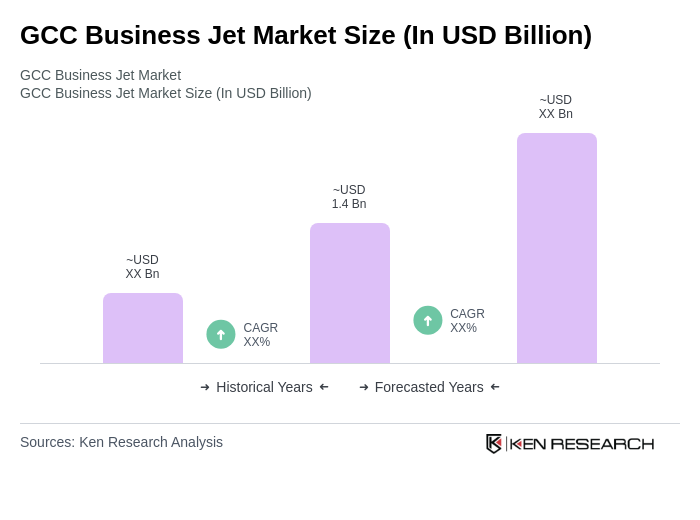
- The GCC Business Jet Market is valued at USD 1.4 billion, based on a five-year historical analysis. This growth is primarily driven by increasing demand for private air travel, fueled by rising disposable incomes and a growing number of high-net-worth individuals in the region. Additionally, the expansion of business activities and tourism in the Gulf Cooperation Council countries has significantly contributed to the market's growth. Recent trends also highlight substantial investments in airport infrastructure and the adoption of advanced, fuel-efficient jet models, further supporting market expansion.
- Key players in this market include the United Arab Emirates and Saudi Arabia, which dominate due to their strategic geographical locations, robust economic growth, and significant investments in aviation infrastructure. The UAE, particularly Dubai, serves as a global aviation hub, attracting business travelers and tourists alike, while Saudi Arabia's Vision 2030 initiative aims to diversify its economy, further boosting demand for business jets. The region's focus on modernizing airports and expanding private terminals has also played a critical role in strengthening its position as a business aviation center.
- In 2023, the UAE government implemented new regulations to streamline the process for obtaining permits for private jet operations. This initiative, governed by the General Civil Aviation Authority under the UAE Civil Aviation Regulations (CARs), aims to enhance the efficiency of air travel and promote the business aviation sector. The regulations require operators to comply with safety, operational, and licensing standards, thereby making it easier for companies and individuals to access private jet services and stimulating market growth.
GCC Business Jet Market Segmentation
By Range:The market is segmented based on the range of business jets, which includes Less than 3,000 nm, Between 3,000 and 5,000 nm, and Above 5,000 nm. Each range serves different customer needs, with shorter ranges being popular for regional travel and longer ranges catering to international business trips. The preference for shorter-range jets is driven by frequent inter-country travel within the GCC, where executives prioritize speed and convenience for regional business engagements.
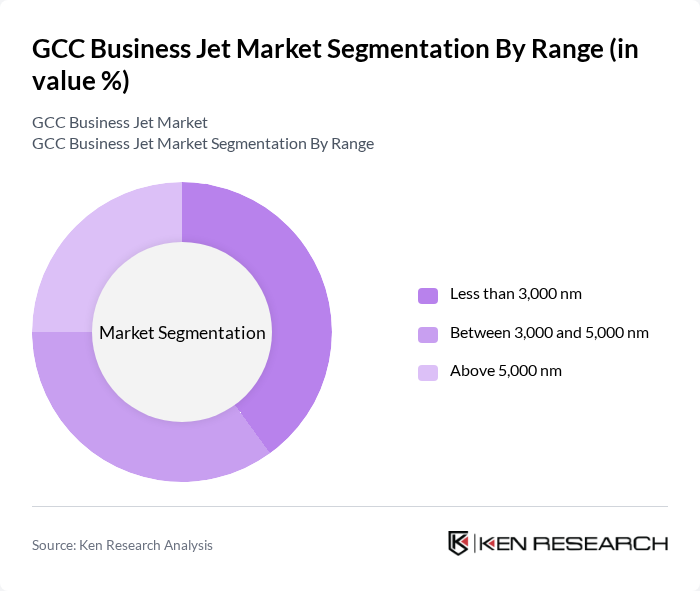
The segment of business jets with a range of less than 3,000 nm is currently dominating the market. This preference is largely due to the high demand for regional travel within the GCC, where business executives frequently travel between neighboring countries. The convenience and time-saving aspects of shorter flights make these jets particularly appealing to corporate clients and government officials, who prioritize efficiency in their travel arrangements.
By Aircraft Type:The market is also segmented by aircraft type, which includes Light Jet, Mid-size Jet, and Large Jet. Each type caters to different customer preferences and operational needs, with light jets being favored for short trips and large jets for long-haul flights. Mid-size jets are increasingly popular for their balance of range, capacity, and cost-effectiveness, meeting the needs of both corporate and private users for regional and international travel.
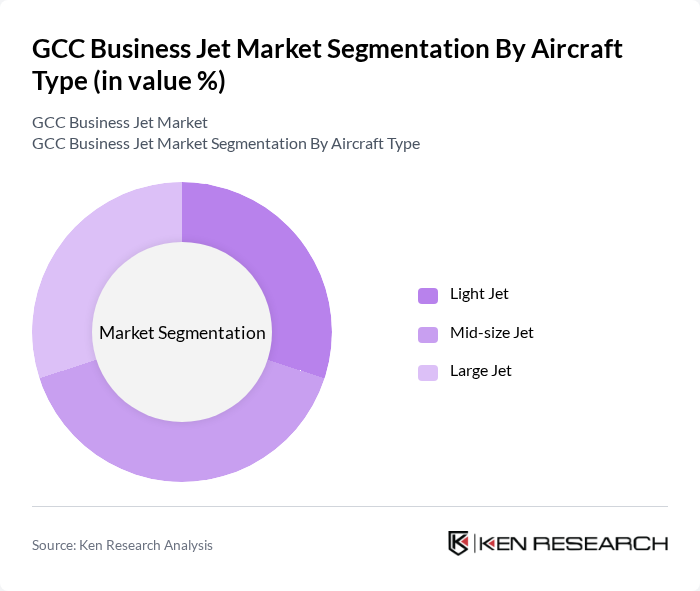
Mid-size jets are leading the market due to their versatility and capacity to accommodate a larger number of passengers while still being cost-effective for both corporate and private users. These jets are ideal for regional and international travel, making them a preferred choice for businesses looking to balance comfort and efficiency. The growing trend of corporate travel in the GCC has further solidified the position of mid-size jets in the market.
GCC Business Jet Market Competitive Landscape
The GCC Business Jet Market is characterized by a dynamic mix of regional and international players. Leading participants such as Gulfstream Aerospace Corporation, Bombardier Inc., Dassault Aviation, Embraer S.A., Textron Aviation, Airbus Corporate Jets, Boeing Business Jets, Piaggio Aerospace, Honda Aircraft Company, Cessna Aircraft Company, Beechcraft Corporation, Sikorsky Aircraft Corporation, Bell Textron Inc., Royal Jet, Qatar Executive, Empire Aviation Group, ExecuJet Middle East contribute to innovation, geographic expansion, and service delivery in this space.
GCC Business Jet Market Industry Analysis
Growth Drivers
- Increasing Demand for Luxury Travel:The GCC region has seen a significant rise in luxury travel, with the number of high-net-worth individuals (HNWIs) increasing by approximately 8% annually, reaching an estimated 1.1 million in future. This surge is driven by a growing affluent class, particularly in the UAE and Saudi Arabia, where luxury travel spending is estimated to exceed $23 billion in future. The demand for personalized and exclusive travel experiences is propelling the business jet market, as affluent travelers seek convenience and privacy.
- Expansion of Business Hubs in the GCC:The GCC is rapidly becoming a global business hub, with cities like Dubai and Riyadh investing heavily in infrastructure. The UAE is expected to attract over $23 billion in foreign direct investment (FDI) in future, enhancing its status as a business center. This growth is fostering increased demand for business jets, as companies require efficient travel solutions to connect with international partners and clients, further driving market expansion.
- Advancements in Aviation Technology:Technological innovations in aviation are transforming the business jet market. The introduction of new aircraft models featuring advanced fuel-efficient engines and enhanced safety systems is expected to increase operational efficiency in future. The global business aviation market is estimated to invest over $5 billion in R&D for sustainable aviation technologies in future, which will likely attract environmentally conscious consumers and enhance the appeal of business jets in the GCC region.
Market Challenges
- High Operational Costs:Operating a business jet involves substantial costs, including maintenance, fuel, and crew salaries. The average operational cost per flight hour is estimated to be around $4,000 in future, which can deter potential buyers. Additionally, fluctuating fuel prices, which can vary by as much as 30% annually, further complicate financial planning for operators, making it a significant challenge for market growth in the GCC.
- Regulatory Hurdles:The business jet market in the GCC faces stringent regulatory requirements that can impede growth. Compliance with new safety and environmental regulations is expected to increase operational complexities in future. For instance, the introduction of stricter emissions standards may require significant investment in retrofitting existing aircraft, which could cost operators millions. Navigating these regulations can be a barrier for new entrants and existing operators alike.
GCC Business Jet Market Future Outlook
The GCC business jet market is poised for significant growth, driven by increasing demand for luxury travel and advancements in aviation technology. As the region continues to expand its business hubs, the need for efficient travel solutions will rise. However, challenges such as high operational costs and regulatory hurdles must be addressed. The market is likely to see innovations in sustainable aviation, enhancing its appeal to environmentally conscious consumers, while the growth of private charter services will provide additional avenues for expansion.
Market Opportunities
- Growth in Private Charter Services:The private charter segment is expected to grow significantly, with an estimated increase in demand by 15% in future. This growth is driven by the flexibility and convenience offered by charter services, appealing to both business and leisure travelers. The rise of digital platforms facilitating charter bookings is further enhancing accessibility, making it a lucrative opportunity for operators in the GCC.
- Increasing Partnerships with Luxury Brands:Collaborations between business jet operators and luxury brands are on the rise, with partnerships projected to increase by 20% in future. These alliances enhance customer experience by offering exclusive services and amenities, attracting high-net-worth individuals. Such partnerships not only elevate brand visibility but also create unique travel experiences, positioning operators favorably in a competitive market.
Scope of the Report
| Segment | Sub-Segments |
|---|---|
| By Range | Less than 3,000 nm Between 3,000 and 5,000 nm Above 5,000 nm |
| By Aircraft Type | Light Jet Mid-size Jet Large Jet |
| By End-User | Corporate Government Charter Services Private Individuals Others |
| By Sales Channel | Direct Sales Brokers Online Platforms Others |
| By Region | Saudi Arabia United Arab Emirates Qatar Kuwait Bahrain Oman |
| By Financing Option | Purchase Lease Fractional Ownership Others |
Key Target Audience
Investors and Venture Capitalist Firms
Government and Regulatory Bodies (e.g., General Civil Aviation Authority, Saudi Arabian General Authority of Civil Aviation)
Manufacturers and Producers
Aircraft Management Companies
Charter Service Providers
Maintenance, Repair, and Overhaul (MRO) Service Providers
Airport Authorities
Insurance Companies
Players Mentioned in the Report:
Gulfstream Aerospace Corporation
Bombardier Inc.
Dassault Aviation
Embraer S.A.
Textron Aviation
Airbus Corporate Jets
Boeing Business Jets
Piaggio Aerospace
Honda Aircraft Company
Cessna Aircraft Company
Beechcraft Corporation
Sikorsky Aircraft Corporation
Bell Textron Inc.
Royal Jet
Qatar Executive
Empire Aviation Group
ExecuJet Middle East
Table of Contents
Market Assessment Phase
1. Executive Summary and Approach
2. GCC Business Jet Market Overview
2.1 Key Insights and Strategic Recommendations
2.2 GCC Business Jet Market Overview
2.3 Definition and Scope
2.4 Evolution of Market Ecosystem
2.5 Timeline of Key Regulatory Milestones
2.6 Value Chain & Stakeholder Mapping
2.7 Business Cycle Analysis
2.8 Policy & Incentive Landscape
3. GCC Business Jet Market Analysis
3.1 Growth Drivers
3.1.1 Increasing demand for luxury travel
3.1.2 Expansion of business hubs in the GCC
3.1.3 Rise in high-net-worth individuals
3.1.4 Advancements in aviation technology
3.2 Market Challenges
3.2.1 High operational costs
3.2.2 Regulatory hurdles
3.2.3 Limited infrastructure in certain regions
3.2.4 Economic fluctuations affecting demand
3.3 Market Opportunities
3.3.1 Growth in private charter services
3.3.2 Increasing partnerships with luxury brands
3.3.3 Expansion into emerging markets
3.3.4 Technological innovations in aircraft design
3.4 Market Trends
3.4.1 Shift towards sustainable aviation
3.4.2 Customization of aircraft interiors
3.4.3 Increased focus on safety and security
3.4.4 Growth of fractional ownership models
3.5 Government Regulation
3.5.1 Stricter safety regulations
3.5.2 Tax incentives for business aviation
3.5.3 Environmental regulations on emissions
3.5.4 Licensing requirements for operators
4. SWOT Analysis
5. Stakeholder Analysis
6. Porter's Five Forces Analysis
7. GCC Business Jet Market Market Size, 2019-2024
7.1 By Value
7.2 By Volume
7.3 By Average Selling Price
8. GCC Business Jet Market Segmentation
8.1 By Range
8.1.1 Less than 3,000 nm
8.1.2 Between 3,000 and 5,000 nm
8.1.3 Above 5,000 nm
8.2 By Aircraft Type
8.2.1 Light Jet
8.2.2 Mid-size Jet
8.2.3 Large Jet
8.3 By End-User
8.3.1 Corporate
8.3.2 Government
8.3.3 Charter Services
8.3.4 Private Individuals
8.3.5 Others
8.4 By Sales Channel
8.4.1 Direct Sales
8.4.2 Brokers
8.4.3 Online Platforms
8.4.4 Others
8.5 By Region
8.5.1 Saudi Arabia
8.5.2 United Arab Emirates
8.5.3 Qatar
8.5.4 Kuwait
8.5.5 Bahrain
8.5.6 Oman
8.6 By Financing Option
8.6.1 Purchase
8.6.2 Lease
8.6.3 Fractional Ownership
8.6.4 Others
9. GCC Business Jet Market Competitive Analysis
9.1 Market Share of Key Players
9.2 KPIs for Cross Comparison of Key Players
9.2.1 Fleet Size
9.2.2 Number of Aircraft Delivered (Annual)
9.2.3 Revenue Growth Rate
9.2.4 Market Share in GCC
9.2.5 Average Aircraft Utilization Rate
9.2.6 Customer Retention Rate
9.2.7 Order Backlog Value
9.2.8 Average Deal Size
9.2.9 Return on Investment (ROI)
9.2.10 Brand Recognition Score
9.3 SWOT Analysis of Top Players
9.4 Pricing Analysis
9.5 Detailed Profile of Major Companies
9.5.1 Gulfstream Aerospace Corporation
9.5.2 Bombardier Inc.
9.5.3 Dassault Aviation
9.5.4 Embraer S.A.
9.5.5 Textron Aviation
9.5.6 Airbus Corporate Jets
9.5.7 Boeing Business Jets
9.5.8 Piaggio Aerospace
9.5.9 Honda Aircraft Company
9.5.10 Cessna Aircraft Company
9.5.11 Beechcraft Corporation
9.5.12 Sikorsky Aircraft Corporation
9.5.13 Bell Textron Inc.
9.5.14 Royal Jet
9.5.15 Qatar Executive
9.5.16 Empire Aviation Group
9.5.17 ExecuJet Middle East
10. GCC Business Jet Market End-User Analysis
10.1 Procurement Behavior of Key Ministries
10.1.1 Government procurement policies
10.1.2 Budget allocation for aviation
10.1.3 Decision-making processes
10.1.4 Preferred suppliers and partnerships
10.2 Corporate Spend on Infrastructure & Energy
10.2.1 Investment in aviation infrastructure
10.2.2 Corporate travel budgets
10.2.3 Trends in corporate spending
10.3 Pain Point Analysis by End-User Category
10.3.1 Cost management issues
10.3.2 Availability of aircraft
10.3.3 Service quality concerns
10.4 User Readiness for Adoption
10.4.1 Awareness of business jet benefits
10.4.2 Training and support needs
10.4.3 Financial readiness
10.5 Post-Deployment ROI and Use Case Expansion
10.5.1 Measurement of ROI
10.5.2 Expansion into new markets
10.5.3 Long-term usage trends
11. GCC Business Jet Market Future Size, 2025-2030
11.1 By Value
11.2 By Volume
11.3 By Average Selling Price
Go-To-Market Strategy Phase
1. Whitespace Analysis + Business Model Canvas
1.1 Market gaps identification
1.2 Business model evaluation
1.3 Value proposition analysis
1.4 Competitive landscape overview
1.5 Customer segmentation
1.6 Revenue stream identification
1.7 Cost structure analysis
2. Marketing and Positioning Recommendations
2.1 Branding strategies
2.2 Product USPs
2.3 Target audience identification
2.4 Marketing channels selection
2.5 Messaging and communication strategy
3. Distribution Plan
3.1 Urban retail strategies
3.2 Rural NGO tie-ups
3.3 Online distribution channels
3.4 Partnerships with travel agencies
4. Channel & Pricing Gaps
4.1 Underserved routes analysis
4.2 Pricing bands evaluation
4.3 Competitor pricing comparison
5. Unmet Demand & Latent Needs
5.1 Category gaps identification
5.2 Consumer segments analysis
5.3 Emerging trends exploration
6. Customer Relationship
6.1 Loyalty programs development
6.2 After-sales service enhancement
6.3 Customer feedback mechanisms
7. Value Proposition
7.1 Sustainability initiatives
7.2 Integrated supply chains
7.3 Unique selling points
8. Key Activities
8.1 Regulatory compliance strategies
8.2 Branding initiatives
8.3 Distribution setup plans
9. Entry Strategy Evaluation
9.1 Domestic Market Entry Strategy
9.1.1 Product mix considerations
9.1.2 Pricing band strategies
9.1.3 Packaging options
9.2 Export Entry Strategy
9.2.1 Target countries analysis
9.2.2 Compliance roadmap development
10. Entry Mode Assessment
10.1 Joint Ventures
10.2 Greenfield investments
10.3 Mergers & Acquisitions
10.4 Distributor Model evaluation
11. Capital and Timeline Estimation
11.1 Capital requirements analysis
11.2 Timelines for market entry
12. Control vs Risk Trade-Off
12.1 Ownership considerations
12.2 Partnerships evaluation
13. Profitability Outlook
13.1 Breakeven analysis
13.2 Long-term sustainability strategies
14. Potential Partner List
14.1 Distributors identification
14.2 Joint Ventures opportunities
14.3 Acquisition targets analysis
15. Execution Roadmap
15.1 Phased Plan for Market Entry
15.1.1 Market Setup
15.1.2 Market Entry
15.1.3 Growth Acceleration
15.1.4 Scale & Stabilize
15.2 Key Activities and Milestones
15.2.1 Activity planning
15.2.2 Milestone tracking
Research Methodology
Phase 1: Approach1
Desk Research
- Industry reports from aviation authorities and trade associations in the GCC region
- Market analysis publications focusing on business aviation trends and forecasts
- Government publications detailing regulations and policies affecting business jet operations
Primary Research
- Interviews with executives from leading business jet manufacturers and operators
- Surveys targeting flight department managers and aviation consultants
- Field interviews with airport authorities and fixed-base operators (FBOs)
Validation & Triangulation
- Cross-validation of data through multiple industry sources and expert opinions
- Triangulation of market size estimates using historical growth rates and current trends
- Sanity checks through feedback from a panel of aviation industry experts
Phase 2: Market Size Estimation1
Top-down Assessment
- Analysis of total aviation spending in the GCC, segmented by business aviation
- Evaluation of the impact of economic factors on business jet demand across GCC countries
- Incorporation of regional infrastructure developments and their influence on market growth
Bottom-up Modeling
- Data collection on fleet sizes and operational metrics from business jet operators
- Cost analysis based on maintenance, fuel, and operational expenditures of business jets
- Volume x cost calculations to estimate revenue generation from charter services
Forecasting & Scenario Analysis
- Multi-variable regression analysis incorporating GDP growth, oil prices, and tourism trends
- Scenario modeling based on potential regulatory changes and market disruptions
- Development of baseline, optimistic, and pessimistic forecasts through 2030
Phase 3: CATI Sample Composition1
| Scope Item/Segment | Sample Size | Target Respondent Profiles |
|---|---|---|
| Business Jet Operators | 60 | Fleet Managers, Operations Directors |
| Charter Service Providers | 50 | Sales Managers, Customer Relations Executives |
| Aircraft Maintenance Facilities | 40 | Maintenance Managers, Quality Assurance Officers |
| Regulatory Bodies | 40 | Aviation Regulators, Policy Makers |
| FBOs and Ground Service Providers | 45 | Operations Managers, Customer Service Representatives |
Frequently Asked Questions
What is the current value of the GCC Business Jet Market?
The GCC Business Jet Market is valued at approximately USD 1.4 billion, reflecting a significant growth trend driven by increasing demand for private air travel and rising disposable incomes among high-net-worth individuals in the region.
Which countries dominate the GCC Business Jet Market?
What factors are driving growth in the GCC Business Jet Market?
What are the main challenges facing the GCC Business Jet Market?
Other Regional/Country Reports
Indonesia Business Jet Market
Malaysia Business Jet Market
Other Adjacent Reports
Japan Private Jet Charter Market
South Africa Aircraft Maintenance Market
Philippines Pacific Luxury Travel Market Report Size Share Growth Drivers Trends Opportunities & Forecast 2025–2030India Aviation Infrastructure MarketGermany Corporate Travel Management Market
Germany Helicopter Transportation Market
UAE Aviation Fuel MarketPhilippines Aircraft Parts Market
Kuwait VIP Ground Transportation Market
Belgium Luxury Hospitality Market
Why Buy From Us?

What makes us stand out is that our consultants follow Robust, Refine and Result (RRR) methodology. Robust for clear definitions, approaches and sanity checking, Refine for differentiating respondents' facts and opinions, and Result for presenting data with story.

We have set a benchmark in the industry by offering our clients with syndicated and customized market research reports featuring coverage of entire market as well as meticulous research and analyst insights.

While we don't replace traditional research, we flip the method upside down. Our dual approach of Top Bottom & Bottom Top ensures quality deliverable by not just verifying company fundamentals but also looking at the sector and macroeconomic factors.

With one step in the future, our research team constantly tries to show you the bigger picture. We help with some of the tough questions you may encounter along the way: How is the industry positioned? Best marketing channel? KPI's of competitors? By aligning every element, we help maximize success.

Our report gives you instant access to the answers and sources that other companies might choose to hide. We elaborate each steps of research methodology we have used and showcase you the sample size to earn your trust.

If you need any support, we are here! We pride ourselves on universe strength, data quality, and quick, friendly, and professional service.