Global Compounding Pharmacies Market Report Size, Share, Growth Drivers, Trends, Opportunities & Forecast 2025–2030

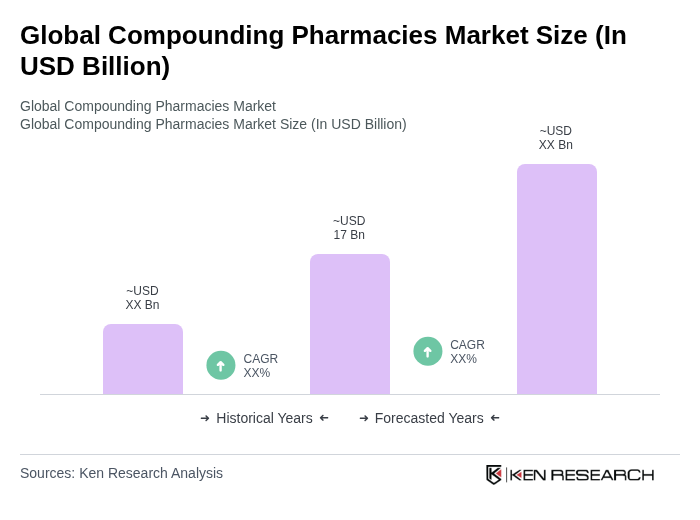
The global compounding pharmacies market, valued at USD 17 billion, is driven by demand for customized medications, drug shortages, and technological advancements in compounding.

Region:Global

Author(s):Rebecca

Product Code:KRAD7428

Pages:93

Published On:December 2025
About the Report

Base Year 2024

Global Compounding Pharmacies Market Overview

  • The Global Compounding Pharmacies Market is valued at USD 17 billion, based on a five-year historical analysis of multiple industry sources indicating global market sizes in the low? to mid?teen billion range. This growth is primarily driven by the increasing demand for personalized medications, ongoing drug shortages, advancements in sterile and non?sterile compounding technologies, and rising awareness of the benefits of compounded drugs among healthcare providers and patients. The market has seen a steady rise in the number and scale of compounding pharmacies, which cater to specific patient needs such as pediatric, geriatric, oncology, pain management, and allergen?free formulations that are not met by mass?produced medications.
  • The United States dominates the Global Compounding Pharmacies Market due to its well?established healthcare infrastructure, relatively high per?capita healthcare spending, a large base of patients with chronic and complex diseases, and a structured federal and state regulatory framework that governs 503A and 503B compounding practices. Other notable countries include Canada and Germany, where there is a strong emphasis on personalized medicine, oncology and pain?management compounding, and patient?centric healthcare solutions, alongside mature hospital pharmacy networks that increasingly use sterile and non?sterile compounded preparations.
  • In the United States, the regulatory environment for compounding pharmacies is shaped by the Federal Food, Drug, and Cosmetic Act as amended by the Drug Quality and Security Act (DQSA), particularly Title I, the Compounding Quality Act issued by the U.S. Congress and implemented by the U.S. Food and Drug Administration. Under sections 503A and 503B, compounding pharmacies must comply with requirements on use of bulk drug substances, prohibition on compounding drugs that are essentially copies of approved products, adherence to applicable USP standards, and, for outsourcing facilities, registration with FDA and current good manufacturing practice (cGMP) obligations designed to enhance the safety and quality of compounded drugs.
Global Compounding Pharmacies Market Size

Global Compounding Pharmacies Market Segmentation

By Product Type:The product type segmentation includes various forms of compounded medications that cater to different patient needs. Among these, oral drugs, such as capsules, tablets, and solutions, are widely used due to their convenience, stability, and suitability for chronic disease management and dose?flexible therapies. Topical drugs, including creams and ointments, are also significant, particularly for dermatological conditions, pain management, and hormone therapies where localized delivery is preferred. Parenteral drugs are gaining traction due to the increasing need for sterile injectable medications in hospitals, ambulatory surgery centers, and clinics, especially for oncology, anesthesia, and critical?care applications.
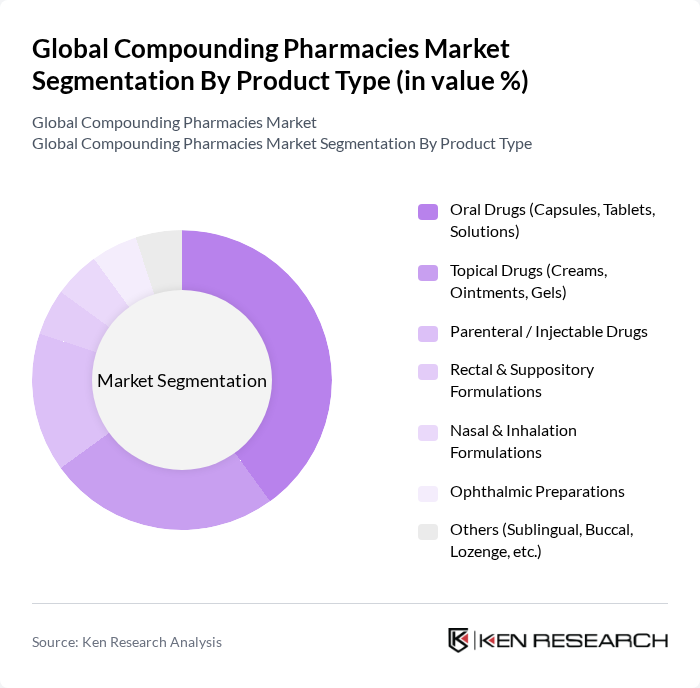
Global Compounding Pharmacies Market segmentation by Product Type.

By Compounding Type:The compounding type segmentation includes various methods of altering medications to meet specific patient needs. Pharmaceutical dosage alteration is a leading segment, allowing for customized strengths, dosage forms, and combinations that are not available in standard formulations, particularly for pediatrics, geriatrics, and patients requiring titrated dosing. Pharmaceutical ingredient alteration, which includes allergen?free, dye?free, preservative?free, and sugar?free options, is also significant as it caters to patients with allergies, intolerances, and specific excipient sensitivities. Bioidentical hormone replacement therapy (BHRT) is gaining popularity, particularly among aging populations seeking personalized hormone treatments and delivery forms tailored to individual hormone profiles, often in topical, sublingual, or oral capsule formats.
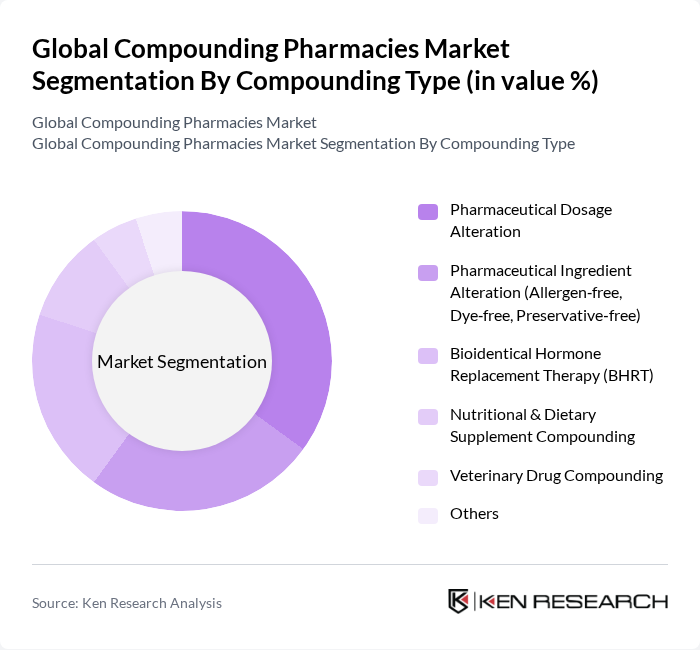
Global Compounding Pharmacies Market segmentation by Compounding Type.

Global Compounding Pharmacies Market Competitive Landscape

The Global Compounding Pharmacies Market is characterized by a dynamic mix of regional and international players. Leading participants such as Fagron N.V., Nephron Pharmaceuticals Corporation, Wedgewood Pharmacy (Wedgewood Village Pharmacy), PCCA (Professional Compounding Centers of America Inc.), MEDISCA Inc., B. Braun Melsungen AG (Compounding Solutions), PharMEDium Services LLC, Cantrell Drug Company, Triangle Compounding Pharmacy, RX3 Compounding Pharmacy, Fresenius Kabi AG (Compounding & Admixture Services), Dougherty’s Pharmacy, Inc., Wedgewood Pharmacy–Diamondback Drugs (Veterinary Compounding), The Compounding Center, Pharmax Pharmacy Compounding contribute to innovation, geographic expansion, and service delivery in this space.

Fagron N.V.

1990

Rotterdam, Netherlands

Nephron Pharmaceuticals Corporation

1997

West Columbia, South Carolina, USA

Wedgewood Pharmacy

1981

Swedesboro, New Jersey, USA

PCCA (Professional Compounding Centers of America Inc.)

1981

Houston, Texas, USA

MEDISCA Inc.

1983

Montreal, Canada

Company

Establishment Year

Headquarters

Business Model (503A, 503B, or Hybrid)

Group Size (Large, Medium, or Small as per industry convention)

Geographic Footprint (No. of Countries / States Served)

Compounded Prescription Volume (Annual Rx or Dose Units)

Revenue from Compounding Services

Revenue Growth Rate (Compounding Segment)

Global Compounding Pharmacies Market Industry Analysis

Growth Drivers

  • Increasing Demand for Personalized Medicine:The global personalized medicine market is projected to reach $2.5 trillion in future, driven by advancements in genomics and biotechnology. This surge in demand is pushing compounding pharmacies to tailor medications to individual patient needs, enhancing treatment efficacy. As healthcare systems increasingly adopt personalized approaches, compounded medications are becoming essential for managing unique patient profiles, particularly in oncology and rare diseases, where standard treatments may not suffice.
  • Rising Prevalence of Chronic Diseases:Chronic diseases, such as diabetes and cardiovascular disorders, affect over 1.7 billion people globally, according to the World Health Organization. This growing patient population necessitates customized medication solutions, which compounding pharmacies are uniquely positioned to provide. The increasing burden of chronic conditions is driving demand for tailored therapies, as patients often require specific dosages or formulations that are not available in standard commercial products, thus boosting the compounding sector.
  • Advancements in Pharmaceutical Technology:The compounding pharmacy sector is benefiting from technological innovations, including 3D printing and automated compounding systems. These advancements enhance precision and efficiency in medication preparation. For instance, the global market for 3D printing in pharmaceuticals is expected to reach $1.5 billion in future. Such technologies enable pharmacies to create complex formulations that meet specific patient needs, thereby expanding their service offerings and improving patient outcomes.

Market Challenges

  • Stringent Regulatory Framework:Compounding pharmacies face rigorous regulations from agencies like the FDA, which can limit operational flexibility. In future, compliance costs are projected to rise by 15% due to increased scrutiny and the need for adherence to Good Manufacturing Practices (GMP). This regulatory environment can hinder smaller pharmacies from competing effectively, as they may lack the resources to meet these stringent requirements, impacting their market viability.
  • Competition from Commercially Available Drugs:The availability of mass-produced medications poses a significant challenge to compounding pharmacies. In future, the global pharmaceutical market is expected to exceed $1.5 trillion, with many patients opting for lower-cost, commercially available alternatives. This trend can limit the market share of compounding pharmacies, particularly in areas where generic drugs are readily accessible, forcing them to differentiate their offerings to attract patients.

Global Compounding Pharmacies Market Future Outlook

The future of compounding pharmacies appears promising, driven by the increasing integration of technology and a growing focus on personalized healthcare solutions. As telehealth services expand, compounding pharmacies can leverage digital platforms to reach patients more effectively. Additionally, the rising interest in natural and organic compounds is likely to create new avenues for growth, as consumers seek alternatives to synthetic medications. These trends suggest a dynamic landscape for compounding pharmacies in future.

Market Opportunities

  • Expansion into Emerging Markets:Emerging markets, particularly in Asia and Africa, are witnessing a surge in healthcare spending, projected to reach $1 trillion in future. This growth presents significant opportunities for compounding pharmacies to establish a presence and cater to the increasing demand for personalized medications, particularly in regions with limited access to standard pharmaceutical products.
  • Development of Innovative Compounding Techniques:The rise of innovative compounding techniques, such as nanotechnology and personalized dosage forms, is set to revolutionize the industry. In future, the market for nanomedicine is expected to reach $350 billion, providing compounding pharmacies with the opportunity to enhance their product offerings and meet the evolving needs of patients seeking customized therapies.

Scope of the Report

SegmentSub-Segments
By Product Type

Oral Drugs (Capsules, Tablets, Solutions)

Topical Drugs (Creams, Ointments, Gels)

Parenteral / Injectable Drugs

Rectal & Suppository Formulations

Nasal & Inhalation Formulations

Ophthalmic Preparations

Others (Sublingual, Buccal, Lozenge, etc.)

By Compounding Type

Pharmaceutical Dosage Alteration

Pharmaceutical Ingredient Alteration (Allergen?free, Dye?free, Preservative?free)

Bioidentical Hormone Replacement Therapy (BHRT)

Nutritional & Dietary Supplement Compounding

Veterinary Drug Compounding

Others

By Sterility

Sterile Compounding (503B & Hospital Outsourcing)

Non?Sterile Compounding (503A)

By Therapeutic Area

Pain Management

Hormone Replacement & Endocrinology

Dermatology

Pediatrics & Geriatrics

Oncology & Critical Care

Others (Ophthalmology, Gastroenterology, etc.)

By End-User

Hospital Pharmacies

Independent Compounding Pharmacies

Retail & Chain Pharmacies

Clinics & Ambulatory Surgical Centers

Home Healthcare & Mail?Order

Veterinary Clinics

Others

By Distribution Channel

Direct Sales to Hospitals & Clinics

Compounding Pharmacy Outlets

Online & Mail?Order Pharmacies

Retail Pharmacy Networks

Others

By Region

North America

Europe

Asia-Pacific

Latin America

Middle East & Africa

Key Target Audience

Investors and Venture Capitalist Firms

Government and Regulatory Bodies (e.g., U.S. Food and Drug Administration, European Medicines Agency)

Pharmaceutical Manufacturers

Healthcare Providers and Institutions

Pharmacy Benefit Managers

Insurance Companies

Industry Associations (e.g., International Academy of Compounding Pharmacists)

Supply Chain and Logistics Companies

Players Mentioned in the Report:

Fagron N.V.

Nephron Pharmaceuticals Corporation

Wedgewood Pharmacy (Wedgewood Village Pharmacy)

PCCA (Professional Compounding Centers of America Inc.)

MEDISCA Inc.

B. Braun Melsungen AG (Compounding Solutions)

PharMEDium Services LLC

Cantrell Drug Company

Triangle Compounding Pharmacy

RX3 Compounding Pharmacy

Fresenius Kabi AG (Compounding & Admixture Services)

Doughertys Pharmacy, Inc.

Wedgewood PharmacyDiamondback Drugs (Veterinary Compounding)

The Compounding Center

Pharmax Pharmacy Compounding

Table of Contents

Market Assessment Phase

1. Executive Summary and Approach


2. Global Compounding Pharmacies Market Overview

2.1 Key Insights and Strategic Recommendations

2.2 Global Compounding Pharmacies Market Overview

2.3 Definition and Scope

2.4 Evolution of Market Ecosystem

2.5 Timeline of Key Regulatory Milestones

2.6 Value Chain & Stakeholder Mapping

2.7 Business Cycle Analysis

2.8 Policy & Incentive Landscape


3. Global Compounding Pharmacies Market Analysis

3.1 Growth Drivers

3.1.1 Increasing Demand for Personalized Medicine
3.1.2 Rising Prevalence of Chronic Diseases
3.1.3 Advancements in Pharmaceutical Technology
3.1.4 Growing Awareness of Compounded Medications

3.2 Market Challenges

3.2.1 Stringent Regulatory Framework
3.2.2 Competition from Commercially Available Drugs
3.2.3 Limited Reimbursement Policies
3.2.4 Quality Control Issues

3.3 Market Opportunities

3.3.1 Expansion into Emerging Markets
3.3.2 Development of Innovative Compounding Techniques
3.3.3 Collaborations with Healthcare Providers
3.3.4 Increasing Focus on Veterinary Compounding

3.4 Market Trends

3.4.1 Shift Towards Home Healthcare Solutions
3.4.2 Integration of Technology in Compounding Processes
3.4.3 Rise of Telehealth Services
3.4.4 Growing Popularity of Natural and Organic Compounds

3.5 Government Regulation

3.5.1 FDA Guidelines on Compounding Practices
3.5.2 State-Level Regulations on Pharmacy Operations
3.5.3 Compliance with USP Standards
3.5.4 Monitoring of Compounded Drug Safety

4. SWOT Analysis


5. Stakeholder Analysis


6. Porter's Five Forces Analysis


7. Global Compounding Pharmacies Market Market Size, 2019-2024

7.1 By Value

7.2 By Volume

7.3 By Average Selling Price


8. Global Compounding Pharmacies Market Segmentation

8.1 By Product Type

8.1.1 Oral Drugs (Capsules, Tablets, Solutions)
8.1.2 Topical Drugs (Creams, Ointments, Gels)
8.1.3 Parenteral / Injectable Drugs
8.1.4 Rectal & Suppository Formulations
8.1.5 Nasal & Inhalation Formulations
8.1.6 Ophthalmic Preparations
8.1.7 Others (Sublingual, Buccal, Lozenge, etc.)

8.2 By Compounding Type

8.2.1 Pharmaceutical Dosage Alteration
8.2.2 Pharmaceutical Ingredient Alteration (Allergen?free, Dye?free, Preservative?free)
8.2.3 Bioidentical Hormone Replacement Therapy (BHRT)
8.2.4 Nutritional & Dietary Supplement Compounding
8.2.5 Veterinary Drug Compounding
8.2.6 Others

8.3 By Sterility

8.3.1 Sterile Compounding (503B & Hospital Outsourcing)
8.3.2 Non?Sterile Compounding (503A)

8.4 By Therapeutic Area

8.4.1 Pain Management
8.4.2 Hormone Replacement & Endocrinology
8.4.3 Dermatology
8.4.4 Pediatrics & Geriatrics
8.4.5 Oncology & Critical Care
8.4.6 Others (Ophthalmology, Gastroenterology, etc.)

8.5 By End-User

8.5.1 Hospital Pharmacies
8.5.2 Independent Compounding Pharmacies
8.5.3 Retail & Chain Pharmacies
8.5.4 Clinics & Ambulatory Surgical Centers
8.5.5 Home Healthcare & Mail?Order
8.5.6 Veterinary Clinics
8.5.7 Others

8.6 By Distribution Channel

8.6.1 Direct Sales to Hospitals & Clinics
8.6.2 Compounding Pharmacy Outlets
8.6.3 Online & Mail?Order Pharmacies
8.6.4 Retail Pharmacy Networks
8.6.5 Others

8.7 By Region

8.7.1 North America
8.7.2 Europe
8.7.3 Asia-Pacific
8.7.4 Latin America
8.7.5 Middle East & Africa

9. Global Compounding Pharmacies Market Competitive Analysis

9.1 Market Share of Key Players

9.2 Cross Comparison of Key Players

9.2.1 Company Name
9.2.2 Business Model (503A, 503B, or Hybrid)
9.2.3 Group Size (Large, Medium, or Small as per industry convention)
9.2.4 Geographic Footprint (No. of Countries / States Served)
9.2.5 Compounded Prescription Volume (Annual Rx or Dose Units)
9.2.6 Revenue from Compounding Services
9.2.7 Revenue Growth Rate (Compounding Segment)
9.2.8 Product & Therapeutic Area Breadth
9.2.9 Share of Sterile vs Non?Sterile Portfolio
9.2.10 Compliance Track Record (USP <795>/<797>/<800>, FDA / State Board Actions)
9.2.11 Investment in Quality & Automation (Cleanrooms, IV Robots, QA Spend as % Sales)
9.2.12 Key Customer Segments (Hospitals, Clinics, Retail, Veterinary, BHRT)
9.2.13 Average Order Size / Contract Value
9.2.14 Pricing Positioning (Premium, Mid, Value)
9.2.15 Strategic Partnerships & Outsourcing Contracts

9.3 SWOT Analysis of Top Players

9.4 Pricing Analysis

9.5 Detailed Profile of Major Companies

9.5.1 Fagron N.V.
9.5.2 Nephron Pharmaceuticals Corporation
9.5.3 Wedgewood Pharmacy (Wedgewood Village Pharmacy)
9.5.4 PCCA (Professional Compounding Centers of America Inc.)
9.5.5 MEDISCA Inc.
9.5.6 B. Braun Melsungen AG (Compounding Solutions)
9.5.7 PharMEDium Services LLC
9.5.8 Cantrell Drug Company
9.5.9 Triangle Compounding Pharmacy
9.5.10 RX3 Compounding Pharmacy
9.5.11 Fresenius Kabi AG (Compounding & Admixture Services)
9.5.12 Dougherty’s Pharmacy, Inc.
9.5.13 Wedgewood Pharmacy–Diamondback Drugs (Veterinary Compounding)
9.5.14 The Compounding Center
9.5.15 Pharmax Pharmacy Compounding

10. Global Compounding Pharmacies Market End-User Analysis

10.1 Procurement Behavior of Key Ministries

10.1.1 Budget Allocation for Compounded Medications
10.1.2 Decision-Making Process
10.1.3 Supplier Selection Criteria
10.1.4 Compliance and Regulatory Considerations

10.2 Corporate Spend on Infrastructure & Energy

10.2.1 Investment in Compounding Facilities
10.2.2 Spending on Technology Upgrades
10.2.3 Budget for Staff Training
10.2.4 Expenditure on Quality Control Measures

10.3 Pain Point Analysis by End-User Category

10.3.1 Access to Compounded Medications
10.3.2 Cost of Compounded Drugs
10.3.3 Availability of Specialized Compounds
10.3.4 Regulatory Compliance Challenges

10.4 User Readiness for Adoption

10.4.1 Awareness of Compounding Benefits
10.4.2 Training and Education Needs
10.4.3 Infrastructure Readiness
10.4.4 Financial Preparedness

10.5 Post-Deployment ROI and Use Case Expansion

10.5.1 Measurement of Cost Savings
10.5.2 Evaluation of Patient Outcomes
10.5.3 Expansion into New Therapeutic Areas
10.5.4 Long-term Sustainability Assessment

11. Global Compounding Pharmacies Market Future Size, 2025-2030

11.1 By Value

11.2 By Volume

11.3 By Average Selling Price


Go-To-Market Strategy Phase

1. Whitespace Analysis + Business Model Canvas

1.1 Market Gaps Identification

1.2 Value Proposition Development

1.3 Revenue Streams Analysis

1.4 Cost Structure Evaluation

1.5 Key Partnerships Exploration

1.6 Customer Segmentation

1.7 Channels of Distribution


2. Marketing and Positioning Recommendations

2.1 Branding Strategies

2.2 Product USPs

2.3 Target Audience Identification

2.4 Communication Strategy

2.5 Digital Marketing Approaches

2.6 Offline Marketing Tactics

2.7 Performance Metrics


3. Distribution Plan

3.1 Urban Retail Strategies

3.2 Rural NGO Tie-ups

3.3 Online Distribution Channels

3.4 Direct Sales Approaches

3.5 Partnerships with Healthcare Providers

3.6 Logistics and Supply Chain Management

3.7 Performance Evaluation


4. Channel & Pricing Gaps

4.1 Underserved Routes

4.2 Pricing Bands Analysis

4.3 Competitor Pricing Strategies

4.4 Customer Willingness to Pay

4.5 Price Sensitivity Assessment

4.6 Recommendations for Pricing Adjustments

4.7 Monitoring Pricing Trends


5. Unmet Demand & Latent Needs

5.1 Category Gaps Identification

5.2 Consumer Segments Analysis

5.3 Emerging Trends Exploration

5.4 Recommendations for Product Development

5.5 Market Entry Strategies for New Segments

5.6 Customer Feedback Mechanisms

5.7 Long-term Demand Forecasting


6. Customer Relationship

6.1 Loyalty Programs Development

6.2 After-sales Service Strategies

6.3 Customer Engagement Initiatives

6.4 Feedback and Improvement Processes

6.5 Building Trust and Credibility

6.6 Community Involvement

6.7 Performance Metrics for Customer Relationships


7. Value Proposition

7.1 Sustainability Initiatives

7.2 Integrated Supply Chains

7.3 Unique Selling Points

7.4 Customer-Centric Approaches

7.5 Competitive Advantage Analysis

7.6 Long-term Value Creation

7.7 Performance Measurement


8. Key Activities

8.1 Regulatory Compliance

8.2 Branding Initiatives

8.3 Distribution Setup

8.4 Staff Training and Development

8.5 Quality Assurance Processes

8.6 Market Research and Analysis

8.7 Performance Tracking


9. Entry Strategy Evaluation

9.1 Domestic Market Entry Strategy

9.1.1 Product Mix Considerations
9.1.2 Pricing Band Analysis
9.1.3 Packaging Strategies

9.2 Export Entry Strategy

9.2.1 Target Countries Identification
9.2.2 Compliance Roadmap Development

10. Entry Mode Assessment

10.1 Joint Ventures

10.2 Greenfield Investments

10.3 Mergers and Acquisitions

10.4 Distributor Model Evaluation

10.5 Risk Assessment

10.6 Strategic Fit Analysis

10.7 Performance Metrics


11. Capital and Timeline Estimation

11.1 Capital Requirements

11.2 Timelines for Implementation

11.3 Financial Projections

11.4 Funding Sources Exploration

11.5 Risk Management Strategies

11.6 Performance Monitoring


12. Control vs Risk Trade-Off

12.1 Ownership Considerations

12.2 Partnership Opportunities

12.3 Risk Mitigation Strategies

12.4 Performance Evaluation

12.5 Long-term Sustainability

12.6 Strategic Alignment


13. Profitability Outlook

13.1 Breakeven Analysis


Research Methodology

ApproachModellingSample

Phase 1: Approach1

Desk Research

  • Industry reports from pharmaceutical associations and regulatory bodies
  • Market analysis publications focusing on compounding pharmacies
  • Academic journals and white papers on pharmaceutical compounding practices

Primary Research

  • Interviews with pharmacists and owners of compounding pharmacies
  • Surveys targeting healthcare professionals involved in patient care
  • Focus groups with patients utilizing compounded medications

Validation & Triangulation

  • Cross-validation of data from multiple industry sources and expert opinions
  • Triangulation of market trends with historical data and future projections
  • Sanity checks through feedback from a panel of industry experts

Phase 2: Market Size Estimation1

Top-down Assessment

  • Analysis of total pharmaceutical market size and growth rates
  • Segmentation of compounding pharmacy market by therapeutic area
  • Incorporation of demographic trends affecting demand for compounded medications

Bottom-up Modeling

  • Volume estimates based on the number of compounding pharmacies and their output
  • Cost analysis of compounded medications across various therapeutic categories
  • Revenue projections based on pricing strategies and market penetration

Forecasting & Scenario Analysis

  • Multi-variable regression analysis incorporating healthcare trends and regulations
  • Scenario modeling based on potential changes in healthcare policies
  • Baseline, optimistic, and pessimistic forecasts through 2030

Phase 3: CATI Sample Composition1

Scope Item/SegmentSample SizeTarget Respondent Profiles
Independent Compounding Pharmacies100Pharmacy Owners, Lead Pharmacists
Hospital-Based Compounding Services80Clinical Pharmacists, Pharmacy Directors
Veterinary Compounding Pharmacies60Veterinary Pharmacists, Animal Health Specialists
Patient Experience with Compounded Medications75Patients, Caregivers
Regulatory Compliance in Compounding50Regulatory Affairs Managers, Compliance Officers

Frequently Asked Questions

What is the current value of the Global Compounding Pharmacies Market?

The Global Compounding Pharmacies Market is valued at approximately USD 17 billion, reflecting a steady growth trend driven by increasing demand for personalized medications and advancements in compounding technologies.

What factors are driving the growth of the compounding pharmacies market?

Which regions dominate the Global Compounding Pharmacies Market?

What are the main types of compounded medications?

Other Regional/Country Reports

Kuwait compounding pharmacies market report size, share, growth drivers, trends, opportunities & forecast 2025–2030

Indonesia Compounding Pharmacies Market

Malaysia Compounding Pharmacies Market

KSA Compounding Pharmacies Market

APAC Compounding Pharmacies Market

SEA Compounding Pharmacies Market

Other Adjacent Reports

US personalized medicine market Size, Share, Growth Drivers, Trends, Opportunities & Forecast 2025–2030UAE Specialty Pharmaceuticals Market

Egypt Oncology Drugs Market

Malaysia Pain Management Therapeutics Market

Qatar hormone replacement therapy market Size, Share, Growth Drivers, Trends, Opportunities & Forecast 2025–2030

Oman Veterinary Compounding Market

Belgium Pharmaceutical Outsourcing Market

Philippines Drug Delivery Systems Market

UAE Biopharmaceuticals Market

UAE Regulatory Affairs Services Market

Why Buy From Us?

Refine Robust Result (RRR) Framework

What makes us stand out is that our consultants follow Robust, Refine and Result (RRR) methodology. Robust for clear definitions, approaches and sanity checking, Refine for differentiating respondents' facts and opinions, and Result for presenting data with story.

Our Reach Is Unmatched

We have set a benchmark in the industry by offering our clients with syndicated and customized market research reports featuring coverage of entire market as well as meticulous research and analyst insights.

Shifting the Research Paradigm

While we don't replace traditional research, we flip the method upside down. Our dual approach of Top Bottom & Bottom Top ensures quality deliverable by not just verifying company fundamentals but also looking at the sector and macroeconomic factors.

More Insights-Better Decisions

With one step in the future, our research team constantly tries to show you the bigger picture. We help with some of the tough questions you may encounter along the way: How is the industry positioned? Best marketing channel? KPI's of competitors? By aligning every element, we help maximize success.

Transparency and Trust

Our report gives you instant access to the answers and sources that other companies might choose to hide. We elaborate each steps of research methodology we have used and showcase you the sample size to earn your trust.

Round the Clock Support

If you need any support, we are here! We pride ourselves on universe strength, data quality, and quick, friendly, and professional service.

Why Clients Choose Us?

400000+
Reports in repository
150+
Consulting projects a year
100+
Analysts
8000+
Client Queries in 2022








