About the Report
Base Year 2024Listen to the audio summary
Global Continuous Glucose Monitoring Market Overview
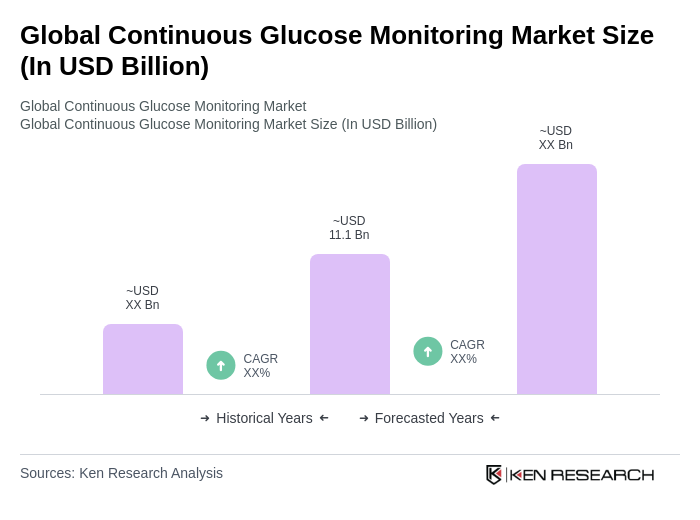
- The Global Continuous Glucose Monitoring Market is valued at USD 11.1 billion, based on a five-year historical analysis. This growth is primarily driven by the increasing prevalence of diabetes, the adoption of wearable healthcare technologies, and advancements in sensor miniaturization and device integration that enhance the accuracy, convenience, and real-time data capabilities of glucose monitoring devices. Additional growth drivers include expanded reimbursement frameworks and the integration of CGM systems with mobile health platforms, supporting both clinical and home-based diabetes management .
- Key players in this market include the United States, Germany, and Japan. The dominance of these countries is attributed to their advanced healthcare infrastructure, high disposable income, and significant investments in research and development, which foster innovation in glucose monitoring technologies. The United States leads the market, followed by strong adoption and innovation in Germany and Japan, driven by robust healthcare systems and early adoption of tele-health and remote monitoring solutions .
- In 2023, the U.S. Food and Drug Administration (FDA) issued updated guidance titled “Self-Monitoring Blood Glucose Test Systems for Over-the-Counter Use,” requiring that all continuous glucose monitoring devices marketed in the United States must comply with enhanced accuracy and performance standards. This regulation, issued by the U.S. Department of Health and Human Services, mandates rigorous clinical validation and labeling requirements to ensure patient safety and the reliability of glucose readings, thereby strengthening the effectiveness of diabetes management .
Global Continuous Glucose Monitoring Market Segmentation
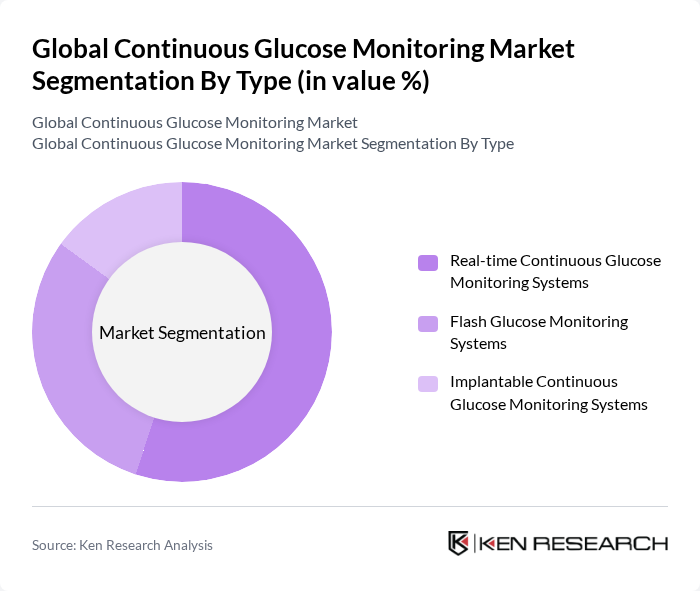
By Type:The market is segmented into three main types: Real-time Continuous Glucose Monitoring Systems, Flash Glucose Monitoring Systems, and Implantable Continuous Glucose Monitoring Systems. Among these, Real-time Continuous Glucose Monitoring Systems are leading the market due to their ability to provide continuous data and alerts, which are crucial for effective diabetes management. The growing demand for real-time data among patients and healthcare providers is driving the adoption of these systems, making them the preferred choice in the market. The integration of real-time CGM with insulin pumps and mobile applications further supports their leading position .
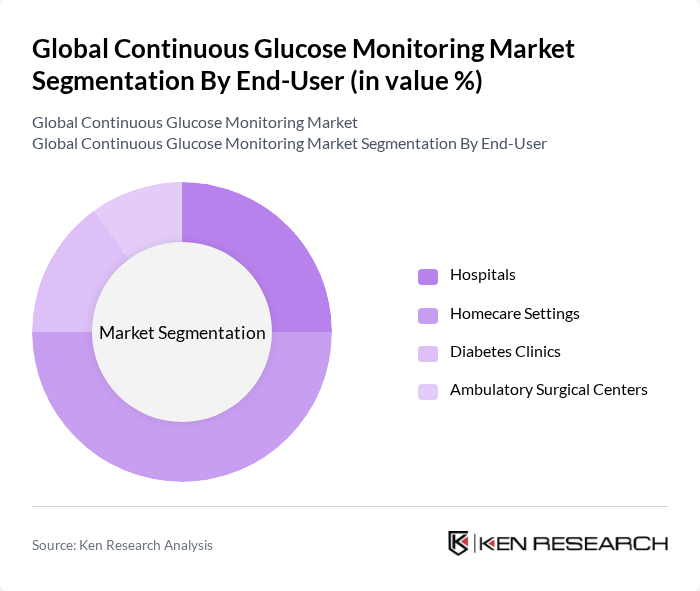
By End-User:The market is categorized into Hospitals, Homecare Settings, Diabetes Clinics, and Ambulatory Surgical Centers. Homecare Settings are currently dominating the market as more patients prefer to manage their diabetes at home, facilitated by the convenience and accessibility of continuous glucose monitoring devices. This trend is further supported by the increasing emphasis on patient-centered care, the proliferation of remote monitoring technologies, and the growing number of diabetes patients opting for home-based management solutions .
Global Continuous Glucose Monitoring Market Competitive Landscape
The Global Continuous Glucose Monitoring Market is characterized by a dynamic mix of regional and international players. Leading participants such as Abbott Laboratories, Dexcom, Inc., Medtronic plc, Roche Diabetes Care, Ascensia Diabetes Care, Senseonics Holdings, Inc., Insulet Corporation, Tandem Diabetes Care, Inc., GlySens, Inc., Nova Biomedical Corporation, Ypsomed AG, Glooko, Inc., A. Menarini Diagnostics S.r.l., Signos, Inc., Medtrum Technologies Inc. contribute to innovation, geographic expansion, and service delivery in this space.
Global Continuous Glucose Monitoring Market Industry Analysis
Growth Drivers
- Increasing Prevalence of Diabetes:The World Health Organization reported that approximately 422 million people worldwide were living with diabetes in 2014, a number that has continued to rise. In future, it is projected that the global diabetes population will exceed 530 million. This alarming increase drives demand for continuous glucose monitoring systems, as patients seek effective management solutions to maintain their health and prevent complications associated with diabetes.
- Technological Advancements in Monitoring Devices:The continuous glucose monitoring market is experiencing rapid innovation, with devices becoming more accurate and user-friendly. For instance, the FDA approved over 20 new CGM devices in future alone, reflecting a significant increase in technological capabilities. These advancements not only enhance patient experience but also improve health outcomes, making CGM systems more appealing to both patients and healthcare providers.
- Rising Health Awareness and Preventive Healthcare:A future survey by the International Diabetes Federation indicated that 70% of respondents are increasingly aware of diabetes management options. This growing health consciousness is leading to a surge in preventive healthcare measures, including regular glucose monitoring. As individuals prioritize their health, the demand for continuous glucose monitoring systems is expected to rise, further propelling market growth in the coming years.
Market Challenges
- High Cost of Continuous Glucose Monitoring Systems:The average cost of continuous glucose monitoring systems can range from $1,000 to $3,000 annually, which poses a significant barrier for many patients. According to the American Diabetes Association, nearly 30% of individuals with diabetes report financial difficulties in accessing necessary medical devices. This high cost limits market penetration and restricts access to essential monitoring technologies for a substantial portion of the population.
- Data Privacy and Security Concerns:With the increasing integration of digital health technologies, data privacy has become a critical issue. A future report from Cybersecurity Ventures estimated that healthcare data breaches cost the industry over $6 billion annually. Patients are increasingly concerned about the security of their personal health information, which can hinder the adoption of continuous glucose monitoring systems that rely on data sharing and connectivity.
Global Continuous Glucose Monitoring Market Future Outlook
The future of the continuous glucose monitoring market appears promising, driven by ongoing technological advancements and a growing emphasis on personalized medicine. As healthcare systems increasingly adopt telehealth services, the integration of CGM devices with digital platforms will enhance patient engagement and monitoring capabilities. Furthermore, the focus on data analytics will enable healthcare providers to deliver tailored treatment plans, improving overall health outcomes for diabetes patients and fostering a more proactive approach to disease management.
Market Opportunities
- Expansion into Emerging Markets:Emerging markets, particularly in Asia and Africa, present significant growth opportunities for continuous glucose monitoring systems. With diabetes prevalence rising in these regions, companies can tap into a growing consumer base seeking affordable and effective monitoring solutions, potentially increasing market share and revenue.
- Development of Innovative and User-Friendly Devices:There is a substantial opportunity for manufacturers to develop innovative, user-friendly continuous glucose monitoring devices. By focusing on features such as smartphone integration and improved accuracy, companies can attract a broader audience, including younger patients who are more tech-savvy and prefer seamless health management solutions.
Scope of the Report
| Segment | Sub-Segments |
|---|---|
| By Type | Real-time Continuous Glucose Monitoring Systems Flash Glucose Monitoring Systems Implantable Continuous Glucose Monitoring Systems |
| By End-User | Hospitals Homecare Settings Diabetes Clinics Ambulatory Surgical Centers |
| By Distribution Channel | Online Retail Pharmacies Direct Sales |
| By Component | Sensors Transmitters Receivers Display Devices & Mobile Apps |
| By Application | Diabetes Management (Type 1 & Type 2) Clinical Research Health Monitoring & Wellness |
| By Age Group | Pediatric Adult Geriatric |
| By Region | North America Europe Asia Pacific Latin America Middle East & Africa |
Key Target Audience
Investors and Venture Capitalist Firms
Government and Regulatory Bodies (e.g., Food and Drug Administration, European Medicines Agency)
Manufacturers and Producers
Distributors and Retailers
Healthcare Providers and Clinics
Health Insurance Companies
Industry Associations
Pharmaceutical Companies
Players Mentioned in the Report:
Abbott Laboratories
Dexcom, Inc.
Medtronic plc
Roche Diabetes Care
Ascensia Diabetes Care
Senseonics Holdings, Inc.
Insulet Corporation
Tandem Diabetes Care, Inc.
GlySens, Inc.
Nova Biomedical Corporation
Ypsomed AG
Glooko, Inc.
A. Menarini Diagnostics S.r.l.
Signos, Inc.
Medtrum Technologies Inc.
Table of Contents
Market Assessment Phase
1. Executive Summary and Approach
2. Global Continuous Glucose Monitoring Market Overview
2.1 Key Insights and Strategic Recommendations
2.2 Global Continuous Glucose Monitoring Market Overview
2.3 Definition and Scope
2.4 Evolution of Market Ecosystem
2.5 Timeline of Key Regulatory Milestones
2.6 Value Chain & Stakeholder Mapping
2.7 Business Cycle Analysis
2.8 Policy & Incentive Landscape
3. Global Continuous Glucose Monitoring Market Analysis
3.1 Growth Drivers
3.1.1 Increasing prevalence of diabetes
3.1.2 Technological advancements in monitoring devices
3.1.3 Rising health awareness and preventive healthcare
3.1.4 Supportive government initiatives and funding
3.2 Market Challenges
3.2.1 High cost of continuous glucose monitoring systems
3.2.2 Data privacy and security concerns
3.2.3 Limited reimbursement policies
3.2.4 Variability in regulatory approvals across regions
3.3 Market Opportunities
3.3.1 Expansion into emerging markets
3.3.2 Development of innovative and user-friendly devices
3.3.3 Integration with digital health platforms
3.3.4 Collaborations with healthcare providers
3.4 Market Trends
3.4.1 Shift towards personalized medicine
3.4.2 Increasing adoption of telehealth services
3.4.3 Growth in wearable health technology
3.4.4 Focus on data analytics for better health outcomes
3.5 Government Regulation
3.5.1 Stricter safety and efficacy standards
3.5.2 Enhanced guidelines for device approval
3.5.3 Incentives for R&D in diabetes management
3.5.4 Regulations on data sharing and patient privacy
4. SWOT Analysis
5. Stakeholder Analysis
6. Porter's Five Forces Analysis
7. Global Continuous Glucose Monitoring Market Market Size, 2019-2024
7.1 By Value
7.2 By Volume
7.3 By Average Selling Price
8. Global Continuous Glucose Monitoring Market Segmentation
8.1 By Type
8.1.1 Real-time Continuous Glucose Monitoring Systems
8.1.2 Flash Glucose Monitoring Systems
8.1.3 Implantable Continuous Glucose Monitoring Systems
8.2 By End-User
8.2.1 Hospitals
8.2.2 Homecare Settings
8.2.3 Diabetes Clinics
8.2.4 Ambulatory Surgical Centers
8.3 By Distribution Channel
8.3.1 Online Retail
8.3.2 Pharmacies
8.3.3 Direct Sales
8.4 By Component
8.4.1 Sensors
8.4.2 Transmitters
8.4.3 Receivers
8.4.4 Display Devices & Mobile Apps
8.5 By Application
8.5.1 Diabetes Management (Type 1 & Type 2)
8.5.2 Clinical Research
8.5.3 Health Monitoring & Wellness
8.6 By Age Group
8.6.1 Pediatric
8.6.2 Adult
8.6.3 Geriatric
8.7 By Region
8.7.1 North America
8.7.2 Europe
8.7.3 Asia Pacific
8.7.4 Latin America
8.7.5 Middle East & Africa
8.8 Others
9. Global Continuous Glucose Monitoring Market Competitive Analysis
9.1 Market Share of Key Players
9.2 Cross Comparison of Key Players
9.2.1 Company Name
9.2.2 Group Size (Large, Medium, or Small as per industry convention)
9.2.3 Global Revenue from CGM (USD, latest FY)
9.2.4 Revenue Growth Rate (CAGR, 3-5 years)
9.2.5 Market Share in Global CGM Market (%)
9.2.6 Installed User Base (Number of Active Users)
9.2.7 Geographic Presence (Number of Countries/Regions)
9.2.8 R&D Investment as % of Revenue
9.2.9 Product Portfolio Breadth (Number of CGM SKUs/Models)
9.2.10 Regulatory Approvals (FDA, CE, etc.)
9.2.11 Distribution Network Efficiency
9.2.12 Pricing Strategy (Premium/Mid/Value)
9.2.13 Product Innovation Rate (New Launches/Patents per Year)
9.2.14 Customer Satisfaction Index (NPS or Equivalent)
9.2.15 Digital Health Integration (App/Cloud Connectivity)
9.3 SWOT Analysis of Top Players
9.4 Pricing Analysis
9.5 Detailed Profile of Major Companies
9.5.1 Abbott Laboratories
9.5.2 Dexcom, Inc.
9.5.3 Medtronic plc
9.5.4 Roche Diabetes Care
9.5.5 Ascensia Diabetes Care
9.5.6 Senseonics Holdings, Inc.
9.5.7 Insulet Corporation
9.5.8 Tandem Diabetes Care, Inc.
9.5.9 GlySens, Inc.
9.5.10 Nova Biomedical Corporation
9.5.11 Ypsomed AG
9.5.12 Glooko, Inc.
9.5.13 A. Menarini Diagnostics S.r.l.
9.5.14 Signos, Inc.
9.5.15 Medtrum Technologies Inc.
10. Global Continuous Glucose Monitoring Market End-User Analysis
10.1 Procurement Behavior of Key Ministries
10.1.1 Government healthcare procurement policies
10.1.2 Budget allocation for diabetes management
10.1.3 Collaboration with private sectors
10.2 Corporate Spend on Infrastructure & Energy
10.2.1 Investment in healthcare infrastructure
10.2.2 Funding for diabetes research and development
10.2.3 Corporate partnerships for technology integration
10.3 Pain Point Analysis by End-User Category
10.3.1 Accessibility of monitoring devices
10.3.2 Affordability of continuous glucose monitoring
10.3.3 User-friendliness of devices
10.4 User Readiness for Adoption
10.4.1 Awareness of continuous glucose monitoring benefits
10.4.2 Training and support for users
10.4.3 Integration with existing health management systems
10.5 Post-Deployment ROI and Use Case Expansion
10.5.1 Measurement of health outcomes improvement
10.5.2 Cost savings from reduced complications
10.5.3 Expansion into new user demographics
11. Global Continuous Glucose Monitoring Market Future Size, 2025-2030
11.1 By Value
11.2 By Volume
11.3 By Average Selling Price
Go-To-Market Strategy Phase
1. Whitespace Analysis + Business Model Canvas
1.1 Market gaps and opportunities
1.2 Business model innovation
1.3 Value proposition development
1.4 Competitive landscape assessment
2. Marketing and Positioning Recommendations
2.1 Branding strategies
2.2 Product USPs
2.3 Target audience identification
2.4 Communication strategies
3. Distribution Plan
3.1 Urban retail strategies
3.2 Rural NGO tie-ups
3.3 Online distribution channels
3.4 Partnerships with healthcare providers
4. Channel & Pricing Gaps
4.1 Underserved routes
4.2 Pricing bands analysis
4.3 Competitor pricing strategies
4.4 Consumer price sensitivity
5. Unmet Demand & Latent Needs
5.1 Category gaps
5.2 Consumer segments analysis
5.3 Emerging trends in consumer preferences
5.4 Future product development needs
6. Customer Relationship
6.1 Loyalty programs
6.2 After-sales service
6.3 Customer feedback mechanisms
6.4 Community engagement initiatives
7. Value Proposition
7.1 Sustainability initiatives
7.2 Integrated supply chains
7.3 Health outcomes improvement
7.4 Cost-effectiveness of solutions
8. Key Activities
8.1 Regulatory compliance
8.2 Branding efforts
8.3 Distribution setup
8.4 Training and support programs
9. Entry Strategy Evaluation
9.1 Domestic Market Entry Strategy
9.1.1 Product mix considerations
9.1.2 Pricing band strategies
9.1.3 Packaging innovations
9.2 Export Entry Strategy
9.2.1 Target countries analysis
9.2.2 Compliance roadmap development
10. Entry Mode Assessment
10.1 Joint Ventures
10.2 Greenfield investments
10.3 Mergers & Acquisitions
10.4 Distributor Model
11. Capital and Timeline Estimation
11.1 Capital requirements
11.2 Timelines for market entry
12. Control vs Risk Trade-Off
12.1 Ownership considerations
12.2 Partnerships evaluation
13. Profitability Outlook
13.1 Breakeven analysis
13.2 Long-term sustainability strategies
14. Potential Partner List
14.1 Distributors
14.2 Joint Ventures
14.3 Acquisition targets
15. Execution Roadmap
15.1 Phased Plan for Market Entry
15.1.1 Market Setup
15.1.2 Market Entry
15.1.3 Growth Acceleration
15.1.4 Scale & Stabilize
15.2 Key Activities and Milestones
15.2.1 Milestone tracking
15.2.2 Activity scheduling
Research Methodology
Phase 1: Approach1
Desk Research
- Analysis of market reports from healthcare organizations and diabetes associations
- Review of published articles in medical journals focusing on continuous glucose monitoring technologies
- Examination of regulatory documents and guidelines from health authorities regarding CGM devices
Primary Research
- Interviews with endocrinologists and diabetes care specialists to understand clinical adoption
- Surveys with patients using CGM devices to gather user experience and satisfaction data
- Discussions with manufacturers and distributors to assess market dynamics and supply chain challenges
Validation & Triangulation
- Cross-validation of findings through multiple data sources including industry reports and expert opinions
- Triangulation of market trends using sales data, clinical studies, and patient feedback
- Sanity checks conducted through expert panel reviews to ensure data accuracy and relevance
Phase 2: Market Size Estimation1
Top-down Assessment
- Estimation of total addressable market based on diabetes prevalence statistics and CGM adoption rates
- Segmentation of market size by geographic regions and demographic factors
- Incorporation of growth trends in telehealth and remote patient monitoring services
Bottom-up Modeling
- Collection of sales data from leading CGM manufacturers to establish baseline revenue figures
- Analysis of pricing strategies and reimbursement policies affecting market penetration
- Volume estimates based on patient population and average usage rates of CGM devices
Forecasting & Scenario Analysis
- Multi-factor regression analysis incorporating technological advancements and healthcare policy changes
- Scenario modeling based on varying rates of diabetes incidence and healthcare access improvements
- Development of baseline, optimistic, and pessimistic forecasts through 2030
Phase 3: CATI Sample Composition1
| Scope Item/Segment | Sample Size | Target Respondent Profiles |
|---|---|---|
| Healthcare Providers | 100 | Endocrinologists, Diabetes Educators |
| Patients Using CGM Devices | 120 | Type 1 and Type 2 Diabetes Patients |
| Manufacturers of CGM Devices | 60 | Product Managers, R&D Directors |
| Healthcare Payers | 50 | Insurance Underwriters, Policy Analysts |
| Regulatory Bodies | 40 | Health Policy Advisors, Compliance Officers |
Frequently Asked Questions
What is the current value of the Global Continuous Glucose Monitoring Market?
The Global Continuous Glucose Monitoring Market is valued at approximately USD 11.1 billion, driven by the rising prevalence of diabetes and advancements in glucose monitoring technologies, enhancing accuracy and convenience for users.
What are the main types of continuous glucose monitoring systems?
Which regions dominate the Global Continuous Glucose Monitoring Market?
What are the key growth drivers for the continuous glucose monitoring market?
Other Regional/Country Reports
Malaysia Continuous Glucose Monitoring Market
SEA Continuous Glucose Monitoring Market
Other Adjacent Reports
Thailand Insulin Delivery Systems Market
Philippines Blood Glucose Meters Market
Philippines Wearable Health Devices Market
UAE Diabetes Management Software Market
Qatar Telemedicine Services Market
GCC Health Data Analytics Market Size, Share, Growth Drivers, Trends, Opportunities & Forecast 2025–2030Qatar Mobile Health Applications Market
Kuwait Artificial Pancreas Devices Market
Germany Biosensor Technology Market
Germany Personalized Diabetes Care Market
Why Buy From Us?

What makes us stand out is that our consultants follow Robust, Refine and Result (RRR) methodology. Robust for clear definitions, approaches and sanity checking, Refine for differentiating respondents' facts and opinions, and Result for presenting data with story.

We have set a benchmark in the industry by offering our clients with syndicated and customized market research reports featuring coverage of entire market as well as meticulous research and analyst insights.

While we don't replace traditional research, we flip the method upside down. Our dual approach of Top Bottom & Bottom Top ensures quality deliverable by not just verifying company fundamentals but also looking at the sector and macroeconomic factors.

With one step in the future, our research team constantly tries to show you the bigger picture. We help with some of the tough questions you may encounter along the way: How is the industry positioned? Best marketing channel? KPI's of competitors? By aligning every element, we help maximize success.

Our report gives you instant access to the answers and sources that other companies might choose to hide. We elaborate each steps of research methodology we have used and showcase you the sample size to earn your trust.

If you need any support, we are here! We pride ourselves on universe strength, data quality, and quick, friendly, and professional service.