About the Report
Base Year 2024Listen to the audio summary
Global Digital Freight Brokerage Market Overview
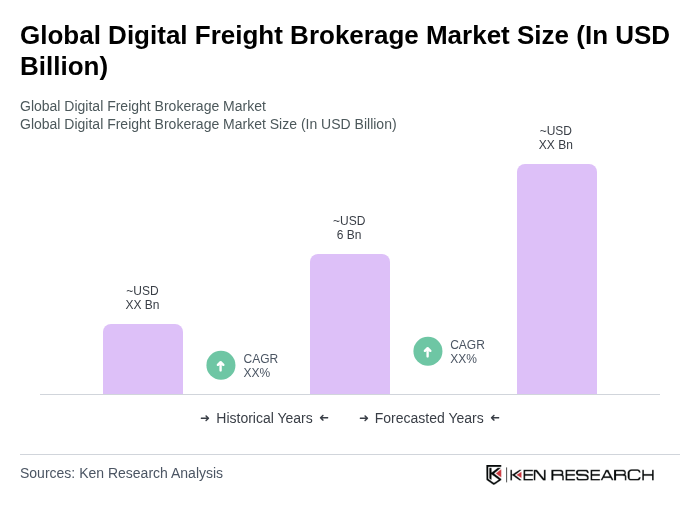
- The Global Digital Freight Brokerage Market is valued at approximately USD 6 billion, based on a five-year historical analysis. This reflects rapid growth from a low single?billion base earlier in the decade, driven by expanding digitization across freight forwarding and brokerage activities. This growth is primarily driven by the increasing demand for efficient logistics solutions, the rise of e?commerce, and advancements in technology that facilitate real?time tracking, automated pricing, and digital documentation workflows across multimodal transport. The market has seen a significant shift towards digital platforms that streamline operations, enhance customer experience, and integrate with warehouse management, transportation management, and visibility solutions to support end?to?end supply chain orchestration.
- Key players in this market are concentrated in regions such as North America and Europe, particularly in countries like the United States and Germany. These regions dominate due to their robust logistics infrastructure, high adoption rates of cloud and API?based platforms, and a strong presence of major freight companies and venture?backed digital startups. The established supply chain networks, clear regulatory frameworks for digital transactions, and strong investment in transportation technology further bolster their market leadership, while Asia Pacific is emerging as the fastest?growing region on the back of cross?border e?commerce and manufacturing exports.
- In 2023, the European Union advanced a broader digital and sustainability agenda in transport, including initiatives such as electronic freight transport information (eFTI), Mobility Package provisions, and Fit for 55 measures, which collectively aim to increase transparency, safety, and efficiency in road and multimodal freight. While there is no single EU regulation exclusively mandating digital freight brokerage platforms to publish standardized pricing and performance metrics, these frameworks encourage digital documentation, better data sharing, and fair competition, indirectly pushing platforms toward clearer pricing structures and service?quality visibility for shippers and carriers. As a result, many providers are voluntarily enhancing real?time visibility, emissions reporting, and performance dashboards to remain compliant with evolving rules and competitive in the digital freight brokerage sector.
Global Digital Freight Brokerage Market Segmentation
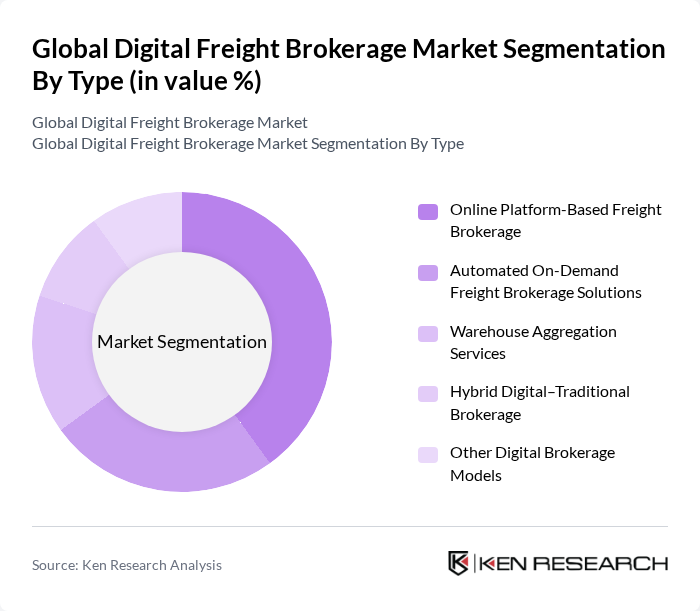
By Type:The market is segmented into various types, including Online Platform-Based Freight Brokerage, Automated On-Demand Freight Brokerage Solutions, Warehouse Aggregation Services, Hybrid Digital–Traditional Brokerage, and Other Digital Brokerage Models. Industry research consistently indicates that Online Platform-Based Freight Brokerage is the leading segment within digital brokerage and related categories, as most adopters first use web? and app?based marketplaces to match loads with carriers and access instant pricing. The convenience, scalability, and integration capabilities offered by these platforms have made them the preferred choice for many businesses seeking to digitize freight booking, with automated on?demand solutions gaining share as algorithmic pricing, dynamic capacity sourcing, and API connectivity with shippers’ systems mature.
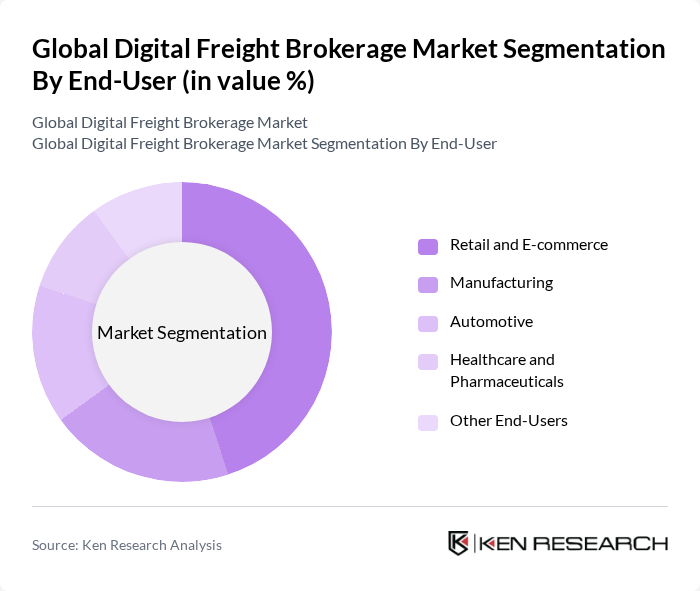
By End-User:The end-user segmentation includes Retail and E-commerce, Manufacturing, Automotive, Healthcare and Pharmaceuticals, and Other End-Users. Research across multiple firms confirms that Retail and E-commerce is one of the most dominant demand drivers for digital freight brokerage, as online sales expansion and tighter delivery windows increase the need for flexible capacity and real?time visibility. This segment’s demand for quick and reliable logistics services, including last?mile and cross?border parcel and freight flows, has significantly influenced overall market dynamics, followed by manufacturing and automotive shippers that use digital platforms to optimize lane performance, reduce empty miles, and gain better cost transparency.
Global Digital Freight Brokerage Market Competitive Landscape
The Global Digital Freight Brokerage Market is characterized by a dynamic mix of regional and international players. Leading participants such as C.H. Robinson (Navisphere), Uber Freight, Convoy, Loadsmart, Freightos, Flexport, Echo Global Logistics, DAT Freight & Analytics, project44, FourKites, Transporeon (Mercell Group), Zencargo, Sennder, Shipwell, J.B. Hunt 360 contribute to innovation, geographic expansion, and service delivery in this space. Many of these companies focus on expanding multimodal capabilities, deepening integrations with enterprise resource planning and transportation management systems, and offering value?added services such as predictive estimated time of arrival, emissions tracking, and automated tendering to differentiate in an increasingly competitive environment.
Global Digital Freight Brokerage Market Industry Analysis
Growth Drivers
- Increased Demand for E-commerce Logistics:The global e-commerce market is projected to reach $6.4 trillion in future, driving the need for efficient logistics solutions. In future, e-commerce accounted for 20% of total retail sales, highlighting a significant shift in consumer behavior. This surge in online shopping necessitates advanced digital freight brokerage services to manage complex supply chains, ensuring timely deliveries and optimized logistics operations, which are crucial for maintaining competitive advantage in the market.
- Technological Advancements in Freight Management:The integration of technologies such as IoT and cloud computing is revolutionizing freight management. In future, the global IoT in logistics market is expected to reach $36 billion, enhancing real-time tracking and inventory management. These advancements enable digital freight brokers to offer more efficient services, reduce operational costs, and improve customer satisfaction, thereby driving market growth as companies increasingly adopt these technologies to streamline their logistics processes.
- Globalization of Supply Chains:As businesses expand internationally, the complexity of supply chains increases, necessitating sophisticated freight solutions. In future, global trade is projected to reach $29 trillion, emphasizing the need for digital freight brokerage services that can navigate diverse regulatory environments and logistics challenges. This globalization trend compels companies to adopt digital platforms that enhance visibility and coordination across borders, ultimately driving demand for innovative freight brokerage solutions.
Market Challenges
- Regulatory Compliance Issues:Navigating the regulatory landscape poses significant challenges for digital freight brokers. In future, the global logistics industry will face stricter regulations, including emissions standards and data protection laws. Compliance with these regulations can incur substantial costs, estimated at $1.6 billion annually for the industry, impacting profitability and operational efficiency. Failure to adhere to these regulations can result in penalties and loss of business, creating a challenging environment for market players.
- High Competition Among Digital Platforms:The digital freight brokerage market is becoming increasingly saturated, with over 350 platforms competing for market share. This intense competition drives down margins, with average commission rates falling to 9% in future. As new entrants continue to emerge, established players must innovate and differentiate their services to maintain their competitive edge, leading to a challenging landscape where price wars and service differentiation are critical for survival.
Global Digital Freight Brokerage Market Future Outlook
The future of the digital freight brokerage market appears promising, driven by ongoing technological advancements and the increasing demand for efficient logistics solutions. As companies continue to embrace digital transformation, the integration of AI and machine learning will enhance operational efficiencies and customer experiences. Additionally, the focus on sustainability will lead to the development of eco-friendly logistics solutions, positioning digital freight brokers as key players in the evolving supply chain landscape, ultimately shaping the future of global trade.
Market Opportunities
- Expansion into Emerging Markets:Emerging markets, particularly in Asia and Africa, present significant growth opportunities for digital freight brokers. With a combined population of over 4.3 billion and increasing internet penetration, these regions are poised for rapid e-commerce growth. By establishing a presence in these markets, companies can tap into new customer bases and drive revenue growth, capitalizing on the rising demand for efficient logistics solutions.
- Integration of AI and Machine Learning:The adoption of AI and machine learning technologies can significantly enhance operational efficiencies in freight brokerage. In future, the AI logistics market is expected to reach $11 billion, enabling predictive analytics and automated decision-making. This integration can streamline operations, reduce costs, and improve service delivery, providing a competitive advantage for digital freight brokers that leverage these technologies effectively.
Scope of the Report
| Segment | Sub-Segments |
|---|---|
| By Type | Online Platform-Based Freight Brokerage Automated On-Demand Freight Brokerage Solutions Warehouse Aggregation Services Hybrid Digital–Traditional Brokerage Other Digital Brokerage Models |
| By End-User | Retail and E-commerce Manufacturing Automotive Healthcare and Pharmaceuticals Other End-Users |
| By Service Type | Full-Truckload (FTL) Brokerage Less-Than-Truckload (LTL) Brokerage Intermodal and Cross-Border Brokerage Expedited and Temperature-Controlled Freight Other Digital Brokerage Services |
| By Mode of Transport | Road Freight Rail Freight Air Freight Ocean/Sea Freight Other Modes |
| By Technology | Cloud-Based Platforms Mobile-First Solutions AI, Analytics and IoT-Enabled Platforms API-Based Integration and Connectivity Other Enabling Technologies |
| By Customer Type | Business-to-Business (B2B) Business-to-Consumer (B2C) Small and Medium Enterprises (SMEs) Large Enterprises Digital-First Startups and Marketplaces |
| By Geographic Coverage | Domestic Freight Cross-Border Freight Regional and Intra-Regional Freight Global Multiregional Networks |
Key Target Audience
Investors and Venture Capitalist Firms
Government and Regulatory Bodies (e.g., Federal Maritime Commission, Department of Transportation)
Logistics and Supply Chain Companies
Freight Forwarders and Carriers
Technology Providers and Software Developers
Industry Associations and Trade Organizations
Financial Institutions and Banks
Insurance Companies and Risk Management Firms
Players Mentioned in the Report:
C.H. Robinson (Navisphere)
Uber Freight
Convoy
Loadsmart
Freightos
Flexport
Echo Global Logistics
DAT Freight & Analytics
project44
FourKites
Transporeon (Mercell Group)
Zencargo
Sennder
Shipwell
J.B. Hunt 360
Table of Contents
Market Assessment Phase
1. Executive Summary and Approach
2. Global Digital Freight Brokerage Market Overview
2.1 Key Insights and Strategic Recommendations
2.2 Global Digital Freight Brokerage Market Overview
2.3 Definition and Scope
2.4 Evolution of Market Ecosystem
2.5 Timeline of Key Regulatory Milestones
2.6 Value Chain & Stakeholder Mapping
2.7 Business Cycle Analysis
2.8 Policy & Incentive Landscape
3. Global Digital Freight Brokerage Market Analysis
3.1 Growth Drivers
3.1.1 Increased Demand for E-commerce Logistics
3.1.2 Technological Advancements in Freight Management
3.1.3 Rising Fuel Prices Driving Efficiency Needs
3.1.4 Globalization of Supply Chains
3.2 Market Challenges
3.2.1 Regulatory Compliance Issues
3.2.2 High Competition Among Digital Platforms
3.2.3 Data Security Concerns
3.2.4 Fluctuating Freight Rates
3.3 Market Opportunities
3.3.1 Expansion into Emerging Markets
3.3.2 Integration of AI and Machine Learning
3.3.3 Development of Sustainable Freight Solutions
3.3.4 Partnerships with Traditional Freight Companies
3.4 Market Trends
3.4.1 Adoption of Blockchain Technology
3.4.2 Growth of Last-Mile Delivery Services
3.4.3 Increasing Use of Mobile Applications
3.4.4 Focus on Customer-Centric Services
3.5 Government Regulation
3.5.1 Emission Standards for Freight Vehicles
3.5.2 Data Protection Regulations
3.5.3 Licensing Requirements for Digital Brokers
3.5.4 Trade Agreements Impacting Freight Movement
4. SWOT Analysis
5. Stakeholder Analysis
6. Porter's Five Forces Analysis
7. Global Digital Freight Brokerage Market Market Size, 2019-2024
7.1 By Value
7.2 By Volume
7.3 By Average Selling Price
8. Global Digital Freight Brokerage Market Segmentation
8.1 By Type
8.1.1 Online Platform-Based Freight Brokerage
8.1.2 Automated On-Demand Freight Brokerage Solutions
8.1.3 Warehouse Aggregation Services
8.1.4 Hybrid Digital–Traditional Brokerage
8.1.5 Other Digital Brokerage Models
8.2 By End-User
8.2.1 Retail and E-commerce
8.2.2 Manufacturing
8.2.3 Automotive
8.2.4 Healthcare and Pharmaceuticals
8.2.5 Other End-Users
8.3 By Service Type
8.3.1 Full-Truckload (FTL) Brokerage
8.3.2 Less-Than-Truckload (LTL) Brokerage
8.3.3 Intermodal and Cross-Border Brokerage
8.3.4 Expedited and Temperature-Controlled Freight
8.3.5 Other Digital Brokerage Services
8.4 By Mode of Transport
8.4.1 Road Freight
8.4.2 Rail Freight
8.4.3 Air Freight
8.4.4 Ocean/Sea Freight
8.4.5 Other Modes
8.5 By Technology
8.5.1 Cloud-Based Platforms
8.5.2 Mobile-First Solutions
8.5.3 AI, Analytics and IoT-Enabled Platforms
8.5.4 API-Based Integration and Connectivity
8.5.5 Other Enabling Technologies
8.6 By Customer Type
8.6.1 Business-to-Business (B2B)
8.6.2 Business-to-Consumer (B2C)
8.6.3 Small and Medium Enterprises (SMEs)
8.6.4 Large Enterprises
8.6.5 Digital-First Startups and Marketplaces
8.7 By Geographic Coverage
8.7.1 Domestic Freight
8.7.2 Cross-Border Freight
8.7.3 Regional and Intra-Regional Freight
8.7.4 Global Multiregional Networks
9. Global Digital Freight Brokerage Market Competitive Analysis
9.1 Market Share of Key Players
9.2 Cross Comparison of Key Players
9.2.1 Company Name
9.2.2 Company Scale (Start-up, Mid-sized, Global Enterprise)
9.2.3 Gross Freight Value (GFV) / Annual Freight Under Management
9.2.4 Digital Brokerage Revenue and Revenue Growth Rate
9.2.5 Number of Active Shippers and Carriers on Platform
9.2.6 Load Match Rate and Platform Utilization
9.2.7 Take Rate / Commission per Transaction
9.2.8 Average Revenue per Load
9.2.9 On-Time Pickup and Delivery Performance
9.2.10 Customer Retention and Net Revenue Retention
9.2.11 Geographic Coverage (Countries / Regions Served)
9.2.12 Technology Depth (AI/Automation Features, API Ecosystem)
9.3 SWOT Analysis of Top Players
9.4 Pricing Analysis
9.5 Detailed Profile of Major Companies
9.5.1 C.H. Robinson (Navisphere)
9.5.2 Uber Freight
9.5.3 Convoy
9.5.4 Loadsmart
9.5.5 Freightos
9.5.6 Flexport
9.5.7 Echo Global Logistics
9.5.8 DAT Freight & Analytics
9.5.9 project44
9.5.10 FourKites
9.5.11 Transporeon (Mercell Group)
9.5.12 Zencargo
9.5.13 Sennder
9.5.14 Shipwell
9.5.15 J.B. Hunt 360
10. Global Digital Freight Brokerage Market End-User Analysis
10.1 Procurement Behavior of Key Ministries
10.1.1 Government Contracts and Tenders
10.1.2 Budget Allocation for Logistics
10.1.3 Compliance with Regulatory Standards
10.1.4 Preference for Digital Solutions
10.2 Corporate Spend on Infrastructure & Energy
10.2.1 Investment in Digital Freight Solutions
10.2.2 Budget for Supply Chain Optimization
10.2.3 Expenditure on Technology Upgrades
10.2.4 Allocation for Sustainability Initiatives
10.3 Pain Point Analysis by End-User Category
10.3.1 Delays in Freight Delivery
10.3.2 High Transportation Costs
10.3.3 Lack of Visibility in Supply Chains
10.3.4 Difficulty in Managing Multiple Carriers
10.4 User Readiness for Adoption
10.4.1 Awareness of Digital Freight Solutions
10.4.2 Training and Support Needs
10.4.3 Integration with Existing Systems
10.4.4 Willingness to Invest in New Technologies
10.5 Post-Deployment ROI and Use Case Expansion
10.5.1 Measurement of Cost Savings
10.5.2 Evaluation of Service Improvements
10.5.3 Expansion into New Markets
10.5.4 Long-term Strategic Benefits
11. Global Digital Freight Brokerage Market Future Size, 2025-2030
11.1 By Value
11.2 By Volume
11.3 By Average Selling Price
Go-To-Market Strategy Phase
1. Whitespace Analysis + Business Model Canvas
1.1 Market Gaps Identification
1.2 Value Proposition Development
1.3 Revenue Streams Analysis
1.4 Cost Structure Evaluation
1.5 Key Partnerships Exploration
1.6 Customer Segmentation
1.7 Channels and Customer Relationships
2. Marketing and Positioning Recommendations
2.1 Branding Strategies
2.2 Product USPs
3. Distribution Plan
3.1 Urban Retail vs Rural NGO Tie-ups
4. Channel & Pricing Gaps
4.1 Underserved Routes
4.2 Pricing Bands
5. Unmet Demand & Latent Needs
5.1 Category Gaps
5.2 Consumer Segments
6. Customer Relationship
6.1 Loyalty Programs
6.2 After-sales Service
7. Value Proposition
7.1 Sustainability
7.2 Integrated Supply Chains
8. Key Activities
8.1 Regulatory Compliance
8.2 Branding
8.3 Distribution Setup
9. Entry Strategy Evaluation
9.1 Domestic Market Entry Strategy
9.1.1 Product Mix
9.1.2 Pricing Band
9.1.3 Packaging
9.2 Export Entry Strategy
9.2.1 Target Countries
9.2.2 Compliance Roadmap
10. Entry Mode Assessment
10.1 JV
10.2 Greenfield
10.3 M&A
10.4 Distributor Model
11. Capital and Timeline Estimation
11.1 Capital Requirements
11.2 Timelines
12. Control vs Risk Trade-Off
12.1 Ownership vs Partnerships
13. Profitability Outlook
13.1 Breakeven Analysis
13.2 Long-term Sustainability
14. Potential Partner List
14.1 Distributors
14.2 JVs
14.3 Acquisition Targets
15. Execution Roadmap
15.1 Phased Plan for Market Entry
15.1.1 Market Setup
15.1.2 Market Entry
15.1.3 Growth Acceleration
15.1.4 Scale & Stabilize
15.2 Key Activities and Milestones
Research Methodology
Phase 1: Approach1
Desk Research
- Industry reports from logistics and transportation associations
- Market analysis publications from trade journals and online platforms
- Government publications on trade regulations and digital freight trends
Primary Research
- Interviews with executives from leading digital freight brokerage firms
- Surveys targeting logistics managers and supply chain analysts
- Focus groups with technology providers in the freight brokerage space
Validation & Triangulation
- Cross-validation of findings with historical market data and trends
- Triangulation of insights from primary and secondary research sources
- Expert panel reviews to ensure accuracy and relevance of data
Phase 2: Market Size Estimation1
Top-down Assessment
- Analysis of global logistics spending and its impact on digital freight
- Segmentation of the market by geographic regions and service types
- Incorporation of macroeconomic indicators influencing freight brokerage
Bottom-up Modeling
- Data collection from key players on transaction volumes and pricing
- Estimation of market share based on operational capabilities and reach
- Volume and revenue projections based on service offerings and demand
Forecasting & Scenario Analysis
- Multi-variable forecasting models considering technological advancements
- Scenario planning based on regulatory changes and market disruptions
- Development of baseline, optimistic, and pessimistic growth scenarios
Phase 3: CATI Sample Composition1
| Scope Item/Segment | Sample Size | Target Respondent Profiles |
|---|---|---|
| Digital Freight Brokerage Adoption | 120 | Logistics Executives, IT Managers |
| Impact of AI on Freight Operations | 90 | Data Analysts, Operations Managers |
| Customer Satisfaction in Freight Services | 75 | Customer Service Managers, Sales Directors |
| Trends in Freight Pricing Models | 65 | Pricing Analysts, Financial Officers |
| Regulatory Compliance in Digital Freight | 55 | Compliance Officers, Legal Advisors |
Frequently Asked Questions
What is the current value of the Global Digital Freight Brokerage Market?
The Global Digital Freight Brokerage Market is valued at approximately USD 6 billion, reflecting significant growth driven by digitization in freight forwarding and brokerage activities, as well as the increasing demand for efficient logistics solutions.
What factors are driving the growth of the Digital Freight Brokerage Market?
Which regions dominate the Digital Freight Brokerage Market?
What are the main types of digital freight brokerage services?
Other Regional/Country Reports
Indonesia Digital Freight Brokerage Market
Malaysia Digital Freight Brokerage Market
KSA Digital Freight Brokerage Market
APAC Digital Freight Brokerage Market
SEA Digital Freight Brokerage Market
Other Adjacent Reports
Brazil Transportation Management Software Market
Kuwait Supply Chain Visibility Market
Australia E-Commerce Logistics Market Size, Share & Forecast, By Service Type, Mode of Transport & Shipment Flow, 2025–2032Mexico Freight Forwarding Market Size, Share & Forecast, By Service Type, Mode of Transport & End-Use Industry, 2025–2032Japan Warehouse Management Systems Market
Kuwait IoT in Logistics Market
Belgium AI in Supply Chain Market
Philippines Last-Mile Delivery Market
Bahrain Multimodal Transportation Market
Global Sustainable Logistics Market Size, Share & Forecast, By Service Type, Mode of Transport & End-Use Industry, 2026–2031Why Buy From Us?

What makes us stand out is that our consultants follow Robust, Refine and Result (RRR) methodology. Robust for clear definitions, approaches and sanity checking, Refine for differentiating respondents' facts and opinions, and Result for presenting data with story.

We have set a benchmark in the industry by offering our clients with syndicated and customized market research reports featuring coverage of entire market as well as meticulous research and analyst insights.

While we don't replace traditional research, we flip the method upside down. Our dual approach of Top Bottom & Bottom Top ensures quality deliverable by not just verifying company fundamentals but also looking at the sector and macroeconomic factors.

With one step in the future, our research team constantly tries to show you the bigger picture. We help with some of the tough questions you may encounter along the way: How is the industry positioned? Best marketing channel? KPI's of competitors? By aligning every element, we help maximize success.

Our report gives you instant access to the answers and sources that other companies might choose to hide. We elaborate each steps of research methodology we have used and showcase you the sample size to earn your trust.

If you need any support, we are here! We pride ourselves on universe strength, data quality, and quick, friendly, and professional service.