Region:Global
Author(s):Rebecca
Product Code:KRAA2437
Pages:90
Published On:August 2025
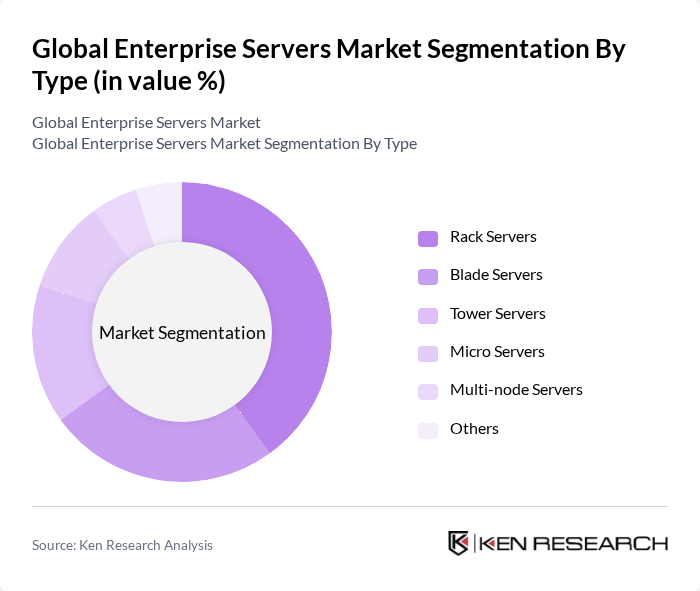
By Type:The market is segmented into various types of servers, including Rack Servers, Blade Servers, Tower Servers, Micro Servers, Multi-node Servers, and Others. Among these, Rack Servers are particularly dominant due to their space efficiency, scalability, and suitability for high-density data center environments, making them a preferred choice for enterprises optimizing IT infrastructure. Blade Servers follow closely, offering high-density computing solutions ideal for virtualization, cloud applications, and rapid deployment in modern data centers .
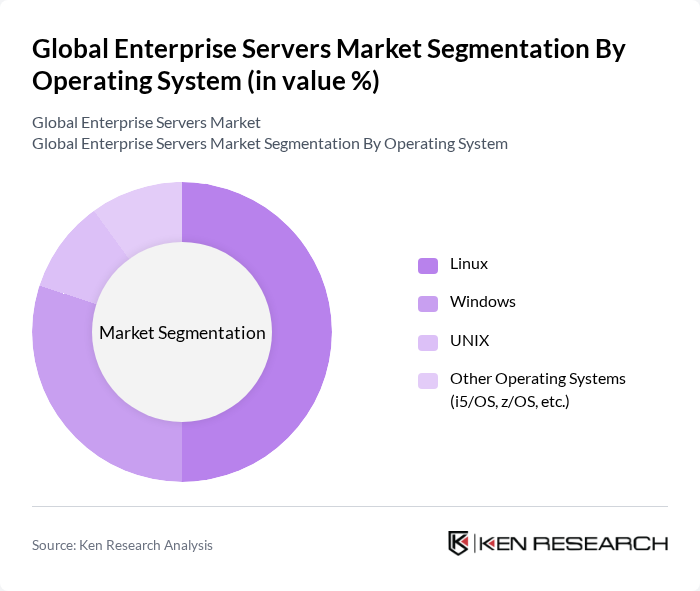
By Operating System:This segmentation includes Linux, Windows, UNIX, and Other Operating Systems (i5/OS, z/OS, etc.). Linux dominates the market due to its open-source nature, flexibility, and strong community support, making it a preferred choice for enterprises looking to customize their server environments. Windows follows closely, particularly in organizations that rely on Microsoft applications and services. UNIX and other specialized operating systems remain relevant in legacy and mission-critical environments .
The Global Enterprise Servers Market is characterized by a dynamic mix of regional and international players. Leading participants such as Dell Technologies Inc., Hewlett Packard Enterprise (HPE), IBM Corporation, Cisco Systems, Inc., Lenovo Group Limited, Fujitsu Limited, Oracle Corporation, Super Micro Computer, Inc. (Supermicro), Inspur Electronic Information Industry Co., Ltd., Huawei Technologies Co., Ltd., NEC Corporation, Hitachi, Ltd., Atos SE, Tyan Computer Corporation, ZTE Corporation, Quanta Computer Inc., Wistron Corporation, Sugon Information Industry Co., Ltd., H3C Technologies Co., Ltd., DataDirect Networks (DDN) contribute to innovation, geographic expansion, and service delivery in this space.
The future of the enterprise servers market is poised for significant transformation, driven by advancements in AI, machine learning, and edge computing technologies. As organizations increasingly adopt hybrid cloud solutions, the demand for versatile and efficient server infrastructures will rise. Additionally, the focus on energy efficiency and sustainability will shape server design and deployment strategies, encouraging innovations that align with regulatory standards and environmental goals, ultimately fostering a more resilient and adaptive market landscape.
| Segment | Sub-Segments |
|---|---|
| By Type | Rack Servers Blade Servers Tower Servers Micro Servers Multi-node Servers Others |
| By Operating System | Linux Windows UNIX Other Operating Systems (i5/OS, z/OS, etc.) |
| By Server Class | High-end Servers Mid-range Servers Volume Servers |
| By End-User Vertical | IT and Telecommunications BFSI (Banking, Financial Services, and Insurance) Manufacturing Retail Healthcare Media and Entertainment Government Others |
| By Application | Data Storage Virtualization Cloud Computing Big Data Processing AI/ML Workloads Others |
| By Distribution Channel | Direct Sales Online Retail Value-Added Resellers System Integrators Others |
| By Region | North America Europe Asia-Pacific Latin America Middle East & Africa |
| By Price Range | Low-End Servers Mid-Range Servers High-End Servers |
| By Service Type | Managed Services Professional Services Support and Maintenance |
| Scope Item/Segment | Sample Size | Target Respondent Profiles |
|---|---|---|
| Enterprise Server Deployment Strategies | 100 | IT Managers, CTOs, Infrastructure Architects |
| Cloud vs On-Premise Server Preferences | 80 | System Integrators, Cloud Service Providers |
| Data Center Operations Insights | 60 | Data Center Managers, Operations Directors |
| Server Technology Adoption Trends | 50 | IT Analysts, Research and Development Managers |
| Market Challenges and Opportunities | 60 | Business Development Managers, Product Managers |
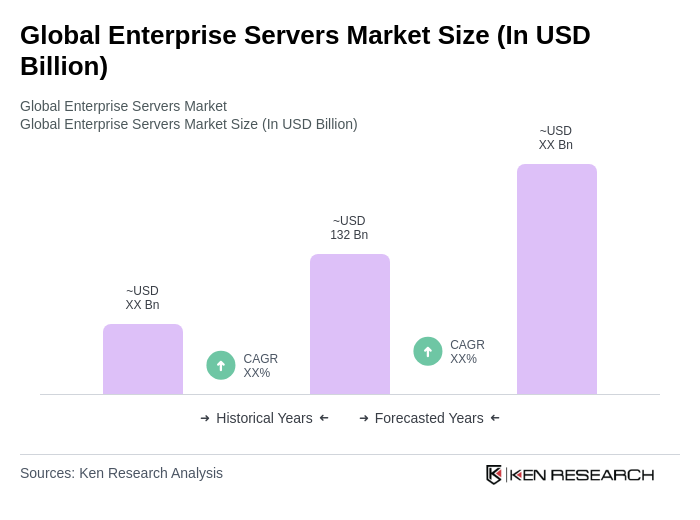
The Global Enterprise Servers Market is valued at approximately USD 132 billion, reflecting a significant growth driven by the increasing demand for data processing, cloud computing, and virtualization technologies across various industries.

What makes us stand out is that our consultants follow Robust, Refine and Result (RRR) methodology. Robust for clear definitions, approaches and sanity checking, Refine for differentiating respondents' facts and opinions, and Result for presenting data with story.

We have set a benchmark in the industry by offering our clients with syndicated and customized market research reports featuring coverage of entire market as well as meticulous research and analyst insights.

While we don't replace traditional research, we flip the method upside down. Our dual approach of Top Bottom & Bottom Top ensures quality deliverable by not just verifying company fundamentals but also looking at the sector and macroeconomic factors.

With one step in the future, our research team constantly tries to show you the bigger picture. We help with some of the tough questions you may encounter along the way: How is the industry positioned? Best marketing channel? KPI's of competitors? By aligning every element, we help maximize success.

Our report gives you instant access to the answers and sources that other companies might choose to hide. We elaborate each steps of research methodology we have used and showcase you the sample size to earn your trust.

If you need any support, we are here! We pride ourselves on universe strength, data quality, and quick, friendly, and professional service.













