About the Report
Base Year 2024Global Explosive Trace Detection Market Overview
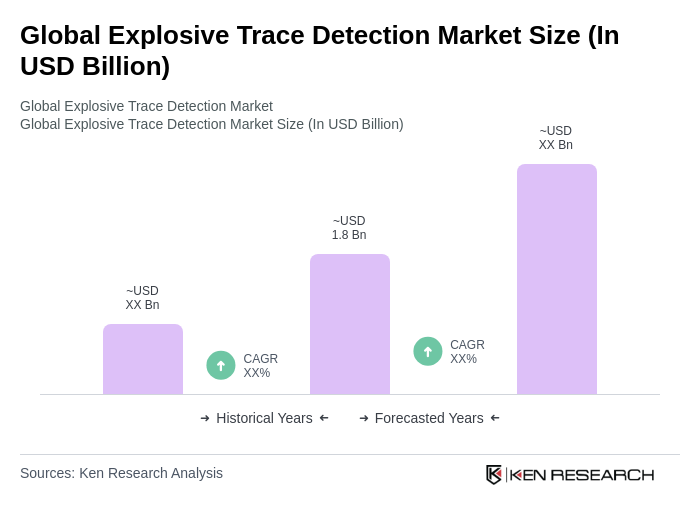
- The Global Explosive Trace Detection Market is valued at USD 1.8 billion, based on a five-year historical analysis. This growth is primarily driven by increasing global security threats, rising terrorism incidents, and the need for advanced security infrastructure in transportation and public venues. The market has seen a surge in demand for sophisticated detection systems, particularly in airports, border security, and critical infrastructure, as governments and organizations prioritize rapid, accurate, and user-friendly detection solutions .
- Key players in this market include the United States, the United Kingdom, and Germany, which dominate due to robust defense budgets, advanced technological capabilities, and stringent security regulations. The presence of leading manufacturers and a strong focus on research and development in these countries further enhance their market position, making them pivotal in the global landscape of explosive trace detection .
- In 2023, the U.S. government implemented the Transportation Security Administration (TSA) Advanced Imaging Technology (AIT) Enhancement Rule, issued by the Department of Homeland Security, requiring the integration of advanced explosive trace detection systems at airports. This regulation mandates enhanced screening protocols and compliance with updated detection standards, directly driving the adoption of innovative detection technologies across U.S. aviation security operations .
Global Explosive Trace Detection Market Segmentation
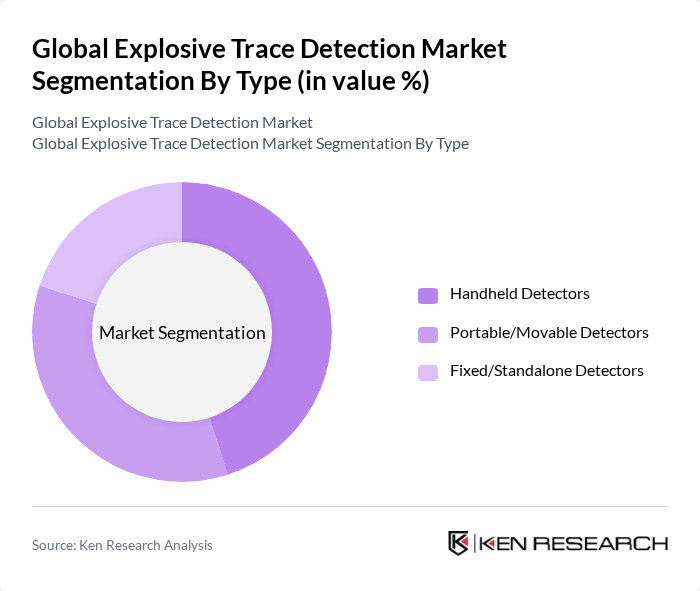
By Type:The market is segmented into Handheld Detectors, Portable/Movable Detectors, and Fixed/Standalone Detectors. Handheld detectors are increasingly adopted for their versatility, portability, and rapid deployment in diverse environments such as airports, border crossings, and military operations. Portable detectors are preferred for their mobility and ability to support emergency response and temporary security setups. Fixed detectors remain essential for continuous monitoring and high-throughput screening in permanent installations at critical infrastructure and transportation hubs .
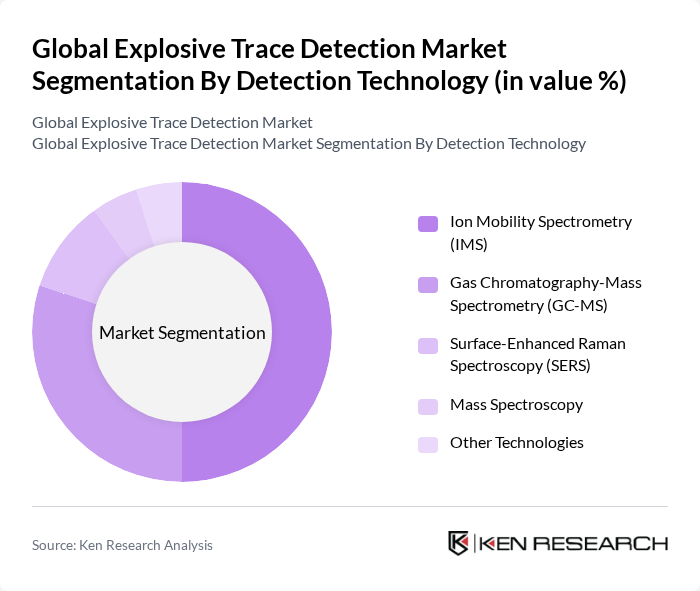
By Detection Technology:The market is categorized into Ion Mobility Spectrometry (IMS), Gas Chromatography-Mass Spectrometry (GC-MS), Surface-Enhanced Raman Spectroscopy (SERS), Mass Spectroscopy, and Other Technologies. IMS remains the leading technology due to its rapid detection speed, high sensitivity, and reliability for field and checkpoint applications. GC-MS is valued for its precision in laboratory and confirmatory analysis of explosive compounds. SERS is gaining traction for its sensitivity, compact form factor, and suitability for portable devices, while other technologies such as colorimetric and chemiluminescence methods are used for specialized applications .
Global Explosive Trace Detection Market Competitive Landscape
The Global Explosive Trace Detection Market is characterized by a dynamic mix of regional and international players. Leading participants such as Smiths Detection, L3Harris Technologies, Chemring Group PLC, Teledyne FLIR, Safran Group, Analogic Corporation, Autoclear LLC, Bruker Corporation, DetectaChem, Kromek Group PLC, Nuctech Company Limited, Westminster Group Plc, OSI Systems, Inc., American Innovations, and Leidos Holdings, Inc. contribute to innovation, geographic expansion, and service delivery in this space.
Global Explosive Trace Detection Market Industry Analysis
Growth Drivers
- Increasing Security Concerns Globally:The global rise in terrorism and violent crime has heightened security concerns, leading to increased investments in explosive trace detection systems. In future, global security spending reached approximately $2 trillion, with a significant portion allocated to advanced detection technologies. Countries like the U.S. and the UK have reported a 20% increase in budget allocations for security measures, reflecting the urgent need for effective explosive detection solutions in public spaces and transportation hubs.
- Technological Advancements in Detection Methods:The explosive trace detection market is significantly driven by technological innovations. In future, the global market for advanced detection technologies, including ion mobility spectrometry and mass spectrometry, is projected to exceed $600 million. These technologies enhance detection accuracy and speed, with systems capable of identifying trace amounts of explosives in under 8 seconds, thus improving overall security efficiency and effectiveness in various sectors.
- Rising Demand from Transportation and Logistics Sectors:The transportation and logistics sectors are increasingly adopting explosive trace detection systems to ensure safety and compliance. In future, the International Air Transport Association reported that air travel increased by 30%, necessitating enhanced security measures. Consequently, airports and shipping companies are investing heavily in detection systems, with an estimated $400 million spent on new technologies in future alone, driven by regulatory requirements and passenger safety concerns.
Market Challenges
- High Costs of Advanced Detection Systems:The implementation of advanced explosive trace detection systems often comes with high initial costs, which can deter potential buyers. For instance, the average cost of a state-of-the-art detection system can range from $120,000 to $600,000, depending on the technology. This financial barrier is particularly pronounced in emerging markets, where budget constraints limit the adoption of such critical security measures, impacting overall market growth.
- Regulatory Compliance Complexities:Navigating the regulatory landscape for explosive detection systems poses significant challenges for manufacturers and users alike. In future, compliance with international standards such as those set by the International Civil Aviation Organization (ICAO) will require substantial investments in training and system upgrades. The complexity of these regulations can lead to delays in procurement processes, hindering timely implementation and increasing operational costs for organizations seeking to enhance security measures.
Global Explosive Trace Detection Market Future Outlook
The future of the explosive trace detection market appears promising, driven by ongoing technological advancements and increasing global security concerns. As governments and private sectors prioritize safety, investments in innovative detection technologies are expected to rise. The integration of artificial intelligence and machine learning will enhance detection capabilities, making systems more efficient. Additionally, the expansion into emerging markets will provide new growth avenues, as these regions increasingly recognize the importance of robust security measures in their infrastructure development.
Market Opportunities
- Expansion in Emerging Markets:Emerging markets present significant opportunities for explosive trace detection systems. With rising urbanization and increased security threats, countries in Asia and Africa are projected to invest over $300 million in detection technologies by future. This growth is driven by government initiatives aimed at enhancing public safety and infrastructure security, creating a favorable environment for market expansion.
- Development of Portable Detection Devices:The demand for portable explosive trace detection devices is on the rise, particularly in field operations and remote locations. In future, the market for portable devices is expected to grow by $200 million, driven by their versatility and ease of use. This trend reflects a broader shift towards mobile security solutions, enabling rapid response capabilities in various security scenarios.
Scope of the Report
| Segment | Sub-Segments |
|---|---|
| By Type | Handheld Detectors Portable/Movable Detectors Fixed/Standalone Detectors |
| By Detection Technology | Ion Mobility Spectrometry (IMS) Gas Chromatography-Mass Spectrometry (GC-MS) Surface-Enhanced Raman Spectroscopy (SERS) Mass Spectroscopy Other Technologies |
| By End-User | Government & Defense Transportation & Logistics Critical Infrastructure Commercial Sector |
| By Application | Airport Security Border Security Event Security Military Operations Cargo & Freight Screening |
| By Component | Hardware Software Services |
| By Region | North America Europe Asia-Pacific Middle East & Africa Latin America |
| By Price Range | Low-End Mid-Range High-End |
Key Target Audience
Investors and Venture Capitalist Firms
Government and Regulatory Bodies (e.g., Department of Homeland Security, Federal Aviation Administration)
Manufacturers and Producers
Distributors and Retailers
Security Agencies (e.g., Transportation Security Administration, Customs and Border Protection)
Military and Defense Organizations
Airport Authorities and Operators
Law Enforcement Agencies
Players Mentioned in the Report:
Smiths Detection
L3Harris Technologies
Chemring Group PLC
Teledyne FLIR
Safran Group
Analogic Corporation
Autoclear LLC
Bruker Corporation
DetectaChem
Kromek Group PLC
Nuctech Company Limited
Westminster Group Plc
OSI Systems, Inc.
American Innovations
Leidos Holdings, Inc.
Table of Contents
Market Assessment Phase
1. Executive Summary and Approach
2. Global Explosive Trace Detection Market Overview
2.1 Key Insights and Strategic Recommendations
2.2 Global Explosive Trace Detection Market Overview
2.3 Definition and Scope
2.4 Evolution of Market Ecosystem
2.5 Timeline of Key Regulatory Milestones
2.6 Value Chain & Stakeholder Mapping
2.7 Business Cycle Analysis
2.8 Policy & Incentive Landscape
3. Global Explosive Trace Detection Market Analysis
3.1 Growth Drivers
3.1.1 Increasing security concerns globally
3.1.2 Technological advancements in detection methods
3.1.3 Rising demand from transportation and logistics sectors
3.1.4 Government initiatives for public safety
3.2 Market Challenges
3.2.1 High costs of advanced detection systems
3.2.2 Regulatory compliance complexities
3.2.3 Limited awareness in emerging markets
3.2.4 Competition from alternative security measures
3.3 Market Opportunities
3.3.1 Expansion in emerging markets
3.3.2 Development of portable detection devices
3.3.3 Integration with AI and machine learning technologies
3.3.4 Partnerships with government agencies
3.4 Market Trends
3.4.1 Increasing automation in security processes
3.4.2 Growing focus on cybersecurity in detection systems
3.4.3 Shift towards multi-threat detection capabilities
3.4.4 Rising investments in R&D for innovative solutions
3.5 Government Regulation
3.5.1 International standards for explosive detection
3.5.2 National security policies impacting procurement
3.5.3 Compliance requirements for manufacturers
3.5.4 Funding programs for security enhancements
4. SWOT Analysis
5. Stakeholder Analysis
6. Porter's Five Forces Analysis
7. Global Explosive Trace Detection Market Market Size, 2019-2024
7.1 By Value
7.2 By Volume
7.3 By Average Selling Price
8. Global Explosive Trace Detection Market Segmentation
8.1 By Type
8.1.1 Handheld Detectors
8.1.2 Portable/Movable Detectors
8.1.3 Fixed/Standalone Detectors
8.2 By Detection Technology
8.2.1 Ion Mobility Spectrometry (IMS)
8.2.2 Gas Chromatography-Mass Spectrometry (GC-MS)
8.2.3 Surface-Enhanced Raman Spectroscopy (SERS)
8.2.4 Mass Spectroscopy
8.2.5 Other Technologies
8.3 By End-User
8.3.1 Government & Defense
8.3.2 Transportation & Logistics
8.3.3 Critical Infrastructure
8.3.4 Commercial Sector
8.4 By Application
8.4.1 Airport Security
8.4.2 Border Security
8.4.3 Event Security
8.4.4 Military Operations
8.4.5 Cargo & Freight Screening
8.5 By Component
8.5.1 Hardware
8.5.2 Software
8.5.3 Services
8.6 By Region
8.6.1 North America
8.6.2 Europe
8.6.3 Asia-Pacific
8.6.4 Middle East & Africa
8.6.5 Latin America
8.7 By Price Range
8.7.1 Low-End
8.7.2 Mid-Range
8.7.3 High-End
9. Global Explosive Trace Detection Market Competitive Analysis
9.1 Market Share of Key Players
9.2 Cross Comparison of Key Players
9.2.1 Company Name
9.2.2 Company Size (Large, Medium, Small)
9.2.3 Revenue (USD Million)
9.2.4 Revenue Growth Rate (%)
9.2.5 Market Share (%)
9.2.6 Geographic Presence (Number of Countries/Regions)
9.2.7 R&D Expenditure (% of Revenue)
9.2.8 Product Portfolio Breadth (Number of ETD Products)
9.2.9 Number of Patents/Intellectual Property Assets
9.2.10 Major End-User Segments Served
9.2.11 Recent Key Contracts/Awards
9.2.12 Customer Satisfaction Score (NPS or Equivalent)
9.3 SWOT Analysis of Top Players
9.4 Pricing Analysis
9.5 Detailed Profile of Major Companies
9.5.1 Smiths Detection
9.5.2 L3Harris Technologies
9.5.3 Chemring Group PLC
9.5.4 Teledyne FLIR
9.5.5 Safran Group
9.5.6 Analogic Corporation
9.5.7 Autoclear LLC
9.5.8 Bruker Corporation
9.5.9 DetectaChem
9.5.10 Kromek Group PLC
9.5.11 Nuctech Company Limited
9.5.12 Westminster Group Plc
9.5.13 OSI Systems, Inc.
9.5.14 American Innovations
9.5.15 Leidos Holdings, Inc.
10. Global Explosive Trace Detection Market End-User Analysis
10.1 Procurement Behavior of Key Ministries
10.1.1 Defense Ministry
10.1.2 Transportation Ministry
10.1.3 Homeland Security Ministry
10.2 Corporate Spend on Infrastructure & Energy
10.2.1 Investment in Security Infrastructure
10.2.2 Budget Allocation for Technology Upgrades
10.3 Pain Point Analysis by End-User Category
10.3.1 Government Agencies
10.3.2 Private Sector Companies
10.4 User Readiness for Adoption
10.4.1 Awareness of Explosive Detection Technologies
10.4.2 Training and Support Needs
10.5 Post-Deployment ROI and Use Case Expansion
10.5.1 Measurement of Effectiveness
10.5.2 Opportunities for System Upgrades
11. Global Explosive Trace Detection Market Future Size, 2025-2030
11.1 By Value
11.2 By Volume
11.3 By Average Selling Price
Go-To-Market Strategy Phase
1. Whitespace Analysis + Business Model Canvas
1.1 Market Gaps Identification
1.2 Value Proposition Development
1.3 Revenue Streams Analysis
1.4 Cost Structure Evaluation
1.5 Key Partnerships Exploration
1.6 Customer Segmentation
1.7 Channels of Distribution
2. Marketing and Positioning Recommendations
2.1 Branding Strategies
2.2 Product USPs
3. Distribution Plan
3.1 Urban Retail vs Rural NGO Tie-ups
4. Channel & Pricing Gaps
4.1 Underserved Routes
4.2 Pricing Bands
5. Unmet Demand & Latent Needs
5.1 Category Gaps
5.2 Consumer Segments
6. Customer Relationship
6.1 Loyalty Programs
6.2 After-Sales Service
7. Value Proposition
7.1 Sustainability
7.2 Integrated Supply Chains
8. Key Activities
8.1 Regulatory Compliance
8.2 Branding
8.3 Distribution Setup
9. Entry Strategy Evaluation
9.1 Domestic Market Entry Strategy
9.1.1 Product Mix
9.1.2 Pricing Band
9.1.3 Packaging
9.2 Export Entry Strategy
9.2.1 Target Countries
9.2.2 Compliance Roadmap
10. Entry Mode Assessment
10.1 JV
10.2 Greenfield
10.3 M&A
10.4 Distributor Model
11. Capital and Timeline Estimation
11.1 Capital Requirements
11.2 Timelines
12. Control vs Risk Trade-Off
12.1 Ownership vs Partnerships
13. Profitability Outlook
13.1 Breakeven Analysis
13.2 Long-Term Sustainability
14. Potential Partner List
14.1 Distributors
14.2 JVs
14.3 Acquisition Targets
15. Execution Roadmap
15.1 Phased Plan for Market Entry
15.1.1 Market Setup
15.1.2 Market Entry
15.1.3 Growth Acceleration
15.1.4 Scale & Stabilize
15.2 Key Activities and Milestones
15.2.1 Activity Planning
15.2.2 Milestone Tracking
Research Methodology
Phase 1: Approach1
Desk Research
- Analysis of market reports from industry associations such as the International Society for Explosive Detection
- Review of government publications and regulations related to explosive trace detection technologies
- Examination of academic journals and white papers focusing on advancements in detection methodologies
Primary Research
- Interviews with key stakeholders in law enforcement and security agencies utilizing explosive trace detection systems
- Surveys conducted with manufacturers of explosive detection equipment to gather insights on market trends
- Field interviews with end-users in airports and border security to understand operational challenges and needs
Validation & Triangulation
- Cross-validation of findings through multiple data sources including trade publications and expert opinions
- Triangulation of market data with insights from industry conferences and symposiums
- Sanity checks through expert panel reviews comprising industry veterans and academic researchers
Phase 2: Market Size Estimation1
Top-down Assessment
- Estimation of the global market size based on defense and security budgets allocated to explosive detection
- Segmentation of the market by application areas such as aviation security, military, and public safety
- Incorporation of growth rates from emerging markets and technological advancements in detection systems
Bottom-up Modeling
- Collection of sales data from leading manufacturers of explosive trace detection equipment
- Estimation of unit sales based on historical data and projected demand in various sectors
- Cost analysis of equipment and operational expenses to derive market value
Forecasting & Scenario Analysis
- Multi-factor regression analysis incorporating factors such as terrorism threats and regulatory changes
- Scenario modeling based on potential shifts in government spending and technological innovations
- Development of baseline, optimistic, and pessimistic forecasts through 2030
Phase 3: CATI Sample Composition1
| Scope Item/Segment | Sample Size | Target Respondent Profiles |
|---|---|---|
| Aviation Security Systems | 100 | Airport Security Managers, Aviation Safety Officers |
| Military Applications | 80 | Defense Procurement Officers, Military Technology Specialists |
| Public Safety Initiatives | 70 | City Security Coordinators, Emergency Response Managers |
| Research and Development in Detection Technologies | 50 | R&D Managers, Product Development Engineers |
| Regulatory Compliance and Standards | 40 | Compliance Officers, Regulatory Affairs Specialists |
Frequently Asked Questions
What is the current value of the Global Explosive Trace Detection Market?
The Global Explosive Trace Detection Market is valued at approximately USD 1.8 billion, reflecting a significant increase driven by rising global security threats and the demand for advanced detection systems in various sectors, including transportation and public venues.
What factors are driving the growth of the Global Explosive Trace Detection Market?
Which countries dominate the Global Explosive Trace Detection Market?
What are the main types of explosive trace detection systems?
Other Regional/Country Reports
Indonesia Explosive Trace Detection Market
Malaysia Explosive Trace Detection Market
APAC Explosive Trace Detection Market
Other Adjacent Reports
South Korea Security Screening Systems Market
UAE Bomb Detection Equipment Market
KSA Narcotics Trace Detection Market
KSA Chemical Detection Systems Market
UAE Radiation Detection Market
Philippines Aviation Security Market
Middle East Border Security Market Report Size, Share, Growth Drivers, Trends, Opportunities & Forecast 2025–2030Mexico Critical Infrastructure Protection Market
Qatar Homeland Security Market Size, Share, Growth Drivers, Trends, Opportunities & Forecast 2025–2030Indonesia Forensic Analysis Equipment Market
Why Buy From Us?

What makes us stand out is that our consultants follow Robust, Refine and Result (RRR) methodology. Robust for clear definitions, approaches and sanity checking, Refine for differentiating respondents' facts and opinions, and Result for presenting data with story.

We have set a benchmark in the industry by offering our clients with syndicated and customized market research reports featuring coverage of entire market as well as meticulous research and analyst insights.

While we don't replace traditional research, we flip the method upside down. Our dual approach of Top Bottom & Bottom Top ensures quality deliverable by not just verifying company fundamentals but also looking at the sector and macroeconomic factors.

With one step in the future, our research team constantly tries to show you the bigger picture. We help with some of the tough questions you may encounter along the way: How is the industry positioned? Best marketing channel? KPI's of competitors? By aligning every element, we help maximize success.

Our report gives you instant access to the answers and sources that other companies might choose to hide. We elaborate each steps of research methodology we have used and showcase you the sample size to earn your trust.

If you need any support, we are here! We pride ourselves on universe strength, data quality, and quick, friendly, and professional service.