Global Generic Pharmaceutical Contract Manufacturing Market Report Size, Share, Growth Drivers, Trends, Opportunities & Forecast 2025–2030

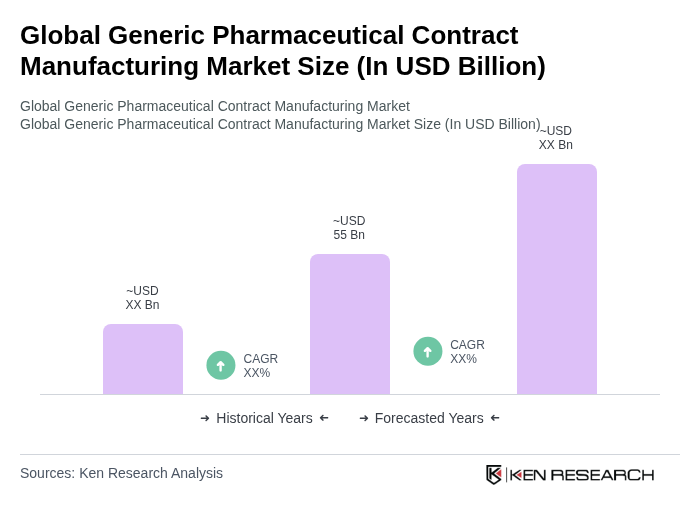
The global generic pharmaceutical contract manufacturing market, valued at USD 55 billion, is growing due to rising demand for cost-effective drugs, technological advancements, and expansion in emerging markets.

Region:Global

Author(s):Dev

Product Code:KRAD1596

Pages:94

Published On:November 2025
About the Report

Base Year 2024

Global Generic Pharmaceutical Contract Manufacturing Market Overview

  • The Global Generic Pharmaceutical Contract Manufacturing Market is valued at USD 55 billion, based on a five-year historical analysis. This growth is primarily driven by the increasing demand for affordable medications, the rise of chronic diseases, and the expansion of healthcare access in emerging markets. The market is also supported by the growing trend of outsourcing manufacturing processes by pharmaceutical companies to reduce costs and enhance efficiency.
  • Key players in this market are predominantly located in North America, Europe, and Asia-Pacific. The United States leads due to its advanced healthcare infrastructure, significant investment in R&D, and a large number of pharmaceutical companies. India and China are also crucial players, benefiting from lower production costs, a robust manufacturing ecosystem, and a rapidly expanding domestic market for generics. The Asia-Pacific region is experiencing accelerated growth as global pharmaceutical companies increasingly outsource production to leverage cost advantages and local expertise.
  • In 2023, the U.S. Food and Drug Administration (FDA) implemented the “Generic Drug User Fee Amendments Reauthorization Act of 2022” (GDUFA III), which introduced enhanced requirements for quality, safety, and documentation in generic drug applications. This regulation mandates more rigorous testing, comprehensive data submissions, and periodic facility inspections to ensure that generic drugs meet the same standards as branded products. These measures are designed to strengthen consumer confidence and elevate the quality of generic pharmaceuticals in the market.
Global Generic Pharmaceutical Contract Manufacturing Market Size

Global Generic Pharmaceutical Contract Manufacturing Market Segmentation

By Type of Manufacturing Service:The market is segmented into various types of manufacturing services, including Active Pharmaceutical Ingredient (API) Manufacturing, Oral Solid Dosage Forms, Sterile Injectable Manufacturing, Topical and Semi-Solid Formulations, and Liquid and Suspension Formulations. Among these, API manufacturing is currently the leading segment due to the increasing demand for raw materials in drug production. The trend towards complex generics, personalized medicine, and biologics is also driving growth in this segment as pharmaceutical companies seek specialized manufacturing expertise and regulatory compliance.
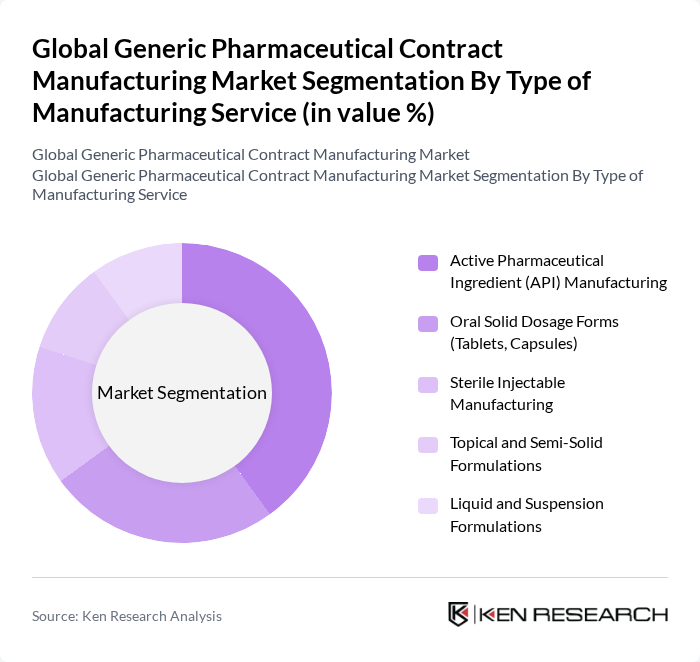
Global Generic Pharmaceutical Contract Manufacturing Market segmentation by Type of Manufacturing Service.

By End-User/Customer Type:The market is categorized into Pharmaceutical Companies, Biotech Firms, Generic Drug Manufacturers, and Contract Development and Manufacturing Organizations (CDMOs). Pharmaceutical companies dominate this segment as they increasingly outsource manufacturing to focus on core competencies such as research and development. This trend is further fueled by the need for cost efficiency, the ability to scale production without significant capital investment, and the growing complexity of drug formulations requiring specialized manufacturing capabilities.
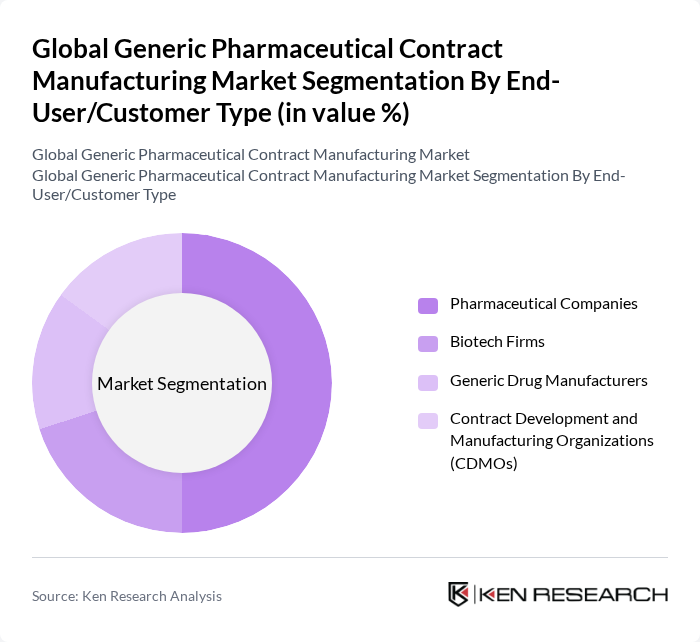
Global Generic Pharmaceutical Contract Manufacturing Market segmentation by End-User/Customer Type.

Global Generic Pharmaceutical Contract Manufacturing Market Competitive Landscape

The Global Generic Pharmaceutical Contract Manufacturing Market is characterized by a dynamic mix of regional and international players. Leading participants such as Teva Pharmaceutical Industries Ltd., Viatris Inc. (formerly Mylan N.V.), Sandoz International GmbH, Sun Pharmaceutical Industries Ltd., Aurobindo Pharma Ltd., Cipla Ltd., Dr. Reddy's Laboratories Ltd., Fresenius Kabi AG, Hikma Pharmaceuticals PLC, Zydus Lifesciences Ltd., Lupin Limited, Perrigo Company plc, Catalent, Inc., Recro Pharma, Inc., and Evonik Industries AG contribute to innovation, geographic expansion, and service delivery in this space. These companies are expanding their service portfolios, investing in advanced manufacturing technologies, and strengthening regulatory compliance to meet the evolving needs of the global generic pharmaceutical sector.

Teva Pharmaceutical Industries Ltd.

1901

Petah Tikva, Israel

Viatris Inc.

2020

Pittsburgh, Pennsylvania, USA

Sandoz International GmbH

2003

Holzkirchen, Germany

Sun Pharmaceutical Industries Ltd.

1993

Mumbai, India

Aurobindo Pharma Ltd.

1986

Hyderabad, India

Company

Establishment Year

Headquarters

Company Size Classification (Large, Mid-Tier, or Specialized)

Revenue and CAGR (2024-2025)

Geographic Market Presence

Manufacturing Capacity and Utilization Rate

Regulatory Certifications (FDA, EMA, WHO-GMP)

Cost Competitiveness and Pricing Model

Global Generic Pharmaceutical Contract Manufacturing Market Industry Analysis

Growth Drivers

  • Increasing Demand for Cost-Effective Medications:The global healthcare expenditure is projected to reach $12 trillion, driving the demand for affordable medications. In future, generic drugs accounted for approximately 89% of all prescriptions in the U.S., highlighting a significant shift towards cost-effective alternatives. This trend is further supported by the rising out-of-pocket costs for patients, which reached an average of $1,500 annually, prompting healthcare providers to seek more economical solutions in pharmaceuticals.
  • Rise in Chronic Diseases:The World Health Organization reported that chronic diseases are responsible for 74% of global deaths, with projections indicating that in future, over 1.7 billion people will be living with chronic conditions. This surge in chronic disease prevalence is increasing the demand for long-term medication solutions, particularly generics, which are more affordable. The growing patient population necessitates a robust supply of generic pharmaceuticals to manage these conditions effectively.
  • Technological Advancements in Manufacturing:The pharmaceutical manufacturing sector is experiencing rapid technological advancements, with investments in automation and AI expected to exceed $3 billion. These innovations enhance production efficiency and reduce costs, making it easier for contract manufacturers to produce high-quality generics. Additionally, the integration of digital technologies is streamlining operations, allowing for faster response times to market demands and improved product quality, which is crucial for maintaining competitiveness.

Market Challenges

  • Regulatory Compliance Issues:The generic pharmaceutical industry faces stringent regulatory requirements, with compliance costs averaging around $2 million per product. In future, the FDA is expected to increase inspections, which could lead to higher operational costs for manufacturers. Non-compliance can result in significant penalties and product recalls, creating a challenging environment for contract manufacturers who must navigate complex regulations while maintaining profitability.
  • Intense Competition:The generic pharmaceutical market is characterized by fierce competition, with over 1,800 companies vying for market share. This saturation leads to price wars, significantly impacting profit margins. In future, the average price of generic drugs fell by 8%, further squeezing manufacturers. As companies strive to differentiate themselves, the pressure to innovate and reduce costs intensifies, posing a significant challenge to sustaining profitability in this competitive landscape.

Global Generic Pharmaceutical Contract Manufacturing Market Future Outlook

The future of the generic pharmaceutical contract manufacturing market appears promising, driven by the increasing demand for affordable medications and the rise of chronic diseases. As manufacturers adopt advanced technologies, operational efficiencies will improve, enabling quicker responses to market needs. Additionally, the expansion into emerging markets will provide new growth avenues. Companies that prioritize strategic partnerships and invest in research and development will likely lead the way in innovation and sustainability, positioning themselves favorably in the evolving landscape.

Market Opportunities

  • Expansion into Emerging Markets:Emerging markets are projected to grow at a rate of 14% annually, presenting significant opportunities for generic manufacturers. Countries like India and Brazil are increasing their healthcare spending, which is expected to reach $600 billion. This growth creates a demand for affordable generics, allowing manufacturers to tap into new customer bases and enhance their market presence.
  • Strategic Partnerships and Collaborations:Collaborations between generic manufacturers and biotech firms are on the rise, with over 35 partnerships formed in future alone. These alliances facilitate access to innovative technologies and new drug formulations, enhancing product offerings. By leveraging shared resources and expertise, companies can accelerate their development timelines and improve their competitive positioning in the market.

Scope of the Report

SegmentSub-Segments
By Type of Manufacturing Service

Active Pharmaceutical Ingredient (API) Manufacturing

Oral Solid Dosage Forms (Tablets, Capsules)

Sterile Injectable Manufacturing

Topical and Semi-Solid Formulations

Liquid and Suspension Formulations

By End-User/Customer Type

Pharmaceutical Companies

Biotech Firms

Generic Drug Manufacturers

Contract Development and Manufacturing Organizations (CDMOs)

By Therapeutic Area

Cardiovascular Diseases

Oncology

Infectious Diseases

Respiratory Disorders

Gastrointestinal Disorders

By Region

North America

Europe

Asia-Pacific

Latin America

Middle East & Africa

By Manufacturing Process Technology

Batch Manufacturing

Continuous Manufacturing

Automated Manufacturing Systems

By Scale of Operations

Small-Scale Manufacturing

Mid-Scale Manufacturing

Large-Scale Manufacturing

By Regulatory Compliance Level

FDA-Compliant Facilities

EMA-Compliant Facilities

WHO-GMP Certified Facilities

Key Target Audience

Investors and Venture Capitalist Firms

Government and Regulatory Bodies (e.g., Food and Drug Administration, European Medicines Agency)

Pharmaceutical Manufacturers

Contract Manufacturing Organizations (CMOs)

Supply Chain Management Firms

Pharmaceutical Wholesalers

Industry Associations (e.g., Generic Pharmaceutical Association)

Healthcare Providers and Institutions

Players Mentioned in the Report:

Teva Pharmaceutical Industries Ltd.

Viatris Inc. (formerly Mylan N.V.)

Sandoz International GmbH

Sun Pharmaceutical Industries Ltd.

Aurobindo Pharma Ltd.

Cipla Ltd.

Dr. Reddy's Laboratories Ltd.

Fresenius Kabi AG

Hikma Pharmaceuticals PLC

Zydus Lifesciences Ltd.

Lupin Limited

Perrigo Company plc

Catalent, Inc.

Recro Pharma, Inc.

Evonik Industries AG

Table of Contents

Market Assessment Phase

1. Executive Summary and Approach


2. Global Generic Pharmaceutical Contract Manufacturing Market Overview

2.1 Key Insights and Strategic Recommendations

2.2 Global Generic Pharmaceutical Contract Manufacturing Market Overview

2.3 Definition and Scope

2.4 Evolution of Market Ecosystem

2.5 Timeline of Key Regulatory Milestones

2.6 Value Chain & Stakeholder Mapping

2.7 Business Cycle Analysis

2.8 Policy & Incentive Landscape


3. Global Generic Pharmaceutical Contract Manufacturing Market Analysis

3.1 Growth Drivers

3.1.1 Increasing Demand for Cost-Effective Medications
3.1.2 Rise in Chronic Diseases
3.1.3 Expanding Generic Drug Approvals
3.1.4 Technological Advancements in Manufacturing

3.2 Market Challenges

3.2.1 Regulatory Compliance Issues
3.2.2 Intense Competition
3.2.3 Supply Chain Disruptions
3.2.4 Quality Control Concerns

3.3 Market Opportunities

3.3.1 Expansion into Emerging Markets
3.3.2 Strategic Partnerships and Collaborations
3.3.3 Investment in R&D for New Formulations
3.3.4 Adoption of Sustainable Practices

3.4 Market Trends

3.4.1 Increasing Outsourcing of Manufacturing
3.4.2 Growth of Biologics and Biosimilars
3.4.3 Digital Transformation in Manufacturing Processes
3.4.4 Focus on Patient-Centric Drug Development

3.5 Government Regulation

3.5.1 FDA Guidelines for Generic Drugs
3.5.2 EU Regulations on Pharmaceutical Manufacturing
3.5.3 Compliance with Good Manufacturing Practices (GMP)
3.5.4 Intellectual Property Rights Enforcement

4. SWOT Analysis


5. Stakeholder Analysis


6. Porter's Five Forces Analysis


7. Global Generic Pharmaceutical Contract Manufacturing Market Size, 2019-2024

7.1 By Value

7.2 By Volume

7.3 By Average Selling Price


8. Global Generic Pharmaceutical Contract Manufacturing Market Segmentation

8.1 By Type of Manufacturing Service

8.1.1 Active Pharmaceutical Ingredient (API) Manufacturing
8.1.2 Oral Solid Dosage Forms (Tablets, Capsules)
8.1.3 Sterile Injectable Manufacturing
8.1.4 Topical and Semi-Solid Formulations
8.1.5 Liquid and Suspension Formulations

8.2 By End-User/Customer Type

8.2.1 Pharmaceutical Companies
8.2.2 Biotech Firms
8.2.3 Generic Drug Manufacturers
8.2.4 Contract Development and Manufacturing Organizations (CDMOs)

8.3 By Therapeutic Area

8.3.1 Cardiovascular Diseases
8.3.2 Oncology
8.3.3 Infectious Diseases
8.3.4 Respiratory Disorders
8.3.5 Gastrointestinal Disorders

8.4 By Region

8.4.1 North America
8.4.2 Europe
8.4.3 Asia-Pacific
8.4.4 Latin America
8.4.5 Middle East & Africa

8.5 By Manufacturing Process Technology

8.5.1 Batch Manufacturing
8.5.2 Continuous Manufacturing
8.5.3 Automated Manufacturing Systems

8.6 By Scale of Operations

8.6.1 Small-Scale Manufacturing
8.6.2 Mid-Scale Manufacturing
8.6.3 Large-Scale Manufacturing

8.7 By Regulatory Compliance Level

8.7.1 FDA-Compliant Facilities
8.7.2 EMA-Compliant Facilities
8.7.3 WHO-GMP Certified Facilities

9. Global Generic Pharmaceutical Contract Manufacturing Market Competitive Analysis

9.1 Market Share of Key Players

9.2 Cross Comparison of Key Players

9.2.1 Company Name
9.2.2 Company Size Classification (Large, Mid-Tier, or Specialized)
9.2.3 Revenue and CAGR (2024-2025)
9.2.4 Geographic Market Presence
9.2.5 Manufacturing Capacity and Utilization Rate
9.2.6 Regulatory Certifications (FDA, EMA, WHO-GMP)
9.2.7 Cost Competitiveness and Pricing Model
9.2.8 Quality Metrics and Defect Rates
9.2.9 R&D Investment and Innovation Pipeline
9.2.10 Supply Chain Resilience and Lead Times

9.3 SWOT Analysis of Top Players

9.4 Pricing Analysis

9.5 Detailed Profile of Major Companies

9.5.1 Teva Pharmaceutical Industries Ltd.
9.5.2 Viatris Inc. (formerly Mylan N.V.)
9.5.3 Sandoz International GmbH
9.5.4 Sun Pharmaceutical Industries Ltd.
9.5.5 Aurobindo Pharma Ltd.
9.5.6 Cipla Ltd.
9.5.7 Dr. Reddy's Laboratories Ltd.
9.5.8 Fresenius Kabi AG
9.5.9 Hikma Pharmaceuticals PLC
9.5.10 Zydus Lifesciences Ltd.
9.5.11 Lupin Limited
9.5.12 Perrigo Company plc
9.5.13 Catalent, Inc.
9.5.14 Recro Pharma, Inc.
9.5.15 Evonik Industries AG

10. Global Generic Pharmaceutical Contract Manufacturing Market End-User Analysis

10.1 Procurement Behavior of Pharmaceutical Companies

10.1.1 Budget Allocation Trends
10.1.2 Supplier Selection Criteria
10.1.3 Contract Negotiation Practices
10.1.4 Long-term Partnership Preferences

10.2 Corporate Spend on Manufacturing Infrastructure

10.2.1 Capital Investment Trends
10.2.2 Operational Cost Management
10.2.3 Technology Upgrade Initiatives
10.2.4 Sustainability and Compliance Investments

10.3 Pain Point Analysis by Customer Category

10.3.1 Supply Chain Reliability and Lead Times
10.3.2 Quality Assurance and Regulatory Compliance
10.3.3 Cost Pressures and Pricing Negotiations
10.3.4 Capacity Constraints and Scalability

10.4 Customer Readiness for Advanced Manufacturing Solutions

10.4.1 Adoption of Continuous Manufacturing Technologies
10.4.2 Digital Integration and Data Management
10.4.3 Change Management and Training Requirements
10.4.4 Risk Assessment and Mitigation Strategies

10.5 Post-Engagement Performance and Expansion

10.5.1 On-Time Delivery and Quality Metrics
10.5.2 Customer Satisfaction and Retention Rates
10.5.3 Capacity Expansion Opportunities
10.5.4 Strategic Growth and New Product Development

11. Global Generic Pharmaceutical Contract Manufacturing Market Future Size, 2025-2030

11.1 By Value

11.2 By Volume

11.3 By Average Selling Price


Go-To-Market Strategy Phase

1. Whitespace Analysis + Business Model Canvas

1.1 Market Gaps Identification

1.2 Value Proposition Development

1.3 Revenue Model Exploration

1.4 Customer Segmentation

1.5 Competitive Landscape Analysis

1.6 Key Partnerships

1.7 Cost Structure Analysis


2. Marketing and Positioning Recommendations

2.1 Branding Strategies

2.2 Product USPs

2.3 Target Audience Identification

2.4 Communication Strategy

2.5 Digital Marketing Tactics

2.6 Market Penetration Strategies

2.7 Performance Metrics


3. Distribution Plan

3.1 Urban Retail Strategies

3.2 Rural NGO Tie-ups

3.3 E-commerce Integration

3.4 Direct Sales Approaches

3.5 Distribution Partnerships

3.6 Logistics Management

3.7 Performance Tracking


4. Channel & Pricing Gaps

4.1 Underserved Routes

4.2 Pricing Bands Analysis

4.3 Competitor Pricing Strategies

4.4 Customer Willingness to Pay

4.5 Value-Based Pricing Models

4.6 Price Sensitivity Analysis

4.7 Pricing Strategy Recommendations


5. Unmet Demand & Latent Needs

5.1 Category Gaps

5.2 Consumer Segments Analysis

5.3 Product Development Opportunities

5.4 Market Entry Strategies

5.5 Customer Feedback Integration

5.6 Future Trends Exploration

5.7 Performance Metrics


6. Customer Relationship

6.1 Loyalty Programs

6.2 After-sales Service

6.3 Customer Engagement Strategies

6.4 Feedback Mechanisms

6.5 Relationship Management Tools

6.6 Performance Metrics


7. Value Proposition

7.1 Sustainability Initiatives

7.2 Integrated Supply Chains

7.3 Customer-Centric Approaches

7.4 Competitive Differentiation

7.5 Value Communication Strategies

7.6 Performance Metrics


8. Key Activities

8.1 Regulatory Compliance

8.2 Branding Initiatives

8.3 Distribution Setup

8.4 Market Research Activities

8.5 Training and Development

8.6 Performance Metrics


9. Entry Strategy Evaluation

9.1 Domestic Market Entry Strategy

9.1.1 Product Mix

Research Methodology

ApproachModellingSample

Phase 1: Approach1

Desk Research

  • Analysis of industry reports from pharmaceutical associations and market research firms
  • Review of regulatory frameworks and guidelines from health authorities such as the FDA and EMA
  • Examination of published financial reports and press releases from leading generic pharmaceutical companies

Primary Research

  • Interviews with executives from contract manufacturing organizations (CMOs) specializing in generics
  • Surveys targeting procurement managers in pharmaceutical companies to understand outsourcing trends
  • Field interviews with quality assurance professionals to assess compliance and operational challenges

Validation & Triangulation

  • Cross-validation of data through multiple sources including trade publications and market analytics
  • Triangulation of insights from primary interviews with secondary data findings
  • Sanity checks conducted through expert panels comprising industry veterans and analysts

Phase 2: Market Size Estimation1

Top-down Assessment

  • Estimation of market size based on global pharmaceutical spending and growth rates in generics
  • Segmentation analysis by therapeutic areas and geographical regions
  • Incorporation of trends in healthcare policies promoting generic drug usage

Bottom-up Modeling

  • Volume estimates derived from production capacities of key contract manufacturers
  • Cost analysis based on pricing models of generic drugs and manufacturing expenses
  • Aggregation of data from various CMOs to establish a comprehensive market overview

Forecasting & Scenario Analysis

  • Multi-variable regression analysis incorporating factors such as patent expirations and market entry of biosimilars
  • Scenario modeling based on potential regulatory changes and shifts in healthcare spending
  • Development of baseline, optimistic, and pessimistic forecasts through 2030

Phase 3: CATI Sample Composition1

Scope Item/SegmentSample SizeTarget Respondent Profiles
Generic Drug Manufacturing100Operations Managers, Production Supervisors
Contract Manufacturing Services60Business Development Managers, Sales Directors
Quality Control in Generics50Quality Assurance Managers, Compliance Officers
Regulatory Affairs in Pharmaceuticals40Regulatory Affairs Specialists, Legal Advisors
Market Access Strategies45Market Access Managers, Health Economists

Frequently Asked Questions

What is the current value of the Global Generic Pharmaceutical Contract Manufacturing Market?

The Global Generic Pharmaceutical Contract Manufacturing Market is valued at approximately USD 55 billion, driven by the increasing demand for affordable medications and the rise of chronic diseases, alongside the trend of outsourcing manufacturing processes by pharmaceutical companies.

What factors are driving the growth of the Generic Pharmaceutical Contract Manufacturing Market?

Which regions are leading in the Generic Pharmaceutical Contract Manufacturing Market?

What are the main types of manufacturing services in this market?

Other Regional/Country Reports

Indonesia Generic Pharmaceutical Contract Manufacturing Market

Malaysia Generic Pharmaceutical Contract Manufacturing Market

KSA Generic Pharmaceutical Contract Manufacturing Market

APAC Generic Pharmaceutical Contract Manufacturing Market

SEA Generic Pharmaceutical Contract Manufacturing Market

Vietnam Generic Pharmaceutical Contract Manufacturing Market

Other Adjacent Reports

South Africa Active Pharmaceutical Ingredient Manufacturing Market

Bahrain Finished Dosage Form Manufacturing Market

Qatar Biopharmaceutical Contract Manufacturing Market

Middle East pharmaceutical packaging market size, share, growth drivers, trends, opportunities & forecast 2025–2030

Qatar Drug Development Services Market

Kuwait biosimilars market Size, Share, Growth Drivers, Trends, Opportunities & Forecast 2025–2030

Vietnam Generic Drugs Distribution Market

Oman Pharmaceutical Supply Chain Management Market

Japan Regulatory Compliance Services Market

Thailand Pharmaceutical Quality Assurance Market

Why Buy From Us?

Refine Robust Result (RRR) Framework

What makes us stand out is that our consultants follow Robust, Refine and Result (RRR) methodology. Robust for clear definitions, approaches and sanity checking, Refine for differentiating respondents' facts and opinions, and Result for presenting data with story.

Our Reach Is Unmatched

We have set a benchmark in the industry by offering our clients with syndicated and customized market research reports featuring coverage of entire market as well as meticulous research and analyst insights.

Shifting the Research Paradigm

While we don't replace traditional research, we flip the method upside down. Our dual approach of Top Bottom & Bottom Top ensures quality deliverable by not just verifying company fundamentals but also looking at the sector and macroeconomic factors.

More Insights-Better Decisions

With one step in the future, our research team constantly tries to show you the bigger picture. We help with some of the tough questions you may encounter along the way: How is the industry positioned? Best marketing channel? KPI's of competitors? By aligning every element, we help maximize success.

Transparency and Trust

Our report gives you instant access to the answers and sources that other companies might choose to hide. We elaborate each steps of research methodology we have used and showcase you the sample size to earn your trust.

Round the Clock Support

If you need any support, we are here! We pride ourselves on universe strength, data quality, and quick, friendly, and professional service.

Why Clients Choose Us?

400000+
Reports in repository
150+
Consulting projects a year
100+
Analysts
8000+
Client Queries in 2022








