About the Report
Base Year 2024Listen to the audio summary
Global Genomics Data Analysis Market Overview
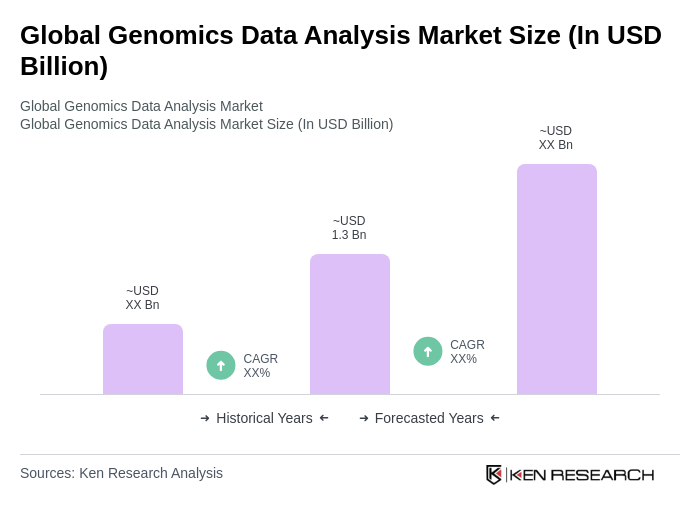
- The Global Genomics Data Analysis Market is valued at USD 1.3 billion, based on a five-year historical analysis. This growth is primarily driven by advancements in next-generation sequencing technologies, increasing adoption of precision oncology and personalized medicine approaches, and the rising prevalence of genetic disorders requiring sophisticated diagnostic solutions. The demand for genomic data analysis services has surged as healthcare providers, biopharmaceutical companies, and research institutions seek to leverage genomic information through advanced bioinformatics platforms and AI-powered analytical tools for better patient outcomes and innovative treatments. Strategic collaborations between technology organizations, drug developers, and cloud computing companies are expanding analytical capacity and facilitating secure data sharing across the healthcare ecosystem.
- Key players in this market include the United States, Germany, and China, which dominate due to their robust healthcare infrastructure, significant investments in research and development, and a high concentration of leading biotechnology firms. The presence of advanced genomic research facilities and a favorable regulatory environment further enhance their competitive edge in the global market. North America particularly holds substantial market share, driven by extensive funding initiatives such as the National Institutes of Health's USD 5.4 million investment in integrating genomics into learning health systems and increasing adoption of population genomics programs.
- The NIH Genomic Data Sharing Policy, implemented in 2015 and updated periodically through subsequent guidance documents issued by the National Institutes of Health, mandates that genomic data generated from NIH-funded research be shared through designated repositories such as dbGaP (database of Genotypes and Phenotypes). This policy requires investigators to submit an Institutional Certification confirming appropriate consent for data sharing, with specific timelines for data submission (typically within six months of final dataset assembly or publication). The policy covers all large-scale human and non-human genomic data, establishing clear operational requirements for data access committees, data use limitations, and security protocols to balance scientific collaboration with privacy protection, ultimately accelerating genomic discoveries while maintaining ethical standards for participant confidentiality.
Global Genomics Data Analysis Market Segmentation
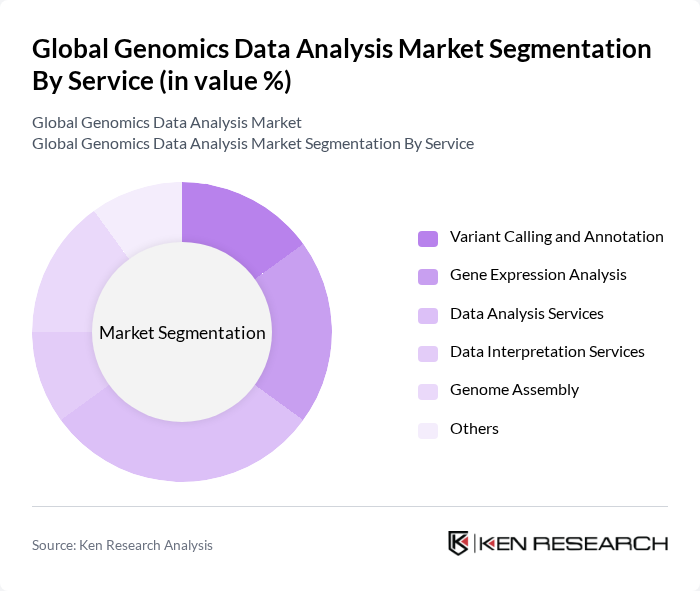
By Service:The service segment includes various offerings such as variant calling and annotation, gene expression analysis, data analysis services, data interpretation services, genome assembly, and others. Among these, data analysis services are currently dominating the market due to the increasing complexity of genomic data and the need for specialized expertise in interpreting results. The demand for these services is driven by the growing number of research projects, clinical applications requiring comprehensive data analysis, and the integration of machine learning algorithms into bioinformatics pipelines to derive meaningful insights from raw sequencing data. Cloud-based analytical workflows are increasingly adopted to handle large-scale datasets efficiently while maintaining regulatory compliance.
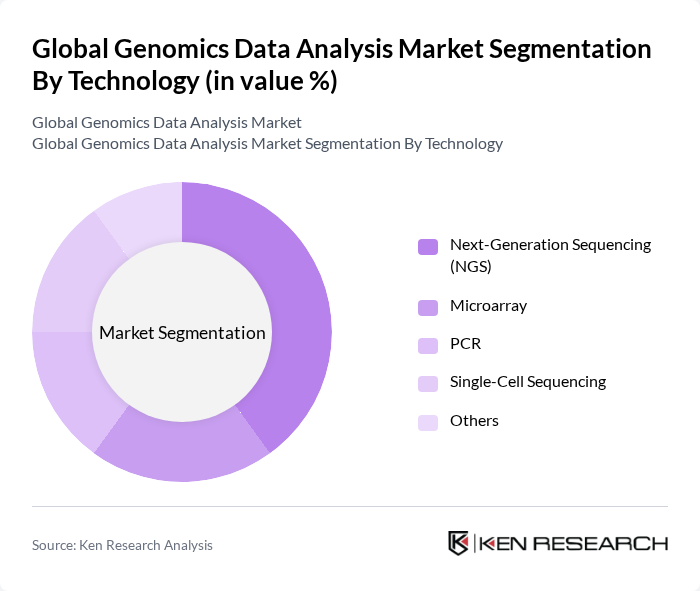
By Technology:The technology segment encompasses various methodologies such as next-generation sequencing (NGS), microarray, PCR, single-cell sequencing, and others. Next-generation sequencing (NGS) is the leading technology in the market, primarily due to its high throughput, cost-effectiveness, and ability to generate vast amounts of data quickly. The increasing adoption of NGS in clinical diagnostics, precision oncology, pharmacogenomics, and rare genetic disorder identification is driving its dominance, as it enables comprehensive genomic profiling and personalized treatment strategies. Continuous innovations in sequencing chemistry, data processing algorithms, and integrated multi-omics analytics further enhance the reliability and efficiency of genomic data interpretation.
Global Genomics Data Analysis Market Competitive Landscape
The Global Genomics Data Analysis Market is characterized by a dynamic mix of regional and international players. Leading participants such as Illumina, Inc., Thermo Fisher Scientific Inc., QIAGEN N.V., BGI Genomics Co., Ltd., Agilent Technologies, Inc., F. Hoffmann-La Roche Ltd. (Roche Sequencing Solutions), Bio-Rad Laboratories, Inc., Eurofins Scientific SE (Eurofins Genomics), Oxford Nanopore Technologies Ltd., 10x Genomics, Inc., PerkinElmer, Inc., CD Genomics, Charles River Laboratories International, Inc., Fios Genomics Ltd., Basepair Technologies, Inc., Golden Helix, Inc., CellCarta (Nexcelom Bioscience) contribute to innovation, geographic expansion, and service delivery in this space.
Global Genomics Data Analysis Market Industry Analysis
Growth Drivers
- Increasing Demand for Personalized Medicine:The global personalized medicine market is projected to reach $2.4 trillion in future, driven by advancements in genomics. This surge is fueled by the growing recognition of tailored therapies that improve patient outcomes. In future, the U.S. spent approximately $4.3 trillion on healthcare, with a significant portion allocated to genomic research and personalized treatments, highlighting the increasing demand for genomic data analysis in developing customized healthcare solutions.
- Advancements in Sequencing Technologies:The cost of whole-genome sequencing has plummeted from around $100 million in 2001 to approximately $1,000 in future. This dramatic reduction has made genomic analysis more accessible, leading to a surge in research and clinical applications. In future, the global market for sequencing technologies is expected to exceed $10.5 billion, reflecting the critical role of these advancements in driving the demand for genomics data analysis services across various sectors.
- Rising Prevalence of Genetic Disorders:The World Health Organization reported that genetic disorders affect approximately 1 in 17 individuals globally, translating to over 580 million people. This rising prevalence has intensified the need for genomic data analysis to identify, diagnose, and treat these conditions effectively. In future, healthcare systems are expected to allocate an estimated $50 billion towards genetic disorder management, further propelling the demand for genomic analysis services and technologies.
Market Challenges
- High Costs of Genomic Data Analysis:The initial investment for genomic data analysis infrastructure can exceed $1 million, posing a significant barrier for many institutions. Additionally, ongoing operational costs, including data storage and processing, can reach up to $500,000 annually. These financial constraints hinder the ability of smaller organizations to adopt advanced genomic technologies, limiting overall market growth and accessibility to genomic insights.
- Data Privacy and Security Concerns:With the increasing volume of genomic data, concerns regarding data privacy and security have escalated. In future, over 60% of healthcare organizations reported data breaches, leading to significant financial losses averaging $4.4 million per incident. Regulatory compliance, such as GDPR, adds complexity and costs, making it challenging for companies to navigate the legal landscape while ensuring the protection of sensitive genomic information.
Global Genomics Data Analysis Market Future Outlook
The future of the genomics data analysis market appears promising, driven by technological advancements and increasing integration with artificial intelligence. As organizations continue to invest in genomic research, the demand for sophisticated data analysis tools will rise. Furthermore, the collaboration between academic institutions and industry players is expected to foster innovation, leading to new applications in personalized medicine and agriculture, ultimately enhancing the overall efficiency and effectiveness of genomic data utilization.
Market Opportunities
- Expansion of Cloud-Based Genomic Services:The global cloud computing market is projected to reach $1.6 trillion in future, providing a significant opportunity for genomic data analysis services. Cloud-based solutions offer scalable storage and processing capabilities, enabling researchers to analyze vast datasets efficiently. This shift is expected to enhance collaboration and accessibility, driving innovation in genomic research and applications.
- Development of AI-Driven Analytics Tools:The AI analytics market is anticipated to grow to $190 billion in future, presenting a substantial opportunity for integrating AI with genomic data analysis. AI-driven tools can enhance data interpretation, leading to faster and more accurate insights. This technological synergy is expected to revolutionize personalized medicine and genetic research, making genomic analysis more efficient and impactful.
Scope of the Report
| Segment | Sub-Segments |
|---|---|
| By Service | Variant Calling and Annotation Gene Expression Analysis Data Analysis Services Data Interpretation Services Genome Assembly Others |
| By Technology | Next-Generation Sequencing (NGS) Microarray PCR Single-Cell Sequencing Others |
| By Application | Drug Discovery and Development Personalized Medicine Oncology Diagnostics Agriculture and Animal Research Others |
| By End Use | Academic and Research Institutions Pharmaceutical and Biotechnology Companies Hospitals and Diagnostic Centers Contract Research Organizations (CROs) Others |
| By Component | Software Services Hardware |
| By Deployment Mode | Cloud-Based On-Premise |
| By Pricing Strategy | Subscription-Based Pricing Pay-Per-Use Pricing Enterprise Licensing |
Key Target Audience
Investors and Venture Capitalist Firms
Government and Regulatory Bodies (e.g., National Institutes of Health, Food and Drug Administration)
Biotechnology Companies
Pharmaceutical Companies
Healthcare Providers and Institutions
Clinical Research Organizations
Data Analytics and Software Development Firms
Health Insurance Companies
Players Mentioned in the Report:
Illumina, Inc.
Thermo Fisher Scientific Inc.
QIAGEN N.V.
BGI Genomics Co., Ltd.
Agilent Technologies, Inc.
F. Hoffmann-La Roche Ltd. (Roche Sequencing Solutions)
Bio-Rad Laboratories, Inc.
Eurofins Scientific SE (Eurofins Genomics)
Oxford Nanopore Technologies Ltd.
10x Genomics, Inc.
PerkinElmer, Inc.
CD Genomics
Charles River Laboratories International, Inc.
Fios Genomics Ltd.
Basepair Technologies, Inc.
Golden Helix, Inc.
CellCarta (Nexcelom Bioscience)
Table of Contents
Market Assessment Phase
1. Executive Summary and Approach
2. Global Genomics Data Analysis Market Overview
2.1 Key Insights and Strategic Recommendations
2.2 Global Genomics Data Analysis Market Overview
2.3 Definition and Scope
2.4 Evolution of Market Ecosystem
2.5 Timeline of Key Regulatory Milestones
2.6 Value Chain & Stakeholder Mapping
2.7 Business Cycle Analysis
2.8 Policy & Incentive Landscape
3. Global Genomics Data Analysis Market Analysis
3.1 Growth Drivers
3.1.1 Increasing demand for personalized medicine
3.1.2 Advancements in sequencing technologies
3.1.3 Rising prevalence of genetic disorders
3.1.4 Growth in research funding and investments
3.2 Market Challenges
3.2.1 High costs of genomic data analysis
3.2.2 Data privacy and security concerns
3.2.3 Lack of skilled professionals
3.2.4 Regulatory hurdles
3.3 Market Opportunities
3.3.1 Expansion of cloud-based genomic services
3.3.2 Collaborations between academia and industry
3.3.3 Development of AI-driven analytics tools
3.3.4 Increasing adoption of genomics in agriculture
3.4 Market Trends
3.4.1 Integration of genomics with big data analytics
3.4.2 Growth of direct-to-consumer genetic testing
3.4.3 Rise of multi-omics approaches
3.4.4 Focus on ethical considerations in genomics
3.5 Government Regulation
3.5.1 GDPR compliance for genomic data
3.5.2 FDA guidelines for genomic testing
3.5.3 National health policies promoting genomics
3.5.4 Regulations on data sharing and usage
4. SWOT Analysis
5. Stakeholder Analysis
6. Porter's Five Forces Analysis
7. Global Genomics Data Analysis Market Market Size, 2019-2024
7.1 By Value
7.2 By Volume
7.3 By Average Selling Price
8. Global Genomics Data Analysis Market Segmentation
8.1 By Service
8.1.1 Variant Calling and Annotation
8.1.2 Gene Expression Analysis
8.1.3 Data Analysis Services
8.1.4 Data Interpretation Services
8.1.5 Genome Assembly
8.1.6 Others
8.2 By Technology
8.2.1 Next-Generation Sequencing (NGS)
8.2.2 Microarray
8.2.3 PCR
8.2.4 Single-Cell Sequencing
8.2.5 Others
8.3 By Application
8.3.1 Drug Discovery and Development
8.3.2 Personalized Medicine
8.3.3 Oncology
8.3.4 Diagnostics
8.3.5 Agriculture and Animal Research
8.3.6 Others
8.4 By End Use
8.4.1 Academic and Research Institutions
8.4.2 Pharmaceutical and Biotechnology Companies
8.4.3 Hospitals and Diagnostic Centers
8.4.4 Contract Research Organizations (CROs)
8.4.5 Others
8.5 By Component
8.5.1 Software
8.5.2 Services
8.5.3 Hardware
8.6 By Deployment Mode
8.6.1 Cloud-Based
8.6.2 On-Premise
8.7 By Pricing Strategy
8.7.1 Subscription-Based Pricing
8.7.2 Pay-Per-Use Pricing
8.7.3 Enterprise Licensing
9. Global Genomics Data Analysis Market Competitive Analysis
9.1 Market Share of Key Players
9.2 Cross Comparison of Key Players
9.2.1 Company Name
9.2.2 Group Size (Large, Medium, or Small as per industry convention)
9.2.3 Annual Revenue (USD Million)
9.2.4 Revenue Growth Rate (CAGR %)
9.2.5 Market Share (%)
9.2.6 R&D Investment as % of Revenue
9.2.7 Number of Genomic Analysis Platforms
9.2.8 Cloud vs On-Premise Solution Mix
9.2.9 Geographic Presence (Number of Countries)
9.2.10 Strategic Partnerships and Collaborations
9.3 SWOT Analysis of Top Players
9.4 Pricing Analysis
9.5 Detailed Profile of Major Companies
9.5.1 Illumina, Inc.
9.5.2 Thermo Fisher Scientific Inc.
9.5.3 QIAGEN N.V.
9.5.4 BGI Genomics Co., Ltd.
9.5.5 Agilent Technologies, Inc.
9.5.6 F. Hoffmann-La Roche Ltd. (Roche Sequencing Solutions)
9.5.7 Bio-Rad Laboratories, Inc.
9.5.8 Eurofins Scientific SE (Eurofins Genomics)
9.5.9 Oxford Nanopore Technologies Ltd.
9.5.10 10x Genomics, Inc.
9.5.11 PerkinElmer, Inc.
9.5.12 CD Genomics
9.5.13 Charles River Laboratories International, Inc.
9.5.14 Fios Genomics Ltd.
9.5.15 Basepair Technologies, Inc.
9.5.16 Golden Helix, Inc.
9.5.17 CellCarta (Nexcelom Bioscience)
10. Global Genomics Data Analysis Market End-User Analysis
10.1 Procurement Behavior of Key Ministries
10.1.1 Government funding for genomics research
10.1.2 Collaboration with private sector
10.1.3 Policy frameworks for genomic data usage
10.2 Corporate Spend on Infrastructure & Energy
10.2.1 Investment in genomic infrastructure
10.2.2 Budget allocation for R&D
10.2.3 Spending on technology upgrades
10.3 Pain Point Analysis by End-User Category
10.3.1 Data management challenges
10.3.2 Integration with existing systems
10.3.3 Cost constraints
10.4 User Readiness for Adoption
10.4.1 Awareness of genomic technologies
10.4.2 Training and support needs
10.4.3 Infrastructure readiness
10.5 Post-Deployment ROI and Use Case Expansion
10.5.1 Measurement of success metrics
10.5.2 Opportunities for scaling
10.5.3 Feedback mechanisms for improvement
11. Global Genomics Data Analysis Market Future Size, 2025-2030
11.1 By Value
11.2 By Volume
11.3 By Average Selling Price
Go-To-Market Strategy Phase
1. Whitespace Analysis + Business Model Canvas
1.1 Market gaps and opportunities
2. Marketing and Positioning Recommendations
2.1 Branding strategies
2.2 Product USPs
3. Distribution Plan
3.1 Urban retail vs rural NGO tie-ups
4. Channel & Pricing Gaps
4.1 Underserved routes
4.2 Pricing bands
5. Unmet Demand & Latent Needs
5.1 Category gaps
5.2 Consumer segments
6. Customer Relationship
6.1 Loyalty programs
6.2 After-sales service
7. Value Proposition
7.1 Sustainability
7.2 Integrated supply chains
8. Key Activities
8.1 Regulatory compliance
8.2 Branding
8.3 Distribution setup
9. Entry Strategy Evaluation
9.1 Domestic Market Entry Strategy
9.1.1 Product mix
9.1.2 Pricing band
9.1.3 Packaging
9.2 Export Entry Strategy
9.2.1 Target countries
9.2.2 Compliance roadmap
10. Entry Mode Assessment
10.1 JV
10.2 Greenfield
10.3 M&A
10.4 Distributor Model
11. Capital and Timeline Estimation
11.1 Capital requirements
11.2 Timelines
12. Control vs Risk Trade-Off
12.1 Ownership vs Partnerships
13. Profitability Outlook
13.1 Breakeven analysis
13.2 Long-term sustainability
14. Potential Partner List
14.1 Distributors
14.2 JVs
14.3 Acquisition targets
15. Execution Roadmap
15.1 Phased Plan for Market Entry
15.1.1 Market Setup
15.1.2 Market Entry
15.1.3 Growth Acceleration
15.1.4 Scale & Stabilize
15.2 Key Activities and Milestones
15.2.1 Milestone planning
15.2.2 Activity tracking
Research Methodology
Phase 1: Approach1
Desk Research
- Analysis of published market reports from industry associations and research firms
- Review of academic journals and white papers on genomics data analysis trends
- Examination of government publications and regulatory frameworks affecting genomics
Primary Research
- Interviews with bioinformatics experts and data scientists in genomics
- Surveys targeting laboratory managers and genomic data analysts
- Field interviews with executives from genomics data analysis firms
Validation & Triangulation
- Cross-validation of findings through multiple data sources and expert opinions
- Triangulation of market data with industry growth rates and technological advancements
- Sanity checks conducted through expert panel discussions and feedback sessions
Phase 2: Market Size Estimation1
Top-down Assessment
- Estimation of market size based on global healthcare expenditure and R&D investments
- Segmentation by application areas such as diagnostics, therapeutics, and research
- Incorporation of trends in personalized medicine and genomic research funding
Bottom-up Modeling
- Data collection from leading genomics firms regarding service offerings and pricing
- Volume estimates based on the number of genomic tests performed annually
- Cost analysis of genomic data processing and storage solutions
Forecasting & Scenario Analysis
- Multi-factor regression analysis incorporating technological advancements and market demand
- Scenario modeling based on regulatory changes and healthcare policy shifts
- Development of baseline, optimistic, and pessimistic market forecasts through 2030
Phase 3: CATI Sample Composition1
| Scope Item/Segment | Sample Size | Target Respondent Profiles |
|---|---|---|
| Clinical Genomics Applications | 120 | Clinical Researchers, Genetic Counselors |
| Pharmaceutical R&D | 80 | Pharmaceutical Scientists, R&D Managers |
| Genomic Data Management Solutions | 60 | IT Managers, Data Analysts |
| Consumer Genomics Services | 50 | Marketing Managers, Product Development Leads |
| Bioinformatics Software Providers | 70 | Software Engineers, Product Managers |
Frequently Asked Questions
What is the current value of the Global Genomics Data Analysis Market?
The Global Genomics Data Analysis Market is valued at approximately USD 1.3 billion, reflecting significant growth driven by advancements in next-generation sequencing technologies and the increasing demand for personalized medicine and precision oncology.
What factors are driving the growth of the Genomics Data Analysis Market?
Which regions dominate the Global Genomics Data Analysis Market?
What are the main services offered in the Genomics Data Analysis Market?
Other Regional/Country Reports
Indonesia Genomics Data Analysis Market
Malaysia Genomics Data Analysis Market
KSA Genomics Data Analysis Market
APAC Genomics Data Analysis Market
SEA Genomics Data Analysis Market
Vietnam Genomics Data Analysis Market
Other Adjacent Reports
Belgium Next-Generation Sequencing Market
UAE Bioinformatics MarketUAE Precision Medicine MarketIndonesia Genetic Testing Market Report Size Share Growth Drivers Trends Opportunities & Forecast 2025–2030UAE Pharmacogenomics MarketUS personalized medicine market Size, Share, Growth Drivers, Trends, Opportunities & Forecast 2025–2030Saudi Arabia biotechnology market Size, Share, Growth Drivers, Trends, Opportunities & Forecast 2025–2030United States Healthcare Analytics Market Outlook to 2030: Size, Share, Growth and TrendsKuwait Artificial Intelligence in Healthcare Market
United States Cloud Computing in Healthcare Market Outlook to 2030: Size, Share, Growth and TrendsWhy Buy From Us?

What makes us stand out is that our consultants follow Robust, Refine and Result (RRR) methodology. Robust for clear definitions, approaches and sanity checking, Refine for differentiating respondents' facts and opinions, and Result for presenting data with story.

We have set a benchmark in the industry by offering our clients with syndicated and customized market research reports featuring coverage of entire market as well as meticulous research and analyst insights.

While we don't replace traditional research, we flip the method upside down. Our dual approach of Top Bottom & Bottom Top ensures quality deliverable by not just verifying company fundamentals but also looking at the sector and macroeconomic factors.

With one step in the future, our research team constantly tries to show you the bigger picture. We help with some of the tough questions you may encounter along the way: How is the industry positioned? Best marketing channel? KPI's of competitors? By aligning every element, we help maximize success.

Our report gives you instant access to the answers and sources that other companies might choose to hide. We elaborate each steps of research methodology we have used and showcase you the sample size to earn your trust.

If you need any support, we are here! We pride ourselves on universe strength, data quality, and quick, friendly, and professional service.