About the Report
Base Year 2024Global GMO Testing Market Overview
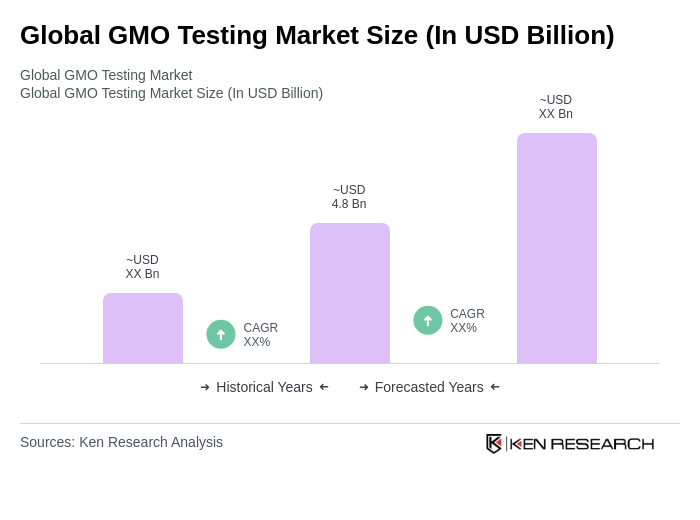
- The Global GMO Testing Market is valued at USD 4.8 billion, based on a five-year historical analysis. This growth is primarily driven by rising consumer demand for transparency in food labeling, heightened health concerns regarding genetically modified organisms, and increasingly stringent regulatory frameworks across major markets. The market has experienced a notable surge in testing services as food manufacturers and agricultural producers seek to ensure compliance with evolving safety standards and consumer expectations .
- Key players in this market include the United States, Canada, and several European countries, which dominate due to advanced agricultural practices, robust regulatory oversight, and high consumer awareness regarding food safety. The presence of leading testing laboratories and research institutions in these regions further strengthens their market position, making them pivotal in the development and adoption of advanced GMO testing methodologies .
- The European Union enforces Regulation (EU) 2018/848, issued by the European Parliament and the Council in 2018, which mandates comprehensive labeling and traceability requirements for genetically modified organisms. This regulation enhances consumer protection and requires all GMO products to be accurately labeled, thereby increasing demand for reliable testing services among food manufacturers and importers .
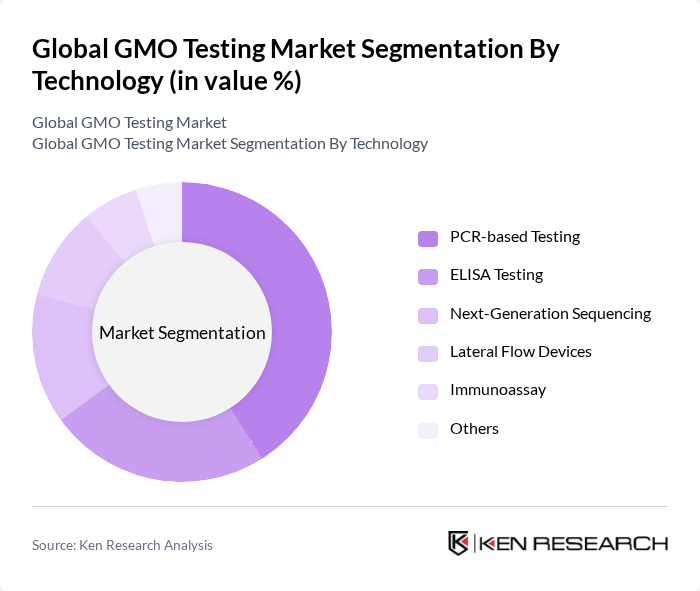
Global GMO Testing Market Segmentation
By Technology:The technology segment encompasses various methodologies used for GMO testing, including PCR-based Testing, ELISA Testing, Next-Generation Sequencing, Lateral Flow Devices, Immunoassay, and Others. Among these, PCR-based Testing remains the most widely adopted due to its high sensitivity and specificity, making it the preferred choice for detecting GMO content in food and agricultural products. The growing need for accurate, rapid, and cost-effective testing solutions continues to drive the expansion of this segment .
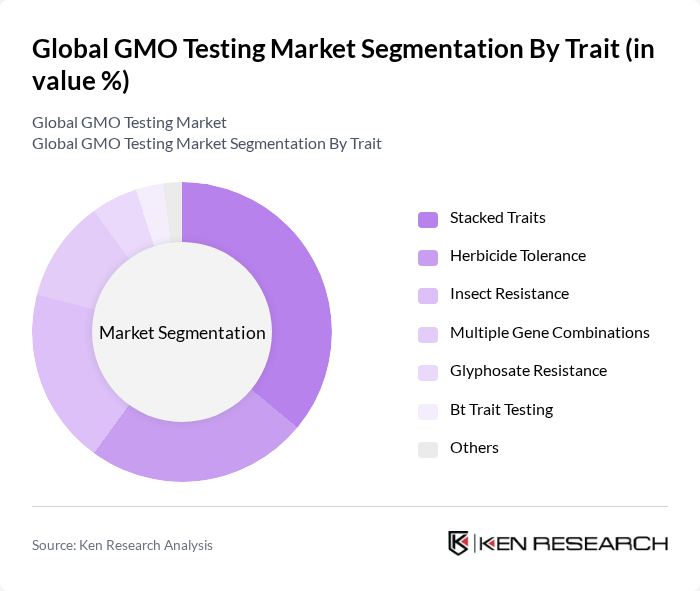
By Trait:The trait segment includes various genetic modifications such as Stacked Traits, Herbicide Tolerance, Insect Resistance, Multiple Gene Combinations, Glyphosate Resistance, Bt Trait Testing, and Others. Stacked Traits continue to lead the market due to their ability to confer multiple agronomic benefits, including enhanced pest resistance and improved yield. The trend is supported by the increasing adoption of multi-trait crops by producers aiming to maximize productivity and reduce reliance on chemical crop protection .
Global GMO Testing Market Competitive Landscape
The Global GMO Testing Market is characterized by a dynamic mix of regional and international players. Leading participants such as Eurofins Scientific, SGS S.A., Intertek Group plc, Bureau Veritas S.A., ALS Limited, Neogen Corporation, Genetic ID NA Inc., FoodChain ID Inc., Thermo Fisher Scientific Inc., Agilent Technologies, Inc., Bio-Rad Laboratories, Inc., Merck KGaA, 3M Company, AsureQuality Limited, EnviroLogix Inc., Symbio Laboratories Pty Ltd., Geneius Laboratories Ltd., Primoris Services Corporation, Qiagen N.V., Silliker Inc., Genetic ID Europe AG contribute to innovation, geographic expansion, and service delivery in this space.
Global GMO Testing Market Industry Analysis
Growth Drivers
- Increasing Consumer Awareness of Food Safety:The global food safety market is projected to reach $25 billion by 2025, driven by heightened consumer awareness regarding food quality and safety. In the near future, 80% of consumers expressed concerns about GMOs in their food, leading to a surge in demand for GMO testing services. This awareness is prompting food manufacturers to invest in testing to ensure compliance with safety standards, thereby driving market growth in the GMO testing sector.
- Stringent Government Regulations on GMO Labeling:In the near future, over 40 countries have implemented mandatory GMO labeling laws, significantly impacting the food industry. The European Union alone has seen a 50% increase in compliance testing since the introduction of these regulations. This regulatory environment compels food producers to adopt rigorous testing protocols, thereby expanding the GMO testing market as companies strive to meet legal requirements and avoid penalties.
- Rising Demand for Organic and Non-GMO Products:The organic food market is expected to reach $300 billion by 2025, with non-GMO products accounting for a significant share. In the near future, sales of non-GMO products increased by 30%, reflecting consumer preference for transparency and health-conscious choices. This trend is driving food manufacturers to invest in GMO testing to validate their product claims, thus propelling the growth of the GMO testing market.
Market Challenges
- High Costs Associated with Testing Procedures:The average cost of comprehensive GMO testing can range from $600 to $2,500 per sample, depending on the complexity of the analysis. This financial burden can deter smaller food producers from utilizing testing services, limiting market growth. In the near future, it is estimated that 70% of small-scale producers may forgo testing due to these high costs, impacting overall market penetration.
- Limited Availability of Skilled Professionals:The GMO testing industry faces a shortage of qualified professionals, with an estimated 50% of laboratories reporting difficulties in hiring skilled technicians. This shortage is exacerbated by the rapid technological advancements in testing methods, which require specialized training. In the near future, the lack of skilled labor could hinder the capacity of testing facilities to meet increasing demand, posing a significant challenge to market growth.
Global GMO Testing Market Future Outlook
The future of the GMO testing market appears promising, driven by increasing consumer demand for transparency and safety in food products. As regulations tighten globally, companies will likely invest more in testing technologies to ensure compliance. Additionally, advancements in rapid testing methods will enhance efficiency and reduce costs, making testing more accessible. The integration of digital platforms for testing services will further streamline processes, allowing for quicker results and improved consumer trust in food safety.
Market Opportunities
- Expansion of Testing Services in Emerging Markets:Emerging markets, particularly in Asia and Africa, are witnessing a growing demand for GMO testing services. With a projected increase in food production by 40% in these regions in future, there is a significant opportunity for testing service providers to establish operations and cater to the rising need for compliance and safety assurance.
- Development of Rapid Testing Technologies:The advancement of rapid testing technologies presents a lucrative opportunity for the GMO testing market. Innovations such as portable testing kits and real-time analysis tools can reduce testing times from days to hours. In the near future, these technologies are expected to capture a 30% market share, enhancing accessibility and efficiency for food producers and consumers alike.
Scope of the Report
| Segment | Sub-Segments |
|---|---|
| By Technology | PCR-based Testing ELISA Testing Next-Generation Sequencing Lateral Flow Devices Immunoassay Others |
| By Trait | Stacked Traits Herbicide Tolerance Insect Resistance Multiple Gene Combinations Glyphosate Resistance Bt Trait Testing Others |
| By Crop Type | Corn Soybean Rapeseed/Canola Potato Tomato Sugar Beet Rice Others |
| By Food Type | Bakery & Confectionery Meat & Meat Products Breakfast Cereals & Snacks Food Additives Dairy Products Infant Food Processed Beverages Others |
| By Application | Food Testing Seed Testing Environmental Testing Feed Testing |
| By End-User | Food Manufacturers Agricultural Producers Research Institutions Regulatory Bodies Testing Laboratories |
| By Region | North America Europe Asia-Pacific Latin America Middle East & Africa |
| By Distribution Channel | Direct Sales Online Sales Distributors |
| By Testing Method | Qualitative Testing Quantitative Testing |
| By Certification Type | Non-GMO Project Verified USDA Organic Others |
Key Target Audience
Investors and Venture Capitalist Firms
Government and Regulatory Bodies (e.g., U.S. Food and Drug Administration, European Food Safety Authority)
Manufacturers and Producers of GMO Products
Testing Laboratories and Service Providers
Biotechnology Companies
Food Safety and Quality Assurance Organizations
Industry Associations (e.g., Biotechnology Innovation Organization)
Financial Institutions and Investment Banks
Players Mentioned in the Report:
Eurofins Scientific
SGS S.A.
Intertek Group plc
Bureau Veritas S.A.
ALS Limited
Neogen Corporation
Genetic ID NA Inc.
FoodChain ID Inc.
Thermo Fisher Scientific Inc.
Agilent Technologies, Inc.
Bio-Rad Laboratories, Inc.
Merck KGaA
3M Company
AsureQuality Limited
EnviroLogix Inc.
Symbio Laboratories Pty Ltd.
Geneius Laboratories Ltd.
Primoris Services Corporation
Qiagen N.V.
Silliker Inc.
Genetic ID Europe AG
Table of Contents
Market Assessment Phase
1. Executive Summary and Approach
2. Global GMO Testing Market Overview
2.1 Key Insights and Strategic Recommendations
2.2 Global GMO Testing Market Overview
2.3 Definition and Scope
2.4 Evolution of Market Ecosystem
2.5 Timeline of Key Regulatory Milestones
2.6 Value Chain & Stakeholder Mapping
2.7 Business Cycle Analysis
2.8 Policy & Incentive Landscape
3. Global GMO Testing Market Analysis
3.1 Growth Drivers
3.1.1 Increasing consumer awareness of food safety
3.1.2 Stringent government regulations on GMO labeling
3.1.3 Rising demand for organic and non-GMO products
3.1.4 Technological advancements in testing methods
3.2 Market Challenges
3.2.1 High costs associated with testing procedures
3.2.2 Limited availability of skilled professionals
3.2.3 Regulatory complexities across different regions
3.2.4 Public skepticism towards GMO products
3.3 Market Opportunities
3.3.1 Expansion of testing services in emerging markets
3.3.2 Development of rapid testing technologies
3.3.3 Partnerships with food manufacturers for compliance
3.3.4 Increasing investment in research and development
3.4 Market Trends
3.4.1 Growing trend towards transparency in food sourcing
3.4.2 Rise of digital platforms for testing services
3.4.3 Increased focus on sustainability in agriculture
3.4.4 Adoption of blockchain for traceability
3.5 Government Regulation
3.5.1 Mandatory labeling of GMO products
3.5.2 Standards for testing methodologies
3.5.3 Restrictions on GMO crop cultivation
3.5.4 Guidelines for consumer information dissemination
4. SWOT Analysis
5. Stakeholder Analysis
6. Porter's Five Forces Analysis
7. Global GMO Testing Market Market Size, 2019-2024
7.1 By Value
7.2 By Volume
7.3 By Average Selling Price
8. Global GMO Testing Market Segmentation
8.1 By Technology
8.1.1 PCR-based Testing
8.1.2 ELISA Testing
8.1.3 Next-Generation Sequencing
8.1.4 Lateral Flow Devices
8.1.5 Immunoassay
8.1.6 Others
8.2 By Trait
8.2.1 Stacked Traits
8.2.2 Herbicide Tolerance
8.2.3 Insect Resistance
8.2.4 Multiple Gene Combinations
8.2.5 Glyphosate Resistance
8.2.6 Bt Trait Testing
8.2.7 Others
8.3 By Crop Type
8.3.1 Corn
8.3.2 Soybean
8.3.3 Rapeseed/Canola
8.3.4 Potato
8.3.5 Tomato
8.3.6 Sugar Beet
8.3.7 Rice
8.3.8 Others
8.4 By Food Type
8.4.1 Bakery & Confectionery
8.4.2 Meat & Meat Products
8.4.3 Breakfast Cereals & Snacks
8.4.4 Food Additives
8.4.5 Dairy Products
8.4.6 Infant Food
8.4.7 Processed Beverages
8.4.8 Others
8.5 By Application
8.5.1 Food Testing
8.5.2 Seed Testing
8.5.3 Environmental Testing
8.5.4 Feed Testing
8.6 By End-User
8.6.1 Food Manufacturers
8.6.2 Agricultural Producers
8.6.3 Research Institutions
8.6.4 Regulatory Bodies
8.6.5 Testing Laboratories
8.7 By Region
8.7.1 North America
8.7.2 Europe
8.7.3 Asia-Pacific
8.7.4 Latin America
8.7.5 Middle East & Africa
8.8 By Distribution Channel
8.8.1 Direct Sales
8.8.2 Online Sales
8.8.3 Distributors
8.9 By Testing Method
8.9.1 Qualitative Testing
8.9.2 Quantitative Testing
8.10 By Certification Type
8.10.1 Non-GMO Project Verified
8.10.2 USDA Organic
8.10.3 Others
9. Global GMO Testing Market Competitive Analysis
9.1 Market Share of Key Players
9.2 KPIs for Cross Comparison of Key Players
9.2.1 Company Name
9.2.2 Group Size (Large, Medium, or Small as per industry convention)
9.2.3 Revenue Growth Rate
9.2.4 Market Penetration Rate
9.2.5 Number of Accredited GMO Testing Methods
9.2.6 Geographic Coverage (Number of Countries/Regions Served)
9.2.7 Share of PCR-based Testing Revenue
9.2.8 Share of Processed Food Testing Revenue
9.2.9 Customer Retention Rate
9.2.10 Pricing Strategy
9.2.11 Operational Efficiency (Turnaround Time)
9.2.12 Brand Recognition
9.2.13 Innovation Rate (New Test Launches per Year)
9.2.14 Customer Satisfaction Score
9.3 SWOT Analysis of Top Players
9.4 Pricing Analysis
9.5 Detailed Profile of Major Companies
9.5.1 Eurofins Scientific
9.5.2 SGS S.A.
9.5.3 Intertek Group plc
9.5.4 Bureau Veritas S.A.
9.5.5 ALS Limited
9.5.6 Neogen Corporation
9.5.7 Genetic ID NA Inc.
9.5.8 FoodChain ID Inc.
9.5.9 Thermo Fisher Scientific Inc.
9.5.10 Agilent Technologies, Inc.
9.5.11 Bio-Rad Laboratories, Inc.
9.5.12 Merck KGaA
9.5.13 3M Company
9.5.14 AsureQuality Limited
9.5.15 EnviroLogix Inc.
9.5.16 Symbio Laboratories Pty Ltd.
9.5.17 Geneius Laboratories Ltd.
9.5.18 Primoris Services Corporation
9.5.19 Qiagen N.V.
9.5.20 Silliker Inc.
9.5.21 Genetic ID Europe AG
10. Global GMO Testing Market End-User Analysis
10.1 Procurement Behavior of Key Ministries
10.1.1 Government procurement policies
10.1.2 Budget allocation for GMO testing
10.1.3 Collaboration with private testing labs
10.2 Corporate Spend on Infrastructure & Energy
10.2.1 Investment in testing facilities
10.2.2 Funding for research and development
10.2.3 Expenditure on compliance and certification
10.3 Pain Point Analysis by End-User Category
10.3.1 Challenges in meeting regulatory requirements
10.3.2 Issues with testing accuracy and reliability
10.3.3 High costs of testing services
10.4 User Readiness for Adoption
10.4.1 Awareness of GMO testing benefits
10.4.2 Availability of testing resources
10.4.3 Training and education on testing procedures
10.5 Post-Deployment ROI and Use Case Expansion
10.5.1 Measurement of testing effectiveness
10.5.2 Expansion into new markets
10.5.3 Long-term partnerships with stakeholders
11. Global GMO Testing Market Future Size, 2025-2030
11.1 By Value
11.2 By Volume
11.3 By Average Selling Price
Go-To-Market Strategy Phase
1. Whitespace Analysis + Business Model Canvas
1.1 Market gaps and opportunities
1.2 Value proposition development
1.3 Revenue model identification
1.4 Key partnerships and alliances
1.5 Customer segmentation
1.6 Cost structure analysis
1.7 Key activities and resources
2. Marketing and Positioning Recommendations
2.1 Branding strategies
2.2 Product USPs
2.3 Target audience identification
2.4 Communication strategies
2.5 Digital marketing initiatives
3. Distribution Plan
3.1 Urban retail vs rural NGO tie-ups
3.2 Online distribution channels
3.3 Partnerships with local distributors
3.4 Logistics and supply chain management
4. Channel & Pricing Gaps
4.1 Underserved routes
4.2 Pricing bands
4.3 Competitive pricing analysis
4.4 Customer willingness to pay
5. Unmet Demand & Latent Needs
5.1 Category gaps
5.2 Consumer segments
5.3 Emerging trends and preferences
6. Customer Relationship
6.1 Loyalty programs
6.2 After-sales service
6.3 Customer feedback mechanisms
7. Value Proposition
7.1 Sustainability
7.2 Integrated supply chains
7.3 Competitive advantages
8. Key Activities
8.1 Regulatory compliance
8.2 Branding
8.3 Distribution setup
9. Entry Strategy Evaluation
9.1 Domestic Market Entry Strategy
9.1.1 Product mix
9.1.2 Pricing band
9.1.3 Packaging
9.2 Export Entry Strategy
9.2.1 Target countries
9.2.2 Compliance roadmap
10. Entry Mode Assessment
10.1 JV
10.2 Greenfield
10.3 M&A
10.4 Distributor Model
11. Capital and Timeline Estimation
11.1 Capital requirements
11.2 Timelines
12. Control vs Risk Trade-Off
12.1 Ownership vs Partnerships
13. Profitability Outlook
13.1 Breakeven analysis
13.2 Long-term sustainability
14. Potential Partner List
14.1 Distributors
14.2 JVs
14.3 Acquisition targets
15. Execution Roadmap
15.1 Phased Plan for Market Entry
15.1.1 Market Setup
15.1.2 Market Entry
15.1.3 Growth Acceleration
15.1.4 Scale & Stabilize
15.2 Key Activities and Milestones
15.2.1 Activity timelines
15.2.2 Milestone tracking
Research Methodology
Phase 1: Approach1
Desk Research
- Analysis of global market reports from agricultural biotechnology associations
- Review of scientific publications and journals on GMO testing methodologies
- Examination of regulatory frameworks and guidelines from international bodies like FAO and WHO
Primary Research
- Interviews with laboratory directors specializing in GMO testing
- Surveys with regulatory affairs professionals in the agricultural sector
- Field interviews with quality assurance managers in food production companies
Validation & Triangulation
- Cross-validation of findings through multiple data sources including industry reports and expert opinions
- Triangulation of market trends using historical data and current market dynamics
- Sanity checks conducted through expert panel discussions and feedback sessions
Phase 2: Market Size Estimation1
Top-down Assessment
- Estimation of market size based on global agricultural output and GMO crop adoption rates
- Segmentation by geographic regions and application areas such as food safety and environmental monitoring
- Incorporation of trends in consumer awareness and demand for non-GMO products
Bottom-up Modeling
- Collection of data on testing volumes from leading GMO testing laboratories
- Cost analysis based on service pricing and testing methodologies employed
- Estimation of market size through volume x price calculations for various testing services
Forecasting & Scenario Analysis
- Multi-factor regression analysis incorporating factors such as regulatory changes and technological advancements
- Scenario modeling based on potential shifts in consumer preferences and agricultural practices
- Development of baseline, optimistic, and pessimistic forecasts through 2030
Phase 3: CATI Sample Composition1
| Scope Item/Segment | Sample Size | Target Respondent Profiles |
|---|---|---|
| Food Safety Testing | 100 | Quality Control Managers, Food Safety Officers |
| Agricultural Biotechnology Firms | 60 | Research Scientists, Product Development Managers |
| Regulatory Compliance Testing | 50 | Regulatory Affairs Specialists, Compliance Managers |
| Environmental Impact Assessments | 40 | Environmental Scientists, Sustainability Managers |
| Consumer Awareness Studies | 50 | Market Researchers, Consumer Insights Analysts |
Frequently Asked Questions
What is the current value of the Global GMO Testing Market?
The Global GMO Testing Market is valued at approximately USD 4.8 billion, reflecting a significant increase driven by consumer demand for transparency in food labeling and stringent regulatory frameworks across major markets.
What factors are driving the growth of the GMO Testing Market?
Which regions dominate the Global GMO Testing Market?
What technologies are commonly used in GMO testing?
Other Regional/Country Reports
Indonesia GMO Testing Market
Malaysia GMO Testing Market
APAC GMO Testing Market
SEA GMO Testing Market
Other Adjacent Reports
Belgium Food Safety Testing Market
China Organic Food Market Outlook to 2020 - Rising Food Safety Concerns and Urban Population to Prosper Market Growth Kuwait Agricultural Biotechnology Market Size, Share, Growth Drivers, Trends, Opportunities & Forecast 2025–2030Brazil Genetic Engineering Market
Bahrain Pesticide Residue Testing Market
GCC food traceability market report size, share, growth drivers, trends, opportunities & forecast 2025–2030UAE Dna Sequencing MarketPhilippines Molecular Diagnostics Market Size Share Growth Drivers Trends Opportunities & Forecast 2025–2030South Korea Regulatory Compliance Services Market
Germany Biotech Seed Market
Why Buy From Us?

What makes us stand out is that our consultants follow Robust, Refine and Result (RRR) methodology. Robust for clear definitions, approaches and sanity checking, Refine for differentiating respondents' facts and opinions, and Result for presenting data with story.

We have set a benchmark in the industry by offering our clients with syndicated and customized market research reports featuring coverage of entire market as well as meticulous research and analyst insights.

While we don't replace traditional research, we flip the method upside down. Our dual approach of Top Bottom & Bottom Top ensures quality deliverable by not just verifying company fundamentals but also looking at the sector and macroeconomic factors.

With one step in the future, our research team constantly tries to show you the bigger picture. We help with some of the tough questions you may encounter along the way: How is the industry positioned? Best marketing channel? KPI's of competitors? By aligning every element, we help maximize success.

Our report gives you instant access to the answers and sources that other companies might choose to hide. We elaborate each steps of research methodology we have used and showcase you the sample size to earn your trust.

If you need any support, we are here! We pride ourselves on universe strength, data quality, and quick, friendly, and professional service.