About the Report
Base Year 2024Listen to the audio summary
Global Golf Cart Market Overview
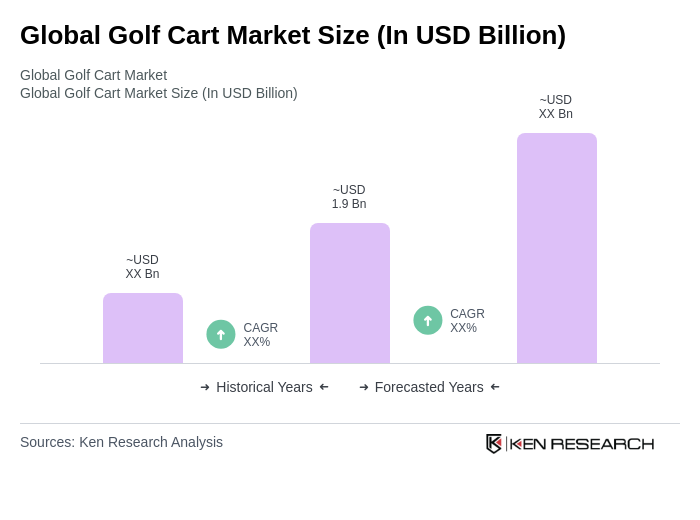
- The Global Golf Cart Market is valued at USD 1.9 billion, based on a five-year historical analysis. This growth is primarily driven by the increasing popularity of golf as a leisure activity, the rising demand for electric and eco-friendly transportation solutions in residential communities, commercial facilities, and resorts, as well as advancements in battery technology and the growing trend of customization in golf carts. The shift toward lithium-ion batteries, integration of smart features (such as GPS tracking and Bluetooth connectivity), and the emergence of solar-powered models are notable market trends.
- Key players in this market include the United States, Canada, and several European countries, which dominate due to their established golf culture, extensive golf course networks, and high disposable incomes. North America holds the largest market share, driven by a dense concentration of golf courses and strong adoption of electric carts. The presence of major manufacturers and a growing trend toward sustainable transportation options further solidify their leadership in the market.
- In 2023, the U.S. government continued to implement regulations and incentives promoting the use of electric vehicles, including golf carts, through tax credits and grants for manufacturers. These initiatives aim to reduce carbon emissions and encourage the adoption of cleaner transportation alternatives, positively impacting the golf cart market.
Global Golf Cart Market Segmentation
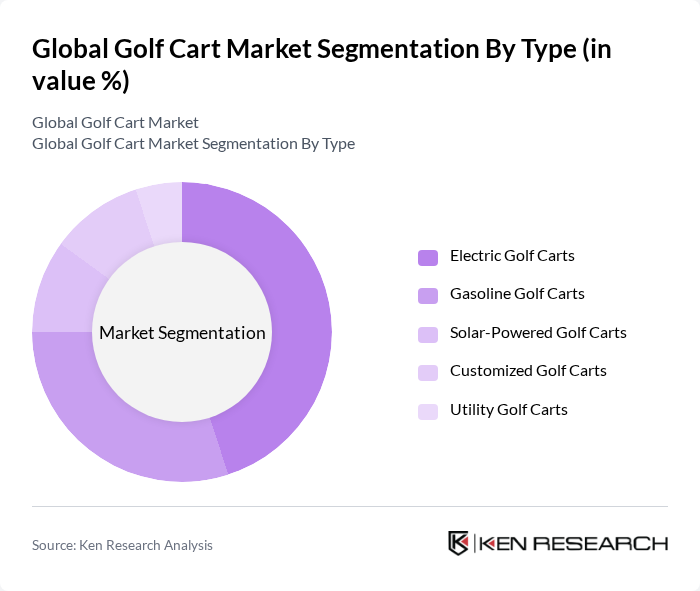
By Type:The market is segmented into Electric Golf Carts, Gasoline Golf Carts, Solar-Powered Golf Carts, Customized Golf Carts, and Utility Golf Carts. Among these, Electric Golf Carts lead the market, supported by their eco-friendliness, lower operational costs, and compliance with emission regulations. The adoption of lithium-ion batteries and smart features further enhances their appeal. Gasoline Golf Carts remain prevalent in regions with limited charging infrastructure, while solar-powered models are gaining traction due to renewable energy initiatives. Customized and utility carts are increasingly used for personal and commercial applications beyond golf courses.
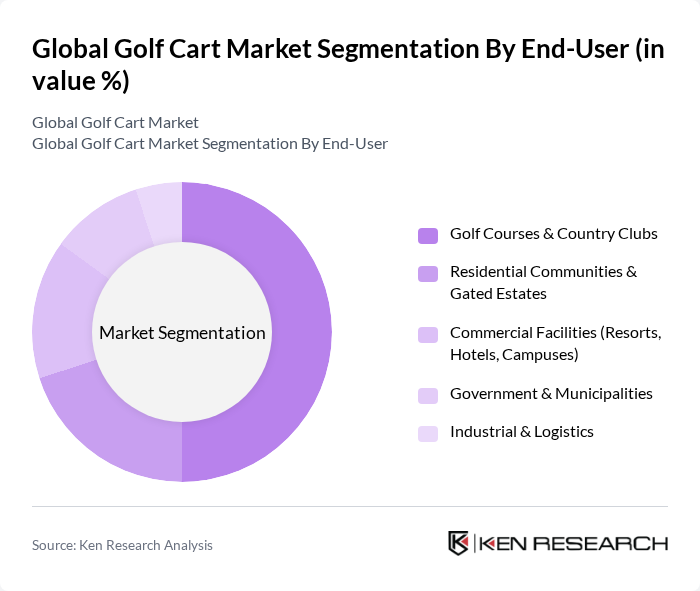
By End-User:The end-user segmentation includes Golf Courses & Country Clubs, Residential Communities & Gated Estates, Commercial Facilities (Resorts, Hotels, Campuses), Government & Municipalities, and Industrial & Logistics. Golf Courses & Country Clubs remain the dominant segment, driven by the need for efficient transportation across large properties and the expansion of golf tourism. Residential communities and gated estates increasingly utilize golf carts for local mobility, while commercial facilities and government sectors adopt them for logistics, maintenance, and passenger transport.
Global Golf Cart Market Competitive Landscape
The Global Golf Cart Market is characterized by a dynamic mix of regional and international players. Leading participants such as Club Car, E-Z-GO (Textron Specialized Vehicles), Yamaha Golf-Car Company, Polaris Industries Inc., Garia A/S, Cushman, STAR EV, Advanced EV, Tomberlin, Bintelli Electric Vehicles, Evolution Electric Vehicles, Marshell Electric Vehicle, JH Global Services, Inc. (Star EV), HDK Electric Vehicle, Columbia Vehicle Group Inc. contribute to innovation, geographic expansion, and service delivery in this space.
Global Golf Cart Market Industry Analysis
Growth Drivers
- Increasing Demand for Eco-Friendly Transportation:The global push for sustainable transport solutions is driving the golf cart market. In future, the electric vehicle market is projected to reach $1.3 trillion, reflecting a growing preference for eco-friendly options. This trend is particularly evident in regions where urbanization is increasing, with cities like San Diego reporting a 35% rise in electric vehicle registrations. Golf carts, as low-emission vehicles, are well-positioned to benefit from this shift towards greener transportation.
- Growth in Golf Tourism:The golf tourism sector is experiencing significant growth, with the global golf tourism market valued at approximately $25 billion in future. Countries like Spain and the USA are leading destinations, attracting millions of tourists annually. This influx of visitors increases the demand for golf carts, as resorts and golf courses invest in fleets to enhance guest experiences. The rise in golf tourism is expected to contribute to a 20% increase in golf cart sales in these regions.
- Expansion of Golf Courses and Recreational Facilities:The number of golf courses worldwide is projected to reach 42,000 in future, up from 38,000. This expansion is particularly notable in emerging markets such as China and India, where golf is gaining popularity. As new courses are developed, the demand for golf carts is expected to rise, with an estimated 12,000 additional carts needed annually to service these new facilities, further driving market growth.
Market Challenges
- High Initial Investment Costs:The average cost of a new electric golf cart ranges from $9,000 to $13,000, which can be a significant barrier for many consumers and businesses. In regions with lower disposable incomes, such as parts of Southeast Asia, this high upfront cost limits market penetration. Additionally, the maintenance costs associated with electric carts can deter potential buyers, impacting overall market growth in these areas.
- Limited Infrastructure in Certain Regions:In many areas, particularly rural or underdeveloped regions, the lack of charging stations and maintenance facilities poses a significant challenge. For instance, only 20% of rural areas in the U.S. have adequate charging infrastructure for electric vehicles, including golf carts. This limitation restricts the usability of electric golf carts, hindering their adoption and growth in these markets, where traditional gas-powered carts remain dominant.
Global Golf Cart Market Future Outlook
The future of the golf cart market appears promising, driven by increasing environmental awareness and technological advancements. As electric vehicle adoption continues to rise, golf carts are likely to see enhanced features, including smart technology integration. Additionally, the expansion of golf courses and recreational facilities will create new opportunities for growth. The market is expected to adapt to changing consumer preferences, focusing on sustainability and innovative designs, ensuring its relevance in the evolving transportation landscape.
Market Opportunities
- Rising Popularity of Electric Vehicles:The global electric vehicle market is anticipated to grow significantly, with sales expected to exceed 35 million units in future. This trend presents a substantial opportunity for golf cart manufacturers to innovate and expand their electric offerings, catering to environmentally conscious consumers and enhancing market competitiveness.
- Development of Smart Golf Carts with IoT Integration:The integration of IoT technology in golf carts is gaining traction, with an estimated 30% of new models expected to feature smart technology in future. This development can enhance user experience through features like GPS tracking and remote diagnostics, appealing to tech-savvy consumers and creating new revenue streams for manufacturers.
Scope of the Report
| Segment | Sub-Segments |
|---|---|
| By Type | Electric Golf Carts Gasoline Golf Carts Solar-Powered Golf Carts Customized Golf Carts Utility Golf Carts |
| By End-User | Golf Courses & Country Clubs Residential Communities & Gated Estates Commercial Facilities (Resorts, Hotels, Campuses) Government & Municipalities Industrial & Logistics |
| By Application | Golfing Resort & Hospitality Transportation Industrial & Utility Use Event & Venue Transportation Airport & Railway Station Mobility |
| By Distribution Channel | Direct Sales Online Retail Dealerships Rental & Leasing Services |
| By Price Range | Budget Golf Carts Mid-Range Golf Carts Premium Golf Carts |
| By Region | North America Europe Asia-Pacific Latin America Middle East & Africa |
| By Technology | Battery Technology (Lead Acid, Lithium-Ion, AGM) Charging Technology (Standard, Fast, Wireless) Navigation & Connectivity (GPS, Bluetooth, IoT) Safety & Automation Features |
Key Target Audience
Investors and Venture Capitalist Firms
Government and Regulatory Bodies (e.g., Environmental Protection Agency, Department of Transportation)
Manufacturers and Producers
Distributors and Retailers
Golf Course Operators and Management Companies
Leasing and Rental Companies
Industry Associations (e.g., National Golf Cart Association)
Financial Institutions
Players Mentioned in the Report:
Club Car
E-Z-GO (Textron Specialized Vehicles)
Yamaha Golf-Car Company
Polaris Industries Inc.
Garia A/S
Cushman
STAR EV
Advanced EV
Tomberlin
Bintelli Electric Vehicles
Evolution Electric Vehicles
Marshell Electric Vehicle
JH Global Services, Inc. (Star EV)
HDK Electric Vehicle
Columbia Vehicle Group Inc.
Table of Contents
Market Assessment Phase
1. Executive Summary and Approach
2. Global Golf Cart Market Overview
2.1 Key Insights and Strategic Recommendations
2.2 Global Golf Cart Market Overview
2.3 Definition and Scope
2.4 Evolution of Market Ecosystem
2.5 Timeline of Key Regulatory Milestones
2.6 Value Chain & Stakeholder Mapping
2.7 Business Cycle Analysis
2.8 Policy & Incentive Landscape
3. Global Golf Cart Market Analysis
3.1 Growth Drivers
3.1.1 Increasing demand for eco-friendly transportation
3.1.2 Growth in golf tourism
3.1.3 Expansion of golf courses and recreational facilities
3.1.4 Technological advancements in electric golf carts
3.2 Market Challenges
3.2.1 High initial investment costs
3.2.2 Limited infrastructure in certain regions
3.2.3 Regulatory hurdles
3.2.4 Competition from alternative transportation modes
3.3 Market Opportunities
3.3.1 Rising popularity of electric vehicles
3.3.2 Potential for expansion into urban areas
3.3.3 Development of smart golf carts with IoT integration
3.3.4 Partnerships with tourism and hospitality sectors
3.4 Market Trends
3.4.1 Shift towards electric and hybrid models
3.4.2 Customization and personalization of golf carts
3.4.3 Increased focus on sustainability and green initiatives
3.4.4 Growth of online sales channels
3.5 Government Regulation
3.5.1 Emission standards for electric vehicles
3.5.2 Safety regulations for golf carts
3.5.3 Incentives for electric vehicle adoption
3.5.4 Zoning laws affecting golf cart usage
4. SWOT Analysis
5. Stakeholder Analysis
6. Porter's Five Forces Analysis
7. Global Golf Cart Market Market Size, 2019-2024
7.1 By Value
7.2 By Volume
7.3 By Average Selling Price
8. Global Golf Cart Market Segmentation
8.1 By Type
8.1.1 Electric Golf Carts
8.1.2 Gasoline Golf Carts
8.1.3 Solar-Powered Golf Carts
8.1.4 Customized Golf Carts
8.1.5 Utility Golf Carts
8.2 By End-User
8.2.1 Golf Courses & Country Clubs
8.2.2 Residential Communities & Gated Estates
8.2.3 Commercial Facilities (Resorts, Hotels, Campuses)
8.2.4 Government & Municipalities
8.2.5 Industrial & Logistics
8.3 By Application
8.3.1 Golfing
8.3.2 Resort & Hospitality Transportation
8.3.3 Industrial & Utility Use
8.3.4 Event & Venue Transportation
8.3.5 Airport & Railway Station Mobility
8.4 By Distribution Channel
8.4.1 Direct Sales
8.4.2 Online Retail
8.4.3 Dealerships
8.4.4 Rental & Leasing Services
8.5 By Price Range
8.5.1 Budget Golf Carts
8.5.2 Mid-Range Golf Carts
8.5.3 Premium Golf Carts
8.6 By Region
8.6.1 North America
8.6.2 Europe
8.6.3 Asia-Pacific
8.6.4 Latin America
8.6.5 Middle East & Africa
8.7 By Technology
8.7.1 Battery Technology (Lead Acid, Lithium-Ion, AGM)
8.7.2 Charging Technology (Standard, Fast, Wireless)
8.7.3 Navigation & Connectivity (GPS, Bluetooth, IoT)
8.7.4 Safety & Automation Features
9. Global Golf Cart Market Competitive Analysis
9.1 Market Share of Key Players
9.2 Cross Comparison of Key Players
9.2.1 Company Name
9.2.2 Global Production Volume
9.2.3 Revenue Growth Rate (YoY)
9.2.4 Market Share by Region
9.2.5 Customer Retention Rate
9.2.6 Average Selling Price (ASP)
9.2.7 Product Portfolio Breadth
9.2.8 Brand Recognition Index
9.2.9 Distribution Network Coverage
9.2.10 R&D and Innovation Investment
9.3 SWOT Analysis of Top Players
9.4 Pricing Analysis
9.5 Detailed Profile of Major Companies
9.5.1 Club Car
9.5.2 E-Z-GO (Textron Specialized Vehicles)
9.5.3 Yamaha Golf-Car Company
9.5.4 Polaris Industries Inc.
9.5.5 Garia A/S
9.5.6 Cushman
9.5.7 STAR EV
9.5.8 Advanced EV
9.5.9 Tomberlin
9.5.10 Bintelli Electric Vehicles
9.5.11 Evolution Electric Vehicles
9.5.12 Marshell Electric Vehicle
9.5.13 JH Global Services, Inc. (Star EV)
9.5.14 HDK Electric Vehicle
9.5.15 Columbia Vehicle Group Inc.
10. Global Golf Cart Market End-User Analysis
10.1 Procurement Behavior of Key Ministries
10.1.1 Government procurement policies
10.1.2 Budget allocation for recreational facilities
10.1.3 Evaluation criteria for golf cart purchases
10.2 Corporate Spend on Infrastructure & Energy
10.2.1 Investment in golf course infrastructure
10.2.2 Spending on electric vehicle charging stations
10.2.3 Budget for maintenance and upgrades
10.3 Pain Point Analysis by End-User Category
10.3.1 Cost of ownership
10.3.2 Availability of service and parts
10.3.3 Regulatory compliance issues
10.4 User Readiness for Adoption
10.4.1 Awareness of electric golf carts
10.4.2 Perceived benefits of golf carts
10.4.3 Readiness to switch from traditional vehicles
10.5 Post-Deployment ROI and Use Case Expansion
10.5.1 Cost savings from electric operation
10.5.2 Increased usage in non-golf applications
10.5.3 Long-term maintenance cost analysis
11. Global Golf Cart Market Future Size, 2025-2030
11.1 By Value
11.2 By Volume
11.3 By Average Selling Price
Go-To-Market Strategy Phase
1. Whitespace Analysis + Business Model Canvas
1.1 Market gaps identification
1.2 Value proposition development
1.3 Revenue model exploration
1.4 Customer segmentation analysis
1.5 Competitive landscape overview
1.6 Key partnerships identification
1.7 Cost structure analysis
2. Marketing and Positioning Recommendations
2.1 Branding strategies
2.2 Product USPs
2.3 Target audience identification
2.4 Marketing channels selection
2.5 Messaging and communication strategy
3. Distribution Plan
3.1 Urban retail strategy
3.2 Rural NGO tie-ups
3.3 Online sales strategy
3.4 Partnership with local dealers
4. Channel & Pricing Gaps
4.1 Underserved routes
4.2 Pricing bands analysis
4.3 Competitor pricing comparison
5. Unmet Demand & Latent Needs
5.1 Category gaps identification
5.2 Consumer segments analysis
5.3 Emerging trends exploration
6. Customer Relationship
6.1 Loyalty programs development
6.2 After-sales service enhancement
6.3 Customer feedback mechanisms
7. Value Proposition
7.1 Sustainability initiatives
7.2 Integrated supply chains
7.3 Unique selling points
8. Key Activities
8.1 Regulatory compliance
8.2 Branding efforts
8.3 Distribution setup
9. Entry Strategy Evaluation
9.1 Domestic Market Entry Strategy
9.1.1 Product mix considerations
9.1.2 Pricing band strategy
9.1.3 Packaging options
9.2 Export Entry Strategy
9.2.1 Target countries selection
9.2.2 Compliance roadmap development
10. Entry Mode Assessment
10.1 Joint Ventures
10.2 Greenfield investments
10.3 Mergers & Acquisitions
10.4 Distributor Model
11. Capital and Timeline Estimation
11.1 Capital requirements analysis
11.2 Timelines for market entry
12. Control vs Risk Trade-Off
12.1 Ownership considerations
12.2 Partnerships evaluation
13. Profitability Outlook
13.1 Breakeven analysis
13.2 Long-term sustainability assessment
14. Potential Partner List
14.1 Distributors identification
14.2 Joint Ventures exploration
14.3 Acquisition targets
15. Execution Roadmap
15.1 Phased Plan for Market Entry
15.1.1 Market Setup
15.1.2 Market Entry
15.1.3 Growth Acceleration
15.1.4 Scale & Stabilize
15.2 Key Activities and Milestones
15.2.1 Activity timelines
15.2.2 Milestone tracking
Research Methodology
Phase 1: Approach1
Desk Research
- Industry reports from golf cart manufacturers and distributors
- Market analysis from trade associations such as the National Golf Cart Association
- Government publications on transportation and recreational vehicle regulations
Primary Research
- Interviews with executives from leading golf cart manufacturers
- Surveys targeting golf course operators and facility managers
- Field interviews with golf cart rental service providers
Validation & Triangulation
- Cross-validation of data through multiple industry sources and reports
- Triangulation of findings from primary interviews and secondary data
- Sanity checks conducted with market experts and analysts
Phase 2: Market Size Estimation1
Top-down Assessment
- Analysis of overall recreational vehicle market size and growth trends
- Segmentation of the golf cart market by type (electric vs. gas) and application (commercial vs. personal use)
- Incorporation of regional market dynamics and consumer preferences
Bottom-up Modeling
- Estimation of sales volume based on historical data from manufacturers
- Operational cost analysis for production and distribution of golf carts
- Revenue projections based on average selling prices and market penetration rates
Forecasting & Scenario Analysis
- Multi-variable regression analysis incorporating economic indicators and consumer trends
- Scenario modeling based on potential regulatory changes and environmental considerations
- Development of baseline, optimistic, and pessimistic forecasts through 2030
Phase 3: CATI Sample Composition1
| Scope Item/Segment | Sample Size | Target Respondent Profiles |
|---|---|---|
| Golf Course Operators | 100 | Golf Course Managers, Facility Directors |
| Golf Cart Manufacturers | 60 | Product Development Managers, Sales Executives |
| Rental Service Providers | 50 | Operations Managers, Business Owners |
| Retailers of Golf Carts | 40 | Store Managers, Sales Representatives |
| End-Users (Golf Enthusiasts) | 80 | Golf Players, Club Members |
Frequently Asked Questions
What is the current value of the Global Golf Cart Market?
The Global Golf Cart Market is valued at approximately USD 1.9 billion, reflecting a significant growth trend driven by the increasing popularity of golf, demand for eco-friendly transportation, and advancements in battery technology.
What factors are driving the growth of the golf cart market?
Which types of golf carts dominate the market?
Who are the major players in the Global Golf Cart Market?
Other Regional/Country Reports
Indonesia Golf Cart Market
Malaysia Golf Cart Market
APAC Golf Cart Market
Why Buy From Us?

What makes us stand out is that our consultants follow Robust, Refine and Result (RRR) methodology. Robust for clear definitions, approaches and sanity checking, Refine for differentiating respondents' facts and opinions, and Result for presenting data with story.

We have set a benchmark in the industry by offering our clients with syndicated and customized market research reports featuring coverage of entire market as well as meticulous research and analyst insights.

While we don't replace traditional research, we flip the method upside down. Our dual approach of Top Bottom & Bottom Top ensures quality deliverable by not just verifying company fundamentals but also looking at the sector and macroeconomic factors.

With one step in the future, our research team constantly tries to show you the bigger picture. We help with some of the tough questions you may encounter along the way: How is the industry positioned? Best marketing channel? KPI's of competitors? By aligning every element, we help maximize success.

Our report gives you instant access to the answers and sources that other companies might choose to hide. We elaborate each steps of research methodology we have used and showcase you the sample size to earn your trust.

If you need any support, we are here! We pride ourselves on universe strength, data quality, and quick, friendly, and professional service.