About the Report
Base Year 2024Global Hangover Rehydration Supplements Market Overview
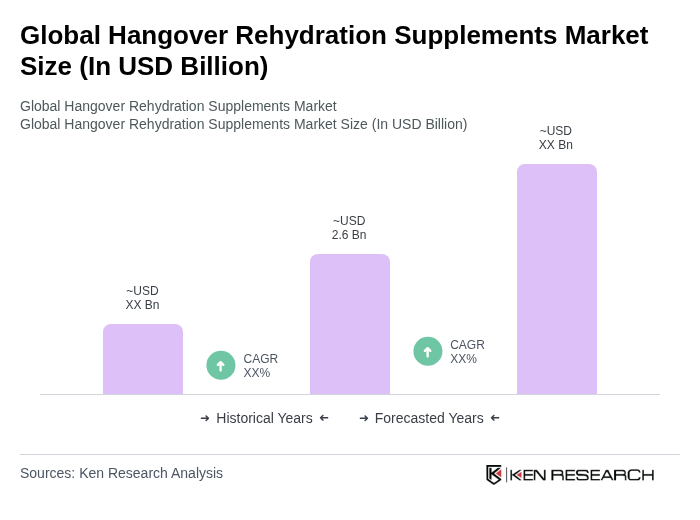
- The Global Hangover Rehydration Supplements Market is valued at USD 2.6 billion, based on a five-year historical analysis. This growth is primarily driven by increasing consumer awareness of health and wellness, coupled with a rising trend in social drinking. Strong demand is also supported by the wider adoption of functional beverages and electrolyte solutions for post-alcohol recovery, particularly among younger demographics who seek quick, convenient recovery options after alcohol consumption.
- Key players in this market include the United States, Canada, and the United Kingdom, which dominate due to their high consumption rates of alcoholic beverages and a growing trend towards health-conscious products. The presence of established nutraceutical and functional beverage brands, strong online and offline retail infrastructure, and early adoption of hangover-focused solutions further enhance their market position, making these regions pivotal in the global landscape.
- In the United States, dietary supplements, including rehydration and hangover recovery products, are required to comply with comprehensive labeling, safety, and manufacturing standards under the Dietary Supplement Health and Education Act (DSHEA) of 1994 and the Current Good Manufacturing Practice (CGMP) regulations for dietary supplements issued by the U.S. Food and Drug Administration (FDA) in 2007. These binding rules mandate accurate ingredient labeling, safety substantiation, manufacturing controls, and restrictions on disease claims, which enhances consumer protection, supports product quality, and underpins trust in hangover rehydration supplements marketed as dietary supplements.
Global Hangover Rehydration Supplements Market Segmentation
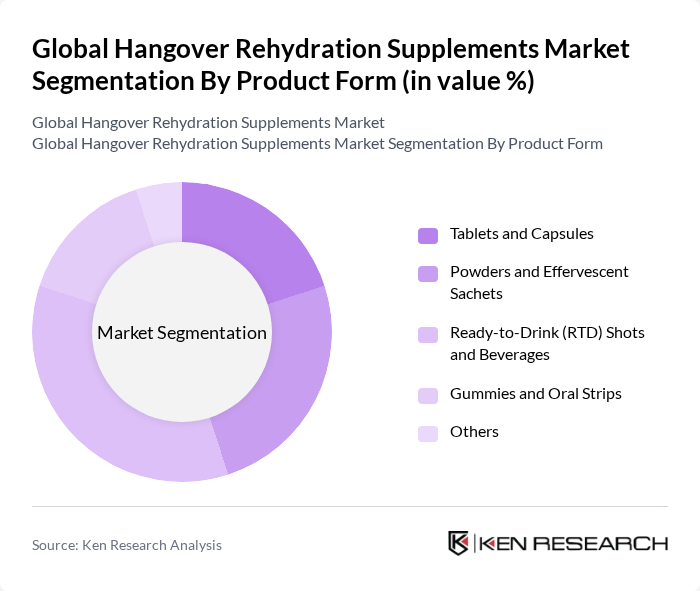
By Product Form:The product form segmentation includes various formats of hangover rehydration supplements, catering to diverse consumer preferences. The subsegments are Tablets and Capsules, Powders and Effervescent Sachets, Ready-to-Drink (RTD) Shots and Beverages, Gummies and Oral Strips, and Others. Powder- and solution-based formats are widely adopted in the broader hangover rehydration space due to their fast absorption and ease of mixing, and Ready-to-Drink (RTD) Shots and Beverages hold a strong position because of their convenience and immediate consumption appeal, particularly among younger consumers who prefer on-the-go solutions.
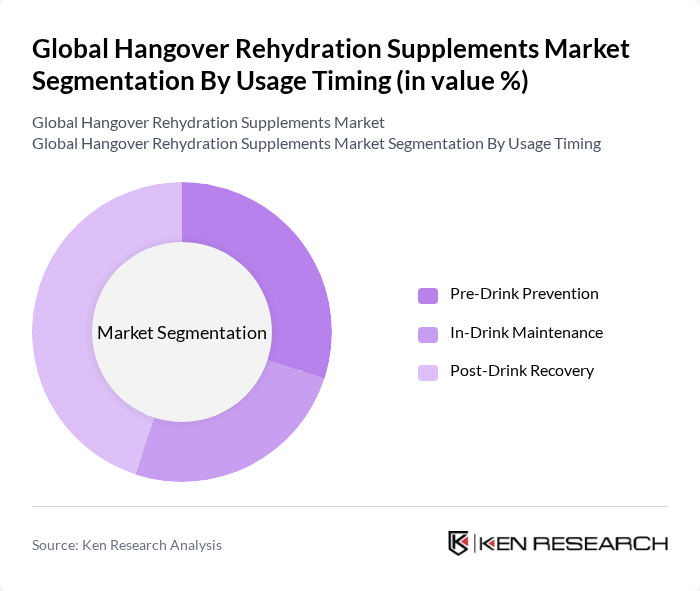
By Usage Timing:This segmentation focuses on the timing of consumption relative to alcohol intake. The subsegments include Pre-Drink Prevention, In-Drink Maintenance, and Post-Drink Recovery. The Post-Drink Recovery segment is currently the most dominant, as consumers increasingly seek effective solutions to alleviate hangover symptoms after drinking, with many products positioned for morning-after use to address dehydration, fatigue, and headaches. At the same time, pre- and during-drink formats are gaining traction in preventive wellness routines, especially among urban, younger consumers looking to reduce next-day impairment.
Global Hangover Rehydration Supplements Market Competitive Landscape
The Global Hangover Rehydration Supplements Market is characterized by a dynamic mix of regional and international players. Leading participants such as Liquid I.V., Hydralyte, DripDrop, SOS Hydration, Hydrant, Pedialyte (Abbott Laboratories), Cheers Health Inc., Morning Recovery, Flyby, Blowfish for Hangovers, Bytox, Ultima Replenisher, Cure Hydration, BodyArmor, Propel (PepsiCo) contribute to innovation, geographic expansion, and service delivery in this space.
Global Hangover Rehydration Supplements Market Industry Analysis
Growth Drivers
- Increasing Consumer Awareness about Health and Wellness:The global health and wellness market is projected to reach, driven by a growing emphasis on preventive healthcare. This trend is reflected in the rising demand for hangover rehydration supplements, as consumers increasingly seek products that promote recovery and overall well-being. In future,of consumers reported prioritizing health-focused products, indicating a significant shift towards wellness-oriented purchasing behaviors that support this market's growth.
- Rising Demand for Convenient and Effective Rehydration Solutions:The global beverage market is expected to reach, with a notable increase in demand for functional beverages, including rehydration supplements. As busy lifestyles become the norm, consumers are seeking quick and effective solutions for hangover relief. In future,of consumers indicated a preference for ready-to-drink supplements, highlighting the market's potential for growth through convenience-driven product offerings.
- Growth in the Nightlife and Entertainment Industry:The global nightlife industry is projected to grow to, fueled by increased disposable income and changing social habits. This growth directly correlates with the demand for hangover rehydration supplements, as consumers seek relief after social events. In future,of nightlife participants reported experiencing hangovers, creating a substantial market opportunity for targeted rehydration products that cater to this demographic.
Market Challenges
- Regulatory Hurdles in Supplement Formulations:The dietary supplement industry faces stringent regulations, with the FDA enforcing compliance on ingredient safety and efficacy. In future,of new supplement formulations were delayed due to regulatory scrutiny. This challenge can hinder innovation and market entry for new hangover rehydration products, as companies must navigate complex regulatory landscapes to ensure compliance and consumer safety.
- Consumer Skepticism Regarding Efficacy:A significant portion of consumers remains skeptical about the effectiveness of hangover rehydration supplements. In future,of surveyed individuals expressed doubts about the claims made by supplement brands. This skepticism can impede market growth, as potential customers may prefer traditional remedies or home solutions, which they perceive as more reliable or cost-effective alternatives to commercial products.
Global Hangover Rehydration Supplements Market Future Outlook
The future of the hangover rehydration supplements market appears promising, driven by evolving consumer preferences and increasing health consciousness. As the demand for natural and organic ingredients rises, brands that prioritize transparency and quality are likely to gain a competitive edge. Additionally, the integration of technology in marketing and product delivery will enhance consumer engagement, fostering brand loyalty and expanding market reach. Companies that adapt to these trends will be well-positioned for success in future.
Market Opportunities
- Development of Innovative Product Formulations:There is a growing opportunity for brands to create unique formulations that cater to specific consumer needs, such as hydration blends tailored for athletes or travelers. By leveraging emerging research on hydration and recovery, companies can differentiate their products and capture niche markets, potentially increasing sales and brand loyalty.
- Collaborations with Bars and Restaurants for Product Placement:Partnering with nightlife venues presents a lucrative opportunity for supplement brands. By strategically placing products in bars and restaurants, companies can enhance visibility and accessibility, driving impulse purchases. This approach not only boosts sales but also aligns the product with social experiences, reinforcing its relevance in the nightlife context.
Scope of the Report
| Segment | Sub-Segments |
|---|---|
| By Product Form | Tablets and Capsules Powders and Effervescent Sachets Ready-to-Drink (RTD) Shots and Beverages Gummies and Oral Strips Others |
| By Usage Timing | Pre-Drink Prevention In-Drink Maintenance Post-Drink Recovery |
| By Distribution Channel | Pharmacies and Drug Stores Grocery and Mass Retail Convenience and Gas Station Retail Specialty Supplement Stores E-Commerce |
| By Ingredient Type | Vitamin and Mineral Blends Botanical Extract Based Amino Acid / NADH Focused Probiotic / Enzyme-Enhanced Others |
| By Packaging Type | Sachets Bottles Cans Blister Packs Stick Packs |
| By Region | North America Europe Asia-Pacific Latin America Middle East and Africa |
| By Consumer Group | Gen Z Millennials Gen X Baby Boomers |
Key Target Audience
Investors and Venture Capitalist Firms
Government and Regulatory Bodies (e.g., Food and Drug Administration, European Food Safety Authority)
Manufacturers and Producers
Distributors and Retailers
Health and Wellness Organizations
Pharmaceutical Companies
Market Analysts and Industry Experts
Financial Institutions
Players Mentioned in the Report:
Liquid I.V.
Hydralyte
DripDrop
SOS Hydration
Hydrant
Pedialyte (Abbott Laboratories)
Cheers Health Inc.
Morning Recovery
Flyby
Blowfish for Hangovers
Bytox
Ultima Replenisher
Cure Hydration
BodyArmor
Propel (PepsiCo)
Table of Contents
Market Assessment Phase
1. Executive Summary and Approach
2. Global Hangover Rehydration Supplements Market Overview
2.1 Key Insights and Strategic Recommendations
2.2 Global Hangover Rehydration Supplements Market Overview
2.3 Definition and Scope
2.4 Evolution of Market Ecosystem
2.5 Timeline of Key Regulatory Milestones
2.6 Value Chain & Stakeholder Mapping
2.7 Business Cycle Analysis
2.8 Policy & Incentive Landscape
3. Global Hangover Rehydration Supplements Market Analysis
3.1 Growth Drivers
3.1.1 Increasing consumer awareness about health and wellness
3.1.2 Rising demand for convenient and effective rehydration solutions
3.1.3 Growth in the nightlife and entertainment industry
3.1.4 Expansion of e-commerce platforms for supplement sales
3.2 Market Challenges
3.2.1 Regulatory hurdles in supplement formulations
3.2.2 Competition from traditional remedies and home solutions
3.2.3 Consumer skepticism regarding efficacy
3.2.4 Price sensitivity among target consumers
3.3 Market Opportunities
3.3.1 Development of innovative product formulations
3.3.2 Targeting specific demographics (e.g., athletes, travelers)
3.3.3 Collaborations with bars and restaurants for product placement
3.3.4 Expansion into emerging markets with growing nightlife
3.4 Market Trends
3.4.1 Increasing popularity of natural and organic ingredients
3.4.2 Rise of personalized nutrition and supplements
3.4.3 Growth of subscription-based supplement services
3.4.4 Integration of technology in product delivery and marketing
3.5 Government Regulation
3.5.1 Labeling requirements for dietary supplements
3.5.2 Safety and efficacy standards for new products
3.5.3 Restrictions on health claims in marketing
3.5.4 Import/export regulations for supplement ingredients
4. SWOT Analysis
5. Stakeholder Analysis
6. Porter's Five Forces Analysis
7. Global Hangover Rehydration Supplements Market Market Size, 2019-2024
7.1 By Value
7.2 By Volume
7.3 By Average Selling Price
8. Global Hangover Rehydration Supplements Market Segmentation
8.1 By Product Form
8.1.1 Tablets and Capsules
8.1.2 Powders and Effervescent Sachets
8.1.3 Ready-to-Drink (RTD) Shots and Beverages
8.1.4 Gummies and Oral Strips
8.1.5 Others
8.2 By Usage Timing
8.2.1 Pre-Drink Prevention
8.2.2 In-Drink Maintenance
8.2.3 Post-Drink Recovery
8.3 By Distribution Channel
8.3.1 Pharmacies and Drug Stores
8.3.2 Grocery and Mass Retail
8.3.3 Convenience and Gas Station Retail
8.3.4 Specialty Supplement Stores
8.3.5 E-Commerce
8.4 By Ingredient Type
8.4.1 Vitamin and Mineral Blends
8.4.2 Botanical Extract Based
8.4.3 Amino Acid / NADH Focused
8.4.4 Probiotic / Enzyme-Enhanced
8.4.5 Others
8.5 By Packaging Type
8.5.1 Sachets
8.5.2 Bottles
8.5.3 Cans
8.5.4 Blister Packs
8.5.5 Stick Packs
8.6 By Region
8.6.1 North America
8.6.2 Europe
8.6.3 Asia-Pacific
8.6.4 Latin America
8.6.5 Middle East and Africa
8.7 By Consumer Group
8.7.1 Gen Z
8.7.2 Millennials
8.7.3 Gen X
8.7.4 Baby Boomers
9. Global Hangover Rehydration Supplements Market Competitive Analysis
9.1 Market Share of Key Players
9.2 Cross Comparison of Key Players
9.2.1 Company Name
9.2.2 Global Hangover Rehydration Revenue (USD Mn)
9.2.3 Hangover Rehydration Revenue CAGR (Historical & Forecast)
9.2.4 Hangover Rehydration Market Share (%)
9.2.5 EBITDA Margin (%) – Hangover Rehydration Segment
9.2.6 Average Selling Price per Unit
9.2.7 R&D Intensity (% of Revenue)
9.2.8 Customer Acquisition Cost (CAC)
9.2.9 Customer Lifetime Value (CLV)
9.2.10 Online vs Offline Sales Mix (%)
9.2.11 Distribution Reach (Number of Retail Outlets / Countries)
9.2.12 Digital Engagement Metrics (App Installs, Website Traffic, Social Reach)
9.3 SWOT Analysis of Top Players
9.4 Pricing Analysis
9.5 Detailed Profile of Major Companies
9.5.1 Liquid I.V.
9.5.2 Hydralyte
9.5.3 DripDrop
9.5.4 SOS Hydration
9.5.5 Hydrant
9.5.6 Pedialyte (Abbott Laboratories)
9.5.7 Cheers Health Inc.
9.5.8 Morning Recovery
9.5.9 Flyby
9.5.10 Blowfish for Hangovers
9.5.11 Bytox
9.5.12 Ultima Replenisher
9.5.13 Cure Hydration
9.5.14 BodyArmor
9.5.15 Propel (PepsiCo)
10. Global Hangover Rehydration Supplements Market End-User Analysis
10.1 Procurement Behavior of Key Ministries
10.1.1 Government health initiatives
10.1.2 Budget allocation for public health
10.1.3 Partnerships with health organizations
10.1.4 Procurement processes and regulations
10.2 Corporate Spend on Infrastructure & Energy
10.2.1 Investment in health and wellness programs
10.2.2 Spending on employee wellness initiatives
10.2.3 Budget for corporate events and entertainment
10.2.4 Partnerships with supplement providers
10.3 Pain Point Analysis by End-User Category
10.3.1 Need for effective recovery solutions
10.3.2 Accessibility of products
10.3.3 Affordability concerns
10.3.4 Awareness of product benefits
10.4 User Readiness for Adoption
10.4.1 Willingness to try new products
10.4.2 Influence of peer recommendations
10.4.3 Availability of information and education
10.4.4 Brand loyalty factors
10.5 Post-Deployment ROI and Use Case Expansion
10.5.1 Measurement of effectiveness
10.5.2 Customer feedback and satisfaction
10.5.3 Opportunities for product line expansion
10.5.4 Long-term partnerships with distributors
11. Global Hangover Rehydration Supplements Market Future Size, 2025-2030
11.1 By Value
11.2 By Volume
11.3 By Average Selling Price
Go-To-Market Strategy Phase
1. Whitespace Analysis + Business Model Canvas
1.1 Market gaps and opportunities
1.2 Value proposition development
1.3 Revenue model identification
1.4 Key partnerships and resources
1.5 Customer segments and relationships
1.6 Cost structure analysis
1.7 Channels for delivery
2. Marketing and Positioning Recommendations
2.1 Branding strategies
2.2 Product USPs
2.3 Target audience identification
2.4 Marketing channels selection
2.5 Promotional tactics
2.6 Customer engagement strategies
2.7 Performance metrics
3. Distribution Plan
3.1 Urban retail strategies
3.2 Rural NGO tie-ups
3.3 Online distribution channels
3.4 Partnerships with health stores
3.5 Logistics and supply chain management
3.6 Inventory management practices
3.7 Distribution network optimization
4. Channel & Pricing Gaps
4.1 Underserved routes
4.2 Pricing bands analysis
4.3 Competitor pricing strategies
4.4 Consumer price sensitivity
4.5 Value-based pricing opportunities
4.6 Discount and promotion strategies
4.7 Pricing model evaluation
5. Unmet Demand & Latent Needs
5.1 Category gaps
5.2 Consumer segments analysis
5.3 Product development opportunities
5.4 Market entry strategies
5.5 Customer feedback incorporation
5.6 Innovation in product offerings
5.7 Future trends anticipation
6. Customer Relationship
6.1 Loyalty programs
6.2 After-sales service
6.3 Customer support strategies
6.4 Feedback and improvement loops
6.5 Community building initiatives
6.6 Engagement through social media
6.7 Customer education and resources
7. Value Proposition
7.1 Sustainability initiatives
7.2 Integrated supply chains
7.3 Unique selling points
7.4 Customer-centric approach
7.5 Competitive advantages
7.6 Brand positioning
7.7 Long-term value creation
8. Key Activities
8.1 Regulatory compliance
8.2 Branding efforts
8.3 Distribution setup
8.4 Marketing campaigns
8.5 Product development
8.6 Customer engagement activities
8.7 Performance monitoring
9. Entry Strategy Evaluation
9.1 Domestic Market Entry Strategy
9.1.1 Product mix considerations
9.1.2 Pricing band analysis
9.1.3 Packaging strategies
9.2 Export Entry Strategy
9.2.1 Target countries identification
9.2.2 Compliance roadmap development
10. Entry Mode Assessment
10.1 Joint Ventures
10.2 Greenfield investments
10.3 Mergers and Acquisitions
10.4 Distributor Model evaluation
10.5 Risk assessment
10.6 Strategic partnerships
10.7 Market entry feasibility
11. Capital and Timeline Estimation
11.1 Capital requirements
11.2 Timelines for market entry
11.3 Budget allocation
11.4 Financial projections
11.5 Funding sources
11.6 Cost management strategies
11.7 Investment return expectations
12. Control vs Risk Trade-Off
12.1 Ownership considerations
12.2 Partnerships evaluation
12.3 Risk management strategies
12.4 Control mechanisms
12.5 Long-term sustainability
12.6 Exit strategies
12.7 Performance monitoring
13. Profitability Outlook
13.1 Breakeven analysis
13.2 Long-term sustainability
13.3 Profit margin expectations
13.4 Revenue growth projections
13.5 Cost reduction strategies
13.6 Financial health indicators
13.7 Market share growth
14. Potential Partner List
14.1 Distributors
14.2 Joint Ventures
14.3 Acquisition targets
14.4 Strategic alliances
14.5 Supplier partnerships
14.6 Research collaborations
14.7 Community engagement partners
15. Execution Roadmap
15.1 Phased Plan for Market Entry
15.1.1 Market Setup
15.1.2 Market Entry
15.1.3 Growth Acceleration
15.1.4 Scale & Stabilize
15.2 Key Activities and Milestones
15.2.1 Timeline for key activities
15.2.2 Milestone tracking
15.2.3 Performance evaluation
15.2.4 Adjustments and pivots
Research Methodology
Phase 1: Approach1
Desk Research
- Analysis of market reports from health and wellness organizations
- Review of scientific literature on hydration and rehydration supplements
- Examination of consumer behavior studies related to hangover remedies
Primary Research
- Interviews with product developers in the rehydration supplement industry
- Surveys targeting consumers who regularly use hangover supplements
- Focus groups with health professionals discussing rehydration strategies
Validation & Triangulation
- Cross-validation of findings with industry expert opinions
- Triangulation of data from consumer surveys and sales reports
- Sanity checks through feedback from focus group discussions
Phase 2: Market Size Estimation1
Top-down Assessment
- Estimation of market size based on global health supplement sales data
- Segmentation by geographic regions and consumer demographics
- Incorporation of trends in alcohol consumption and health awareness
Bottom-up Modeling
- Volume estimates based on sales data from leading rehydration supplement brands
- Cost analysis of production and distribution for various product types
- Calculation of market potential based on average consumer spend on supplements
Forecasting & Scenario Analysis
- Multi-variable forecasting using trends in health consciousness and alcohol consumption
- Scenario analysis based on potential regulatory changes affecting supplement sales
- Development of baseline, optimistic, and pessimistic market growth projections through 2030
Phase 3: CATI Sample Composition1
| Scope Item/Segment | Sample Size | Target Respondent Profiles |
|---|---|---|
| Consumer Usage Patterns | 150 | Regular users of hangover supplements, age 21-45 |
| Retail Insights | 120 | Store managers and buyers in health food and supplement stores |
| Health Professional Perspectives | 80 | Nutritionists, dietitians, and general practitioners |
| Market Trends Analysis | 70 | Industry analysts and market researchers in health supplements |
| Product Development Feedback | 60 | R&D managers and product formulators in supplement companies |
Frequently Asked Questions
What is the current value of the Global Hangover Rehydration Supplements Market?
The Global Hangover Rehydration Supplements Market is valued at approximately USD 2.6 billion, reflecting a significant growth trend driven by increasing consumer awareness of health and wellness, as well as the rising popularity of social drinking.
What factors are driving the growth of the hangover rehydration supplements market?
Which regions dominate the hangover rehydration supplements market?
What are the main product forms available in the hangover rehydration supplements market?
Other Regional/Country Reports
Indonesia Hangover Rehydration Supplements Market
Malaysia Hangover Rehydration Supplements Market
KSA Hangover Rehydration Supplements Market
APAC Hangover Rehydration Supplements Market
SEA Hangover Rehydration Supplements Market
Vietnam Hangover Rehydration Supplements Market
Other Adjacent Reports
Kuwait Electrolyte Supplements Market
Vietnam Sports Nutrition Market Report: Size, Share, Growth Drivers, Trends, Opportunities & Forecast 2025–2030United States Dietary Supplements Market Outlook to 2030: Size, Share, Growth and TrendsUAE Alcoholic Beverages MarketMiddle East Energy Drinks MarketGCC Nutraceuticals MarketBelgium Wellness Products Market
Indonesia Hydration Solutions Market
Indonesia vitamin supplements market report size, share, growth drivers, trends, opportunities & forecast 2025–2030Why Buy From Us?

What makes us stand out is that our consultants follow Robust, Refine and Result (RRR) methodology. Robust for clear definitions, approaches and sanity checking, Refine for differentiating respondents' facts and opinions, and Result for presenting data with story.

We have set a benchmark in the industry by offering our clients with syndicated and customized market research reports featuring coverage of entire market as well as meticulous research and analyst insights.

While we don't replace traditional research, we flip the method upside down. Our dual approach of Top Bottom & Bottom Top ensures quality deliverable by not just verifying company fundamentals but also looking at the sector and macroeconomic factors.

With one step in the future, our research team constantly tries to show you the bigger picture. We help with some of the tough questions you may encounter along the way: How is the industry positioned? Best marketing channel? KPI's of competitors? By aligning every element, we help maximize success.

Our report gives you instant access to the answers and sources that other companies might choose to hide. We elaborate each steps of research methodology we have used and showcase you the sample size to earn your trust.

If you need any support, we are here! We pride ourselves on universe strength, data quality, and quick, friendly, and professional service.