About the Report
Base Year 2024Listen to the audio summary
Global Hemp CBD Market Overview
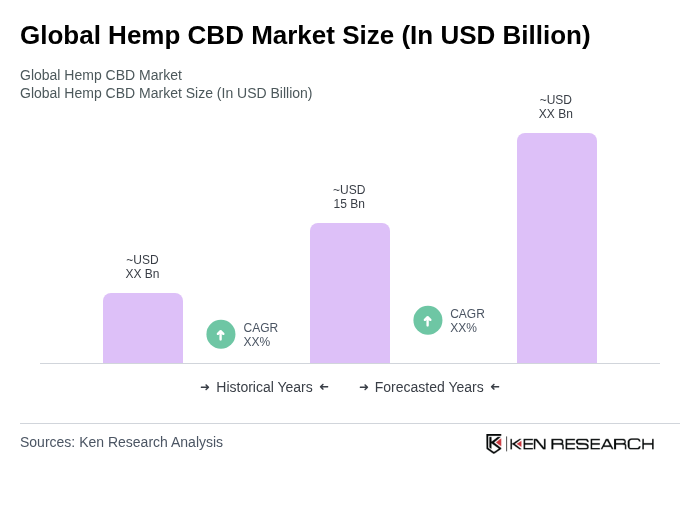
- The Global Hemp CBD Market is valued at USD 15 billion, based on recent analysis. Market expansion is propelled by rising consumer interest in natural wellness alternatives, expanding applications in personal care and therapeutic sectors, and innovative product formats such as topicals, edibles, and beverages. Regulatory liberalization and improving e-commerce infrastructure further complement demand growth, creating a favorable environment for continued market development.
- Key players in this market include Canopy Growth Corporation, Aphria, Ecofibre, ENDOCA, and HempMeds, which are advancing the market through product innovation and vertical integration. Market leadership is concentrated in North America, where a progressive regulatory framework, robust distribution channels, and mature wellness consumer base position the region as dominant, while Europe and Asia-Pacific are rapidly emerging due to changing legal stances and growing consumer awareness.
- In 2024, recent U.S. federal regulation includes tightened restrictions on hemp-derived products, limiting total THC content to no more than 0.4 milligrams per package. This move aims to protect minors and clarify legal standards, raising concerns about its impact on industry access and costs.
Global Hemp CBD Market Segmentation
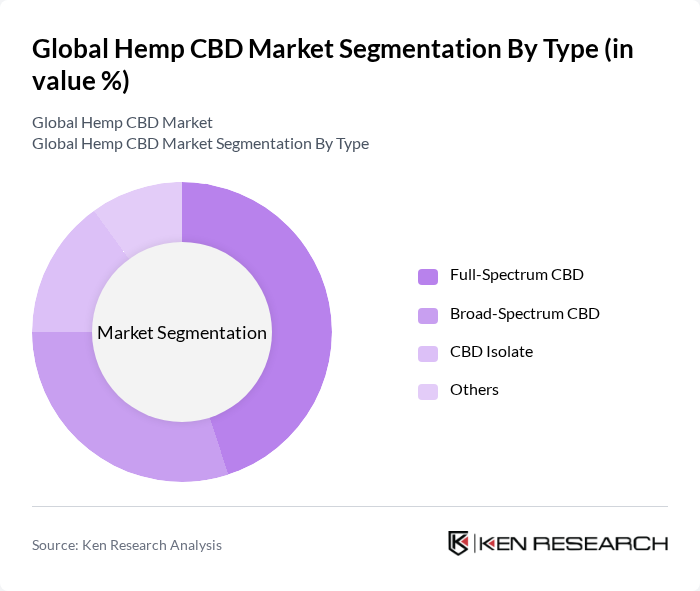
By Type:The market is segmented into Full-Spectrum CBD, Broad-Spectrum CBD, CBD Isolate, and Others. Full-Spectrum CBD is currently the leading sub-segment due to its holistic benefits, which appeal to health-conscious consumers seeking natural remedies. Broad-Spectrum CBD follows closely, offering similar benefits without THC, catering to those who prefer to avoid psychoactive effects. CBD Isolate, while popular for its purity, has a smaller market share as consumers increasingly favor full-spectrum products for their enhanced therapeutic effects.
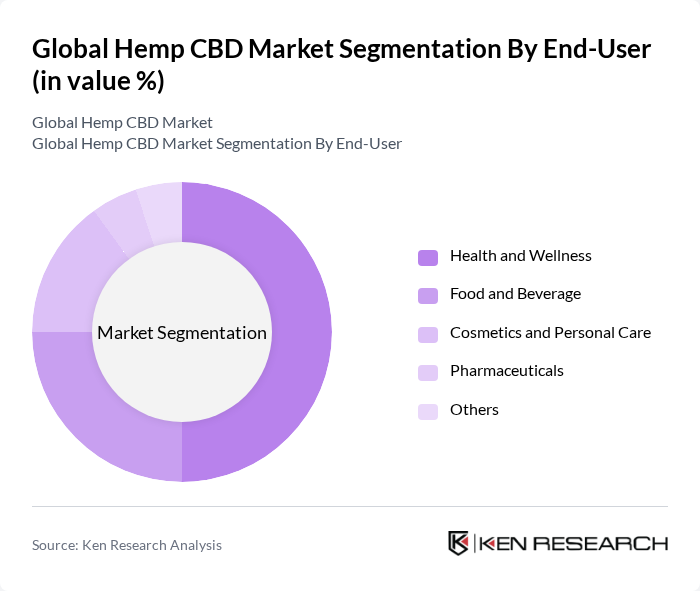
By End-User:The end-user segmentation includes Health and Wellness, Food and Beverage, Cosmetics and Personal Care, Pharmaceuticals, and Others. The Health and Wellness segment dominates the market, driven by increasing consumer awareness of the therapeutic benefits of CBD. This segment is followed by Food and Beverage, where CBD-infused products are gaining traction among consumers seeking functional foods. The Cosmetics and Personal Care segment is also growing, as brands incorporate CBD for its anti-inflammatory and moisturizing properties.
Global Hemp CBD Market Competitive Landscape
The Global Hemp CBD Market is characterized by a dynamic mix of regional and international players. Leading participants such as Charlotte's Web, CBDistillery, Medterra, Elixinol, Green Roads, NuLeaf Naturals, Joy Organics, Lazarus Naturals, PureKana, Hemp Bombs, Veritas Farms, Sunday Scaries, Receptra Naturals, Koi CBD, CBDfx contribute to innovation, geographic expansion, and service delivery in this space.
Global Hemp CBD Market Industry Analysis
Growth Drivers
- Increasing Consumer Awareness of Health Benefits:The global health and wellness market is projected to reach $4.5 trillion in the future, with consumers increasingly seeking natural remedies. A survey by the Hemp Business Journal indicates that 60% of CBD users report improved health outcomes, driving demand. Additionally, the World Health Organization recognizes CBD's potential therapeutic benefits, further enhancing consumer interest. This growing awareness is a significant factor propelling the hemp CBD market forward, as more individuals prioritize holistic health solutions.
- Expansion of Legal Frameworks Supporting CBD Use:As of the future, over 30 countries have legalized hemp-derived CBD, creating a more favorable regulatory environment. The U.S. alone has seen a 50% increase in states allowing CBD sales since the past few years. This legal expansion not only boosts market accessibility but also encourages investment in the sector. The establishment of clear regulations fosters consumer trust, which is essential for market growth, as businesses can operate within a defined legal framework, ensuring product safety and quality.
- Rising Demand for Natural and Organic Products:The organic personal care market is expected to reach $25 billion in the future, reflecting a shift towards natural ingredients. A report from Grand View Research shows that 70% of consumers prefer products with organic certifications. This trend is particularly evident in the beauty and wellness sectors, where CBD-infused products are gaining traction. The increasing consumer preference for organic and natural products is a key driver for the hemp CBD market, as brands align their offerings with these values.
Market Challenges
- Regulatory Uncertainties Across Different Regions:Despite progress, regulatory inconsistencies remain a significant challenge. For instance, while the U.S. has made strides, the European Union's regulations vary widely, with some countries still prohibiting CBD sales. This lack of uniformity complicates market entry for businesses and can lead to legal disputes. According to the European Industrial Hemp Association, 40% of companies cite regulatory hurdles as a primary barrier to growth, impacting overall market stability and expansion efforts.
- Stigma Associated with Cannabis Products:The lingering stigma surrounding cannabis products poses a challenge for the hemp CBD market. A recent study by the Pew Research Center found that 45% of Americans still view cannabis negatively. This perception can deter potential consumers from trying CBD products, limiting market growth. Additionally, negative media portrayals can influence public opinion, making it essential for companies to engage in educational campaigns to shift perceptions and promote the benefits of hemp-derived CBD.
Global Hemp CBD Market Future Outlook
The hemp CBD market is poised for significant growth as consumer preferences shift towards natural health solutions and regulatory frameworks continue to evolve. Innovations in product development, particularly in the food and beverage sectors, are expected to drive market expansion. Furthermore, as more countries legalize hemp-derived CBD, the potential for market penetration in emerging economies will increase. Companies that prioritize sustainability and transparency in their supply chains will likely gain a competitive edge, appealing to environmentally conscious consumers.
Market Opportunities
- Development of Innovative CBD-Infused Products:The demand for unique CBD-infused products, such as beverages and edibles, is on the rise. The global CBD beverage market is projected to reach $1.4 billion in the future, driven by consumer interest in functional drinks. Companies that invest in product innovation can capture this growing segment, appealing to health-conscious consumers seeking new experiences.
- Expansion into Emerging Markets:Emerging markets, particularly in Asia and Latin America, present significant growth opportunities for the hemp CBD sector. With a combined population of over 2.5 billion, these regions are witnessing increasing interest in wellness products. As regulations evolve, companies that strategically enter these markets can leverage early mover advantages, establishing brand loyalty and capturing market share in untapped demographics.
Scope of the Report
| Segment | Sub-Segments |
|---|---|
| By Type | Full-Spectrum CBD Broad-Spectrum CBD CBD Isolate Others |
| By End-User | Health and Wellness Food and Beverage Cosmetics and Personal Care Pharmaceuticals Others |
| By Distribution Channel | Online Retail Offline Retail Dispensaries Others |
| By Product Form | Oils and Tinctures Edibles Topicals Capsules and Softgels Others |
| By Source | Organic Hemp Conventional Hemp Others |
| By Region | North America Europe Asia-Pacific Latin America Middle East and Africa |
| By Regulatory Status | Legalized Restricted Prohibited Others |
Key Target Audience
Investors and Venture Capitalist Firms
Government and Regulatory Bodies (e.g., Food and Drug Administration, Drug Enforcement Administration)
Manufacturers and Producers
Distributors and Retailers
Pharmaceutical Companies
Cosmetic and Personal Care Brands
Health and Wellness Product Companies
Financial Institutions
Players Mentioned in the Report:
Charlotte's Web
CBDistillery
Medterra
Elixinol
Green Roads
NuLeaf Naturals
Joy Organics
Lazarus Naturals
PureKana
Hemp Bombs
Veritas Farms
Sunday Scaries
Receptra Naturals
Koi CBD
CBDfx
Table of Contents
Market Assessment Phase
1. Executive Summary and Approach
2. Global Hemp CBD Market Overview
2.1 Key Insights and Strategic Recommendations
2.2 Global Hemp CBD Market Overview
2.3 Definition and Scope
2.4 Evolution of Market Ecosystem
2.5 Timeline of Key Regulatory Milestones
2.6 Value Chain & Stakeholder Mapping
2.7 Business Cycle Analysis
2.8 Policy & Incentive Landscape
3. Global Hemp CBD Market Analysis
3.1 Growth Drivers
3.1.1 Increasing consumer awareness of health benefits
3.1.2 Expansion of legal frameworks supporting CBD use
3.1.3 Rising demand for natural and organic products
3.1.4 Growth in the wellness and beauty sectors
3.2 Market Challenges
3.2.1 Regulatory uncertainties across different regions
3.2.2 Stigma associated with cannabis products
3.2.3 Supply chain complexities and quality control
3.2.4 Competition from synthetic alternatives
3.3 Market Opportunities
3.3.1 Development of innovative CBD-infused products
3.3.2 Expansion into emerging markets
3.3.3 Collaborations with health and wellness brands
3.3.4 Increasing investment in research and development
3.4 Market Trends
3.4.1 Growth of e-commerce platforms for CBD sales
3.4.2 Rising popularity of CBD in food and beverages
3.4.3 Increased focus on sustainability in production
3.4.4 Customization and personalization of CBD products
3.5 Government Regulation
3.5.1 Legalization of hemp-derived CBD in various countries
3.5.2 Establishment of quality and safety standards
3.5.3 Taxation policies affecting CBD products
3.5.4 Restrictions on marketing and advertising of CBD
4. SWOT Analysis
5. Stakeholder Analysis
6. Porter's Five Forces Analysis
7. Global Hemp CBD Market Market Size, 2019-2024
7.1 By Value
7.2 By Volume
7.3 By Average Selling Price
8. Global Hemp CBD Market Segmentation
8.1 By Type
8.1.1 Full-Spectrum CBD
8.1.2 Broad-Spectrum CBD
8.1.3 CBD Isolate
8.1.4 Others
8.2 By End-User
8.2.1 Health and Wellness
8.2.2 Food and Beverage
8.2.3 Cosmetics and Personal Care
8.2.4 Pharmaceuticals
8.2.5 Others
8.3 By Distribution Channel
8.3.1 Online Retail
8.3.2 Offline Retail
8.3.3 Dispensaries
8.3.4 Others
8.4 By Product Form
8.4.1 Oils and Tinctures
8.4.2 Edibles
8.4.3 Topicals
8.4.4 Capsules and Softgels
8.4.5 Others
8.5 By Source
8.5.1 Organic Hemp
8.5.2 Conventional Hemp
8.5.3 Others
8.6 By Region
8.6.1 North America
8.6.2 Europe
8.6.3 Asia-Pacific
8.6.4 Latin America
8.6.5 Middle East and Africa
8.7 By Regulatory Status
8.7.1 Legalized
8.7.2 Restricted
8.7.3 Prohibited
8.7.4 Others
9. Global Hemp CBD Market Competitive Analysis
9.1 Market Share of Key Players
9.2 Cross Comparison of Key Players
9.2.1 Company Name
9.2.2 Group Size (Large, Medium, or Small as per industry convention)
9.2.3 Revenue Growth Rate
9.2.4 Market Penetration Rate
9.2.5 Customer Retention Rate
9.2.6 Pricing Strategy
9.2.7 Product Diversification Index
9.2.8 Brand Recognition Score
9.2.9 Distribution Efficiency
9.2.10 Innovation Rate
9.3 SWOT Analysis of Top Players
9.4 Pricing Analysis
9.5 Detailed Profile of Major Companies
9.5.1 Charlotte's Web
9.5.2 CBDistillery
9.5.3 Medterra
9.5.4 Elixinol
9.5.5 Green Roads
9.5.6 NuLeaf Naturals
9.5.7 Joy Organics
9.5.8 Lazarus Naturals
9.5.9 PureKana
9.5.10 Hemp Bombs
9.5.11 Veritas Farms
9.5.12 Sunday Scaries
9.5.13 Receptra Naturals
9.5.14 Koi CBD
9.5.15 CBDfx
10. Global Hemp CBD Market End-User Analysis
10.1 Procurement Behavior of Key Ministries
10.1.1 Government procurement policies
10.1.2 Budget allocation for CBD products
10.1.3 Evaluation criteria for suppliers
10.1.4 Compliance with health regulations
10.2 Corporate Spend on Infrastructure & Energy
10.2.1 Investment in CBD production facilities
10.2.2 Expenditure on research and development
10.2.3 Funding for marketing initiatives
10.2.4 Partnerships with distributors
10.3 Pain Point Analysis by End-User Category
10.3.1 Quality assurance issues
10.3.2 Supply chain disruptions
10.3.3 Price volatility
10.3.4 Limited product availability
10.4 User Readiness for Adoption
10.4.1 Awareness of CBD benefits
10.4.2 Accessibility of products
10.4.3 Consumer education initiatives
10.4.4 Feedback mechanisms for product improvement
10.5 Post-Deployment ROI and Use Case Expansion
10.5.1 Measurement of customer satisfaction
10.5.2 Analysis of repeat purchase rates
10.5.3 Evaluation of market expansion opportunities
10.5.4 Identification of new product lines
11. Global Hemp CBD Market Future Size, 2025-2030
11.1 By Value
11.2 By Volume
11.3 By Average Selling Price
Go-To-Market Strategy Phase
1. Whitespace Analysis + Business Model Canvas
1.1 Market gaps and opportunities
1.2 Business model components
1.3 Value proposition analysis
1.4 Revenue streams identification
1.5 Cost structure evaluation
1.6 Key partnerships and resources
1.7 Customer segments and relationships
2. Marketing and Positioning Recommendations
2.1 Branding strategies
2.2 Product USPs
2.3 Target audience identification
2.4 Communication strategies
2.5 Digital marketing tactics
2.6 Influencer partnerships
2.7 Customer engagement initiatives
3. Distribution Plan
3.1 Urban retail strategies
3.2 Rural NGO tie-ups
3.3 E-commerce platform integration
3.4 Wholesale distribution channels
3.5 Direct-to-consumer models
3.6 Logistics and supply chain management
3.7 Inventory management practices
4. Channel & Pricing Gaps
4.1 Underserved routes
4.2 Pricing bands analysis
4.3 Competitor pricing strategies
4.4 Customer willingness to pay
4.5 Discounting strategies
4.6 Bundling opportunities
4.7 Price elasticity considerations
5. Unmet Demand & Latent Needs
5.1 Category gaps
5.2 Consumer segments analysis
5.3 Product development opportunities
5.4 Market entry strategies
5.5 Customer feedback incorporation
5.6 Trend analysis for future needs
5.7 Innovation in product offerings
6. Customer Relationship
6.1 Loyalty programs
6.2 After-sales service
6.3 Customer feedback loops
6.4 Community engagement initiatives
6.5 Personalization of customer interactions
6.6 Customer education programs
6.7 Retention strategies
7. Value Proposition
7.1 Sustainability initiatives
7.2 Integrated supply chains
7.3 Unique selling propositions
7.4 Customer-centric approaches
7.5 Competitive advantages
7.6 Brand loyalty factors
7.7 Value delivery mechanisms
8. Key Activities
8.1 Regulatory compliance
8.2 Branding efforts
8.3 Distribution setup
8.4 Marketing campaigns
8.5 Product development
8.6 Customer service enhancements
8.7 Performance monitoring
9. Entry Strategy Evaluation
9.1 Domestic Market Entry Strategy
9.1.1 Product mix considerations
9.1.2 Pricing band strategies
9.1.3 Packaging innovations
9.2 Export Entry Strategy
9.2.1 Target countries analysis
9.2.2 Compliance roadmap development
10. Entry Mode Assessment
10.1 Joint Ventures
10.2 Greenfield Investments
10.3 Mergers & Acquisitions
10.4 Distributor Model
11. Capital and Timeline Estimation
11.1 Capital requirements
11.2 Timelines for market entry
12. Control vs Risk Trade-Off
12.1 Ownership considerations
12.2 Partnerships evaluation
13. Profitability Outlook
13.1 Breakeven analysis
13.2 Long-term sustainability strategies
14. Potential Partner List
14.1 Distributors
14.2 Joint Ventures
14.3 Acquisition targets
15. Execution Roadmap
15.1 Phased Plan for Market Entry
15.1.1 Market Setup
15.1.2 Market Entry
15.1.3 Growth Acceleration
15.1.4 Scale & Stabilize
15.2 Key Activities and Milestones
15.2.1 Activity timelines
15.2.2 Milestone tracking
Research Methodology
Phase 1: Approach1
Desk Research
- Market reports from industry associations such as the Hemp Industries Association
- Analysis of regulatory frameworks and compliance guidelines from the FDA and USDA
- Review of academic journals and publications focusing on CBD extraction and applications
Primary Research
- Interviews with key stakeholders in the hemp supply chain, including farmers and processors
- Surveys targeting retailers and distributors of CBD products to gauge market trends
- Focus groups with consumers to understand preferences and purchasing behavior
Validation & Triangulation
- Cross-validation of data from multiple sources, including trade publications and market surveys
- Triangulation of findings from expert interviews and consumer feedback
- Sanity checks through expert panel discussions to ensure data reliability
Phase 2: Market Size Estimation1
Top-down Assessment
- Estimation of total market size based on national CBD sales data and growth rates
- Segmentation by product type, including oils, edibles, and topicals
- Incorporation of regional market dynamics and consumer adoption rates
Bottom-up Modeling
- Collection of sales data from leading CBD brands and retailers
- Estimation of average selling prices across different product categories
- Volume estimates based on production capacities and market demand forecasts
Forecasting & Scenario Analysis
- Utilization of time-series analysis to project market growth through 2030
- Scenario modeling based on potential regulatory changes and market entry of new players
- Development of best-case, worst-case, and most-likely market scenarios
Phase 3: CATI Sample Composition1
| Scope Item/Segment | Sample Size | Target Respondent Profiles |
|---|---|---|
| Retail CBD Product Sales | 150 | Store Managers, Product Buyers |
| Hemp Farming Practices | 100 | Farm Owners, Agricultural Consultants |
| Consumer Preferences for CBD | 200 | End Consumers, Health and Wellness Enthusiasts |
| CBD Product Distribution Channels | 80 | Distributors, Supply Chain Managers |
| Regulatory Impact on CBD Market | 60 | Legal Advisors, Compliance Officers |
Frequently Asked Questions
What is the current value of the Global Hemp CBD Market?
The Global Hemp CBD Market is valued at approximately USD 15 billion, driven by increasing consumer interest in natural wellness alternatives and expanding applications in personal care and therapeutic sectors.
What factors are driving the growth of the Hemp CBD Market?
Who are the major players in the Global Hemp CBD Market?
How is the Hemp CBD Market segmented?
Other Regional/Country Reports
Indonesia Hemp CBD Market
Malaysia Hemp CBD Market
KSA Hemp CBD Market
APAC Hemp CBD Market
SEA Hemp CBD Market
Vietnam Hemp CBD Market
Other Adjacent Reports
South Korea Natural Wellness Products Market
Vietnam Personal Care Products Market Size, Share, Growth Drivers, Trends, Opportunities & Forecast 2025–2030Singapore Therapeutic Products Market
India E-commerce MarketUnited States Health and Wellness Market Outlook to 2030: Size, Share, Growth and TrendsKSA Food and Beverage Market Outlook to 2030APAC Global Cosmetics and Personal Care MarketGCC Pharmaceuticals Market Report Size Share Growth Drivers Trends Opportunities & Forecast 2025–2030GCC Organic Personal Care MarketIndonesia Functional Foods MarketWhy Buy From Us?

What makes us stand out is that our consultants follow Robust, Refine and Result (RRR) methodology. Robust for clear definitions, approaches and sanity checking, Refine for differentiating respondents' facts and opinions, and Result for presenting data with story.

We have set a benchmark in the industry by offering our clients with syndicated and customized market research reports featuring coverage of entire market as well as meticulous research and analyst insights.

While we don't replace traditional research, we flip the method upside down. Our dual approach of Top Bottom & Bottom Top ensures quality deliverable by not just verifying company fundamentals but also looking at the sector and macroeconomic factors.

With one step in the future, our research team constantly tries to show you the bigger picture. We help with some of the tough questions you may encounter along the way: How is the industry positioned? Best marketing channel? KPI's of competitors? By aligning every element, we help maximize success.

Our report gives you instant access to the answers and sources that other companies might choose to hide. We elaborate each steps of research methodology we have used and showcase you the sample size to earn your trust.

If you need any support, we are here! We pride ourselves on universe strength, data quality, and quick, friendly, and professional service.