Global Hvac Filter Change Service Market Report Size, Share, Growth Drivers, Trends, Opportunities & Forecast 2025–2030

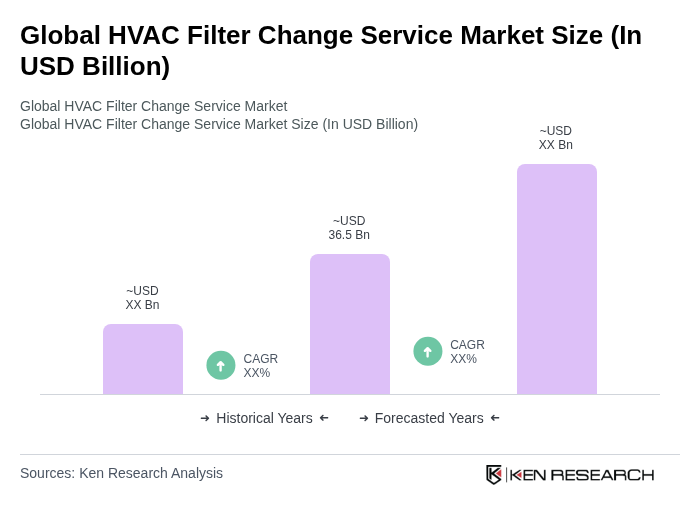
The Global HVAC Filter Change Service Market is valued at USD 36.5 billion, growing due to rising demand for clean air and efficient HVAC systems in residential and commercial sectors.

Region:Global

Author(s):Shubham

Product Code:KRAD6676

Pages:98

Published On:December 2025
About the Report

Base Year 2024

Global HVAC Filter Change Service Market Overview

  • The Global HVAC Filter Change Service Market is valued at USD 36.5 billion, based on a five-year historical analysis of the dedicated HVAC filter change service segment within the broader HVAC services market. This growth is primarily driven by increasing awareness of indoor air quality, rising demand for energy-efficient HVAC systems, stricter building performance standards, and a growing trend toward preventive and predictive maintenance contracts among residential, commercial, and industrial end users.
  • Key country-level demand centers in this market include the United States, Germany, and China, supported by large installed bases of HVAC equipment, advanced building infrastructure, high levels of industrialization, and stringent standards regarding filtration efficiency, indoor air quality, and energy performance. These countries have extensive commercial, industrial, and residential HVAC penetration, which in turn sustains recurring demand for professional filter change and maintenance services.
  • In the United States, federal clean air and building-related requirements, together with state and local codes, reinforce the role of regular HVAC maintenance and filter replacement in maintaining acceptable indoor air quality. For example, the Clean Air Act, administered by the U.S. Environmental Protection Agency (EPA), establishes National Ambient Air Quality Standards and related control measures that influence building ventilation and filtration requirements, while ASHRAE Standard 62.1 “Ventilation for Acceptable Indoor Air Quality” sets minimum ventilation and filtration performance levels that building owners and operators commonly follow to support occupant health and regulatory compliance.
Global HVAC Filter Change Service Market Size

Global HVAC Filter Change Service Market Segmentation

By Service Type:The service type segmentation includes various methods of HVAC filter change services, which cater to different consumer needs and preferences.
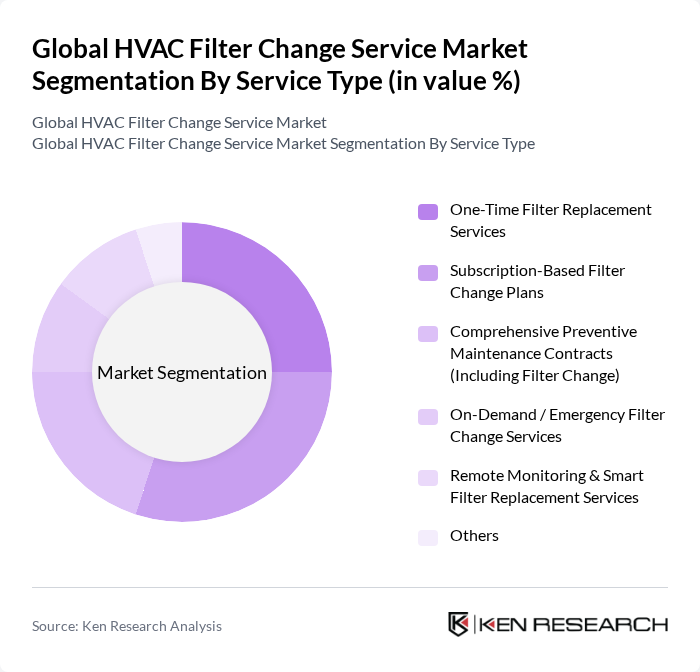
Global HVAC Filter Change Service Market segmentation by Service Type.

The subscription-based filter change plans segment is currently one of the most attractive and rapidly growing models in the market, supported by the increasing preference for convenience, predictable costs, and scheduled maintenance among consumers and facility managers. This model allows homeowners and businesses to ensure their HVAC systems are consistently serviced without the hassle of ad hoc scheduling, often bundling filter replacement with broader maintenance and inspection services. Additionally, the rise of smart thermostats, connected HVAC equipment, and Wi?Fi–enabled air quality sensors has led to a growing interest in remote monitoring and smart filter replacement services, where filter life and air quality are tracked digitally and service visits are automated. As end users become more aware of the links between air quality, energy efficiency, and operating costs, this segment is expected to maintain strong momentum relative to traditional one?time services.

By End-User:The end-user segmentation encompasses various sectors that utilize HVAC filter change services, reflecting the diverse applications of these services.
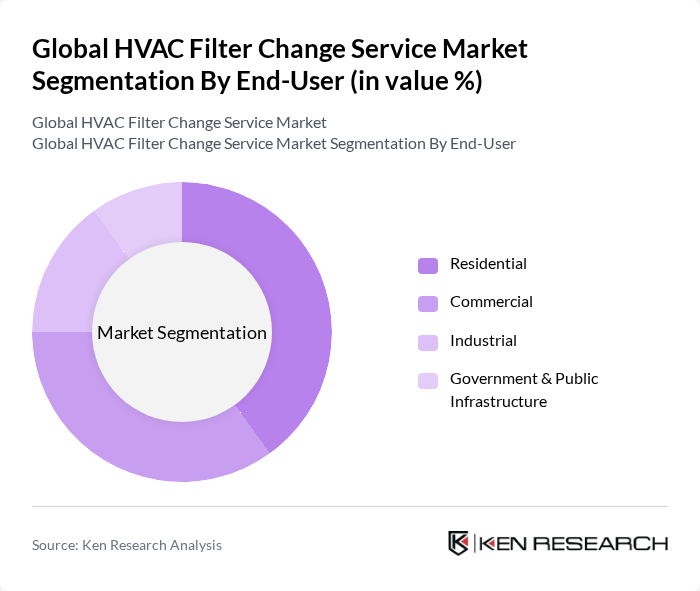
Global HVAC Filter Change Service Market segmentation by End-User.

The residential segment is the largest end-user category, driven by the increasing number of households equipped with central HVAC systems and room units, along with heightened awareness of indoor air quality and health among occupants. Homeowners are becoming more proactive about maintenance as manufacturers, utilities, and service companies promote regular filter changes to improve comfort, manage energy bills, and protect equipment, leading to growing adoption of packaged maintenance plans and do?it?for?me filter services. The commercial sector follows closely, as offices, retail, healthcare, hospitality, and data centers prioritize filtration performance to comply with building codes, green building certifications, and corporate ESG targets, while also enhancing employee productivity and customer experience. The industrial and government segments also contribute meaningfully to demand, particularly in facilities such as manufacturing plants, cleanrooms, laboratories, schools, hospitals, and transport hubs, where higher filtration efficiencies, specialized filter media, and documented maintenance schedules are required to support safety, uptime, and occupant health.

Global HVAC Filter Change Service Market Competitive Landscape

The Global HVAC Filter Change Service Market is characterized by a dynamic mix of regional and international players. Leading participants such as Trane Technologies plc, Carrier Global Corporation, Lennox International Inc., Honeywell International Inc., Daikin Industries, Ltd., Johnson Controls International plc, Rheem Manufacturing Company, Goodman Manufacturing Company, L.P., American Standard Heating & Air Conditioning, Mitsubishi Electric Corporation, Fujitsu General Limited, Bosch Thermotechnology GmbH, Nortek Global HVAC, LLC, Aprilaire (Research Products Corporation), FilterBuy, Inc. contribute to innovation, geographic expansion, and service delivery in this space.

Trane Technologies plc

1913

Dublin, Ireland

Carrier Global Corporation

1915

Palm Beach Gardens, Florida, USA

Lennox International Inc.

1895

Richardson, Texas, USA

Honeywell International Inc.

1906

Charlotte, North Carolina, USA

Daikin Industries, Ltd.

1924

Osaka, Japan

Company

Establishment Year

Headquarters

Service Portfolio Breadth (Filter Types, Equipment Covered)

Geographic Coverage (Regions / Countries Served)

Installed Base / Number of Active Service Contracts

Average Contract Value (ACV)

Recurring Revenue Share (Subscription & AMC)

Average Service Response Time (On-Site)

Global HVAC Filter Change Service Market Industry Analysis

Growth Drivers

  • Increasing Awareness of Indoor Air Quality:The global focus on health has led to a significant rise in awareness regarding indoor air quality. According to the World Health Organization, poor indoor air quality contributes to approximately 4.3 million premature deaths annually. In future, the demand for HVAC filter change services is expected to increase as consumers prioritize cleaner air, with the indoor air quality market projected to reach $12 billion, driving the need for regular filter changes.
  • Rising Demand for Energy-Efficient HVAC Systems:The global HVAC market is projected to reach $250 billion in future, with a significant shift towards energy-efficient systems. Energy-efficient HVAC systems not only reduce energy consumption but also require regular maintenance, including filter changes. The U.S. Department of Energy estimates that energy-efficient systems can save consumers up to $250 annually, further driving the demand for filter change services as homeowners seek to maximize their investments.
  • Government Regulations Promoting Regular Maintenance:Governments worldwide are implementing stricter regulations to improve energy efficiency and indoor air quality. For instance, the U.S. Environmental Protection Agency has established guidelines that encourage regular HVAC maintenance, including filter changes. In future, compliance with these regulations is expected to increase service demand, as businesses and homeowners aim to adhere to standards that can lead to energy savings of up to 35% annually.

Market Challenges

  • High Initial Costs of HVAC Systems:The initial investment for HVAC systems can be substantial, often exceeding $6,000 for residential installations. This high upfront cost can deter consumers from opting for professional filter change services, as many may prioritize immediate savings over long-term maintenance. Consequently, this challenge can hinder the growth of the HVAC filter change service market, particularly in price-sensitive regions.
  • Lack of Consumer Awareness About Filter Change Importance:Despite the known benefits of regular filter changes, many consumers remain unaware of their significance. A survey by the American Lung Association indicates that only 35% of homeowners understand the impact of dirty filters on air quality and system efficiency. This lack of awareness can lead to infrequent service usage, posing a challenge for service providers aiming to educate consumers on the necessity of regular maintenance.

Global HVAC Filter Change Service Market Future Outlook

The HVAC filter change service market is poised for significant growth as awareness of indoor air quality and energy efficiency continues to rise. With increasing government regulations and a shift towards smart HVAC systems, service providers are likely to see enhanced demand. Additionally, the integration of IoT technology will facilitate proactive maintenance, ensuring timely filter changes. As consumers become more environmentally conscious, the market will likely adapt to offer sustainable and eco-friendly filter options, further driving growth in the coming years.

Market Opportunities

  • Expansion into Emerging Markets:Emerging markets, particularly in Asia and Africa, present significant growth opportunities for HVAC filter change services. With urbanization rates projected to reach 60% in future, the demand for HVAC systems will increase, necessitating regular maintenance services. This expansion can lead to a potential market size increase of over $1.2 billion in these regions.
  • Development of Smart HVAC Systems:The rise of smart home technology is creating opportunities for HVAC filter change services. Smart HVAC systems equipped with IoT capabilities can monitor filter conditions and send alerts for changes. This innovation is expected to enhance service demand, as homeowners increasingly seek automated solutions, potentially increasing service contracts by 25% in future.

Scope of the Report

SegmentSub-Segments
By Service Type

One-Time Filter Replacement Services

Subscription-Based Filter Change Plans

Comprehensive Preventive Maintenance Contracts (Including Filter Change)

On-Demand / Emergency Filter Change Services

Remote Monitoring & Smart Filter Replacement Services

Others

By End-User

Residential

Commercial

Industrial

Government & Public Infrastructure

By Service Frequency

Monthly

Quarterly

Bi-Annually

Annually

Condition-Based / As-Needed

By Filter Material Serviced

Fiberglass Filters

Synthetic / Polyester Filters

Metal Mesh Filters

Pleated Paper Filters

Activated Carbon / Odor Control Filters

HEPA & High-Efficiency Filters

Others

By Service Delivery Channel

OEM-Authorized Service Providers

Independent HVAC Contractors

Facility Management & Integrated FM Companies

Online Platforms & Subscription Services

Retail / Home Improvement Service Programs

Others

By Region

North America

Europe

Asia-Pacific

Latin America

Middle East & Africa

By Customer Segment

Homeowners

Property Managers & Landlords

HVAC Service Companies & Contractors

Facility & Operations Managers

Healthcare & Cleanroom Operators

Others

Key Target Audience

Investors and Venture Capitalist Firms

Government and Regulatory Bodies (e.g., Environmental Protection Agency, Department of Energy)

Manufacturers and Producers of HVAC Systems

Distributors and Retailers of HVAC Filters

Facility Management Companies

Building Contractors and Developers

Energy Efficiency Organizations

Maintenance and Service Providers

Players Mentioned in the Report:

Trane Technologies plc

Carrier Global Corporation

Lennox International Inc.

Honeywell International Inc.

Daikin Industries, Ltd.

Johnson Controls International plc

Rheem Manufacturing Company

Goodman Manufacturing Company, L.P.

American Standard Heating & Air Conditioning

Mitsubishi Electric Corporation

Fujitsu General Limited

Bosch Thermotechnology GmbH

Nortek Global HVAC, LLC

Aprilaire (Research Products Corporation)

FilterBuy, Inc.

Table of Contents

Market Assessment Phase

1. Executive Summary and Approach


2. Global HVAC Filter Change Service Market Overview

2.1 Key Insights and Strategic Recommendations

2.2 Global HVAC Filter Change Service Market Overview

2.3 Definition and Scope

2.4 Evolution of Market Ecosystem

2.5 Timeline of Key Regulatory Milestones

2.6 Value Chain & Stakeholder Mapping

2.7 Business Cycle Analysis

2.8 Policy & Incentive Landscape


3. Global HVAC Filter Change Service Market Analysis

3.1 Growth Drivers

3.1.1 Increasing awareness of indoor air quality
3.1.2 Rising demand for energy-efficient HVAC systems
3.1.3 Government regulations promoting regular maintenance
3.1.4 Growth in residential and commercial construction

3.2 Market Challenges

3.2.1 High initial costs of HVAC systems
3.2.2 Lack of consumer awareness about filter change importance
3.2.3 Competition from DIY solutions
3.2.4 Supply chain disruptions affecting service delivery

3.3 Market Opportunities

3.3.1 Expansion into emerging markets
3.3.2 Development of smart HVAC systems
3.3.3 Partnerships with construction companies
3.3.4 Increased focus on sustainability and eco-friendly products

3.4 Market Trends

3.4.1 Growing adoption of subscription-based services
3.4.2 Integration of IoT in HVAC systems
3.4.3 Shift towards automated filter change reminders
3.4.4 Rising popularity of HEPA filters

3.5 Government Regulation

3.5.1 Energy efficiency standards for HVAC systems
3.5.2 Regulations on indoor air quality
3.5.3 Incentives for using eco-friendly filters
3.5.4 Compliance requirements for HVAC service providers

4. SWOT Analysis


5. Stakeholder Analysis


6. Porter's Five Forces Analysis


7. Global HVAC Filter Change Service Market Size, 2019-2024

7.1 By Value

7.2 By Volume

7.3 By Average Selling Price


8. Global HVAC Filter Change Service Market Segmentation

8.1 By Service Type

8.1.1 One-Time Filter Replacement Services
8.1.2 Subscription-Based Filter Change Plans
8.1.3 Comprehensive Preventive Maintenance Contracts (Including Filter Change)
8.1.4 On-Demand / Emergency Filter Change Services
8.1.5 Remote Monitoring & Smart Filter Replacement Services
8.1.6 Others

8.2 By End-User

8.2.1 Residential
8.2.2 Commercial
8.2.3 Industrial
8.2.4 Government & Public Infrastructure

8.3 By Service Frequency

8.3.1 Monthly
8.3.2 Quarterly
8.3.3 Bi-Annually
8.3.4 Annually
8.3.5 Condition-Based / As-Needed

8.4 By Filter Material Serviced

8.4.1 Fiberglass Filters
8.4.2 Synthetic / Polyester Filters
8.4.3 Metal Mesh Filters
8.4.4 Pleated Paper Filters
8.4.5 Activated Carbon / Odor Control Filters
8.4.6 HEPA & High-Efficiency Filters
8.4.7 Others

8.5 By Service Delivery Channel

8.5.1 OEM-Authorized Service Providers
8.5.2 Independent HVAC Contractors
8.5.3 Facility Management & Integrated FM Companies
8.5.4 Online Platforms & Subscription Services
8.5.5 Retail / Home Improvement Service Programs
8.5.6 Others

8.6 By Region

8.6.1 North America
8.6.2 Europe
8.6.3 Asia-Pacific
8.6.4 Latin America
8.6.5 Middle East & Africa

8.7 By Customer Segment

8.7.1 Homeowners
8.7.2 Property Managers & Landlords
8.7.3 HVAC Service Companies & Contractors
8.7.4 Facility & Operations Managers
8.7.5 Healthcare & Cleanroom Operators
8.7.6 Others

9. Global HVAC Filter Change Service Market Competitive Analysis

9.1 Market Share of Key Players

9.2 Cross Comparison of Key Players

9.2.1 Company Name
9.2.2 Service Portfolio Breadth (Filter Types, Equipment Covered)
9.2.3 Geographic Coverage (Regions / Countries Served)
9.2.4 Installed Base / Number of Active Service Contracts
9.2.5 Average Contract Value (ACV)
9.2.6 Recurring Revenue Share (Subscription & AMC)
9.2.7 Average Service Response Time (On-Site)
9.2.8 First-Time Fix Rate
9.2.9 Filter Change Compliance Rate (On-Time Visits %)
9.2.10 Customer Retention Rate
9.2.11 Net Promoter Score (NPS) / Customer Satisfaction Score
9.2.12 Safety Incident Rate per 1,000 Service Visits
9.2.13 Revenue Growth Rate (3–5 Year CAGR)
9.2.14 Digital / Remote Monitoring Adoption (% of Contracts)

9.3 SWOT Analysis of Top Players

9.4 Pricing Analysis

9.5 Detailed Profile of Major Companies

9.5.1 Trane Technologies plc
9.5.2 Carrier Global Corporation
9.5.3 Lennox International Inc.
9.5.4 Honeywell International Inc.
9.5.5 Daikin Industries, Ltd.
9.5.6 Johnson Controls International plc
9.5.7 Rheem Manufacturing Company
9.5.8 Goodman Manufacturing Company, L.P.
9.5.9 American Standard Heating & Air Conditioning
9.5.10 Mitsubishi Electric Corporation
9.5.11 Fujitsu General Limited
9.5.12 Bosch Thermotechnology GmbH
9.5.13 Nortek Global HVAC, LLC
9.5.14 Aprilaire (Research Products Corporation)
9.5.15 FilterBuy, Inc.

10. Global HVAC Filter Change Service Market End-User Analysis

10.1 Procurement Behavior of Key Ministries

10.1.1 Budget Allocation for HVAC Services
10.1.2 Decision-Making Process
10.1.3 Preferred Service Providers
10.1.4 Compliance Requirements

10.2 Corporate Spend on Infrastructure & Energy

10.2.1 Investment Trends in HVAC Maintenance
10.2.2 Budgeting for Energy Efficiency
10.2.3 Long-term Contracts with Service Providers
10.2.4 Impact of Energy Costs on Spending

10.3 Pain Point Analysis by End-User Category

10.3.1 Common Maintenance Issues
10.3.2 Cost Concerns
10.3.3 Service Reliability
10.3.4 Knowledge Gaps in HVAC Management

10.4 User Readiness for Adoption

10.4.1 Awareness of Filter Change Importance
10.4.2 Willingness to Pay for Services
10.4.3 Adoption of Smart HVAC Solutions
10.4.4 Feedback on Current Services

10.5 Post-Deployment ROI and Use Case Expansion

10.5.1 Measurement of Energy Savings
10.5.2 Customer Satisfaction Metrics
10.5.3 Opportunities for Upselling
10.5.4 Long-term Maintenance Contracts

11. Global HVAC Filter Change Service Market Future Size, 2025-2030

11.1 By Value

11.2 By Volume

11.3 By Average Selling Price


Go-To-Market Strategy Phase

1. Whitespace Analysis + Business Model Canvas

1.1 Market Gaps Identification

1.2 Value Proposition Development

1.3 Revenue Streams Analysis

1.4 Cost Structure Evaluation

1.5 Key Partnerships Identification

1.6 Customer Segmentation

1.7 Channels to Market


2. Marketing and Positioning Recommendations

2.1 Branding Strategies

2.2 Product USPs

2.3 Target Audience Identification

2.4 Communication Strategy

2.5 Digital Marketing Tactics

2.6 Offline Marketing Strategies

2.7 Performance Metrics


3. Distribution Plan

3.1 Urban Retail Strategies

3.2 Rural NGO Tie-ups

3.3 E-commerce Integration

3.4 Direct Sales Force Development

3.5 Distribution Partnerships

3.6 Logistics and Supply Chain Management

3.7 Performance Tracking


4. Channel & Pricing Gaps

4.1 Underserved Routes

4.2 Pricing Bands Analysis

4.3 Competitor Pricing Comparison

4.4 Customer Willingness to Pay

4.5 Value-Based Pricing Strategies

4.6 Dynamic Pricing Models

4.7 Pricing Strategy Evaluation


5. Unmet Demand & Latent Needs

5.1 Category Gaps Identification

5.2 Consumer Segments Analysis

5.3 Emerging Trends Exploration

5.4 Customer Feedback Integration

5.5 Product Development Opportunities

5.6 Market Entry Strategies

5.7 Future Demand Projections


6. Customer Relationship

6.1 Loyalty Programs

6.2 After-sales Service Enhancements

6.3 Customer Engagement Strategies

6.4 Feedback Mechanisms

6.5 Relationship Management Tools

6.6 Performance Metrics

6.7 Long-term Relationship Building


7. Value Proposition

7.1 Sustainability Initiatives

7.2 Integrated Supply Chains

7.3 Customer-Centric Innovations

7.4 Competitive Differentiation

7.5 Value Communication Strategies

7.6 Performance Metrics

7.7 Long-term Value Creation


8. Key Activities

8.1 Regulatory Compliance

8.2 Branding Initiatives

8.3 Distribution Setup

8.4 Training and Development

8.5 Performance Monitoring

8.6 Stakeholder Engagement

8.7 Continuous Improvement Processes


9. Entry Strategy Evaluation

9.1 Domestic Market Entry Strategy

9.1.1 Product Mix Considerations
9.1.2 Pricing Band Analysis
9.1.3 Packaging Strategies

9.2 Export Entry Strategy

9.2.1 Target Countries Identification
9.2.2 Compliance Roadmap Development

10. Entry Mode Assessment

10.1 Joint Ventures

10.2 Greenfield Investments

10.3 Mergers & Acquisitions

10.4 Distributor Model Evaluation

10.5 Risk Assessment

10.6 Strategic Fit Analysis

10.7 Performance Metrics


11. Capital and Timeline Estimation

11.1 Capital Requirements

11.2 Timelines for Implementation

11.3 Financial Projections

11.4 Funding Sources

11.5 Risk Management Strategies

11.6 Performance Metrics


12. Control vs Risk Trade-Off

12.1 Ownership vs Partnerships

12.2 Risk Mitigation Strategies

12.3 Control Mechanisms

12.4 Performance Metrics

12.5 Long-term Sustainability Considerations


13. Profitability Outlook

13.1 Breakeven Analysis

13.2 Long-term Sustainability

13.3 Financial Health Indicators

13.4 Profit Margin Projections

13.5 Performance Metrics


14. Potential Partner List

14.1 Distributors

14.2 Joint Ventures

14.3 Acquisition Targets

14.4 Strategic Alliances

14.5 Performance Metrics


15. Execution Roadmap

15.1 Phased Plan for Market Entry

15.1.1 Market Setup
15.1.2 Market Entry
15.1.3 Growth Acceleration</

Research Methodology

ApproachModellingSample

Phase 1: Approach1

Desk Research

  • Industry reports from HVAC associations and market research firms
  • Government publications on energy efficiency and environmental regulations
  • Academic journals and white papers on HVAC technologies and trends

Primary Research

  • Interviews with HVAC service providers and maintenance professionals
  • Surveys targeting facility managers and building operators
  • Field interviews with HVAC equipment manufacturers and distributors

Validation & Triangulation

  • Cross-validation of data from multiple industry sources and reports
  • Triangulation of findings from primary interviews and secondary data
  • Sanity checks through expert panels comprising HVAC industry veterans

Phase 2: Market Size Estimation1

Top-down Assessment

  • Analysis of global HVAC market size and growth trends
  • Segmentation by geographic regions and end-user industries
  • Incorporation of trends in energy efficiency and sustainability initiatives

Bottom-up Modeling

  • Estimation of service frequency based on HVAC system types and usage
  • Cost analysis of filter change services across different market segments
  • Volume estimates based on the number of HVAC units in operation

Forecasting & Scenario Analysis

  • Multi-variable regression analysis considering economic indicators and climate policies
  • Scenario modeling based on technological advancements and market disruptions
  • Baseline, optimistic, and pessimistic forecasts through 2030

Phase 3: CATI Sample Composition1

Scope Item/SegmentSample SizeTarget Respondent Profiles
Commercial HVAC Maintenance120Facility Managers, HVAC Technicians
Residential HVAC Services110Homeowners, Property Managers
Industrial HVAC Systems90Operations Managers, Maintenance Supervisors
HVAC Filter Manufacturing60Product Development Managers, Sales Directors
Energy Efficiency Programs70Energy Auditors, Sustainability Coordinators

Frequently Asked Questions

What is the current value of the Global HVAC Filter Change Service Market?

The Global HVAC Filter Change Service Market is valued at approximately USD 36.5 billion, reflecting a significant growth trend driven by increasing awareness of indoor air quality and the demand for energy-efficient HVAC systems.

What factors are driving the growth of the HVAC Filter Change Service Market?

Which regions are the largest markets for HVAC filter change services?

What are the main service types offered in the HVAC Filter Change Service Market?

Other Regional/Country Reports

Indonesia HVAC Filter Change Service Market

Malaysia HVAC Filter Change Service Market

KSA HVAC Filter Change Service Market

APAC HVAC Filter Change Service Market

SEA HVAC Filter Change Service Market

Vietnam HVAC Filter Change Service Market

Other Adjacent Reports

Ksa Hvac Maintenance Services Market Report Size, Share, Growth Drivers, Trends, Opportunities & Forecast 2025–2030

UAE Indoor Air Quality Monitoring Market

Vietnam Air Filter Manufacturing Market

Japan Energy Efficient HVAC Systems Market

Saudi Arabia Building Automation Systems Market Size, Share, Trends & Forecast 2025–2030

Qatar Commercial HVAC Installation Market

Belgium Residential HVAC Services Market

Oman Smart Thermostat Market Report Size Share Growth Drivers Trends Opportunities & Forecast 2025–2030UAE Ventilation Equipment Market

Bahrain Air Purification Systems Market

Why Buy From Us?

Refine Robust Result (RRR) Framework

What makes us stand out is that our consultants follow Robust, Refine and Result (RRR) methodology. Robust for clear definitions, approaches and sanity checking, Refine for differentiating respondents' facts and opinions, and Result for presenting data with story.

Our Reach Is Unmatched

We have set a benchmark in the industry by offering our clients with syndicated and customized market research reports featuring coverage of entire market as well as meticulous research and analyst insights.

Shifting the Research Paradigm

While we don't replace traditional research, we flip the method upside down. Our dual approach of Top Bottom & Bottom Top ensures quality deliverable by not just verifying company fundamentals but also looking at the sector and macroeconomic factors.

More Insights-Better Decisions

With one step in the future, our research team constantly tries to show you the bigger picture. We help with some of the tough questions you may encounter along the way: How is the industry positioned? Best marketing channel? KPI's of competitors? By aligning every element, we help maximize success.

Transparency and Trust

Our report gives you instant access to the answers and sources that other companies might choose to hide. We elaborate each steps of research methodology we have used and showcase you the sample size to earn your trust.

Round the Clock Support

If you need any support, we are here! We pride ourselves on universe strength, data quality, and quick, friendly, and professional service.

Why Clients Choose Us?

400000+
Reports in repository
150+
Consulting projects a year
100+
Analysts
8000+
Client Queries in 2022








