About the Report
Base Year 2024Global Hydrocolloids Market Overview
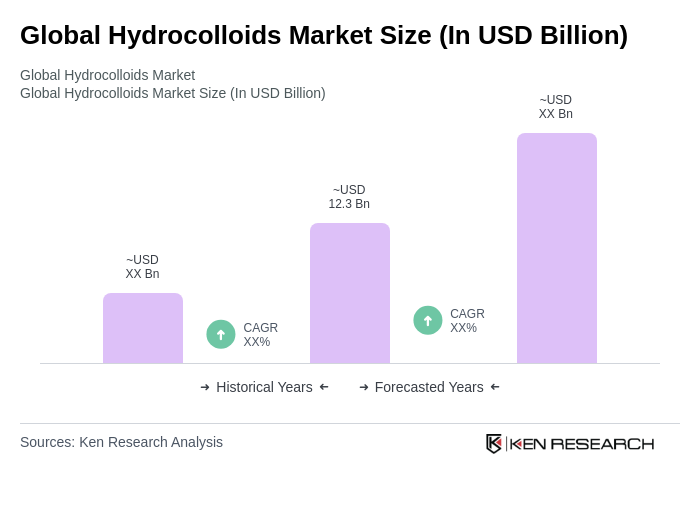
- The Global Hydrocolloids Market is valued at approximately USD 12.3 billion, based on a five-year analysis. Multiple industry trackers place the market in the low-to-mid teens in recent assessments, with IMARC reporting USD 12.5 billion and other analysts citing a similar range, reflecting robust demand across food, pharmaceuticals, and personal care driven by clean-label adoption and functionality needs in texture, stabilization, and emulsification .
- Key players in this market include the United States, Germany, and China, which are leading hubs due to advanced processing capacity, strong ingredient R&D ecosystems, and deep integration with global food and beverage supply chains; industry coverage consistently identifies North America, Europe (notably Germany), and Asia (notably China) as core production and demand centers for hydrocolloids and related specialty ingredients .
- In 2023, the European Union advanced food additive regulatory oversight under the General Food Law and additive framework, reinforcing labeling transparency for additive names/E-numbers and purity specifications maintained in Union lists; ongoing re-evaluations and guidance updates by EFSA and the Commission underpin stricter information requirements that affect hydrocolloids used as food additives .
Global Hydrocolloids Market Segmentation
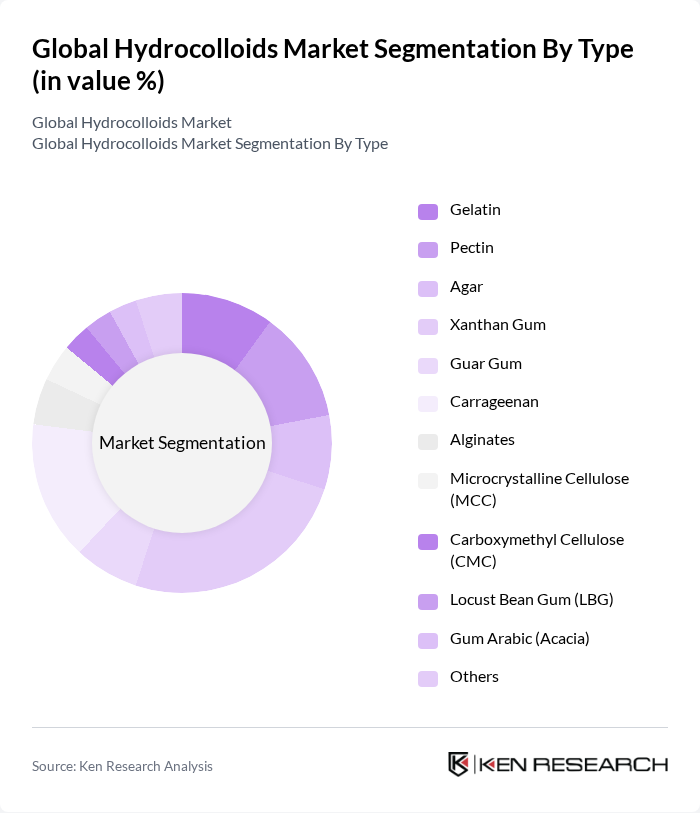
By Type:The hydrocolloids market is segmented into various types, including Gelatin, Pectin, Agar, Xanthan Gum, Guar Gum, Carrageenan, Alginates, Microcrystalline Cellulose (MCC), Carboxymethyl Cellulose (CMC), Locust Bean Gum (LBG), Gum Arabic (Acacia), and Others. Among these, Xanthan Gum is currently the leading subsegment due to its widespread use in food and beverage applications, particularly in gluten-free products and sauces; recent industry analyses highlight xanthan gum’s role as a versatile thickener/stabilizer across food, cosmetics, pharma, and oilfield applications, supported by clean-label and gluten-free trends .
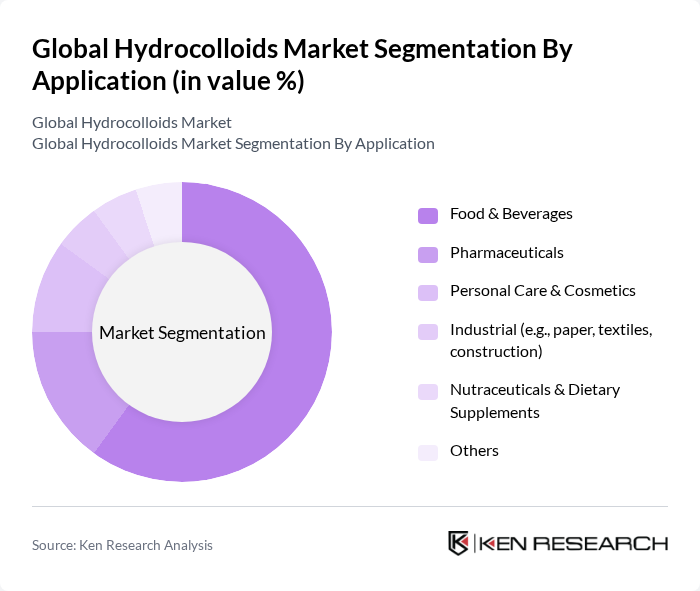
By Application:The applications of hydrocolloids span across various sectors, including Food & Beverages, Pharmaceuticals, Personal Care & Cosmetics, Industrial (e.g., paper, textiles, construction), Nutraceuticals & Dietary Supplements, and Others. The Food & Beverages segment is the largest application area, driven by the increasing demand for processed foods and the need for texture and stability in food products; industry reports point to expanding use in dairy, bakery, beverages, and plant-based alternatives aligning with clean-label and functionality requirements .
Global Hydrocolloids Market Competitive Landscape
The Global Hydrocolloids Market is characterized by a dynamic mix of regional and international players. Leading participants such as Ingredion Incorporated, Cargill, Incorporated, CP Kelco U.S., Inc. (J.M. Huber Corporation), DuPont Nutrition & Biosciences (IFF Health & Biosciences), Tate & Lyle PLC, Kerry Group plc, Nexira, Fufeng Group Company Limited, Gelita AG, PB Leiner (part of Tessenderlo Group), Darling Ingredients (Rousselot), W Hydrocolloids, Inc., Givaudan S.A. (Naturex), Ashland Inc., Symrise AG (Diana Food), Roquette Frères, Jungbunzlauer Suisse AG, FMC Corporation (Alginate business legacy), LBG Sicilia S.r.l., AEP Colloids contribute to innovation, geographic expansion, and service delivery in this space .
Global Hydrocolloids Market Industry Analysis
Growth Drivers
- Increasing Demand for Natural Ingredients:The global shift towards natural ingredients is evident, with the natural food market projected to reach $300 billion in the future. This trend is driven by consumer preferences for clean label products, as 70% of consumers actively seek natural ingredients in their food. The hydrocolloids sector benefits significantly, as these ingredients are essential for texture and stability in natural formulations, thus driving demand in the food industry.
- Expanding Applications in Food and Beverage Industry:The food and beverage sector is a major consumer of hydrocolloids, with an estimated consumption of 1.5 million tons in the future. Hydrocolloids are increasingly used in dairy, bakery, and meat products for their gelling and thickening properties. The rise in convenience foods, projected to grow by $100 billion in the future, further propels the demand for hydrocolloids, as manufacturers seek to enhance product quality and shelf life.
- Rising Health Consciousness Among Consumers:Health consciousness is driving the demand for functional foods, with the global functional food market expected to reach $275 billion in the future. Consumers are increasingly looking for products that offer health benefits, such as improved digestion and weight management. Hydrocolloids, known for their health benefits, such as fiber content and low-calorie properties, are becoming integral in formulating healthier food options, thus boosting their market presence.
Market Challenges
- Fluctuating Raw Material Prices:The hydrocolloid industry faces significant challenges due to the volatility of raw material prices, particularly for natural sources like seaweed and plant extracts. For instance, the price of carrageenan has seen fluctuations of up to 30% in recent years, impacting production costs. This instability can lead to increased prices for end products, potentially reducing demand as manufacturers seek cost-effective alternatives.
- Stringent Regulatory Compliance:The hydrocolloid market is subject to rigorous regulatory standards, particularly in food safety and labeling. In the future, compliance costs are expected to rise by 15% due to new regulations in key markets like the EU and North America. These regulations can create barriers for smaller manufacturers, limiting their ability to compete effectively and potentially stifling innovation within the industry.
Global Hydrocolloids Market Future Outlook
The future of the hydrocolloids market appears promising, driven by increasing consumer demand for natural and functional food products. Innovations in hydrocolloid applications, particularly in plant-based and clean label products, are expected to enhance market growth. Additionally, the expansion into emerging economies, where rising disposable incomes and changing dietary preferences are evident, will provide new avenues for market players. Companies that adapt to these trends will likely gain a competitive edge in the evolving landscape.
Market Opportunities
- Growth in Plant-Based Food Products:The plant-based food market is projected to reach $74 billion in the future, creating significant opportunities for hydrocolloids. These ingredients are essential for improving texture and stability in plant-based alternatives, making them crucial for manufacturers aiming to meet consumer demand for vegan and vegetarian options.
- Increasing Demand for Clean Label Products:The clean label trend is gaining momentum, with 60% of consumers willing to pay more for products with transparent ingredient lists. Hydrocolloids, often derived from natural sources, align well with this trend, providing manufacturers with opportunities to develop products that meet consumer expectations for health and transparency.
Scope of the Report
| Segment | Sub-Segments |
|---|---|
| By Type | Gelatin Pectin Agar Xanthan Gum Guar Gum Carrageenan Alginates Microcrystalline Cellulose (MCC) Carboxymethyl Cellulose (CMC) Locust Bean Gum (LBG) Gum Arabic (Acacia) Others |
| By Application | Food & Beverages Pharmaceuticals Personal Care & Cosmetics Industrial (e.g., paper, textiles, construction) Nutraceuticals & Dietary Supplements Others |
| By End-User | Food Manufacturers (bakery, dairy, confectionery, meats, sauces) Beverage Producers Pharmaceutical Companies Personal Care & Cosmetic Manufacturers Industrial Formulators Others |
| By Distribution Channel | Direct Sales (Key Accounts) Distributors & Traders Online B2B Marketplaces Others |
| By Region | North America Europe Asia-Pacific Latin America Middle East & Africa |
| By Source | Plant-derived Seaweed-derived Microbial-derived Animal-derived Synthetic/Modified |
| By Function | Thickening Gelling Stabilizing Emulsifying Coating/Film-forming Water Binding/Retention |
Key Target Audience
Investors and Venture Capitalist Firms
Government and Regulatory Bodies (e.g., Food and Drug Administration, European Food Safety Authority)
Manufacturers and Producers
Distributors and Retailers
Food and Beverage Companies
Pharmaceutical Companies
Cosmetic and Personal Care Product Manufacturers
Food Technology and Ingredient Suppliers
Players Mentioned in the Report:
Ingredion Incorporated
Cargill, Incorporated
CP Kelco U.S., Inc. (J.M. Huber Corporation)
DuPont Nutrition & Biosciences (IFF Health & Biosciences)
Tate & Lyle PLC
Kerry Group plc
Nexira
Fufeng Group Company Limited
Gelita AG
PB Leiner (part of Tessenderlo Group)
Darling Ingredients (Rousselot)
W Hydrocolloids, Inc.
Givaudan S.A. (Naturex)
Ashland Inc.
Symrise AG (Diana Food)
Roquette Freres
Jungbunzlauer Suisse AG
FMC Corporation (Alginate business legacy)
LBG Sicilia S.r.l.
AEP Colloids
Table of Contents
Market Assessment Phase
1. Executive Summary and Approach
2. Global Hydrocolloids Market Overview
2.1 Key Insights and Strategic Recommendations
2.2 Global Hydrocolloids Market Overview
2.3 Definition and Scope
2.4 Evolution of Market Ecosystem
2.5 Timeline of Key Regulatory Milestones
2.6 Value Chain & Stakeholder Mapping
2.7 Business Cycle Analysis
2.8 Policy & Incentive Landscape
3. Global Hydrocolloids Market Analysis
3.1 Growth Drivers
3.1.1 Increasing Demand for Natural Ingredients
3.1.2 Expanding Applications in Food and Beverage Industry
3.1.3 Rising Health Consciousness Among Consumers
3.1.4 Technological Advancements in Hydrocolloid Production
3.2 Market Challenges
3.2.1 Fluctuating Raw Material Prices
3.2.2 Stringent Regulatory Compliance
3.2.3 Competition from Synthetic Alternatives
3.2.4 Limited Awareness in Emerging Markets
3.3 Market Opportunities
3.3.1 Growth in Plant-Based Food Products
3.3.2 Expansion in Emerging Economies
3.3.3 Innovations in Hydrocolloid Applications
3.3.4 Increasing Demand for Clean Label Products
3.4 Market Trends
3.4.1 Shift Towards Sustainable Sourcing
3.4.2 Rising Popularity of Functional Foods
3.4.3 Integration of Hydrocolloids in Pharmaceuticals
3.4.4 Growth of E-commerce in Food Ingredients
3.5 Government Regulation
3.5.1 Food Safety Standards and Regulations
3.5.2 Labeling Requirements for Hydrocolloids
3.5.3 Import and Export Regulations
3.5.4 Environmental Regulations Impacting Production
4. SWOT Analysis
5. Stakeholder Analysis
6. Porter's Five Forces Analysis
7. Global Hydrocolloids Market Market Size, 2019-2024
7.1 By Value
7.2 By Volume
7.3 By Average Selling Price
8. Global Hydrocolloids Market Segmentation
8.1 By Type
8.1.1 Gelatin
8.1.2 Pectin
8.1.3 Agar
8.1.4 Xanthan Gum
8.1.5 Guar Gum
8.1.6 Carrageenan
8.1.7 Alginates
8.1.8 Microcrystalline Cellulose (MCC)
8.1.9 Carboxymethyl Cellulose (CMC)
8.1.10 Locust Bean Gum (LBG)
8.1.11 Gum Arabic (Acacia)
8.1.12 Others
8.2 By Application
8.2.1 Food & Beverages
8.2.2 Pharmaceuticals
8.2.3 Personal Care & Cosmetics
8.2.4 Industrial (e.g., paper, textiles, construction)
8.2.5 Nutraceuticals & Dietary Supplements
8.2.6 Others
8.3 By End-User
8.3.1 Food Manufacturers (bakery, dairy, confectionery, meats, sauces)
8.3.2 Beverage Producers
8.3.3 Pharmaceutical Companies
8.3.4 Personal Care & Cosmetic Manufacturers
8.3.5 Industrial Formulators
8.3.6 Others
8.4 By Distribution Channel
8.4.1 Direct Sales (Key Accounts)
8.4.2 Distributors & Traders
8.4.3 Online B2B Marketplaces
8.4.4 Others
8.5 By Region
8.5.1 North America
8.5.2 Europe
8.5.3 Asia-Pacific
8.5.4 Latin America
8.5.5 Middle East & Africa
8.6 By Source
8.6.1 Plant-derived
8.6.2 Seaweed-derived
8.6.3 Microbial-derived
8.6.4 Animal-derived
8.6.5 Synthetic/Modified
8.7 By Function
8.7.1 Thickening
8.7.2 Gelling
8.7.3 Stabilizing
8.7.4 Emulsifying
8.7.5 Coating/Film-forming
8.7.6 Water Binding/Retention
9. Global Hydrocolloids Market Competitive Analysis
9.1 Market Share of Key Players
9.2 Cross Comparison of Key Players
9.2.1 Company Name
9.2.2 Revenue from Hydrocolloids (USD, latest FY)
9.2.3 Hydrocolloids Growth Rate (CAGR, 3–5 years)
9.2.4 Product Portfolio Breadth (number of hydrocolloid families)
9.2.5 End-market Exposure Mix (F&B, pharma, personal care %)
9.2.6 Geographic Reach (regions served, manufacturing footprint)
9.2.7 Capacity & Sourcing Security (own plants, raw material integration)
9.2.8 Certifications & Compliance (FSSC 22000, GMP, halal, kosher)
9.2.9 Innovation Intensity (R&D spend %, patents, new launches)
9.2.10 Sustainability Metrics (renewable energy %, traceable sourcing)
9.2.11 Customer Stickiness (top-10 account concentration, contract tenor)
9.2.12 Pricing Power (value-added share, premium mix)
9.3 SWOT Analysis of Top Players
9.4 Pricing Analysis
9.5 Detailed Profile of Major Companies
9.5.1 Ingredion Incorporated
9.5.2 Cargill, Incorporated
9.5.3 CP Kelco U.S., Inc. (J.M. Huber Corporation)
9.5.4 DuPont Nutrition & Biosciences (IFF Health & Biosciences)
9.5.5 Tate & Lyle PLC
9.5.6 Kerry Group plc
9.5.7 Nexira
9.5.8 Fufeng Group Company Limited
9.5.9 Gelita AG
9.5.10 PB Leiner (part of Tessenderlo Group)
9.5.11 Darling Ingredients (Rousselot)
9.5.12 W Hydrocolloids, Inc.
9.5.13 Givaudan S.A. (Naturex)
9.5.14 Ashland Inc.
9.5.15 Symrise AG (Diana Food)
9.5.16 Roquette Frères
9.5.17 Jungbunzlauer Suisse AG
9.5.18 FMC Corporation (Alginate business legacy)
9.5.19 LBG Sicilia S.r.l.
9.5.20 AEP Colloids
10. Global Hydrocolloids Market End-User Analysis
10.1 Procurement Behavior of Key Ministries
10.1.1 Government Procurement Policies
10.1.2 Budget Allocations for Food Safety
10.1.3 Collaboration with Industry Stakeholders
10.2 Corporate Spend on Infrastructure & Energy
10.2.1 Investment in Sustainable Practices
10.2.2 Funding for Research and Development
10.2.3 Expenditure on Quality Assurance
10.3 Pain Point Analysis by End-User Category
10.3.1 Supply Chain Disruptions
10.3.2 Quality Control Issues
10.3.3 Regulatory Compliance Challenges
10.4 User Readiness for Adoption
10.4.1 Awareness of Hydrocolloid Benefits
10.4.2 Training and Support Needs
10.4.3 Technology Adoption Barriers
10.5 Post-Deployment ROI and Use Case Expansion
10.5.1 Measurement of Performance Metrics
10.5.2 Case Studies of Successful Implementations
10.5.3 Future Expansion Opportunities
11. Global Hydrocolloids Market Future Size, 2025-2030
11.1 By Value
11.2 By Volume
11.3 By Average Selling Price
Go-To-Market Strategy Phase
1. Whitespace Analysis + Business Model Canvas
1.1 Market Gaps Identification
1.2 Value Proposition Development
1.3 Revenue Streams Analysis
1.4 Cost Structure Evaluation
1.5 Key Partnerships Exploration
1.6 Customer Segmentation
1.7 Channels of Distribution
2. Marketing and Positioning Recommendations
2.1 Branding Strategies
2.2 Product USPs
2.3 Target Market Identification
2.4 Communication Strategies
2.5 Digital Marketing Approaches
3. Distribution Plan
3.1 Urban Retail Strategies
3.2 Rural NGO Tie-ups
3.3 E-commerce Integration
3.4 Logistics and Supply Chain Management
4. Channel & Pricing Gaps
4.1 Underserved Routes
4.2 Pricing Bands Analysis
4.3 Competitor Pricing Strategies
5. Unmet Demand & Latent Needs
5.1 Category Gaps Identification
5.2 Consumer Segments Analysis
5.3 Product Development Opportunities
6. Customer Relationship
6.1 Loyalty Programs
6.2 After-sales Service
6.3 Customer Feedback Mechanisms
7. Value Proposition
7.1 Sustainability Initiatives
7.2 Integrated Supply Chains
7.3 Competitive Advantages
8. Key Activities
8.1 Regulatory Compliance
8.2 Branding Initiatives
8.3 Distribution Setup
9. Entry Strategy Evaluation
9.1 Domestic Market Entry Strategy
9.1.1 Product Mix Considerations
9.1.2 Pricing Band Strategy
9.1.3 Packaging Solutions
9.2 Export Entry Strategy
9.2.1 Target Countries Analysis
9.2.2 Compliance Roadmap Development
10. Entry Mode Assessment
10.1 Joint Ventures
10.2 Greenfield Investments
10.3 Mergers & Acquisitions
10.4 Distributor Model Evaluation
11. Capital and Timeline Estimation
11.1 Capital Requirements
11.2 Timelines for Implementation
12. Control vs Risk Trade-Off
12.1 Ownership Considerations
12.2 Partnerships Evaluation
13. Profitability Outlook
13.1 Breakeven Analysis
13.2 Long-term Sustainability Strategies
14. Potential Partner List
14.1 Distributors
14.2 Joint Ventures
14.3 Acquisition Targets
15. Execution Roadmap
15.1 Phased Plan for Market Entry
15.1.1 Market Setup
15.1.2 Market Entry
15.1.3 Growth Acceleration
15.1.4 Scale & Stabilize
15.2 Key Activities and Milestones
15.2.1 Milestone Planning
15.2.2 Activity Tracking
Research Methodology
Phase 1: Approach1
Desk Research
- Industry reports from global hydrocolloid associations and market research firms
- Analysis of trade statistics from international trade databases and customs reports
- Review of academic journals and publications focusing on hydrocolloid applications and innovations
Primary Research
- Interviews with product development managers at food and beverage companies
- Surveys with suppliers and manufacturers of hydrocolloid products
- Field interviews with researchers in food science and materials engineering
Validation & Triangulation
- Cross-validation of data through multiple industry sources and expert opinions
- Triangulation of market trends using sales data, consumer behavior studies, and regulatory impacts
- Sanity checks through feedback from a panel of industry experts and stakeholders
Phase 2: Market Size Estimation1
Top-down Assessment
- Estimation of market size based on global food and beverage industry revenue
- Segmentation by hydrocolloid type (e.g., gelatin, pectin, xanthan gum) and application
- Incorporation of regional growth trends and emerging market dynamics
Bottom-up Modeling
- Volume estimates derived from production capacities of leading hydrocolloid manufacturers
- Cost analysis based on pricing models for different hydrocolloid types
- Calculation of market size using volume x price for each segment
Forecasting & Scenario Analysis
- Multi-variable regression analysis incorporating factors like health trends and food safety regulations
- Scenario modeling based on potential shifts in consumer preferences and technological advancements
- Development of baseline, optimistic, and pessimistic forecasts through 2030
Phase 3: CATI Sample Composition1
| Scope Item/Segment | Sample Size | Target Respondent Profiles |
|---|---|---|
| Food and Beverage Applications | 150 | Product Development Managers, Quality Assurance Specialists |
| Pharmaceutical and Nutraceutical Uses | 120 | Regulatory Affairs Managers, R&D Scientists |
| Cosmetic and Personal Care Products | 80 | Formulation Chemists, Brand Managers |
| Industrial Applications | 70 | Process Engineers, Supply Chain Managers |
| Emerging Markets Insights | 90 | Market Analysts, Business Development Executives |
Frequently Asked Questions
What is the current value of the Global Hydrocolloids Market?
The Global Hydrocolloids Market is valued at approximately USD 12.3 billion, with estimates ranging from USD 12.3 billion to USD 12.5 billion, reflecting strong demand across various sectors, including food, pharmaceuticals, and personal care.
Which regions are leading in the Hydrocolloids Market?
What are the main applications of hydrocolloids?
What types of hydrocolloids are most commonly used?
Other Regional/Country Reports
Indonesia Hydrocolloids Market
Malaysia Hydrocolloids Market
Why Buy From Us?

What makes us stand out is that our consultants follow Robust, Refine and Result (RRR) methodology. Robust for clear definitions, approaches and sanity checking, Refine for differentiating respondents' facts and opinions, and Result for presenting data with story.

We have set a benchmark in the industry by offering our clients with syndicated and customized market research reports featuring coverage of entire market as well as meticulous research and analyst insights.

While we don't replace traditional research, we flip the method upside down. Our dual approach of Top Bottom & Bottom Top ensures quality deliverable by not just verifying company fundamentals but also looking at the sector and macroeconomic factors.

With one step in the future, our research team constantly tries to show you the bigger picture. We help with some of the tough questions you may encounter along the way: How is the industry positioned? Best marketing channel? KPI's of competitors? By aligning every element, we help maximize success.

Our report gives you instant access to the answers and sources that other companies might choose to hide. We elaborate each steps of research methodology we have used and showcase you the sample size to earn your trust.

If you need any support, we are here! We pride ourselves on universe strength, data quality, and quick, friendly, and professional service.