Region:Global
Author(s):Rebecca
Product Code:KRAA2861
Pages:98
Published On:August 2025
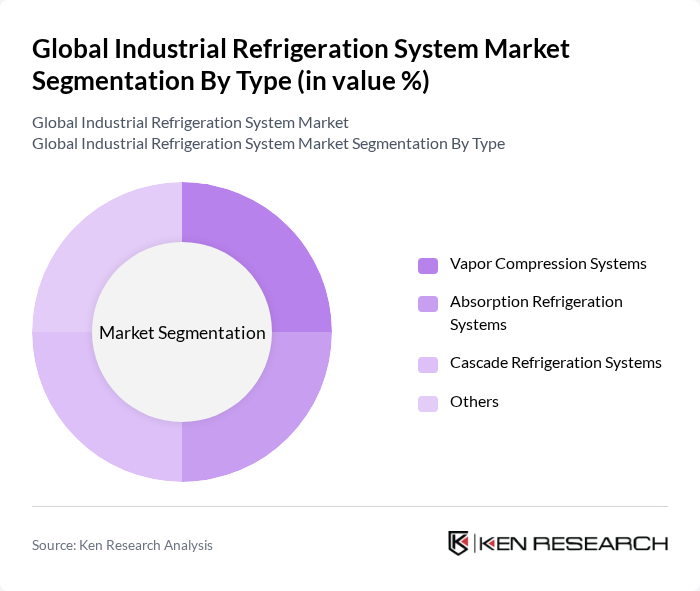
By Type:The market is segmented into various types of refrigeration systems, including Vapor Compression Systems, Absorption Refrigeration Systems, Cascade Refrigeration Systems, and Others. Among these, Vapor Compression Systems account for the largest market share due to their high efficiency, reliability, and broad applicability across industrial sectors. The increasing focus on energy efficiency, cost-effectiveness, and the integration of smart technologies further drives the preference for these systems, solidifying their position as the leading choice for industrial refrigeration .
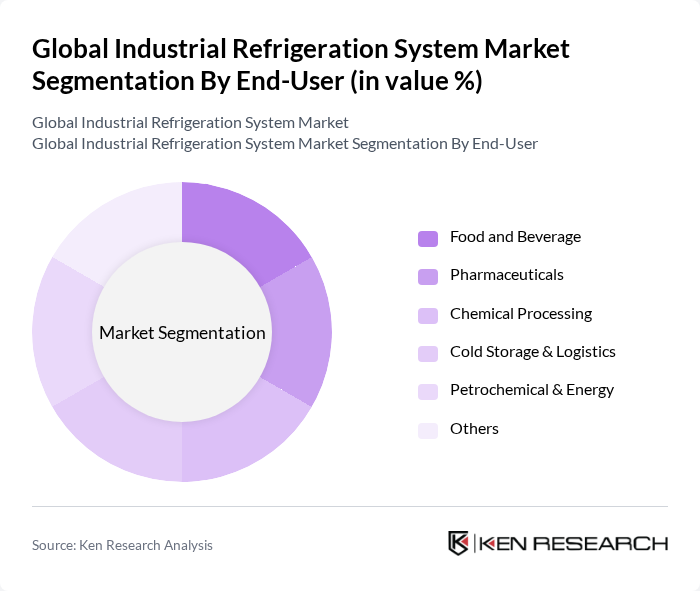
By End-User:The end-user segmentation includes Food and Beverage, Pharmaceuticals, Chemical Processing, Cold Storage & Logistics, Petrochemical & Energy, and Others. The Food and Beverage sector represents the largest end-user segment, driven by the critical need for safe storage and preservation of perishable goods. The expansion of cold chain logistics, rising demand for processed and packaged foods, and stringent food safety regulations further reinforce the dominance of this segment in the industrial refrigeration market .
The Global Industrial Refrigeration System Market is characterized by a dynamic mix of regional and international players. Leading participants such as Carrier Global Corporation, Daikin Industries, Ltd., Johnson Controls International plc, Emerson Electric Co., GEA Group AG, Lennox International Inc., Trane Technologies plc, Bitzer SE, Danfoss A/S, Mitsubishi Electric Corporation, Panasonic Corporation, Hillphoenix, Inc., AHT Cooling Systems GmbH, Frigel Firenze S.p.A., Kysor Warren LLC, Parker Hannifin Corporation, Copeland (formerly Emerson Climate Technologies), Rivacold S.r.l., SCM Frigo S.p.A., Weiss Umwelttechnik GmbH contribute to innovation, geographic expansion, and service delivery in this space.
The future of the industrial refrigeration market is poised for significant transformation, driven by technological advancements and sustainability initiatives. As industries increasingly adopt IoT-enabled refrigeration systems, operational efficiency and monitoring capabilities will improve, reducing energy consumption. Additionally, the shift towards natural refrigerants will align with global environmental goals, fostering innovation. Emerging markets, particularly in Asia-Pacific and Africa, present substantial growth opportunities, as rising urbanization and food demand necessitate advanced refrigeration solutions to support local economies.
| Segment | Sub-Segments |
|---|---|
| By Type | Vapor Compression Systems Absorption Refrigeration Systems Cascade Refrigeration Systems Others |
| By End-User | Food and Beverage Pharmaceuticals Chemical Processing Cold Storage & Logistics Petrochemical & Energy Others |
| By Application | Cold Storage Warehouses Process Cooling Transport Refrigeration Ice Production Others |
| By Component | Compressors Condensers Evaporators Controls & Automation Refrigerant (Ammonia, CO?, HFCs, HCFCs) Others |
| By Sales Channel | Direct Sales Distributors Online Sales Others |
| By Distribution Mode | Wholesale Retail E-commerce Others |
| By Price Range | Low Medium High Others |
| Scope Item/Segment | Sample Size | Target Respondent Profiles |
|---|---|---|
| Food Processing Industry | 100 | Plant Managers, Operations Directors |
| Pharmaceutical Manufacturing | 60 | Quality Assurance Managers, Production Supervisors |
| Chemical Processing Sector | 50 | Process Engineers, Safety Officers |
| Cold Storage Facilities | 40 | Facility Managers, Logistics Coordinators |
| Retail and Distribution | 60 | Supply Chain Managers, Refrigeration Technicians |
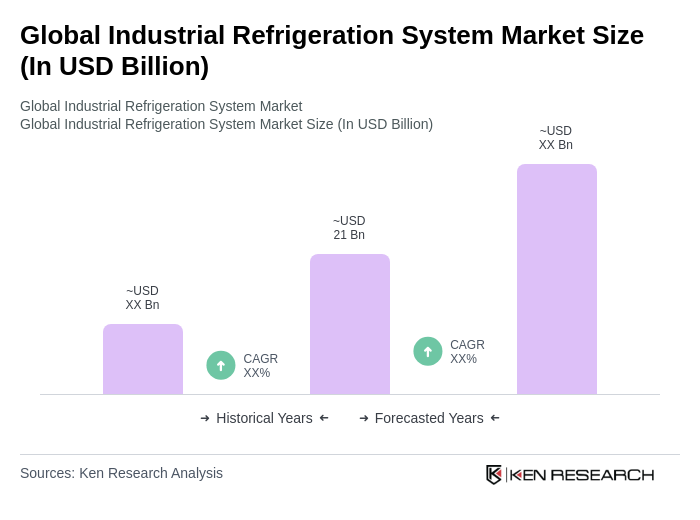
The Global Industrial Refrigeration System Market is valued at approximately USD 21 billion, driven by the increasing demand for energy-efficient refrigeration solutions across various industries, including food and beverage, pharmaceuticals, and chemical processing.

What makes us stand out is that our consultants follow Robust, Refine and Result (RRR) methodology. Robust for clear definitions, approaches and sanity checking, Refine for differentiating respondents' facts and opinions, and Result for presenting data with story.

We have set a benchmark in the industry by offering our clients with syndicated and customized market research reports featuring coverage of entire market as well as meticulous research and analyst insights.

While we don't replace traditional research, we flip the method upside down. Our dual approach of Top Bottom & Bottom Top ensures quality deliverable by not just verifying company fundamentals but also looking at the sector and macroeconomic factors.

With one step in the future, our research team constantly tries to show you the bigger picture. We help with some of the tough questions you may encounter along the way: How is the industry positioned? Best marketing channel? KPI's of competitors? By aligning every element, we help maximize success.

Our report gives you instant access to the answers and sources that other companies might choose to hide. We elaborate each steps of research methodology we have used and showcase you the sample size to earn your trust.

If you need any support, we are here! We pride ourselves on universe strength, data quality, and quick, friendly, and professional service.













