About the Report
Base Year 2024Global Industrial Tugger Market Overview
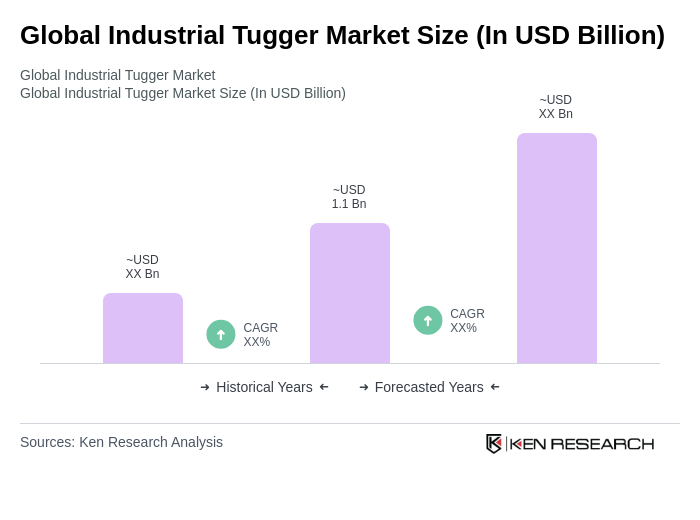
- The Global Industrial Tugger Market is valued at USD 1.1 billion. This growth is primarily driven by the increasing demand for efficient material handling solutions across various industries, including manufacturing and logistics. The rise in automation and the need for streamlined operations have further propelled the adoption of tuggers, enhancing productivity and reducing operational costs. Additionally, the market is influenced by the growing emphasis on sustainability and safety in industrial operations.
- Key players in this market include countries with robust industrial sectors and advanced logistics infrastructure, such as the United States, Germany, and China. These countries dominate due to the presence of major manufacturing hubs and a strong focus on automation technologies, contributing significantly to their market leadership.
- While there is no specific mention of new regulations in 2023, the European Union has been actively promoting workplace safety and efficiency through various directives and standards. For instance, the EU's Machinery Directive (2006/42/EC) sets out essential health and safety requirements for machinery, including automated and semi-automated equipment like tuggers.
Global Industrial Tugger Market Segmentation
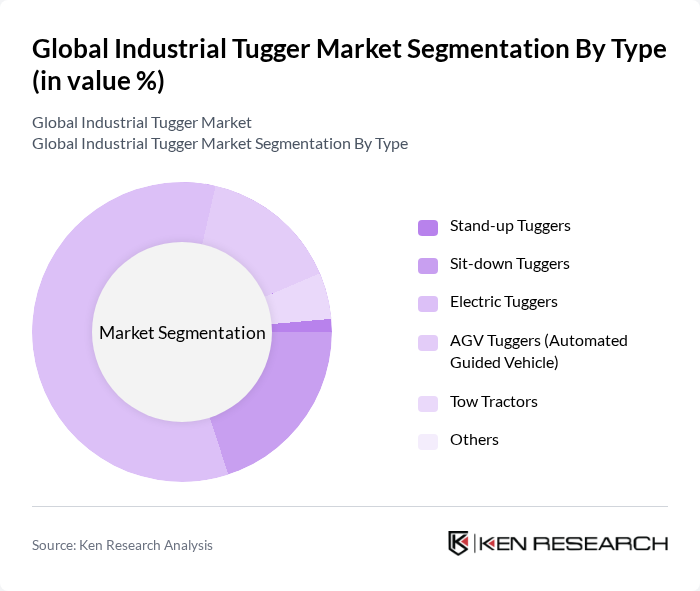
By Type:The market is segmented into various types of tuggers, including Stand-up Tuggers, Sit-down Tuggers, Electric Tuggers, AGV Tuggers (Automated Guided Vehicle), Tow Tractors, and Others. Each type serves specific operational needs and preferences in different industrial settings.
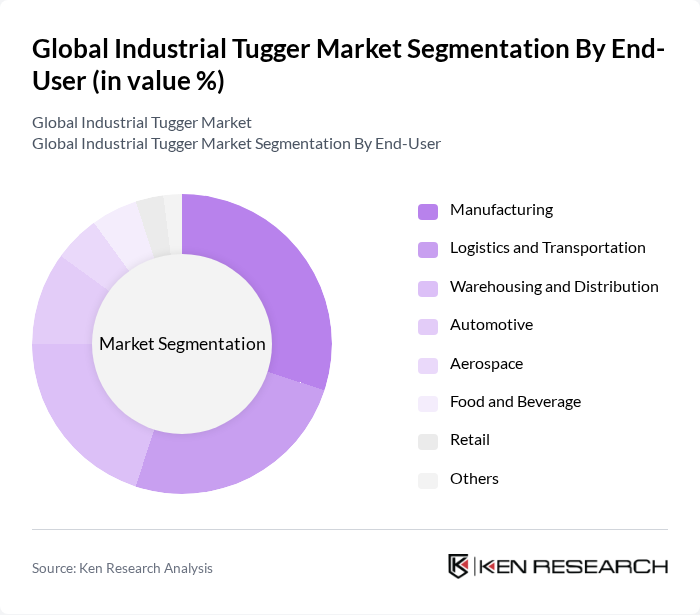
By End-User:The end-user segmentation includes Manufacturing, Logistics and Transportation, Warehousing and Distribution, Automotive, Aerospace, Food and Beverage, Retail, and Others. Each sector utilizes tuggers to enhance operational efficiency and streamline material handling processes.
Global Industrial Tugger Market Competitive Landscape
The Global Industrial Tugger Market is characterized by a dynamic mix of regional and international players. Leading participants such as Toyota Material Handling Solutions, Crown Equipment Corporation, KION Group AG, Jungheinrich AG, Hyster-Yale Materials Handling, Inc., Mitsubishi Logisnext Co., Ltd., Eagle Tugs, MasterMover, Inc., DJ Products Inc., Taylor-Dunn, Nu-Star Inc., Electro Kinetic Technologies, Bastian Solutions, Daifuku Co., Ltd., Vecna Robotics, Balyo, BlueBotics, Zallys Srl, Green Valley Manufacturing, Vestil Manufacturing contribute to innovation, geographic expansion, and service delivery in this space.
Global Industrial Tugger Market Industry Analysis
Growth Drivers
- Increasing Demand for Automation:The global push towards automation is evident, with the industrial automation market projected to reach $200 billion in future. This surge is driven by the need for increased efficiency and reduced labor costs. In manufacturing sectors, automation can enhance productivity by up to 30%, leading to a higher demand for tugger systems that facilitate automated material handling processes. As industries adopt smart technologies, the integration of tugger systems becomes essential for maintaining competitive advantage.
- Rising Need for Efficient Material Handling:The material handling equipment market is expected to grow to $200 billion in future, reflecting a significant demand for efficient solutions. Industries are increasingly recognizing the importance of optimizing logistics and supply chain operations. Efficient material handling can reduce operational costs by approximately 20%, prompting businesses to invest in advanced tugger systems that streamline workflows and enhance overall productivity, particularly in high-volume environments like warehouses and distribution centers.
- Growth in E-commerce and Warehousing:The e-commerce sector is projected to reach $6 trillion in future, driving substantial growth in warehousing needs. This expansion necessitates efficient material handling solutions, including tugger systems, to manage increased inventory and order fulfillment demands. With over 50% of consumers expecting same-day delivery, warehouses are under pressure to optimize operations, leading to a heightened adoption of tugger systems that facilitate quick and efficient material transport within facilities.
Market Challenges
- High Initial Investment Costs:The adoption of advanced tugger systems often requires significant upfront capital investment, which can deter potential buyers. For instance, the average cost of a tugger system can range from $10,000 to $50,000, depending on specifications and features. This financial barrier is particularly challenging for small to medium-sized enterprises (SMEs) that may lack the necessary budget to invest in such equipment, limiting market penetration and growth opportunities.
- Limited Awareness Among End-Users:Many potential end-users remain unaware of the benefits and capabilities of modern tugger systems. A survey indicated that over 40% of SMEs do not utilize automated material handling solutions due to a lack of knowledge. This gap in awareness can hinder market growth, as businesses may continue relying on outdated manual processes, missing out on the efficiency and cost-saving advantages that tugger systems can provide in their operations.
Global Industrial Tugger Market Future Outlook
The future of the industrial tugger market appears promising, driven by technological advancements and increasing automation across various sectors. As industries continue to embrace smart technologies, the integration of IoT and AI into tugger systems will enhance operational efficiency and data analytics capabilities. Furthermore, the shift towards electric and sustainable solutions will likely gain momentum, aligning with global sustainability goals. This evolution will create new avenues for growth and innovation within the market, fostering a competitive landscape.
Market Opportunities
- Expansion in Emerging Markets:Emerging markets, particularly in Asia-Pacific, are experiencing rapid industrialization, with manufacturing output expected to grow by 6% annually in future. This growth presents significant opportunities for tugger system manufacturers to penetrate these markets, catering to the increasing demand for efficient material handling solutions in burgeoning industries.
- Integration of IoT in Tugger Systems:The global IoT market is projected to reach $1 trillion in future, offering substantial opportunities for tugger systems equipped with IoT capabilities. By integrating IoT technology, manufacturers can provide real-time tracking and monitoring solutions, enhancing operational efficiency and reducing downtime, thus appealing to a broader customer base seeking advanced material handling solutions.
Scope of the Report
| Segment | Sub-Segments |
|---|---|
| By Type | Stand-up Tuggers Sit-down Tuggers Electric Tuggers AGV Tuggers (Automated Guided Vehicle) Tow Tractors Others |
| By End-User | Manufacturing Logistics and Transportation Warehousing and Distribution Automotive Aerospace Food and Beverage Retail Others |
| By Application | Material Handling Assembly Line Operations Order Picking Transportation within Facilities Load Towing Others |
| By Payload Capacity | Up to 500 kg kg to 1000 kg kg to 2000 kg Above 2000 kg |
| By Distribution Channel | Direct Sales Distributors Online Sales Retail Outlets Others |
| By Region | North America Europe Asia-Pacific Latin America Middle East & Africa |
| By Price Range | Low-End Mid-Range High-End Premium |
Key Target Audience
Investors and Venture Capitalist Firms
Government and Regulatory Bodies (e.g., U.S. Department of Transportation, European Commission)
Manufacturers and Producers
Distributors and Retailers
Logistics and Supply Chain Companies
Industry Associations (e.g., Material Handling Industry Association)
Financial Institutions
Equipment Rental Companies
Players Mentioned in the Report:
Toyota Material Handling Solutions
Crown Equipment Corporation
KION Group AG
Jungheinrich AG
Hyster-Yale Materials Handling, Inc.
Mitsubishi Logisnext Co., Ltd.
Eagle Tugs
MasterMover, Inc.
DJ Products Inc.
Taylor-Dunn
Nu-Star Inc.
Electro Kinetic Technologies
Bastian Solutions
Daifuku Co., Ltd.
Vecna Robotics
Balyo
BlueBotics
Zallys Srl
Green Valley Manufacturing
Vestil Manufacturing
Table of Contents
Market Assessment Phase
1. Executive Summary and Approach
2. Global Industrial Tugger Market Overview
2.1 Key Insights and Strategic Recommendations
2.2 Global Industrial Tugger Market Overview
2.3 Definition and Scope
2.4 Evolution of Market Ecosystem
2.5 Timeline of Key Regulatory Milestones
2.6 Value Chain & Stakeholder Mapping
2.7 Business Cycle Analysis
2.8 Policy & Incentive Landscape
3. Global Industrial Tugger Market Analysis
3.1 Growth Drivers
3.1.1 Increasing Demand for Automation
3.1.2 Rising Need for Efficient Material Handling
3.1.3 Growth in E-commerce and Warehousing
3.1.4 Technological Advancements in Tugger Systems
3.2 Market Challenges
3.2.1 High Initial Investment Costs
3.2.2 Limited Awareness Among End-Users
3.2.3 Maintenance and Operational Issues
3.2.4 Regulatory Compliance Challenges
3.3 Market Opportunities
3.3.1 Expansion in Emerging Markets
3.3.2 Integration of IoT in Tugger Systems
3.3.3 Customization and Flexibility in Solutions
3.3.4 Partnerships with Logistics Providers
3.4 Market Trends
3.4.1 Shift Towards Electric Tugger Systems
3.4.2 Increasing Focus on Sustainability
3.4.3 Adoption of Autonomous Tugger Solutions
3.4.4 Growth of Smart Warehousing Solutions
3.5 Government Regulation
3.5.1 Safety Standards for Material Handling Equipment
3.5.2 Environmental Regulations on Emissions
3.5.3 Labor Regulations Affecting Automation
3.5.4 Incentives for Energy-Efficient Equipment
4. SWOT Analysis
5. Stakeholder Analysis
6. Porter's Five Forces Analysis
7. Global Industrial Tugger Market Market Size, 2019-2024
7.1 By Value
7.2 By Volume
7.3 By Average Selling Price
8. Global Industrial Tugger Market Segmentation
8.1 By Type
8.1.1 Stand-up Tuggers
8.1.2 Sit-down Tuggers
8.1.3 Electric Tuggers
8.1.4 AGV Tuggers (Automated Guided Vehicle)
8.1.5 Tow Tractors
8.1.6 Others
8.2 By End-User
8.2.1 Manufacturing
8.2.2 Logistics and Transportation
8.2.3 Warehousing and Distribution
8.2.4 Automotive
8.2.5 Aerospace
8.2.6 Food and Beverage
8.2.7 Retail
8.2.8 Others
8.3 By Application
8.3.1 Material Handling
8.3.2 Assembly Line Operations
8.3.3 Order Picking
8.3.4 Transportation within Facilities
8.3.5 Load Towing
8.3.6 Others
8.4 By Payload Capacity
8.4.1 Up to 500 kg
8.4.2 500 kg to 1000 kg
8.4.3 1000 kg to 2000 kg
8.4.4 Above 2000 kg
8.5 By Distribution Channel
8.5.1 Direct Sales
8.5.2 Distributors
8.5.3 Online Sales
8.5.4 Retail Outlets
8.5.5 Others
8.6 By Region
8.6.1 North America
8.6.2 Europe
8.6.3 Asia-Pacific
8.6.4 Latin America
8.6.5 Middle East & Africa
8.7 By Price Range
8.7.1 Low-End
8.7.2 Mid-Range
8.7.3 High-End
8.7.4 Premium
9. Global Industrial Tugger Market Competitive Analysis
9.1 Market Share of Key Players
9.2 Cross Comparison of Key Players
9.2.1 Company Name
9.2.2 Market Capitalization/Company Size
9.2.3 Annual Revenue (USD Million)
9.2.4 Revenue Growth Rate (CAGR %)
9.2.5 Product Portfolio Breadth
9.2.6 Geographic Presence
9.2.7 Technology Innovation Index
9.2.8 AGV/Autonomous Integration Capability
9.2.9 Fleet Management Solutions
9.2.10 Market Share (%)
9.2.11 Customer Base Size
9.2.12 R&D Investment (% of Revenue)
9.3 SWOT Analysis of Top Players
9.4 Pricing Analysis
9.5 Detailed Profile of Major Companies
9.5.1 Toyota Material Handling Solutions
9.5.2 Crown Equipment Corporation
9.5.3 KION Group AG
9.5.4 Jungheinrich AG
9.5.5 Hyster-Yale Materials Handling, Inc.
9.5.6 Mitsubishi Logisnext Co., Ltd.
9.5.7 Eagle Tugs
9.5.8 MasterMover, Inc.
9.5.9 DJ Products Inc.
9.5.10 Taylor-Dunn
9.5.11 Nu-Star Inc.
9.5.12 Electro Kinetic Technologies
9.5.13 Bastian Solutions
9.5.14 Daifuku Co., Ltd.
9.5.15 Vecna Robotics
9.5.16 Balyo
9.5.17 BlueBotics
9.5.18 Zallys Srl
9.5.19 Green Valley Manufacturing
9.5.20 Vestil Manufacturing
10. Global Industrial Tugger Market End-User Analysis
10.1 Procurement Behavior of Key Ministries
10.1.1 Government Procurement Policies
10.1.2 Budget Allocations for Infrastructure
10.1.3 Evaluation Criteria for Bids
10.1.4 Supplier Selection Process
10.2 Corporate Spend on Infrastructure & Energy
10.2.1 Investment Trends in Material Handling
10.2.2 Budgeting for Automation Solutions
10.2.3 Cost-Benefit Analysis Practices
10.3 Pain Point Analysis by End-User Category
10.3.1 Operational Inefficiencies
10.3.2 Equipment Downtime
10.3.3 Safety Concerns
10.3.4 Training and Skill Gaps
10.4 User Readiness for Adoption
10.4.1 Awareness of Tugger Solutions
10.4.2 Willingness to Invest in Automation
10.4.3 Training and Support Needs
10.5 Post-Deployment ROI and Use Case Expansion
10.5.1 Measurement of ROI
10.5.2 Case Studies of Successful Implementations
10.5.3 Future Expansion Plans
11. Global Industrial Tugger Market Future Size, 2025-2030
11.1 By Value
11.2 By Volume
11.3 By Average Selling Price
Go-To-Market Strategy Phase
1. Whitespace Analysis + Business Model Canvas
1.1 Market Gaps Identification
1.2 Value Proposition Development
1.3 Revenue Streams Analysis
1.4 Customer Segmentation
1.5 Key Partnerships
1.6 Cost Structure Analysis
1.7 Channels of Distribution
2. Marketing and Positioning Recommendations
2.1 Branding Strategies
2.2 Product USPs
2.3 Target Market Positioning
2.4 Communication Strategies
2.5 Digital Marketing Approaches
3. Distribution Plan
3.1 Urban Retail Strategies
3.2 Rural NGO Tie-Ups
3.3 E-commerce Distribution
3.4 Direct Sales Force
4. Channel & Pricing Gaps
4.1 Underserved Routes
4.2 Pricing Bands Analysis
4.3 Competitor Pricing Strategies
5. Unmet Demand & Latent Needs
5.1 Category Gaps
5.2 Consumer Segments Analysis
5.3 Emerging Trends
6. Customer Relationship
6.1 Loyalty Programs
6.2 After-sales Service
6.3 Customer Feedback Mechanisms
7. Value Proposition
7.1 Sustainability Initiatives
7.2 Integrated Supply Chains
7.3 Competitive Advantages
8. Key Activities
8.1 Regulatory Compliance
8.2 Branding Initiatives
8.3 Distribution Setup
9. Entry Strategy Evaluation
9.1 Domestic Market Entry Strategy
9.1.1 Product Mix Considerations
9.1.2 Pricing Band Strategy
9.1.3 Packaging Solutions
9.2 Export Entry Strategy
9.2.1 Target Countries Identification
9.2.2 Compliance Roadmap Development
10. Entry Mode Assessment
10.1 Joint Ventures
10.2 Greenfield Investments
10.3 Mergers & Acquisitions
10.4 Distributor Model
11. Capital and Timeline Estimation
Research Methodology
Phase 1: Approach1
Desk Research
- Industry reports from global logistics and manufacturing associations
- Market analysis publications focusing on industrial tugger applications
- Government publications on transportation and logistics infrastructure
Primary Research
- Interviews with operations managers in manufacturing facilities utilizing tuggers
- Surveys with logistics coordinators regarding tugger fleet management
- Field visits to warehouses and distribution centers employing tugger systems
Validation & Triangulation
- Cross-validation of data from multiple industry sources and reports
- Triangulation of insights from primary interviews with secondary data findings
- Sanity checks through expert panels comprising industry veterans
Phase 2: Market Size Estimation1
Top-down Assessment
- Analysis of global industrial equipment market size and growth trends
- Segmentation by end-user industries such as automotive, electronics, and consumer goods
- Incorporation of regional growth patterns and economic indicators
Bottom-up Modeling
- Estimation of unit sales based on historical data from key manufacturers
- Operational cost analysis for different types of tugger systems
- Volume and pricing analysis based on customer segments and applications
Forecasting & Scenario Analysis
- Multi-variable forecasting using economic growth rates and industry trends
- Scenario modeling based on technological advancements and automation adoption
- Baseline, optimistic, and pessimistic forecasts through 2030
Phase 3: CATI Sample Composition1
| Scope Item/Segment | Sample Size | Target Respondent Profiles |
|---|---|---|
| Automotive Manufacturing Facilities | 50 | Production Managers, Logistics Coordinators |
| Warehouse Operations in E-commerce | 45 | Warehouse Managers, Supply Chain Analysts |
| Consumer Goods Distribution Centers | 40 | Operations Supervisors, Inventory Managers |
| Electronics Assembly Lines | 45 | Facility Managers, Process Engineers |
| Pharmaceutical Logistics Providers | 40 | Quality Assurance Managers, Distribution Directors |
Frequently Asked Questions
What is the current value of the Global Industrial Tugger Market?
The Global Industrial Tugger Market is valued at approximately USD 1.1 billion. This growth is driven by the increasing demand for efficient material handling solutions across various industries, including manufacturing and logistics.
What factors are driving the growth of the Industrial Tugger Market?
Which countries dominate the Global Industrial Tugger Market?
What are the main types of tuggers available in the market?
Other Regional/Country Reports
Indonesia Industrial Tugger Market
Malaysia Industrial Tugger Market
KSA Industrial Tugger Market
APAC Industrial Tugger Market
SEA Industrial Tugger Market
Vietnam Industrial Tugger Market
Other Adjacent Reports
Malaysia Material Handling Equipment Market
Indonesia Automated Guided Vehicles Market
UAE Forklift Trucks MarketVietnam warehouse automation market report size, share, growth drivers, trends, opportunities & forecast 2025–2030Middle East Industrial Robotics Market Report Size Share Growth Drivers Trends Opportunities & Forecast 2025–2030United Arab Emirates Conveyor Systems Market Size Share Growth Drivers Trends Opportunities & Forecast 2025–2030South Korea Tow Tractors Market
KSA logistics automation market report Size, Share, Growth Drivers, Trends, Opportunities & Forecast 2025–2030Bahrain E-commerce Warehousing Market
UAE Supply Chain Management Software MarketWhy Buy From Us?

What makes us stand out is that our consultants follow Robust, Refine and Result (RRR) methodology. Robust for clear definitions, approaches and sanity checking, Refine for differentiating respondents' facts and opinions, and Result for presenting data with story.

We have set a benchmark in the industry by offering our clients with syndicated and customized market research reports featuring coverage of entire market as well as meticulous research and analyst insights.

While we don't replace traditional research, we flip the method upside down. Our dual approach of Top Bottom & Bottom Top ensures quality deliverable by not just verifying company fundamentals but also looking at the sector and macroeconomic factors.

With one step in the future, our research team constantly tries to show you the bigger picture. We help with some of the tough questions you may encounter along the way: How is the industry positioned? Best marketing channel? KPI's of competitors? By aligning every element, we help maximize success.

Our report gives you instant access to the answers and sources that other companies might choose to hide. We elaborate each steps of research methodology we have used and showcase you the sample size to earn your trust.

If you need any support, we are here! We pride ourselves on universe strength, data quality, and quick, friendly, and professional service.