About the Report
Base Year 2024Listen to the audio summary
Global Location Based Entertainment Market Overview
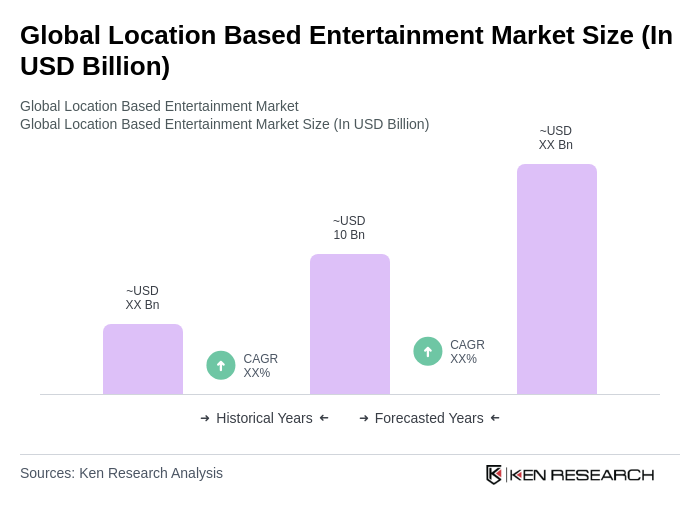
- The Global Location Based Entertainment Market is valued at USD 10 billion, based on a five-year historical analysis. This growth is primarily driven by the increasing demand for immersive experiences, rapid advancements in virtual and augmented reality technologies, and the rising popularity of family-oriented entertainment options. The market has seen a notable uptick in consumer spending on leisure activities, especially in urban areas where entertainment options are diverse and readily accessible. Enhanced digital integration and the proliferation of mixed-reality attractions are further accelerating market expansion .
- Key players in this market include the United States, China, and several European countries. The dominance of these regions is attributed to robust infrastructure, high disposable incomes, and a strong cultural inclination towards entertainment and leisure activities. The presence of major theme parks, entertainment hubs, and leading VR/AR technology providers in these areas further solidifies their leading position in the market .
- In 2023, the U.S. government introduced enhanced safety standards for amusement parks and entertainment venues. These regulations require all facilities to undergo regular safety inspections and comply with strict operational guidelines to ensure visitor safety. The initiative aims to boost consumer confidence and promote a safer environment for entertainment activities, with increased adoption of touchless technologies and physical distancing measures .
Global Location Based Entertainment Market Segmentation
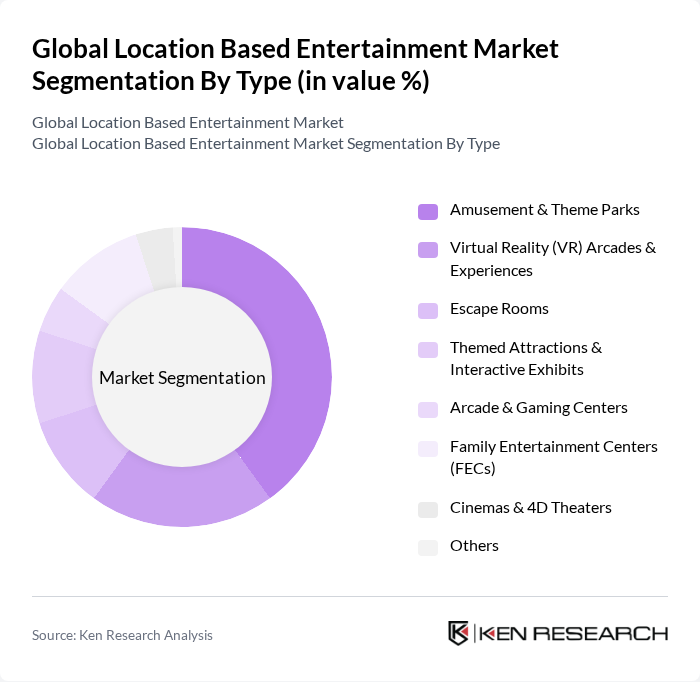
By Type:The market is segmented into Amusement & Theme Parks, Virtual Reality (VR) Arcades & Experiences, Escape Rooms, Themed Attractions & Interactive Exhibits, Arcade & Gaming Centers, Family Entertainment Centers (FECs), Cinemas & 4D Theaters, and Others. Amusement & Theme Parks hold the largest market share, driven by their ability to attract large crowds and offer a diverse range of entertainment options. VR Arcades & Experiences are rapidly gaining popularity among younger audiences, fueled by advancements in immersive technologies and a growing appetite for interactive entertainment. Escape Rooms and Themed Attractions continue to expand, catering to group activities and experiential trends .
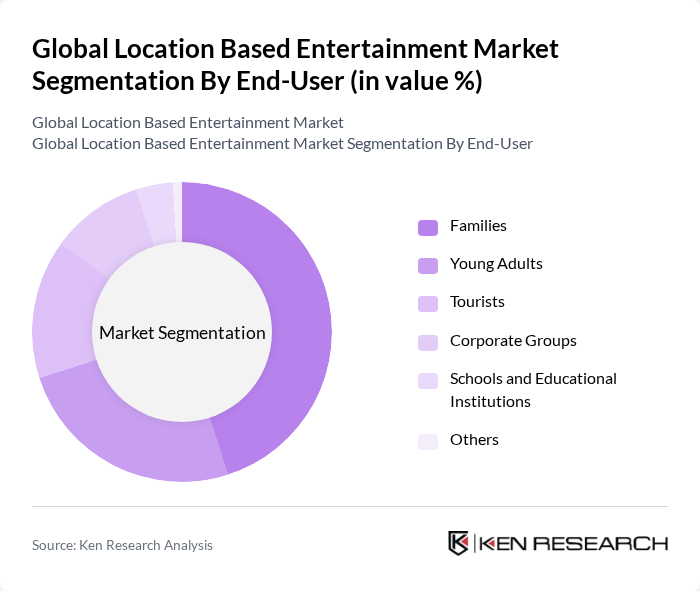
By End-User:The end-user segmentation includes Families, Young Adults, Tourists, Corporate Groups, Schools and Educational Institutions, and Others. Families represent the largest segment, driven by the increasing trend of family outings and vacations focused on entertainment. Young adults are a significant demographic, seeking unique and social experiences, especially in urban settings. Tourists and corporate groups contribute to market growth through demand for group activities and team-building experiences. Schools and educational institutions are increasingly integrating location-based entertainment for experiential learning and field trips .
Global Location Based Entertainment Market Competitive Landscape
The Global Location Based Entertainment Market is characterized by a dynamic mix of regional and international players. Leading participants such as Disney Parks, Experiences and Products, Universal Destinations & Experiences (Universal Studios), Merlin Entertainments, Six Flags Entertainment Corporation, Cedar Fair Entertainment Company, Dave & Buster's Entertainment, Inc., LEGOLAND Parks, iFLY Indoor Skydiving, The Escape Game, Topgolf Entertainment Group, VR Park Dubai, K1 Speed, Round1 Bowling & Amusement, Sky Zone Trampoline Park, Bounce Inc. contribute to innovation, geographic expansion, and service delivery in this space.
Global Location Based Entertainment Market Industry Analysis
Growth Drivers
- Increasing Consumer Demand for Immersive Experiences:The global demand for immersive experiences is surging, with the entertainment sector witnessing a 15% increase in consumer spending on experiential activities in future, reaching approximately $200 billion. This trend is driven by a shift in consumer preferences towards unique, engaging experiences over traditional entertainment. As urban populations grow, the need for innovative entertainment solutions that provide memorable experiences is becoming paramount, further fueling the growth of location-based entertainment venues.
- Expansion of Urban Entertainment Complexes:Urban entertainment complexes are proliferating, with over 50 new complexes projected to open in major cities worldwide in future. These complexes often combine various entertainment options, including dining, shopping, and immersive attractions, catering to diverse consumer preferences. The urban population is expected to reach approximately 5 billion in future, according to United Nations estimates. This creates a significant market for these complexes, which are designed to attract both locals and tourists seeking comprehensive entertainment experiences.
- Technological Advancements in AR and VR:The rapid advancements in augmented reality (AR) and virtual reality (VR) technologies are revolutionizing the location-based entertainment industry. In future, the global AR and VR market was valued at approximately $30 billion, with projections to exceed $50 billion in future. These technologies enhance user engagement and create immersive environments, making attractions more appealing. As more venues adopt AR and VR, the overall consumer experience improves, driving higher foot traffic and revenue for entertainment providers.
Market Challenges
- High Initial Investment Costs:The high initial investment required to establish location-based entertainment venues poses a significant challenge. On average, the cost to develop a medium-sized entertainment complex ranges from $10 million to $50 million, depending on location and scale. This financial barrier can deter potential investors, particularly in regions with limited access to capital. As a result, many innovative concepts struggle to secure funding, hindering market growth and diversification.
- Regulatory Hurdles and Compliance Issues:Navigating the complex regulatory landscape is a major challenge for location-based entertainment operators. Compliance with safety, health, and zoning regulations can be cumbersome and costly. For instance, in the U.S., entertainment venues must adhere to numerous local, state, and federal regulations, which can delay project timelines and increase operational costs. These hurdles can stifle innovation and limit the ability of new entrants to compete effectively in the market.
Global Location Based Entertainment Market Future Outlook
The future of the location-based entertainment market appears promising, driven by technological innovations and evolving consumer preferences. As urban populations continue to grow, the demand for diverse entertainment options will increase, prompting further investment in immersive experiences. Additionally, the integration of sustainability practices will likely become a focal point, as consumers increasingly favor eco-friendly entertainment solutions. The market is expected to adapt to these trends, fostering a dynamic environment for growth and innovation in the coming years.
Market Opportunities
- Growth in Family-Oriented Entertainment:The family-oriented entertainment segment is expanding rapidly, with a projected increase in family visits to entertainment venues by 20% in future. This growth is driven by a rising number of family-friendly attractions, such as interactive museums and themed parks, which cater to diverse age groups. This trend presents significant opportunities for operators to develop tailored experiences that engage families and enhance customer loyalty.
- Integration of E-sports and Gaming:The integration of e-sports and gaming into location-based entertainment venues is gaining traction, with the e-sports market expected to reach approximately $1.5 billion in future. This trend offers opportunities for venues to attract younger audiences through competitive gaming events and interactive experiences. By incorporating e-sports, operators can diversify their offerings and tap into a rapidly growing demographic, enhancing overall profitability.
Scope of the Report
| Segment | Sub-Segments |
|---|---|
| By Type | Amusement & Theme Parks Virtual Reality (VR) Arcades & Experiences Escape Rooms Themed Attractions & Interactive Exhibits Arcade & Gaming Centers Family Entertainment Centers (FECs) Cinemas & 4D Theaters Others |
| By End-User | Families Young Adults Tourists Corporate Groups Schools and Educational Institutions Others |
| By Revenue Model | Pay-per-visit Membership Subscriptions Event Hosting Merchandise & In-venue Sales Sponsorships & Partnerships Others |
| By Location | Urban Centers Suburban Areas Tourist Destinations Shopping Malls Resorts & Hotels Others |
| By Experience Type | Interactive Experiences Spectator Experiences Educational Experiences Competitive & Gamified Experiences Social & Group Experiences Others |
| By Duration of Visit | Short Visits (Less than 2 hours) Half-Day Visits (2-4 hours) Full-Day Visits (4-8 hours) Multi-Day Visits Others |
| By Pricing Tier | Budget Mid-Range Premium Luxury Others |
Key Target Audience
Investors and Venture Capitalist Firms
Government and Regulatory Bodies (e.g., Federal Communications Commission, National Endowment for the Arts)
Manufacturers and Producers of Entertainment Equipment
Distributors and Retailers of Entertainment Products
Theme Park Operators
Location-Based Entertainment Venue Owners
Technology Providers for Augmented and Virtual Reality
Event Organizers and Promoters
Players Mentioned in the Report:
Disney Parks, Experiences and Products
Universal Destinations & Experiences (Universal Studios)
Merlin Entertainments
Six Flags Entertainment Corporation
Cedar Fair Entertainment Company
Dave & Buster's Entertainment, Inc.
LEGOLAND Parks
iFLY Indoor Skydiving
The Escape Game
Topgolf Entertainment Group
VR Park Dubai
K1 Speed
Round1 Bowling & Amusement
Sky Zone Trampoline Park
Bounce Inc.
Table of Contents
Market Assessment Phase
1. Executive Summary and Approach
2. Global Location Based Entertainment Market Overview
2.1 Key Insights and Strategic Recommendations
2.2 Global Location Based Entertainment Market Overview
2.3 Definition and Scope
2.4 Evolution of Market Ecosystem
2.5 Timeline of Key Regulatory Milestones
2.6 Value Chain & Stakeholder Mapping
2.7 Business Cycle Analysis
2.8 Policy & Incentive Landscape
3. Global Location Based Entertainment Market Analysis
3.1 Growth Drivers
3.1.1 Increasing consumer demand for immersive experiences
3.1.2 Expansion of urban entertainment complexes
3.1.3 Technological advancements in AR and VR
3.1.4 Rise in disposable income and leisure spending
3.2 Market Challenges
3.2.1 High initial investment costs
3.2.2 Regulatory hurdles and compliance issues
3.2.3 Competition from home entertainment options
3.2.4 Seasonal fluctuations in visitor numbers
3.3 Market Opportunities
3.3.1 Growth in family-oriented entertainment
3.3.2 Integration of e-sports and gaming
3.3.3 Development of themed attractions
3.3.4 Expansion into emerging markets
3.4 Market Trends
3.4.1 Increasing use of gamification in attractions
3.4.2 Focus on sustainability and eco-friendly practices
3.4.3 Rise of hybrid entertainment models
3.4.4 Enhanced personalization through data analytics
3.5 Government Regulation
3.5.1 Safety and health regulations for public spaces
3.5.2 Licensing requirements for entertainment venues
3.5.3 Zoning laws affecting location-based entertainment
3.5.4 Tax incentives for entertainment development
4. SWOT Analysis
5. Stakeholder Analysis
6. Porter's Five Forces Analysis
7. Global Location Based Entertainment Market Market Size, 2019-2024
7.1 By Value
7.2 By Volume
7.3 By Average Selling Price
8. Global Location Based Entertainment Market Segmentation
8.1 By Type
8.1.1 Amusement & Theme Parks
8.1.2 Virtual Reality (VR) Arcades & Experiences
8.1.3 Escape Rooms
8.1.4 Themed Attractions & Interactive Exhibits
8.1.5 Arcade & Gaming Centers
8.1.6 Family Entertainment Centers (FECs)
8.1.7 Cinemas & 4D Theaters
8.1.8 Others
8.2 By End-User
8.2.1 Families
8.2.2 Young Adults
8.2.3 Tourists
8.2.4 Corporate Groups
8.2.5 Schools and Educational Institutions
8.2.6 Others
8.3 By Revenue Model
8.3.1 Pay-per-visit
8.3.2 Membership Subscriptions
8.3.3 Event Hosting
8.3.4 Merchandise & In-venue Sales
8.3.5 Sponsorships & Partnerships
8.3.6 Others
8.4 By Location
8.4.1 Urban Centers
8.4.2 Suburban Areas
8.4.3 Tourist Destinations
8.4.4 Shopping Malls
8.4.5 Resorts & Hotels
8.4.6 Others
8.5 By Experience Type
8.5.1 Interactive Experiences
8.5.2 Spectator Experiences
8.5.3 Educational Experiences
8.5.4 Competitive & Gamified Experiences
8.5.5 Social & Group Experiences
8.5.6 Others
8.6 By Duration of Visit
8.6.1 Short Visits (Less than 2 hours)
8.6.2 Half-Day Visits (2-4 hours)
8.6.3 Full-Day Visits (4-8 hours)
8.6.4 Multi-Day Visits
8.6.5 Others
8.7 By Pricing Tier
8.7.1 Budget
8.7.2 Mid-Range
8.7.3 Premium
8.7.4 Luxury
8.7.5 Others
9. Global Location Based Entertainment Market Competitive Analysis
9.1 Market Share of Key Players
9.2 Cross Comparison of Key Players
9.2.1 Company Name
9.2.2 Group Size (Large, Medium, or Small as per industry convention)
9.2.3 Annual Revenue
9.2.4 Revenue Growth Rate
9.2.5 Number of Locations/Attractions
9.2.6 Average Ticket Price
9.2.7 Visitor Volume (Annual Attendance)
9.2.8 Customer Retention Rate
9.2.9 Visitor Satisfaction Score (NPS or Equivalent)
9.2.10 Market Penetration Rate
9.2.11 Operational Efficiency Ratio (Revenue/Employee or Revenue/Sq Ft)
9.2.12 Brand Recognition Index
9.2.13 Investment in Technology (% of Revenue)
9.2.14 Sustainability Initiatives (e.g., % Green Operations)
9.3 SWOT Analysis of Top Players
9.4 Pricing Analysis
9.5 Detailed Profile of Major Companies
9.5.1 Disney Parks, Experiences and Products
9.5.2 Universal Destinations & Experiences (Universal Studios)
9.5.3 Merlin Entertainments
9.5.4 Six Flags Entertainment Corporation
9.5.5 Cedar Fair Entertainment Company
9.5.6 Dave & Buster's Entertainment, Inc.
9.5.7 LEGOLAND Parks
9.5.8 iFLY Indoor Skydiving
9.5.9 The Escape Game
9.5.10 Topgolf Entertainment Group
9.5.11 VR Park Dubai
9.5.12 K1 Speed
9.5.13 Round1 Bowling & Amusement
9.5.14 Sky Zone Trampoline Park
9.5.15 Bounce Inc.
10. Global Location Based Entertainment Market End-User Analysis
10.1 Procurement Behavior of Key Ministries
10.1.1 Budget Allocation for Entertainment Projects
10.1.2 Approval Processes for New Ventures
10.1.3 Collaboration with Private Sector
10.1.4 Focus on Community Engagement
10.2 Corporate Spend on Infrastructure & Energy
10.2.1 Investment in New Attractions
10.2.2 Upgrades to Existing Facilities
10.2.3 Energy Efficiency Initiatives
10.2.4 Partnerships with Local Businesses
10.3 Pain Point Analysis by End-User Category
10.3.1 Accessibility Issues
10.3.2 Safety Concerns
10.3.3 Pricing Sensitivity
10.3.4 Quality of Experience
10.4 User Readiness for Adoption
10.4.1 Awareness of New Technologies
10.4.2 Willingness to Pay for Experiences
10.4.3 Feedback Mechanisms
10.4.4 Trends in Consumer Preferences
10.5 Post-Deployment ROI and Use Case Expansion
10.5.1 Measurement of Visitor Engagement
10.5.2 Analysis of Revenue Streams
10.5.3 Opportunities for Upselling
10.5.4 Long-term Customer Loyalty Programs
11. Global Location Based Entertainment Market Future Size, 2025-2030
11.1 By Value
11.2 By Volume
11.3 By Average Selling Price
Go-To-Market Strategy Phase
1. Whitespace Analysis + Business Model Canvas
1.1 Identification of Market Gaps
1.2 Value Proposition Development
1.3 Revenue Model Exploration
1.4 Customer Segmentation
1.5 Competitive Landscape Analysis
1.6 Key Partnerships
1.7 Risk Assessment
2. Marketing and Positioning Recommendations
2.1 Branding Strategies
2.2 Product USPs
2.3 Target Audience Identification
2.4 Marketing Channels
2.5 Promotional Activities
2.6 Customer Engagement Strategies
3. Distribution Plan
3.1 Urban Retail Strategies
3.2 Rural NGO Tie-ups
3.3 Online vs Offline Distribution
3.4 Partnerships with Local Businesses
3.5 Logistics and Supply Chain Management
4. Channel & Pricing Gaps
4.1 Underserved Routes
4.2 Pricing Bands Analysis
4.3 Competitor Pricing Strategies
4.4 Consumer Price Sensitivity
4.5 Recommendations for Pricing Adjustments
5. Unmet Demand & Latent Needs
5.1 Category Gaps
5.2 Consumer Segments Analysis
5.3 Emerging Trends
5.4 Feedback from Current Users
5.5 Future Demand Projections
6. Customer Relationship
6.1 Loyalty Programs
6.2 After-sales Service
6.3 Customer Feedback Mechanisms
6.4 Community Engagement Initiatives
6.5 Personalization Strategies
7. Value Proposition
7.1 Sustainability Initiatives
7.2 Integrated Supply Chains
7.3 Unique Selling Points
7.4 Customer-Centric Approach
7.5 Competitive Advantages
8. Key Activities
8.1 Regulatory Compliance
8.2 Branding Initiatives
8.3 Distribution Setup
8.4 Staff Training and Development
8.5 Marketing Campaigns
9. Entry Strategy Evaluation
9.1 Domestic Market Entry Strategy
9.1.1 Product Mix
9.1.2 Pricing Band
9.1.3 Packaging Strategies
9.2 Export Entry Strategy
9.2.1 Target Countries
9.2.2 Compliance Roadmap
10. Entry Mode Assessment
10.1 Joint Ventures
10.2 Greenfield Investments
10.3 Mergers & Acquisitions
10.4 Distributor Model
11. Capital and Timeline Estimation
11.1 Capital Requirements
11.2 Timelines for Implementation
12. Control vs Risk Trade-Off
12.1 Ownership vs Partnerships
13. Profitability Outlook
13.1 Breakeven Analysis
13.2 Long-term Sustainability
14. Potential Partner List
14.1 Distributors
14.2 Joint Ventures
14.3 Acquisition Targets
15. Execution Roadmap
15.1 Phased Plan for Market Entry
15.1.1 Market Setup
15.1.2 Market Entry
15.1.3 Growth Acceleration
15.1.4 Scale & Stabilize
15.2 Key Activities and Milestones
15.2.1 Milestone Identification
15.2.2 Timeline for Activities
Research Methodology
Phase 1: Approach1
Desk Research
- Industry reports from global entertainment associations and market research firms
- Analysis of consumer behavior trends through social media and online forums
- Review of regulatory frameworks impacting location-based entertainment venues
Primary Research
- Interviews with executives from leading location-based entertainment companies
- Surveys targeting visitors of entertainment venues to gather consumer insights
- Focus groups with industry stakeholders, including developers and investors
Validation & Triangulation
- Cross-validation of findings through multiple data sources, including financial reports
- Triangulation of consumer insights with industry expert opinions
- Sanity checks through peer reviews and expert panel discussions
Phase 2: Market Size Estimation1
Top-down Assessment
- Analysis of global entertainment spending trends and their impact on location-based entertainment
- Segmentation of the market by type of entertainment (e.g., VR, AR, theme parks)
- Incorporation of demographic data to assess potential market reach
Bottom-up Modeling
- Estimation of revenue streams from ticket sales, merchandise, and food services
- Analysis of operational costs and investment requirements for new venues
- Volume x average spend calculations based on visitor statistics
Forecasting & Scenario Analysis
- Multi-factor regression analysis incorporating economic indicators and technological advancements
- Scenario modeling based on varying levels of consumer engagement and market penetration
- Baseline, optimistic, and pessimistic forecasts through 2030
Phase 3: CATI Sample Composition1
| Scope Item/Segment | Sample Size | Target Respondent Profiles |
|---|---|---|
| Theme Park Visitors | 120 | Families, Young Adults, Tourists |
| Virtual Reality Experience Users | 90 | Gamers, Tech Enthusiasts, Event Attendees |
| Augmented Reality Attraction Participants | 60 | Millennials, Tech Savvy Consumers, Tourists |
| Escape Room Enthusiasts | 50 | Friends Groups, Corporate Teams, Adventure Seekers |
| Interactive Museum Visitors | 70 | Families, School Groups, Cultural Enthusiasts |
Frequently Asked Questions
What is the current value of the Global Location Based Entertainment Market?
The Global Location Based Entertainment Market is valued at approximately USD 10 billion, driven by increasing consumer demand for immersive experiences and advancements in virtual and augmented reality technologies.
What factors are driving the growth of the Location Based Entertainment Market?
Which regions dominate the Global Location Based Entertainment Market?
What types of entertainment are included in the Location Based Entertainment Market?
Other Regional/Country Reports
Why Buy From Us?

What makes us stand out is that our consultants follow Robust, Refine and Result (RRR) methodology. Robust for clear definitions, approaches and sanity checking, Refine for differentiating respondents' facts and opinions, and Result for presenting data with story.

We have set a benchmark in the industry by offering our clients with syndicated and customized market research reports featuring coverage of entire market as well as meticulous research and analyst insights.

While we don't replace traditional research, we flip the method upside down. Our dual approach of Top Bottom & Bottom Top ensures quality deliverable by not just verifying company fundamentals but also looking at the sector and macroeconomic factors.

With one step in the future, our research team constantly tries to show you the bigger picture. We help with some of the tough questions you may encounter along the way: How is the industry positioned? Best marketing channel? KPI's of competitors? By aligning every element, we help maximize success.

Our report gives you instant access to the answers and sources that other companies might choose to hide. We elaborate each steps of research methodology we have used and showcase you the sample size to earn your trust.

If you need any support, we are here! We pride ourselves on universe strength, data quality, and quick, friendly, and professional service.