About the Report
Base Year 2024Listen to the audio summary
Australia Location Based Entertainment Market Overview
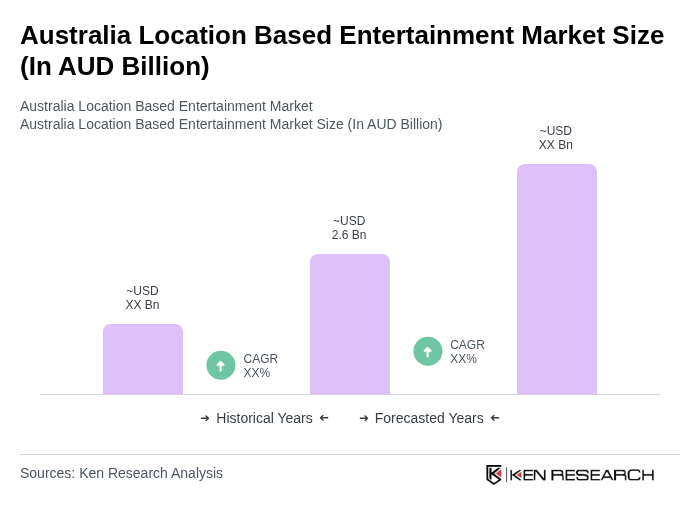
- The Australia Location Based Entertainment Market is valued at approximately AUD 2.6 billion, based on a five-year historical analysis of the broader amusement parks and centres operation industry and the growing contribution of immersive and technology-led venues. This growth is primarily driven by increasing consumer demand for immersive experiences, technological advancements in entertainment, and a rise in discretionary leisure spending among Australians. The market has seen a notable uptick in participation rates, particularly in urban areas where entertainment options such as theme parks, FECs, VR arcades, and experiential attractions are abundant.
- Key cities such as Sydney, Melbourne, and Brisbane dominate the Australia Location Based Entertainment Market due to their large populations, well-developed tourism sectors, and a high concentration of entertainment venues, including theme parks, aquariums, branded attractions, and urban entertainment centers. These cities offer a diverse range of attractions, from major theme parks like Dreamworld and Warner Bros. Movie World on the Gold Coast to inner-city immersive experiences, escape rooms, and interactive museums, making them prime locations for both local and international visitors.
- In 2023, the Australian government implemented regulations aimed at enhancing safety standards in amusement parks and entertainment venues, building on existing work health and safety and plant safety obligations. This includes mandatory safety audits and compliance checks under instruments such as the Work Health and Safety (Amusement Devices and Rides) provisions in the model Work Health and Safety Regulations 2011 issued by Safe Work Australia, which require regular inspection, registration of certain amusement devices, documented risk management, and competent operation and maintenance. These measures foster a safer environment for visitors and support consumer confidence in the industry.
Australia Location Based Entertainment Market Segmentation
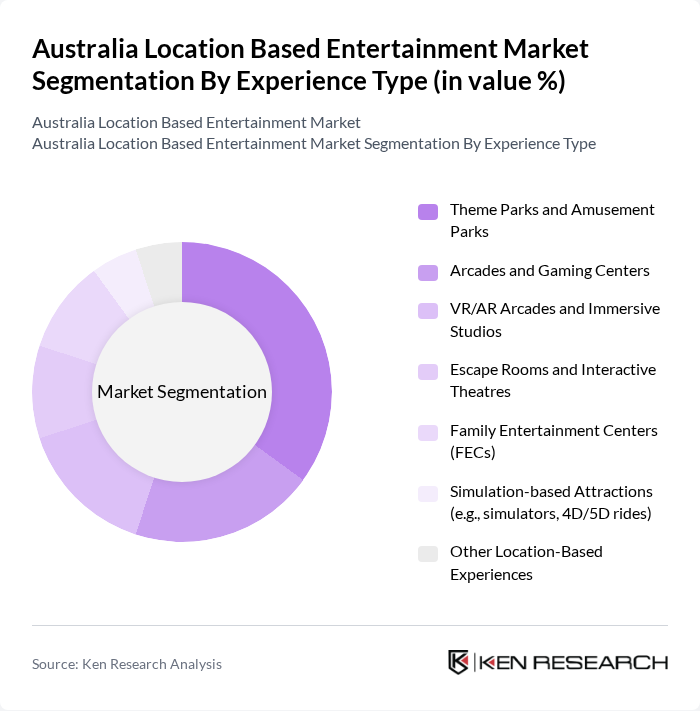
By Experience Type:The experience type segmentation includes various subsegments such as Theme Parks and Amusement Parks, Arcades and Gaming Centers, VR/AR Arcades and Immersive Studios, Escape Rooms and Interactive Theatres, Family Entertainment Centers (FECs), Simulation-based Attractions, and Other Location-Based Experiences. This structure aligns with global practice where LBE covers theme parks, FECs, arcades, immersive art spaces, and simulation-based attractions. Among these, Theme Parks and Amusement Parks are the leading subsegment by revenue within Australia, supported by large-scale destination parks and water parks that draw both domestic and international tourists seeking full-day entertainment options. The popularity of iconic parks like Dreamworld, Warner Bros. Movie World, Sea World, and Luna Park, combined with seasonal events, holiday campaigns, and cross-promotional offers, significantly contributes to their market dominance.
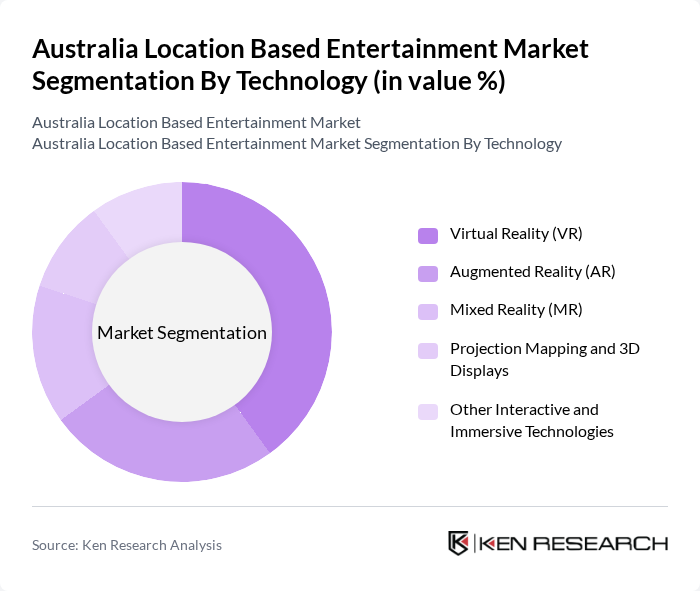
By Technology:The technology segmentation encompasses Virtual Reality (VR), Augmented Reality (AR), Mixed Reality (MR), Projection Mapping and 3D Displays, and Other Interactive and Immersive Technologies. Global market analyses highlight rapid adoption of VR, AR, projection mapping, and multi-sensory systems in LBE venues, with hardware-intensive immersive platforms forming a major share of investments. Virtual Reality (VR) is a core technology in the market, used in free-roam VR arenas, VR coasters, and simulator attractions that appeal strongly to gaming-oriented and tech-savvy consumers. The increasing availability of high-quality VR equipment, advances in AR and MR content, and the use of projection mapping and interactive displays in attractions and experiential events have propelled immersive technologies to the forefront of the location-based entertainment landscape.
Australia Location Based Entertainment Market Competitive Landscape
The Australia Location Based Entertainment Market is characterized by a dynamic mix of regional and international players. Leading participants such as Village Roadshow Theme Parks, Ardent Leisure Group (Dreamworld & WhiteWater World), Merlin Entertainments (SEA LIFE Sydney Aquarium & Madame Tussauds Sydney), Luna Park Sydney, Funlab (Timezone, Zone Bowling, Kingpin, Hijinx Hotel), iFLY Downunder, Escape Hunt, Strike Bowling, Holey Moley Golf Club, Adventure Park Geelong, Funfields Themepark, Jamberoo Action Park, Infinity Attraction Gold Coast, Local and Emerging LBE Operators, Others contribute to innovation, geographic expansion, and service delivery in this space. Operators are increasingly integrating IP-led attractions, social competitive gaming concepts, and technology-enabled guest experiences to differentiate offerings and drive repeat visitation.
Australia Location Based Entertainment Market Industry Analysis
Growth Drivers
- Increasing Consumer Spending on Leisure Activities:In future, Australian households are projected to spend approximately AUD 1,300 on leisure activities per capita, reflecting a 6% increase from previous years. This rise in disposable income, coupled with a growing trend towards prioritizing experiences over material goods, is driving demand for location-based entertainment. The Australian Bureau of Statistics reported that leisure spending accounted for 11% of total household expenditure, indicating a robust market for entertainment providers to capitalize on this trend.
- Rise in Tourism and Domestic Travel:Australia welcomed over 10 million international visitors in previous years, contributing AUD 50 billion to the economy. The Australian government anticipates a further 12% increase in tourism in future, driven by relaxed travel restrictions and enhanced marketing efforts. Domestic travel is also on the rise, with Australians expected to spend AUD 90 billion on local tourism, creating significant opportunities for location-based entertainment venues to attract both tourists and locals alike.
- Technological Advancements in Entertainment Experiences:The integration of advanced technologies, such as virtual reality (VR) and augmented reality (AR), is transforming the entertainment landscape. In future, the Australian VR market is expected to reach AUD 2 billion, growing at a rapid pace. This technological evolution enhances consumer engagement and satisfaction, encouraging more visitors to location-based entertainment venues. As technology continues to evolve, it will play a crucial role in shaping the future of the entertainment industry in Australia.
Market Challenges
- High Operational Costs:The operational costs for location-based entertainment venues in Australia are projected to rise by 9% in future, primarily due to increased labor costs and utility expenses. The Fair Work Commission's recent decision to raise the minimum wage by 6% adds pressure on profit margins. Additionally, maintaining high-quality experiences requires significant investment in technology and infrastructure, making it challenging for smaller operators to compete effectively in the market.
- Intense Competition Among Entertainment Providers:The Australian location-based entertainment market is becoming increasingly saturated, with over 1,600 venues operating nationwide. This intense competition is driving down prices and forcing operators to innovate continuously. According to IBISWorld, the industry is expected to see a 4% decline in profit margins in future as businesses struggle to differentiate themselves. This competitive landscape poses a significant challenge for new entrants and established players alike.
Australia Location Based Entertainment Market Future Outlook
The future of the Australia location-based entertainment market appears promising, driven by technological advancements and evolving consumer preferences. As the market adapts to post-pandemic realities, operators are likely to focus on enhancing safety measures and integrating immersive technologies. The demand for unique, experiential offerings will continue to grow, encouraging innovation. Additionally, collaboration with local businesses and investment in sustainable practices will be crucial for long-term success, positioning the industry for resilience and growth in the coming years.
Market Opportunities
- Expansion of Virtual and Augmented Reality Experiences:The growing interest in VR and AR presents a significant opportunity for entertainment venues. With the VR market projected to reach AUD 2 billion in future, operators can leverage this technology to create unique experiences that attract tech-savvy consumers, enhancing engagement and driving revenue growth.
- Development of Family-Friendly Entertainment Options:As families seek safe and engaging activities, there is a growing demand for family-oriented entertainment. In future, the family entertainment center market is expected to grow by 7%, providing opportunities for venues to develop attractions that cater to children and parents alike, fostering repeat visits and customer loyalty.
Scope of the Report
| Segment | Sub-Segments |
|---|---|
| By Experience Type | Theme Parks and Amusement Parks Arcades and Gaming Centers VR/AR Arcades and Immersive Studios Escape Rooms and Interactive Theatres Family Entertainment Centers (FECs) Simulation-based Attractions (e.g., simulators, 4D/5D rides) Other Location-Based Experiences |
| By Technology | Virtual Reality (VR) Augmented Reality (AR) Mixed Reality (MR) Projection Mapping and 3D Displays Other Interactive and Immersive Technologies |
| By Venue Format | Indoor Venues Outdoor Venues Hybrid / Pop-up Venues |
| By Application | Entertainment and Leisure Education and Edutainment Retail and Experiential Marketing Corporate Events and Team-building Tourism and Destination Attractions Other Applications |
| By End User | Individual Consumers Families and Groups Corporate and Institutional Clients Educational Institutions Tourists (Domestic and International) Other End Users |
| By Business Model | Pay-per-Use (Ticketing) Membership and Subscription Revenue Share and Licensing Event-based and Corporate Hire Other Business Models |
| By Region (Within Australia) | New South Wales Victoria Queensland Western Australia South Australia Other States and Territories |
Key Target Audience
Investors and Venture Capitalist Firms
Government and Regulatory Bodies (e.g., Australian Competition and Consumer Commission, Screen Australia)
Manufacturers and Producers of Entertainment Equipment
Distributors and Retailers of Entertainment Products
Event Organizers and Venue Operators
Technology Providers and Software Developers
Industry Associations (e.g., Australian Amusement, Leisure and Recreation Association)
Financial Institutions and Investment Banks
Players Mentioned in the Report:
Village Roadshow Theme Parks
Ardent Leisure Group (Dreamworld & WhiteWater World)
Merlin Entertainments (SEA LIFE Sydney Aquarium & Madame Tussauds Sydney)
Luna Park Sydney
Funlab (Timezone, Zone Bowling, Kingpin, Hijinx Hotel)
iFLY Downunder
Escape Hunt
Strike Bowling
Holey Moley Golf Club
Adventure Park Geelong
Funfields Themepark
Jamberoo Action Park
Infinity Attraction Gold Coast
Local and Emerging LBE Operators
Others
Table of Contents
Market Assessment Phase
1. Executive Summary and Approach
2. Australia Location Based Entertainment Market Overview
2.1 Key Insights and Strategic Recommendations
2.2 Australia Location Based Entertainment Market Overview
2.3 Definition and Scope
2.4 Evolution of Market Ecosystem
2.5 Timeline of Key Regulatory Milestones
2.6 Value Chain & Stakeholder Mapping
2.7 Business Cycle Analysis
2.8 Policy & Incentive Landscape
3. Australia Location Based Entertainment Market Analysis
3.1 Growth Drivers
3.1.1 Increasing consumer spending on leisure activities
3.1.2 Rise in tourism and domestic travel
3.1.3 Technological advancements in entertainment experiences
3.1.4 Growing demand for immersive experiences
3.2 Market Challenges
3.2.1 High operational costs
3.2.2 Intense competition among entertainment providers
3.2.3 Regulatory hurdles and compliance issues
3.2.4 Fluctuating consumer preferences
3.3 Market Opportunities
3.3.1 Expansion of virtual and augmented reality experiences
3.3.2 Development of family-friendly entertainment options
3.3.3 Collaborations with local businesses for unique offerings
3.3.4 Investment in sustainable entertainment solutions
3.4 Market Trends
3.4.1 Increasing integration of technology in entertainment
3.4.2 Growth of themed entertainment venues
3.4.3 Rise of experiential marketing strategies
3.4.4 Focus on health and safety in entertainment venues
3.5 Government Regulation
3.5.1 Licensing requirements for entertainment venues
3.5.2 Health and safety regulations
3.5.3 Tax incentives for entertainment investments
3.5.4 Environmental regulations impacting venue operations
4. SWOT Analysis
5. Stakeholder Analysis
6. Porter's Five Forces Analysis
7. Australia Location Based Entertainment Market Market Size, 2019-2024
7.1 By Value
7.2 By Volume
7.3 By Average Selling Price
8. Australia Location Based Entertainment Market Segmentation
8.1 By Experience Type
8.1.1 Theme Parks and Amusement Parks
8.1.2 Arcades and Gaming Centers
8.1.3 VR/AR Arcades and Immersive Studios
8.1.4 Escape Rooms and Interactive Theatres
8.1.5 Family Entertainment Centers (FECs)
8.1.6 Simulation-based Attractions (e.g., simulators, 4D/5D rides)
8.1.7 Other Location-Based Experiences
8.2 By Technology
8.2.1 Virtual Reality (VR)
8.2.2 Augmented Reality (AR)
8.2.3 Mixed Reality (MR)
8.2.4 Projection Mapping and 3D Displays
8.2.5 Other Interactive and Immersive Technologies
8.3 By Venue Format
8.3.1 Indoor Venues
8.3.2 Outdoor Venues
8.3.3 Hybrid / Pop-up Venues
8.4 By Application
8.4.1 Entertainment and Leisure
8.4.2 Education and Edutainment
8.4.3 Retail and Experiential Marketing
8.4.4 Corporate Events and Team-building
8.4.5 Tourism and Destination Attractions
8.4.6 Other Applications
8.5 By End User
8.5.1 Individual Consumers
8.5.2 Families and Groups
8.5.3 Corporate and Institutional Clients
8.5.4 Educational Institutions
8.5.5 Tourists (Domestic and International)
8.5.6 Other End Users
8.6 By Business Model
8.6.1 Pay-per-Use (Ticketing)
8.6.2 Membership and Subscription
8.6.3 Revenue Share and Licensing
8.6.4 Event-based and Corporate Hire
8.6.5 Other Business Models
8.7 By Region (Within Australia)
8.7.1 New South Wales
8.7.2 Victoria
8.7.3 Queensland
8.7.4 Western Australia
8.7.5 South Australia
8.7.6 Other States and Territories
9. Australia Location Based Entertainment Market Competitive Analysis
9.1 Market Share of Key Players
9.2 Cross Comparison of Key Players
9.2.1 Company Name
9.2.2 Group Size (Large, Medium, or Small as per industry convention)
9.2.3 Annual Revenue (AUD million)
9.2.4 3-year Revenue CAGR (%)
9.2.5 EBITDA Margin (%)
9.2.6 Average Revenue per Visitor (ARPV)
9.2.7 Visitor Footfall (Annual, in millions)
9.2.8 Utilization Rate / Capacity Utilization (%)
9.2.9 Customer Retention / Repeat Visit Rate (%)
9.2.10 Digital Engagement (App/Online Bookings as % of Total)
9.2.11 Capex Intensity (Capex as % of Revenue)
9.2.12 Return on Invested Capital (ROIC %)
9.3 SWOT Analysis of Top Players
9.4 Pricing Analysis
9.5 Detailed Profile of Major Companies
9.5.1 Village Roadshow Theme Parks
9.5.2 Ardent Leisure Group (Dreamworld & WhiteWater World)
9.5.3 Merlin Entertainments (SEA LIFE Sydney Aquarium & Madame Tussauds Sydney)
9.5.4 Luna Park Sydney
9.5.5 Funlab (Timezone, Zone Bowling, Kingpin, Hijinx Hotel)
9.5.6 iFLY Downunder
9.5.7 Escape Hunt
9.5.8 Strike Bowling
9.5.9 Holey Moley Golf Club
9.5.10 Adventure Park Geelong
9.5.11 Funfields Themepark
9.5.12 Jamberoo Action Park
9.5.13 Infinity Attraction Gold Coast
9.5.14 Local and Emerging LBE Operators
9.5.15 Others
10. Australia Location Based Entertainment Market End-User Analysis
10.1 Procurement Behavior of Key Ministries
10.1.1 Budget Allocation for Entertainment
10.1.2 Decision-Making Process
10.1.3 Preferred Vendors
10.1.4 Contracting Procedures
10.2 Corporate Spend on Infrastructure & Energy
10.2.1 Investment in New Venues
10.2.2 Upgrades to Existing Facilities
10.2.3 Technology Integration Costs
10.2.4 Marketing and Promotion Budgets
10.3 Pain Point Analysis by End-User Category
10.3.1 Accessibility Issues
10.3.2 Pricing Concerns
10.3.3 Quality of Experience
10.3.4 Safety and Security
10.4 User Readiness for Adoption
10.4.1 Awareness of Offerings
10.4.2 Willingness to Pay
10.4.3 Feedback Mechanisms
10.4.4 Engagement Strategies
10.5 Post-Deployment ROI and Use Case Expansion
10.5.1 Measurement of Success
10.5.2 Customer Feedback Analysis
10.5.3 Opportunities for Upselling
10.5.4 Expansion into New Markets
11. Australia Location Based Entertainment Market Future Size, 2025-2030
11.1 By Value
11.2 By Volume
11.3 By Average Selling Price
Go-To-Market Strategy Phase
1. Whitespace Analysis + Business Model Canvas
1.1 Market Gaps Identification
1.2 Business Model Development
2. Marketing and Positioning Recommendations
2.1 Branding Strategies
2.2 Product USPs
3. Distribution Plan
3.1 Urban Retail vs Rural NGO Tie-ups
4. Channel & Pricing Gaps
4.1 Underserved Routes
4.2 Pricing Bands
5. Unmet Demand & Latent Needs
5.1 Category Gaps
5.2 Consumer Segments
6. Customer Relationship
6.1 Loyalty Programs
6.2 After-sales Service
7. Value Proposition
7.1 Sustainability
7.2 Integrated Supply Chains
8. Key Activities
8.1 Regulatory Compliance
8.2 Branding
8.3 Distribution Setup
9. Entry Strategy Evaluation
9.1 Domestic Market Entry Strategy
9.1.1 Product Mix
9.1.2 Pricing Band
9.1.3 Packaging
9.2 Export Entry Strategy
9.2.1 Target Countries
9.2.2 Compliance Roadmap
10. Entry Mode Assessment
10.1 JV
10.2 Greenfield
10.3 M&A
10.4 Distributor Model
11. Capital and Timeline Estimation
11.1 Capital Requirements
11.2 Timelines
12. Control vs Risk Trade-Off
12.1 Ownership vs Partnerships
13. Profitability Outlook
13.1 Breakeven Analysis
13.2 Long-term Sustainability
14. Potential Partner List
14.1 Distributors
14.2 JVs
14.3 Acquisition Targets
15. Execution Roadmap
15.1 Phased Plan for Market Entry
15.1.1 Market Setup
15.1.2 Market Entry
15.1.3 Growth Acceleration
15.1.4 Scale & Stabilize
15.2 Key Activities and Milestones
15.2.1 Activity Planning
15.2.2 Milestone Tracking
Research Methodology
Phase 1: Approach1
Desk Research
- Industry reports from Australian entertainment associations and market research firms
- Government publications on tourism and entertainment trends in Australia
- Academic journals and case studies focusing on location-based entertainment innovations
Primary Research
- Interviews with executives from leading location-based entertainment venues
- Surveys targeting consumers who frequently engage in entertainment activities
- Focus groups with industry stakeholders, including event organizers and technology providers
Validation & Triangulation
- Cross-validation of findings through multiple data sources, including financial reports and market surveys
- Triangulation of consumer insights with industry expert opinions
- Sanity checks through peer reviews and expert panel discussions
Phase 2: Market Size Estimation1
Top-down Assessment
- Analysis of overall entertainment spending trends in Australia
- Segmentation of the market by type of location-based entertainment (e.g., theme parks, escape rooms)
- Incorporation of demographic data to assess potential market growth
Bottom-up Modeling
- Estimation of revenue generated by key players in the location-based entertainment sector
- Analysis of visitor numbers and average spending per visit across various entertainment venues
- Calculation of market size based on operational metrics and capacity utilization rates
Forecasting & Scenario Analysis
- Multi-variable forecasting using historical growth rates and emerging trends in consumer behavior
- Scenario analysis based on potential impacts of economic fluctuations and tourism recovery
- Development of baseline, optimistic, and pessimistic market projections through 2030
Phase 3: CATI Sample Composition1
| Scope Item/Segment | Sample Size | Target Respondent Profiles |
|---|---|---|
| Theme Park Visitors | 120 | Families, Young Adults |
| Escape Room Participants | 80 | Millennials, Corporate Teams |
| Virtual Reality Experience Users | 60 | Tech Enthusiasts, Gamers |
| Live Event Attendees | 100 | Concert Goers, Festival Participants |
| Tourism-Related Entertainment Consumers | 70 | International Tourists, Local Visitors |
Frequently Asked Questions
What is the current value of the Australia Location Based Entertainment Market?
The Australia Location Based Entertainment Market is valued at approximately AUD 2.6 billion. This valuation reflects a five-year historical analysis of the amusement parks and centers operation industry, highlighting the growing demand for immersive and technology-led venues.
Which cities dominate the Australia Location Based Entertainment Market?
What are the main types of experiences in the Australia Location Based Entertainment Market?
How is technology influencing the Australia Location Based Entertainment Market?
Other Regional/Country Reports
Other Adjacent Reports
Oman Family Entertainment Center Market
Philippines Gaming Arcade Market
Japan Escape Room Market
Belgium Tourism Market
South Korea Leisure Spending Market
Middle East Immersive Technology Market Report Size Share Growth Drivers Trends Opportunities & Forecast 2025–2030Why Buy From Us?

What makes us stand out is that our consultants follow Robust, Refine and Result (RRR) methodology. Robust for clear definitions, approaches and sanity checking, Refine for differentiating respondents' facts and opinions, and Result for presenting data with story.

We have set a benchmark in the industry by offering our clients with syndicated and customized market research reports featuring coverage of entire market as well as meticulous research and analyst insights.

While we don't replace traditional research, we flip the method upside down. Our dual approach of Top Bottom & Bottom Top ensures quality deliverable by not just verifying company fundamentals but also looking at the sector and macroeconomic factors.

With one step in the future, our research team constantly tries to show you the bigger picture. We help with some of the tough questions you may encounter along the way: How is the industry positioned? Best marketing channel? KPI's of competitors? By aligning every element, we help maximize success.

Our report gives you instant access to the answers and sources that other companies might choose to hide. We elaborate each steps of research methodology we have used and showcase you the sample size to earn your trust.

If you need any support, we are here! We pride ourselves on universe strength, data quality, and quick, friendly, and professional service.