About the Report
Base Year 2024Listen to the audio summary
Japan Location Based Entertainment Market Overview
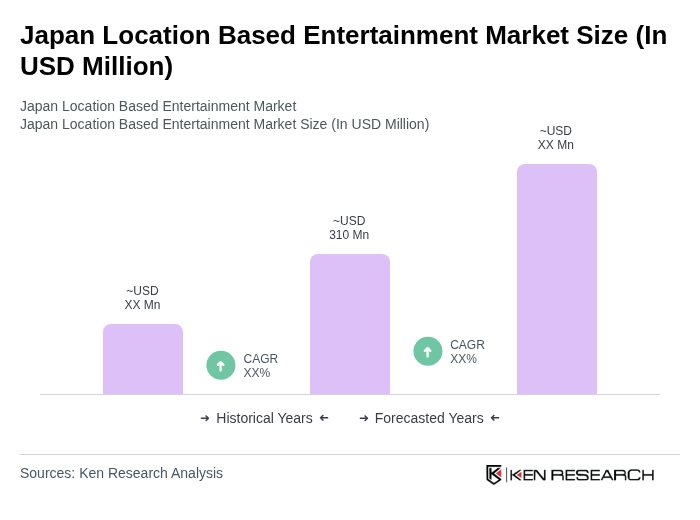
- The Japan Location Based Entertainment Market is valued at USD 310 million, based on a five-year historical analysis. This growth is primarily driven by the increasing demand for immersive experiences, rapid deployment of advanced virtual and augmented reality attractions in theme parks and arcades, and the rising popularity of high?quality entertainment venues among both domestic and international tourists, supported by the recovery of inbound tourism and expanding disposable incomes in major urban areas.
- Key cities such as Tokyo, Osaka, and Yokohama dominate the market due to their high population density, vibrant tourism sectors, and a strong cultural emphasis on entertainment. These urban centers are home to numerous theme parks, arcades, family entertainment centers, and immersive experience facilities such as Tokyo Disney Resort, Universal Studios Japan, Ghibli Park, and teamLab museums, making them prime locations for location-based entertainment.
- In 2023, the Japanese government implemented regulations to promote the development of safe and innovative entertainment venues. This includes guidelines for health and safety standards in amusement parks and entertainment centers, ensuring a secure environment for visitors while encouraging investment in new technologies and attractions, as reflected in instruments such as the Ordinance for Enforcement of the Act on Safety of Regulated Amusement Facilities and Amusement Parks (Cabinet Office / Ministry of Land, Infrastructure, Transport and Tourism), which specifies design, inspection, and operational safety requirements for amusement rides and related facilities.
Japan Location Based Entertainment Market Segmentation
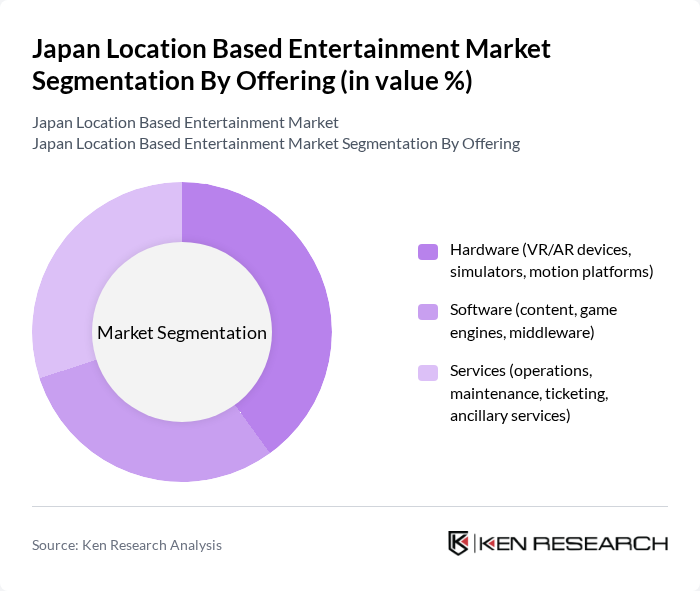
By Offering:The market is segmented into three main categories: Hardware, Software, and Services. Hardware includes VR/AR devices, simulators, motion platforms, projection systems, and interactive installations that are essential for creating immersive, site?based experiences. Software encompasses content, game engines, middleware, and venue management platforms that support the operation, personalization, and analytics of these attractions. Services cover operations, maintenance, ticketing, theming, experiential design, and other ancillary services that enhance the overall visitor experience and drive repeat visitation.
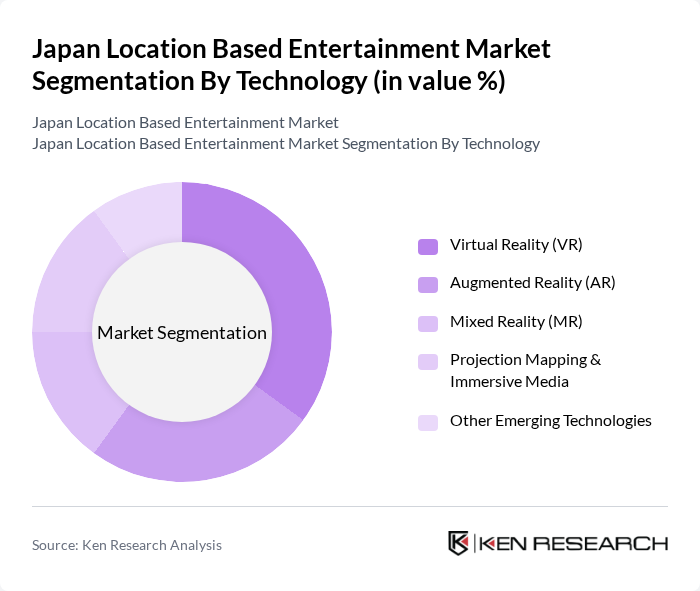
By Technology:The technology segment includes Virtual Reality (VR), Augmented Reality (AR), Mixed Reality (MR), Projection Mapping & Immersive Media, and Other Emerging Technologies. VR and AR are leading technologies in location-based entertainment, providing highly interactive and engaging experiences through head?mounted displays, motion platforms, and smartphone?based overlays in parks and indoor venues. Mixed Reality combines both VR and AR elements to blend physical sets with digital content, while projection mapping and immersive media enhance physical spaces with large?scale digital visuals, sound, and interactive lighting, creating fully immersive environments for events, exhibitions, and theme park attractions.
Japan Location Based Entertainment Market Competitive Landscape
The Japan Location Based Entertainment Market is characterized by a dynamic mix of regional and international players. Leading participants such as SEGA Sammy Holdings Inc., Bandai Namco Holdings Inc., Oriental Land Co., Ltd. (Tokyo Disney Resort), Universal Studios Japan (USJ LLC), Fuji-Q Highland (Fujikyu Highland Co., Ltd.), LEGOLAND Japan Resort, Round One Corporation, KidZania Tokyo / KidZania Koshien, Tokyo Joypolis, Sanrio Puroland, Ghibli Park & Ghibli Museum, teamLab Planets / teamLab Borderless, Tokyo Dome City Attractions, Huis Ten Bosch, Other Emerging VR/AR LBE Operators in Japan contribute to innovation, geographic expansion, and service delivery in this space.
Japan Location Based Entertainment Market Industry Analysis
Growth Drivers
- Increasing Consumer Demand for Immersive Experiences:The Japanese entertainment sector is witnessing a surge in consumer demand for immersive experiences, with the market for virtual reality (VR) and augmented reality (AR) projected to reach ¥1.3 trillion by the future. This growth is driven by a cultural inclination towards unique experiences, with 70% of consumers expressing interest in interactive entertainment options. The rise of social media platforms further amplifies this trend, as users seek shareable, engaging experiences that enhance their social interactions.
- Expansion of Technology Integration in Entertainment:The integration of advanced technologies such as AI and VR is transforming the entertainment landscape in Japan. In the future, investments in technology-driven entertainment are expected to exceed ¥575 billion, reflecting a 15% increase from the previous year. This trend is supported by the growing number of tech startups focusing on entertainment solutions, with over 300 new companies entering the market in the past year, enhancing the overall consumer experience through innovative offerings.
- Rise of Social and Interactive Entertainment Venues:The emergence of social and interactive entertainment venues is reshaping consumer preferences in Japan. In the future, the number of interactive entertainment venues is projected to grow by 20%, reaching approximately 1,440 locations nationwide. This growth is fueled by a shift towards experiences that promote social interaction, with 65% of consumers preferring venues that offer collaborative activities, such as escape rooms and VR gaming centers, enhancing community engagement and participation.
Market Challenges
- High Operational Costs for Entertainment Venues:The operational costs for entertainment venues in Japan are a significant challenge, with average annual expenses exceeding ¥330 million per venue. This includes rent, staffing, and maintenance costs, which have risen by 10% in the past year due to inflation and increased demand for premium experiences. As a result, many smaller operators struggle to maintain profitability, leading to a consolidation trend in the industry.
- Intense Competition Among Entertainment Providers:The competitive landscape in Japan's location-based entertainment market is intensifying, with over 1,200 new entrants in the past two years. This saturation has led to price wars and reduced profit margins, with some venues reporting a 15% decline in revenue. Established players are forced to innovate continuously to retain market share, while new entrants often lack the resources to compete effectively, creating a challenging environment for all stakeholders.
Japan Location Based Entertainment Market Future Outlook
The future of Japan's location-based entertainment market appears promising, driven by technological advancements and evolving consumer preferences. As immersive experiences gain traction, venues that leverage VR and AR technologies are likely to thrive. Additionally, the focus on sustainability and community engagement will shape new entertainment concepts. With government support for tourism and entertainment, the sector is poised for growth, fostering innovation and attracting investments that will enhance the overall consumer experience in the coming years.
Market Opportunities
- Growth of Virtual and Augmented Reality Experiences:The increasing popularity of VR and AR presents a significant opportunity for entertainment providers. With the market for VR experiences expected to reach ¥1.1 trillion by the future, businesses can capitalize on this trend by developing unique, immersive attractions that cater to tech-savvy consumers, enhancing engagement and driving foot traffic to venues.
- Expansion into Underserved Regional Markets:There is a notable opportunity for entertainment providers to expand into underserved regional markets in Japan. With over 30% of the population residing outside major urban centers, developing entertainment venues in these areas can tap into a growing demand for local experiences, fostering community engagement and driving economic growth in these regions.
Scope of the Report
| Segment | Sub-Segments |
|---|---|
| By Offering | Hardware (VR/AR devices, simulators, motion platforms) Software (content, game engines, middleware) Services (operations, maintenance, ticketing, ancillary services) |
| By Technology | Virtual Reality (VR) Augmented Reality (AR) Mixed Reality (MR) Projection Mapping & Immersive Media Other Emerging Technologies |
| By Venue Type | Theme Parks & Amusement Parks Family Entertainment Centers & Arcades VR/AR Experience Centers Museums, Galleries & Cultural Attractions Location-Based eSports & Gaming Arenas Other Venues |
| By End-User Segment | Families with Children Teenagers & Young Adults Domestic Tourists Inbound Tourists Corporate & MICE Groups Educational & Institutional Groups Other Visitor Segments |
| By Revenue Model | Ticket-Based (Single Entry) Time-Based & Session-Based Pricing Memberships & Season Passes In-Experience Monetization (F&B, merchandise, add-ons) Sponsorships & IP Licensing Other Revenue Models |
| By Ownership & Operation | Integrated Resort & Theme Park Operators Independent LBE Operators Retail & Mall-Based Operators IP Owners & Media Companies Franchise & Partnership Models Other Operator Types |
| By Region (Japan) | Kanto (Tokyo, Yokohama and surrounding areas) Kansai (Osaka, Kyoto, Kobe) Tokai & Chubu Hokkaido & Tohoku Chugoku & Shikoku Kyushu & Okinawa |
Key Target Audience
Investors and Venture Capitalist Firms
Government and Regulatory Bodies (e.g., Ministry of Economy, Trade and Industry; Japan Tourism Agency)
Manufacturers and Producers
Distributors and Retailers
Theme Park Operators
Technology Providers
Event Organizers
Real Estate Developers
Players Mentioned in the Report:
SEGA Sammy Holdings Inc.
Bandai Namco Holdings Inc.
Oriental Land Co., Ltd. (Tokyo Disney Resort)
Universal Studios Japan (USJ LLC)
Fuji-Q Highland (Fujikyu Highland Co., Ltd.)
LEGOLAND Japan Resort
Round One Corporation
KidZania Tokyo / KidZania Koshien
Tokyo Joypolis
Sanrio Puroland
Ghibli Park & Ghibli Museum
teamLab Planets / teamLab Borderless
Tokyo Dome City Attractions
Huis Ten Bosch
Other Emerging VR/AR LBE Operators in Japan
Table of Contents
Market Assessment Phase
1. Executive Summary and Approach
2. Japan Location Based Entertainment Market Overview
2.1 Key Insights and Strategic Recommendations
2.2 Japan Location Based Entertainment Market Overview
2.3 Definition and Scope
2.4 Evolution of Market Ecosystem
2.5 Timeline of Key Regulatory Milestones
2.6 Value Chain & Stakeholder Mapping
2.7 Business Cycle Analysis
2.8 Policy & Incentive Landscape
3. Japan Location Based Entertainment Market Analysis
3.1 Growth Drivers
3.1.1 Increasing consumer demand for immersive experiences
3.1.2 Expansion of technology integration in entertainment
3.1.3 Rise of social and interactive entertainment venues
3.1.4 Government support for tourism and entertainment sectors
3.2 Market Challenges
3.2.1 High operational costs for entertainment venues
3.2.2 Intense competition among entertainment providers
3.2.3 Regulatory hurdles and compliance issues
3.2.4 Fluctuating consumer spending patterns
3.3 Market Opportunities
3.3.1 Growth of virtual and augmented reality experiences
3.3.2 Development of themed entertainment attractions
3.3.3 Collaboration with technology firms for innovation
3.3.4 Expansion into underserved regional markets
3.4 Market Trends
3.4.1 Increasing focus on sustainability in entertainment
3.4.2 Integration of mobile technology for customer engagement
3.4.3 Rise of experiential marketing strategies
3.4.4 Growth of eSports and competitive gaming events
3.5 Government Regulation
3.5.1 Licensing requirements for entertainment venues
3.5.2 Safety regulations for amusement attractions
3.5.3 Tax incentives for tourism-related businesses
3.5.4 Compliance with health and safety standards
4. SWOT Analysis
5. Stakeholder Analysis
6. Porter's Five Forces Analysis
7. Japan Location Based Entertainment Market Market Size, 2019-2024
7.1 By Value
7.2 By Volume
7.3 By Average Selling Price
8. Japan Location Based Entertainment Market Segmentation
8.1 By Offering
8.1.1 Hardware (VR/AR devices, simulators, motion platforms)
8.1.2 Software (content, game engines, middleware)
8.1.3 Services (operations, maintenance, ticketing, ancillary services)
8.2 By Technology
8.2.1 Virtual Reality (VR)
8.2.2 Augmented Reality (AR)
8.2.3 Mixed Reality (MR)
8.2.4 Projection Mapping & Immersive Media
8.2.5 Other Emerging Technologies
8.3 By Venue Type
8.3.1 Theme Parks & Amusement Parks
8.3.2 Family Entertainment Centers & Arcades
8.3.3 VR/AR Experience Centers
8.3.4 Museums, Galleries & Cultural Attractions
8.3.5 Location-Based eSports & Gaming Arenas
8.3.6 Other Venues
8.4 By End-User Segment
8.4.1 Families with Children
8.4.2 Teenagers & Young Adults
8.4.3 Domestic Tourists
8.4.4 Inbound Tourists
8.4.5 Corporate & MICE Groups
8.4.6 Educational & Institutional Groups
8.4.7 Other Visitor Segments
8.5 By Revenue Model
8.5.1 Ticket-Based (Single Entry)
8.5.2 Time-Based & Session-Based Pricing
8.5.3 Memberships & Season Passes
8.5.4 In-Experience Monetization (F&B, merchandise, add-ons)
8.5.5 Sponsorships & IP Licensing
8.5.6 Other Revenue Models
8.6 By Ownership & Operation
8.6.1 Integrated Resort & Theme Park Operators
8.6.2 Independent LBE Operators
8.6.3 Retail & Mall-Based Operators
8.6.4 IP Owners & Media Companies
8.6.5 Franchise & Partnership Models
8.6.6 Other Operator Types
8.7 By Region (Japan)
8.7.1 Kanto (Tokyo, Yokohama and surrounding areas)
8.7.2 Kansai (Osaka, Kyoto, Kobe)
8.7.3 Tokai & Chubu
8.7.4 Hokkaido & Tohoku
8.7.5 Chugoku & Shikoku
8.7.6 Kyushu & Okinawa
9. Japan Location Based Entertainment Market Competitive Analysis
9.1 Market Share of Key Players
9.2 Cross Comparison of Key Players
9.2.1 Company Name
9.2.2 Player Classification (Global / Regional / Local)
9.2.3 Revenue from LBE in Japan (Latest Year, USD Million)
9.2.4 3-Year LBE Revenue CAGR (%)
9.2.5 Number of LBE Sites / Venues in Japan
9.2.6 Average Revenue Per Venue (USD Million)
9.2.7 Average Revenue Per Visitor (ARPV)
9.2.8 Annual Footfall / Visitors (Million)
9.2.9 Occupancy / Utilization Rate (%)
9.2.10 EBITDA Margin from LBE Operations (%)
9.2.11 Capital Expenditure Intensity (Capex / Sales, %)
9.2.12 Customer Repeat-Visit Rate (%)
9.2.13 Net Promoter Score (NPS)
9.2.14 Share of Digital / Immersive Attractions in Portfolio (%)
9.2.15 Strategic Partnerships & IP Tie-ups (Count)
9.3 SWOT Analysis of Top Players
9.4 Pricing Analysis
9.5 Detailed Profile of Major Companies
9.5.1 SEGA Sammy Holdings Inc.
9.5.2 Bandai Namco Holdings Inc.
9.5.3 Oriental Land Co., Ltd. (Tokyo Disney Resort)
9.5.4 Universal Studios Japan (USJ LLC)
9.5.5 Fuji-Q Highland (Fujikyu Highland Co., Ltd.)
9.5.6 LEGOLAND Japan Resort
9.5.7 Round One Corporation
9.5.8 KidZania Tokyo / KidZania Koshien
9.5.9 Tokyo Joypolis
9.5.10 Sanrio Puroland
9.5.11 Ghibli Park & Ghibli Museum
9.5.12 teamLab Planets / teamLab Borderless
9.5.13 Tokyo Dome City Attractions
9.5.14 Huis Ten Bosch
9.5.15 Other Emerging VR/AR LBE Operators in Japan
10. Japan Location Based Entertainment Market End-User Analysis
10.1 Procurement Behavior of Key Ministries
10.1.1 Engagement with local entertainment providers
10.1.2 Budget allocation for cultural events
10.1.3 Collaboration with tourism boards
10.1.4 Support for community-based entertainment initiatives
10.2 Corporate Spend on Infrastructure & Energy
10.2.1 Investment in entertainment infrastructure
10.2.2 Funding for technology upgrades
10.2.3 Expenditure on marketing and promotions
10.2.4 Budget for employee engagement activities
10.3 Pain Point Analysis by End-User Category
10.3.1 Accessibility issues for certain demographics
10.3.2 High costs of entry for families
10.3.3 Limited variety of entertainment options
10.3.4 Seasonal fluctuations in attendance
10.4 User Readiness for Adoption
10.4.1 Awareness of new entertainment technologies
10.4.2 Willingness to pay for premium experiences
10.4.3 Interest in interactive and immersive formats
10.4.4 Feedback mechanisms for continuous improvement
10.5 Post-Deployment ROI and Use Case Expansion
10.5.1 Measurement of customer engagement levels
10.5.2 Analysis of repeat visitation rates
10.5.3 Evaluation of customer feedback for enhancements
10.5.4 Identification of new market segments
11. Japan Location Based Entertainment Market Future Size, 2025-2030
11.1 By Value
11.2 By Volume
11.3 By Average Selling Price
Go-To-Market Strategy Phase
1. Whitespace Analysis + Business Model Canvas
1.1 Market Gaps Identification
1.2 Business Model Development
2. Marketing and Positioning Recommendations
2.1 Branding Strategies
2.2 Product USPs
3. Distribution Plan
3.1 Urban Retail vs Rural NGO Tie-ups
4. Channel & Pricing Gaps
4.1 Underserved Routes
4.2 Pricing Bands
5. Unmet Demand & Latent Needs
5.1 Category Gaps
5.2 Consumer Segments
6. Customer Relationship
6.1 Loyalty Programs
6.2 After-sales Service
7. Value Proposition
7.1 Sustainability
7.2 Integrated Supply Chains
8. Key Activities
8.1 Regulatory Compliance
8.2 Branding
8.3 Distribution Setup
9. Entry Strategy Evaluation
9.1 Domestic Market Entry Strategy
9.1.1 Product Mix
9.1.2 Pricing Band
9.1.3 Packaging
9.2 Export Entry Strategy
9.2.1 Target Countries
9.2.2 Compliance Roadmap
10. Entry Mode Assessment
10.1 JV
10.2 Greenfield
10.3 M&A
10.4 Distributor Model
11. Capital and Timeline Estimation
11.1 Capital Requirements
11.2 Timelines
12. Control vs Risk Trade-Off
12.1 Ownership vs Partnerships
13. Profitability Outlook
13.1 Breakeven Analysis
13.2 Long-term Sustainability
14. Potential Partner List
14.1 Distributors
14.2 JVs
14.3 Acquisition Targets
15. Execution Roadmap
15.1 Phased Plan for Market Entry
15.1.1 Market Setup
15.1.2 Market Entry
15.1.3 Growth Acceleration
15.1.4 Scale & Stabilize
15.2 Key Activities and Milestones
15.2.1 Milestone Planning
15.2.2 Activity Tracking
Research Methodology
Phase 1: Approach1
Desk Research
- Analysis of industry reports from Japanese entertainment associations and market research firms
- Review of government publications on tourism and entertainment trends in Japan
- Examination of academic journals focusing on consumer behavior in location-based entertainment
Primary Research
- Interviews with executives from leading location-based entertainment venues in Japan
- Surveys targeting visitors of amusement parks, arcades, and VR experiences
- Focus groups with families and young adults to understand preferences and spending habits
Validation & Triangulation
- Cross-validation of findings with data from tourism boards and entertainment industry stakeholders
- Triangulation of consumer insights with financial performance metrics of key players
- Sanity checks through expert panel discussions with industry analysts and consultants
Phase 2: Market Size Estimation1
Top-down Assessment
- Estimation of total market size based on national entertainment spending statistics
- Segmentation by type of location-based entertainment (e.g., theme parks, arcades, VR centers)
- Incorporation of demographic trends and tourism data to refine estimates
Bottom-up Modeling
- Collection of revenue data from major location-based entertainment operators
- Estimation of average ticket prices and visitor numbers across different venues
- Calculation of ancillary revenue streams (e.g., food, merchandise) to enhance market size
Forecasting & Scenario Analysis
- Multi-variable forecasting using historical growth rates and economic indicators
- Scenario analysis based on potential impacts of tourism recovery post-pandemic
- Development of optimistic, pessimistic, and baseline growth scenarios through 2030
Phase 3: CATI Sample Composition1
| Scope Item/Segment | Sample Size | Target Respondent Profiles |
|---|---|---|
| Theme Park Visitors | 120 | Families, Young Adults, Tourists |
| Arcade Patrons | 85 | Teenagers, College Students, Gamers |
| VR Experience Users | 70 | Tech Enthusiasts, Early Adopters, Families |
| Event Attendees (Concerts, Festivals) | 95 | Music Fans, Young Adults, Event Organizers |
| Tourism Impact on Entertainment | 75 | Travelers, Tour Operators, Local Business Owners |
Frequently Asked Questions
What is the current value of the Japan Location Based Entertainment Market?
The Japan Location Based Entertainment Market is valued at approximately USD 310 million, reflecting a five-year historical analysis. This growth is driven by increasing demand for immersive experiences and the popularity of high-quality entertainment venues among tourists and locals.
Which cities are the primary hubs for location-based entertainment in Japan?
What technologies are driving the Japan Location Based Entertainment Market?
What are the main segments of the Japan Location Based Entertainment Market?
Other Regional/Country Reports
Other Adjacent Reports
Kuwait Family Entertainment Center Market
Bahrain Arcade Gaming Market
Middle East Immersive Technology Market Report Size Share Growth Drivers Trends Opportunities & Forecast 2025–2030South Korea Tourism Entertainment Market
Bahrain Interactive Media Market
Why Buy From Us?

What makes us stand out is that our consultants follow Robust, Refine and Result (RRR) methodology. Robust for clear definitions, approaches and sanity checking, Refine for differentiating respondents' facts and opinions, and Result for presenting data with story.

We have set a benchmark in the industry by offering our clients with syndicated and customized market research reports featuring coverage of entire market as well as meticulous research and analyst insights.

While we don't replace traditional research, we flip the method upside down. Our dual approach of Top Bottom & Bottom Top ensures quality deliverable by not just verifying company fundamentals but also looking at the sector and macroeconomic factors.

With one step in the future, our research team constantly tries to show you the bigger picture. We help with some of the tough questions you may encounter along the way: How is the industry positioned? Best marketing channel? KPI's of competitors? By aligning every element, we help maximize success.

Our report gives you instant access to the answers and sources that other companies might choose to hide. We elaborate each steps of research methodology we have used and showcase you the sample size to earn your trust.

If you need any support, we are here! We pride ourselves on universe strength, data quality, and quick, friendly, and professional service.