














Region:Global
Author(s):Shubham
Product Code:KRAA3107
Pages:82
Published On:August 2025

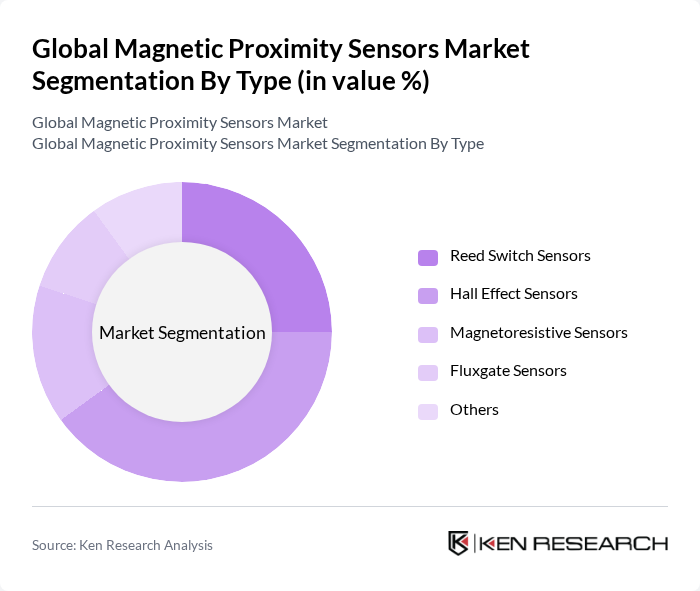
By Type:The market is segmented into Reed Switch Sensors, Hall Effect Sensors, Magnetoresistive Sensors, Fluxgate Sensors, and Others. Among these,Hall Effect Sensorslead the market owing to their high accuracy, reliability, and versatility across automotive, industrial, and consumer electronics applications. The increasing adoption of automation and smart technologies has significantly boosted demand for Hall Effect Sensors.Reed Switch Sensorsmaintain a notable share, particularly for simple, cost-effective, and contactless switching applications.
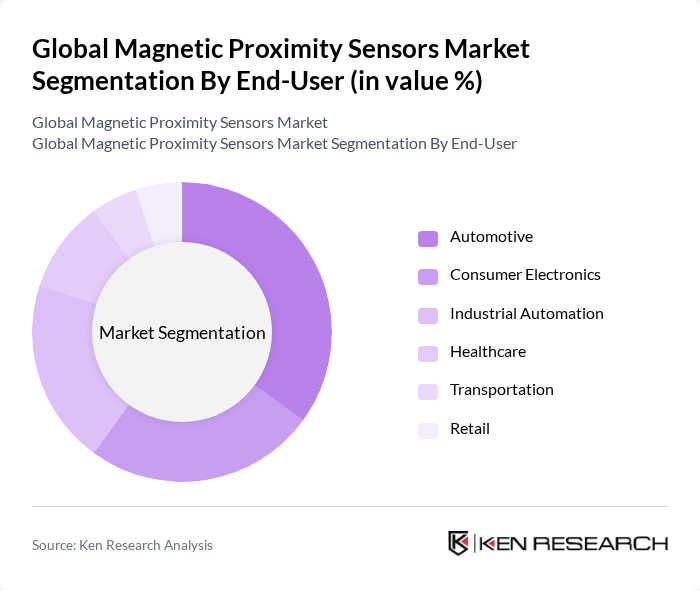
By End-User:The end-user segments include Automotive, Consumer Electronics, Industrial Automation, Healthcare, Transportation, and Retail. Theautomotive sectoris the dominant end-user, driven by the integration of advanced driver-assistance systems and electrification trends. Demand inconsumer electronicsis rising as manufacturers enhance device functionality and user experience with compact, energy-efficient sensors.Industrial automationis experiencing robust growth, propelled by the global shift toward smart factories, IoT integration, and predictive maintenance.
The Global Magnetic Proximity Sensors Market is characterized by a dynamic mix of regional and international players. Leading participants such as Honeywell International Inc., Siemens AG, Omron Corporation, Schneider Electric SE, Rockwell Automation, Inc., TE Connectivity Ltd., Balluff GmbH, SICK AG, Panasonic Corporation, IFM Electronic GmbH, ABB Ltd., Eaton Corporation plc, Turck GmbH & Co. KG, Banner Engineering Corp., C&K Components, NXP Semiconductors N.V., Allegro MicroSystems, Inc., Infineon Technologies AG, Alps Alpine Co., Ltd., Asahi Kasei Microdevices Corporation, MultiDimension Technology Co., Ltd., Elmos Semiconductor SE, Memsic, Inc., NVE Corporation, Baumer Ltd. contribute to innovation, geographic expansion, and service delivery in this space.
The future of the magnetic proximity sensors market appears promising, driven by technological advancements and increasing integration with IoT solutions. As industries continue to embrace smart technologies, the demand for sensors that provide real-time data and enhance automation will grow. Additionally, the expansion of smart home applications is expected to create new avenues for market growth, as consumers increasingly seek convenience and energy efficiency in their devices, further propelling the adoption of magnetic proximity sensors.
| Segment | Sub-Segments |
|---|---|
| By Type | Reed Switch Sensors Hall Effect Sensors Magnetoresistive Sensors Fluxgate Sensors Others |
| By End-User | Automotive Consumer Electronics Industrial Automation Healthcare Transportation Retail |
| By Application | Position Sensing Speed Detection Proximity Detection Angle Sensing Others |
| By Distribution Channel | Direct Sales Online Retail Distributors Others |
| By Region | North America Europe Asia-Pacific Latin America Middle East & Africa |
| By Price Range | Low Price Mid Price High Price |
| By Technology | Analog Sensors Digital Sensors Smart Sensors Miniature Sensors Others |
| Scope Item/Segment | Sample Size | Target Respondent Profiles |
|---|---|---|
| Automotive Magnetic Sensors | 100 | Automotive Engineers, Product Development Managers |
| Consumer Electronics Applications | 70 | Design Engineers, Product Managers |
| Industrial Automation Solutions | 60 | Operations Managers, Automation Specialists |
| Healthcare Device Integration | 50 | Biomedical Engineers, Regulatory Affairs Specialists |
| Robotics and Drones | 80 | Robotics Engineers, R&D Managers |
The Global Magnetic Proximity Sensors Market is valued at approximately USD 3.0 billion, driven by increasing automation in industrial sectors, advancements in consumer electronics, and the automotive industry's focus on safety and driver-assistance features.

What makes us stand out is that our consultants follow Robust, Refine and Result (RRR) methodology. Robust for clear definitions, approaches and sanity checking, Refine for differentiating respondents' facts and opinions, and Result for presenting data with story.

We have set a benchmark in the industry by offering our clients with syndicated and customized market research reports featuring coverage of entire market as well as meticulous research and analyst insights.

While we don't replace traditional research, we flip the method upside down. Our dual approach of Top Bottom & Bottom Top ensures quality deliverable by not just verifying company fundamentals but also looking at the sector and macroeconomic factors.

With one step in the future, our research team constantly tries to show you the bigger picture. We help with some of the tough questions you may encounter along the way: How is the industry positioned? Best marketing channel? KPI's of competitors? By aligning every element, we help maximize success.

Our report gives you instant access to the answers and sources that other companies might choose to hide. We elaborate each steps of research methodology we have used and showcase you the sample size to earn your trust.

If you need any support, we are here! We pride ourselves on universe strength, data quality, and quick, friendly, and professional service.