Ken Research Logo

Global Manual Toothbrush Market

The global manual toothbrush market, valued at USD 5 billion, is growing due to rising oral health awareness, eco-friendly innovations, and demand from adults and emerging markets.

Region:Global

Author(s):Geetanshi

Product Code:KRAE1010

Pages:114

Published On:December 2025

About the Report

Base Year 2024

Global Manual Toothbrush Market Overview

  • The Global Manual Toothbrush Market is valued at USD 5 billion, based on a five?year historical analysis. This growth is primarily driven by increasing consumer awareness regarding oral hygiene, the rise in dental health issues, and the growing demand for eco-friendly products. The market has seen a shift towards sustainable options, with biodegradable toothbrushes gaining traction among environmentally conscious consumers.
  • Key players in this market include the United States, China, and Germany. The United States dominates due to its high consumer spending on personal care products and advanced marketing strategies. China’s large population and growing middle class contribute to its significant market presence, while Germany is known for its high-quality manufacturing standards and innovation in dental care products.
  • The European Union is encouraging brands and retailers to increase recycled content, reduce single-use plastics, and improve recyclability across consumer goods, including oral-care products, as part of broader EU circular-economy and plastics legislation.
Global Manual Toothbrush Market Size

Global Manual Toothbrush Market Segmentation

By Type:The market is segmented into various types of manual toothbrushes, including Ultra-Soft Bristle, Soft Bristle, Medium Bristle, Hard Bristle, Biodegradable / Eco-Friendly, and Others. Among these, the Soft and Medium Bristle segments together form the core of global demand due to their widespread acceptance among consumers for their gentle cleaning action, making them suitable for sensitive gums. The increasing awareness of oral health and the recommendation of dental professionals further bolster the demand for these toothbrushes.
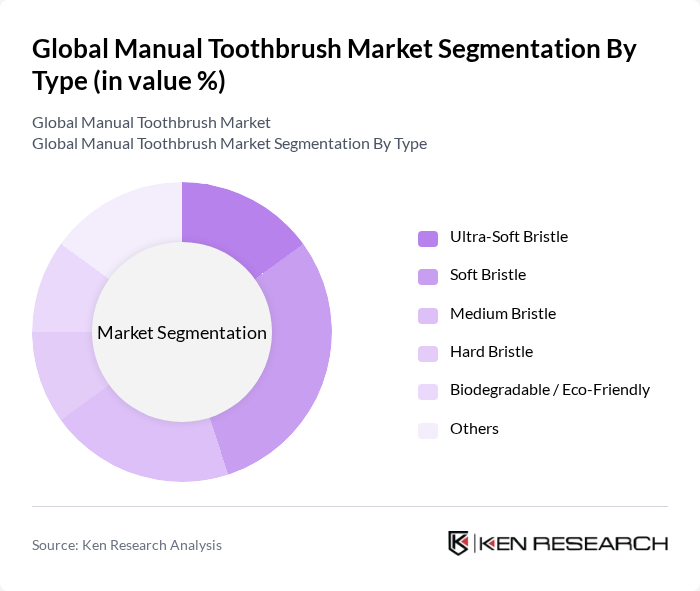
Global Manual Toothbrush Market segmentation by Type.

By End-User:The market is segmented by end-users into Adults, Children, Dental Clinics / Offices, and Institutional & Others. The Adults segment holds the largest share, driven by the increasing focus on personal hygiene and preventive dental care. Adults are more likely to invest in quality oral care products, leading to a higher demand for manual toothbrushes tailored to their specific needs, such as sensitivity and gum health.
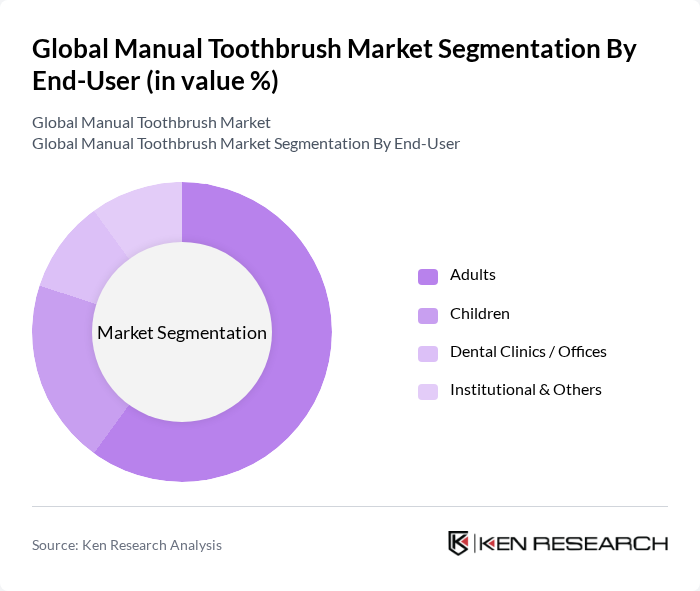
Global Manual Toothbrush Market segmentation by End-User.

Global Manual Toothbrush Market Competitive Landscape

The Global Manual Toothbrush Market is characterized by a dynamic mix of regional and international players. Leading participants such as Procter & Gamble (Oral-B), Colgate-Palmolive, Unilever (Signal, Pepsodent), GlaxoSmithKline (Sensodyne, Parodontax), Church & Dwight (Arm & Hammer), Lion Corporation, Sunstar Suisse SA (GUM), Henkel AG & Co. KGaA, Johnson & Johnson (Reach), TePe Munhygienprodukter AB, Curaden AG (Curaprox), Dr. Bronner’s Magic Soaps, RADIUS Corporation, EcoTools (Paris Presents Inc.), Brush with Bamboo, WooBamboo, The Humble Co. contribute to innovation, geographic expansion, and service delivery in this space.

Procter & Gamble (Oral-B)

1837

Cincinnati, Ohio, USA

Colgate-Palmolive

1806

New York City, New York, USA

Unilever (Signal, Pepsodent)

1929

London, UK

GlaxoSmithKline (Sensodyne, Parodontax)

2000

Brentford, UK

Church & Dwight (Arm & Hammer)

1846

Princeton, New Jersey, USA

Company

Establishment Year

Headquarters

Core Product Focus (Mass, Premium, Eco-Friendly, Professional)

Global Manual Toothbrush Revenue

Revenue Growth Rate (Manual Segment)

Market Share in Manual Toothbrushes

Geographic Footprint (No. of Countries / Regions)

Average Selling Price Positioning

Global Manual Toothbrush Market Industry Analysis

Growth Drivers

  • Increasing Awareness of Oral Hygiene:The global emphasis on oral hygiene has surged, with the World Health Organization reporting that 3.5 billion people suffer from oral diseases. This awareness has led to a significant increase in manual toothbrush sales, with an estimated 1.6 billion units sold in future alone. As educational campaigns proliferate, particularly in developing regions, the demand for manual toothbrushes is expected to rise, driven by a growing understanding of the importance of dental care.
  • Rising Demand for Eco-Friendly Products:The shift towards sustainability is reshaping consumer preferences, with a notable increase in demand for eco-friendly manual toothbrushes. In future, the market for biodegradable toothbrushes reached approximately 250 million units, reflecting a 25% increase from the previous year. This trend is supported by environmental regulations and consumer advocacy for reducing plastic waste, prompting manufacturers to innovate with sustainable materials, thus driving market growth.
  • Innovations in Toothbrush Design and Technology:Continuous innovations in manual toothbrush design are enhancing user experience and effectiveness. In future, over 35 new designs were introduced, focusing on ergonomic handles and advanced bristle technology. These innovations have contributed to a 15% increase in consumer interest, as evidenced by a rise in sales to 1.9 billion units. As manufacturers invest in research and development, the market is poised for further growth driven by improved product offerings.

Market Challenges

  • Intense Competition from Electric Toothbrushes:The manual toothbrush market faces significant competition from electric toothbrushes, which have gained a substantial market share. In future, electric toothbrush sales reached 600 million units, overshadowing manual toothbrush sales. This competition is intensified by aggressive marketing strategies and the perception of superior cleaning efficacy associated with electric models, posing a challenge for manual toothbrush manufacturers to maintain their market presence.
  • Price Sensitivity Among Consumers:Price sensitivity remains a critical challenge in the manual toothbrush market, particularly in emerging economies. With an average manual toothbrush priced at $2.50, many consumers opt for lower-cost alternatives, impacting overall sales. In future, approximately 65% of consumers reported price as a primary factor in their purchasing decisions, forcing manufacturers to balance quality and affordability to retain market share amidst economic fluctuations.

Global Manual Toothbrush Market Future Outlook

The future of the manual toothbrush market appears promising, driven by increasing consumer awareness of oral hygiene and a growing preference for sustainable products. As innovations continue to enhance product offerings, manufacturers are likely to focus on developing eco-friendly designs that cater to health-conscious consumers. Additionally, the expansion into emerging markets will provide new growth avenues, as rising disposable incomes enable greater access to dental care products, including manual toothbrushes.

Market Opportunities

  • Expansion into Emerging Markets:Emerging markets present significant growth opportunities for manual toothbrush manufacturers. With a projected population increase of 1.3 billion people in these regions by future, the demand for affordable oral hygiene products is expected to rise. Companies can capitalize on this trend by tailoring products to local preferences and increasing distribution channels, thereby enhancing market penetration.
  • Development of Subscription-Based Models:Subscription-based models for manual toothbrushes are gaining traction, offering consumers convenience and regular product updates. In future, subscription services accounted for 12% of manual toothbrush sales, indicating a growing trend. By providing personalized toothbrush deliveries, companies can foster customer loyalty and ensure consistent revenue streams, tapping into the evolving consumer landscape.

Scope of the Report

SegmentSub-Segments
By Type

Ultra-Soft Bristle

Soft Bristle

Medium Bristle

Hard Bristle

Biodegradable / Eco-Friendly

Others

By End-User

Adults

Children

Dental Clinics / Offices

Institutional & Others

By Material

Conventional Plastic

Bioplastics & Plant-Based Polymers

Bamboo & Wood

Recycled Materials

Others

By Design

Straight Handle

Ergonomic / Contoured Handle

Compact Head

Orthodontic & Specialty Heads

Travel-Friendly / Foldable

Others

By Distribution Channel

Supermarkets / Hypermarkets

Pharmacies & Drugstores

Convenience & Grocery Stores

Online Retail & E-commerce

Dental Clinics & Professional Channels

Others

By Price Range

Mass / Economy

Mid-Range

Premium

Super-Premium & Specialty

By Brand Positioning

Value & Mass-Market Brands

Premium & Professional Brands

Eco-Friendly & Sustainable Brands

Kids-Focused & Lifestyle Brands

Others

Key Target Audience

Investors and Venture Capitalist Firms

Government and Regulatory Bodies (e.g., Food and Drug Administration, Environmental Protection Agency)

Manufacturers and Producers

Distributors and Retailers

Health and Dental Organizations (e.g., American Dental Association)

Private Label Brands

Packaging Suppliers

Market Analysts and Industry Experts

Players Mentioned in the Report:

Procter & Gamble (Oral-B)

Colgate-Palmolive

Unilever (Signal, Pepsodent)

GlaxoSmithKline (Sensodyne, Parodontax)

Church & Dwight (Arm & Hammer)

Lion Corporation

Sunstar Suisse SA (GUM)

Henkel AG & Co. KGaA

Johnson & Johnson (Reach)

TePe Munhygienprodukter AB

Curaden AG (Curaprox)

Dr. Bronners Magic Soaps

RADIUS Corporation

EcoTools (Paris Presents Inc.)

Brush with Bamboo

WooBamboo

The Humble Co.

Table of Contents

Market Assessment Phase

1. Executive Summary and Approach


2. Global Manual Toothbrush Market Overview

2.1 Key Insights and Strategic Recommendations

2.2 Global Manual Toothbrush Market Overview

2.3 Definition and Scope

2.4 Evolution of Market Ecosystem

2.5 Timeline of Key Regulatory Milestones

2.6 Value Chain & Stakeholder Mapping

2.7 Business Cycle Analysis

2.8 Policy & Incentive Landscape


3. Global Manual Toothbrush Market Analysis

3.1 Growth Drivers

3.1.1 Increasing awareness of oral hygiene
3.1.2 Rising demand for eco-friendly products
3.1.3 Growth in the global population
3.1.4 Innovations in toothbrush design and technology

3.2 Market Challenges

3.2.1 Intense competition from electric toothbrushes
3.2.2 Price sensitivity among consumers
3.2.3 Regulatory compliance and standards
3.2.4 Supply chain disruptions

3.3 Market Opportunities

3.3.1 Expansion into emerging markets
3.3.2 Development of subscription-based models
3.3.3 Collaborations with dental professionals
3.3.4 Introduction of personalized toothbrushes

3.4 Market Trends

3.4.1 Shift towards sustainable materials
3.4.2 Increasing online sales channels
3.4.3 Growth of health-conscious consumer behavior
3.4.4 Rise in dental tourism

3.5 Government Regulation

3.5.1 Standards for dental products
3.5.2 Environmental regulations on plastic use
3.5.3 Health and safety compliance
3.5.4 Labeling and advertising regulations

4. SWOT Analysis


5. Stakeholder Analysis


6. Porter's Five Forces Analysis


7. Global Manual Toothbrush Market Market Size, 2019-2024

7.1 By Value

7.2 By Volume

7.3 By Average Selling Price


8. Global Manual Toothbrush Market Segmentation

8.1 By Type

8.1.1 Ultra-Soft Bristle
8.1.2 Soft Bristle
8.1.3 Medium Bristle
8.1.4 Hard Bristle
8.1.5 Biodegradable / Eco-Friendly
8.1.6 Others

8.2 By End-User

8.2.1 Adults
8.2.2 Children
8.2.3 Dental Clinics / Offices
8.2.4 Institutional & Others

8.3 By Material

8.3.1 Conventional Plastic
8.3.2 Bioplastics & Plant-Based Polymers
8.3.3 Bamboo & Wood
8.3.4 Recycled Materials
8.3.5 Others

8.4 By Design

8.4.1 Straight Handle
8.4.2 Ergonomic / Contoured Handle
8.4.3 Compact Head
8.4.4 Orthodontic & Specialty Heads
8.4.5 Travel-Friendly / Foldable
8.4.6 Others

8.5 By Distribution Channel

8.5.1 Supermarkets / Hypermarkets
8.5.2 Pharmacies & Drugstores
8.5.3 Convenience & Grocery Stores
8.5.4 Online Retail & E-commerce
8.5.5 Dental Clinics & Professional Channels
8.5.6 Others

8.6 By Price Range

8.6.1 Mass / Economy
8.6.2 Mid-Range
8.6.3 Premium
8.6.4 Super-Premium & Specialty

8.7 By Brand Positioning

8.7.1 Value & Mass-Market Brands
8.7.2 Premium & Professional Brands
8.7.3 Eco-Friendly & Sustainable Brands
8.7.4 Kids-Focused & Lifestyle Brands
8.7.5 Others

9. Global Manual Toothbrush Market Competitive Analysis

9.1 Market Share of Key Players

9.2 Cross Comparison of Key Players

9.2.1 Company Name
9.2.2 Core Product Focus (Mass, Premium, Eco-Friendly, Professional)
9.2.3 Global Manual Toothbrush Revenue
9.2.4 Revenue Growth Rate (Manual Segment)
9.2.5 Market Share in Manual Toothbrushes
9.2.6 Geographic Footprint (No. of Countries / Regions)
9.2.7 Average Selling Price Positioning
9.2.8 Product Portfolio Breadth (Variants, Bristle Types, SKUs)
9.2.9 Innovation Intensity (New Launches, Patents, Claims)
9.2.10 Distribution Channel Strength (Offline vs Online Mix)
9.2.11 Sustainability Initiatives (Recycled / Biobased, Packaging)
9.2.12 Brand Awareness & Preference Scores

9.3 SWOT Analysis of Top Players

9.4 Pricing Analysis

9.5 Detailed Profile of Major Companies

9.5.1 Procter & Gamble (Oral-B)
9.5.2 Colgate-Palmolive
9.5.3 Unilever (Signal, Pepsodent)
9.5.4 GlaxoSmithKline (Sensodyne, Parodontax)
9.5.5 Church & Dwight (Arm & Hammer)
9.5.6 Lion Corporation
9.5.7 Sunstar Suisse SA (GUM)
9.5.8 Henkel AG & Co. KGaA
9.5.9 Johnson & Johnson (Reach)
9.5.10 TePe Munhygienprodukter AB
9.5.11 Curaden AG (Curaprox)
9.5.12 Dr. Bronner’s Magic Soaps
9.5.13 RADIUS Corporation
9.5.14 EcoTools (Paris Presents Inc.)
9.5.15 Brush with Bamboo
9.5.16 WooBamboo
9.5.17 The Humble Co.

10. Global Manual Toothbrush Market End-User Analysis

10.1 Procurement Behavior of Key Ministries

10.1.1 Government contracts for public health initiatives
10.1.2 Bulk purchasing trends
10.1.3 Preference for sustainable products
10.1.4 Compliance with health regulations

10.2 Corporate Spend on Infrastructure & Energy

10.2.1 Investment in dental health programs
10.2.2 Budget allocation for employee wellness
10.2.3 Partnerships with dental care providers
10.2.4 Sponsorship of community health events

10.3 Pain Point Analysis by End-User Category

10.3.1 Accessibility of dental care products
10.3.2 Affordability of quality toothbrushes
10.3.3 Awareness of oral hygiene importance
10.3.4 Availability of eco-friendly options

10.4 User Readiness for Adoption

10.4.1 Consumer willingness to switch brands
10.4.2 Acceptance of new product features
10.4.3 Interest in subscription services
10.4.4 Feedback on product trials

10.5 Post-Deployment ROI and Use Case Expansion

10.5.1 Evaluation of product effectiveness
10.5.2 Customer feedback for improvements
10.5.3 Expansion into new markets
10.5.4 Long-term customer engagement strategies

11. Global Manual Toothbrush Market Future Size, 2025-2030

11.1 By Value

11.2 By Volume

11.3 By Average Selling Price


Go-To-Market Strategy Phase

1. Whitespace Analysis + Business Model Canvas

1.1 Market gaps and opportunities

1.2 Value proposition development

1.3 Revenue model exploration

1.4 Customer segmentation analysis

1.5 Competitive landscape overview

1.6 Key partnerships identification

1.7 Resource allocation strategy


2. Marketing and Positioning Recommendations

2.1 Branding strategies

2.2 Product USPs

2.3 Target audience identification

2.4 Communication strategy

2.5 Digital marketing tactics

2.6 Influencer partnerships

2.7 Customer engagement initiatives


3. Distribution Plan

3.1 Urban retail vs rural NGO tie-ups

3.2 E-commerce strategy

3.3 Wholesale partnerships

3.4 Direct-to-consumer channels

3.5 Logistics and supply chain management

3.6 Inventory management practices

3.7 Distribution network optimization


4. Channel & Pricing Gaps

4.1 Underserved routes

4.2 Pricing bands

4.3 Competitor pricing analysis

4.4 Value-based pricing strategies

4.5 Discount and promotion strategies

4.6 Price elasticity assessment

4.7 Customer willingness to pay


5. Unmet Demand & Latent Needs

5.1 Category gaps

5.2 Consumer segments

5.3 Product feature enhancements

5.4 Market entry barriers

5.5 Customer feedback integration

5.6 Future product development

5.7 Market trend alignment


6. Customer Relationship

6.1 Loyalty programs

6.2 After-sales service

6.3 Customer feedback loops

6.4 Community engagement

6.5 Brand advocacy initiatives

6.6 Customer education programs

6.7 Relationship management tools


7. Value Proposition

7.1 Sustainability

7.2 Integrated supply chains

7.3 Unique selling points

7.4 Customer-centric innovations

7.5 Competitive differentiation

7.6 Long-term value creation

7.7 Brand loyalty enhancement


8. Key Activities

8.1 Regulatory compliance

8.2 Branding

8.3 Distribution setup

8.4 Marketing execution

8.5 Product development

8.6 Customer service enhancement

8.7 Performance monitoring


9. Entry Strategy Evaluation

9.1 Domestic Market Entry Strategy

9.1.1 Product mix
9.1.2 Pricing band
9.1.3 Packaging
9.1.4 Marketing approach
9.1.5 Distribution channels
9.1.6 Customer engagement
9.1.7 Compliance considerations

9.2 Export Entry Strategy

9.2.1 Target countries
9.2.2 Compliance roadmap
9.2.3 Market research
9.2.4 Distribution partnerships
9.2.5 Marketing localization
9.2.6 Risk assessment
9.2.7 Financial projections

10. Entry Mode Assessment

10.1 JV

10.2 Greenfield

10.3 M&A

10.4 Distributor Model

10.5 Risk vs. control analysis

10.6 Strategic fit evaluation

10.7 Long-term sustainability


11. Capital and Timeline Estimation

11.1 Capital requirements

11.2 Timelines

11.3 Funding sources

11.4 Financial modeling

11.5 Investment return analysis

11.6 Budget allocation

11.7 Milestone tracking


12. Control vs Risk Trade-Off

12.1 Ownership vs Partnerships

12.2 Risk management strategies

12.3 Control mechanisms

12.4 Partnership evaluation

12.5 Long-term implications

12.6 Flexibility considerations

12.7 Exit strategies


13. Profitability Outlook

13.1 Breakeven analysis

13.2 Long-term sustainability

13.3 Profit margin assessment

13.4 Revenue growth projections

13.5 Cost management strategies

13.6 Financial health indicators

13.7 Market share growth


14. Potential Partner List</h


Research Methodology

ApproachModellingSample

Phase 1: Approach1

Desk Research

  • Market reports from industry associations such as the International Association of Dental Research
  • Analysis of consumer behavior studies published in dental health journals
  • Review of sales data from major retailers and e-commerce platforms

Primary Research

  • Interviews with dental professionals and hygienists to understand consumer preferences
  • Surveys targeting consumers to gauge brand loyalty and purchasing habits
  • Focus groups with diverse demographics to explore attitudes towards manual toothbrushes

Validation & Triangulation

  • Cross-validation of findings with data from dental product manufacturers
  • Triangulation of consumer insights with sales data from retail partners
  • Sanity checks through expert reviews from dental industry analysts

Phase 2: Market Size Estimation1

Top-down Assessment

  • Estimation of total market size based on global oral care market reports
  • Segmentation by region, focusing on North America, Europe, and Asia-Pacific
  • Incorporation of growth trends in health awareness and oral hygiene practices

Bottom-up Modeling

  • Volume estimates based on sales data from leading manual toothbrush manufacturers
  • Analysis of pricing strategies across different market segments
  • Calculation of market size based on unit sales and average selling prices

Forecasting & Scenario Analysis

  • Multi-factor regression analysis incorporating demographic trends and health campaigns
  • Scenario modeling based on potential shifts in consumer preferences towards eco-friendly products
  • Baseline, optimistic, and pessimistic forecasts through 2030 based on market dynamics

Phase 3: CATI Sample Composition1

Scope Item/SegmentSample SizeTarget Respondent Profiles
Consumer Preferences in Manual Toothbrushes140General Consumers, Health-Conscious Individuals
Dental Professional Insights60Dentists, Dental Hygienists
Retail Market Trends50Retail Managers, Category Buyers
Environmental Impact Awareness40Sustainability Advocates, Eco-conscious Consumers
Brand Loyalty and Switching Behavior70Brand Loyalists, Switchers

Frequently Asked Questions

What is the current value of the Global Manual Toothbrush Market?

The Global Manual Toothbrush Market is valued at approximately USD 5 billion, reflecting a significant growth driven by increased consumer awareness of oral hygiene, rising dental health issues, and a demand for eco-friendly products.

Which countries are the key players in the manual toothbrush market?

What types of manual toothbrushes are available in the market?

Who are the primary end-users of manual toothbrushes?

Other Regional/Country Reports

Indonesia Manual Toothbrush Market

Malaysia Manual Toothbrush Market

KSA Manual Toothbrush Market

APAC Manual Toothbrush Market

SEA Manual Toothbrush Market

Vietnam Manual Toothbrush Market

Why Buy From Us?

Refine Robust Result (RRR) Framework

What makes us stand out is that our consultants follow Robust, Refine and Result (RRR) methodology. Robust for clear definitions, approaches and sanity checking, Refine for differentiating respondents' facts and opinions, and Result for presenting data with story.

Our Reach Is Unmatched

We have set a benchmark in the industry by offering our clients with syndicated and customized market research reports featuring coverage of entire market as well as meticulous research and analyst insights.

Shifting the Research Paradigm

While we don't replace traditional research, we flip the method upside down. Our dual approach of Top Bottom & Bottom Top ensures quality deliverable by not just verifying company fundamentals but also looking at the sector and macroeconomic factors.

More Insights-Better Decisions

With one step in the future, our research team constantly tries to show you the bigger picture. We help with some of the tough questions you may encounter along the way: How is the industry positioned? Best marketing channel? KPI's of competitors? By aligning every element, we help maximize success.

Transparency and Trust

Our report gives you instant access to the answers and sources that other companies might choose to hide. We elaborate each steps of research methodology we have used and showcase you the sample size to earn your trust.

Round the Clock Support

If you need any support, we are here! We pride ourselves on universe strength, data quality, and quick, friendly, and professional service.

Why Clients Choose Us?

400000+
Reports in repository
150+
Consulting projects a year
100+
Analysts
8000+
Client Queries in 2022








