About the Report
Base Year 2024Global Mineral Sunscreen Market Overview
- The Global Mineral Sunscreen Market is valued at USD 1.7 billion, based on a five-year historical analysis. This growth is primarily driven by increasing consumer awareness regarding skin health and the harmful effects of UV radiation, rising incidences of skin cancer, and a growing preference for natural, “reef-safe”, and organic products. The market has seen a significant shift towards mineral-based formulations, which are perceived as safer alternatives to chemical sunscreens, particularly among consumers concerned about ingredient safety and environmental impact.
- Key countries driving this market include the United States, Germany, Australia, China, and other developed Asia Pacific economies, supported by high consumer spending on skincare, strong dermatological endorsement of sun protection, and well-established omnichannel retail infrastructure. The United States remains a major contributor due to strong demand for natural and eco-friendly sun care, while Germany and other European markets benefit from premium dermocosmetic positioning. In Australia, high UV exposure and outdoor lifestyles, together with public health campaigns on skin cancer prevention, continue to fuel the demand for effective mineral sun protection solutions.
- In the European Union, cosmetic products including sunscreens are regulated under Regulation (EC) No 1223/2009 of the European Parliament and of the Council on cosmetic products, which requires a safety assessment, a product information file, and compliance with the list of permitted UV filters before products are placed on the market. Safety requirements for ultraviolet filters such as titanium dioxide and zinc oxide are further underpinned by scientific opinions from the Scientific Committee on Consumer Safety (SCCS), which assess concentration limits, particle characteristics (including nano-forms), and conditions of use to ensure a high level of protection for human health. These measures support high safety and efficacy standards for all sunscreen products and align with growing interest in mineral-based formulations, including those marketed as less harmful to marine ecosystems.

Global Mineral Sunscreen Market Segmentation
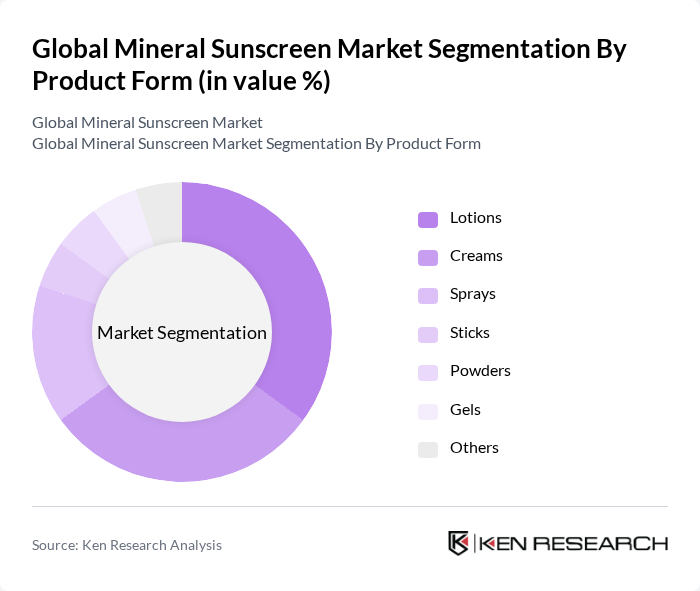
By Product Form:The product form segmentation includes various types of mineral sunscreens such as lotions, creams, sprays, sticks, powders, gels, and others. This aligns with common product categorizations used in industry analyses that group mineral sunscreens by form, including lotions/creams, sprays, sticks and other formats. Among these, lotions and creams are the most popular due to their familiarity, ease of application, and effectiveness in providing uniform sun protection, particularly in facial and body care routines. The demand for sprays has also been increasing, particularly among consumers looking for convenience, quick application, and easier coverage of large body areas, especially in outdoor and sports contexts. The market is witnessing a trend towards innovative formats such as tinted mineral creams, hybrid skincare-suncare products, and sticks designed for on-the-go use and sensitive areas, reflecting the focus on specific consumer needs and skin types.
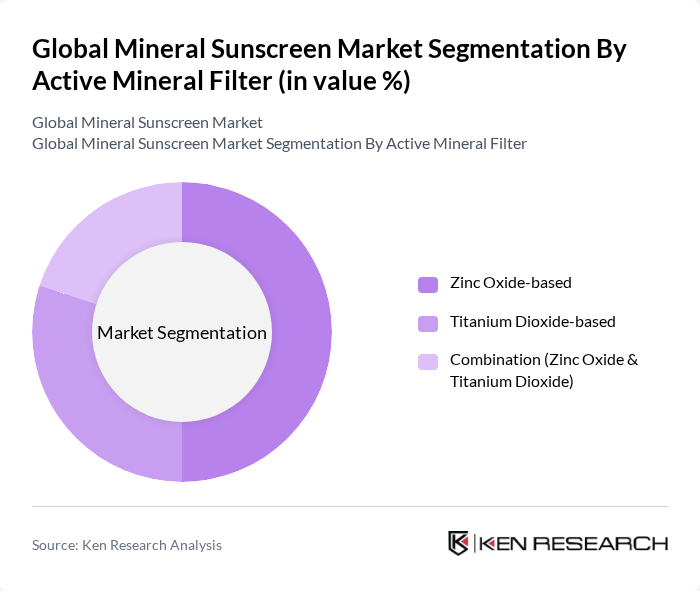
By Active Mineral Filter:The active mineral filter segmentation includes zinc oxide-based, titanium dioxide-based, and combination filters. Zinc oxide-based sunscreens are leading the market due to their broad-spectrum protection covering both UVA and UVB rays and their favorable profile for sensitive and acne-prone skin. Titanium dioxide is also popular, particularly for products targeting sensitive skin and daily-use facial sunscreens, as it offers strong UVB and short-wave UVA protection and tends to be more cosmetically elegant in certain formulations. The combination of both filters is gaining traction as it offers enhanced broad-spectrum coverage, better texture optimization, and is favored by consumers looking for high-efficacy mineral sun care solutions that minimize white cast while maintaining perceived safety.
Global Mineral Sunscreen Market Competitive Landscape
The Global Mineral Sunscreen Market is characterized by a dynamic mix of regional and international players. Leading participants such as Neutrogena (Johnson & Johnson Consumer Inc.), La Roche-Posay (L’Oréal S.A.), Coppertone (Beiersdorf AG), Blue Lizard Australian Sunscreen (Crown Laboratories, Inc.), Badger Company (Badger Balm), Think (Thinkbaby & Thinksport), Sun Bum (Sun Bum LLC), Aveeno (Johnson & Johnson Consumer Inc.), Alba Botanica (The Hain Celestial Group, Inc.), Supergoop! LLC, Raw Elements USA, Inc., Babo Botanicals (Babo Botanicals LLC), Kiehl’s (L’Oréal S.A.), Hawaiian Tropic (Edgewell Personal Care Company), CeraVe (L’Oréal S.A.) contribute to innovation, geographic expansion, and service delivery in this space, with many of these brands emphasizing mineral or “reef-conscious” lines within their broader sun care portfolios.
Global Mineral Sunscreen Market Industry Analysis
Growth Drivers
- Increasing Awareness of Skin Protection:The global skincare market is projected to reach $189.3 billion by 2025, driven by heightened consumer awareness regarding skin protection. In the future, 70% of consumers reported using sunscreen regularly, reflecting a significant increase from previous years. This trend is particularly pronounced among millennials and Gen Z, who prioritize skin health and are more informed about the harmful effects of UV exposure, thus boosting demand for mineral sunscreens.
- Rising Demand for Natural and Organic Products:The organic personal care market is expected to grow to $25.1 billion by 2025, with mineral sunscreens benefiting from this trend. In the future, 60% of consumers expressed a preference for natural ingredients in their skincare products. This shift is driven by concerns over synthetic chemicals and their potential health risks, leading to increased sales of mineral-based formulations, which are perceived as safer and more environmentally friendly.
- Regulatory Support for Mineral-Based Formulations:Governments worldwide are increasingly supporting mineral sunscreen formulations through favorable regulations. For instance, the European Union has implemented stricter guidelines promoting mineral-based products, which are less harmful to marine ecosystems. In the future, 40% of new sunscreen products launched in Europe were mineral-based, reflecting a regulatory shift that encourages manufacturers to innovate in this segment, thus driving market growth.
Market Challenges
- High Production Costs:The production of mineral sunscreens often involves higher costs due to the sourcing of natural ingredients and advanced formulation techniques. In the future, the average cost of titanium dioxide, a key ingredient, rose to $3,000 per ton, impacting overall product pricing. This cost barrier can limit market entry for smaller brands and restrict competitive pricing strategies, posing a challenge to market expansion.
- Limited Consumer Awareness about Mineral Sunscreens:Despite the growing popularity of mineral sunscreens, consumer awareness remains a significant challenge. In the future, only 35% of consumers were familiar with the benefits of mineral-based products compared to chemical alternatives. This lack of knowledge can hinder market penetration, as many consumers still prefer traditional chemical sunscreens, which are often marketed more aggressively, creating an uphill battle for mineral brands.
Global Mineral Sunscreen Market Future Outlook
The future of the mineral sunscreen market appears promising, driven by increasing consumer demand for eco-friendly and health-conscious products. As awareness of skin protection continues to rise, brands are likely to innovate with new formulations that cater to diverse consumer needs. Additionally, the trend towards sustainable practices will likely encourage more companies to adopt mineral-based products, aligning with regulatory support and consumer preferences for transparency and safety in ingredient sourcing.
Market Opportunities
- Expansion into Emerging Markets:Emerging markets, particularly in Asia-Pacific, present significant growth opportunities for mineral sunscreens. With a projected increase in disposable income and a growing middle class, the demand for skincare products is expected to rise. In the future, the Asia-Pacific skincare market is anticipated to reach $60 billion, providing a fertile ground for mineral sunscreen brands to establish a foothold.
- Development of Innovative Product Formulations:There is a growing opportunity for brands to develop innovative mineral sunscreen formulations that cater to specific consumer needs, such as anti-aging or water-resistant properties. In the future, 45% of consumers expressed interest in multifunctional skincare products, indicating a market trend that brands can leverage to create unique offerings that stand out in a competitive landscape.
Scope of the Report
| Segment | Sub-Segments |
|---|---|
| By Product Form | Lotions Creams Sprays Sticks Powders Gels Others |
| By Active Mineral Filter | Zinc Oxide-based Titanium Dioxide-based Combination (Zinc Oxide & Titanium Dioxide) |
| By SPF Range | SPF < 30 SPF 30–49 SPF ? 50 |
| By Consumer Group | Adults Babies & Children Sports & Outdoor Enthusiasts Dermatological / Sensitive Skin Users Others |
| By Claim / Positioning | Reef-safe / Ocean-friendly Organic / Natural Hypoallergenic / Sensitive Skin Tinted / Cosmetic Water-resistant Others |
| By Distribution Channel | Online Retail (E-commerce & Brand Websites) Supermarkets/Hypermarkets Specialty Beauty & Cosmetic Stores Pharmacies & Drugstores Dermatology Clinics & Professional Channels Others |
| By Region | North America Europe Asia-Pacific Latin America Middle East & Africa |
Key Target Audience
Investors and Venture Capitalist Firms
Government and Regulatory Bodies (e.g., U.S. Food and Drug Administration, European Commission)
Manufacturers and Producers
Distributors and Retailers
Cosmetic and Personal Care Brands
Environmental NGOs and Advocacy Groups
Health and Safety Regulatory Agencies (e.g., Environmental Protection Agency)
Market Analysts and Industry Experts
Players Mentioned in the Report:
Neutrogena (Johnson & Johnson Consumer Inc.)
La Roche-Posay (LOreal S.A.)
Coppertone (Beiersdorf AG)
Blue Lizard Australian Sunscreen (Crown Laboratories, Inc.)
Badger Company (Badger Balm)
Think (Thinkbaby & Thinksport)
Sun Bum (Sun Bum LLC)
Aveeno (Johnson & Johnson Consumer Inc.)
Alba Botanica (The Hain Celestial Group, Inc.)
Supergoop! LLC
Raw Elements USA, Inc.
Babo Botanicals (Babo Botanicals LLC)
Kiehls (LOreal S.A.)
Hawaiian Tropic (Edgewell Personal Care Company)
CeraVe (LOreal S.A.)
Table of Contents
Market Assessment Phase
1. Executive Summary and Approach
2. Global Mineral Sunscreen Market Overview
2.1 Key Insights and Strategic Recommendations
2.2 Global Mineral Sunscreen Market Overview
2.3 Definition and Scope
2.4 Evolution of Market Ecosystem
2.5 Timeline of Key Regulatory Milestones
2.6 Value Chain & Stakeholder Mapping
2.7 Business Cycle Analysis
2.8 Policy & Incentive Landscape
3. Global Mineral Sunscreen Market Analysis
3.1 Growth Drivers
3.1.1 Increasing awareness of skin protection
3.1.2 Rising demand for natural and organic products
3.1.3 Regulatory support for mineral-based formulations
3.1.4 Growth in outdoor activities and tourism
3.2 Market Challenges
3.2.1 High production costs
3.2.2 Limited consumer awareness about mineral sunscreens
3.2.3 Competition from chemical sunscreens
3.2.4 Regulatory hurdles in different regions
3.3 Market Opportunities
3.3.1 Expansion into emerging markets
3.3.2 Development of innovative product formulations
3.3.3 Collaborations with skincare brands
3.3.4 Increasing online sales channels
3.4 Market Trends
3.4.1 Shift towards eco-friendly packaging
3.4.2 Growth of multi-functional skincare products
3.4.3 Rising popularity of reef-safe products
3.4.4 Increased focus on product transparency and ingredient sourcing
3.5 Government Regulation
3.5.1 Stricter labeling requirements
3.5.2 Bans on certain chemical ingredients
3.5.3 Guidelines for SPF testing
3.5.4 Incentives for sustainable product development
4. SWOT Analysis
5. Stakeholder Analysis
6. Porter's Five Forces Analysis
7. Global Mineral Sunscreen Market Market Size, 2019-2024
7.1 By Value
7.2 By Volume
7.3 By Average Selling Price
8. Global Mineral Sunscreen Market Segmentation
8.1 By Product Form
8.1.1 Lotions
8.1.2 Creams
8.1.3 Sprays
8.1.4 Sticks
8.1.5 Powders
8.1.6 Gels
8.1.7 Others
8.2 By Active Mineral Filter
8.2.1 Zinc Oxide-based
8.2.2 Titanium Dioxide-based
8.2.3 Combination (Zinc Oxide & Titanium Dioxide)
8.3 By SPF Range
8.3.1 SPF < 30
8.3.2 SPF 30–49
8.3.3 SPF ? 50
8.4 By Consumer Group
8.4.1 Adults
8.4.2 Babies & Children
8.4.3 Sports & Outdoor Enthusiasts
8.4.4 Dermatological / Sensitive Skin Users
8.4.5 Others
8.5 By Claim / Positioning
8.5.1 Reef-safe / Ocean-friendly
8.5.2 Organic / Natural
8.5.3 Hypoallergenic / Sensitive Skin
8.5.4 Tinted / Cosmetic
8.5.5 Water-resistant
8.5.6 Others
8.6 By Distribution Channel
8.6.1 Online Retail (E-commerce & Brand Websites)
8.6.2 Supermarkets/Hypermarkets
8.6.3 Specialty Beauty & Cosmetic Stores
8.6.4 Pharmacies & Drugstores
8.6.5 Dermatology Clinics & Professional Channels
8.6.6 Others
8.7 By Region
8.7.1 North America
8.7.2 Europe
8.7.3 Asia-Pacific
8.7.4 Latin America
8.7.5 Middle East & Africa
9. Global Mineral Sunscreen Market Competitive Analysis
9.1 Market Share of Key Players
9.2 Cross Comparison of Key Players
9.2.1 Company Name
9.2.2 Total Revenue (Latest Fiscal Year, USD Million)
9.2.3 Mineral Sunscreen Revenue (USD Million)
9.2.4 Mineral Sunscreen Revenue Share in Total Suncare Portfolio (%)
9.2.5 3-year CAGR in Mineral Sunscreen Sales (%)
9.2.6 Global Mineral Sunscreen Market Share (%)
9.2.7 Regional Footprint (No. of Countries / Regions Served)
9.2.8 Mineral SKU Count (No. of SKUs / Formats)
9.2.9 R&D Intensity for Mineral Formulations (% of Revenue)
9.2.10 Share of Online Sales in Mineral Portfolio (%)
9.2.11 Average Mineral SPF Range Coverage (No. of SPF Bands)
9.2.12 Average Retail Price per 100 ml (USD)
9.2.13 Regulatory & Certification Coverage (e.g., Reef-safe, Organic, Dermatologist-tested)
9.2.14 Social Media / Digital Engagement Metrics (Followers, Engagement Rate)
9.3 SWOT Analysis of Top Players
9.4 Pricing Analysis
9.5 Detailed Profile of Major Companies
9.5.1 Neutrogena (Johnson & Johnson Consumer Inc.)
9.5.2 La Roche-Posay (L’Oréal S.A.)
9.5.3 Coppertone (Beiersdorf AG)
9.5.4 Blue Lizard Australian Sunscreen (Crown Laboratories, Inc.)
9.5.5 Badger Company (Badger Balm)
9.5.6 Think (Thinkbaby & Thinksport)
9.5.7 Sun Bum (Sun Bum LLC)
9.5.8 Aveeno (Johnson & Johnson Consumer Inc.)
9.5.9 Alba Botanica (The Hain Celestial Group, Inc.)
9.5.10 Supergoop! LLC
9.5.11 Raw Elements USA, Inc.
9.5.12 Babo Botanicals (Babo Botanicals LLC)
9.5.13 Kiehl’s (L’Oréal S.A.)
9.5.14 Hawaiian Tropic (Edgewell Personal Care Company)
9.5.15 CeraVe (L’Oréal S.A.)
10. Global Mineral Sunscreen Market End-User Analysis
10.1 Procurement Behavior of Key Ministries
10.1.1 Government health initiatives
10.1.2 Public awareness campaigns
10.1.3 Funding for skin cancer prevention
10.1.4 Partnerships with NGOs
10.2 Corporate Spend on Infrastructure & Energy
10.2.1 Investment in sustainable products
10.2.2 Budget allocation for employee wellness
10.2.3 Sponsorship of health events
10.2.4 Collaborations with dermatologists
10.3 Pain Point Analysis by End-User Category
10.3.1 Skin sensitivity issues
10.3.2 Product efficacy concerns
10.3.3 Availability of products
10.3.4 Price sensitivity
10.4 User Readiness for Adoption
10.4.1 Awareness of mineral sunscreen benefits
10.4.2 Willingness to switch from chemical to mineral
10.4.3 Accessibility of products
10.4.4 Influence of social media on purchasing
10.5 Post-Deployment ROI and Use Case Expansion
10.5.1 Long-term skin health benefits
10.5.2 Brand loyalty development
10.5.3 Expansion into new demographics
10.5.4 Increased market share through education
11. Global Mineral Sunscreen Market Future Size, 2025-2030
11.1 By Value
11.2 By Volume
11.3 By Average Selling Price
Go-To-Market Strategy Phase
1. Whitespace Analysis + Business Model Canvas
1.1 Market Gaps Identification
1.2 Value Proposition Development
1.3 Revenue Streams Analysis
1.4 Cost Structure Evaluation
1.5 Key Partnerships Exploration
1.6 Customer Segmentation
1.7 Channels of Distribution
2. Marketing and Positioning Recommendations
2.1 Branding Strategies
2.2 Product USPs
3. Distribution Plan
3.1 Urban Retail vs Rural NGO Tie-ups
4. Channel & Pricing Gaps
4.1 Underserved Routes
4.2 Pricing Bands
5. Unmet Demand & Latent Needs
5.1 Category Gaps
5.2 Consumer Segments
6. Customer Relationship
6.1 Loyalty Programs
6.2 After-sales Service
7. Value Proposition
7.1 Sustainability
7.2 Integrated Supply Chains
8. Key Activities
8.1 Regulatory Compliance
8.2 Branding
8.3 Distribution Setup
9. Entry Strategy Evaluation
9.1 Domestic Market Entry Strategy
9.1.1 Product Mix
9.1.2 Pricing Band
9.1.3 Packaging
9.2 Export Entry Strategy
9.2.1 Target Countries
9.2.2 Compliance Roadmap
10. Entry Mode Assessment
10.1 JV
10.2 Greenfield
10.3 M&A
10.4 Distributor Model
11. Capital and Timeline Estimation
11.1 Capital Requirements
11.2 Timelines
12. Control vs Risk Trade-Off
12.1 Ownership vs Partnerships
13. Profitability Outlook
13.1 Breakeven Analysis
13.2 Long-term Sustainability
14. Potential Partner List
14.1 Distributors
14.2 JVs
14.3 Acquisition Targets
15. Execution Roadmap
15.1 Phased Plan for Market Entry
15.1.1 Market Setup
15.1.2 Market Entry
15.1.3 Growth Acceleration
15.1.4 Scale & Stabilize
15.2 Key Activities and Milestones
15.2.1 Milestone Planning
15.2.2 Activity Tracking
Research Methodology
Phase 1: Approach1
Desk Research
- Analysis of market reports from industry associations such as the Personal Care Products Council
- Review of scientific literature on mineral sunscreen formulations and their efficacy
- Examination of consumer behavior studies related to sunscreen usage and preferences
Primary Research
- Interviews with dermatologists and skincare experts to understand market trends
- Surveys with consumers to gauge awareness and preferences for mineral sunscreens
- Discussions with manufacturers regarding production challenges and innovations
Validation & Triangulation
- Cross-validation of findings with sales data from major retailers
- Triangulation of consumer insights with dermatologist recommendations
- Sanity checks through expert panels comprising industry veterans and researchers
Phase 2: Market Size Estimation1
Top-down Assessment
- Estimation of total sunscreen market size and segmentation by mineral vs. chemical products
- Analysis of demographic trends influencing sunscreen adoption rates
- Incorporation of regulatory impacts on mineral sunscreen formulations
Bottom-up Modeling
- Volume estimates based on production data from leading mineral sunscreen manufacturers
- Pricing analysis to determine average selling prices across different regions
- Calculation of market size based on unit sales and revenue generation
Forecasting & Scenario Analysis
- Multi-variable forecasting considering factors like climate change awareness and skin cancer rates
- Scenario analysis based on potential regulatory changes and market entry of new players
- Development of baseline, optimistic, and pessimistic market growth projections through 2030
Phase 3: CATI Sample Composition1
| Scope Item/Segment | Sample Size | Target Respondent Profiles |
|---|---|---|
| Consumer Awareness and Preferences | 150 | General Consumers, Skincare Enthusiasts |
| Dermatologist Insights | 60 | Dermatologists, Skincare Professionals |
| Retailer Perspectives | 100 | Retail Managers, Beauty Product Buyers |
| Manufacturer Feedback | 75 | Product Development Managers, R&D Heads |
| Regulatory Insights | 40 | Regulatory Affairs Specialists, Compliance Officers |
Frequently Asked Questions
What is the current value of the Global Mineral Sunscreen Market?
The Global Mineral Sunscreen Market is valued at approximately USD 1.7 billion, reflecting a significant growth trend driven by increasing consumer awareness of skin health and the harmful effects of UV radiation.
What factors are driving the growth of the mineral sunscreen market?
Which countries are leading the mineral sunscreen market?
What are the main product forms available in the mineral sunscreen market?
Other Regional/Country Reports
Indonesia Mineral Sunscreen Market
Malaysia Mineral Sunscreen Market
KSA Mineral Sunscreen Market
APAC Mineral Sunscreen Market
SEA Mineral Sunscreen Market
Other Adjacent Reports
Kuwait Organic Skincare Market
Kuwait natural cosmetics market size, share, growth drivers, trends, opportunities & forecast 2025–2030KSA Anti-Aging Skincare Market
Brazil Dermatological Products Market
Brazil Eco-Friendly Personal Care Market
Indonesia UV Protection Apparel Market
Germany Sunscreen Ingredients Market
Egypt Reef-Safe Products Market
United States Baby Care Products Market Outlook to 2030: Size, Share, Growth and TrendsKuwait Sports Sun Protection Market
Why Buy From Us?

What makes us stand out is that our consultants follow Robust, Refine and Result (RRR) methodology. Robust for clear definitions, approaches and sanity checking, Refine for differentiating respondents' facts and opinions, and Result for presenting data with story.

We have set a benchmark in the industry by offering our clients with syndicated and customized market research reports featuring coverage of entire market as well as meticulous research and analyst insights.

While we don't replace traditional research, we flip the method upside down. Our dual approach of Top Bottom & Bottom Top ensures quality deliverable by not just verifying company fundamentals but also looking at the sector and macroeconomic factors.

With one step in the future, our research team constantly tries to show you the bigger picture. We help with some of the tough questions you may encounter along the way: How is the industry positioned? Best marketing channel? KPI's of competitors? By aligning every element, we help maximize success.

Our report gives you instant access to the answers and sources that other companies might choose to hide. We elaborate each steps of research methodology we have used and showcase you the sample size to earn your trust.

If you need any support, we are here! We pride ourselves on universe strength, data quality, and quick, friendly, and professional service.