Global Nasal Cannula Market Size, Share, Growth Drivers, Trends, Opportunities & Forecast 2025–2030

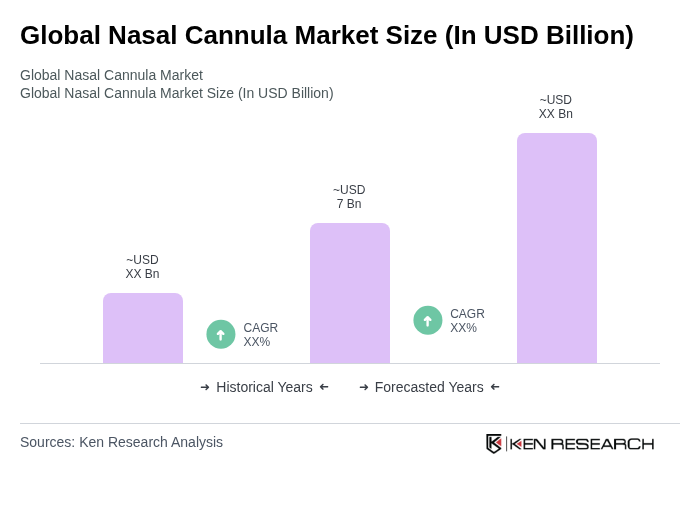
The Global Nasal Cannula Market, valued at USD 7 billion, is growing due to increasing respiratory issues and aging population, with dominance in North America, Europe, and Asia-Pacific.

Region:Global

Author(s):Shubham

Product Code:KRAD6617

Pages:89

Published On:December 2025
About the Report

Base Year 2024

Global Nasal Cannula Market Overview

  • The Global Nasal Cannula Market is valued at USD 7 billion, based on a five-year historical analysis. This growth is primarily driven by the increasing prevalence of respiratory diseases, the rising geriatric population, and advancements in healthcare technology. The demand for nasal cannulas has surged due to their effectiveness in oxygen therapy and respiratory support, particularly in hospital and homecare settings.
  • Key regions in this market include North America, Europe, and Asia-Pacific, which dominate due to their advanced healthcare infrastructure, high healthcare expenditure, and significant investments in medical technology. The presence of leading manufacturers and a growing awareness of respiratory health further contribute to their market leadership.
  • The Quality System Regulation (21 CFR Part 820), 1996 issued by the U.S. Food and Drug Administration (FDA) requires manufacturers of nasal cannulas to implement current good manufacturing practices covering design controls, production processes, and labeling to ensure device safety and effectiveness for oxygen delivery in flows up to 6 liters per minute with compliance verified through premarket notifications or approvals.
Global Nasal Cannula Market Size

Global Nasal Cannula Market Segmentation

By Type:The nasal cannula market is segmented into various types, including Low-Flow Nasal Cannula, High-Flow Nasal Cannula, Heated Humidified Nasal Cannula Systems, Pediatric/Neonatal Nasal Cannula, Curved / Straight / Flared Tip Cannulas, and Others. Among these, the Low-Flow Nasal Cannula is the most widely used due to its simplicity, cost-effectiveness, and versatility in delivering oxygen therapy. The increasing number of patients requiring long-term oxygen therapy has further solidified its dominance in the market.
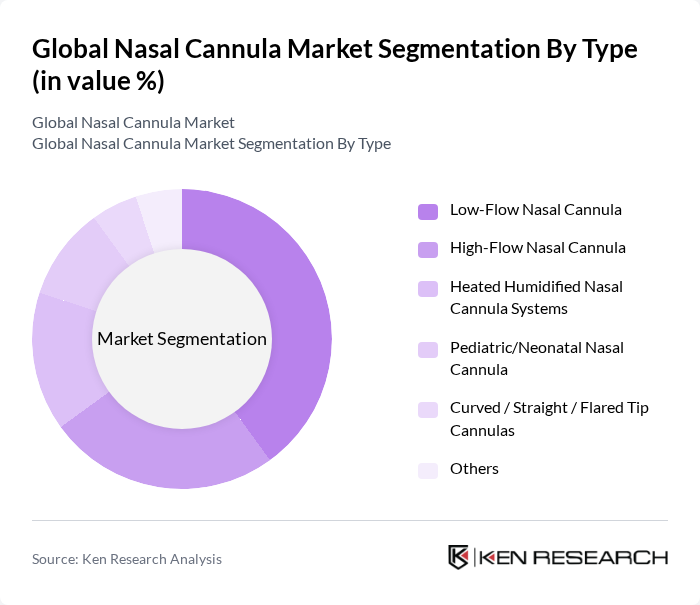
Global Nasal Cannula Market segmentation by Type.

By End-User:The end-user segmentation includes Hospitals, Homecare Settings, Ambulatory Surgical Centers, Long-Term Care Facilities, Emergency Medical Services, and Others. Hospitals are the leading end-user segment, driven by the high volume of patients requiring oxygen therapy and respiratory support. The increasing number of hospital admissions due to respiratory conditions has led to a higher demand for nasal cannulas in these settings.
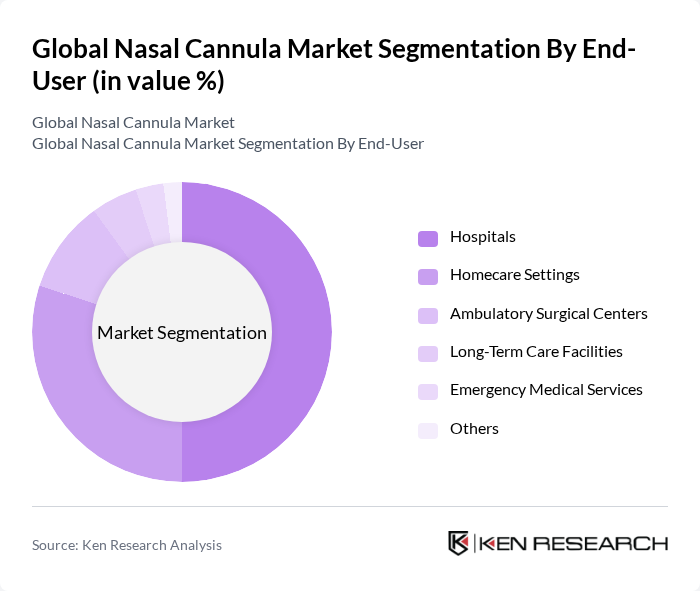
Global Nasal Cannula Market segmentation by End-User.

Global Nasal Cannula Market Competitive Landscape

The Global Nasal Cannula Market is characterized by a dynamic mix of regional and international players. Leading participants such as Medtronic plc, Fisher & Paykel Healthcare Corporation Limited, Koninklijke Philips N.V., ResMed Inc., Becton, Dickinson and Company (BD), Teleflex Incorporated, ICU Medical, Inc. (including former Smiths Medical portfolio), Vyaire Medical, Inc., Salter Labs (a SunMed company), Medline Industries, LP, Ambu A/S, Cardinal Health, Inc., Drive DeVilbiss Healthcare, Flexicare Medical Limited, Westmed, Inc. contribute to innovation, geographic expansion, and service delivery in this space.

Medtronic plc

1949

Dublin, Ireland

Fisher & Paykel Healthcare Corporation Limited

1934

Auckland, New Zealand

Koninklijke Philips N.V.

1891

Amsterdam, Netherlands

ResMed Inc.

1989

San Diego, California, USA

Becton, Dickinson and Company (BD)

1897

Franklin Lakes, New Jersey, USA

Company

Establishment Year

Headquarters

Group Size (Global, Regional, or Niche Player)

Nasal Cannula Segment Revenue (USD Million)

Nasal Cannula Revenue CAGR (Last 3–5 Years)

Global Nasal Cannula Market Share (%)

Geographic Footprint (Number of Countries / Regions Served)

Manufacturing Footprint (Number of Plants / Key Locations)

Global Nasal Cannula Market Industry Analysis

Growth Drivers

  • Increasing Prevalence of Respiratory Diseases:The World Health Organization reported that respiratory diseases affect over 260 million people globally, with conditions like asthma and COPD on the rise. In future, the incidence of respiratory diseases is projected to increase by 5% annually, driven by factors such as air pollution and smoking. This growing patient population necessitates effective oxygen delivery solutions, significantly boosting the demand for nasal cannulas, which are essential for managing these conditions.
  • Rising Geriatric Population:According to the United Nations, the global population aged 65 and older is expected to exceed 1.5 billion in future. In future, this demographic is projected to grow by 20%, leading to an increased prevalence of age-related respiratory issues. As older adults often require supplemental oxygen, the demand for nasal cannulas will rise, creating a substantial market opportunity for manufacturers to cater to this vulnerable population segment.
  • Technological Advancements in Nasal Cannula Design:Innovations in nasal cannula technology, such as the development of lightweight, ergonomic designs, have improved patient comfort and compliance. For instance, the introduction of soft, silicone materials has reduced irritation, leading to higher usage rates. In future, the adoption of these advanced designs is expected to increase by 15%, as healthcare providers prioritize patient-centered solutions that enhance the overall treatment experience.

Market Challenges

  • High Competition Among Manufacturers:The nasal cannula market is characterized by intense competition, with numerous players vying for market share. In future, over 50 manufacturers are currently active, leading to price wars and reduced profit margins. This competitive landscape makes it challenging for new entrants to establish themselves, as they must invest heavily in marketing and product differentiation to capture consumer attention and loyalty.
  • Regulatory Hurdles in Product Approval:Navigating the regulatory landscape for medical devices can be complex and time-consuming. In future, the average time for obtaining product approval from health authorities can exceed 12 months, delaying market entry for new innovations. This lengthy process can hinder manufacturers' ability to respond quickly to market demands and technological advancements, ultimately impacting their competitiveness and growth potential.

Global Nasal Cannula Market Future Outlook

The future of the nasal cannula market in future appears promising, driven by increasing healthcare investments and a growing focus on respiratory care. As the demand for home healthcare solutions rises, manufacturers are likely to innovate further, enhancing product usability and comfort. Additionally, the integration of smart technology into nasal cannulas could revolutionize patient monitoring, providing real-time data to healthcare providers and improving treatment outcomes. These trends indicate a dynamic market landscape poised for growth.

Market Opportunities

  • Expansion into Emerging Markets:Emerging markets in future present significant growth opportunities due to increasing healthcare access and rising disposable incomes. As more individuals seek quality healthcare solutions, manufacturers can capitalize on this trend by tailoring products to meet local needs, potentially increasing market penetration and revenue streams.
  • Development of Innovative Products:There is a growing demand for innovative nasal cannula designs that enhance patient comfort and usability. By investing in research and development, manufacturers can create products that incorporate features such as adjustable flow rates and integrated humidification, addressing specific patient needs and differentiating themselves in a competitive market.

Scope of the Report

SegmentSub-Segments
By Type

Low-Flow Nasal Cannula

High-Flow Nasal Cannula

Heated Humidified Nasal Cannula Systems

Pediatric/Neonatal Nasal Cannula

Curved / Straight / Flared Tip Cannulas

Others

By End-User

Hospitals

Homecare Settings

Ambulatory Surgical Centers

Long-Term Care Facilities

Emergency Medical Services

Others

By Distribution Channel

Direct Tender / Institutional Sales

Medical Device Distributors / Dealers

Online B2B Platforms

Retail & Hospital Pharmacies

Others

By Material

PVC

Silicone

Latex-Free / DEHP-Free Polymers

Thermoplastic Elastomers (TPE)

Others

By Application

Oxygen Therapy

High-Flow Oxygen Therapy / Respiratory Support

Anesthesia & Perioperative Care

Sleep Apnea & Non-invasive Ventilation Interfaces

Neonatal & Pediatric Respiratory Care

Others

By Region

North America

Europe

Asia-Pacific

Latin America

Middle East & Africa

By Product Features

Adjustable Cannulas

Disposable Cannulas

Reusable Cannulas

Soft-Touch / Comfort-Fit Cannulas

Anti-Kink / Crush-Resistant Tubing Cannulas

Others

Key Target Audience

Investors and Venture Capitalist Firms

Government and Regulatory Bodies (e.g., Food and Drug Administration, European Medicines Agency)

Manufacturers and Producers

Distributors and Retailers

Healthcare Providers and Hospitals

Medical Device Wholesalers

Industry Associations

Health Insurance Companies

Players Mentioned in the Report:

Medtronic plc

Fisher & Paykel Healthcare Corporation Limited

Koninklijke Philips N.V.

ResMed Inc.

Becton, Dickinson and Company (BD)

Teleflex Incorporated

ICU Medical, Inc. (including former Smiths Medical portfolio)

Vyaire Medical, Inc.

Salter Labs (a SunMed company)

Medline Industries, LP

Ambu A/S

Cardinal Health, Inc.

Drive DeVilbiss Healthcare

Flexicare Medical Limited

Westmed, Inc.

Table of Contents

Market Assessment Phase

1. Executive Summary and Approach


2. Global Nasal Cannula Market Overview

2.1 Key Insights and Strategic Recommendations

2.2 Global Nasal Cannula Market Overview

2.3 Definition and Scope

2.4 Evolution of Market Ecosystem

2.5 Timeline of Key Regulatory Milestones

2.6 Value Chain & Stakeholder Mapping

2.7 Business Cycle Analysis

2.8 Policy & Incentive Landscape


3. Global Nasal Cannula Market Analysis

3.1 Growth Drivers

3.1.1 Increasing prevalence of respiratory diseases
3.1.2 Rising geriatric population
3.1.3 Technological advancements in nasal cannula design
3.1.4 Growing demand for home healthcare solutions

3.2 Market Challenges

3.2.1 High competition among manufacturers
3.2.2 Regulatory hurdles in product approval
3.2.3 Price sensitivity among consumers
3.2.4 Limited awareness in emerging markets

3.3 Market Opportunities

3.3.1 Expansion into emerging markets
3.3.2 Development of innovative products
3.3.3 Strategic partnerships with healthcare providers
3.3.4 Increasing investment in healthcare infrastructure

3.4 Market Trends

3.4.1 Shift towards disposable nasal cannulas
3.4.2 Integration of smart technology in medical devices
3.4.3 Growing focus on patient comfort and usability
3.4.4 Rise in telehealth services

3.5 Government Regulation

3.5.1 Compliance with FDA regulations
3.5.2 CE marking for European markets
3.5.3 Guidelines from WHO on respiratory devices
3.5.4 National health policies promoting respiratory care

4. SWOT Analysis


5. Stakeholder Analysis


6. Porter's Five Forces Analysis


7. Global Nasal Cannula Market Market Size, 2019-2024

7.1 By Value

7.2 By Volume

7.3 By Average Selling Price


8. Global Nasal Cannula Market Segmentation

8.1 By Type

8.1.1 Low-Flow Nasal Cannula
8.1.2 High-Flow Nasal Cannula
8.1.3 Heated Humidified Nasal Cannula Systems
8.1.4 Pediatric/Neonatal Nasal Cannula
8.1.5 Curved / Straight / Flared Tip Cannulas
8.1.6 Others

8.2 By End-User

8.2.1 Hospitals
8.2.2 Homecare Settings
8.2.3 Ambulatory Surgical Centers
8.2.4 Long-Term Care Facilities
8.2.5 Emergency Medical Services
8.2.6 Others

8.3 By Distribution Channel

8.3.1 Direct Tender / Institutional Sales
8.3.2 Medical Device Distributors / Dealers
8.3.3 Online B2B Platforms
8.3.4 Retail & Hospital Pharmacies
8.3.5 Others

8.4 By Material

8.4.1 PVC
8.4.2 Silicone
8.4.3 Latex-Free / DEHP-Free Polymers
8.4.4 Thermoplastic Elastomers (TPE)
8.4.5 Others

8.5 By Application

8.5.1 Oxygen Therapy
8.5.2 High-Flow Oxygen Therapy / Respiratory Support
8.5.3 Anesthesia & Perioperative Care
8.5.4 Sleep Apnea & Non-invasive Ventilation Interfaces
8.5.5 Neonatal & Pediatric Respiratory Care
8.5.6 Others

8.6 By Region

8.6.1 North America
8.6.2 Europe
8.6.3 Asia-Pacific
8.6.4 Latin America
8.6.5 Middle East & Africa

8.7 By Product Features

8.7.1 Adjustable Cannulas
8.7.2 Disposable Cannulas
8.7.3 Reusable Cannulas
8.7.4 Soft-Touch / Comfort-Fit Cannulas
8.7.5 Anti-Kink / Crush-Resistant Tubing Cannulas
8.7.6 Others

9. Global Nasal Cannula Market Competitive Analysis

9.1 Market Share of Key Players

9.2 Cross Comparison of Key Players

9.2.1 Company Name
9.2.2 Group Size (Global, Regional, or Niche Player)
9.2.3 Nasal Cannula Segment Revenue (USD Million)
9.2.4 Nasal Cannula Revenue CAGR (Last 3–5 Years)
9.2.5 Global Nasal Cannula Market Share (%)
9.2.6 Geographic Footprint (Number of Countries / Regions Served)
9.2.7 Manufacturing Footprint (Number of Plants / Key Locations)
9.2.8 Product Portfolio Breadth (Low-Flow, High-Flow, Neonatal, etc.)
9.2.9 R&D Intensity (% of Revenue Spent on R&D)
9.2.10 New Product Launches / Regulatory Approvals (Last 3 Years)
9.2.11 Average Selling Price Positioning (Premium / Mid / Value)
9.2.12 Sales & Distribution Reach (Key Channels, Number of Distributors)
9.2.13 Key Strategic Partnerships & OEM Relationships
9.2.14 Patient Safety & Quality Certifications (FDA 510(k), CE, ISO, etc.)
9.2.15 Customer Base Mix (Hospitals vs Homecare vs EMS)

9.3 SWOT Analysis of Top Players

9.4 Pricing Analysis

9.5 Detailed Profile of Major Companies

9.5.1 Medtronic plc
9.5.2 Fisher & Paykel Healthcare Corporation Limited
9.5.3 Koninklijke Philips N.V.
9.5.4 ResMed Inc.
9.5.5 Becton, Dickinson and Company (BD)
9.5.6 Teleflex Incorporated
9.5.7 ICU Medical, Inc. (including former Smiths Medical portfolio)
9.5.8 Vyaire Medical, Inc.
9.5.9 Salter Labs (a SunMed company)
9.5.10 Medline Industries, LP
9.5.11 Ambu A/S
9.5.12 Cardinal Health, Inc.
9.5.13 Drive DeVilbiss Healthcare
9.5.14 Flexicare Medical Limited
9.5.15 Westmed, Inc.

10. Global Nasal Cannula Market End-User Analysis

10.1 Procurement Behavior of Key Ministries

10.1.1 Budget Allocation for Respiratory Care
10.1.2 Procurement Processes and Regulations
10.1.3 Supplier Selection Criteria
10.1.4 Contract Management Practices

10.2 Corporate Spend on Infrastructure & Energy

10.2.1 Investment in Healthcare Facilities
10.2.2 Spending on Medical Equipment
10.2.3 Budgeting for Patient Care Services
10.2.4 Others

10.3 Pain Point Analysis by End-User Category

10.3.1 Challenges Faced by Hospitals
10.3.2 Issues in Homecare Settings
10.3.3 Barriers in Emergency Medical Services
10.3.4 Others

10.4 User Readiness for Adoption

10.4.1 Awareness of Nasal Cannula Benefits
10.4.2 Training and Support Needs
10.4.3 Adoption Barriers
10.4.4 Others

10.5 Post-Deployment ROI and Use Case Expansion

10.5.1 Measurement of Patient Outcomes
10.5.2 Cost Savings Analysis
10.5.3 Expansion of Use Cases
10.5.4 Others

11. Global Nasal Cannula Market Future Size, 2025-2030

11.1 By Value

11.2 By Volume

11.3 By Average Selling Price


Go-To-Market Strategy Phase

1. Whitespace Analysis + Business Model Canvas

1.1 Market Gaps Identification

1.2 Business Model Development


2. Marketing and Positioning Recommendations

2.1 Branding Strategies

2.2 Product USPs


3. Distribution Plan

3.1 Urban Retail vs Rural NGO Tie-ups


4. Channel & Pricing Gaps

4.1 Underserved Routes

4.2 Pricing Bands


5. Unmet Demand & Latent Needs

5.1 Category Gaps

5.2 Consumer Segments


6. Customer Relationship

6.1 Loyalty Programs

6.2 After-sales Service


7. Value Proposition

7.1 Sustainability

7.2 Integrated Supply Chains


8. Key Activities

8.1 Regulatory Compliance

8.2 Branding

8.3 Distribution Setup


9. Entry Strategy Evaluation

9.1 Domestic Market Entry Strategy

9.1.1 Product Mix
9.1.2 Pricing Band
9.1.3 Packaging

9.2 Export Entry Strategy

9.2.1 Target Countries
9.2.2 Compliance Roadmap

10. Entry Mode Assessment

10.1 JV

10.2 Greenfield

10.3 M&A

10.4 Distributor Model


11. Capital and Timeline Estimation

11.1 Capital Requirements

11.2 Timelines


12. Control vs Risk Trade-Off

12.1 Ownership vs Partnerships


13. Profitability Outlook

13.1 Breakeven Analysis

13.2 Long-term Sustainability


14. Potential Partner List

14.1 Distributors

14.2 JVs

14.3 Acquisition Targets


15. Execution Roadmap

15.1 Phased Plan for Market Entry

15.1.1 Market Setup
15.1.2 Market Entry
15.1.3 Growth Acceleration
15.1.4 Scale & Stabilize

15.2 Key Activities and Milestones

15.2.1 Milestone Planning
15.2.2 Activity Tracking

Research Methodology

ApproachModellingSample

Phase 1: Approach1

Desk Research

  • Analysis of industry reports from healthcare organizations and market research firms
  • Review of published articles and white papers on nasal cannula technology and usage trends
  • Examination of regulatory guidelines and standards from health authorities regarding nasal cannula usage

Primary Research

  • Interviews with respiratory therapists and healthcare professionals using nasal cannulas
  • Surveys conducted with hospital procurement managers to understand purchasing behavior
  • Field interviews with manufacturers and suppliers of nasal cannula products

Validation & Triangulation

  • Cross-validation of data through multiple sources including sales data and clinical studies
  • Triangulation of findings from primary interviews and secondary research insights
  • Sanity checks through expert panel reviews comprising industry veterans and market analysts

Phase 2: Market Size Estimation1

Top-down Assessment

  • Estimation of market size based on overall respiratory device market growth rates
  • Segmentation analysis by application areas such as home care, hospitals, and emergency services
  • Incorporation of demographic trends affecting respiratory health and device usage

Bottom-up Modeling

  • Volume estimates derived from sales data of leading nasal cannula manufacturers
  • Cost analysis based on average selling prices and market penetration rates
  • Estimation of usage frequency and patient population statistics for accurate volume projections

Forecasting & Scenario Analysis

  • Multi-factor regression analysis incorporating factors such as aging population and chronic respiratory diseases
  • Scenario modeling based on potential market disruptions like new product innovations and regulatory changes
  • Development of baseline, optimistic, and pessimistic forecasts through 2030

Phase 3: CATI Sample Composition1

Scope Item/SegmentSample SizeTarget Respondent Profiles
Hospital Respiratory Departments150Respiratory Therapists, Clinical Managers
Home Care Providers100Home Health Aides, Care Coordinators
Emergency Medical Services80Paramedics, EMT Supervisors
Medical Device Distributors70Sales Representatives, Product Managers
Clinical Research Organizations60Clinical Researchers, Regulatory Affairs Specialists

Frequently Asked Questions

What is the current value of the Global Nasal Cannula Market?

The Global Nasal Cannula Market is valued at approximately USD 7 billion, driven by the increasing prevalence of respiratory diseases, a growing geriatric population, and advancements in healthcare technology, particularly in oxygen therapy and respiratory support.

What factors are driving the growth of the Nasal Cannula Market?

Which regions dominate the Global Nasal Cannula Market?

What are the main types of nasal cannulas available in the market?

Other Regional/Country Reports

Indonesia Nasal Cannula Market

Malaysia Nasal Cannula Market

KSA Nasal Cannula Market

APAC Nasal Cannula Market

SEA Nasal Cannula Market

Vietnam Nasal Cannula Market

Other Adjacent Reports

Bahrain Oxygen Therapy Devices Market

Qatar Respiratory Care Equipment Market

Oman medical oxygen concentrators market Size, Share, Growth Drivers, Trends, Opportunities & Forecast 2025–2030

Malaysia Ventilators Market

Brazil CPAP Devices Market

Thailand Nebulizers Market

Qatar Pulse Oximeters Market

Philippines Airway Management Devices Market Size, Share, Growth Drivers, Trends, Opportunities & Forecast 2025–2030

Malaysia Respiratory Masks Market

Kuwait Home Healthcare Devices Market

Why Buy From Us?

Refine Robust Result (RRR) Framework

What makes us stand out is that our consultants follow Robust, Refine and Result (RRR) methodology. Robust for clear definitions, approaches and sanity checking, Refine for differentiating respondents' facts and opinions, and Result for presenting data with story.

Our Reach Is Unmatched

We have set a benchmark in the industry by offering our clients with syndicated and customized market research reports featuring coverage of entire market as well as meticulous research and analyst insights.

Shifting the Research Paradigm

While we don't replace traditional research, we flip the method upside down. Our dual approach of Top Bottom & Bottom Top ensures quality deliverable by not just verifying company fundamentals but also looking at the sector and macroeconomic factors.

More Insights-Better Decisions

With one step in the future, our research team constantly tries to show you the bigger picture. We help with some of the tough questions you may encounter along the way: How is the industry positioned? Best marketing channel? KPI's of competitors? By aligning every element, we help maximize success.

Transparency and Trust

Our report gives you instant access to the answers and sources that other companies might choose to hide. We elaborate each steps of research methodology we have used and showcase you the sample size to earn your trust.

Round the Clock Support

If you need any support, we are here! We pride ourselves on universe strength, data quality, and quick, friendly, and professional service.

Why Clients Choose Us?

400000+
Reports in repository
150+
Consulting projects a year
100+
Analysts
8000+
Client Queries in 2022








