About the Report
Base Year 2024Listen to the audio summary
Global Neurodiagnostics Market Overview
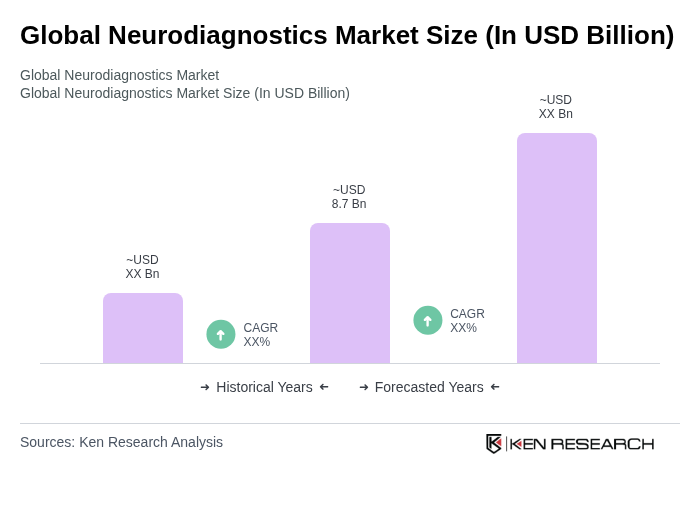
- The Global Neurodiagnostics Market is valued at USD 8.7 billion, based on a five-year historical analysis. This growth is primarily driven by the increasing prevalence of neurological disorders, advancements in neuroimaging technologies, and the rising demand for early diagnosis and treatment options. The market is also supported by the growing geriatric population, which is more susceptible to neurological conditions.
- Key players in this market include the United States, Germany, and Japan, which dominate due to their advanced healthcare infrastructure, significant investments in research and development, and a high prevalence of neurological disorders. The presence of leading medical technology companies and a strong focus on innovation further contribute to their market leadership. North America, particularly the United States, maintains the largest share, supported by early adoption of advanced neurodiagnostics and favorable reimbursement policies, while Asia-Pacific is the fastest-growing region due to expanding healthcare infrastructure and rising disease incidence.
- In 2023, the U.S. Food and Drug Administration (FDA) updated its regulatory framework for neurodiagnostic devices under the “Medical Device User Fee Amendments of 2022,” issued by the U.S. Congress and administered by the FDA. This binding regulation streamlines the premarket approval process, sets specific compliance requirements for clinical evidence, and establishes new performance standards for neurodiagnostic technologies, thereby promoting innovation and accelerating market access for new devices.
Global Neurodiagnostics Market Segmentation
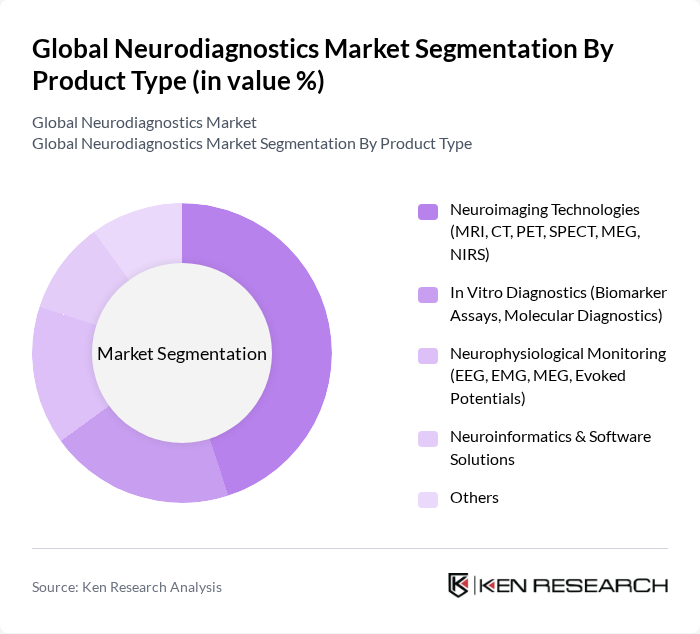
By Product Type:The product type segmentation includes various categories such as neuroimaging technologies, in vitro diagnostics, neurophysiological monitoring, neuroinformatics & software solutions, and others. Among these, neuroimaging technologies are leading the market due to their critical role in diagnosing and monitoring neurological conditions. The demand for advanced imaging techniques like MRI and CT scans is increasing, driven by technological advancements, integration of artificial intelligence, and the need for accurate, non-invasive diagnostics.
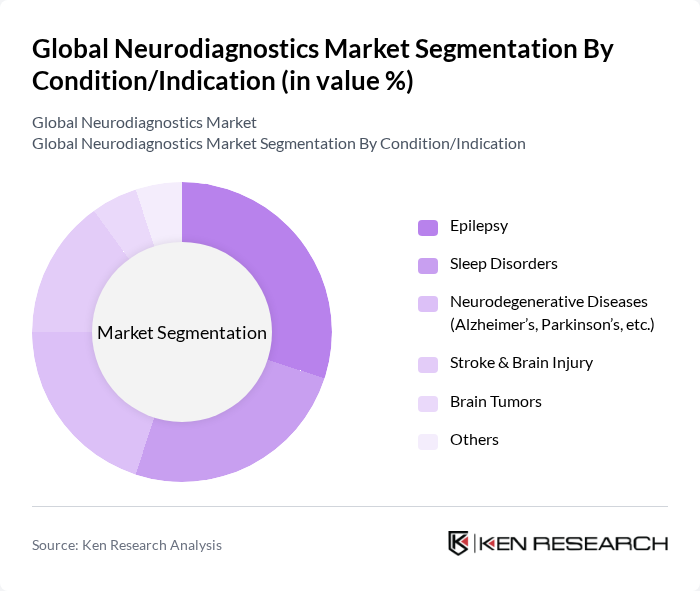
By Condition/Indication:The condition/indication segmentation encompasses various neurological disorders such as epilepsy, sleep disorders, neurodegenerative diseases, stroke & brain injury, brain tumors, and others. Epilepsy remains the leading condition in this segment, driven by the increasing incidence of epilepsy cases, improved access to diagnostic modalities, and heightened awareness of the need for effective diagnostic tools and treatment options.
Global Neurodiagnostics Market Competitive Landscape
The Global Neurodiagnostics Market is characterized by a dynamic mix of regional and international players. Leading participants such as Siemens Healthineers, GE Healthcare, Philips Healthcare, Canon Medical Systems Corporation, Hitachi Medical Corporation, Nihon Kohden Corporation, Medtronic plc, Abbott Laboratories, Natus Medical Incorporated, Compumedics Limited, BrainScope Company, Inc., NeuroWave Systems Inc., Cadwell Industries, Inc., Elekta AB, United Imaging Healthcare Co., Ltd., Drägerwerk AG & Co. KGaA, Masimo Corporation, Zynex Medical, Inc., Lifelines Neuro Company, LLC, Neurosoft Ltd. contribute to innovation, geographic expansion, and service delivery in this space.
Global Neurodiagnostics Market Industry Analysis
Growth Drivers
- Increasing Prevalence of Neurological Disorders:The World Health Organization reported that approximately 1 in 6 people globally will experience a neurological disorder at some point in their lives. In future, it is estimated that over 1.4 billion individuals will be affected by conditions such as Alzheimer's and Parkinson's disease. This rising prevalence drives the demand for neurodiagnostic services, as early detection and management are crucial for improving patient outcomes and reducing healthcare costs associated with advanced disease stages.
- Advancements in Neurodiagnostic Technologies:The neurodiagnostics sector is witnessing rapid technological advancements, with the global market for neuroimaging technologies projected to reach $12 billion in future. Innovations such as functional MRI and advanced EEG systems enhance diagnostic accuracy and efficiency. These technologies enable healthcare providers to offer more precise diagnoses, thus increasing the adoption of neurodiagnostic services across various healthcare settings, including hospitals and outpatient clinics.
- Rising Demand for Early Diagnosis and Treatment:A significant shift towards preventive healthcare is evident, with a focus on early diagnosis of neurological conditions. The National Institute of Health reported that early intervention can reduce the long-term costs of care by up to 25%. As awareness of neurological disorders grows, patients and healthcare providers are increasingly prioritizing neurodiagnostic tests, leading to a surge in demand for these services in future.
Market Challenges
- High Costs of Neurodiagnostic Equipment:The initial investment for advanced neurodiagnostic equipment can exceed $1 million, posing a significant barrier for many healthcare facilities, especially in low-income regions. This high cost limits access to essential diagnostic tools, resulting in delayed diagnoses and treatment for patients. As a result, healthcare providers may struggle to justify the expenditure, impacting the overall growth of the neurodiagnostics market.
- Lack of Skilled Professionals:The neurodiagnostics field faces a critical shortage of trained professionals, with estimates indicating a deficit of over 40,000 neurodiagnostic technicians in the U.S. alone in future. This shortage hampers the ability of healthcare facilities to provide timely and accurate diagnostic services. The lack of skilled personnel not only affects patient care but also limits the potential for market expansion in the neurodiagnostics sector.
Global Neurodiagnostics Market Future Outlook
The future of the neurodiagnostics market appears promising, driven by technological advancements and a growing emphasis on preventive healthcare. As artificial intelligence continues to integrate into diagnostic processes, accuracy and efficiency are expected to improve significantly. Additionally, the expansion of telemedicine will facilitate access to neurodiagnostic services, particularly in underserved areas. These trends indicate a robust growth trajectory for the market, with increased investment in research and development further enhancing service delivery and patient outcomes.
Market Opportunities
- Expansion of Telemedicine in Neurodiagnostics:The rise of telemedicine presents a unique opportunity for neurodiagnostics, allowing remote consultations and diagnostics. In future, telehealth services are projected to reach $300 billion, enabling patients in rural areas to access specialized neurodiagnostic services without the need for travel, thus improving overall healthcare accessibility.
- Development of Portable Neurodiagnostic Devices:The market for portable neurodiagnostic devices is expected to grow significantly, with innovations such as handheld EEG devices gaining traction. These devices, which can be used in various settings, are projected to increase diagnostic capabilities in emergency and outpatient care, enhancing patient management and treatment outcomes in future.
Scope of the Report
| Segment | Sub-Segments |
|---|---|
| By Product Type | Neuroimaging Technologies (MRI, CT, PET, SPECT, MEG, NIRS) In Vitro Diagnostics (Biomarker Assays, Molecular Diagnostics) Neurophysiological Monitoring (EEG, EMG, MEG, Evoked Potentials) Neuroinformatics & Software Solutions Others |
| By Condition/Indication | Epilepsy Sleep Disorders Neurodegenerative Diseases (Alzheimer’s, Parkinson’s, etc.) Stroke & Brain Injury Brain Tumors Others |
| By End-User | Hospitals & Surgical Centers Diagnostic Laboratories & Imaging Centers Ambulatory Care & Emergency Settings Research & Academic Institutes Specialized Neurology Centers Others |
| By Technology | Digital Neurodiagnostics Wearable Neurodiagnostic Devices Cloud-based Neurodiagnostic Solutions Artificial Intelligence & Machine Learning Tools Others |
| By Distribution Channel | Direct Sales Online Sales Distributors Others |
| By Region | North America (U.S., Canada, Mexico) Europe (Germany, UK, France, Italy, Spain, Rest of Europe) Asia-Pacific (China, Japan, India, Australia, South Korea, Rest of APAC) Latin America (Brazil, Argentina, Rest of Latin America) Middle East & Africa (GCC, South Africa, Rest of MEA) |
| By Policy Support | Government Grants Tax Incentives Research Funding Others |
Key Target Audience
Investors and Venture Capitalist Firms
Government and Regulatory Bodies (e.g., Food and Drug Administration, European Medicines Agency)
Manufacturers and Producers of Neurodiagnostic Devices
Healthcare Providers and Hospitals
Medical Equipment Distributors
Pharmaceutical Companies
Health Insurance Companies
Clinical Research Organizations
Players Mentioned in the Report:
Siemens Healthineers
GE Healthcare
Philips Healthcare
Canon Medical Systems Corporation
Hitachi Medical Corporation
Nihon Kohden Corporation
Medtronic plc
Abbott Laboratories
Natus Medical Incorporated
Compumedics Limited
BrainScope Company, Inc.
NeuroWave Systems Inc.
Cadwell Industries, Inc.
Elekta AB
United Imaging Healthcare Co., Ltd.
Dragerwerk AG & Co. KGaA
Masimo Corporation
Zynex Medical, Inc.
Lifelines Neuro Company, LLC
Neurosoft Ltd.
Table of Contents
Market Assessment Phase
1. Executive Summary and Approach
2. Global Neurodiagnostics Market Overview
2.1 Key Insights and Strategic Recommendations
2.2 Global Neurodiagnostics Market Overview
2.3 Definition and Scope
2.4 Evolution of Market Ecosystem
2.5 Timeline of Key Regulatory Milestones
2.6 Value Chain & Stakeholder Mapping
2.7 Business Cycle Analysis
2.8 Policy & Incentive Landscape
3. Global Neurodiagnostics Market Analysis
3.1 Growth Drivers
3.1.1 Increasing prevalence of neurological disorders
3.1.2 Advancements in neurodiagnostic technologies
3.1.3 Rising demand for early diagnosis and treatment
3.1.4 Growing geriatric population
3.2 Market Challenges
3.2.1 High costs of neurodiagnostic equipment
3.2.2 Lack of skilled professionals
3.2.3 Stringent regulatory requirements
3.2.4 Limited access to neurodiagnostic services in rural areas
3.3 Market Opportunities
3.3.1 Expansion of telemedicine in neurodiagnostics
3.3.2 Development of portable neurodiagnostic devices
3.3.3 Increasing investment in research and development
3.3.4 Collaborations and partnerships among key players
3.4 Market Trends
3.4.1 Integration of artificial intelligence in neurodiagnostics
3.4.2 Shift towards personalized medicine
3.4.3 Growing focus on preventive healthcare
3.4.4 Rise in patient-centric care models
3.5 Government Regulation
3.5.1 FDA regulations on neurodiagnostic devices
3.5.2 CE marking requirements in Europe
3.5.3 HIPAA compliance for patient data protection
3.5.4 National health policies promoting neurodiagnostic services
4. SWOT Analysis
5. Stakeholder Analysis
6. Porter's Five Forces Analysis
7. Global Neurodiagnostics Market Market Size, 2019-2024
7.1 By Value
7.2 By Volume
7.3 By Average Selling Price
8. Global Neurodiagnostics Market Segmentation
8.1 By Product Type
8.1.1 Neuroimaging Technologies (MRI, CT, PET, SPECT, MEG, NIRS)
8.1.2 In Vitro Diagnostics (Biomarker Assays, Molecular Diagnostics)
8.1.3 Neurophysiological Monitoring (EEG, EMG, MEG, Evoked Potentials)
8.1.4 Neuroinformatics & Software Solutions
8.1.5 Others
8.2 By Condition/Indication
8.2.1 Epilepsy
8.2.2 Sleep Disorders
8.2.3 Neurodegenerative Diseases (Alzheimer’s, Parkinson’s, etc.)
8.2.4 Stroke & Brain Injury
8.2.5 Brain Tumors
8.2.6 Others
8.3 By End-User
8.3.1 Hospitals & Surgical Centers
8.3.2 Diagnostic Laboratories & Imaging Centers
8.3.3 Ambulatory Care & Emergency Settings
8.3.4 Research & Academic Institutes
8.3.5 Specialized Neurology Centers
8.3.6 Others
8.4 By Technology
8.4.1 Digital Neurodiagnostics
8.4.2 Wearable Neurodiagnostic Devices
8.4.3 Cloud-based Neurodiagnostic Solutions
8.4.4 Artificial Intelligence & Machine Learning Tools
8.4.5 Others
8.5 By Distribution Channel
8.5.1 Direct Sales
8.5.2 Online Sales
8.5.3 Distributors
8.5.4 Others
8.6 By Region
8.6.1 North America (U.S., Canada, Mexico)
8.6.2 Europe (Germany, UK, France, Italy, Spain, Rest of Europe)
8.6.3 Asia-Pacific (China, Japan, India, Australia, South Korea, Rest of APAC)
8.6.4 Latin America (Brazil, Argentina, Rest of Latin America)
8.6.5 Middle East & Africa (GCC, South Africa, Rest of MEA)
8.7 By Policy Support
8.7.1 Government Grants
8.7.2 Tax Incentives
8.7.3 Research Funding
8.7.4 Others
9. Global Neurodiagnostics Market Competitive Analysis
9.1 Market Share of Key Players
9.2 Cross Comparison of Key Players
9.2.1 Company Name
9.2.2 Group Size (Large, Medium, Small as per industry convention)
9.2.3 Global Neurodiagnostics Revenue (USD, Latest FY)
9.2.4 Revenue Growth Rate (3-Year CAGR)
9.2.5 R&D Expenditure as % of Revenue
9.2.6 Installed Base / Market Penetration (Units or Sites)
9.2.7 Product Portfolio Breadth (Modalities/Technologies)
9.2.8 Regulatory Approvals (FDA, CE, etc.)
9.2.9 Geographic Presence (No. of Countries/Regions)
9.2.10 Strategic Partnerships & M&A Activity
9.2.11 Customer Satisfaction Score (Net Promoter Score or Equivalent)
9.2.12 After-Sales Service Coverage
9.3 SWOT Analysis of Top Players
9.4 Pricing Analysis
9.5 Detailed Profile of Major Companies
9.5.1 Siemens Healthineers
9.5.2 GE Healthcare
9.5.3 Philips Healthcare
9.5.4 Canon Medical Systems Corporation
9.5.5 Hitachi Medical Corporation
9.5.6 Nihon Kohden Corporation
9.5.7 Medtronic plc
9.5.8 Abbott Laboratories
9.5.9 Natus Medical Incorporated
9.5.10 Compumedics Limited
9.5.11 BrainScope Company, Inc.
9.5.12 NeuroWave Systems Inc.
9.5.13 Cadwell Industries, Inc.
9.5.14 Elekta AB
9.5.15 United Imaging Healthcare Co., Ltd.
9.5.16 Drägerwerk AG & Co. KGaA
9.5.17 Masimo Corporation
9.5.18 Zynex Medical, Inc.
9.5.19 Lifelines Neuro Company, LLC
9.5.20 Neurosoft Ltd.
10. Global Neurodiagnostics Market End-User Analysis
10.1 Procurement Behavior of Key Ministries
10.1.1 Government funding for neurodiagnostic services
10.1.2 Policy frameworks influencing procurement
10.1.3 Collaboration with private sector
10.1.4 Evaluation criteria for procurement
10.2 Corporate Spend on Infrastructure & Energy
10.2.1 Investment in neurodiagnostic facilities
10.2.2 Budget allocation for technology upgrades
10.2.3 Spending on training and development
10.2.4 Partnerships with technology providers
10.3 Pain Point Analysis by End-User Category
10.3.1 Challenges faced by hospitals
10.3.2 Issues in diagnostic laboratories
10.3.3 Barriers for research institutions
10.3.4 Needs of rehabilitation centers
10.4 User Readiness for Adoption
10.4.1 Awareness of neurodiagnostic technologies
10.4.2 Training requirements for staff
10.4.3 Infrastructure readiness
10.4.4 Financial readiness for investment
10.5 Post-Deployment ROI and Use Case Expansion
10.5.1 Measurement of ROI in neurodiagnostics
10.5.2 Expansion of use cases post-deployment
10.5.3 Long-term benefits of neurodiagnostic technologies
10.5.4 Case studies of successful implementations
11. Global Neurodiagnostics Market Future Size, 2025-2030
11.1 By Value
11.2 By Volume
11.3 By Average Selling Price
Go-To-Market Strategy Phase
1. Whitespace Analysis + Business Model Canvas
1.1 Market gaps and opportunities
1.2 Business model components
2. Marketing and Positioning Recommendations
2.1 Branding strategies
2.2 Product USPs
3. Distribution Plan
3.1 Urban retail vs rural NGO tie-ups
4. Channel & Pricing Gaps
4.1 Underserved routes
4.2 Pricing bands
5. Unmet Demand & Latent Needs
5.1 Category gaps
5.2 Consumer segments
6. Customer Relationship
6.1 Loyalty programs
6.2 After-sales service
7. Value Proposition
7.1 Sustainability
7.2 Integrated supply chains
8. Key Activities
8.1 Regulatory compliance
8.2 Branding
8.3 Distribution setup
9. Entry Strategy Evaluation
9.1 Domestic Market Entry Strategy
9.1.1 Product mix
9.1.2 Pricing band
9.1.3 Packaging
9.2 Export Entry Strategy
9.2.1 Target countries
9.2.2 Compliance roadmap
10. Entry Mode Assessment
10.1 JV
10.2 Greenfield
10.3 M&A
10.4 Distributor Model
11. Capital and Timeline Estimation
11.1 Capital requirements
11.2 Timelines
12. Control vs Risk Trade-Off
12.1 Ownership vs Partnerships
13. Profitability Outlook
13.1 Breakeven analysis
13.2 Long-term sustainability
14. Potential Partner List
14.1 Distributors
14.2 JVs
14.3 Acquisition targets
15. Execution Roadmap
15.1 Phased Plan for Market Entry
15.1.1 Market Setup
15.1.2 Market Entry
15.1.3 Growth Acceleration
15.1.4 Scale & Stabilize
15.2 Key Activities and Milestones
15.2.1 Milestone planning
15.2.2 Activity tracking
Research Methodology
Phase 1: Approach1
Desk Research
- Analysis of market reports from industry associations such as the American Academy of Neurology
- Review of published articles in peer-reviewed journals focusing on neurodiagnostic technologies
- Examination of regulatory updates from health authorities like the FDA and EMA regarding neurodiagnostic devices
Primary Research
- Interviews with neurologists and neurodiagnostic technologists to gather insights on current practices
- Surveys with hospital administrators to understand procurement processes for neurodiagnostic equipment
- Field interviews with manufacturers of neurodiagnostic devices to assess market trends and innovations
Validation & Triangulation
- Cross-validation of findings through multiple data sources including clinical studies and market surveys
- Triangulation of data from primary interviews, secondary research, and market trends
- Sanity checks conducted through expert panel reviews comprising industry veterans and academic professionals
Phase 2: Market Size Estimation1
Top-down Assessment
- Estimation of the global neurodiagnostics market size based on healthcare expenditure data
- Segmentation by device type, including EEG, EMG, and MRI systems
- Incorporation of growth rates from emerging markets and technological advancements
Bottom-up Modeling
- Collection of sales data from leading neurodiagnostic device manufacturers
- Estimation of market share based on unit sales and pricing strategies
- Volume x price analysis for each device category to derive total market value
Forecasting & Scenario Analysis
- Multi-factor regression analysis incorporating demographic trends and healthcare policies
- Scenario modeling based on technological advancements and shifts in healthcare delivery
- Development of baseline, optimistic, and pessimistic forecasts through 2030
Phase 3: CATI Sample Composition1
| Scope Item/Segment | Sample Size | Target Respondent Profiles |
|---|---|---|
| Hospital Neurodiagnostic Departments | 100 | Neurodiagnostic Technologists, Department Heads |
| Neurology Clinics | 70 | Neurologists, Clinic Managers |
| Medical Device Manufacturers | 50 | Product Managers, R&D Directors |
| Healthcare Policy Makers | 40 | Health Economists, Policy Analysts |
| Academic Institutions | 40 | Research Professors, Graduate Students in Neuroscience |
Frequently Asked Questions
What is the current value of the Global Neurodiagnostics Market?
The Global Neurodiagnostics Market is valued at approximately USD 8.7 billion, driven by the increasing prevalence of neurological disorders and advancements in neuroimaging technologies. This market is expected to grow further due to rising demand for early diagnosis and treatment options.
What factors are driving the growth of the Neurodiagnostics Market?
Which regions dominate the Global Neurodiagnostics Market?
What are the main product types in the Neurodiagnostics Market?
Other Regional/Country Reports
Indonesia Neurodiagnostics Market
Malaysia Neurodiagnostics Market
KSA Neurodiagnostics Market
APAC Neurodiagnostics Market
SEA Neurodiagnostics Market
Vietnam Neurodiagnostics Market
Other Adjacent Reports
Philippines Neuroimaging Market
Vietnam Neurological Devices Market
KSA Brain Monitoring Market
KSA Electrophysiology Market
Belgium Neuroinformatics Market
Philippines Medical Imaging Market Size, Share & Forecast, By Product Type, Technology & End User, 2025-2032Global Telemedicine Market Report Size, Share, Growth Drivers, Trends, Opportunities & Forecast 2025–2030Philippines Neurological Therapeutics Market
Egypt Neurosurgery Market
GCC AI in Healthcare Market Size, Share & Forecast, By Solution Type, Application & Care Setting, 2026-2031Why Buy From Us?

What makes us stand out is that our consultants follow Robust, Refine and Result (RRR) methodology. Robust for clear definitions, approaches and sanity checking, Refine for differentiating respondents' facts and opinions, and Result for presenting data with story.

We have set a benchmark in the industry by offering our clients with syndicated and customized market research reports featuring coverage of entire market as well as meticulous research and analyst insights.

While we don't replace traditional research, we flip the method upside down. Our dual approach of Top Bottom & Bottom Top ensures quality deliverable by not just verifying company fundamentals but also looking at the sector and macroeconomic factors.

With one step in the future, our research team constantly tries to show you the bigger picture. We help with some of the tough questions you may encounter along the way: How is the industry positioned? Best marketing channel? KPI's of competitors? By aligning every element, we help maximize success.

Our report gives you instant access to the answers and sources that other companies might choose to hide. We elaborate each steps of research methodology we have used and showcase you the sample size to earn your trust.

If you need any support, we are here! We pride ourselves on universe strength, data quality, and quick, friendly, and professional service.