About the Report
Base Year 2024Global Next Gen Biometric Authentication Market Overview
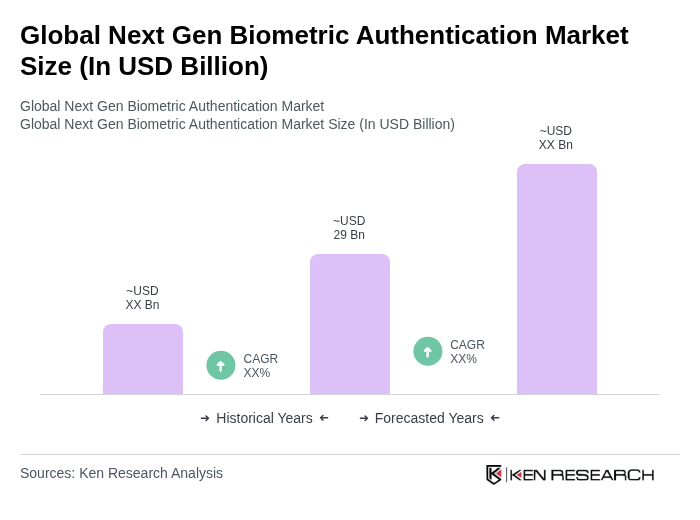
- The Global Next Gen Biometric Authentication Market is valued at USD 29 billion, based on a five-year historical analysis. This growth is primarily driven by the increasing demand for secure and efficient authentication methods across various sectors, including banking, healthcare, and government, where biometrics are increasingly used for customer onboarding, access control, eKYC, and digital identity verification. The rise in cyber threats and large-scale data breaches, along with the shift toward passwordless authentication and strong customer authentication in digital channels, has further propelled the adoption of biometric technologies.
- Key players in this market are predominantly located in North America and Europe, with the United States and leading European economies such as Germany and France at the forefront. The dominance of these regions can be attributed to their advanced technological infrastructure, substantial investments in artificial intelligence–enabled biometric R&D, and comprehensive regulatory and security requirements across sectors such as BFSI, border control, and public services that promote the adoption of biometric solutions for security and identification purposes.
- The European Union’s General Data Protection Regulation (GDPR), formally Regulation (EU) 2016/679 of the European Parliament and of the Council issued in 2016, establishes strict, binding rules for the processing of personal data, including biometric data used for uniquely identifying a natural person, and has been applicable since 2018. Under GDPR, biometric data are classified as “special categories of personal data,” requiring explicit consent or another specific legal basis, data protection impact assessments for high-risk processing, data minimization, purpose limitation, and robust technical and organizational security measures. These obligations have significant implications for biometric authentication technologies, as companies must ensure compliant data collection, storage, and user consent protocols, which is influencing market dynamics and driving innovation in privacy-preserving and secure biometric solutions.
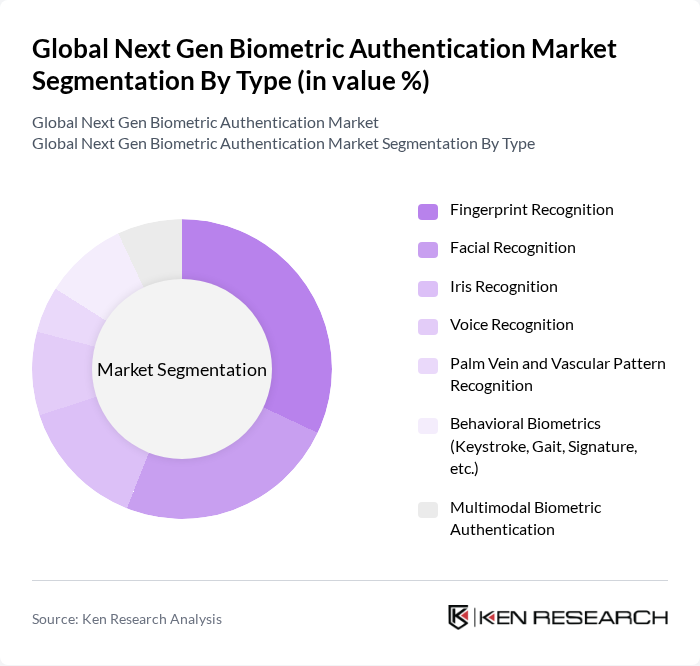
Global Next Gen Biometric Authentication Market Segmentation
By Type:The market is segmented into various types of biometric authentication technologies, including Fingerprint Recognition, Facial Recognition, Iris Recognition, Voice Recognition, Palm Vein and Vascular Pattern Recognition, Behavioral Biometrics, and Multimodal Biometric Authentication. Each of these technologies has unique applications and advantages, catering to different security needs.
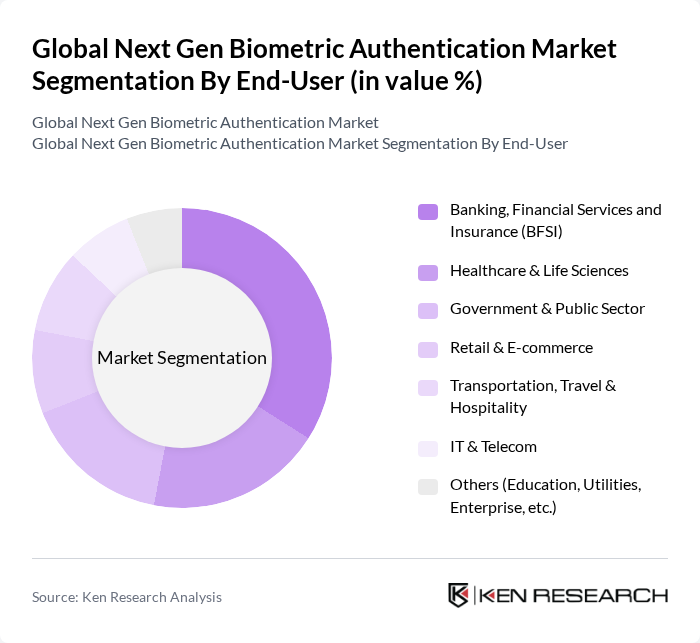
By End-User:The market is further segmented by end-user applications, including Banking, Financial Services and Insurance (BFSI), Healthcare & Life Sciences, Government & Public Sector, Retail & E-commerce, Transportation, Travel & Hospitality, IT & Telecom, and Others. Each sector has distinct requirements for biometric authentication, influencing the adoption rates of various technologies, with BFSI, government, and healthcare among the most intensive adopters due to high security, compliance, and identity assurance needs.
Global Next Gen Biometric Authentication Market Competitive Landscape
The Global Next Gen Biometric Authentication Market is characterized by a dynamic mix of regional and international players. Leading participants such as NEC Corporation, Thales Group (Including Gemalto Digital Identity & Security), HID Global Corporation, IDEMIA, Suprema Inc., Aware, Inc., BioID AG, FaceTec, Inc., ZKTeco Co., Ltd., Innovatrics s.r.o., Cognitec Systems GmbH, Nuance Communications, Inc. (Microsoft), Daon, Inc., Veridium IP Ltd., NEXT Biometrics Group ASA contribute to innovation, geographic expansion, and service delivery in this space.
Global Next Gen Biometric Authentication Market Industry Analysis
Growth Drivers
- Increasing Demand for Enhanced Security Measures:The global security market is projected to reach $300 billion, driven by the need for advanced security solutions. With cybercrime costs expected to hit $10.5 trillion annually, organizations are increasingly investing in biometric authentication systems. This trend is particularly evident in sectors like banking and healthcare, where sensitive data protection is paramount, leading to a surge in biometric technology adoption.
- Rising Adoption of Mobile Devices and Applications:The number of smartphone users worldwide is anticipated to surpass 6.8 billion, creating a significant demand for biometric authentication. Mobile applications are increasingly integrating biometric features, with over 70% of banking apps now offering fingerprint or facial recognition. This trend is fueled by the convenience and security that biometrics provide, making it a preferred choice for mobile transactions and user authentication.
- Growing Concerns Over Identity Theft and Fraud:Identity theft incidents are projected to affect 33 million individuals in the U.S. alone, prompting businesses to seek robust authentication solutions. The financial sector, which loses approximately $16 billion annually to fraud, is particularly focused on implementing biometric systems. This urgency to combat identity-related crimes is driving the adoption of next-gen biometric technologies across various industries.
Market Challenges
- High Implementation Costs:The initial investment for biometric systems can range from $10,000 to $100,000, depending on the technology and scale of deployment. This high cost can deter small and medium-sized enterprises from adopting biometric solutions. Additionally, ongoing maintenance and updates can further strain budgets, making it a significant barrier to widespread implementation in various sectors.
- Privacy Concerns and Regulatory Hurdles:With the implementation of GDPR, companies face stringent regulations regarding biometric data usage. Non-compliance can result in fines up to €20 million or 4% of annual global turnover, creating apprehension among businesses. Furthermore, public skepticism regarding data privacy can hinder the acceptance of biometric systems, complicating their integration into existing frameworks.
Global Next Gen Biometric Authentication Market Future Outlook
The future of biometric authentication is poised for significant transformation, driven by technological advancements and evolving consumer expectations. As organizations increasingly prioritize security, the integration of AI and machine learning will enhance biometric accuracy and efficiency. Additionally, the shift towards contactless solutions will likely accelerate adoption, particularly in public spaces and healthcare settings. This evolution will create a more secure and user-friendly environment, fostering greater trust in biometric technologies.
Market Opportunities
- Expansion in Emerging Markets:Emerging economies, particularly in Asia-Pacific, are experiencing rapid urbanization and digitalization. With a projected increase in smartphone penetration to 80%, these markets present significant opportunities for biometric solutions. Companies can capitalize on this growth by tailoring products to meet local security needs and regulatory requirements.
- Development of Multi-Modal Biometric Systems:The demand for multi-modal biometric systems, which combine various biometric traits, is on the rise. In future, the market for these systems is expected to grow significantly, driven by their enhanced security and accuracy. Companies that innovate in this space can differentiate themselves and capture a larger share of the market, addressing diverse consumer needs.
Scope of the Report
| Segment | Sub-Segments |
|---|---|
| By Type | Fingerprint Recognition Facial Recognition Iris Recognition Voice Recognition Palm Vein and Vascular Pattern Recognition Behavioral Biometrics (Keystroke, Gait, Signature, etc.) Multimodal Biometric Authentication |
| By End-User | Banking, Financial Services and Insurance (BFSI) Healthcare & Life Sciences Government & Public Sector (ID, Border, Law Enforcement) Retail & E?commerce Transportation, Travel & Hospitality IT & Telecom Others (Education, Utilities, Enterprise, etc.) |
| By Application | Physical Access Control & Logical Access Management Time and Attendance Tracking Digital Identity Verification & KYC Border Control, eGate & Passenger Processing Mobile & Online Payments / Transaction Authentication Fraud Prevention & Continuous Authentication |
| By Technology | Contact-based Biometrics Contactless Biometrics Hybrid / Multimodal Biometric Platforms AI-driven Liveness Detection & Anti-Spoofing Biometric-on-Card and Secure Element Technologies Cloud & Edge-based Biometric Matching |
| By Deployment Mode | On-Premises Cloud-Based (Biometrics-as-a-Service) Hybrid Edge / Device-Embedded |
| By Region | North America Europe Asia-Pacific Latin America Middle East & Africa |
| By Industry Vertical | Banking, Financial Services and Insurance (BFSI) Retail & E?commerce Government & Public Sector Healthcare & Life Sciences Transportation, Travel & Hospitality IT & Telecom and Other Enterprise Verticals |
Key Target Audience
Investors and Venture Capitalist Firms
Government and Regulatory Bodies (e.g., Federal Trade Commission, National Institute of Standards and Technology)
Manufacturers and Producers of Biometric Devices
Distributors and Retailers of Security Solutions
Technology Providers specializing in Biometric Solutions
Industry Associations related to Security and Authentication
Financial Institutions focusing on Secure Transactions
Telecommunications Companies implementing Biometric Security
Players Mentioned in the Report:
NEC Corporation
Thales Group (Including Gemalto Digital Identity & Security)
HID Global Corporation
IDEMIA
Suprema Inc.
Aware, Inc.
BioID AG
FaceTec, Inc.
ZKTeco Co., Ltd.
Innovatrics s.r.o.
Cognitec Systems GmbH
Nuance Communications, Inc. (Microsoft)
Daon, Inc.
Veridium IP Ltd.
NEXT Biometrics Group ASA
Table of Contents
Market Assessment Phase
1. Executive Summary and Approach
2. Global Next Gen Biometric Authentication Market Overview
2.1 Key Insights and Strategic Recommendations
2.2 Global Next Gen Biometric Authentication Market Overview
2.3 Definition and Scope
2.4 Evolution of Market Ecosystem
2.5 Timeline of Key Regulatory Milestones
2.6 Value Chain & Stakeholder Mapping
2.7 Business Cycle Analysis
2.8 Policy & Incentive Landscape
3. Global Next Gen Biometric Authentication Market Analysis
3.1 Growth Drivers
3.1.1 Increasing demand for enhanced security measures
3.1.2 Rising adoption of mobile devices and applications
3.1.3 Growing concerns over identity theft and fraud
3.1.4 Technological advancements in biometric systems
3.2 Market Challenges
3.2.1 High implementation costs
3.2.2 Privacy concerns and regulatory hurdles
3.2.3 Integration complexities with existing systems
3.2.4 Limited public awareness and acceptance
3.3 Market Opportunities
3.3.1 Expansion in emerging markets
3.3.2 Development of multi-modal biometric systems
3.3.3 Increasing government initiatives for digital identity
3.3.4 Collaborations with tech companies for innovation
3.4 Market Trends
3.4.1 Shift towards contactless biometric solutions
3.4.2 Integration of AI and machine learning in biometrics
3.4.3 Growing use of biometrics in financial services
3.4.4 Rise of biometric authentication in IoT devices
3.5 Government Regulation
3.5.1 GDPR compliance for biometric data
3.5.2 National standards for biometric systems
3.5.3 Data protection laws affecting biometric usage
3.5.4 Regulations on cross-border data transfer
4. SWOT Analysis
5. Stakeholder Analysis
6. Porter's Five Forces Analysis
7. Global Next Gen Biometric Authentication Market Market Size, 2019-2024
7.1 By Value
7.2 By Volume
7.3 By Average Selling Price
8. Global Next Gen Biometric Authentication Market Segmentation
8.1 By Type
8.1.1 Fingerprint Recognition
8.1.2 Facial Recognition
8.1.3 Iris Recognition
8.1.4 Voice Recognition
8.1.5 Palm Vein and Vascular Pattern Recognition
8.1.6 Behavioral Biometrics (Keystroke, Gait, Signature, etc.)
8.1.7 Multimodal Biometric Authentication
8.2 By End-User
8.2.1 Banking, Financial Services and Insurance (BFSI)
8.2.2 Healthcare & Life Sciences
8.2.3 Government & Public Sector (ID, Border, Law Enforcement)
8.2.4 Retail & E?commerce
8.2.5 Transportation, Travel & Hospitality
8.2.6 IT & Telecom
8.2.7 Others (Education, Utilities, Enterprise, etc.)
8.3 By Application
8.3.1 Physical Access Control & Logical Access Management
8.3.2 Time and Attendance Tracking
8.3.3 Digital Identity Verification & KYC
8.3.4 Border Control, eGate & Passenger Processing
8.3.5 Mobile & Online Payments / Transaction Authentication
8.3.6 Fraud Prevention & Continuous Authentication
8.4 By Technology
8.4.1 Contact-based Biometrics
8.4.2 Contactless Biometrics
8.4.3 Hybrid / Multimodal Biometric Platforms
8.4.4 AI-driven Liveness Detection & Anti-Spoofing
8.4.5 Biometric-on-Card and Secure Element Technologies
8.4.6 Cloud & Edge-based Biometric Matching
8.5 By Deployment Mode
8.5.1 On-Premises
8.5.2 Cloud-Based (Biometrics-as-a-Service)
8.5.3 Hybrid
8.5.4 Edge / Device-Embedded
8.6 By Region
8.6.1 North America
8.6.2 Europe
8.6.3 Asia-Pacific
8.6.4 Latin America
8.6.5 Middle East & Africa
8.7 By Industry Vertical
8.7.1 Banking, Financial Services and Insurance (BFSI)
8.7.2 Retail & E?commerce
8.7.3 Government & Public Sector
8.7.4 Healthcare & Life Sciences
8.7.5 Transportation, Travel & Hospitality
8.7.6 IT & Telecom and Other Enterprise Verticals
9. Global Next Gen Biometric Authentication Market Competitive Analysis
9.1 Market Share of Key Players
9.2 Cross Comparison of Key Players
9.2.1 Company Name
9.2.2 Core Biometric Modality Focus (Face, Fingerprint, Multimodal, Behavioral, etc.)
9.2.3 Group Size (Large, Medium, or Small as per industry convention)
9.2.4 Biometric Segment Revenue and Share in Total Revenue
9.2.5 Revenue Growth Rate in Biometric Authentication Business
9.2.6 R&D Intensity (% of Revenue Spent on Biometric R&D)
9.2.7 Installed Base / Number of Deployed Licenses or Devices
9.2.8 Market Penetration in Key Verticals (BFSI, Government, Consumer, etc.)
9.2.9 Average Deal Size and Pricing Positioning
9.2.10 Product Innovation Rate (New Releases / Major Upgrades per Year)
9.2.11 Liveness Detection & Anti-Spoofing Capabilities (Yes/No, Maturity)
9.2.12 Certification & Compliance Portfolio (FIDO, ISO/IEC, NIST, GDPR, etc.)
9.2.13 Cloud & Edge Deployment Capability
9.2.14 Geographic Revenue Mix (Americas, EMEA, APAC)
9.2.15 Key Strategic Partnerships and OEM Integrations
9.3 SWOT Analysis of Top Players
9.4 Pricing Analysis
9.5 Detailed Profile of Major Companies
9.5.1 NEC Corporation
9.5.2 Thales Group (Including Gemalto Digital Identity & Security)
9.5.3 HID Global Corporation
9.5.4 IDEMIA
9.5.5 Suprema Inc.
9.5.6 Aware, Inc.
9.5.7 BioID AG
9.5.8 FaceTec, Inc.
9.5.9 ZKTeco Co., Ltd.
9.5.10 Innovatrics s.r.o.
9.5.11 Cognitec Systems GmbH
9.5.12 Nuance Communications, Inc. (Microsoft)
9.5.13 Daon, Inc.
9.5.14 Veridium IP Ltd.
9.5.15 NEXT Biometrics Group ASA
10. Global Next Gen Biometric Authentication Market End-User Analysis
10.1 Procurement Behavior of Key Ministries
10.1.1 Government procurement processes
10.1.2 Budget allocation for biometric systems
10.1.3 Decision-making criteria for procurement
10.1.4 Vendor selection process
10.2 Corporate Spend on Infrastructure & Energy
10.2.1 Investment trends in biometric technologies
10.2.2 Budgeting for security enhancements
10.2.3 Long-term financial commitments
10.2.4 Impact of biometric solutions on operational costs
10.3 Pain Point Analysis by End-User Category
10.3.1 Security vulnerabilities
10.3.2 Integration issues with legacy systems
10.3.3 User experience challenges
10.3.4 Compliance with regulations
10.4 User Readiness for Adoption
10.4.1 Awareness of biometric technologies
10.4.2 Training and support requirements
10.4.3 Perceived benefits vs. risks
10.4.4 Adoption barriers
10.5 Post-Deployment ROI and Use Case Expansion
10.5.1 Measurement of ROI post-implementation
10.5.2 Expansion into new use cases
10.5.3 Long-term benefits realization
10.5.4 Case studies of successful deployments
11. Global Next Gen Biometric Authentication Market Future Size, 2025-2030
11.1 By Value
11.2 By Volume
11.3 By Average Selling Price
Go-To-Market Strategy Phase
1. Whitespace Analysis + Business Model Canvas
1.1 Market gaps and opportunities
1.2 Business model components
2. Marketing and Positioning Recommendations
2.1 Branding strategies
2.2 Product USPs
3. Distribution Plan
3.1 Urban retail vs rural NGO tie-ups
4. Channel & Pricing Gaps
4.1 Underserved routes
4.2 Pricing bands
5. Unmet Demand & Latent Needs
5.1 Category gaps
5.2 Consumer segments
6. Customer Relationship
6.1 Loyalty programs
6.2 After-sales service
7. Value Proposition
7.1 Sustainability
7.2 Integrated supply chains
8. Key Activities
8.1 Regulatory compliance
8.2 Branding
8.3 Distribution setup
9. Entry Strategy Evaluation
9.1 Domestic Market Entry Strategy
9.1.1 Product mix
9.1.2 Pricing band
9.1.3 Packaging
9.2 Export Entry Strategy
9.2.1 Target countries
9.2.2 Compliance roadmap
10. Entry Mode Assessment
10.1 JV
10.2 Greenfield
10.3 M&A
10.4 Distributor Model
11. Capital and Timeline Estimation
11.1 Capital requirements
11.2 Timelines
12. Control vs Risk Trade-Off
12.1 Ownership vs Partnerships
13. Profitability Outlook
13.1 Breakeven analysis
13.2 Long-term sustainability
14. Potential Partner List
14.1 Distributors
14.2 JVs
14.3 Acquisition targets
15. Execution Roadmap
15.1 Phased Plan for Market Entry
15.1.1 Market Setup
15.1.2 Market Entry
15.1.3 Growth Acceleration
15.1.4 Scale & Stabilize
15.2 Key Activities and Milestones
15.2.1 Milestone tracking
15.2.2 Activity scheduling
Research Methodology
Phase 1: Approach1
Desk Research
- Industry reports from leading market research firms focusing on biometric technologies
- Published white papers and case studies on next-gen biometric authentication solutions
- Government publications and regulatory frameworks related to biometric data security
Primary Research
- Interviews with technology leaders in biometric authentication firms
- Surveys targeting IT security professionals across various industries
- Field interviews with end-users to understand adoption challenges and preferences
Validation & Triangulation
- Cross-validation of findings through multiple data sources including market reports and expert opinions
- Triangulation of qualitative insights from interviews with quantitative data from surveys
- Sanity checks through expert panel reviews to ensure data accuracy and relevance
Phase 2: Market Size Estimation1
Top-down Assessment
- Analysis of global spending on cybersecurity and biometric solutions
- Segmentation of market size by technology type (e.g., fingerprint, facial recognition)
- Incorporation of growth trends in sectors such as finance, healthcare, and retail
Bottom-up Modeling
- Estimation of market size based on unit sales of biometric devices and software
- Operational cost analysis of implementing biometric systems in various sectors
- Volume x average selling price calculations for different biometric technologies
Forecasting & Scenario Analysis
- Multi-factor regression analysis incorporating technological advancements and market demand
- Scenario modeling based on regulatory changes and consumer privacy concerns
- Baseline, optimistic, and pessimistic forecasts through 2030 based on market dynamics
Phase 3: CATI Sample Composition1
| Scope Item/Segment | Sample Size | Target Respondent Profiles |
|---|---|---|
| Financial Services Biometric Adoption | 120 | IT Security Managers, Compliance Officers |
| Healthcare Biometric Solutions | 90 | Healthcare IT Directors, Patient Data Managers |
| Retail Sector Biometric Implementations | 80 | Store Managers, Loss Prevention Officers |
| Government Biometric Programs | 70 | Policy Makers, IT Administrators |
| Education Sector Biometric Systems | 60 | Campus Security Directors, IT Coordinators |
Frequently Asked Questions
What is the current value of the Global Next Gen Biometric Authentication Market?
The Global Next Gen Biometric Authentication Market is valued at approximately USD 29 billion, reflecting a significant growth trend driven by the increasing demand for secure authentication methods across various sectors, including banking, healthcare, and government.
What are the main drivers of growth in the biometric authentication market?
Which regions are leading in the biometric authentication market?
What types of biometric authentication technologies are available?
Other Regional/Country Reports
Indonesia Next Gen Biometric Authentication Market
Malaysia Next Gen Biometric Authentication Market
KSA Next Gen Biometric Authentication Market
APAC Next Gen Biometric Authentication Market
SEA Next Gen Biometric Authentication Market
Vietnam Next Gen Biometric Authentication Market
Other Adjacent Reports
South Africa Cybersecurity Solutions Market
Kuwait Identity and Access Management Market
Oman Digital Identity Verification MarketBahrain Fraud Detection and Prevention Market
Bahrain Mobile Security MarketGlobal AI in Security Market Outlook to 2030Bahrain cloud security market Size, Share, Growth Drivers, Trends, Opportunities & Forecast 2025–2030United States IoT Security Market Outlook to 2030: Size, Share, Growth and TrendsSingapore Blockchain Identity Market
Brazil Surveillance Technology Market
Why Buy From Us?

What makes us stand out is that our consultants follow Robust, Refine and Result (RRR) methodology. Robust for clear definitions, approaches and sanity checking, Refine for differentiating respondents' facts and opinions, and Result for presenting data with story.

We have set a benchmark in the industry by offering our clients with syndicated and customized market research reports featuring coverage of entire market as well as meticulous research and analyst insights.

While we don't replace traditional research, we flip the method upside down. Our dual approach of Top Bottom & Bottom Top ensures quality deliverable by not just verifying company fundamentals but also looking at the sector and macroeconomic factors.

With one step in the future, our research team constantly tries to show you the bigger picture. We help with some of the tough questions you may encounter along the way: How is the industry positioned? Best marketing channel? KPI's of competitors? By aligning every element, we help maximize success.

Our report gives you instant access to the answers and sources that other companies might choose to hide. We elaborate each steps of research methodology we have used and showcase you the sample size to earn your trust.

If you need any support, we are here! We pride ourselves on universe strength, data quality, and quick, friendly, and professional service.