Global Pacific Air Ambulance Services Market Report Size Share Growth Drivers Trends Opportunities & Forecast 2025–2030

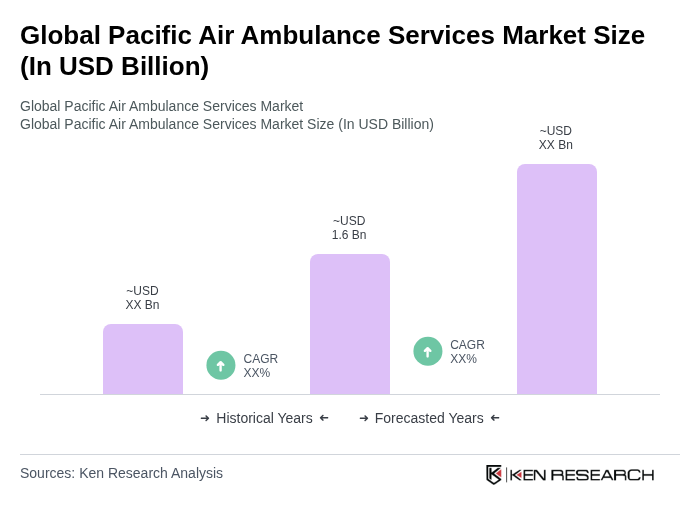
Pacific air ambulance market at $1.6 Bn, driven by accidents and subsidies, with India, Australia, Japan leading.

Region:Global

Author(s):Rebecca

Product Code:KRAB0852

Pages:96

Published On:December 2025
About the Report

Base Year 2024

Global Pacific Air Ambulance Services Market Overview

  • The Global Pacific Air Ambulance Services Market is valued at USD 1.6 billion, based on a five-year historical analysis. This growth is primarily driven by the increasing incidence of road accidents and trauma emergencies in the Asia-Pacific region, coupled with the expansion of private insurance and government subsidies that enhance access to aerial medical services.
  • Key countries dominating the market include India, Australia, and Japan. These nations have established robust healthcare systems and infrastructure that support air ambulance services, particularly in remote and rural areas where ground transportation may be inadequate. The presence of leading air ambulance providers further strengthens their market position.
  • In 2023, the Indian government launched the 'Sanjeevani Yojana,' a free Helicopter Emergency Medical Service initiative aimed at improving emergency response in hilly terrains. This program is designed to provide timely medical assistance within a 150 km radius, significantly enhancing the accessibility of air ambulance services in remote regions.
Global Pacific Air Ambulance Services Market Size

Global Pacific Air Ambulance Services Market Segmentation

By Type:The air ambulance services market is segmented into various types, including Fixed-Wing Aircraft, Helicopters, Specialty Aircraft, and Others. Among these, helicopters are the most widely used due to their ability to access remote locations quickly and efficiently, making them the preferred choice for emergency medical services. Fixed-wing aircraft are also significant, particularly for longer-distance transfers, while specialty aircraft cater to specific medical needs.
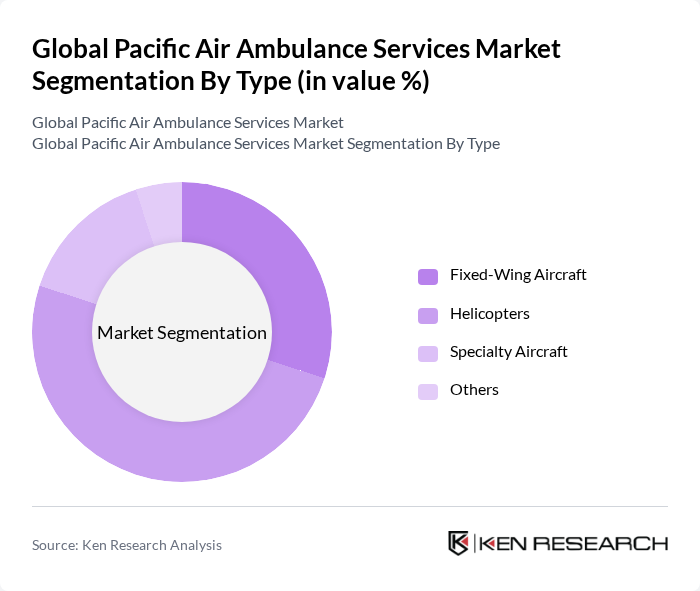
Global Pacific Air Ambulance Services Market segmentation by Type.

By End-User:The end-user segmentation includes Hospitals, Insurance Companies, Government Agencies, Private Individuals, and Others. Hospitals are the leading end-users, as they require rapid patient transport for critical care. Insurance companies also play a significant role by covering air ambulance costs, while government agencies are increasingly investing in air medical services to enhance public health response capabilities.
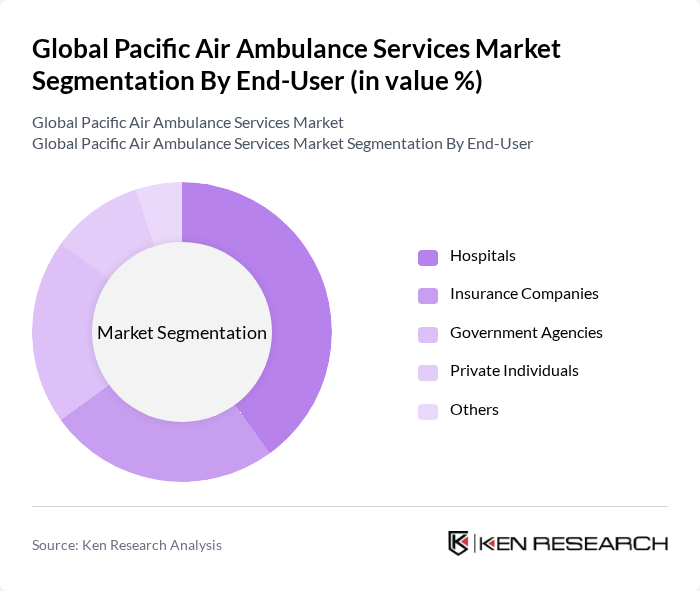
Global Pacific Air Ambulance Services Market segmentation by End-User.

Global Pacific Air Ambulance Services Market Competitive Landscape

The Global Pacific Air Ambulance Services Market is characterized by a dynamic mix of regional and international players. Leading participants such as Air Methods Corporation, PHI Air Medical, Air Ambulance Worldwide, Med-Trans Corporation, REVA Air Ambulance, Global Medical Response, Lifeguard Ambulance Service, Air Ambulance Network, Air Rescue, SkyHealth, AirMed International, Air Ambulance Services, Inc., MedFlight, and AirLink contribute to innovation, geographic expansion, and service delivery in this space.

Air Methods Corporation

1982

Englewood, Colorado, USA

PHI Air Medical

1949

Lake Charles, Louisiana, USA

Air Ambulance Worldwide

2004

Fort Lauderdale, Florida, USA

Med-Trans Corporation

1982

Dallas, Texas, USA

REVA Air Ambulance

2006

Fort Lauderdale, Florida, USA

Company

Establishment Year

Headquarters

Group Size (Large, Medium, or Small as per industry convention)

Revenue Growth Rate

Customer Retention Rate

Average Response Time

Fleet Utilization Rate

Pricing Strategy

Global Pacific Air Ambulance Services Market Industry Analysis

Growth Drivers

  • Regional Economic Growth in East Asia & Pacific:The GDP of the East Asia & Pacific region reached USD 32.12 trillion in future, with a per capita GDP of USD 13,500. This robust economic output supports increased investments in emergency healthcare infrastructure, including air ambulance services. As healthcare spending rises, the demand for efficient emergency medical services is expected to grow, driving the air ambulance market forward. Source: World Bank ((https://data.worldbank.org/country/Z4?utm_source=openai)).
  • Urbanization and Megacity Expansion:Currently, 46% of the global population resides in urban areas, with the number of megacities (?10 million residents) projected to reach 34 by future, over half of which are in Asia. This urbanization leads to increased traffic congestion and geographic challenges, necessitating rapid-response air ambulance services to ensure timely medical assistance. Source: UN DESA ((https://www.un.org/sustainabledevelopment/blog/2025/11/press-release-wup2025/?utm_source=openai)).
  • Rising Average Wages in Asia-Pacific:The average wage across Asian economies was USD 12,500 in future (market exchange rate) and USD 24,000 in purchasing power parity (PPP) terms. As income levels rise, individuals are more likely to afford premium healthcare services, including air ambulance transport, thereby increasing market demand. Source: OECD ((https://www.oecd-ilibrary.org/en/publications/pensions-at-a-glance-asia-pacific-2024_d4146d12-en/full-report/average-wage_8131a99a.html?utm_source=openai)).

Market Challenges

  • Slowing Regional Economic Growth:The growth rate in East Asia & Pacific is projected at 4.5% in future, down from 5.1% in previous, while Pacific Island countries are expected to grow at 3.7%. This deceleration in economic expansion may limit both public and private sector investments in air ambulance infrastructure and operations, posing a significant challenge to market growth. Source: World Bank ((https://www.worldbank.org/en/news/press-release/2024/10/07/east-asia-and-pacific-resilient-growth-in-turbulent-times?utm_source=openai)).
  • Funding Shortfalls for Infrastructure and Climate Resilience:The Asia-Pacific region requires between USD 105 billion and USD 440 billion annually from future to future for climate adaptation, yet only USD 36 billion was committed in previous. This funding gap may lead to prioritization of climate and basic infrastructure projects over investments in air ambulance services, hindering market development. Source: Asian Development Bank via FT ((https://www.ft.com/content/980b037b-05ed-44f6-9bd3-8fbe5a216e10?utm_source=openai)).

Global Pacific Air Ambulance Services Market Future Outlook

The future of the air ambulance services market in the Asia-Pacific region appears promising, driven by technological advancements and increasing healthcare demands. The adoption of electric vertical takeoff and landing (eVTOL) aircraft is expected to enhance service efficiency, while the integration of drones for medical transport can significantly improve response times in remote areas. As urbanization continues and healthcare needs grow, the air ambulance sector is poised for substantial transformation and expansion.

Market Opportunities

  • Rapid Expansion in Asia-Pacific Region:The air ambulance services market in Asia-Pacific generated USD 2,000 million in previous and is projected to reach USD 4,500 million by future. This rapid growth presents significant opportunities for service providers looking to expand their operations in this lucrative market. Source: Grand View Research ((https://www.grandviewresearch.com/horizon/outlook/air-ambulance-services-market/asia-pacific?utm_source=openai)).
  • Untapped Rural and Island Coverage:The Asia-Pacific region includes many developing and island nations with growing tourism and remote populations. Providing air ambulance services in underserved areas, particularly in Pacific Islands growing at 3.7%, represents a scalable opportunity for market players to enhance healthcare access. Source: World Bank and Grand View Research ((https://www.worldbank.org/en/news/press-release/2024/10/07/east-asia-and-pacific-resilient-growth-in-turbulent-times?utm_source=openai)).

Scope of the Report

SegmentSub-Segments
By Type

Fixed-Wing Aircraft

Helicopters

Specialty Aircraft

Others

By End-User

Hospitals

Insurance Companies

Government Agencies

Private Individuals

Others

By Service Type

Emergency Medical Services

Non-Emergency Medical Transport

Inter-facility Transfers

Others

By Region

North America

Europe

Asia-Pacific

Latin America

Middle East & Africa

By Aircraft Size

Small Aircraft

Medium Aircraft

Large Aircraft

Others

By Payload Capacity

Up to 1,000 lbs

,001 to 2,500 lbs

,501 to 5,000 lbs

Others

By Service Duration

Short-term Services

Long-term Services

Others

Key Target Audience

Investors and Venture Capitalist Firms

Government and Regulatory Bodies (e.g., Federal Aviation Administration, National Transportation Safety Board)

Air Ambulance Service Providers

Healthcare Providers and Hospitals

Insurance Companies

Emergency Medical Services (EMS) Organizations

Aircraft Manufacturers and Suppliers

Logistics and Transportation Companies

Players Mentioned in the Report:

Air Methods Corporation

PHI Air Medical

Air Ambulance Worldwide

Med-Trans Corporation

REVA Air Ambulance

Global Medical Response

Lifeguard Ambulance Service

Air Ambulance Network

Air Rescue

SkyHealth

AirMed International

Air Ambulance Services, Inc.

MedFlight

AirLink

Guardian Flight

Table of Contents

Market Assessment Phase

1. Executive Summary and Approach


2. Global Pacific Air Ambulance Services Market Overview

2.1 Key Insights and Strategic Recommendations

2.2 Global Pacific Air Ambulance Services Market Overview

2.3 Definition and Scope

2.4 Evolution of Market Ecosystem

2.5 Timeline of Key Regulatory Milestones

2.6 Value Chain & Stakeholder Mapping

2.7 Business Cycle Analysis

2.8 Policy & Incentive Landscape


3. Global Pacific Air Ambulance Services Market Analysis

3.1 Growth Drivers

3.1.1 Increasing demand for emergency medical services
3.1.2 Advancements in aviation technology
3.1.3 Rising healthcare expenditure
3.1.4 Expansion of healthcare infrastructure in remote areas

3.2 Market Challenges

3.2.1 High operational costs
3.2.2 Regulatory compliance issues
3.2.3 Limited availability of trained personnel
3.2.4 Competition from ground ambulance services

3.3 Market Opportunities

3.3.1 Growth in medical tourism
3.3.2 Partnerships with hospitals and healthcare providers
3.3.3 Technological innovations in air ambulance services
3.3.4 Expansion into underserved regions

3.4 Market Trends

3.4.1 Increasing use of telemedicine in air ambulances
3.4.2 Integration of drones for medical transport
3.4.3 Focus on patient-centric services
3.4.4 Adoption of eco-friendly aircraft

3.5 Government Regulation

3.5.1 Licensing and certification requirements
3.5.2 Airspace regulations
3.5.3 Health and safety standards
3.5.4 Insurance and liability regulations

4. SWOT Analysis


5. Stakeholder Analysis


6. Porter's Five Forces Analysis


7. Global Pacific Air Ambulance Services Market Market Size, 2019-2024

7.1 By Value

7.2 By Volume

7.3 By Average Selling Price


8. Global Pacific Air Ambulance Services Market Segmentation

8.1 By Type

8.1.1 Fixed-Wing Aircraft
8.1.2 Helicopters
8.1.3 Specialty Aircraft
8.1.4 Others

8.2 By End-User

8.2.1 Hospitals
8.2.2 Insurance Companies
8.2.3 Government Agencies
8.2.4 Private Individuals
8.2.5 Others

8.3 By Service Type

8.3.1 Emergency Medical Services
8.3.2 Non-Emergency Medical Transport
8.3.3 Inter-facility Transfers
8.3.4 Others

8.4 By Region

8.4.1 North America
8.4.2 Europe
8.4.3 Asia-Pacific
8.4.4 Latin America
8.4.5 Middle East & Africa

8.5 By Aircraft Size

8.5.1 Small Aircraft
8.5.2 Medium Aircraft
8.5.3 Large Aircraft
8.5.4 Others

8.6 By Payload Capacity

8.6.1 Up to 1,000 lbs
8.6.2 1,001 to 2,500 lbs
8.6.3 2,501 to 5,000 lbs
8.6.4 Others

8.7 By Service Duration

8.7.1 Short-term Services
8.7.2 Long-term Services
8.7.3 Others

9. Global Pacific Air Ambulance Services Market Competitive Analysis

9.1 Market Share of Key Players

9.2 Cross Comparison of Key Players

9.2.1 Company Name
9.2.2 Group Size (Large, Medium, or Small as per industry convention)
9.2.3 Revenue Growth Rate
9.2.4 Customer Retention Rate
9.2.5 Average Response Time
9.2.6 Fleet Utilization Rate
9.2.7 Pricing Strategy
9.2.8 Service Expansion Rate
9.2.9 Patient Satisfaction Score
9.2.10 Operational Efficiency Ratio

9.3 SWOT Analysis of Top Players

9.4 Pricing Analysis

9.5 Detailed Profile of Major Companies

9.5.1 Air Methods Corporation
9.5.2 PHI Air Medical
9.5.3 Air Ambulance Worldwide
9.5.4 Med-Trans Corporation
9.5.5 REVA Air Ambulance
9.5.6 Global Medical Response
9.5.7 Lifeguard Ambulance Service
9.5.8 Air Ambulance Network
9.5.9 Air Rescue
9.5.10 SkyHealth
9.5.11 AirMed International
9.5.12 Air Ambulance Services, Inc.
9.5.13 MedFlight
9.5.14 AirLink
9.5.15 Guardian Flight

10. Global Pacific Air Ambulance Services Market End-User Analysis

10.1 Procurement Behavior of Key Ministries

10.1.1 Budget Allocation Trends
10.1.2 Decision-Making Processes
10.1.3 Contracting Preferences
10.1.4 Evaluation Criteria

10.2 Corporate Spend on Infrastructure & Energy

10.2.1 Investment Trends in Air Ambulance Services
10.2.2 Budgeting for Emergency Services
10.2.3 Cost-Benefit Analysis
10.2.4 Funding Sources

10.3 Pain Point Analysis by End-User Category

10.3.1 Challenges Faced by Hospitals
10.3.2 Issues for Insurance Companies
10.3.3 Concerns of Government Agencies
10.3.4 Needs of Private Individuals

10.4 User Readiness for Adoption

10.4.1 Awareness Levels
10.4.2 Training Requirements
10.4.3 Infrastructure Readiness
10.4.4 Financial Preparedness

10.5 Post-Deployment ROI and Use Case Expansion

10.5.1 Measurement of ROI
10.5.2 Case Studies of Successful Deployments
10.5.3 Expansion Opportunities
10.5.4 Long-term Benefits Analysis

11. Global Pacific Air Ambulance Services Market Future Size, 2025-2030

11.1 By Value

11.2 By Volume

11.3 By Average Selling Price


Go-To-Market Strategy Phase

1. Whitespace Analysis + Business Model Canvas

1.1 Market Gaps Identification

1.2 Business Model Framework


2. Marketing and Positioning Recommendations

2.1 Branding Strategies

2.2 Product USPs


3. Distribution Plan

3.1 Urban Retail vs Rural NGO Tie-ups


4. Channel & Pricing Gaps

4.1 Underserved Routes

4.2 Pricing Bands


5. Unmet Demand & Latent Needs

5.1 Category Gaps

5.2 Consumer Segments


6. Customer Relationship

6.1 Loyalty Programs

6.2 After-sales Service


7. Value Proposition

7.1 Sustainability

7.2 Integrated Supply Chains


8. Key Activities

8.1 Regulatory Compliance

8.2 Branding

8.3 Distribution Setup


9. Entry Strategy Evaluation

9.1 Domestic Market Entry Strategy

9.1.1 Product Mix
9.1.2 Pricing Band
9.1.3 Packaging

9.2 Export Entry Strategy

9.2.1 Target Countries
9.2.2 Compliance Roadmap

10. Entry Mode Assessment

10.1 JV

10.2 Greenfield

10.3 M&A

10.4 Distributor Model


11. Capital and Timeline Estimation

11.1 Capital Requirements

11.2 Timelines


12. Control vs Risk Trade-Off

12.1 Ownership vs Partnerships


13. Profitability Outlook

13.1 Breakeven Analysis

13.2 Long-term Sustainability


14. Potential Partner List

14.1 Distributors

14.2 JVs

14.3 Acquisition Targets


15. Execution Roadmap

15.1 Phased Plan for Market Entry

15.1.1 Market Setup
15.1.2 Market Entry
15.1.3 Growth Acceleration
15.1.4 Scale & Stabilize

15.2 Key Activities and Milestones

15.2.1 Milestone Planning
15.2.2 Activity Scheduling

Research Methodology

ApproachModellingSample

Phase 1: Approach1

Desk Research

  • Analysis of industry reports from aviation and healthcare organizations
  • Review of government publications and regulations related to air ambulance services
  • Examination of market trends and forecasts from reputable market research databases

Primary Research

  • Interviews with executives from air ambulance service providers
  • Surveys targeting healthcare professionals involved in emergency medical services
  • Field interviews with paramedics and flight nurses to gather operational insights

Validation & Triangulation

  • Cross-validation of findings through multiple data sources including industry publications and expert opinions
  • Triangulation of market data with financial performance metrics of key players
  • Sanity checks conducted through expert panel reviews and feedback sessions

Phase 2: Market Size Estimation1

Top-down Assessment

  • Estimation of market size based on national healthcare expenditure and emergency response budgets
  • Segmentation by geographical regions and service types (e.g., fixed-wing vs. rotor-wing)
  • Incorporation of demographic trends influencing demand for air ambulance services

Bottom-up Modeling

  • Collection of operational data from leading air ambulance operators
  • Cost analysis based on service pricing models and operational expenses
  • Volume estimates derived from patient transport statistics and service frequency

Forecasting & Scenario Analysis

  • Multi-factor regression analysis incorporating factors such as population growth and healthcare access
  • Scenario modeling based on potential regulatory changes and technological advancements
  • Development of baseline, optimistic, and pessimistic forecasts through 2030

Phase 3: CATI Sample Composition1

Scope Item/SegmentSample SizeTarget Respondent Profiles
Air Ambulance Service Providers100CEOs, Operations Managers
Healthcare Professionals80Emergency Room Physicians, Paramedics
Insurance Companies60Claims Adjusters, Underwriters
Regulatory Bodies50Policy Makers, Compliance Officers
Patients and Families70Patients who have used air ambulance services, Family Members

Frequently Asked Questions

What is the current value of the Global Pacific Air Ambulance Services Market?

The Global Pacific Air Ambulance Services Market is valued at approximately USD 1.6 billion, reflecting a five-year historical analysis. This growth is largely attributed to the rising incidence of road accidents and trauma emergencies in the Asia-Pacific region.

Which countries are leading in the Global Pacific Air Ambulance Services Market?

What initiatives has the Indian government launched to improve air ambulance services?

What types of aircraft are used in air ambulance services?

Other Adjacent Reports

Saudi Arabia Emergency Medical Services Market Size, Share, Growth Drivers, Trends, Opportunities & Forecast 2025–2030

Indonesia Helicopter Services Market

Oman Fixed-Wing Aircraft Market

Philippines Insurance Services Market

Bahrain Healthcare Infrastructure Market

UAE Medical Transport Market

Indonesia Remote Healthcare Services Market

Mexico Government Health Initiatives Market

Malaysia Private Healthcare Market

Uae Urban Air Mobility Market Report Size, Share, Growth Drivers, Trends, Opportunities & Forecast 2025–2030

Why Buy From Us?

Refine Robust Result (RRR) Framework

What makes us stand out is that our consultants follow Robust, Refine and Result (RRR) methodology. Robust for clear definitions, approaches and sanity checking, Refine for differentiating respondents' facts and opinions, and Result for presenting data with story.

Our Reach Is Unmatched

We have set a benchmark in the industry by offering our clients with syndicated and customized market research reports featuring coverage of entire market as well as meticulous research and analyst insights.

Shifting the Research Paradigm

While we don't replace traditional research, we flip the method upside down. Our dual approach of Top Bottom & Bottom Top ensures quality deliverable by not just verifying company fundamentals but also looking at the sector and macroeconomic factors.

More Insights-Better Decisions

With one step in the future, our research team constantly tries to show you the bigger picture. We help with some of the tough questions you may encounter along the way: How is the industry positioned? Best marketing channel? KPI's of competitors? By aligning every element, we help maximize success.

Transparency and Trust

Our report gives you instant access to the answers and sources that other companies might choose to hide. We elaborate each steps of research methodology we have used and showcase you the sample size to earn your trust.

Round the Clock Support

If you need any support, we are here! We pride ourselves on universe strength, data quality, and quick, friendly, and professional service.

Why Clients Choose Us?

400000+
Reports in repository
150+
Consulting projects a year
100+
Analysts
8000+
Client Queries in 2022








