About the Report
Base Year 2024Global Rocket Propulsion Systems Market Overview
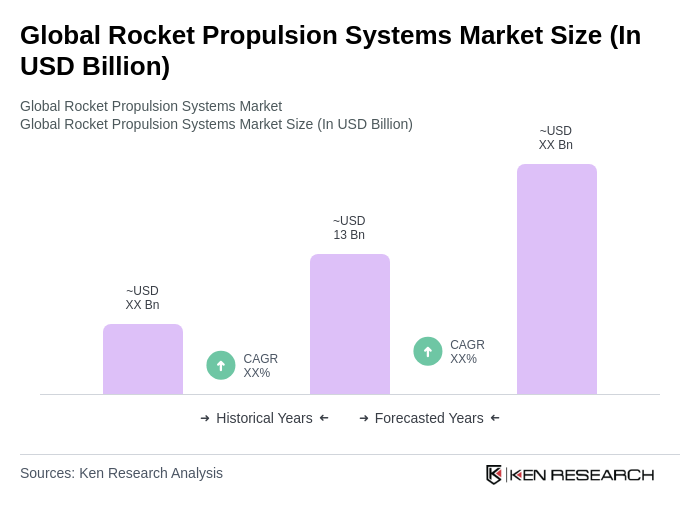
- The Global Rocket Propulsion Systems Market is valued at USD 13 billion, based on a five-year historical analysis. This growth is primarily driven by increasing investments in space exploration, advancements in propulsion technologies, and the rising demand for satellite launches. The market has seen a surge in commercial space activities, leading to a robust demand for efficient and reliable propulsion systems .
- Key players in this market include the United States, Russia, and China, which dominate due to their extensive government-backed space programs and significant investments in research and development. The presence of leading aerospace companies and a strong industrial base in these countries further solidifies their position in the global market .
- In 2023, the U.S. government implemented the Space Policy Directive-1, issued by the Executive Office of the President. This directive emphasizes the nation's leadership in space exploration and the importance of developing advanced propulsion systems for deep space missions, fostering innovation and collaboration among private and public sectors in the rocket propulsion industry .
Global Rocket Propulsion Systems Market Segmentation
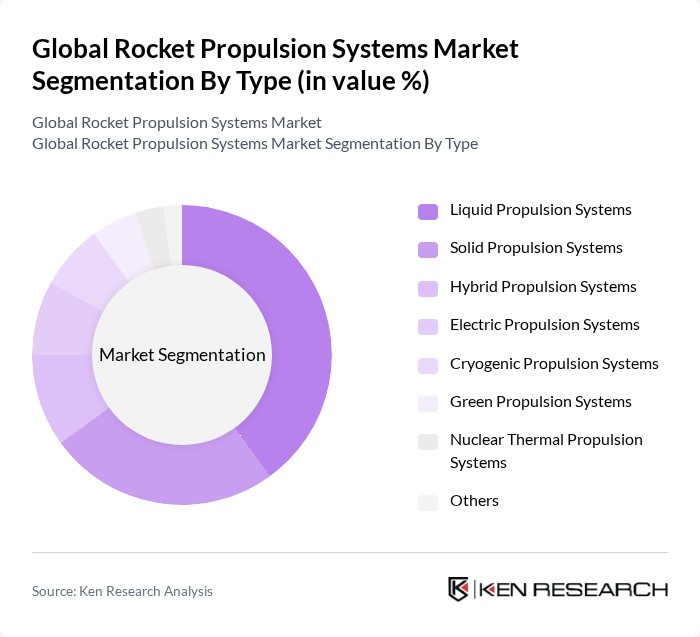
By Type:The market is segmented into various types of propulsion systems, including Liquid Propulsion Systems, Solid Propulsion Systems, Hybrid Propulsion Systems, Electric Propulsion Systems, Cryogenic Propulsion Systems, Green Propulsion Systems, Nuclear Thermal Propulsion Systems, and Others. Among these, Liquid Propulsion Systems dominate the market due to their high efficiency and reliability, making them the preferred choice for most space missions. Solid Propulsion Systems also hold a significant share, particularly in military applications, due to their simplicity and robustness .
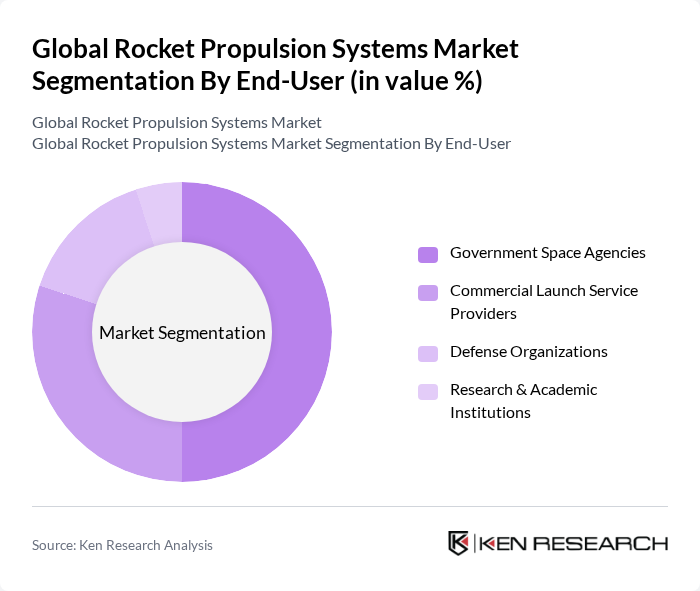
By End-User:The end-user segmentation includes Government Space Agencies, Commercial Launch Service Providers, Defense Organizations, and Research & Academic Institutions. Government Space Agencies are the leading end-users, driven by national space exploration initiatives and funding. Commercial Launch Service Providers are also growing rapidly, fueled by the increasing demand for satellite launches and space tourism, while Defense Organizations utilize propulsion systems for military applications .
Global Rocket Propulsion Systems Market Competitive Landscape
The Global Rocket Propulsion Systems Market is characterized by a dynamic mix of regional and international players. Leading participants such as SpaceX, Blue Origin, Northrop Grumman, The Boeing Company, Lockheed Martin Corporation, Rocket Lab USA, Inc., Arianespace SA, Virgin Galactic Holdings, Inc., Sierra Space (Sierra Nevada Corporation), Relativity Space, Inc., Thales Alenia Space, Mitsubishi Heavy Industries, Ltd., IHI Corporation, Indian Space Research Organisation (ISRO), European Space Agency (ESA), Aerojet Rocketdyne Holdings, Inc., Safran S.A., Avio S.p.A. contribute to innovation, geographic expansion, and service delivery in this space.
Global Rocket Propulsion Systems Market Industry Analysis
Growth Drivers
- Increasing Demand for Satellite Launches:The global satellite launch market is projected to reach approximately 3,000 satellite launches in future, driven by the growing need for communication, Earth observation, and scientific research. The demand for small satellites, which accounted for 60% of launches in future, is expected to further boost the rocket propulsion systems market. This surge is supported by a projected increase in global space budgets, which are estimated to exceed $110 billion in future, enhancing launch capabilities.
- Advancements in Propulsion Technology:The propulsion technology landscape is evolving rapidly, with investments in innovative systems such as electric and hybrid propulsion. In future, the global investment in propulsion technology is expected to surpass $18 billion, reflecting a 20% increase from previous periods. These advancements are crucial for improving efficiency and reducing costs, as new technologies can enhance payload capacity and reduce launch times, making space more accessible for various applications.
- Growth in Space Exploration Initiatives:The global space exploration budget is projected to reach $35 billion in future, driven by national space agencies and private sector investments. Notable missions, such as NASA's Artemis program aiming for lunar exploration, are expected to catalyze demand for advanced rocket propulsion systems. This growth is further supported by international collaborations, with over 60 countries actively participating in space exploration initiatives, thereby expanding the market for propulsion technologies.
Market Challenges
- High Development and Operational Costs:The development of rocket propulsion systems involves significant financial investment, with costs often exceeding $600 million per project. In future, operational costs for launching a single rocket are expected to average around $160 million, which poses a barrier for new entrants and smaller companies. These high costs can limit the number of launches and slow down innovation, impacting overall market growth and accessibility.
- Stringent Regulatory Requirements:The rocket propulsion industry faces complex regulatory frameworks that vary by country, often leading to delays and increased costs. In future, compliance with international treaties and national security regulations is expected to require an average of 20 months for launch licensing. This regulatory burden can hinder the speed of market entry for new technologies and companies, creating a challenging environment for innovation and competition.
Global Rocket Propulsion Systems Market Future Outlook
The future of the rocket propulsion systems market appears promising, driven by technological advancements and increasing global investments in space initiatives. As countries and private companies ramp up their space exploration efforts, the demand for innovative propulsion solutions will likely rise. Additionally, the integration of sustainable practices and the development of reusable systems are expected to reshape the industry landscape, making space more accessible and cost-effective for a broader range of applications.
Market Opportunities
- Expansion of Commercial Space Travel:The commercial space travel sector is projected to grow significantly, with an estimated market value of $6 billion in future. This growth presents opportunities for propulsion system manufacturers to develop specialized technologies tailored for suborbital and orbital flights, catering to a new demographic of space tourists and researchers.
- Development of Reusable Rocket Systems:The push for sustainability in space travel is driving the development of reusable rocket systems, which can reduce launch costs by up to 35%. In future, companies focusing on reusability are expected to capture a significant share of the market, as they offer a more economical and environmentally friendly alternative to traditional launch methods.
Scope of the Report
| Segment | Sub-Segments |
|---|---|
| By Type | Liquid Propulsion Systems Solid Propulsion Systems Hybrid Propulsion Systems Electric Propulsion Systems Cryogenic Propulsion Systems Green Propulsion Systems Nuclear Thermal Propulsion Systems Others |
| By End-User | Government Space Agencies Commercial Launch Service Providers Defense Organizations Research & Academic Institutions |
| By Application | Satellite Launching Interplanetary Missions Space Tourism Cargo Resupply Missions Suborbital Flights |
| By Component | Engines & Thrusters Propellant Tanks & Feed Systems Control & Guidance Systems Structural Components Avionics |
| By Distribution Mode | Direct Contracts Online Tenders & Procurement Distributors & Integrators |
| By Investment Source | Private Investments Government Funding Public-Private Partnerships |
| By Policy Support | Government Subsidies Tax Incentives Research Grants Regulatory Support |
Key Target Audience
Investors and Venture Capitalist Firms
Government and Regulatory Bodies (e.g., NASA, European Space Agency)
Manufacturers and Producers of Rocket Propulsion Systems
Aerospace and Defense Contractors
Space Exploration Agencies (e.g., ISRO, Roscosmos)
Military and Defense Organizations
Space Technology Startups
Financial Institutions and Investment Banks
Players Mentioned in the Report:
SpaceX
Blue Origin
Northrop Grumman
The Boeing Company
Lockheed Martin Corporation
Rocket Lab USA, Inc.
Arianespace SA
Virgin Galactic Holdings, Inc.
Sierra Space (Sierra Nevada Corporation)
Relativity Space, Inc.
Thales Alenia Space
Mitsubishi Heavy Industries, Ltd.
IHI Corporation
Indian Space Research Organisation (ISRO)
European Space Agency (ESA)
Aerojet Rocketdyne Holdings, Inc.
Safran S.A.
Avio S.p.A.
Table of Contents
Market Assessment Phase
1. Executive Summary and Approach
2. Global Rocket Propulsion Systems Market Overview
2.1 Key Insights and Strategic Recommendations
2.2 Global Rocket Propulsion Systems Market Overview
2.3 Definition and Scope
2.4 Evolution of Market Ecosystem
2.5 Timeline of Key Regulatory Milestones
2.6 Value Chain & Stakeholder Mapping
2.7 Business Cycle Analysis
2.8 Policy & Incentive Landscape
3. Global Rocket Propulsion Systems Market Analysis
3.1 Growth Drivers
3.1.1 Increasing demand for satellite launches
3.1.2 Advancements in propulsion technology
3.1.3 Growth in space exploration initiatives
3.1.4 Rising investments in defense and aerospace sectors
3.2 Market Challenges
3.2.1 High development and operational costs
3.2.2 Stringent regulatory requirements
3.2.3 Limited availability of skilled workforce
3.2.4 Environmental concerns regarding rocket emissions
3.3 Market Opportunities
3.3.1 Expansion of commercial space travel
3.3.2 Development of reusable rocket systems
3.3.3 Collaborations with private sector companies
3.3.4 Emerging markets investing in space technology
3.4 Market Trends
3.4.1 Increasing focus on sustainability in propulsion systems
3.4.2 Integration of AI and automation in rocket design
3.4.3 Growth of small satellite launch services
3.4.4 Partnerships between government and private entities
3.5 Government Regulation
3.5.1 International treaties on space activities
3.5.2 National security regulations for launch operations
3.5.3 Environmental regulations on rocket emissions
3.5.4 Licensing requirements for commercial launches
4. SWOT Analysis
5. Stakeholder Analysis
6. Porter's Five Forces Analysis
7. Global Rocket Propulsion Systems Market Market Size, 2019-2024
7.1 By Value
7.2 By Volume
7.3 By Average Selling Price
8. Global Rocket Propulsion Systems Market Segmentation
8.1 By Type
8.1.1 Liquid Propulsion Systems
8.1.2 Solid Propulsion Systems
8.1.3 Hybrid Propulsion Systems
8.1.4 Electric Propulsion Systems
8.1.5 Cryogenic Propulsion Systems
8.1.6 Green Propulsion Systems
8.1.7 Nuclear Thermal Propulsion Systems
8.1.8 Others
8.2 By End-User
8.2.1 Government Space Agencies
8.2.2 Commercial Launch Service Providers
8.2.3 Defense Organizations
8.2.4 Research & Academic Institutions
8.3 By Application
8.3.1 Satellite Launching
8.3.2 Interplanetary Missions
8.3.3 Space Tourism
8.3.4 Cargo Resupply Missions
8.3.5 Suborbital Flights
8.4 By Component
8.4.1 Engines & Thrusters
8.4.2 Propellant Tanks & Feed Systems
8.4.3 Control & Guidance Systems
8.4.4 Structural Components
8.4.5 Avionics
8.5 By Distribution Mode
8.5.1 Direct Contracts
8.5.2 Online Tenders & Procurement
8.5.3 Distributors & Integrators
8.6 By Investment Source
8.6.1 Private Investments
8.6.2 Government Funding
8.6.3 Public-Private Partnerships
8.7 By Policy Support
8.7.1 Government Subsidies
8.7.2 Tax Incentives
8.7.3 Research Grants
8.7.4 Regulatory Support
9. Global Rocket Propulsion Systems Market Competitive Analysis
9.1 Market Share of Key Players
9.2 Cross Comparison of Key Players
9.2.1 Company Name
9.2.2 Group Size (Large, Medium, or Small as per industry convention)
9.2.3 Annual Revenue (USD)
9.2.4 Revenue Growth Rate (%)
9.2.5 Number of Launches per Year
9.2.6 Market Penetration (Global/Regional)
9.2.7 R&D Investment as % of Revenue
9.2.8 Launch Success Rate (%)
9.2.9 Propulsion Technology Portfolio Breadth
9.2.10 Strategic Partnerships & Alliances
9.2.11 Patent Portfolio Size
9.2.12 Production Capacity (Units/Year)
9.2.13 Supply Chain Reliability
9.2.14 ESG/Sustainability Initiatives
9.3 SWOT Analysis of Top Players
9.4 Pricing Analysis
9.5 Detailed Profile of Major Companies
9.5.1 SpaceX
9.5.2 Blue Origin
9.5.3 Northrop Grumman
9.5.4 The Boeing Company
9.5.5 Lockheed Martin Corporation
9.5.6 Rocket Lab USA, Inc.
9.5.7 Arianespace SA
9.5.8 Virgin Galactic Holdings, Inc.
9.5.9 Sierra Space (Sierra Nevada Corporation)
9.5.10 Relativity Space, Inc.
9.5.11 Thales Alenia Space
9.5.12 Mitsubishi Heavy Industries, Ltd.
9.5.13 IHI Corporation
9.5.14 Indian Space Research Organisation (ISRO)
9.5.15 European Space Agency (ESA)
9.5.16 Aerojet Rocketdyne Holdings, Inc.
9.5.17 Safran S.A.
9.5.18 Avio S.p.A.
10. Global Rocket Propulsion Systems Market End-User Analysis
10.1 Procurement Behavior of Key Ministries
10.1.1 Defense Ministry
10.1.2 Space Agency
10.1.3 Research and Development Departments
10.2 Corporate Spend on Infrastructure & Energy
10.2.1 Investment in Launch Facilities
10.2.2 Funding for R&D in Propulsion Technologies
10.2.3 Expenditure on Safety and Compliance
10.3 Pain Point Analysis by End-User Category
10.3.1 Budget Constraints
10.3.2 Technical Challenges in Development
10.3.3 Regulatory Compliance Issues
10.4 User Readiness for Adoption
10.4.1 Awareness of New Technologies
10.4.2 Training and Skill Development Needs
10.5 Post-Deployment ROI and Use Case Expansion
10.5.1 Performance Metrics Evaluation
10.5.2 Opportunities for Upgrades
10.5.3 Expansion into New Markets
11. Global Rocket Propulsion Systems Market Future Size, 2025-2030
11.1 By Value
11.2 By Volume
11.3 By Average Selling Price
Go-To-Market Strategy Phase
1. Whitespace Analysis + Business Model Canvas
1.1 Market Gaps Identification
1.2 Value Proposition Development
1.3 Revenue Streams Analysis
1.4 Cost Structure Evaluation
1.5 Key Partnerships Exploration
1.6 Customer Segmentation
1.7 Competitive Advantage Assessment
2. Marketing and Positioning Recommendations
2.1 Branding Strategies
2.2 Product USPs
3. Distribution Plan
3.1 Urban Retail Strategies
3.2 Rural NGO Tie-ups
4. Channel & Pricing Gaps
4.1 Underserved Routes
4.2 Pricing Bands Analysis
5. Unmet Demand & Latent Needs
5.1 Category Gaps
5.2 Consumer Segments
6. Customer Relationship
6.1 Loyalty Programs
6.2 After-sales Service
7. Value Proposition
7.1 Sustainability Initiatives
7.2 Integrated Supply Chains
8. Key Activities
8.1 Regulatory Compliance
8.2 Branding Efforts
8.3 Distribution Setup
9. Entry Strategy Evaluation
9.1 Domestic Market Entry Strategy
9.1.1 Product Mix Considerations
9.1.2 Pricing Band Strategy
9.1.3 Packaging Solutions
9.2 Export Entry Strategy
9.2.1 Target Countries Identification
9.2.2 Compliance Roadmap Development
10. Entry Mode Assessment
10.1 Joint Ventures
10.2 Greenfield Investments
10.3 Mergers & Acquisitions
10.4 Distributor Model Evaluation
11. Capital and Timeline Estimation
11.1 Capital Requirements
11.2 Timelines for Implementation
12. Control vs Risk Trade-Off
12.1 Ownership Considerations
12.2 Partnerships Evaluation
13. Profitability Outlook
13.1 Breakeven Analysis
13.2 Long-term Sustainability Strategies
14. Potential Partner List
14.1 Distributors
14.2 Joint Ventures
14.3 Acquisition Targets
15. Execution Roadmap
15.1 Phased Plan for Market Entry
15.1.1 Market Setup
15.1.2 Market Entry
15.1.3 Growth Acceleration
15.1.4 Scale & Stabilize
15.2 Key Activities and Milestones
15.2.1 Milestone Planning
15.2.2 Activity Tracking
Research Methodology
Phase 1: Approach1
Desk Research
- Analysis of industry reports from space agencies and aerospace organizations
- Review of academic publications and white papers on rocket propulsion technologies
- Examination of market trends and forecasts from aerospace market research firms
Primary Research
- Interviews with propulsion engineers and R&D heads at leading aerospace companies
- Surveys with procurement managers in the aerospace and defense sectors
- Field interviews with experts in propulsion system testing and validation
Validation & Triangulation
- Cross-validation of findings through multiple industry expert interviews
- Triangulation of data from market reports, expert insights, and historical trends
- Sanity checks through peer reviews and feedback from industry panels
Phase 2: Market Size Estimation1
Top-down Assessment
- Estimation of market size based on global aerospace spending and satellite launches
- Segmentation by propulsion type (liquid, solid, hybrid) and application (commercial, military, research)
- Incorporation of government space exploration budgets and initiatives
Bottom-up Modeling
- Volume estimates derived from production data of major rocket manufacturers
- Cost analysis based on component pricing and assembly costs for propulsion systems
- Calculation of market size using unit sales multiplied by average selling prices
Forecasting & Scenario Analysis
- Multi-variable regression analysis incorporating technological advancements and market demand
- Scenario modeling based on geopolitical factors and international space treaties
- Baseline, optimistic, and pessimistic forecasts through 2035
Phase 3: CATI Sample Composition1
| Scope Item/Segment | Sample Size | Target Respondent Profiles |
|---|---|---|
| Commercial Rocket Propulsion | 100 | Propulsion Engineers, Product Managers |
| Military Propulsion Systems | 70 | Defense Contractors, Program Managers |
| Research and Development in Propulsion | 60 | R&D Directors, Aerospace Researchers |
| Satellite Launch Services | 80 | Operations Managers, Launch Coordinators |
| Emerging Propulsion Technologies | 50 | Innovation Officers, Technology Analysts |
Frequently Asked Questions
What is the current value of the Global Rocket Propulsion Systems Market?
The Global Rocket Propulsion Systems Market is valued at approximately USD 13 billion, driven by increased investments in space exploration, advancements in propulsion technologies, and a growing demand for satellite launches.
What are the main types of rocket propulsion systems?
Who are the key players in the Global Rocket Propulsion Systems Market?
What factors are driving growth in the rocket propulsion systems market?
Other Regional/Country Reports
Indonesia Rocket Propulsion Systems Market
Malaysia Rocket Propulsion Systems Market
APAC Rocket Propulsion Systems Market
SEA Rocket Propulsion Systems Market
Other Adjacent Reports
Belgium Aerospace Materials Market
Bahrain Defense Missile Systems Market
Qatar space tourism market report Size, Share, Growth Drivers, Trends, Opportunities & Forecast 2025–2030Qatar Electric Propulsion Systems Market
Belgium Hypersonic Technology Market
Singapore Reusable Launch Vehicle Market
Vietnam Avionics Systems Market
South Korea Space Exploration Equipment Market
Why Buy From Us?

What makes us stand out is that our consultants follow Robust, Refine and Result (RRR) methodology. Robust for clear definitions, approaches and sanity checking, Refine for differentiating respondents' facts and opinions, and Result for presenting data with story.

We have set a benchmark in the industry by offering our clients with syndicated and customized market research reports featuring coverage of entire market as well as meticulous research and analyst insights.

While we don't replace traditional research, we flip the method upside down. Our dual approach of Top Bottom & Bottom Top ensures quality deliverable by not just verifying company fundamentals but also looking at the sector and macroeconomic factors.

With one step in the future, our research team constantly tries to show you the bigger picture. We help with some of the tough questions you may encounter along the way: How is the industry positioned? Best marketing channel? KPI's of competitors? By aligning every element, we help maximize success.

Our report gives you instant access to the answers and sources that other companies might choose to hide. We elaborate each steps of research methodology we have used and showcase you the sample size to earn your trust.

If you need any support, we are here! We pride ourselves on universe strength, data quality, and quick, friendly, and professional service.