About the Report
Base Year 2024Listen to the audio summary
Qatar Space Tourism Market Overview
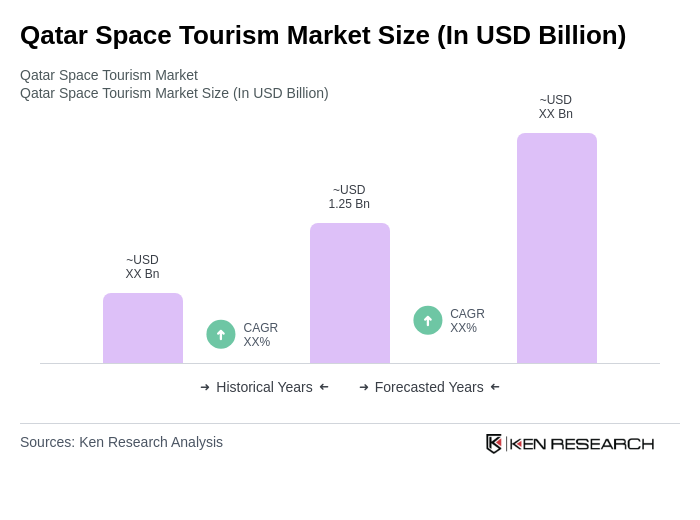
- The Qatar Space Tourism Market is valued at USD 1.25 billion, based on a five-year historical analysis. This figure aligns with the latest available global and regional market estimates for space tourism, reflecting robust growth driven by increasing investments in space technology, rising interest in space exploration, and the emergence of private spaceflight companies. The market continues to see heightened demand for unique travel experiences, especially among affluent consumers seeking adventure and novelty .
- Key players in this market include the United States, Russia, and China, which maintain dominance due to their advanced space programs and substantial investments in space tourism infrastructure. Qatar is emerging as a competitive player, leveraging its strategic location, government-backed investments in space technology, and partnerships with international space agencies to attract tourists and businesses in the space sector .
- In 2023, Qatar's government introduced the “Qatar Space Activities Licensing and Safety Framework, 2023” issued by the Ministry of Transport and Communications. This regulation establishes a licensing system for space tourism operators, sets mandatory safety standards, and defines operational compliance requirements for commercial spaceflight activities. The framework aims to position Qatar as a leading destination for space tourism in the MENA region, fostering innovation and attracting international investment .
Qatar Space Tourism Market Segmentation
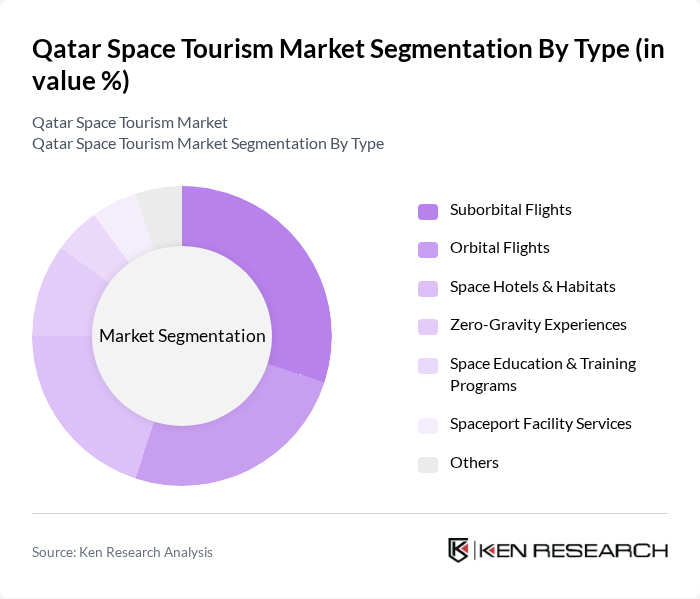
By Type:The segmentation by type includes subsegments such as Suborbital Flights, Orbital Flights, Space Hotels & Habitats, Zero-Gravity Experiences, Space Education & Training Programs, Spaceport Facility Services, and Others. Suborbital Flights offer brief journeys to the edge of space, providing passengers with several minutes of weightlessness and panoramic views of Earth. Orbital Flights involve longer missions that circle the planet, often including stays at orbital habitats or stations. Space Hotels & Habitats are under development to provide extended stays and leisure experiences in orbit. Zero-Gravity Experiences deliver short-duration microgravity environments, typically via parabolic flights. Space Education & Training Programs focus on astronaut training, STEM outreach, and experiential learning. Spaceport Facility Services encompass ground-based infrastructure, logistics, and support for launches and landings. The 'Others' category includes emerging concepts such as lunar excursions and deep space missions .
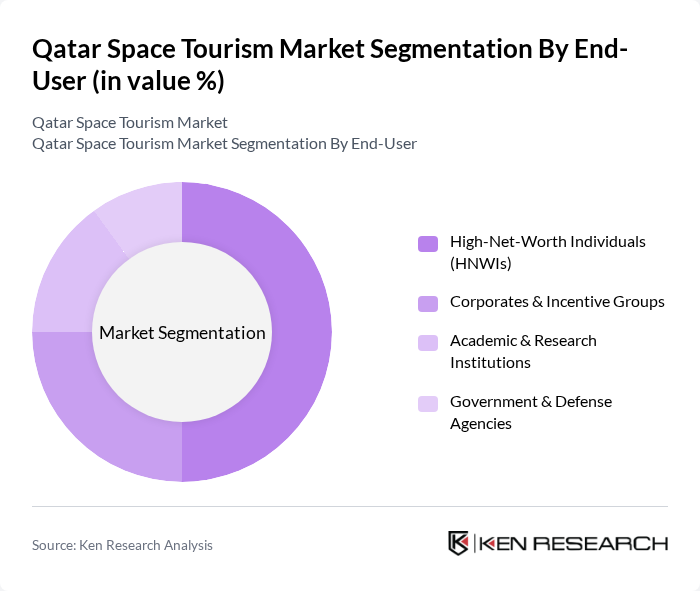
By End-User:The end-user segmentation includes High-Net-Worth Individuals (HNWIs), Corporates & Incentive Groups, Academic & Research Institutions, and Government & Defense Agencies. High-Net-Worth Individuals drive the market with demand for exclusive and adventurous experiences. Corporates & Incentive Groups utilize space tourism for branding, executive incentives, and team-building. Academic & Research Institutions engage in space tourism for scientific research, technology demonstration, and educational outreach. Government & Defense Agencies participate for strategic, training, and research purposes .
Qatar Space Tourism Market Competitive Landscape
The Qatar Space Tourism Market is characterized by a dynamic mix of regional and international players. Leading participants such as SpaceX, Blue Origin, Virgin Galactic, Axiom Space, Space Adventures, Boeing, Lockheed Martin, Sierra Space, Space Perspective, Orbital Assembly Corporation, Rocket Lab, Northrop Grumman, Relativity Space, and Spaceflight Inc. contribute to innovation, geographic expansion, and service delivery in this space.
Qatar Space Tourism Market Industry Analysis
Growth Drivers
- Increasing Disposable Income:The affluent consumer segment in Qatar is projected to see a rise in disposable income, with estimates indicating an increase from QAR 15,000 to QAR 18,000 monthly in future. This growth is driven by a robust economy, with Qatar's GDP expected to reach QAR 220 billion in future. As wealth increases, more individuals can afford luxury experiences, including space tourism, which is anticipated to attract high-net-worth individuals seeking unique adventures.
- Government Support:The Qatari government has committed over QAR 1.5 billion to support space exploration initiatives, including the establishment of a national space agency. This funding aims to enhance the country's capabilities in space technology and tourism. Additionally, Qatar's Vision 2030 emphasizes diversification of the economy, positioning space tourism as a key sector for growth, thereby fostering an environment conducive to investment and innovation in this emerging market.
- Rising Interest in Unique Travel Experiences:The global travel market is witnessing a shift towards unique and experiential travel, with 75% of affluent travelers expressing interest in space tourism experiences. In Qatar, this trend is reflected in the increasing demand for exclusive travel packages that offer once-in-a-lifetime experiences. The country's strategic location and investment in tourism infrastructure further enhance its appeal as a destination for space tourism, catering to adventurous travelers seeking novelty.
Market Challenges
- High Cost of Space Travel:The average cost of a space tourism ticket is currently around QAR 1.8 million, which limits accessibility to a small segment of the population. This high price point poses a significant barrier to entry for potential customers, as only a few thousand individuals globally can afford such experiences. As a result, the market must find ways to reduce costs and make space tourism more accessible to a broader audience to stimulate growth.
- Regulatory Hurdles:The space tourism industry faces stringent regulatory requirements, including safety standards and licensing, which can delay the launch of new services. In Qatar, the regulatory framework is still developing, with the government working to establish clear guidelines. This uncertainty can deter investment and slow down the pace of innovation, as companies navigate complex legal landscapes while ensuring compliance with international safety protocols.
Qatar Space Tourism Market Future Outlook
The future of space tourism in Qatar appears promising, driven by increasing collaboration between government entities and private companies. As technological advancements continue to lower costs and improve safety, the market is likely to see a surge in interest. Additionally, the emergence of suborbital flights and luxury travel experiences will cater to affluent consumers. With ongoing investments in infrastructure and education, Qatar is poised to become a leading destination for space tourism, attracting both local and international travelers seeking extraordinary adventures.
Market Opportunities
- Development of Commercial Spaceports:Qatar's investment in commercial spaceports presents a significant opportunity for growth. With an estimated QAR 600 million allocated for infrastructure development, these facilities can facilitate space tourism operations, attracting international companies and tourists. This strategic move can position Qatar as a regional hub for space travel, enhancing its global tourism profile.
- Partnerships with Private Space Companies:Collaborating with established private space companies can accelerate the growth of Qatar's space tourism sector. By leveraging expertise and technology from industry leaders, Qatar can enhance its offerings and ensure safety standards. Such partnerships can also lead to innovative tourism packages, making space travel more appealing and accessible to a wider audience, thus driving market expansion.
Scope of the Report
| Segment | Sub-Segments |
|---|---|
| By Type | Suborbital Flights Orbital Flights Space Hotels & Habitats Zero-Gravity Experiences Space Education & Training Programs Spaceport Facility Services Others |
| By End-User | High-Net-Worth Individuals (HNWIs) Corporates & Incentive Groups Academic & Research Institutions Government & Defense Agencies |
| By Application | Adventure & Leisure Tourism Scientific Research & Experiments Corporate Events & Brand Activations Astronaut Training & Simulation |
| By Pricing Model | Per-Seat Ticketing All-Inclusive Packages Membership & Loyalty Programs |
| By Customer Demographics | Age Groups Income Levels Country of Residence |
| By Marketing Channel | Digital & Online Platforms Luxury Travel Agencies Direct Corporate Sales |
| By Policy Support | Government Subsidies Tax Incentives Regulatory Support |
Key Target Audience
Investors and Venture Capitalist Firms
Government and Regulatory Bodies (e.g., Qatar Civil Aviation Authority, Qatar Space Agency)
Aerospace and Spacecraft Manufacturers
Tourism and Hospitality Companies
Space Tourism Operators
Insurance Providers for Space Tourism
Technology Providers for Spacecraft and Infrastructure
Event Organizers for Space Tourism Experiences
Players Mentioned in the Report:
SpaceX
Blue Origin
Virgin Galactic
Axiom Space
Space Adventures
Boeing
Lockheed Martin
Sierra Space
Space Perspective
Orbital Assembly Corporation
Rocket Lab
Northrop Grumman
Relativity Space
Spaceflight Inc.
Astroscale
Table of Contents
Market Assessment Phase
1. Executive Summary and Approach
2. Qatar Space Tourism Market Overview
2.1 Key Insights and Strategic Recommendations
2.2 Qatar Space Tourism Market Overview
2.3 Definition and Scope
2.4 Evolution of Market Ecosystem
2.5 Timeline of Key Regulatory Milestones
2.6 Value Chain & Stakeholder Mapping
2.7 Business Cycle Analysis
2.8 Policy & Incentive Landscape
3. Qatar Space Tourism Market Analysis
3.1 Growth Drivers
3.1.1 Increasing disposable income among affluent consumers
3.1.2 Government support for space exploration initiatives
3.1.3 Rising interest in unique travel experiences
3.1.4 Technological advancements in space travel
3.2 Market Challenges
3.2.1 High cost of space travel
3.2.2 Regulatory hurdles and safety concerns
3.2.3 Limited public awareness and understanding
3.2.4 Competition from traditional tourism sectors
3.3 Market Opportunities
3.3.1 Development of commercial spaceports
3.3.2 Partnerships with private space companies
3.3.3 Growth of space tourism packages
3.3.4 Expansion of educational space programs
3.4 Market Trends
3.4.1 Increasing collaboration between governments and private sectors
3.4.2 Emergence of suborbital flights
3.4.3 Focus on sustainable space tourism practices
3.4.4 Rise of luxury space travel experiences
3.5 Government Regulation
3.5.1 Licensing requirements for space tourism operators
3.5.2 Safety regulations for space travel
3.5.3 Environmental impact assessments
3.5.4 International collaboration agreements
4. SWOT Analysis
5. Stakeholder Analysis
6. Porter's Five Forces Analysis
7. Qatar Space Tourism Market Market Size, 2019-2024
7.1 By Value
7.2 By Volume
7.3 By Average Selling Price
8. Qatar Space Tourism Market Segmentation
8.1 By Type
8.1.1 Suborbital Flights
8.1.2 Orbital Flights
8.1.3 Space Hotels & Habitats
8.1.4 Zero-Gravity Experiences
8.1.5 Space Education & Training Programs
8.1.6 Spaceport Facility Services
8.1.7 Others
8.2 By End-User
8.2.1 High-Net-Worth Individuals (HNWIs)
8.2.2 Corporates & Incentive Groups
8.2.3 Academic & Research Institutions
8.2.4 Government & Defense Agencies
8.3 By Application
8.3.1 Adventure & Leisure Tourism
8.3.2 Scientific Research & Experiments
8.3.3 Corporate Events & Brand Activations
8.3.4 Astronaut Training & Simulation
8.4 By Pricing Model
8.4.1 Per-Seat Ticketing
8.4.2 All-Inclusive Packages
8.4.3 Membership & Loyalty Programs
8.5 By Customer Demographics
8.5.1 Age Groups
8.5.2 Income Levels
8.5.3 Country of Residence
8.6 By Marketing Channel
8.6.1 Digital & Online Platforms
8.6.2 Luxury Travel Agencies
8.6.3 Direct Corporate Sales
8.7 By Policy Support
8.7.1 Government Subsidies
8.7.2 Tax Incentives
8.7.3 Regulatory Support
9. Qatar Space Tourism Market Competitive Analysis
9.1 Market Share of Key Players
9.2 Cross Comparison of Key Players
9.2.1 Company Name
9.2.2 Number of Commercial Flights Conducted
9.2.3 Average Ticket Price (USD)
9.2.4 Customer Acquisition Cost (CAC)
9.2.5 Customer Retention Rate (%)
9.2.6 Average Revenue Per Passenger (ARPP)
9.2.7 Market Penetration Rate (Qatar/MENA)
9.2.8 Brand Awareness Index (Qatar)
9.2.9 Safety Record (Incidents per Flight)
9.2.10 Revenue Growth Rate (%)
9.3 SWOT Analysis of Top Players
9.4 Pricing Analysis
9.5 Detailed Profile of Major Companies
9.5.1 SpaceX
9.5.2 Blue Origin
9.5.3 Virgin Galactic
9.5.4 Axiom Space
9.5.5 Space Adventures
9.5.6 Boeing
9.5.7 Lockheed Martin
9.5.8 Sierra Space
9.5.9 Space Perspective
9.5.10 Orbital Assembly Corporation
9.5.11 Rocket Lab
9.5.12 Northrop Grumman
9.5.13 Relativity Space
9.5.14 Spaceflight Inc.
9.5.15 Astroscale
10. Qatar Space Tourism Market End-User Analysis
10.1 Procurement Behavior of Key Ministries
10.1.1 Interest in Space Research
10.1.2 Budget Allocation for Space Programs
10.1.3 Collaboration with Private Sector
10.2 Corporate Spend on Infrastructure & Energy
10.2.1 Investment in Space Facilities
10.2.2 Funding for Research Initiatives
10.2.3 Partnerships with Educational Institutions
10.3 Pain Point Analysis by End-User Category
10.3.1 Cost Barriers for Consumers
10.3.2 Safety Concerns
10.3.3 Limited Availability of Services
10.4 User Readiness for Adoption
10.4.1 Awareness of Space Tourism
10.4.2 Perceived Value of Experience
10.4.3 Willingness to Pay
10.5 Post-Deployment ROI and Use Case Expansion
10.5.1 Evaluation of Customer Experience
10.5.2 Opportunities for Upselling
10.5.3 Long-term Engagement Strategies
11. Qatar Space Tourism Market Future Size, 2025-2030
11.1 By Value
11.2 By Volume
11.3 By Average Selling Price
Go-To-Market Strategy Phase
1. Whitespace Analysis + Business Model Canvas
1.1 Market Gaps Identification
1.2 Business Model Development
2. Marketing and Positioning Recommendations
2.1 Branding Strategies
2.2 Product USPs
3. Distribution Plan
3.1 Urban Retail Strategies
3.2 Rural NGO Tie-ups
4. Channel & Pricing Gaps
4.1 Underserved Routes
4.2 Pricing Bands Analysis
5. Unmet Demand & Latent Needs
5.1 Category Gaps
5.2 Consumer Segments
6. Customer Relationship
6.1 Loyalty Programs
6.2 After-sales Service
7. Value Proposition
7.1 Sustainability Initiatives
7.2 Integrated Supply Chains
8. Key Activities
8.1 Regulatory Compliance
8.2 Branding Efforts
8.3 Distribution Setup
9. Entry Strategy Evaluation
9.1 Domestic Market Entry Strategy
9.1.1 Product Mix Considerations
9.1.2 Pricing Band Strategy
9.1.3 Packaging Options
9.2 Export Entry Strategy
9.2.1 Target Countries
9.2.2 Compliance Roadmap
10. Entry Mode Assessment
10.1 Joint Ventures
10.2 Greenfield Investments
10.3 Mergers & Acquisitions
10.4 Distributor Model
11. Capital and Timeline Estimation
11.1 Capital Requirements
11.2 Timelines for Implementation
12. Control vs Risk Trade-Off
12.1 Ownership Considerations
12.2 Partnerships Evaluation
13. Profitability Outlook
13.1 Breakeven Analysis
13.2 Long-term Sustainability
14. Potential Partner List
14.1 Distributors
14.2 Joint Ventures
14.3 Acquisition Targets
15. Execution Roadmap
15.1 Phased Plan for Market Entry
15.1.1 Market Setup
15.1.2 Market Entry
15.1.3 Growth Acceleration
15.1.4 Scale & Stabilize
15.2 Key Activities and Milestones
15.2.1 Milestone Planning
15.2.2 Activity Tracking
Research Methodology
Phase 1: Approach1
Desk Research
- Analysis of government reports and white papers on space tourism regulations in Qatar
- Review of industry publications and market analysis reports specific to the space tourism sector
- Examination of demographic and economic data from Qatar's National Statistics Authority
Primary Research
- Interviews with key stakeholders in the Qatari space sector, including government officials and industry leaders
- Surveys targeting potential space tourists to gauge interest and willingness to pay
- Focus groups with travel agencies and tour operators specializing in luxury and adventure tourism
Validation & Triangulation
- Cross-validation of findings through multiple data sources, including academic studies and market reports
- Triangulation of insights from expert interviews with quantitative survey data
- Sanity checks through feedback from a panel of space tourism experts and analysts
Phase 2: Market Size Estimation1
Top-down Assessment
- Estimation of the total addressable market based on global space tourism trends and Qatar's economic indicators
- Segmentation of the market by customer demographics, including age, income, and travel preferences
- Incorporation of tourism growth forecasts and government initiatives to promote space tourism
Bottom-up Modeling
- Analysis of pricing models from existing space tourism companies and potential pricing strategies for Qatar
- Estimation of potential customer volumes based on interest surveys and market penetration rates
- Calculation of revenue projections based on average ticket prices and expected sales volume
Forecasting & Scenario Analysis
- Development of multiple scenarios based on varying levels of consumer interest and regulatory support
- Utilization of time-series analysis to project market growth over the next decade
- Assessment of external factors such as technological advancements and global economic conditions impacting the market
Phase 3: CATI Sample Composition1
| Scope Item/Segment | Sample Size | Target Respondent Profiles |
|---|---|---|
| Potential Space Tourists | 100 | Affluent Individuals, Adventure Seekers |
| Travel Agencies | 60 | Travel Agents, Tour Operators |
| Government Officials | 40 | Policy Makers, Tourism Board Members |
| Space Industry Experts | 40 | Aerospace Engineers, Space Tourism Analysts |
| Luxury Travel Enthusiasts | 50 | High Net-Worth Individuals, Luxury Travel Bloggers |
Frequently Asked Questions
What is the current value of the Qatar Space Tourism Market?
The Qatar Space Tourism Market is valued at approximately USD 1.25 billion, reflecting significant growth driven by investments in space technology and increasing interest in unique travel experiences among affluent consumers.
What types of space tourism experiences are available in Qatar?
Who are the key players in the Qatar Space Tourism Market?
What government initiatives support space tourism in Qatar?
Other Regional/Country Reports
Indonesia Space Tourism Market
Malaysia Space Tourism Market
KSA Space Tourism Market
APAC Space Tourism Market
SEA Space Tourism Market
Vietnam Space Tourism Market
Other Adjacent Reports
Kuwait Space Exploration Market
Vietnam Luxury Travel Market Size, Share & Forecast, By Service Type, Customer Type & Booking Channel, 2025–2032UAE Adventure Tourism Market Size, Share & Forecast, By Activity Type, Traveler Type & Booking Channel, 2026–2032Global Aerospace Manufacturing Market Outlook to 2030Malaysia Satellite Technology Market
South Korea Commercial Spaceflight Market
Indonesia Spaceport Infrastructure Market
Qatar Astronaut Training Market
UAE High-Tech Materials Market
Mexico Renewable Energy Propulsion Market
Why Buy From Us?

What makes us stand out is that our consultants follow Robust, Refine and Result (RRR) methodology. Robust for clear definitions, approaches and sanity checking, Refine for differentiating respondents' facts and opinions, and Result for presenting data with story.

We have set a benchmark in the industry by offering our clients with syndicated and customized market research reports featuring coverage of entire market as well as meticulous research and analyst insights.

While we don't replace traditional research, we flip the method upside down. Our dual approach of Top Bottom & Bottom Top ensures quality deliverable by not just verifying company fundamentals but also looking at the sector and macroeconomic factors.

With one step in the future, our research team constantly tries to show you the bigger picture. We help with some of the tough questions you may encounter along the way: How is the industry positioned? Best marketing channel? KPI's of competitors? By aligning every element, we help maximize success.

Our report gives you instant access to the answers and sources that other companies might choose to hide. We elaborate each steps of research methodology we have used and showcase you the sample size to earn your trust.

If you need any support, we are here! We pride ourselves on universe strength, data quality, and quick, friendly, and professional service.