Region:Global
Author(s):Dev
Product Code:KRAA3933
Pages:86
Published On:January 2026
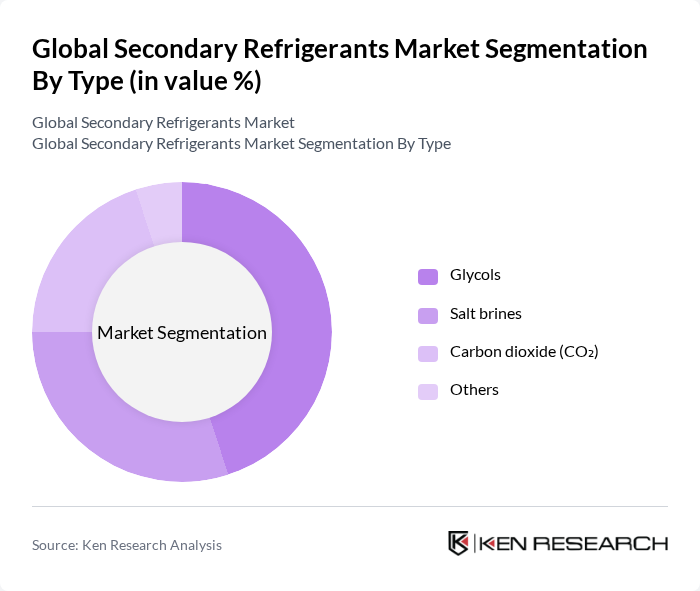
By Type:The market is segmented into various types of secondary refrigerants, including Glycols, Salt brines, Carbon dioxide (CO?), and Others. Among these, Glycols are the most widely used and represent the largest segment, supported by their excellent thermal properties, freeze protection capability in closed-loop systems, compatibility with HVAC and process cooling, and relatively low toxicity, making them suitable for a range of commercial and industrial applications. Salt brines are also gaining traction, particularly in industrial refrigeration and food processing, due to their cost-effectiveness and efficient heat transfer performance where corrosion can be managed with proper system design. Carbon dioxide (CO?), used either as a volatile secondary refrigerant or in cascade/indirect systems, is increasingly being adopted as a sustainable alternative with very low GWP, especially in supermarket and commercial refrigeration systems.
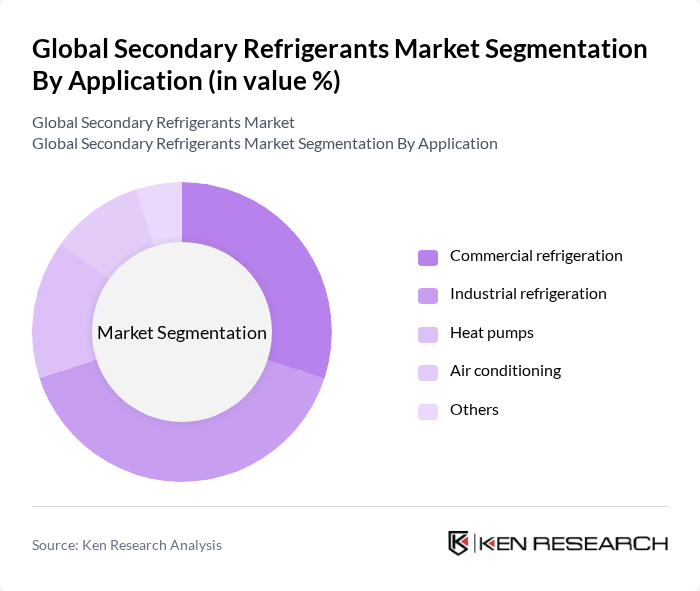
By Application:The applications of secondary refrigerants include Commercial refrigeration, Industrial refrigeration, Heat pumps, Air conditioning, and Others. Industrial refrigeration currently accounts for the largest share of demand, supported by large-scale cold storage, food and beverage processing, chemical and pharmaceutical facilities that favor indirect systems for safety, charge reduction and environmental performance. Commercial refrigeration is also a major application, with supermarkets, hypermarkets and convenience stores increasingly using secondary loops and CO??based systems to comply with GWP limits and improve energy efficiency. The heat pump segment is witnessing steady growth due to the rising adoption of high?efficiency heat pumps in Europe, North America and Asia for space heating, district heating and industrial processes, where secondary fluids are used to distribute thermal energy efficiently. Air conditioning and other niche applications, including ice rinks and data centers, further contribute to the uptake of secondary refrigerants as operators prioritize system efficiency, safety and lower environmental impact.
The Global Secondary Refrigerants Market is characterized by a dynamic mix of regional and international players. Leading participants such as The Chemours Company, Honeywell International Inc., Daikin Industries, Ltd., Arkema S.A., BASF SE, Linde plc, Air Products and Chemicals, Inc., Mitsubishi Chemical Group Corporation, Solvay S.A., A-Gas International, Orbia – Koura, Harp International Ltd., A-Gas Americas, E.I. du Pont de Nemours and Company (DuPont), Trane Technologies plc contribute to innovation, geographic expansion, and service delivery in this space.
The future of the secondary refrigerants market appears promising, driven by increasing regulatory pressures and technological advancements. As industries shift towards sustainable practices, the adoption of natural refrigerants is expected to rise significantly. Furthermore, the integration of smart technologies in refrigeration systems will enhance operational efficiency and reduce energy consumption. These trends indicate a robust growth trajectory, with companies increasingly prioritizing eco-friendly solutions to meet both regulatory requirements and consumer demand for sustainability.
| Segment | Sub-Segments |
|---|---|
| By Type | Glycols Salt brines Carbon dioxide (CO?) Others |
| By Application | Commercial refrigeration Industrial refrigeration Heat pumps Air conditioning Others |
| By End-User Industry | Food and beverages Pharmaceuticals Oil and gas Chemicals Plastics Others |
| By Region | North America Europe Asia-Pacific Latin America Middle East & Africa |
| Scope Item/Segment | Sample Size | Target Respondent Profiles |
|---|---|---|
| Commercial Refrigeration Users | 120 | Facility Managers, Refrigeration Technicians |
| Industrial Cooling Applications | 90 | Operations Managers, Process Engineers |
| HVAC System Manufacturers | 75 | Product Development Engineers, Sales Directors |
| Environmental Regulatory Bodies | 40 | Policy Analysts, Environmental Scientists |
| Research Institutions in Refrigeration | 60 | Research Scientists, Academic Professors |
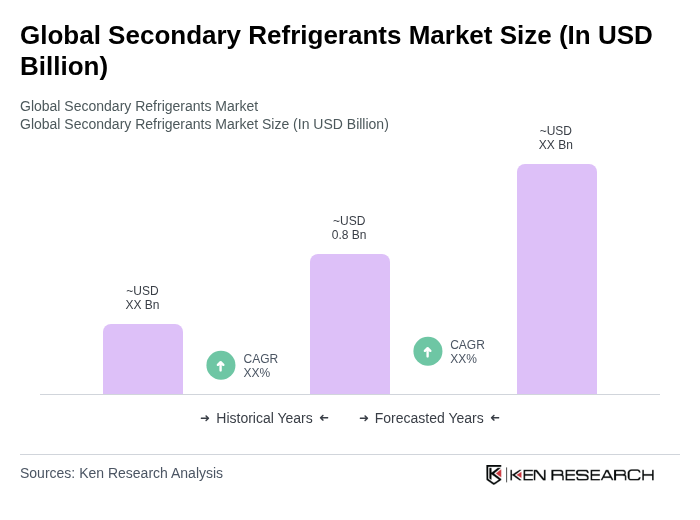
The Global Secondary Refrigerants Market is valued at approximately USD 0.8 billion, reflecting a growing demand for energy-efficient cooling solutions and increased awareness of environmental sustainability.

What makes us stand out is that our consultants follow Robust, Refine and Result (RRR) methodology. Robust for clear definitions, approaches and sanity checking, Refine for differentiating respondents' facts and opinions, and Result for presenting data with story.

We have set a benchmark in the industry by offering our clients with syndicated and customized market research reports featuring coverage of entire market as well as meticulous research and analyst insights.

While we don't replace traditional research, we flip the method upside down. Our dual approach of Top Bottom & Bottom Top ensures quality deliverable by not just verifying company fundamentals but also looking at the sector and macroeconomic factors.

With one step in the future, our research team constantly tries to show you the bigger picture. We help with some of the tough questions you may encounter along the way: How is the industry positioned? Best marketing channel? KPI's of competitors? By aligning every element, we help maximize success.

Our report gives you instant access to the answers and sources that other companies might choose to hide. We elaborate each steps of research methodology we have used and showcase you the sample size to earn your trust.

If you need any support, we are here! We pride ourselves on universe strength, data quality, and quick, friendly, and professional service.













